The number of red, blue, and green marbles in a bag is in the ratio 3 : 4 : 6. If 25 red marbles, 15 blue marbles, and an unknown number of green marbles are added to the bag, the ratio of red, blue, and green marbles becomes 4 : 5 : 9. Determine the number of green marbles added.
A.103
B.110
C.107
D.105
Solution
Ratio — marbles added
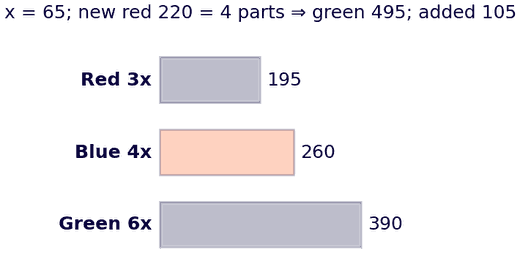
Let the original counts be 3x, 4x, 6x. Then = ⇒ 15x + 125 = 16x + 60 ⇒ x = 65.
New red = 220 ⇒ 1 new part = 55, so new green must be 9 × 55 = 495.
Green added = 495 − 6 × 65 = 495 − 390 = 105 — option (d).
53
Evaluate the continued fraction:
x = 4 + 1/(5 + 1/(6 + 1/2))
A.
B.
C.
D.
Solution
Continued fraction
Innermost first: 6 + = , so its reciprocal is .
Next level: 5 + = , reciprocal .
Finally x = 4 + = — option (a).
54
A and B invest ₹20,000 and ₹35,000 respectively in a business. What is A's share in a profit of ₹25,000?
P and Q contribute to a business investment in the ratio 3 : 5. They earn a profit of ₹66,000. P is a working partner and receives 10% of the profit extra. What is P's total share?
A.₹26,500
B.₹28,875
C.₹38,875
D.₹36,875
Solution
Partnership — working partner
Working-partner bonus = 10% of 66000 = ₹6,600; remaining profit = ₹59,400.
Split 59,400 in 3 : 5 ⇒ P gets × 59400 = ₹22,275.
P's total = 22275 + 6600 = ₹28,875 — option (b).
56
In a team of 85 employees, the average monthly sales per employee is ₹2.8 lakh. If 30 junior employees average ₹1.2 lakh each, what is the average monthly sales figure (in ₹ lakh) for the senior employees?
A.₹3.47 lakh
B.₹3.67 lakh
C.₹3.87 lakh
D.₹3.57 lakh
Solution
Weighted average
Total sales = 85 × 2.8 = ₹238 lakh; juniors contribute 30 × 1.2 = ₹36 lakh.
Seniors (55 employees) account for 238 − 36 = ₹202 lakh.
Senior average = ≈ ₹3.67 lakh — option (b).
57
The price of petrol shot up by 15%. Before the hike, the price was Rs. 82 per litre. A man travels 2,639 km every month and his car gives a mileage of 13 km per litre. What is the increase in the monthly expenditure (to the nearest Rs.) on the man's travel due to the hike in the petrol prices?
A.₹2,496.9
B.₹2,296.7
C.₹2,596.9
D.₹2,256.9
Solution
Percentage — petrol hike
Monthly petrol needed = = 203 litres.
Price increase per litre = 15% of 82 = ₹12.30.
Extra monthly expense = 203 × 12.30 = ₹2,496.9 — option (a).
58
A company ordered 30 mobile phones and a certain number of laptops. The mobile phones cost 4 times as much as the laptops. Due to a mistake, the number of mobile phones and laptops was interchanged during delivery. This increased the total bill by 60%. What was the ratio of the number of mobile phones to laptops in the original order?
A.1 : 2
B.2 : 1
C.9 : 4
D.4 : 9
Solution
Ratio — interchanged order
Let laptop price = p (mobile = 4p) and laptops = L. Original bill = 30(4p) + Lp = (120 + L)p.
After interchange: bill = L(4p) + 30p = (4L + 30)p = 1.6(120 + L)p.
4L + 30 = 192 + 1.6L ⇒ 2.4L = 162 ⇒ L = 67.5 ⇒ ratio = 30 : 67.5 = 4 : 9 — option (d).
59
Find the compound interest on ₹6,000 at 12% per annum for 3 years 4 months, compounded annually.
A.₹3,000.76
B.₹2,866.57
C.₹2,766.57
D.₹2,966.57
Solution
CI — fractional year
For 3 full years: 6000 × = 6000 × 1.404928 = ₹8,429.57.
For the extra 4 months ( year), simple growth: × (1 + 0.12 × ) = × 1.04 ⇒ amount = ₹8,766.75.
CI = 8766.75 − 6000 ≈ ₹2,766.57 — option (c).
60
A candy shop owner buys three kinds of candies: red, yellow, and green. Red candies are purchased at 3 for ₹15, yellow candies at 4 for ₹18, and green candies at 5 for ₹22. He mixes them in the ratio 1 : 1 : 2. He sells all the mixed candies at 3 for ₹20. What is his approximate gain or loss percentage?
A.Loss of 45.21%
B.Profit of 45.71%
C.Profit of 55.71%
D.Loss of 40.51%
Solution
Mixture — candy profit
Cost per candy: red = ₹5, yellow = ₹4.50, green = ₹4.40.
For mix 1 : 1 : 2 (take 4 candies): cost = 5 + 4.50 + 2 × 4.40 = ₹18.30 ⇒ ₹4.575 per candy; SP per candy = = ₹6.667.
Profit% = × 100 ≈ 45.71% profit — option (b).
61
The ratio of boys to girls in a school is 5 : 3. If 10 more boys join the school, the new ratio of boys to girls becomes 2 : 1. What is the total number of students in the school initially?
A.50
B.80
C.60
D.100
Solution
Ratio — boys and girls
Let boys = 5x, girls = 3x. After joining: = .
5x + 10 = 6x ⇒ x = 10.
Initial total = 8x = 80 — option (b).
62
P, Q, and R are capable of completing a job in 24, 36, and 72 days, respectively. P works every day, while Q and R join P every third day. How long will it take to finish the task?
A.25 days
B.18 days
C.16 days
D.12 days
Solution
Work — cyclic help
Take work = 72 units: P = 3, Q = 2, R = 1 unit/day.
In each 3-day cycle: P alone on days 1–2 (6 units) + all three on day 3 (6 units) = 12 units per cycle.
= 6 cycles = 18 days — option (b).
63
A 200-liter solution contains milk and water in the ratio 3 : 2. Some of this solution is removed and replaced with pure milk. If the final ratio of milk and water becomes 7 : 3, how many liters of solution were replaced?
A.35 litres
B.25 litres
C.50 litres
D.20 litres
Solution
Replacement — milk & water
Initially: milk = 120 L, water = 80 L. Removing S litres takes out 0.4S water; adding milk adds none back.
Final water = 80 − 0.4S must equal × 200 = 60 L.
0.4S = 20 ⇒ S = 50 litres — option (c).
64
The ratio of the efficiencies of two workers, Ram and Shyam, is 5 : 2. If Ram can complete a project in 20 days, how many days will Shyam take to complete the same project alone?
A.24 days
B.50 days
C.35 days
D.40 days
Solution
Efficiency ratio
Work = efficiency × time = 5 × 20 = 100 units.
Shyam's efficiency = 2 units/day.
Time = = 50 days — option (b).
65
A car starts from point P on a circular track and an SUV starts from point Q, which is 800 meters ahead of P in the direction of motion. The car's speed is 20 m/s, and the SUV's speed is 15 m/s. The circumference of the track is 1.5 km. How much distance will the car have traveled when it first overtakes the SUV?
A.2800 m
B.3100 m
C.3000 m
D.3200 m
Solution
Circular track — chase
The car gains on the SUV at 20 − 15 = 5 m/s and must close the 800 m gap.
Time to overtake = = 160 s.
Car distance = 20 × 160 = 3200 m — option (d).
66
A circular park having a radius of 15 m. If a 1.5 m wide path is built around it, what is the approximate area of the path?
A.148.5 m²
B.158.5 m²
C.138.5 m²
D.118.5 m²
Solution
Circular path area
Outer radius = 15 + 1.5 = 16.5 m.
Path area = ( − ) = (272.25 − 225) = 47.25.
≈ 148.5 m² — option (a).
The angles of a cyclic quadrilateral are in the ratio 1 : 2 : 4 : 5. What is the measure of the smallest angle?
A.30°
B.36°
C.108°
D.150°
Solution
Cyclic quadrilateral
In a cyclic quadrilateral, opposite angles sum to 180° — so the ratio pairs as (1, 5) and (2, 4).
1k + 5k = 180° ⇒ k = 30° (and 2k + 4k = 180° ✓).
Smallest angle = 1k = 30° — option (a).
75
If sec A = and A is acute, find tan A.
A.
B.
C.
D.
Solution
Trigonometry — sec to tan
sec A = means hypotenuse = 13, base = 5.
Perpendicular = = = 12.
tan A = — option (b).
Finished reading? Now test yourself.
The same 25 questions, but with a timer and the answers hidden — 15 minutes.

 Let the original counts be 3x, 4x, 6x. Then = ⇒ 15x + 125 = 16x + 60 ⇒ x = 65.
New red = 220 ⇒ 1 new part = 55, so new green must be 9 × 55 = 495.
Green added = 495 − 6 × 65 = 495 − 390 = 105 — option (d).
Let the original counts be 3x, 4x, 6x. Then = ⇒ 15x + 125 = 16x + 60 ⇒ x = 65.
New red = 220 ⇒ 1 new part = 55, so new green must be 9 × 55 = 495.
Green added = 495 − 6 × 65 = 495 − 390 = 105 — option (d).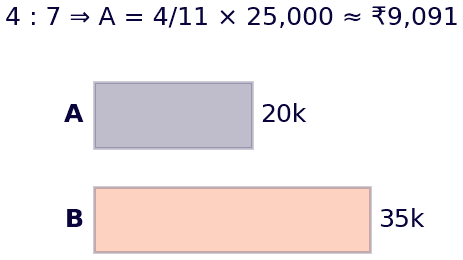 Investment ratio A : B = 20000 : 35000 = 4 : 7 (total 11 parts).
A's share = × 25000.
= ₹9,090.9 ≈ ₹9,091 — option (b).
Investment ratio A : B = 20000 : 35000 = 4 : 7 (total 11 parts).
A's share = × 25000.
= ₹9,090.9 ≈ ₹9,091 — option (b).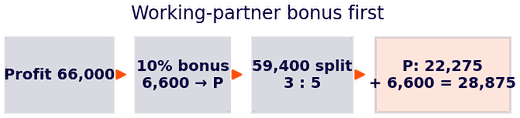 Working-partner bonus = 10% of 66000 = ₹6,600; remaining profit = ₹59,400.
Split 59,400 in 3 : 5 ⇒ P gets × 59400 = ₹22,275.
P's total = 22275 + 6600 = ₹28,875 — option (b).
Working-partner bonus = 10% of 66000 = ₹6,600; remaining profit = ₹59,400.
Split 59,400 in 3 : 5 ⇒ P gets × 59400 = ₹22,275.
P's total = 22275 + 6600 = ₹28,875 — option (b).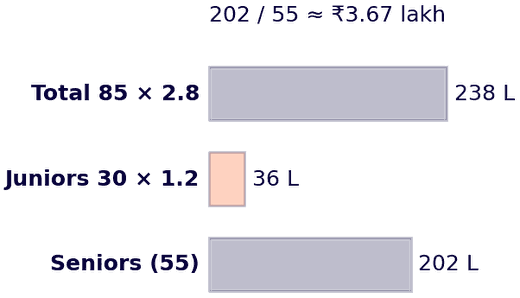 Total sales = 85 × 2.8 = ₹238 lakh; juniors contribute 30 × 1.2 = ₹36 lakh.
Seniors (55 employees) account for 238 − 36 = ₹202 lakh.
Senior average = ≈ ₹3.67 lakh — option (b).
Total sales = 85 × 2.8 = ₹238 lakh; juniors contribute 30 × 1.2 = ₹36 lakh.
Seniors (55 employees) account for 238 − 36 = ₹202 lakh.
Senior average = ≈ ₹3.67 lakh — option (b).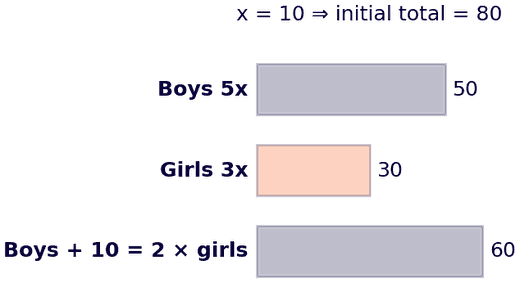 Let boys = 5x, girls = 3x. After joining: = .
5x + 10 = 6x ⇒ x = 10.
Initial total = 8x = 80 — option (b).
Let boys = 5x, girls = 3x. After joining: = .
5x + 10 = 6x ⇒ x = 10.
Initial total = 8x = 80 — option (b).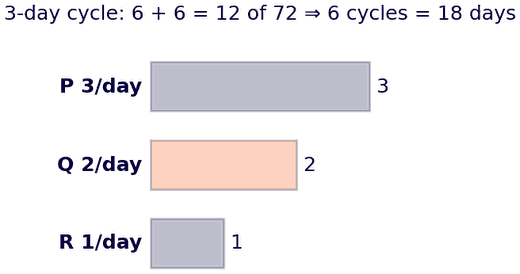 Take work = 72 units: P = 3, Q = 2, R = 1 unit/day.
In each 3-day cycle: P alone on days 1–2 (6 units) + all three on day 3 (6 units) = 12 units per cycle.
= 6 cycles = 18 days — option (b).
Take work = 72 units: P = 3, Q = 2, R = 1 unit/day.
In each 3-day cycle: P alone on days 1–2 (6 units) + all three on day 3 (6 units) = 12 units per cycle.
= 6 cycles = 18 days — option (b).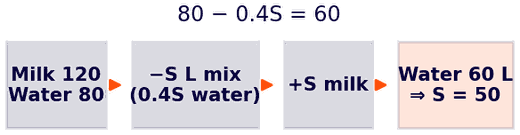 Initially: milk = 120 L, water = 80 L. Removing S litres takes out 0.4S water; adding milk adds none back.
Final water = 80 − 0.4S must equal × 200 = 60 L.
0.4S = 20 ⇒ S = 50 litres — option (c).
Initially: milk = 120 L, water = 80 L. Removing S litres takes out 0.4S water; adding milk adds none back.
Final water = 80 − 0.4S must equal × 200 = 60 L.
0.4S = 20 ⇒ S = 50 litres — option (c).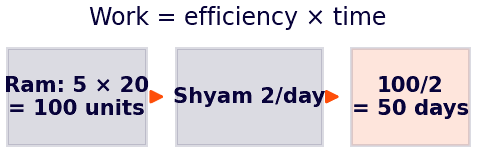 Work = efficiency × time = 5 × 20 = 100 units.
Shyam's efficiency = 2 units/day.
Time = = 50 days — option (b).
Work = efficiency × time = 5 × 20 = 100 units.
Shyam's efficiency = 2 units/day.
Time = = 50 days — option (b).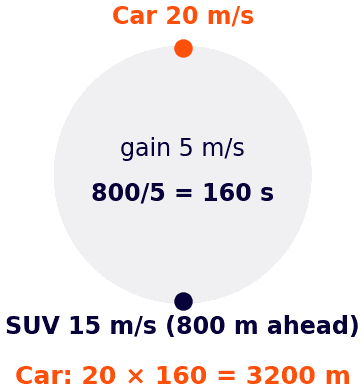 The car gains on the SUV at 20 − 15 = 5 m/s and must close the 800 m gap.
Time to overtake = = 160 s.
Car distance = 20 × 160 = 3200 m — option (d).
The car gains on the SUV at 20 − 15 = 5 m/s and must close the 800 m gap.
Time to overtake = = 160 s.
Car distance = 20 × 160 = 3200 m — option (d).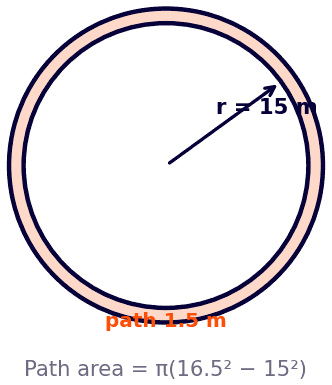 Outer radius = 15 + 1.5 = 16.5 m.
Path area = ( − ) = (272.25 − 225) = 47.25.
≈ 148.5 m² — option (a).
Outer radius = 15 + 1.5 = 16.5 m.
Path area = ( − ) = (272.25 − 225) = 47.25.
≈ 148.5 m² — option (a).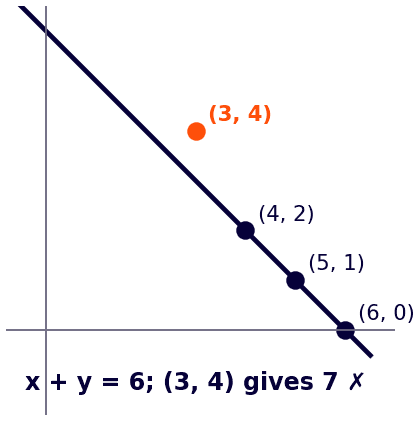 On the line, x + y must equal 6.
(4, 2): 6 ✓; (5, 1): 6 ✓; (6, 0): 6 ✓.
(3, 4): 3 + 4 = 7 ≠ 6 — the line misses it; option (b).
On the line, x + y must equal 6.
(4, 2): 6 ✓; (5, 1): 6 ✓; (6, 0): 6 ✓.
(3, 4): 3 + 4 = 7 ≠ 6 — the line misses it; option (b).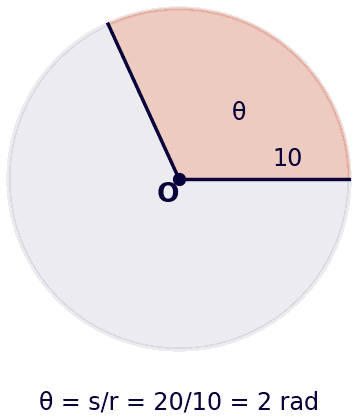 Arc length s = rθ (θ in radians).
θ = = .
= 2 radians — option (c).
Arc length s = rθ (θ in radians).
θ = = .
= 2 radians — option (c).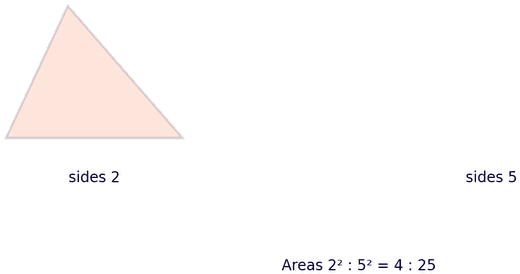 For similar triangles, the ratio of areas equals the square of the ratio of sides.
: .
= 4 : 25 — option (c).
For similar triangles, the ratio of areas equals the square of the ratio of sides.
: .
= 4 : 25 — option (c).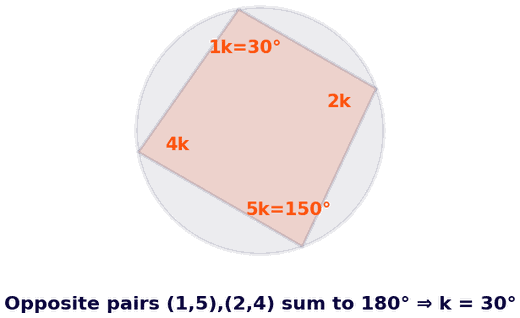 In a cyclic quadrilateral, opposite angles sum to 180° — so the ratio pairs as (1, 5) and (2, 4).
1k + 5k = 180° ⇒ k = 30° (and 2k + 4k = 180° ✓).
Smallest angle = 1k = 30° — option (a).
In a cyclic quadrilateral, opposite angles sum to 180° — so the ratio pairs as (1, 5) and (2, 4).
1k + 5k = 180° ⇒ k = 30° (and 2k + 4k = 180° ✓).
Smallest angle = 1k = 30° — option (a).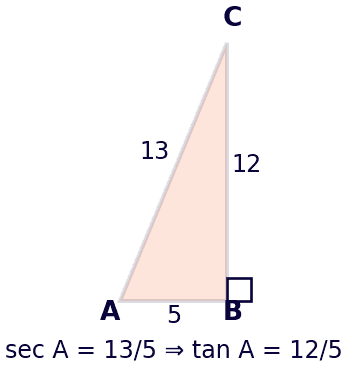 sec A = means hypotenuse = 13, base = 5.
Perpendicular = = = 12.
tan A = — option (b).
sec A = means hypotenuse = 13, base = 5.
Perpendicular = = = 12.
tan A = — option (b).