Surds — rationalisation
Combine the first two: = = .
The third term: 87 − 65 = 22, so it is also .
= 0 — option (c).
54
A family's expenditures on food, medicine, and entertainment are in the ratio 4 : 6 : 7. In the coming year, the cost of food is expected to increase by 25%, the cost of medicine to increase by 33.33%, and the cost of entertainment to decrease by 10%. What is the percentage change (increase or decrease) in total household expenditure?
A.12.55% decrease
B.13.53% increase
C.13.53% decrease
D.12.55% increase
Solution
Percentage — weighted change
Take expenditures 4, 6 and 7 (total 17).
New values: 4 × 1.25 = 5; 6 × = 8; 7 × 0.9 = 6.3 — new total = 19.3.
Change = × 100 ≈ 13.53% increase — option (b).
55
A and B invested ₹1,40,000 and ₹1,80,000 respectively. A remained for 10 months and B for 7 months. What is the total profit if B's share is ₹15,201?
Two friends, Sachin and Kuldeep, rent a stable. Sachin rents 21 horses for 6 months and 15 cows for 2 months. Kuldeep rents 15 cows for 6 months and 40 sheep for 7.5 months. If 3 horses eat as much food as 5 cows, and 6 cows eat as much as 10 sheep, what share of the rent should Sachin pay?
Two individuals, A and B, rent a pasture. A uses 18 cows for a period of 3 months and 20 sheep for 4 months, and B uses 35 sheep for 6 months. If 3 cows are equal to 6 sheep, determine A's share of the rent.
The average ages of three groups of artisans are 18, 30, and 22. If the ratio of the number of artisans in the three groups is 3 : 2 : 5, what is the overall average age?
A.22.1
B.22.4
C.15.6
D.22.6
Solution
Weighted average age
Weighted sum = 18 × 3 + 30 × 2 + 22 × 5 = 54 + 60 + 110 = 224.
Total weight = 3 + 2 + 5 = 10.
Average = = 22.4 — option (b).
59
The average of 21 numbers is 69. If the average of the first ten is 66 and the average of the last ten is 72, find the 11th number.
A.72
B.74
C.69
D.76
Solution
Average — middle term
Total of all 21 = 21 × 69 = 1449.
First ten + last ten = 660 + 720 = 1380.
11th number = 1449 − 1380 = 69 — option (c).
60
What is the average of all integers between 200 and 350 that are exactly divisible by 13?
A.277
B.263
C.287
D.273
Solution
Average of multiples
Multiples of 13 in this range run from 208 (13×16) to 338 (13×26).
For an arithmetic progression, average = = .
= 273 — option (d).
61
Evaluate:
12% of 480 km + 66% of 270 km
A.240 km
B.230 km
C.320 km
D.450 km
Solution
Fractional percentages
12% = , so × 480 = 60 km.
66% = , so × 270 = 180 km.
60 + 180 = 240 km — option (a).
62
A salesman earns a 2% commission on a shirt sold for ₹600 and a 12% commission on a tie sold for ₹150. If he sells 3 shirts and 4 ties per day, what will be his total commission in 60 days?
A.₹6450
B.₹6440
C.₹6480
D.₹6200
Solution
Commission
Per shirt: 2% of 600 = ₹12; per tie: 12% of 150 = ₹18.
Daily commission = 3 × 12 + 4 × 18 = 36 + 72 = ₹108.
In 60 days: 108 × 60 = ₹6,480 — option (c).
63
A fruit seller sells apples at a loss of 10% on the cost price but uses a weight that is 25% less than the actual weight. Find his total profit percentage.
A.16.626%
B.16.257%
C.20%
D.18.757%
Solution
False weight with loss
He charges for 1000 g at 90% of CP, but hands over only 750 g.
Profit multiplier = = 1.2.
So the true profit is 20% — option (c).
64
The profit made on an item sold for ₹2200 is equal to the loss incurred when it is sold for ₹1800. What will be the profit or loss percentage if the item is sold for ₹2150?
A.Profit of 7.25%
B.Loss of 5.5%
C.Profit of 7.5%
D.Loss of 5.25%
Solution
Equal profit and loss
Equal profit and loss means CP is midway: CP = = ₹2,000.
At SP ₹2,150, profit = ₹150.
Profit% = × 100 = 7.5% — option (c).
65
A mobile phone retailer sells a phone for ₹P and makes a profit of 30%. For a special festive offer, he sells the same phone for ₹1.5P. He offers a 10% discount on the offer. What percentage profit will he make during the festive offer?
A shopkeeper marked an item 20% above its cost price. During a sale, he offered a discount of 10%. What was his profit percentage?
A.10%
B.8%
C.15%
D.17.5%
Solution
Markup and discount
Let CP = 100; marked price = 120.
SP after 10% discount = 120 × 0.9 = 108.
Profit = 8 on 100 = 8% — option (b).
67
A shopkeeper marks his goods at 50% above the cost price. He allows a discount of 20% on the marked price. If he also gives an additional cash discount of ₹300, and still makes a profit of 14% on the cost price, what is the cost price of the goods?
Approximately how many kg of pulses costing ₹45 per kg should be mixed with 24 kg of pulses costing ₹32 per kg so as to make a profit of 15% by selling the mixture at ₹43.70 per kg?
A.17.3 kg
B.22.4 kg
C.20.5 kg
D.15.2 kg
Solution
Alligation — pulses
CP of mixture = = ₹38 per kg.
By alligation: (45 − 38) : (38 − 32) = 7 : 6 = cheaper : dearer.
Dearer pulses = 24 × ≈ 20.5 kg — option (c).
69
A right circular cone has a diameter of 14 cm and a height of 24 cm. What is the slant height?
A.25 cm
B.30 cm
C.35 cm
D.40 cm
Solution
Cone — slant height
Radius r = = 7 cm.
l² = r² + h² = 49 + 576 = 625.
l = = 25 cm — option (a).
70
Sunil lent ₹5,000 to Sudhir for 2 years and ₹3,000 to Vinod for 4 years at the same simple interest rate. In total, he received ₹4,400 as interest from both borrowers. What is the rate of interest per annum?
A.17%
B.12%
C.15%
D.20%
Solution
SI — common rate
Total SI = + = 100r + 120r = 220r.
220r = 4400.
r = 20% per annum — option (d).
71
A triangular prism has a base area of 25 cm². If height is increased by 25%, what is the new volume (original height was 16 cm)?
A.550 cm³
B.575 cm³
C.500 cm³
D.225 cm³
Solution
Prism volume
New height = 16 × 1.25 = 20 cm.
Volume of a prism = base area × height = 25 × 20.
= 500 cm³ — option (c).
72
A circular disc's radius is decreased by 20%. What is the percentage decrease in its area?
A.20%
B.38%
C.36%
D.30%
Solution
Radius − 20% → area
Area ∝ r², so the new area factor = = 0.64.
Decrease = 1 − 0.64 = 0.36.
= 36% — option (c).
73
A man has 160 m of fencing wire. He can use this wire to enclose a circular garden or a square garden. If he wants to maximize the enclosed area, what is the approximate ratio of the area of the largest possible circular garden to the area of the largest possible square garden, using the entire 160 m of wire?
A.1.3 : 1
B.1.27 : 1
C.1.7 : 1
D.1.6 : 1
Solution
Same wire — circle vs square
Circle: 2r = 160 ⇒ r = ; area = r² = ≈ 2037 m².
Square: side = 40 m; area = 1600 m².
Ratio = = = ≈ 1.27, i.e. 1.27 : 1 — option (b).
74
A vertical cylindrical container is filled with oil. A solid hemispherical stone of radius 6 cm is immersed completely, and the oil level rises by 2.5 cm. What is the radius of the cylindrical container?
A.6.29 cm
B.7.59 cm
C.8.79 cm
D.11.41 cm
Solution
Cylinder — immersed hemisphere
Displaced volume = volume of hemisphere = = 144 cm³.
Rise in level: R² × 2.5 = 144 ⇒ R² = 57.6.
R = ≈ 7.59 cm — option (b).
75
A sector of a circle has a central angle of 135° and a radius of 9 cm. Another sector of the same circle has a central angle of radians. What is the ratio of the area of the first sector to the area of the second sector?
A.4 : 3
B.5 : 4
C.1 : 1
D.6 : 7
Solution
Two sectors — same angle
Convert: radians = × 180° = 135°.
Both sectors of the same circle have equal central angles, hence equal areas.
Ratio = 1 : 1 — option (c).
Finished reading? Now test yourself.
The same 25 questions, but with a timer and the answers hidden — 15 minutes.

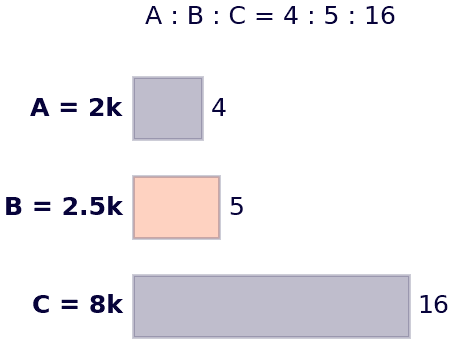 Let = = = k.
Then A = 2k, B = 2.5k, C = 8k.
A : B : C = 2 : 2.5 : 8 = 4 : 5 : 16 — option (a).
Let = = = k.
Then A = 2k, B = 2.5k, C = 8k.
A : B : C = 2 : 2.5 : 8 = 4 : 5 : 16 — option (a).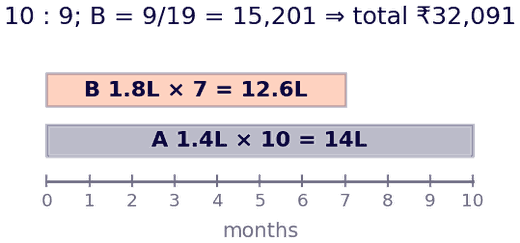 Capital-months — A: 140000 × 10 = 14,00,000; B: 180000 × 7 = 12,60,000; ratio = 10 : 9.
B's share = of total profit = 15,201 ⇒ total = 15201 × .
= ₹32,091 — option (b).
Capital-months — A: 140000 × 10 = 14,00,000; B: 180000 × 7 = 12,60,000; ratio = 10 : 9.
B's share = of total profit = 15,201 ⇒ total = 15201 × .
= ₹32,091 — option (b).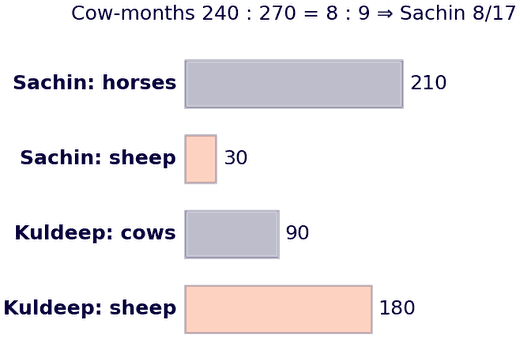 Convert to cow-units: 1 horse = cow, 1 sheep = cow.
Sachin: 21 × × 6 + 15 × 2 = 210 + 30 = 240 cow-months; Kuldeep: 15 × 6 + 40 × × 7.5 = 90 + 180 = 270.
Ratio 240 : 270 = 8 : 9, so Sachin pays of the rent — option (a).
Convert to cow-units: 1 horse = cow, 1 sheep = cow.
Sachin: 21 × × 6 + 15 × 2 = 210 + 30 = 240 cow-months; Kuldeep: 15 × 6 + 40 × × 7.5 = 90 + 180 = 270.
Ratio 240 : 270 = 8 : 9, so Sachin pays of the rent — option (a).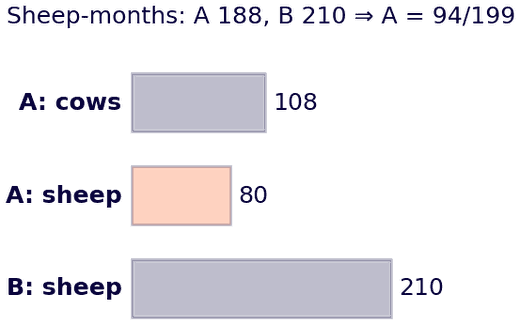 3 cows = 6 sheep ⇒ 1 cow = 2 sheep.
A: 18 cows × 3 = 36 sheep × 3 = 108 sheep-months, plus 20 × 4 = 80 — total 188; B: 35 × 6 = 210.
A's share = = of the rent — option (b).
3 cows = 6 sheep ⇒ 1 cow = 2 sheep.
A: 18 cows × 3 = 36 sheep × 3 = 108 sheep-months, plus 20 × 4 = 80 — total 188; B: 35 × 6 = 210.
A's share = = of the rent — option (b).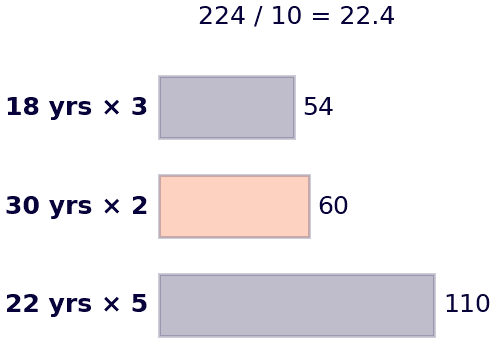 Weighted sum = 18 × 3 + 30 × 2 + 22 × 5 = 54 + 60 + 110 = 224.
Total weight = 3 + 2 + 5 = 10.
Average = = 22.4 — option (b).
Weighted sum = 18 × 3 + 30 × 2 + 22 × 5 = 54 + 60 + 110 = 224.
Total weight = 3 + 2 + 5 = 10.
Average = = 22.4 — option (b).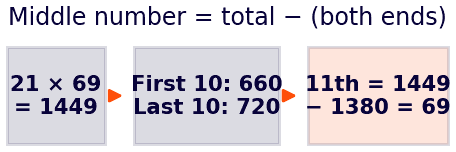 Total of all 21 = 21 × 69 = 1449.
First ten + last ten = 660 + 720 = 1380.
11th number = 1449 − 1380 = 69 — option (c).
Total of all 21 = 21 × 69 = 1449.
First ten + last ten = 660 + 720 = 1380.
11th number = 1449 − 1380 = 69 — option (c). Multiples of 13 in this range run from 208 (13×16) to 338 (13×26).
For an arithmetic progression, average = = .
= 273 — option (d).
Multiples of 13 in this range run from 208 (13×16) to 338 (13×26).
For an arithmetic progression, average = = .
= 273 — option (d). He charges for 1000 g at 90% of CP, but hands over only 750 g.
Profit multiplier = = 1.2.
So the true profit is 20% — option (c).
He charges for 1000 g at 90% of CP, but hands over only 750 g.
Profit multiplier = = 1.2.
So the true profit is 20% — option (c).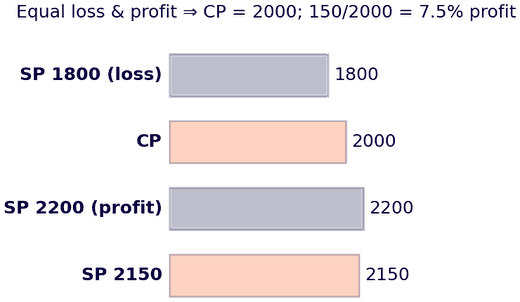 Equal profit and loss means CP is midway: CP = = ₹2,000.
At SP ₹2,150, profit = ₹150.
Profit% = × 100 = 7.5% — option (c).
Equal profit and loss means CP is midway: CP = = ₹2,000.
At SP ₹2,150, profit = ₹150.
Profit% = × 100 = 7.5% — option (c).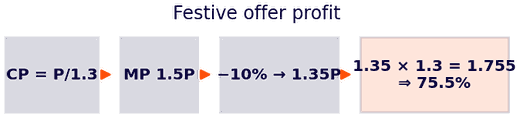 CP = .
Festive SP = 1.5P × 0.9 = 1.35P.
Profit% = ( − 1) × 100 = (1.755 − 1) × 100 = 75.5% — option (c).
CP = .
Festive SP = 1.5P × 0.9 = 1.35P.
Profit% = ( − 1) × 100 = (1.755 − 1) × 100 = 75.5% — option (c).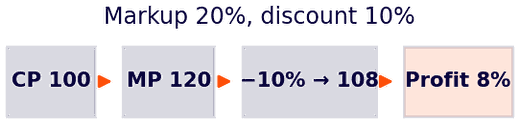 Let CP = 100; marked price = 120.
SP after 10% discount = 120 × 0.9 = 108.
Profit = 8 on 100 = 8% — option (b).
Let CP = 100; marked price = 120.
SP after 10% discount = 120 × 0.9 = 108.
Profit = 8 on 100 = 8% — option (b).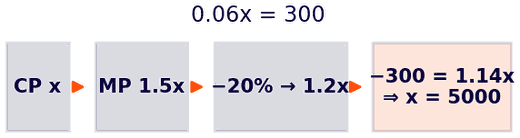 Let CP = x. MP = 1.5x; after 20% discount SP = 1.2x; after ₹300 cash rebate SP = 1.2x − 300.
Profit 14% ⇒ 1.2x − 300 = 1.14x.
0.06x = 300 ⇒ x = ₹5,000 — option (b).
Let CP = x. MP = 1.5x; after 20% discount SP = 1.2x; after ₹300 cash rebate SP = 1.2x − 300.
Profit 14% ⇒ 1.2x − 300 = 1.14x.
0.06x = 300 ⇒ x = ₹5,000 — option (b).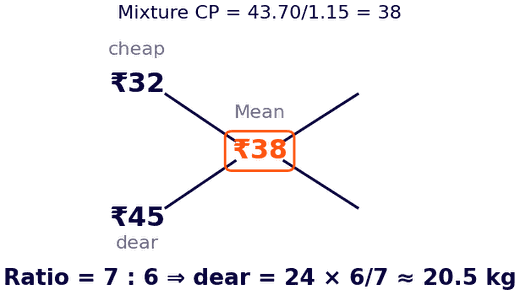 CP of mixture = = ₹38 per kg.
By alligation: (45 − 38) : (38 − 32) = 7 : 6 = cheaper : dearer.
Dearer pulses = 24 × ≈ 20.5 kg — option (c).
CP of mixture = = ₹38 per kg.
By alligation: (45 − 38) : (38 − 32) = 7 : 6 = cheaper : dearer.
Dearer pulses = 24 × ≈ 20.5 kg — option (c).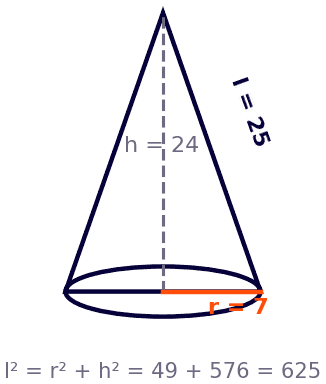 Radius r = = 7 cm.
l² = r² + h² = 49 + 576 = 625.
l = = 25 cm — option (a).
Radius r = = 7 cm.
l² = r² + h² = 49 + 576 = 625.
l = = 25 cm — option (a).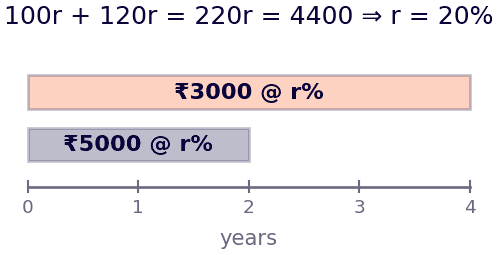 Total SI = + = 100r + 120r = 220r.
220r = 4400.
r = 20% per annum — option (d).
Total SI = + = 100r + 120r = 220r.
220r = 4400.
r = 20% per annum — option (d).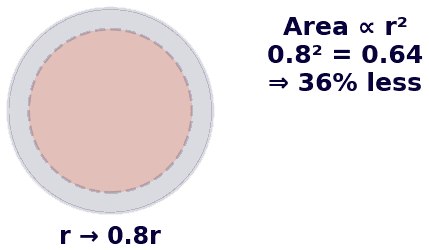 Area ∝ r², so the new area factor = = 0.64.
Decrease = 1 − 0.64 = 0.36.
= 36% — option (c).
Area ∝ r², so the new area factor = = 0.64.
Decrease = 1 − 0.64 = 0.36.
= 36% — option (c).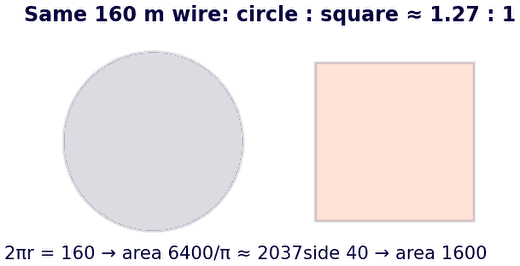 Circle: 2r = 160 ⇒ r = ; area = r² = ≈ 2037 m².
Square: side = 40 m; area = 1600 m².
Ratio = = = ≈ 1.27, i.e. 1.27 : 1 — option (b).
Circle: 2r = 160 ⇒ r = ; area = r² = ≈ 2037 m².
Square: side = 40 m; area = 1600 m².
Ratio = = = ≈ 1.27, i.e. 1.27 : 1 — option (b).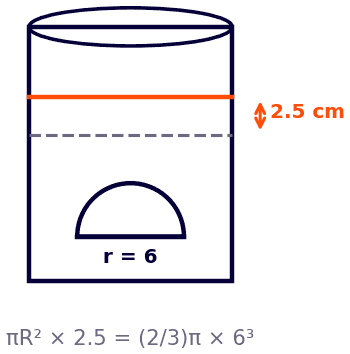 Displaced volume = volume of hemisphere = = 144 cm³.
Rise in level: R² × 2.5 = 144 ⇒ R² = 57.6.
R = ≈ 7.59 cm — option (b).
Displaced volume = volume of hemisphere = = 144 cm³.
Rise in level: R² × 2.5 = 144 ⇒ R² = 57.6.
R = ≈ 7.59 cm — option (b).