If − + − + − + = x, then find the value of (x + 1) = ?
A.8
B.7
C.2
D.0
Solution
Surds — telescoping
Rationalising each term turns the sum into: (4 + ) − ( + ) + ( + ) − ( + ) + ( + ) − ( + ) + ( + 3).
Every surd cancels in pairs, leaving x = 4 + 3 = 7.
Therefore x + 1 = 8 — option (a).
54
From the following table, determine the ratio of the number of students playing Cricket to the number of students playing Badminton in a survey of 160 students:
Category
Number
Play Cricket and Badminton
35
Play Cricket but not Badminton
55
Play Badminton but not Cricket
45
Play neither sport
25
A.6 : 7
B.7 : 5
C.9 : 8
D.5 : 7
Solution
Table — sets
Total playing Cricket = 35 + 55 = 90.
Total playing Badminton = 35 + 45 = 80.
Ratio = 90 : 80 = 9 : 8 — option (c).
55
Komal and Koyal started a business with ₹1,20,000 and ₹80,000 respectively. After 6 months, Koyal added ₹40,000 more. Komal withdrew ₹40,000 at the same time. What is the ratio of their profit shares at the end of the year?
Ankit invested ₹20,000 and Shakti invested ₹30,000. The total profit was ₹80,000. Ankit receives 25% of the total profit as a management fee. The remaining profit is divided in the ratio of their investments. What is the total amount received by Ankit?
A.₹41,000
B.₹44,000
C.₹46,000
D.₹48,000
Solution
Partnership — management fee
Management fee = 25% of 80,000 = ₹20,000; remaining = ₹60,000.
Investment ratio 20,000 : 30,000 = 2 : 3, so Ankit’s share = × 60,000 = ₹24,000.
Total for Ankit = 20,000 + 24,000 = ₹44,000 — option (b).
57
A batsman's average score for a certain number of innings is 66. If he scores 144 runs in the next innings, his average becomes 72. How many innings did he play earlier?
The average of 15 numbers is 80. The average of the first six numbers is 70. The average of the next six numbers is 20% more than the average of the first six numbers. What is the average of the last three numbers?
A.96
B.100
C.92
D.94
Solution
Average — groups
Total of 15 numbers = 15 × 80 = 1200; first six = 6 × 70 = 420.
Next six average = 70 × 1.2 = 84, total = 504.
Last three total = 1200 − 420 − 504 = 276 ⇒ average = = 92 — option (c).
59
In an election, 80% of eligible voters cast their votes. Of these, 10% were declared invalid. If the winning candidate received 16,200 votes, which is 60% of the valid votes, find the total number of eligible voters.
The compound interest on a sum at 12% p.a. for 1 years, compounded yearly, is ₹1872. Find the principal.
A.₹10,000
B.₹8,000
C.₹2,000
D.₹4,000
Solution
CI — 1½ years
For 1 years compounded yearly: one full year at 12%, then half a year at 6%.
Amount factor = 1.12 × 1.06 = 1.1872, so CI = 0.1872 × P.
0.1872P = 1872 ⇒ P = ₹10,000 — option (a).
61
If the compound interest on a certain sum at 16% per annum for 3 years is ₹2540, find the simple interest on the same sum at the same rate and for the same period.
A.₹2160
B.₹2170
C.₹2180
D.₹2060
Solution
CI → SI — 16⅔%
16% = ; in 3 years the CI factor = − 1 = = .
P = 2540 × = ₹4,320.
SI = 4320 × × 3 = ₹2,160 — option (a).
62
A tea seller bought 20 kg of Darjeeling tea at ₹310 per kg and 15 kg of Assam tea at ₹220 per kg. He mixed them together. Due to a slight drop in market prices, he had to sell the entire mixture at ₹260 per kg. Calculate his total profit or loss.
A car dealer sold three cars, A, B, and C, whose selling prices were in the ratio 5 : 4 : 6. He made a profit of 50% on car A, a loss of 10% on car B, and an equal loss (no profit or loss) on car C. What was his approximate profit or loss percentage on the total transaction?
A.loss of 8.88%
B.profit of 8.88%
C.profit of 10.88%
D.loss of 10.88%
Solution
Profit % — three items
Take SPs as 500, 400 and 600 (total 1500).
CPs: A = = 333.33; B = = 444.44; C = 600 — total CP = 1377.77.
Profit = × 100 ≈ 8.88% profit — option (b).
64
A 70 litre mixture contains milk and water in the ratio 4 : 3. If 7 litres of this mixture is removed and 10 litres of pure milk is added in its place, what will be the new ratio of milk to water?
A.23 : 18
B.46 : 27
C.46 : 21
D.43 : 27
Solution
Mixture — replacement
Initially milk = 40 L, water = 30 L; the 7 L removed carries milk 4 L and water 3 L.
Left: milk 36, water 27; adding 10 L milk gives milk 46, water 27.
New ratio = 46 : 27 — option (b).
65
A wholesaler buys a batch of ceiling fans at a 40% markup over the factory's base cost ₹P. He then allows a 10% trade discount to the retailer. The retailer applies a 50% markup on his cost and offers a flat 10% discount to customers on the printed price. If a customer finally pays ₹20412, what is the original base cost (₹P) of one ceiling fan from the factory?
A can lay railway track between two specified stations in 18 days, while B can complete the same task in 15 days. When C assists them, they manage to finish the job in just 5 days. How long would it take for C to complete the job on their own?
A.11 days
B.12 days
C.12 days
D.12 days
Solution
Work — third worker
Take the work as 90 units: A does 5/day, B does 6/day, all three do = 18/day.
C’s rate = 18 − (5 + 6) = 7 units/day.
C alone = = 12 days — option (c).
67
Three varieties of lentils, priced at ₹50/kg, ₹40/kg, and a third at an unknown price, are mixed in the ratio 3 : 2 : 5. If the resulting mixture is sold at ₹55/kg, making a profit of 10% on the cost price, what is the price per kg of the third variety of lentils?
A.₹53.50
B.₹55.50
C.₹54.00
D.₹62.50
Solution
Alligation — unknown price
Mean CP of the mixture = = ₹50 per kg.
So = 50 ⇒ 230 + 5x = 500.
x = ₹54 — option (c).
68
A can build up a wall in 9 days while B can break it in 4 days. A has worked for 4 days and then B joined to work with A for another 2 days only. In how many more days will A alone finish the remaining work?
A.7 days
B.8 days
C.7 days
D.7 days
Solution
Work — build vs break
A builds per day; B breaks per day.
In 4 days A builds ; in the next 2 days the net rate is − = −, so gets undone — built portion = − = .
Remaining at A’s rate takes × 9 = 7 days — option (a).
69
An airplane travels a specific distance at a speed of 250 km/h over the course of 4 hours. To cover the same distance in just 1 hour, it needs to fly at a speed of:
A.1200 km/h
B.1000 km/h
C.1100 km/h
D.1600 km/h
Solution
Speed — inverse time
Distance = 250 × 4 = 1000 km.
To cover 1000 km in 1 hour, speed = .
= 1000 km/h — option (b).
70
A man travels from Delhi to Noida. If he travels at 60 km/h, he arrives 1 hour early. If he travels at 40 km/h, he arrives 1 hour late. What is the distance (in km)?
A.250 km
B.220 km
C.240 km
D.280 km
Solution
Early/late — distance
The time difference between the two speeds = 2 hours.
− = 2 ⇒ = 2.
d = 240 km — option (c).
71
A ring-shaped metallic sheet has outer and inner radii 14 cm and 7 cm. What percentage of the full circle's area is the ring?
A.36%
B.48%
C.64%
D.75%
Solution
Ring vs full circle
Ring area = (14² − 7²) = (196 − 49) = 147.
Full circle = × 196.
Fraction = = = 75% — option (d).
72
A circular pond is surrounded by a 2 m wide path. If the total area (pond + path) is 804.25 m² and the area of the pond alone is 615.75 m², what is the radius of the pond?
A.10 m
B.14 m
C.12 m
D.11 m
Solution
Pond & path
Pond area: r² = 615.75.
r² = ≈ 196.
r = = 14 m — option (b).
73
The ratio of the circumferences of two circular flower beds is 5 : 4. If the larger flower bed has a radius of 10 m, what is the radius of the smaller flower bed?
A.8 m
B.7 m
C.9 m
D.5 m
Solution
Circumference ratio
Circumference ∝ radius, so = = .
The larger bed corresponds to the ratio-5 side: = .
5r₂ = 40.
r₂ = 8 m — option (a).
74
What is the equation of line through (0, 2) with slope −1?
A.y = x + 2
B.y = −x − 2
C.y = −x + 2
D.y = x − 2
Solution
Equation of a line
The point (0, 2) is the y-intercept, so c = 2.
With slope m = −1, the equation y = mx + c becomes:
y = −x + 2 — option (c).
75
Given, x + = 6, then determine the value of x² + .

 Take 7 common: 7 × (1 + 11 + 111 + 1111 + 11111).
= 7 × 12345.
= 86415 — option (a).
Take 7 common: 7 × (1 + 11 + 111 + 1111 + 11111).
= 7 × 12345.
= 86415 — option (a).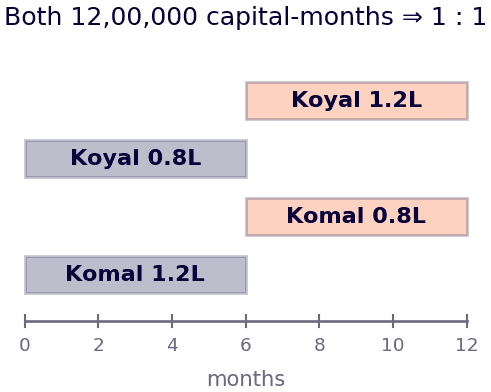 Komal: 1,20,000 × 6 + 80,000 × 6 = 7,20,000 + 4,80,000 = 12,00,000 capital-months.
Koyal: 80,000 × 6 + 1,20,000 × 6 = 4,80,000 + 7,20,000 = 12,00,000 capital-months.
Ratio = 1 : 1 — option (a).
Komal: 1,20,000 × 6 + 80,000 × 6 = 7,20,000 + 4,80,000 = 12,00,000 capital-months.
Koyal: 80,000 × 6 + 1,20,000 × 6 = 4,80,000 + 7,20,000 = 12,00,000 capital-months.
Ratio = 1 : 1 — option (a).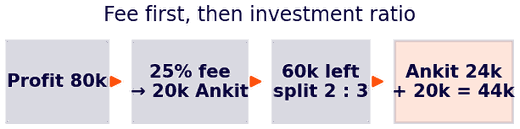 Management fee = 25% of 80,000 = ₹20,000; remaining = ₹60,000.
Investment ratio 20,000 : 30,000 = 2 : 3, so Ankit’s share = × 60,000 = ₹24,000.
Total for Ankit = 20,000 + 24,000 = ₹44,000 — option (b).
Management fee = 25% of 80,000 = ₹20,000; remaining = ₹60,000.
Investment ratio 20,000 : 30,000 = 2 : 3, so Ankit’s share = × 60,000 = ₹24,000.
Total for Ankit = 20,000 + 24,000 = ₹44,000 — option (b).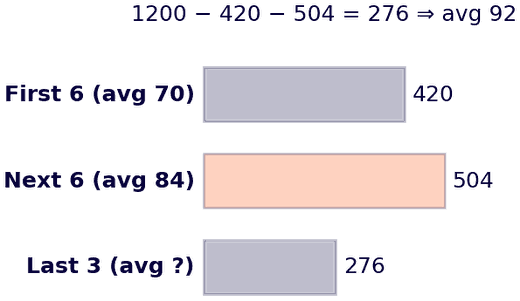 Total of 15 numbers = 15 × 80 = 1200; first six = 6 × 70 = 420.
Next six average = 70 × 1.2 = 84, total = 504.
Last three total = 1200 − 420 − 504 = 276 ⇒ average = = 92 — option (c).
Total of 15 numbers = 15 × 80 = 1200; first six = 6 × 70 = 420.
Next six average = 70 × 1.2 = 84, total = 504.
Last three total = 1200 − 420 − 504 = 276 ⇒ average = = 92 — option (c). Valid votes = = 27,000.
Votes cast = = 30,000.
Eligible voters = = 37,500 — option (c).
Valid votes = = 27,000.
Votes cast = = 30,000.
Eligible voters = = 37,500 — option (c).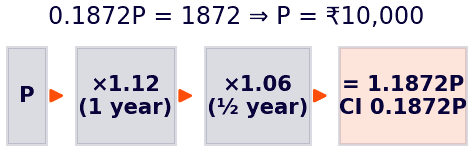 For 1 years compounded yearly: one full year at 12%, then half a year at 6%.
Amount factor = 1.12 × 1.06 = 1.1872, so CI = 0.1872 × P.
0.1872P = 1872 ⇒ P = ₹10,000 — option (a).
For 1 years compounded yearly: one full year at 12%, then half a year at 6%.
Amount factor = 1.12 × 1.06 = 1.1872, so CI = 0.1872 × P.
0.1872P = 1872 ⇒ P = ₹10,000 — option (a).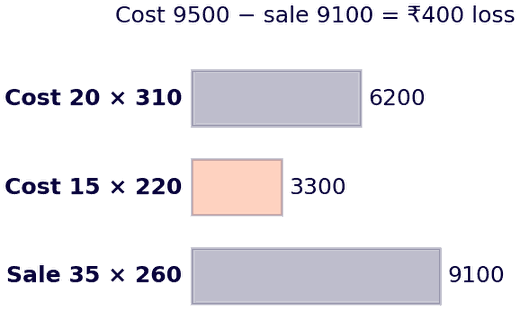 Cost = 20 × 310 + 15 × 220 = 6200 + 3300 = ₹9,500.
Sale = 35 × 260 = ₹9,100.
Loss = 9500 − 9100 = ₹400 — option (a).
Cost = 20 × 310 + 15 × 220 = 6200 + 3300 = ₹9,500.
Sale = 35 × 260 = ₹9,100.
Loss = 9500 − 9100 = ₹400 — option (a).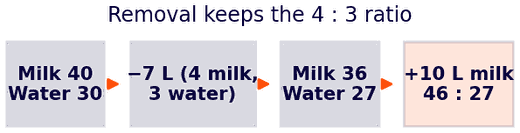 Initially milk = 40 L, water = 30 L; the 7 L removed carries milk 4 L and water 3 L.
Left: milk 36, water 27; adding 10 L milk gives milk 46, water 27.
New ratio = 46 : 27 — option (b).
Initially milk = 40 L, water = 30 L; the 7 L removed carries milk 4 L and water 3 L.
Left: milk 36, water 27; adding 10 L milk gives milk 46, water 27.
New ratio = 46 : 27 — option (b).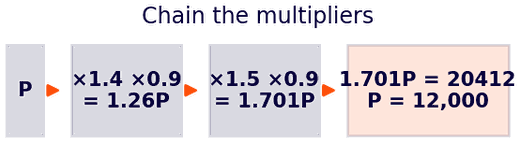 Retailer’s cost = 1.4P × 0.9 = 1.26P.
Customer pays = 1.26P × 1.5 × 0.9 = 1.701P.
1.701P = 20412 ⇒ P = ₹12,000 — option (a).
Retailer’s cost = 1.4P × 0.9 = 1.26P.
Customer pays = 1.26P × 1.5 × 0.9 = 1.701P.
1.701P = 20412 ⇒ P = ₹12,000 — option (a).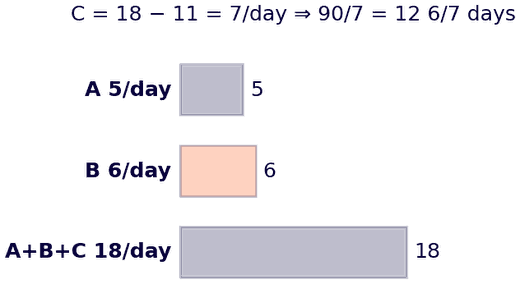 Take the work as 90 units: A does 5/day, B does 6/day, all three do = 18/day.
C’s rate = 18 − (5 + 6) = 7 units/day.
C alone = = 12 days — option (c).
Take the work as 90 units: A does 5/day, B does 6/day, all three do = 18/day.
C’s rate = 18 − (5 + 6) = 7 units/day.
C alone = = 12 days — option (c).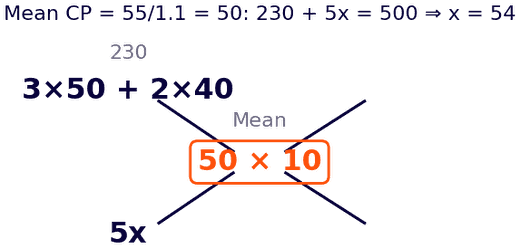 Mean CP of the mixture = = ₹50 per kg.
So = 50 ⇒ 230 + 5x = 500.
x = ₹54 — option (c).
Mean CP of the mixture = = ₹50 per kg.
So = 50 ⇒ 230 + 5x = 500.
x = ₹54 — option (c).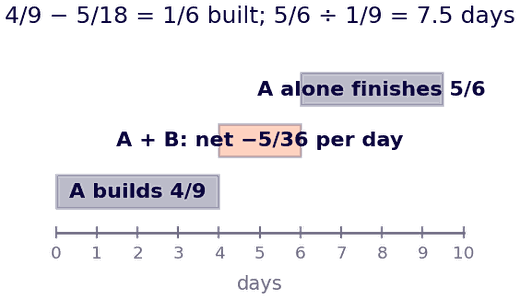 A builds per day; B breaks per day.
In 4 days A builds ; in the next 2 days the net rate is − = −, so gets undone — built portion = − = .
Remaining at A’s rate takes × 9 = 7 days — option (a).
A builds per day; B breaks per day.
In 4 days A builds ; in the next 2 days the net rate is − = −, so gets undone — built portion = − = .
Remaining at A’s rate takes × 9 = 7 days — option (a).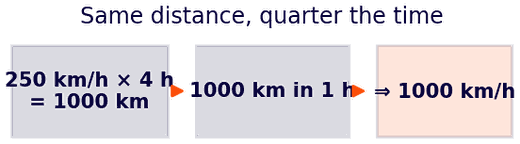 Distance = 250 × 4 = 1000 km.
To cover 1000 km in 1 hour, speed = .
= 1000 km/h — option (b).
Distance = 250 × 4 = 1000 km.
To cover 1000 km in 1 hour, speed = .
= 1000 km/h — option (b).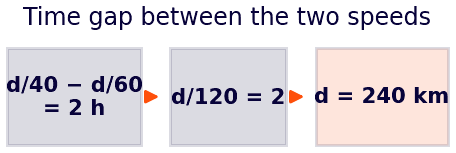 The time difference between the two speeds = 2 hours.
− = 2 ⇒ = 2.
d = 240 km — option (c).
The time difference between the two speeds = 2 hours.
− = 2 ⇒ = 2.
d = 240 km — option (c).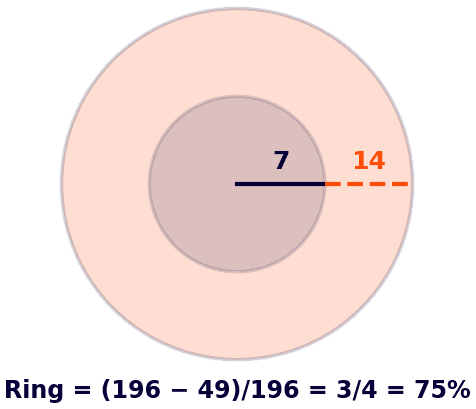 Ring area = (14² − 7²) = (196 − 49) = 147.
Full circle = × 196.
Fraction = = = 75% — option (d).
Ring area = (14² − 7²) = (196 − 49) = 147.
Full circle = × 196.
Fraction = = = 75% — option (d).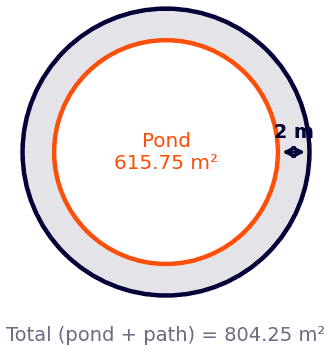 Pond area: r² = 615.75.
r² = ≈ 196.
r = = 14 m — option (b).
Pond area: r² = 615.75.
r² = ≈ 196.
r = = 14 m — option (b).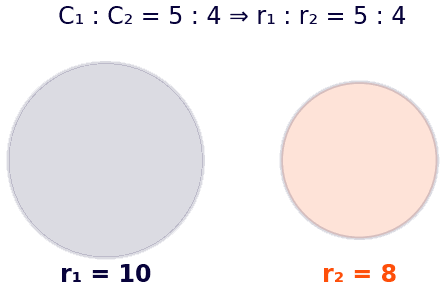 Circumference ∝ radius, so = = .
The larger bed corresponds to the ratio-5 side: = .
5r₂ = 40.
r₂ = 8 m — option (a).
Circumference ∝ radius, so = = .
The larger bed corresponds to the ratio-5 side: = .
5r₂ = 40.
r₂ = 8 m — option (a).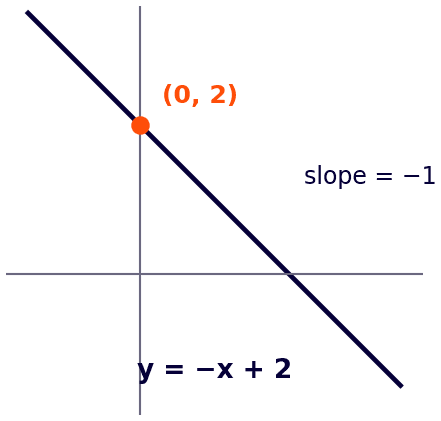 The point (0, 2) is the y-intercept, so c = 2.
With slope m = −1, the equation y = mx + c becomes:
y = −x + 2 — option (c).
The point (0, 2) is the y-intercept, so c = 2.
With slope m = −1, the equation y = mx + c becomes:
y = −x + 2 — option (c).