SSC CGL 13 September 2025 · Shift 3 · General Intelligence & Reasoning — questions with answers · ShikshaSphere
Chapter 21 of 192
13 September 2025 · Shift 3
General Intelligence & Reasoning
25 questions ~25 min readFree
25 questions
A
1
Select the letter-cluster from among the given options that can replace the question mark (?) in the following series.
ABC, DEF, GHI, ?
A.GFS
B.GCA
C.JKH
D.JKL
Solution
Letter series — consecutive triplets
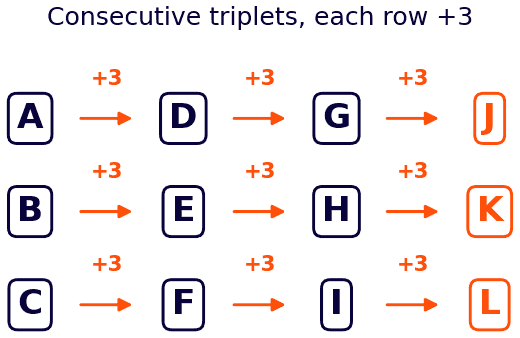
Concept: watch how each cluster is built — here every cluster has three CONSECUTIVE letters of the alphabet.
A-B-C, then D-E-F, then G-H-I — each new cluster simply starts from the very next letter.
After I, the next three consecutive letters are J, K, L.
Hence JKL — option (d).
2
Select the letter-cluster from among the given options that can replace the question mark (?) in the following series.
XIN, VMU, TQB, RUI, ?
A.PYO
B.PWP
C.PYP
D.PWQ
Solution
Letter series (−2, +4, +7)
Trick: track each position separately across the clusters.
1st letters: X, V, T, R — every time −2 ⇒ next is P.
2nd letters: I, M, Q, U — every time +4 ⇒ next is Y; 3rd letters: N, U, B, I — every time +7 (cyclic) ⇒ next is P.
Hence PYP — option (c).
3
Complete the pattern:
1, 2, 5, ?, 677
A.26
B.37
C.36
D.27
Solution
Series (n² + 1)
Trick: when terms grow very fast (5 → 677), think of squaring.
Rule here: next term = (previous term)² + 1.
Check: 1²+1 = 2 ✓; 2²+1 = 5 ✓; so ? = 5²+1 = 26; and 26²+1 = 677 ✓ — the rule fits the whole series.
Hence 26 — option (a).
4
Choose the option that is similar to the following numbers:
59, 61, 71, 79
A.111
B.101
C.147
D.169
Solution
Prime numbers
First identify what is common: 59, 61, 71 and 79 are all PRIME numbers.
Now test each option: 111 = 3 × 37 ✗; 147 = 3 × 49 ✗; 169 = 13 × 13 ✗.
101 has no factor other than 1 and itself — it is prime.
Hence 101 — option (b).
5
Identify the assumptions that must hold for the statement to be valid, then choose the correct option.Statement: The government has launched a nationwide campaign to promote electric vehicles in order to reduce air pollution.
Assumptions:
I. Air pollution is a serious problem in the country.
II. Promoting electric vehicles can help reduce air pollution.
III. People are willing to switch from fuel-based vehicles to electric vehicles.
A.Only I and II are implicit
B.Only I and III are implicit
C.All I, II, and III are implicit
D.Only I is implicit
Solution
Statement — assumptions
Rule: an assumption is something the statement TAKES FOR GRANTED — without it, the action makes no sense.
Why launch an anti-pollution campaign unless pollution is a serious problem? — I is implicit. Why promote EVs 'to reduce pollution' unless EVs can actually reduce it? — II is implicit.
III (people are willing to switch) is a hoped-for OUTCOME, not a necessary assumption — campaigns are launched precisely to create willingness.
Hence only I and II — option (a).
6
The position of how many letters will remain unchanged if each of the letters in the word BALANCE is arranged in alphabetical order?
A.Two
B.Four
C.Three
D.One
Solution
Alphabetical arrangement — BALANCE
Write both forms one below the other and compare position by position.
Original: B A L A N C E; Alphabetical: A A B C E L N.
Position 1: B/A ✗; position 2: A/A ✓; positions 3–7: L/B, A/C, N/E, C/L, E/N — all change.
Only ONE letter (the A at position 2) keeps its place — option (d).
7
Identify the similar address:
Flat No. 16C, Building 10, Sector 17, Sohna Road, Gurgaon, Haryana-122001
Address matching
Method: compare word-by-word — spellings, abbreviations and the PIN code.
Option (a) shortens everything (Bldg., Sec-17, Rd.) and writes Gurugram; option (c) changes the PIN to 122011; option (d) writes Gurugram.
Option (b) keeps every word and the PIN 122001 exactly as given.
Hence option (b).
8
How many meaningful four-letter English words can be formed using the first, second, third and sixth letters of the word MARKET (when counted from left to right), using each letter only once in each word?
A.1
B.2
C.3
D.4
Solution
Word formation — MARKET
Step 1 — pick the letters: M (1st), A (2nd), R (3rd), T (6th).
Step 2 — try arrangements that make real words: MART (a market) ✓ and TRAM (a rail car) ✓.
Other arrangements like RAMT, TARM, MATR are not meaningful English words.
So 2 words — option (b).
9
In a row, Amit is 10th from the left and Sunil is 12th from the right. After they interchange their positions, Amit becomes 15th from the left. What is the total number of persons in the row?
A.30
B.29
C.26
D.32
Solution
Row positions — interchange
Key idea: after the swap, Amit stands exactly where Sunil was standing.
So Sunil's seat is 15th from the left AND (as given) 12th from the right.
Formula: Total = (position from left) + (position from right) − 1 = 15 + 12 − 1.
= 26 persons — option (c).
10
In each of the following questions, the second word is formed by applying a specific alphabetic coding pattern to the first word. Apply the same pattern to the third word to determine the correct option from the given alternatives.
TIP : SUHJOQ :: CUT : ?
A.BCVTUS
B.BDTVSU
C.BCTVSU
D.BDTUSV
Solution
Coding — letter splits into ±1
Pattern: each letter of the word EXPANDS into two letters — (letter − 1) followed by (letter + 1).
Check with TIP: T → S,U; I → H,J; P → O,Q — giving SUHJOQ ✓.
Apply to CUT: C → B,D; U → T,V; T → S,U — giving BD TV SU.
Hence BDTVSU — option (b).
11
In each of the following questions, the second word is coded from the first using a consistent letter substitution pattern (e.g., reverse alphabet cipher, positional shift, etc.). Identify the logic in the first pair and apply the same to find the correct code for the third word.
WRONG : JEBAT :: WRITE : ?
A.JEVGR
B.JEWGR
C.JEUHS
D.JEVGS
Solution
Coding — +13 cipher
Find the shift using the first pair: W(23) → J(10). Going forward, 23 + 13 = 36 → 36 − 26 = 10 — a +13 cyclic shift.
Verify: R+13 = E ✓, O+13 = B ✓, N+13 = A ✓, G+13 = T ✓ — the rule holds for every letter.
Apply +13 to WRITE: W→J, R→E, I→V, T→G, E→R.
Hence JEVGR — option (a).
12
Complete the series.
1, 4, 9, _, 25
A.8
B.6
C.16
D.12
Solution
Perfect squares
These are perfect squares of the counting numbers.
1² = 1, 2² = 4, 3² = 9, 4² = ?, 5² = 25.
4² = 16.
Hence 16 — option (c).
13
In each of the following questions, a group of three numbers/symbols is given in each option. Identify the group that does NOT follow the same pattern as the others.
A.A7$ : B8# : C9@
B.X21% : Y22^ : Z23&
C.P11* : Q12( : R13)
D.M10_ : O11@ : P13#
Solution
Pattern — letter, number, symbol
Common pattern in (a), (b), (c): the letters move +1 each time (A,B,C / X,Y,Z / P,Q,R) and the numbers also move +1.
In option (d): M → O jumps +2, and the numbers 10, 11, 13 rise unevenly (+1, then +2).
Both chains break in (d).
Hence option (d).
14
How many diagonals does an octagon have?
A.20
B.18
C.16
D.12
Solution
Diagonals of a polygon
Formula: number of diagonals of an n-sided polygon = .
Why n − 3? From each vertex you cannot draw a diagonal to itself or to its 2 neighbours.
For an octagon, n = 8: = = 20.
Hence 20 — option (a).
15
If 4 @ 1 = 17, 5 @ 2 = 27, then 6 @ 3 = ?
A.36
B.38
C.40
D.39
Solution
Number puzzle (a² + b)
Test a simple rule: a @ b = a² + b.
Check: 4² + 1 = 17 ✓ and 5² + 2 = 27 ✓ — the rule works for both given pairs.
Apply: 6 @ 3 = 6² + 3 = 36 + 3.
= 39 — option (d).
16
If 'SPECTOR' is coded as 'HTWFZLI', then how is 'PHANTOM' coded?
A.KLSOZLN
B.KLSOLNZ
C.KLSQZLN
D.KLSQZNL
Solution
Coding — position-wise rules
Decode the first pair position by position: S→H (opposite letter), P→T (+4), E→W (+18), C→F (+3), T→Z (+6), O→L (−3), R→I (opposite letter).
Apply the SAME position-wise changes to PHANTOM: P→K (opposite), H→L (+4), A→S (+18), N→Q (+3), T→Z (+6), O→L (−3), M→N (opposite).
Reading the results together: K-L-S-Q-Z-L-N.
Hence KLSQZLN — option (c).
17
If STONE is coded as TUPMF, how is PEARL coded?
A.QFBIM
B.QFBQM
C.QFCQM
D.QFBMQ
Solution
Coding (+1,+1,+1,−1,+1)
Compare letter by letter: S→T (+1), T→U (+1), O→P (+1), N→M (−1), E→F (+1).
So the pattern is +1, +1, +1, −1, +1 by position.
Apply to PEARL: P→Q, E→F, A→B, R→Q, L→M.
Hence QFBQM — option (b).
18
A 50 L solution has alcohol and water in 4 : 6 ratio. How much water should be added to make the ratio 4 : 9?
A.15 L
B.18 L
C.20 L
D.22 L
Solution
Ratio — add water
Step 1 — find actual quantities: ratio 4 : 6 means 10 units = 50 L, so 1 unit = 5 L ⇒ alcohol = 20 L, water = 30 L.
Step 2 — alcohol stays the same (only water is added), so keep alcohol = 4 units = 20 L.
For the new ratio 4 : 9, water must become 9 units = 9 × 5 = 45 L.
Water to add = 45 − 30 = 15 L — option (a).
19
If 4 & 3 = 25 and 2 & 5 = 29, then find the value of 3 & 6 = ?
A.35
B.55
C.45
D.65
Solution
Number puzzle (a² + b²)
Test the rule a & b = a² + b².
Check: 4² + 3² = 16 + 9 = 25 ✓ and 2² + 5² = 4 + 25 = 29 ✓.
Apply: 3 & 6 = 3² + 6² = 9 + 36.
= 45 — option (c).
20
Ram introduces a woman: "She is the only daughter of my father's only son." How is the woman related to Ram?
A.Sister
B.Son
C.Cousin
D.Daughter
Solution
Blood relation
Break the sentence from inside out: 'my father's only son' — since Ram's father has only one son, that son is Ram himself.
So the sentence becomes: 'She is the only daughter of RAM.'
The woman is therefore Ram’s daughter.
Hence option (d).
21
A's brother is B. B is the father of C. C is the sister of D. How is D related to B?
A.Son
B.Nephew
C.Niece
D.Cannot be determined
Solution
Blood relation — gender unknown
B is the father of C, and C is the sister of D — so C and D are siblings, both children of B.
D is therefore B’s child. But is D a son or a daughter?
Nothing in the question reveals D’s gender.
Hence Cannot be determined — option (d).
22
After interchanging + & × and 3 & 5, which of the following equations will hold true?
A.(3+4)×5=17
B.(5+2)×3=21
C.(3+6)×5=33
D.(5+1)×3=18
Solution
Interchange check
Apply BOTH swaps to each option: + becomes ×, × becomes +, 3 becomes 5, 5 becomes 3.
Option (c): (3+6)×5 becomes (5×6)+3.
= 30 + 3 = 33 — exactly the value written on the right side ✓ (the others give 23, 11 and 6).
Hence option (c).
23
If 'J' means '+', 'K' means '−', 'L' means '×', and 'M' means '÷', what is the value of the following expression?
20 M 4 L 3 J 5 K 5 = ?
A.20
B.18
C.25
D.15
Solution
Symbol substitution
Replace each letter with its sign: 20 ÷ 4 × 3 + 5 − 5.
BODMAS: do division and multiplication first, left to right: 20 ÷ 4 = 5, then 5 × 3 = 15.
Now the additions: 15 + 5 − 5 = 15.
Hence 15 — option (d).
24
If '+' means '÷', '×' means '+' and '−' means '×', then 15 + 5 × 6 − 2 = ?
A.20
B.15
C.18
D.10
Solution
Symbol substitution
Replace the signs as instructed: 15 ÷ 5 + 6 × 2.
BODMAS: division and multiplication first: 15 ÷ 5 = 3 and 6 × 2 = 12.
Then add: 3 + 12 = 15.
Hence 15 — option (b).
25
If the sum of 55 and 22 is multiplied by 5, what is the result?

 Concept: watch how each cluster is built — here every cluster has three CONSECUTIVE letters of the alphabet.
A-B-C, then D-E-F, then G-H-I — each new cluster simply starts from the very next letter.
After I, the next three consecutive letters are J, K, L.
Hence JKL — option (d).
Concept: watch how each cluster is built — here every cluster has three CONSECUTIVE letters of the alphabet.
A-B-C, then D-E-F, then G-H-I — each new cluster simply starts from the very next letter.
After I, the next three consecutive letters are J, K, L.
Hence JKL — option (d).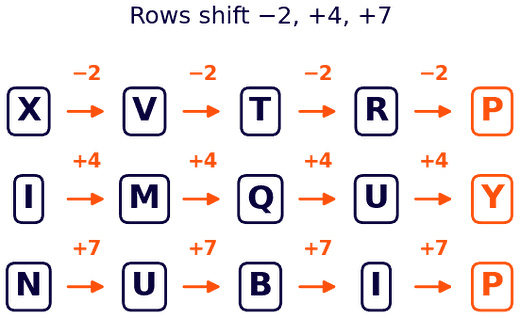 Trick: track each position separately across the clusters.
1st letters: X, V, T, R — every time −2 ⇒ next is P.
2nd letters: I, M, Q, U — every time +4 ⇒ next is Y; 3rd letters: N, U, B, I — every time +7 (cyclic) ⇒ next is P.
Hence PYP — option (c).
Trick: track each position separately across the clusters.
1st letters: X, V, T, R — every time −2 ⇒ next is P.
2nd letters: I, M, Q, U — every time +4 ⇒ next is Y; 3rd letters: N, U, B, I — every time +7 (cyclic) ⇒ next is P.
Hence PYP — option (c).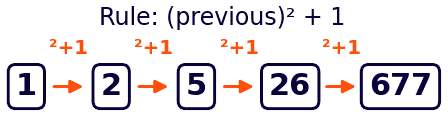 Trick: when terms grow very fast (5 → 677), think of squaring.
Rule here: next term = (previous term)² + 1.
Check: 1²+1 = 2 ✓; 2²+1 = 5 ✓; so ? = 5²+1 = 26; and 26²+1 = 677 ✓ — the rule fits the whole series.
Hence 26 — option (a).
Trick: when terms grow very fast (5 → 677), think of squaring.
Rule here: next term = (previous term)² + 1.
Check: 1²+1 = 2 ✓; 2²+1 = 5 ✓; so ? = 5²+1 = 26; and 26²+1 = 677 ✓ — the rule fits the whole series.
Hence 26 — option (a).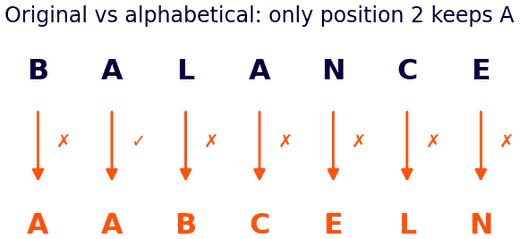 Write both forms one below the other and compare position by position.
Original: B A L A N C E; Alphabetical: A A B C E L N.
Position 1: B/A ✗; position 2: A/A ✓; positions 3–7: L/B, A/C, N/E, C/L, E/N — all change.
Only ONE letter (the A at position 2) keeps its place — option (d).
Write both forms one below the other and compare position by position.
Original: B A L A N C E; Alphabetical: A A B C E L N.
Position 1: B/A ✗; position 2: A/A ✓; positions 3–7: L/B, A/C, N/E, C/L, E/N — all change.
Only ONE letter (the A at position 2) keeps its place — option (d).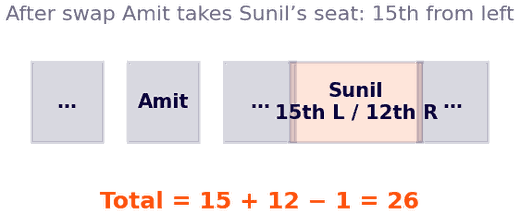 Key idea: after the swap, Amit stands exactly where Sunil was standing.
So Sunil's seat is 15th from the left AND (as given) 12th from the right.
Formula: Total = (position from left) + (position from right) − 1 = 15 + 12 − 1.
= 26 persons — option (c).
Key idea: after the swap, Amit stands exactly where Sunil was standing.
So Sunil's seat is 15th from the left AND (as given) 12th from the right.
Formula: Total = (position from left) + (position from right) − 1 = 15 + 12 − 1.
= 26 persons — option (c).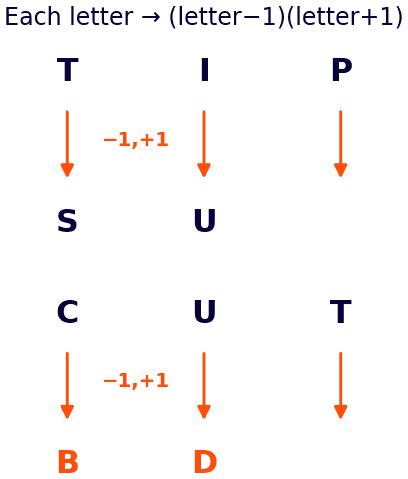 Pattern: each letter of the word EXPANDS into two letters — (letter − 1) followed by (letter + 1).
Check with TIP: T → S,U; I → H,J; P → O,Q — giving SUHJOQ ✓.
Apply to CUT: C → B,D; U → T,V; T → S,U — giving BD TV SU.
Hence BDTVSU — option (b).
Pattern: each letter of the word EXPANDS into two letters — (letter − 1) followed by (letter + 1).
Check with TIP: T → S,U; I → H,J; P → O,Q — giving SUHJOQ ✓.
Apply to CUT: C → B,D; U → T,V; T → S,U — giving BD TV SU.
Hence BDTVSU — option (b).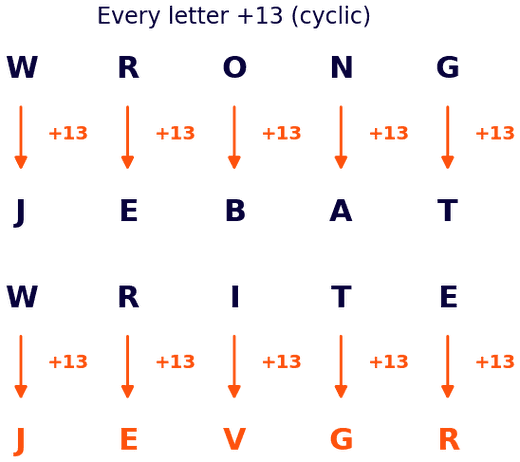 Find the shift using the first pair: W(23) → J(10). Going forward, 23 + 13 = 36 → 36 − 26 = 10 — a +13 cyclic shift.
Verify: R+13 = E ✓, O+13 = B ✓, N+13 = A ✓, G+13 = T ✓ — the rule holds for every letter.
Apply +13 to WRITE: W→J, R→E, I→V, T→G, E→R.
Hence JEVGR — option (a).
Find the shift using the first pair: W(23) → J(10). Going forward, 23 + 13 = 36 → 36 − 26 = 10 — a +13 cyclic shift.
Verify: R+13 = E ✓, O+13 = B ✓, N+13 = A ✓, G+13 = T ✓ — the rule holds for every letter.
Apply +13 to WRITE: W→J, R→E, I→V, T→G, E→R.
Hence JEVGR — option (a).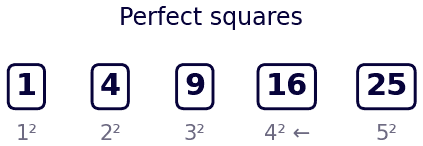 These are perfect squares of the counting numbers.
1² = 1, 2² = 4, 3² = 9, 4² = ?, 5² = 25.
4² = 16.
Hence 16 — option (c).
These are perfect squares of the counting numbers.
1² = 1, 2² = 4, 3² = 9, 4² = ?, 5² = 25.
4² = 16.
Hence 16 — option (c).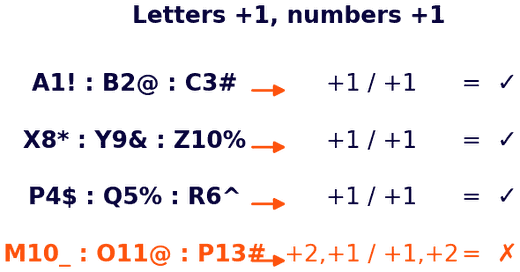 Common pattern in (a), (b), (c): the letters move +1 each time (A,B,C / X,Y,Z / P,Q,R) and the numbers also move +1.
In option (d): M → O jumps +2, and the numbers 10, 11, 13 rise unevenly (+1, then +2).
Both chains break in (d).
Hence option (d).
Common pattern in (a), (b), (c): the letters move +1 each time (A,B,C / X,Y,Z / P,Q,R) and the numbers also move +1.
In option (d): M → O jumps +2, and the numbers 10, 11, 13 rise unevenly (+1, then +2).
Both chains break in (d).
Hence option (d).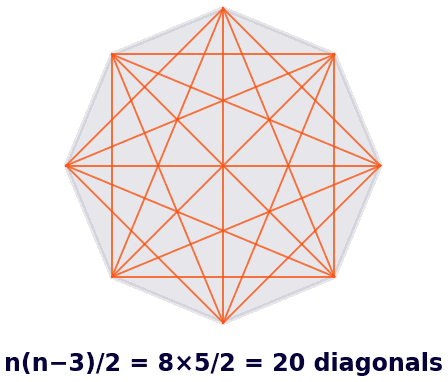 Formula: number of diagonals of an n-sided polygon = .
Why n − 3? From each vertex you cannot draw a diagonal to itself or to its 2 neighbours.
For an octagon, n = 8: = = 20.
Hence 20 — option (a).
Formula: number of diagonals of an n-sided polygon = .
Why n − 3? From each vertex you cannot draw a diagonal to itself or to its 2 neighbours.
For an octagon, n = 8: = = 20.
Hence 20 — option (a).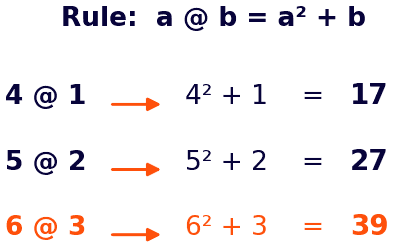 Test a simple rule: a @ b = a² + b.
Check: 4² + 1 = 17 ✓ and 5² + 2 = 27 ✓ — the rule works for both given pairs.
Apply: 6 @ 3 = 6² + 3 = 36 + 3.
= 39 — option (d).
Test a simple rule: a @ b = a² + b.
Check: 4² + 1 = 17 ✓ and 5² + 2 = 27 ✓ — the rule works for both given pairs.
Apply: 6 @ 3 = 6² + 3 = 36 + 3.
= 39 — option (d).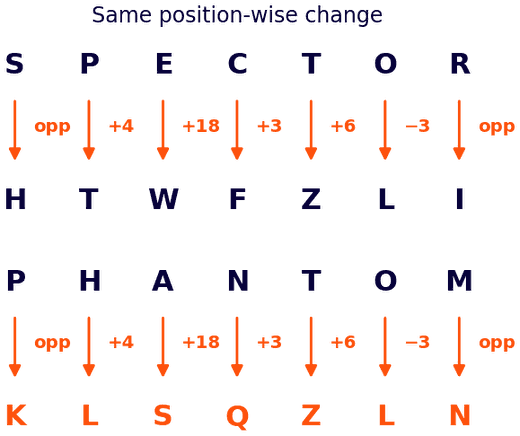 Decode the first pair position by position: S→H (opposite letter), P→T (+4), E→W (+18), C→F (+3), T→Z (+6), O→L (−3), R→I (opposite letter).
Apply the SAME position-wise changes to PHANTOM: P→K (opposite), H→L (+4), A→S (+18), N→Q (+3), T→Z (+6), O→L (−3), M→N (opposite).
Reading the results together: K-L-S-Q-Z-L-N.
Hence KLSQZLN — option (c).
Decode the first pair position by position: S→H (opposite letter), P→T (+4), E→W (+18), C→F (+3), T→Z (+6), O→L (−3), R→I (opposite letter).
Apply the SAME position-wise changes to PHANTOM: P→K (opposite), H→L (+4), A→S (+18), N→Q (+3), T→Z (+6), O→L (−3), M→N (opposite).
Reading the results together: K-L-S-Q-Z-L-N.
Hence KLSQZLN — option (c).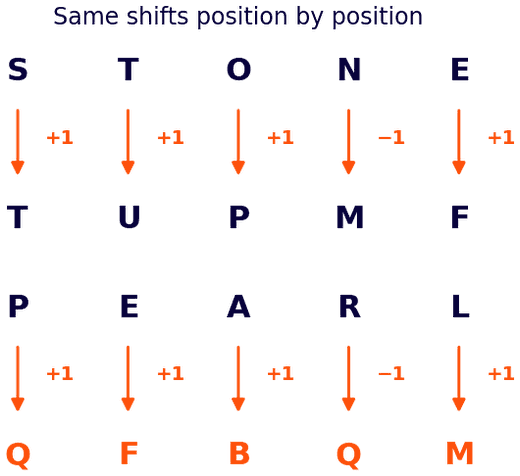 Compare letter by letter: S→T (+1), T→U (+1), O→P (+1), N→M (−1), E→F (+1).
So the pattern is +1, +1, +1, −1, +1 by position.
Apply to PEARL: P→Q, E→F, A→B, R→Q, L→M.
Hence QFBQM — option (b).
Compare letter by letter: S→T (+1), T→U (+1), O→P (+1), N→M (−1), E→F (+1).
So the pattern is +1, +1, +1, −1, +1 by position.
Apply to PEARL: P→Q, E→F, A→B, R→Q, L→M.
Hence QFBQM — option (b).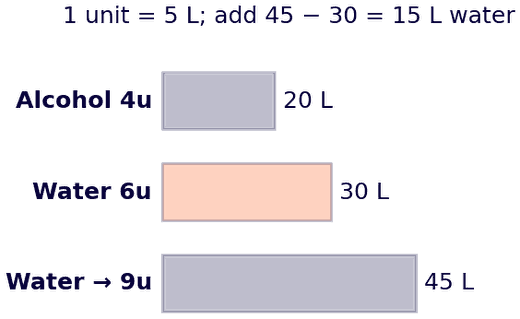 Step 1 — find actual quantities: ratio 4 : 6 means 10 units = 50 L, so 1 unit = 5 L ⇒ alcohol = 20 L, water = 30 L.
Step 2 — alcohol stays the same (only water is added), so keep alcohol = 4 units = 20 L.
For the new ratio 4 : 9, water must become 9 units = 9 × 5 = 45 L.
Water to add = 45 − 30 = 15 L — option (a).
Step 1 — find actual quantities: ratio 4 : 6 means 10 units = 50 L, so 1 unit = 5 L ⇒ alcohol = 20 L, water = 30 L.
Step 2 — alcohol stays the same (only water is added), so keep alcohol = 4 units = 20 L.
For the new ratio 4 : 9, water must become 9 units = 9 × 5 = 45 L.
Water to add = 45 − 30 = 15 L — option (a).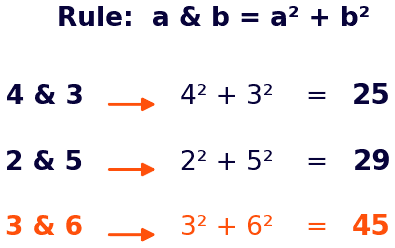 Test the rule a & b = a² + b².
Check: 4² + 3² = 16 + 9 = 25 ✓ and 2² + 5² = 4 + 25 = 29 ✓.
Apply: 3 & 6 = 3² + 6² = 9 + 36.
= 45 — option (c).
Test the rule a & b = a² + b².
Check: 4² + 3² = 16 + 9 = 25 ✓ and 2² + 5² = 4 + 25 = 29 ✓.
Apply: 3 & 6 = 3² + 6² = 9 + 36.
= 45 — option (c).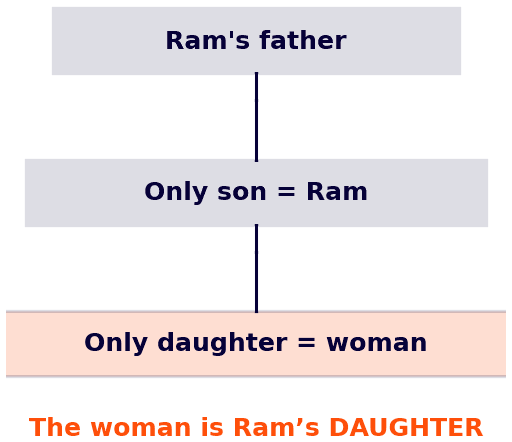 Break the sentence from inside out: 'my father's only son' — since Ram's father has only one son, that son is Ram himself.
So the sentence becomes: 'She is the only daughter of RAM.'
The woman is therefore Ram’s daughter.
Hence option (d).
Break the sentence from inside out: 'my father's only son' — since Ram's father has only one son, that son is Ram himself.
So the sentence becomes: 'She is the only daughter of RAM.'
The woman is therefore Ram’s daughter.
Hence option (d).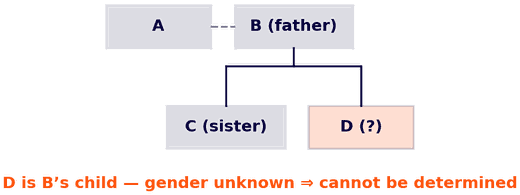 B is the father of C, and C is the sister of D — so C and D are siblings, both children of B.
D is therefore B’s child. But is D a son or a daughter?
Nothing in the question reveals D’s gender.
Hence Cannot be determined — option (d).
B is the father of C, and C is the sister of D — so C and D are siblings, both children of B.
D is therefore B’s child. But is D a son or a daughter?
Nothing in the question reveals D’s gender.
Hence Cannot be determined — option (d).