SSC CGL 13 September 2025 · Shift 3 · Quantitative Aptitude — questions with answers · ShikshaSphere
Chapter 23 of 192
13 September 2025 · Shift 3
Quantitative Aptitude
25 questions ~25 min readFree
25 questions
A
51
If B is 30% more than A, and C is 25% more than B, then what is A : C?
A.13 : 8
B.8 : 13
C.16 : 25
D.25 : 16
Solution
Percentage chain → ratio
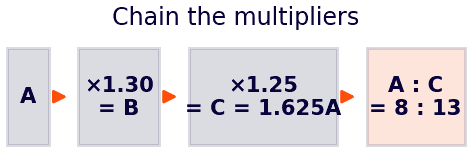
Write each statement as a multiplier: B = 1.30 × A and C = 1.25 × B.
Chain them: C = 1.25 × 1.30 × A = 1.625A.
So A : C = A : 1.625A = 1 : 1.625 — multiply both sides by 8 to clear the decimal: 8 : 13.
Hence option (b).
52
A pipe releases 0.365 liters of water every second. How much does it release in 6 seconds?
A.2.19 liters
B.2.25 liters
C.1.83 liters
D.1.90 liters
Solution
Decimal multiplication
Water released = rate × time = 0.365 × 6.
Shortcut: 365 × 6 = 2190, then place the 3 decimal digits back.
0.365 × 6 = 2.190.
Hence 2.19 liters — option (a).
53
A rope is divided in the ratio : : : 1. Total length = 5 m. Find the smallest piece.
A.0.556 m
B.0.889 m
C.1.333 m
D.2.222 m
Solution
Fraction ratio → pieces
Step 1 — clear the fractions: LCM of 5, 4, 5 is 20, so multiply every term by 20: ×20 : ×20 : ×20 : 1×20 = 8 : 5 : 12 : 20.
Step 2 — sum of ratio parts = 8 + 5 + 12 + 20 = 45.
Step 3 — the smallest part is 5, so smallest piece = × 5 m = m.
= 0.556 m — option (a).
54
A vendor mixes two types of rice — one costing ₹110 per kg and the other costing ₹170 per kg, in the ratio 2 : 3. If he sells the mixed variety at ₹142 per kg, find his gain or loss percent.
A.2.74% loss
B.2.74% gain
C.3.25% Loss
D.3.25% Gain
Solution
Mixture — gain/loss %
Cost of the mixture per kg (take 2 kg + 3 kg = 5 kg): CP = = = = ₹146.
Selling price = ₹142, which is BELOW the cost — so it is a loss.
Loss% = × 100 = = 2.74%.
Hence 2.74% loss — option (a).
55
A, B, and C invested ₹30,000, ₹50,000, and ₹90,000 respectively in a business. If the total profit at the end of the year is ₹30,000, what is A's share of the profit?
A.₹8823.53
B.₹5294.12
C.₹15882.35
D.₹9000
Solution
Profit sharing
Same time period for all — so profit is shared in the ratio of investments.
A : B : C = 30000 : 50000 : 90000 = 3 : 5 : 9; total parts = 3 + 5 + 9 = 17.
A's share = × 30,000 = .
= ₹5294.12 — option (b).
56
X and Y share a rented field. X utilizes 15 horses for 5 months, while Y uses 25 cows for 4 months and 40 sheep for 5 months. If 2 horses are equivalent to 5 cows, and 3 cows are equal to 9 sheep, what portion of the rent is X to pay?
A and B start a business. A invests 2 times more than B. After 6 months, A withdraws half of his capital, and B triples his capital. If the total profit after one year is ₹65,000, find the share of A.
A.₹30,000
B.₹32413.78
C.₹38,000
D.₹34,411.77
Solution
Partnership — capital changes
'2 times MORE than B' means A = B + 2B = 3B. Let B's capital = x, so A's = 3x.
A: 3x for 6 months, then half withdrawn → 1.5x for 6 months ⇒ A's capital-months = 18x + 9x = 27x.
B: x for 6 months, then tripled → 3x for 6 months ⇒ B's capital-months = 6x + 18x = 24x. Ratio A : B = 27 : 24 = 9 : 8.
A's share = × 65,000 = ₹34,411.77 — option (d).
58
The average salary of 12 employees is ₹20,000. The average salary of 4 senior staff is ₹30,000. What is the average salary for the other employees?
A.₹15,000
B.₹16,000
C.₹17,000
D.₹18,000
Solution
Average — remaining group
Rule: total = average × count. Total of all 12 = 12 × 20,000 = ₹2,40,000.
Total of the 4 seniors = 4 × 30,000 = ₹1,20,000.
Remaining 8 employees earn 2,40,000 − 1,20,000 = ₹1,20,000 in total.
Their average = = ₹15,000 — option (a).
59
A cricketer's average in 9 innings is 55. If his highest score is excluded, the average drops to 50. What is his highest score?
A.93
B.92
C.95
D.94
Solution
Average — excluded score
Total runs in 9 innings = 9 × 55 = 495.
Without the highest score, 8 innings remain with average 50 — total = 8 × 50 = 400.
Highest score = 495 − 400 = 95.
Hence option (c).
60
Table — Scores in a Quiz Contest (out of 50)
Team
Round 1
Round 2
Round 3
A
44
35
41
B
46
50
49
Which team had a higher average score?
A.Team A
B.Team B
C.Team A and Team B are equal
D.It cannot be Determined
Solution
Table — comparing averages
Average of Team A = = = 40.
Average of Team B = = ≈ 48.33.
48.33 > 40, so Team B scored higher on average.
Hence option (b).
61
A tank contains 3,800 milliliters of water. If its full capacity is 0.008 kiloliters, what percentage of the tank is empty?
A.50%
B.52%
C.51%
D.55%
Solution
Unit conversion — percentage
First bring both to the same unit: 0.008 kiloliters = 8 liters = 8,000 milliliters.
Empty space = 8,000 − 3,800 = 4,200 ml.
Empty percentage = × 100 = 52.5%, i.e. about 52%.
Hence option (b).
62
A stationery supplier ordered 4 boxes of premium pens and some boxes of standard pens. The price of premium pens per box was twice that of standard pens. When the order was delivered, the number of boxes of premium and standard pens had been accidentally interchanged. This increased the total bill by 20%. What was the ratio of the original number of boxes of premium pens to the original number of boxes of standard pens?
A.4 : 5
B.5 : 7
C.4 : 7
D.3 : 1
Solution
Interchanged order — ratio
Let a standard box cost ₹p, so a premium box costs ₹2p; let standard boxes = S.
Original bill = 4(2p) + S(p) = (8 + S)p; after the mix-up: S premium + 4 standard = (2S + 4)p.
Bill rose 20%: (2S + 4)p = 1.2 × (8 + S)p ⇒ 2S + 4 = 9.6 + 1.2S ⇒ 0.8S = 5.6 ⇒ S = 7.
Original ratio = 4 : 7 — option (c).
63
A principal of ₹2,00,000 is invested at 10% per annum compound interest, compounded annually. After how many years will the amount grow to ₹2,66,200?
A.3
B.4
C.5
D.6
Solution
CI — finding time
CI formula: Amount = P×. Here = 1.331 must equal .
Build powers of 1.1: 1.1¹ = 1.1; 1.1² = 1.21; 1.1³ = 1.331.
So n = 3.
Hence 3 years — option (a).
64
A shopkeeper made a loss of ₹135 on an article. If the loss percentage was 10%, what was the cost price of the article (in ₹)?
A.₹1347
B.₹1345
C.₹1350
D.₹1400
Solution
Loss % → CP
Loss% is always calculated on the COST price.
So 10% of CP = ₹135.
CP = = 135 × 10 = ₹1350.
Hence option (c).
65
A bookseller sells a novel for ₹A and makes a loss of 15%. To clear old stock, he decides to mark the novel at ₹0.8A. He then allows a further discount of 10% on this marked price. What is his overall loss percentage now?
A.30.5%
B.45.5%
C.36.8%
D.38.8%
Solution
Loss on new marked price
From the first sale: A = 85% of CP, so CP = = .
New selling price = 0.8A minus 10% = 0.8A × 0.9 = 0.72A.
Loss = CP − 0.72A; Loss% = × 100 = (1 − 0.72 × ) × 100 = (1 − 0.612) × 100.
= 38.8% — option (d).
66
An article is marked at ₹600. A shop owner allows a discount of 6% and still gains 4%. What is the approximate cost price of the article?
A.₹540.31
B.₹555.30
C.₹542.31
D.₹600.51
Solution
Discount + gain → CP
Selling price = marked price − discount = 600 × 0.94 = ₹564.
This SP includes a 4% gain, so SP = 1.04 × CP.
CP = = ₹542.31.
Hence option (c).
67
A furniture manufacturer sells a dining table set to a showroom at a 20% discount on the marked price, but adds a 10% handling fee on the discounted price. The showroom then sells the set for ₹3500 more than what they paid, thereby earning a profit of 20%. At what price had the manufacturer marked the dining table set?
A.₹19,254.62
B.₹19886.36
C.₹20,654.67
D.₹19888.68
Solution
Marked price — chain
Let the marked price be M. Showroom pays: M × 0.80 × 1.10 = 0.88M.
The showroom’s profit is ₹3500 and this equals 20% of what it paid: 3500 = 0.20 × 0.88M.
So 3500 = 0.176M ⇒ M = .
= ₹19,886.36 — option (b).
68
Two types of sugar, one costing ₹35/kg and another costing ₹50/kg, are mixed with a third variety in the ratio 1 : 2 : 3. If the mixture is worth ₹44/kg, what is the price of the third variety?
A.₹43.00
B.₹42.50
C.₹44.00
D.₹55.50
Solution
Alligation — third price
Weighted average rule: (1 kg × 35) + (2 kg × 50) + (3 kg × x) over 6 kg must equal ₹44/kg.
35 + 100 + 3x = 44 × 6 = 264.
3x = 264 − 135 = 129 ⇒ x = 43.
Hence ₹43.00 — option (a).
69
A person invested ₹10,000 in two schemes — Scheme A at 12% p.a. and Scheme B at 8% p.a., both under simple interest. After 1 year, the total interest from both schemes was ₹1,000. How much was invested in Scheme A?
A.₹2,000
B.₹3,000
C.₹5,000
D.₹2,800
Solution
SI — two schemes
Let ₹x go into Scheme A; then Scheme B gets ₹(10,000 − x).
One-year interest: 0.12x + 0.08(10,000 − x) = 1,000.
0.12x + 800 − 0.08x = 1000 ⇒ 0.04x = 200 ⇒ x = 5,000.
Hence ₹5,000 — option (c).
70
A cylinder and a cone have the same base radius and volume. Find the ratio of the height of the cylinder to the height of the cone.
A.1 : 3
B.3 : 1
C.2 : 1
D.1 : 2
Solution
Cylinder vs cone — heights
Formulas: cylinder V = r²h₁; cone V = r²h₂.
Volumes are equal with the same r: r²h₁ = r²h₂.
Cancel r² on both sides: h₁ = ⇒ = .
Hence 1 : 3 — option (a).
71
Two circular ponds have circumferences in the ratio 6 : 10. If the smaller pond has an area of 160 m², what is the approximate area of the larger pond?
A.444 m²
B.450 m²
C.438 m²
D.449 m²
Solution
Circumference ratio → areas
Circumference ∝ radius, so the radii are also in the ratio 6 : 10 = 3 : 5.
Area ∝ radius², so areas are in the ratio 3² : 5² = 9 : 25.
Larger area = 160 × = = 444.4 m².
≈ 444 m² — option (a).
72
If the base of a prism is a regular hexagon of side 3 cm and the height is 8 cm, what is its volume?
A.106 cm³
B.104 cm³
C.107 cm³
D.108 cm³
Solution
Hexagonal prism — volume
Volume of any prism = (area of base) × height.
Area of a regular hexagon of side a = a² = × 9 = cm².
Volume = × 8 = 27 × 4.
= 108 cm³ — option (d).
73
Three concentric circles are designed as part of a target practice board. Their diameters form an arithmetic progression. If the smallest circle has a circumference of 8π cm and the largest circle has a circumference of 16π cm, what is the circumference of the middle circle?
A.14π cm
B.12π cm
C.10π cm
D.11π cm
Solution
Concentric circles — AP
Circumference = π × diameter — so 8π means diameter 8 cm and 16π means diameter 16 cm.
The three diameters are in AP: 8, d, 16.
In an AP the middle term is the average of its neighbours: d = = 12.
Middle circumference = 12π cm — option (b).
74
There are two parallel chords measuring 14 cm and 10 cm, both situated on the same side of the center of a circle. The space between the two chords is 4 cm. What is the approximate radius of the circle?
A.7.07 cm
B.8.07 cm
C.6.05 cm
D.5.05 cm
Solution
Two chords — same side
Property: the perpendicular from the centre bisects a chord. Let the 14 cm chord (half = 7) be at distance x from the centre; the 10 cm chord (half = 5) is then at distance x + 4 (same side, and the LONGER chord lies closer to the centre).
Both reach the same radius: x² + 7² = r² and (x + 4)² + 5² = r².
Equate: x² + 49 = x² + 8x + 16 + 25 ⇒ 8x = 8 ⇒ x = 1; so r² = 1 + 49 = 50.
r = ≈ 7.07 cm — option (a).
75
A sector has a central angle of 225° and a radius of 6 cm. Another sector of the same circle has a central angle of radians. What is the ratio of the area of the first sector to the second?
A.5 : 7
B.1 : 1
C.4 : 3
D.3 : 7
Solution
Degrees vs radians
Convert the radian angle to degrees: radians = × 180° = 225°.
Both sectors belong to the SAME circle, so their areas depend only on their central angles.
Both angles are 225° — the two sectors are identical in area.
Ratio = 1 : 1 — option (b).
Finished reading? Now test yourself.
The same 25 questions, but with a timer and the answers hidden — 15 minutes.

 Write each statement as a multiplier: B = 1.30 × A and C = 1.25 × B.
Chain them: C = 1.25 × 1.30 × A = 1.625A.
So A : C = A : 1.625A = 1 : 1.625 — multiply both sides by 8 to clear the decimal: 8 : 13.
Hence option (b).
Write each statement as a multiplier: B = 1.30 × A and C = 1.25 × B.
Chain them: C = 1.25 × 1.30 × A = 1.625A.
So A : C = A : 1.625A = 1 : 1.625 — multiply both sides by 8 to clear the decimal: 8 : 13.
Hence option (b).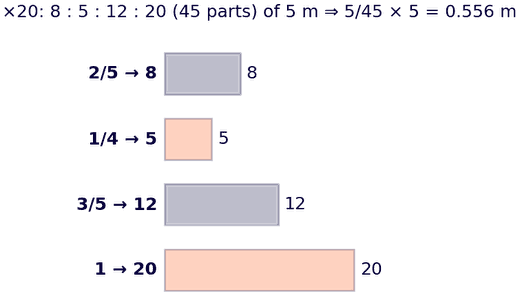 Step 1 — clear the fractions: LCM of 5, 4, 5 is 20, so multiply every term by 20: ×20 : ×20 : ×20 : 1×20 = 8 : 5 : 12 : 20.
Step 2 — sum of ratio parts = 8 + 5 + 12 + 20 = 45.
Step 3 — the smallest part is 5, so smallest piece = × 5 m = m.
= 0.556 m — option (a).
Step 1 — clear the fractions: LCM of 5, 4, 5 is 20, so multiply every term by 20: ×20 : ×20 : ×20 : 1×20 = 8 : 5 : 12 : 20.
Step 2 — sum of ratio parts = 8 + 5 + 12 + 20 = 45.
Step 3 — the smallest part is 5, so smallest piece = × 5 m = m.
= 0.556 m — option (a).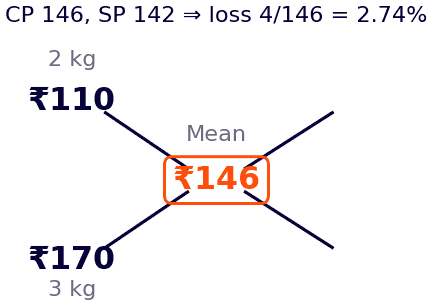 Cost of the mixture per kg (take 2 kg + 3 kg = 5 kg): CP = = = = ₹146.
Selling price = ₹142, which is BELOW the cost — so it is a loss.
Loss% = × 100 = = 2.74%.
Hence 2.74% loss — option (a).
Cost of the mixture per kg (take 2 kg + 3 kg = 5 kg): CP = = = = ₹146.
Selling price = ₹142, which is BELOW the cost — so it is a loss.
Loss% = × 100 = = 2.74%.
Hence 2.74% loss — option (a).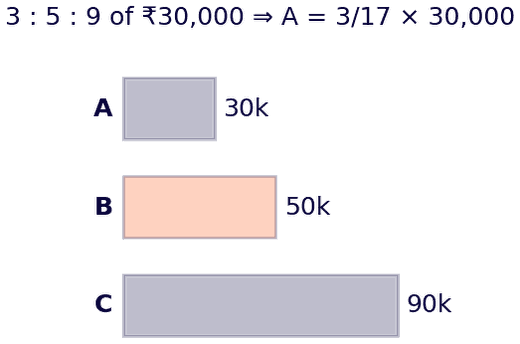 Same time period for all — so profit is shared in the ratio of investments.
A : B : C = 30000 : 50000 : 90000 = 3 : 5 : 9; total parts = 3 + 5 + 9 = 17.
A's share = × 30,000 = .
= ₹5294.12 — option (b).
Same time period for all — so profit is shared in the ratio of investments.
A : B : C = 30000 : 50000 : 90000 = 3 : 5 : 9; total parts = 3 + 5 + 9 = 17.
A's share = × 30,000 = .
= ₹5294.12 — option (b).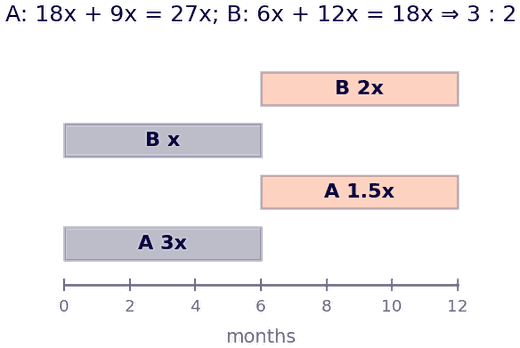 '2 times MORE than B' means A = B + 2B = 3B. Let B's capital = x, so A's = 3x.
A: 3x for 6 months, then half withdrawn → 1.5x for 6 months ⇒ A's capital-months = 18x + 9x = 27x.
B: x for 6 months, then tripled → 3x for 6 months ⇒ B's capital-months = 6x + 18x = 24x. Ratio A : B = 27 : 24 = 9 : 8.
A's share = × 65,000 = ₹34,411.77 — option (d).
'2 times MORE than B' means A = B + 2B = 3B. Let B's capital = x, so A's = 3x.
A: 3x for 6 months, then half withdrawn → 1.5x for 6 months ⇒ A's capital-months = 18x + 9x = 27x.
B: x for 6 months, then tripled → 3x for 6 months ⇒ B's capital-months = 6x + 18x = 24x. Ratio A : B = 27 : 24 = 9 : 8.
A's share = × 65,000 = ₹34,411.77 — option (d).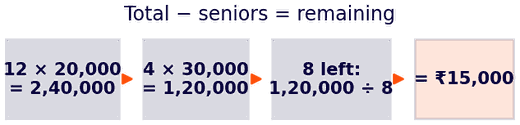 Rule: total = average × count. Total of all 12 = 12 × 20,000 = ₹2,40,000.
Total of the 4 seniors = 4 × 30,000 = ₹1,20,000.
Remaining 8 employees earn 2,40,000 − 1,20,000 = ₹1,20,000 in total.
Their average = = ₹15,000 — option (a).
Rule: total = average × count. Total of all 12 = 12 × 20,000 = ₹2,40,000.
Total of the 4 seniors = 4 × 30,000 = ₹1,20,000.
Remaining 8 employees earn 2,40,000 − 1,20,000 = ₹1,20,000 in total.
Their average = = ₹15,000 — option (a).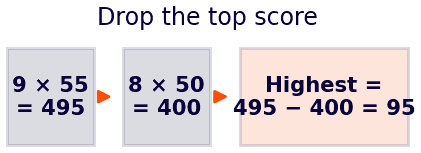 Total runs in 9 innings = 9 × 55 = 495.
Without the highest score, 8 innings remain with average 50 — total = 8 × 50 = 400.
Highest score = 495 − 400 = 95.
Hence option (c).
Total runs in 9 innings = 9 × 55 = 495.
Without the highest score, 8 innings remain with average 50 — total = 8 × 50 = 400.
Highest score = 495 − 400 = 95.
Hence option (c).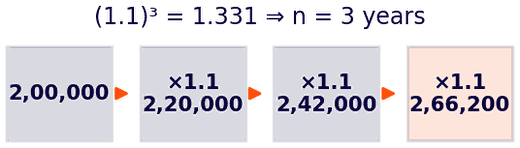 CI formula: Amount = P×. Here = 1.331 must equal .
Build powers of 1.1: 1.1¹ = 1.1; 1.1² = 1.21; 1.1³ = 1.331.
So n = 3.
Hence 3 years — option (a).
CI formula: Amount = P×. Here = 1.331 must equal .
Build powers of 1.1: 1.1¹ = 1.1; 1.1² = 1.21; 1.1³ = 1.331.
So n = 3.
Hence 3 years — option (a).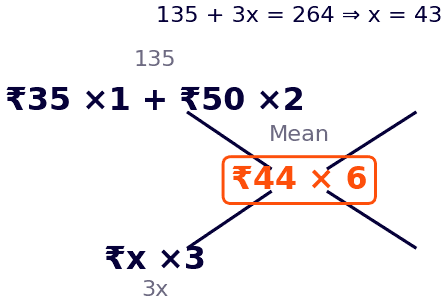 Weighted average rule: (1 kg × 35) + (2 kg × 50) + (3 kg × x) over 6 kg must equal ₹44/kg.
35 + 100 + 3x = 44 × 6 = 264.
3x = 264 − 135 = 129 ⇒ x = 43.
Hence ₹43.00 — option (a).
Weighted average rule: (1 kg × 35) + (2 kg × 50) + (3 kg × x) over 6 kg must equal ₹44/kg.
35 + 100 + 3x = 44 × 6 = 264.
3x = 264 − 135 = 129 ⇒ x = 43.
Hence ₹43.00 — option (a).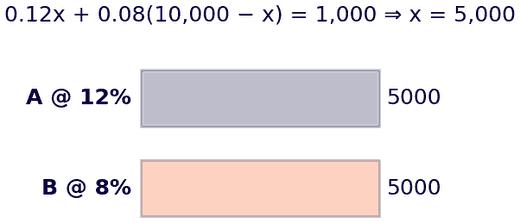 Let ₹x go into Scheme A; then Scheme B gets ₹(10,000 − x).
One-year interest: 0.12x + 0.08(10,000 − x) = 1,000.
0.12x + 800 − 0.08x = 1000 ⇒ 0.04x = 200 ⇒ x = 5,000.
Hence ₹5,000 — option (c).
Let ₹x go into Scheme A; then Scheme B gets ₹(10,000 − x).
One-year interest: 0.12x + 0.08(10,000 − x) = 1,000.
0.12x + 800 − 0.08x = 1000 ⇒ 0.04x = 200 ⇒ x = 5,000.
Hence ₹5,000 — option (c).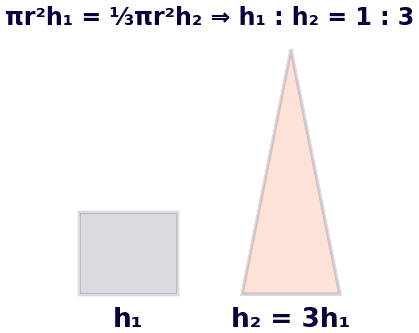 Formulas: cylinder V = r²h₁; cone V = r²h₂.
Volumes are equal with the same r: r²h₁ = r²h₂.
Cancel r² on both sides: h₁ = ⇒ = .
Hence 1 : 3 — option (a).
Formulas: cylinder V = r²h₁; cone V = r²h₂.
Volumes are equal with the same r: r²h₁ = r²h₂.
Cancel r² on both sides: h₁ = ⇒ = .
Hence 1 : 3 — option (a).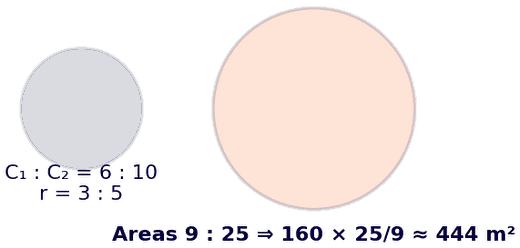 Circumference ∝ radius, so the radii are also in the ratio 6 : 10 = 3 : 5.
Area ∝ radius², so areas are in the ratio 3² : 5² = 9 : 25.
Larger area = 160 × = = 444.4 m².
≈ 444 m² — option (a).
Circumference ∝ radius, so the radii are also in the ratio 6 : 10 = 3 : 5.
Area ∝ radius², so areas are in the ratio 3² : 5² = 9 : 25.
Larger area = 160 × = = 444.4 m².
≈ 444 m² — option (a).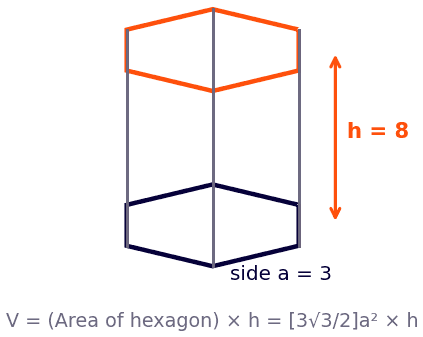 Volume of any prism = (area of base) × height.
Area of a regular hexagon of side a = a² = × 9 = cm².
Volume = × 8 = 27 × 4.
= 108 cm³ — option (d).
Volume of any prism = (area of base) × height.
Area of a regular hexagon of side a = a² = × 9 = cm².
Volume = × 8 = 27 × 4.
= 108 cm³ — option (d).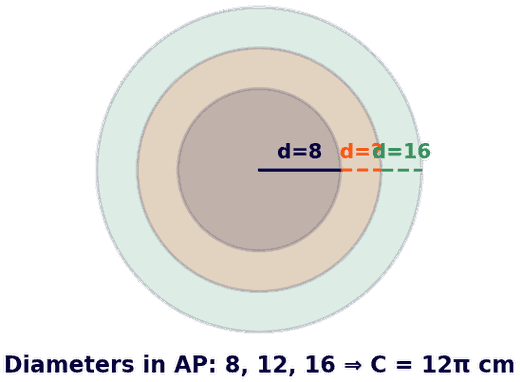 Circumference = π × diameter — so 8π means diameter 8 cm and 16π means diameter 16 cm.
The three diameters are in AP: 8, d, 16.
In an AP the middle term is the average of its neighbours: d = = 12.
Middle circumference = 12π cm — option (b).
Circumference = π × diameter — so 8π means diameter 8 cm and 16π means diameter 16 cm.
The three diameters are in AP: 8, d, 16.
In an AP the middle term is the average of its neighbours: d = = 12.
Middle circumference = 12π cm — option (b).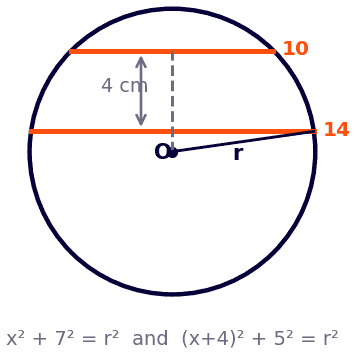 Property: the perpendicular from the centre bisects a chord. Let the 14 cm chord (half = 7) be at distance x from the centre; the 10 cm chord (half = 5) is then at distance x + 4 (same side, and the LONGER chord lies closer to the centre).
Both reach the same radius: x² + 7² = r² and (x + 4)² + 5² = r².
Equate: x² + 49 = x² + 8x + 16 + 25 ⇒ 8x = 8 ⇒ x = 1; so r² = 1 + 49 = 50.
r = ≈ 7.07 cm — option (a).
Property: the perpendicular from the centre bisects a chord. Let the 14 cm chord (half = 7) be at distance x from the centre; the 10 cm chord (half = 5) is then at distance x + 4 (same side, and the LONGER chord lies closer to the centre).
Both reach the same radius: x² + 7² = r² and (x + 4)² + 5² = r².
Equate: x² + 49 = x² + 8x + 16 + 25 ⇒ 8x = 8 ⇒ x = 1; so r² = 1 + 49 = 50.
r = ≈ 7.07 cm — option (a).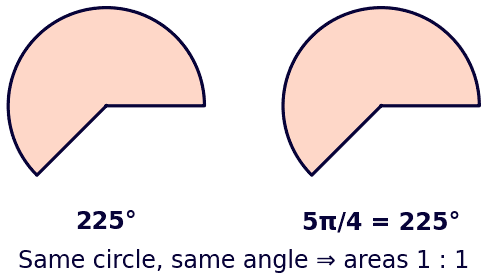 Convert the radian angle to degrees: radians = × 180° = 225°.
Both sectors belong to the SAME circle, so their areas depend only on their central angles.
Both angles are 225° — the two sectors are identical in area.
Ratio = 1 : 1 — option (b).
Convert the radian angle to degrees: radians = × 180° = 225°.
Both sectors belong to the SAME circle, so their areas depend only on their central angles.
Both angles are 225° — the two sectors are identical in area.
Ratio = 1 : 1 — option (b).