SSC CGL 14 October 2025 · Shift 1 · General Intelligence & Reasoning — questions with answers · ShikshaSphere
Chapter 181 of 192
14 October 2025 · Shift 1
General Intelligence & Reasoning
25 questions ~25 min readFree
25 questions
A
1
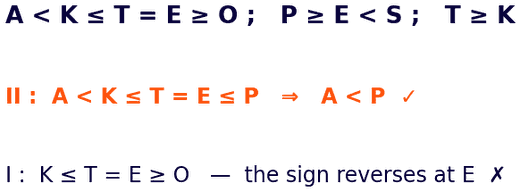
A statement is given followed by two conclusions. Find which conclusion is TRUE based on the given statement.Statement: A < K ≤ T = E ≥ O; P ≥ E < S; T ≥ K
Conclusions:
I. K ≤ O
II. A < P
A.Either I or II
B.Neither I nor II
C.Only I
D.Only II
Solution
Coded inequality
For II: A < K ≤ T = E, and P ≥ E, so A < K ≤ E ≤ P.
The chain runs one way throughout, giving A < P ✓.
For I: K ≤ T = E ≥ O — the sign reverses at E, so K and O cannot be compared ✗.
Only II — option (d).
2
Select the letter-cluster that can replace the question mark (?) in the following series.
HIJ, KLM, NOP, QRS, ?
A.NOP
B.GHS
C.TUV
D.KMN
Solution
Letter clusters
Each group holds three consecutive letters.
The groups themselves run on without a break: H-I-J, K-L-M, N-O-P, Q-R-S.
So the next three letters are T, U and V.
= TUV — option (c).
3
Interchange two signs to make the equation correct.
50 ÷ 5 + 6 − 8 × 2 = 20
Consider the following statements and choose the option that follows.Statements:
I. The municipal corporation started a cleanliness drive in the city.
II. Citizens have been throwing garbage in public places.
A.I is the cause and II is the effect
B.II is the cause and I is the effect
C.Both are effects of the same cause
D.No relation
Solution
Cause and effect
A cleanliness drive is launched only when there is a problem to be tackled.
Citizens throwing garbage in public places is that problem.
So the littering came first and the drive was the response.
II is the cause and I the effect — option (b).
5
Solve:
JP : MS :: EK : ?
A.VP
B.HN
C.VQ
D.UW
Solution
Letter pairs (+3)
Compare JP with MS: J+3 = M and P+3 = S.
So both letters move three places forward.
Apply to EK: E+3 = H and K+3 = N.
Hence HN — option (b).
6
Choose the address that is the same as the one given below.
Sample Address: W840, Monarch Street, Lane No. 4, Kochi, Kerala 78965
A.W840, Monarch Street, Lane No. 4, Kochi, Kerala 78865
B.W840, Monarch Street, Lane No. 4A, Kochi, Kerala 78965
C.W840, Monarch Street, Lane No. 4, Cochi, Kerala 78965
D.W840, Monarch Street, Lane No. 4, Kochi, Kerala 78965
Solution
Address matching
(a) changes the PIN to 78865 and (b) the lane to 4A.
(c) spells Kochi as Cochi.
Only (d) matches the sample exactly.
Hence option (d).
7
Find the odd one out from the given alternatives.
A.Flute
B.Clarinet
C.Trumpet
D.Dholak
Solution
Wind instruments
The flute, clarinet and trumpet are all WIND instruments, played by blowing air.
The dholak is a percussion instrument, played by striking.
So it belongs to a different family.
Hence option (d).
8
X is the son of Y. Y is the brother of Z. Z is the son of A. How is X related to A?
A.Son
B.Nephew
C.Grandson
D.Uncle
Solution
Blood relation
Z is the son of A, and Y is Z’s brother, so Y is also A’s son.
X is the son of Y.
That places X two generations below A.
X is A’s grandson — option (c).
9
Identify the assumptions that must hold for the statement to be valid, then choose the correct option.Statement: The introduction of online medical consultation apps has improved access to healthcare services, especially for people living in remote areas.
Assumptions:
I. Online medical apps help people receive medical advice without visiting hospitals.
II. People in remote areas face difficulty accessing traditional healthcare services.
III. Online consultations are always as effective as in-person medical visits.
A.Only I and II are implicit
B.Only II and III are implicit
C.Only I is implicit
D.All I, II and III are implicit
Solution
Assumptions
The claim of improved access rests on the apps giving advice without a hospital visit — I is implicit.
It also rests on remote areas having had difficulty before — II is implicit.
III claims the apps are ALWAYS as effective as an in-person visit; the statement only says access improved, never that quality is equal, so III is too strong ✗.
Only I and II — option (a).
10
If 6 * 3 = 54 and 7 * 2 = 42, what is 4 * 6?
A.40
B.44
C.45
D.72
Solution
a × b × 3
Rule: multiply the two numbers and then by 3.
Check: 6 × 3 × 3 = 54 ✓ and 7 × 2 × 3 = 42 ✓.
4 × 6 × 3.
= 72 — option (d).
11
Read the following statements carefully and identify the conclusion that follows.Statements:
Some cats are wild.
All wild are scary.
Conclusions:
I. Some cats are scary.
II. All wild are cats.
A.Only I follows
B.Only II follows
C.Both I and II follow
D.Neither I nor II follows
Solution
Syllogism
Some cats are wild, and every wild thing is scary.
So those cats are certainly scary — I follows.
"Some cats are wild" never gives "all wild are cats" — II does not follow.
Only I — option (a).
12
Choose the correct option to complete the analogy.
Scalpel : Incise :: Microscope : ?
A.Research
B.Enlarge
C.Discover
D.Analyse
Solution
Tool and function
A scalpel is a tool, and incising is what it DOES.
So the second word names the direct function of the instrument.
A microscope enlarges what is placed under it.
= Enlarge — option (b).
13
Find the odd one out from the given alternatives.
A.Article 15
B.Article 32
C.Article 24
D.Article 368
Solution
Fundamental Rights
Articles 15, 32 and 24 all lie in Part III and deal with FUNDAMENTAL RIGHTS.
Article 15 bars discrimination, Article 24 bans child labour in hazardous work and Article 32 gives the right to constitutional remedies.
Article 368 lays down the procedure for amending the Constitution.
Hence option (d).
14
In a row of 70 students, Sonam is 30th from the left and Madhuri is 25th from the right. How many students are there between them?
A.26
B.15
C.28
D.24
Solution
Row position
Madhuri is 25th from the right, so from the left she is 70 − 25 + 1 = 46th.
Sonam is 30th from the left.
Students between them = 46 − 30 − 1.
= 15 — option (b).
15
Evaluate: (4 + 3) × (8 − 3)²
A.200
B.225
C.175
D.135
Solution
BODMAS
Work inside the brackets first: 4 + 3 = 7 and 8 − 3 = 5.
Then the power: 5² = 25.
7 × 25.
= 175 — option (c).
16
Determine the logic and find the missing value.
JQ : :: KP : ?
A.
B.
C.
D.
Solution
Squares of place values
J is the 10th letter and Q the 17th; 10² = 100 and 17² = 289 ✓.
So each letter is replaced by the square of its place value.
K is the 11th letter and P the 16th.
11² = 121 and 16² = 256, giving — option (c).
17
Identify the odd number:
8, 27, 64, 125, 216, 356
A.64
B.125
C.356
D.27
Solution
Cubes
These are the cubes of consecutive numbers.
2³ = 8, 3³ = 27, 4³ = 64, 5³ = 125, 6³ = 216 ✓.
The next should be 7³ = 343, but the series shows 356 ✗.
Hence 356 — option (c).
18
In a certain code, PURPLE is written as QWUTQK. How will ORANGE be written?
A.PSBPIH
B.PSBOIH
C.PTDRLK
D.PQBOIH
Solution
Rising letter shifts
Compare PURPLE with QWUTQK: P+1 = Q, U+2 = W, R+3 = U, P+4 = T, L+5 = Q, E+6 = K.
So the shift rises by one at each position: +1, +2, +3, +4, +5, +6.
Apply to ORANGE: O+1 = P, R+2 = T, A+3 = D, N+4 = R, G+5 = L, E+6 = K.
Hence PTDRLK — option (c).
19
A 45-litre solution has juice : water = 5 : 4. How much water must be added to make juice : water = 1 : 1?
A.10 L
B.5 L
C.8.5 L
D.9 L
Solution
Mixture ratio
Juice = × 45 = 25 L and water = 20 L.
The juice stays 25 L, so for a 1 : 1 ratio the water must also become 25 L.
Water to be added = 25 − 20.
= 5 L — option (b).
20
A group of three letter-number pairs is given in each option. Identify the group that does NOT follow the same pattern as the others.
A.C1 : F5 : I9
B.D2 : G6 : J10
C.J3 : M7 : P13
D.Q4 : T8 : W12
Solution
Letter-number groups
In each group the letters move +3 and the numbers +4.
(a) C→F→I with 1, 5, 9 ✓; (b) D→G→J with 2, 6, 10 ✓; (d) Q→T→W with 4, 8, 12 ✓.
(c) has J→M→P ✓ but the numbers run 3, 7, 13 — the last should be 11 ✗.
Hence option (c).
21
The second group of letters is formed from the first using a specific transformation. Apply the same pattern to the third group.
XKLY : ZMNA :: HWRP : ?
A.SFNY
B.JYTR
C.RSEF
D.SFYN
Solution
Coding (+2)
Compare XKLY with ZMNA: X+2 = Z, K+2 = M, L+2 = N, Y+2 = A (cyclic).
So every letter moves two places forward.
Apply to HWRP: H+2 = J, W+2 = Y, R+2 = T, P+2 = R.
Hence JYTR — option (b).
22
After interchanging + and ×, and 3 and 5, which of the following equations will hold true?
A.(3 + 4) × 5 = 17
B.(5 + 2) × 3 = 21
C.(3 + 6) × 5 = 33
D.(5 + 1) × 3 = 18
Solution
Interchange signs and digits
Swap the signs and the digits in each option and then test it.
Option (c) becomes (5 × 6) + 3.
= 30 + 3 = 33, which matches the right side ✓.
The other three do not balance — option (c).
23
If the sum of 29 and 37 is multiplied by 2, what is the result?
A.158
B.160
C.132
D.164
Solution
Simple arithmetic
First find the sum: 29 + 37 = 66.
Then multiply by 2.
66 × 2.
= 132 — option (c).
24
If = A and = B, then what is A − B?
A.−0.024
B.0.56
C.0.76
D.0.067
Solution
Difference of fractions
≈ 1.0667 and ≈ 1.0909.
B is the larger of the two, so the answer must be negative.
1.0667 − 1.0909.
≈ −0.024 — option (a).
25
In a code language, "He plays football daily" is coded as "ra sa ta ka", "He plays cricket daily" is coded as "ra sa pa ka", and "She plays football well" is coded as "ma sa ta ja".
What is the code for "She plays cricket daily"?
A.ja sa ma ka
B.ra sa ta ja
C.ma sa pa ka
D.ka sa ra ma
Solution
Code language
Lines 1 and 2 differ only in football/cricket, and in ta/pa ⇒ football = ta and cricket = pa.
"Plays" appears in all three lines and sa is the only common code ⇒ plays = sa.
Line 3 has ma and ja for "she" and "well"; since "she" is needed here, ma = she, leaving ka for daily.
She plays cricket daily = ma, sa, pa, ka — option (c).
Finished reading? Now test yourself.
The same 25 questions, but with a timer and the answers hidden — 15 minutes.

 For II: A < K ≤ T = E, and P ≥ E, so A < K ≤ E ≤ P.
The chain runs one way throughout, giving A < P ✓.
For I: K ≤ T = E ≥ O — the sign reverses at E, so K and O cannot be compared ✗.
Only II — option (d).
For II: A < K ≤ T = E, and P ≥ E, so A < K ≤ E ≤ P.
The chain runs one way throughout, giving A < P ✓.
For I: K ≤ T = E ≥ O — the sign reverses at E, so K and O cannot be compared ✗.
Only II — option (d).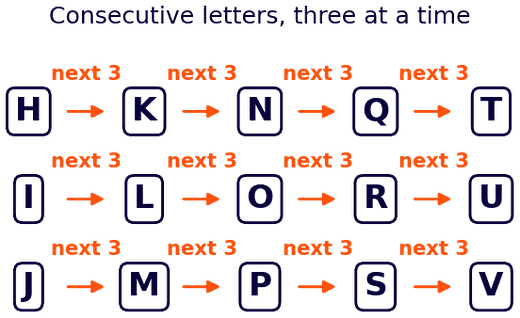 Each group holds three consecutive letters.
The groups themselves run on without a break: H-I-J, K-L-M, N-O-P, Q-R-S.
So the next three letters are T, U and V.
= TUV — option (c).
Each group holds three consecutive letters.
The groups themselves run on without a break: H-I-J, K-L-M, N-O-P, Q-R-S.
So the next three letters are T, U and V.
= TUV — option (c).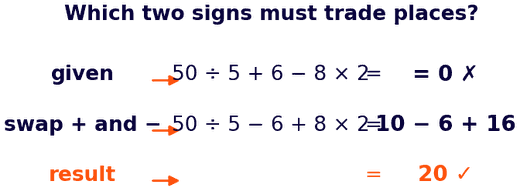 As it stands: 10 + 6 − 16 = 0 ✗.
Swap + and −: the equation becomes 50 ÷ 5 − 6 + 8 × 2.
BODMAS: 10 − 6 + 16.
= 20 ✓ — option (b).
As it stands: 10 + 6 − 16 = 0 ✗.
Swap + and −: the equation becomes 50 ÷ 5 − 6 + 8 × 2.
BODMAS: 10 − 6 + 16.
= 20 ✓ — option (b). A cleanliness drive is launched only when there is a problem to be tackled.
Citizens throwing garbage in public places is that problem.
So the littering came first and the drive was the response.
II is the cause and I the effect — option (b).
A cleanliness drive is launched only when there is a problem to be tackled.
Citizens throwing garbage in public places is that problem.
So the littering came first and the drive was the response.
II is the cause and I the effect — option (b).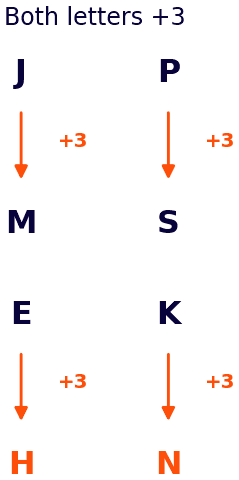 Compare JP with MS: J+3 = M and P+3 = S.
So both letters move three places forward.
Apply to EK: E+3 = H and K+3 = N.
Hence HN — option (b).
Compare JP with MS: J+3 = M and P+3 = S.
So both letters move three places forward.
Apply to EK: E+3 = H and K+3 = N.
Hence HN — option (b).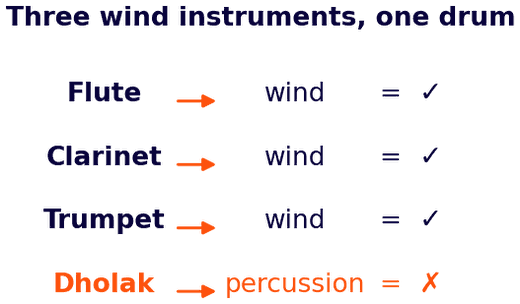 The flute, clarinet and trumpet are all WIND instruments, played by blowing air.
The dholak is a percussion instrument, played by striking.
So it belongs to a different family.
Hence option (d).
The flute, clarinet and trumpet are all WIND instruments, played by blowing air.
The dholak is a percussion instrument, played by striking.
So it belongs to a different family.
Hence option (d).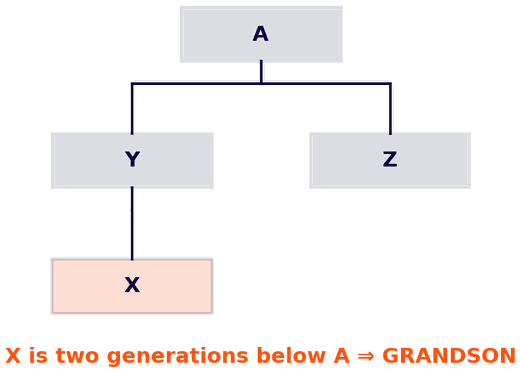 Z is the son of A, and Y is Z’s brother, so Y is also A’s son.
X is the son of Y.
That places X two generations below A.
X is A’s grandson — option (c).
Z is the son of A, and Y is Z’s brother, so Y is also A’s son.
X is the son of Y.
That places X two generations below A.
X is A’s grandson — option (c).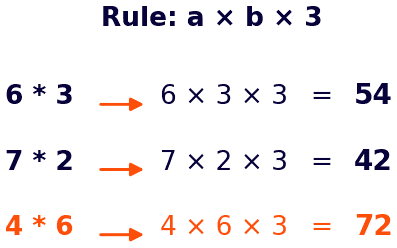 Rule: multiply the two numbers and then by 3.
Check: 6 × 3 × 3 = 54 ✓ and 7 × 2 × 3 = 42 ✓.
4 × 6 × 3.
= 72 — option (d).
Rule: multiply the two numbers and then by 3.
Check: 6 × 3 × 3 = 54 ✓ and 7 × 2 × 3 = 42 ✓.
4 × 6 × 3.
= 72 — option (d).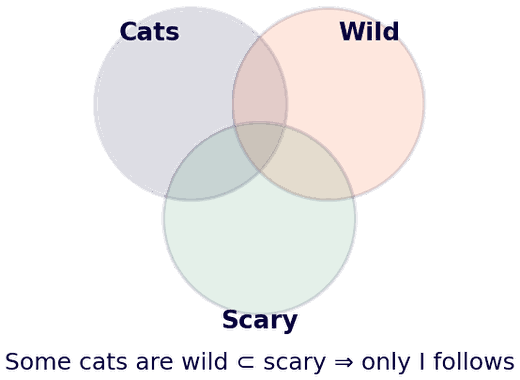 Some cats are wild, and every wild thing is scary.
So those cats are certainly scary — I follows.
"Some cats are wild" never gives "all wild are cats" — II does not follow.
Only I — option (a).
Some cats are wild, and every wild thing is scary.
So those cats are certainly scary — I follows.
"Some cats are wild" never gives "all wild are cats" — II does not follow.
Only I — option (a).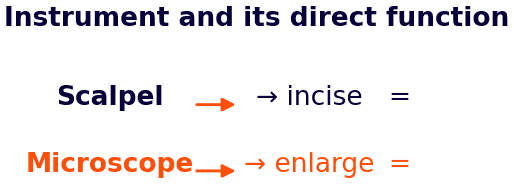 A scalpel is a tool, and incising is what it DOES.
So the second word names the direct function of the instrument.
A microscope enlarges what is placed under it.
= Enlarge — option (b).
A scalpel is a tool, and incising is what it DOES.
So the second word names the direct function of the instrument.
A microscope enlarges what is placed under it.
= Enlarge — option (b).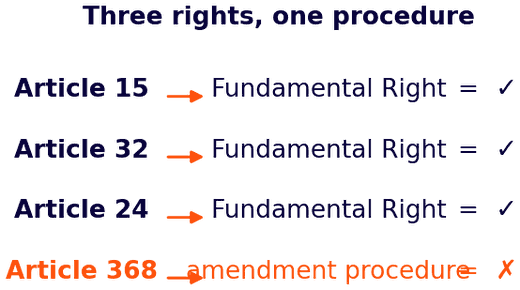 Articles 15, 32 and 24 all lie in Part III and deal with FUNDAMENTAL RIGHTS.
Article 15 bars discrimination, Article 24 bans child labour in hazardous work and Article 32 gives the right to constitutional remedies.
Article 368 lays down the procedure for amending the Constitution.
Hence option (d).
Articles 15, 32 and 24 all lie in Part III and deal with FUNDAMENTAL RIGHTS.
Article 15 bars discrimination, Article 24 bans child labour in hazardous work and Article 32 gives the right to constitutional remedies.
Article 368 lays down the procedure for amending the Constitution.
Hence option (d).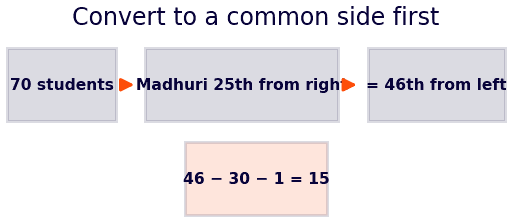 Madhuri is 25th from the right, so from the left she is 70 − 25 + 1 = 46th.
Sonam is 30th from the left.
Students between them = 46 − 30 − 1.
= 15 — option (b).
Madhuri is 25th from the right, so from the left she is 70 − 25 + 1 = 46th.
Sonam is 30th from the left.
Students between them = 46 − 30 − 1.
= 15 — option (b).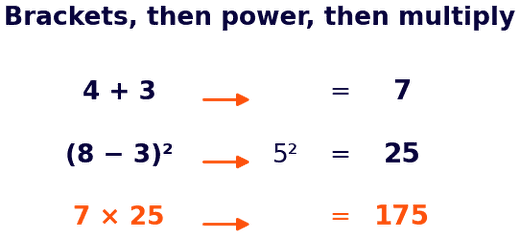 Work inside the brackets first: 4 + 3 = 7 and 8 − 3 = 5.
Then the power: 5² = 25.
7 × 25.
= 175 — option (c).
Work inside the brackets first: 4 + 3 = 7 and 8 − 3 = 5.
Then the power: 5² = 25.
7 × 25.
= 175 — option (c).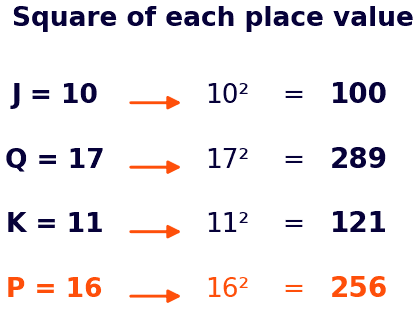 J is the 10th letter and Q the 17th; 10² = 100 and 17² = 289 ✓.
So each letter is replaced by the square of its place value.
K is the 11th letter and P the 16th.
11² = 121 and 16² = 256, giving — option (c).
J is the 10th letter and Q the 17th; 10² = 100 and 17² = 289 ✓.
So each letter is replaced by the square of its place value.
K is the 11th letter and P the 16th.
11² = 121 and 16² = 256, giving — option (c).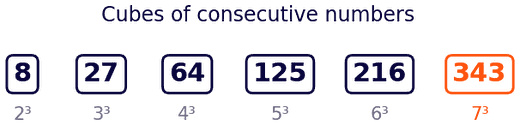 These are the cubes of consecutive numbers.
2³ = 8, 3³ = 27, 4³ = 64, 5³ = 125, 6³ = 216 ✓.
The next should be 7³ = 343, but the series shows 356 ✗.
Hence 356 — option (c).
These are the cubes of consecutive numbers.
2³ = 8, 3³ = 27, 4³ = 64, 5³ = 125, 6³ = 216 ✓.
The next should be 7³ = 343, but the series shows 356 ✗.
Hence 356 — option (c).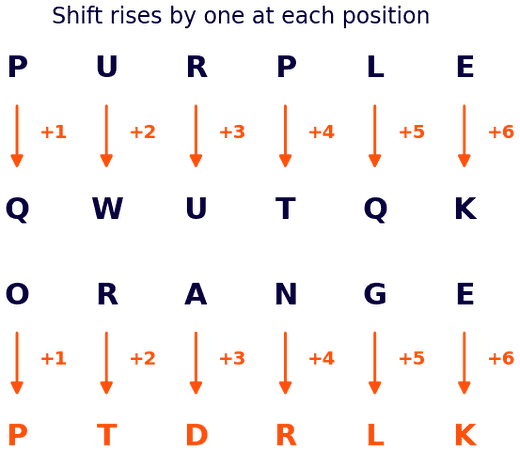 Compare PURPLE with QWUTQK: P+1 = Q, U+2 = W, R+3 = U, P+4 = T, L+5 = Q, E+6 = K.
So the shift rises by one at each position: +1, +2, +3, +4, +5, +6.
Apply to ORANGE: O+1 = P, R+2 = T, A+3 = D, N+4 = R, G+5 = L, E+6 = K.
Hence PTDRLK — option (c).
Compare PURPLE with QWUTQK: P+1 = Q, U+2 = W, R+3 = U, P+4 = T, L+5 = Q, E+6 = K.
So the shift rises by one at each position: +1, +2, +3, +4, +5, +6.
Apply to ORANGE: O+1 = P, R+2 = T, A+3 = D, N+4 = R, G+5 = L, E+6 = K.
Hence PTDRLK — option (c). Juice = × 45 = 25 L and water = 20 L.
The juice stays 25 L, so for a 1 : 1 ratio the water must also become 25 L.
Water to be added = 25 − 20.
= 5 L — option (b).
Juice = × 45 = 25 L and water = 20 L.
The juice stays 25 L, so for a 1 : 1 ratio the water must also become 25 L.
Water to be added = 25 − 20.
= 5 L — option (b).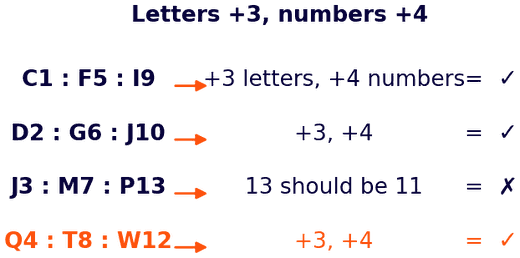 In each group the letters move +3 and the numbers +4.
(a) C→F→I with 1, 5, 9 ✓; (b) D→G→J with 2, 6, 10 ✓; (d) Q→T→W with 4, 8, 12 ✓.
(c) has J→M→P ✓ but the numbers run 3, 7, 13 — the last should be 11 ✗.
Hence option (c).
In each group the letters move +3 and the numbers +4.
(a) C→F→I with 1, 5, 9 ✓; (b) D→G→J with 2, 6, 10 ✓; (d) Q→T→W with 4, 8, 12 ✓.
(c) has J→M→P ✓ but the numbers run 3, 7, 13 — the last should be 11 ✗.
Hence option (c).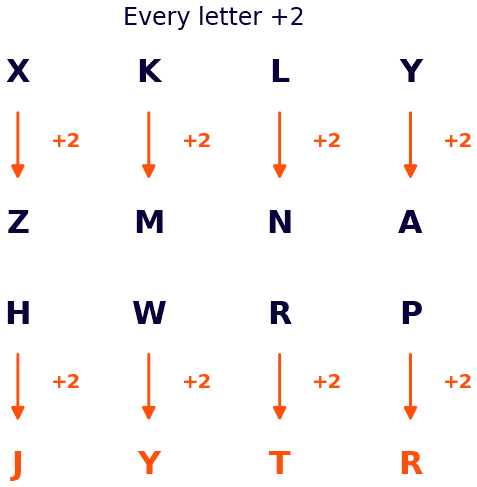 Compare XKLY with ZMNA: X+2 = Z, K+2 = M, L+2 = N, Y+2 = A (cyclic).
So every letter moves two places forward.
Apply to HWRP: H+2 = J, W+2 = Y, R+2 = T, P+2 = R.
Hence JYTR — option (b).
Compare XKLY with ZMNA: X+2 = Z, K+2 = M, L+2 = N, Y+2 = A (cyclic).
So every letter moves two places forward.
Apply to HWRP: H+2 = J, W+2 = Y, R+2 = T, P+2 = R.
Hence JYTR — option (b).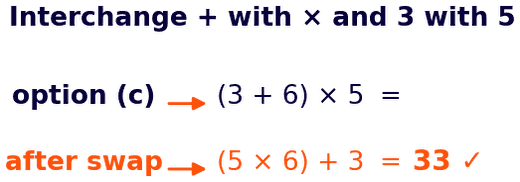 Swap the signs and the digits in each option and then test it.
Option (c) becomes (5 × 6) + 3.
= 30 + 3 = 33, which matches the right side ✓.
The other three do not balance — option (c).
Swap the signs and the digits in each option and then test it.
Option (c) becomes (5 × 6) + 3.
= 30 + 3 = 33, which matches the right side ✓.
The other three do not balance — option (c).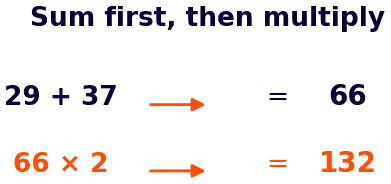 First find the sum: 29 + 37 = 66.
Then multiply by 2.
66 × 2.
= 132 — option (c).
First find the sum: 29 + 37 = 66.
Then multiply by 2.
66 × 2.
= 132 — option (c).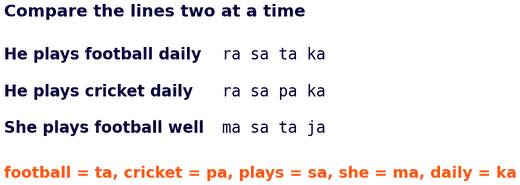 Lines 1 and 2 differ only in football/cricket, and in ta/pa ⇒ football = ta and cricket = pa.
"Plays" appears in all three lines and sa is the only common code ⇒ plays = sa.
Line 3 has ma and ja for "she" and "well"; since "she" is needed here, ma = she, leaving ka for daily.
She plays cricket daily = ma, sa, pa, ka — option (c).
Lines 1 and 2 differ only in football/cricket, and in ta/pa ⇒ football = ta and cricket = pa.
"Plays" appears in all three lines and sa is the only common code ⇒ plays = sa.
Line 3 has ma and ja for "she" and "well"; since "she" is needed here, ma = she, leaving ka for daily.
She plays cricket daily = ma, sa, pa, ka — option (c).