SSC CGL 14 September 2025 · Shift 1 · Quantitative Aptitude — questions with answers · ShikshaSphere
Chapter 27 of 192
14 September 2025 · Shift 1
Quantitative Aptitude
25 questions ~25 min readFree
25 questions
A
51
Find the product: 1.2 × 2 ×
A.2.4
B.1.5
C.1.44
D.2.1
Solution
Fraction product
Convert everything to decimals first: 2 = 2.4 and = 0.5.
Now multiply step by step: 1.2 × 2.4 = 2.88.
2.88 × 0.5 = 1.44.
Hence 1.44 — option (c).
52
What is the value of ?
A.0.037
B.0.05
C.0.125
D.0.025
Solution
Cubes — scaling trick
Spot the scaling: 0.4 = 2 × 0.2 and 0.08 = 2 × 0.04 — the denominator terms are exactly DOUBLE the numerator terms.
So the denominator = (2×0.2)³ + (2×0.04)³ = 8 × (0.2³ + 0.04³) — the cube pulls out a factor of 2³ = 8.
The big fraction therefore collapses to .
= 0.125 — option (c).
53
The number of students in two sections A and B having different heights is shown in the table given below:
Height (in metres)
Section A
Section B
1.55
6
5
1.60
8
7
1.62
11
13
1.65
14
10
1.68
6
7
1.71
7
5
1.75
4
3
What is the ratio of the total number of students in Section A whose height is less than 1.65 metres to the total number of students in Section B whose height is less than 1.65 metres?
A.15 : 16
B.1 : 1
C.26 : 25
D.25 : 25
Solution
Table — heights
'Less than 1.65 m' means only the rows 1.55, 1.60 and 1.62 — the 1.65 row itself is NOT counted.
Section A: 6 + 8 + 11 = 25 students.
Section B: 5 + 7 + 13 = 25 students.
Ratio = 25 : 25 = 1 : 1 — option (b).
54
Ravi, Aman, and Karan started a business together. They invested ₹40,000, ₹60,000, and ₹80,000 respectively for one year. If the total profit at the end of the year is ₹55,000, what will be Aman's share in the profit?
A.₹18,333.33
B.₹19,333.67
C.₹23,333.76
D.₹28,333.33
Solution
Profit sharing
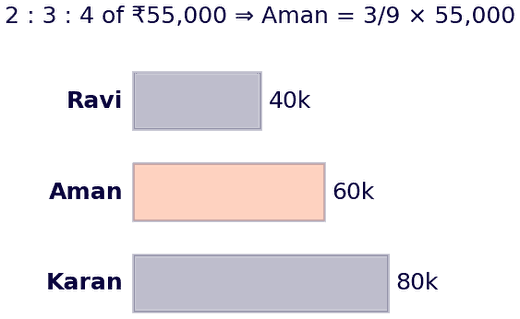
Same duration for all, so profit splits in the ratio of investments.
Ravi : Aman : Karan = 40 : 60 : 80 = 2 : 3 : 4; total parts = 9.
Aman's share = × 55,000 = .
= ₹18,333.33 — option (a).
55
A and B invest ₹50,000 and ₹1,00,000 respectively, in a business. After one year, the profit is distributed, including simple interest at 10% per annum on the capital. Total profit, including interest, is ₹30,000. What is A's share?
A.₹9,000
B.₹10,000
C.₹11,000
D.₹12,000
Solution
Profit with interest on capital
First pay the interest on capital: A gets 10% of 50,000 = ₹5,000; B gets 10% of 1,00,000 = ₹10,000 — total interest ₹15,000.
Remaining profit = 30,000 − 15,000 = ₹15,000, shared in the investment ratio 50,000 : 1,00,000 = 1 : 2.
A's share of the remainder = × 15,000 = ₹5,000.
A's total = 5,000 + 5,000 = ₹10,000 — option (b).
56
Table — Units Sold of 3 Products
Product
Jan
Feb
Mar
A
80
105
103
B
80
70
90
C
155
145
120
Which product had the lowest average units sold?
A.B & C both
B.A
C.B
D.C
Solution
Table — lowest average
Average of A = = = 96.
Average of B = = = 80.
Average of C = = = 140.
The lowest is 80, for product B — option (c).
57
Three numbers are such that when the average of any two of them is added to the third, the results obtained are 210, 192, and 174, respectively. What is the average of the three numbers?
A.93
B.94
C.95
D.96
Solution
Three numbers — clever sum
Let the numbers be x, y, z and their sum S. Each result looks like + z = + z = + .
Adding all three results: 3× + = 2S.
So 2S = 210 + 192 + 174 = 576 ⇒ S = 288.
Average = = 96 — option (d).
58
A school conducted an educational tour for 100 students and 10 chaperones. Each student received a snack pack containing items equal to 20% of the total number of students, while each chaperone received a snack pack containing items equal to 25% of the total number of students. Calculate the total number of snack items distributed among all participants.
A.1750
B.1760
C.2250
D.2000
Solution
Percent of a count
Each student’s pack = 20% of 100 students = 20 items; 100 students get 100 × 20 = 2000 items.
Each chaperone’s pack = 25% of 100 = 25 items; 10 chaperones get 10 × 25 = 250 items.
Total = 2000 + 250 = 2250.
Hence option (c).
59
Anita invested ₹10,000 in a savings scheme that offers interest at the rate of 10% per annum, compounded annually. Find the compound interest earned by her at the end of 2 years 6 months.
A.₹2,750
B.₹2,705
C.₹2,700
D.₹2,505
Solution
CI — 2½ years
For 2 years 6 months compounded annually: two full years at 10%, then half a year at = 5%.
Amount factor = 1.1 × 1.1 × 1.05 = 1.21 × 1.05 = 1.2705.
Amount = 10,000 × 1.2705 = ₹12,705; CI = 12,705 − 10,000.
= ₹2,705 — option (b).
60
A certain amount invested at compound interest of 15% per annum, compounded annually, amounts to ₹2645 in 2 years. What is 140% of the amount invested?
A.₹2,600
B.₹2,800
C.₹2,500
D.₹2,000
Solution
CI — find principal
Two years at 15%: factor = 1.15 × 1.15 = 1.3225.
Principal = = ₹2,000.
140% of 2,000 = 1.4 × 2000.
= ₹2,800 — option (b).
61
Two varieties of rice are sold at ₹72 per kg and ₹60 per kg respectively, with profit percentages of 20% and 25%. When they are mixed in the ratio 2 : 1 and sold at ₹70 per kg, what is the profit or loss percentage?
A.Profit of 50%
B.Loss of 25%
C.Profit of 25%
D.Loss of 50%
Solution
Mixture — profit on SP-given rates
First find the COST of each variety from its selling price: CP₁ = = ₹60; CP₂ = = ₹48.
Mixture CP (2 : 1) = = = ₹56 per kg.
Selling at ₹70: profit = × 100 = .
= 25% profit — option (c).
62
A clothing store sold three dresses, D1, D2, and D3, whose selling prices were in the ratio 12 : 6 : 3. They made a profit of 20% on D1, a loss of 10% on D2, and a profit of 5% on D3. What was their approximate total profit or loss percentage for the entire sale?
A.profit of 7.58%
B.loss of 10.78%
C.profit of 10.78%
D.loss of 7.58%
Solution
Three items — overall %
Take SPs as 12, 6 and 3 (total SP = 21).
Work back to each CP: CP₁ = = 10; CP₂ = = 6.67; CP₃ = = 2.86.
Total CP = 10 + 6.67 + 2.86 = 19.52; profit = 21 − 19.52 = 1.48.
Profit% = × 100 ≈ 7.58% profit — option (a).
63
A wholesaler marks up the price of a microwave oven by 50% above its cost price. He gives a 15% trade discount to a retailer. The retailer, in turn, marks up the price by 20% above his purchase price and offers a 10% festival discount to the customer. If the customer finally pays ₹12,200 for the microwave, what is the original approximate cost price of the oven to the wholesaler?
A.₹8860
B.₹8,500
C.₹8,000
D.₹8650
Solution
Markup–discount chain
Chain the multipliers on cost C: markup 50% → ×1.5; trade discount 15% → ×0.85; retailer markup 20% → ×1.2; festival discount 10% → ×0.9.
Customer pays C × 1.5 × 0.85 × 1.2 × 0.9 = 1.377C.
1.377C = 12,200 ⇒ C = ≈ 8,859.8.
≈ ₹8,860 — option (a).
64
A 30-litre solution of alcohol and water has 20% water. How many litres of alcohol must be added to the solution to make the water content 15%?
A.10 litres
B.20 litres
C.30 litres
D.40 litres
Solution
Dilution — add alcohol
Water in the solution = 20% of 30 = 6 L — and adding alcohol does not change this 6 L.
After adding x litres of alcohol, water must be 15%: = 0.15.
30 + x = = 40 ⇒ x = 10.
Hence 10 litres — option (a).
65
A can do work in 4 days and B in 8 days. They work together for 2 days. What part of the work is left?
A.
B.
C.
D.
Solution
Work — part left
One-day work together = + = .
In 2 days they finish 2 × = = .
Work left = 1 − = .
Hence option (a).
66
A shopkeeper mixes 50 kg of sugar costing ₹60 per kg with a certain quantity of sugar costing ₹90 per kg. If he sells the mixture at ₹84 per kg and makes a 20% profit, find the quantity of the ₹90 per kg sugar.
A.30 kg
B.25 kg
C.20 kg
D.15 kg
Solution
Alligation — quantity
First find the mixture’s COST price: SP ₹84 with 20% profit ⇒ CP = = ₹70 per kg.
Alligation between ₹60 and ₹90 around mean ₹70: ratio = (90 − 70) : (70 − 60) = 20 : 10 = 2 : 1.
So cheap : costly = 2 : 1; with 50 kg of the cheap sugar, costly sugar = × 1 = 25 kg.
Hence 25 kg — option (b).
67
A and B can complete a task together in 24 days, while B and C can finish it in 32 days. After A works on it for 10 days and B for 14 days, C takes the remaining 26 days to finish the work. How many days would it take for C to complete the work alone?
A.48 days
B.46 days
C.40 days
D.38 days
Solution
Work — three workers
The work done adds to 1: 10A + 14B + 26C = 1, with A + B = and B + C = .
Rewrite: 10(A + B) + 4B + 26C = + 4B + 26C, and 26C = 26( − B) ⇒ whole = + − 22B = 1.
+ = = , so 22B = ⇒ B = .
C = − = = ⇒ C alone takes 48 days — option (a).
68
A cyclist travels from City A to City B at an average speed of 40 km/h and takes 8 hours. If they want to complete the same journey in 5 hours, by what amount (in km/h) must the average speed be increased?
A.24 km/h
B.20 km/h
C.25 km/h
D.18 km/h
Solution
Speed increase
Distance = 40 × 8 = 320 km.
Required speed for 5 hours = = 64 km/h.
Increase needed = 64 − 40 = 24 km/h.
Hence option (a).
69
A train leaves Station P at 5:00 AM and travels towards Station Q at a constant speed of 60 km/h. Another train leaves Station Q at 7:00 AM and travels towards Station P at a constant speed of 90 km/h. The distance between the two stations is 540 km. At what time will the two trains meet?
A.12:45 PM
B.10:45 AM
C.11:48 AM
D.9:48 AM
Solution
Two trains — meeting time
By 7:00 AM the first train has already covered 2 × 60 = 120 km, leaving 540 − 120 = 420 km between them.
From 7:00 AM they close the gap at 60 + 90 = 150 km/h.
Time to meet = = 2.8 hours = 2 hours 48 minutes.
7:00 AM + 2 h 48 min = 9:48 AM — option (d).
70
A circular garden having a diameter of 20 m is surrounded by a concrete path that is 2 m wide. Calculate the percentage increase in area resulting from the addition of the path.
A.24%
B.20%
C.44%
D.54%
Solution
Garden + path — % increase
Garden radius = = 10 m; with the 2 m path, outer radius = 12 m.
Garden area = × 10² = 100; total area = × 12² = 144.
Increase = 144 − 100 = 44 on a base of 100.
= 44% — option (c).
71
A sector of a circle having a radius 14 cm has area 77 cm². Find the angle of the sector.
A.90°
B.45°
C.60°
D.180°
Solution
Sector — find angle
Sector area formula: Area = × r².
Full circle area = × 14 × 14 = 616 cm².
So = = ⇒ θ = = 45°.
Hence 45° — option (b).
72
A circular signboard has a radius of 4 m. If painting costs ₹30 per m² and 80% of the board is painted, what is the total painting cost? [use π = 3.14]
A.₹1658.2
B.₹1205.7
C.₹1206.7
D.₹1681.2
Solution
Painting cost — partial circle
Full board area = r² = 3.14 × 4² = 3.14 × 16 = 50.24 m².
Painted portion = 80% of 50.24 = 40.192 m².
Cost = 40.192 × 30 = ₹1205.76.
≈ ₹1205.7 — option (b).
73
Find the y-intercept of 2x + 3y = 18.
A.3
B.4
C.5
D.6
Solution
y-intercept
The y-intercept is where the line crosses the y-axis — that is, where x = 0.
Put x = 0: 2(0) + 3y = 18.
3y = 18 ⇒ y = 6.
Hence 6 — option (d).
74
Given, x + = 5, find the value of x³ + .
A.110
B.120
C.100
D.130
Solution
Identity — cubes
Standard identity: x³ + = − 3(x + ).
Substitute the given value 5: = 5³ − 3 × 5.
= 125 − 15 = 110.
Hence 110 — option (a).
75
0.2 + 0.02 + 0.002 = ?
A.0.223
B.0.111
C.0.221
D.0.222
Solution
Decimal addition
Line up the decimal places: 0.200 + 0.020 + 0.002.
Add column-wise: 200 + 20 + 2 = 222 (thousandths).
= 0.222.
Hence option (d).
Finished reading? Now test yourself.
The same 25 questions, but with a timer and the answers hidden — 15 minutes.

 Same duration for all, so profit splits in the ratio of investments.
Ravi : Aman : Karan = 40 : 60 : 80 = 2 : 3 : 4; total parts = 9.
Aman's share = × 55,000 = .
= ₹18,333.33 — option (a).
Same duration for all, so profit splits in the ratio of investments.
Ravi : Aman : Karan = 40 : 60 : 80 = 2 : 3 : 4; total parts = 9.
Aman's share = × 55,000 = .
= ₹18,333.33 — option (a).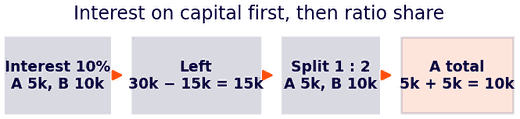 First pay the interest on capital: A gets 10% of 50,000 = ₹5,000; B gets 10% of 1,00,000 = ₹10,000 — total interest ₹15,000.
Remaining profit = 30,000 − 15,000 = ₹15,000, shared in the investment ratio 50,000 : 1,00,000 = 1 : 2.
A's share of the remainder = × 15,000 = ₹5,000.
A's total = 5,000 + 5,000 = ₹10,000 — option (b).
First pay the interest on capital: A gets 10% of 50,000 = ₹5,000; B gets 10% of 1,00,000 = ₹10,000 — total interest ₹15,000.
Remaining profit = 30,000 − 15,000 = ₹15,000, shared in the investment ratio 50,000 : 1,00,000 = 1 : 2.
A's share of the remainder = × 15,000 = ₹5,000.
A's total = 5,000 + 5,000 = ₹10,000 — option (b).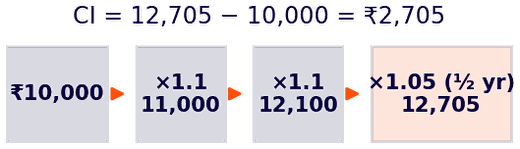 For 2 years 6 months compounded annually: two full years at 10%, then half a year at = 5%.
Amount factor = 1.1 × 1.1 × 1.05 = 1.21 × 1.05 = 1.2705.
Amount = 10,000 × 1.2705 = ₹12,705; CI = 12,705 − 10,000.
= ₹2,705 — option (b).
For 2 years 6 months compounded annually: two full years at 10%, then half a year at = 5%.
Amount factor = 1.1 × 1.1 × 1.05 = 1.21 × 1.05 = 1.2705.
Amount = 10,000 × 1.2705 = ₹12,705; CI = 12,705 − 10,000.
= ₹2,705 — option (b).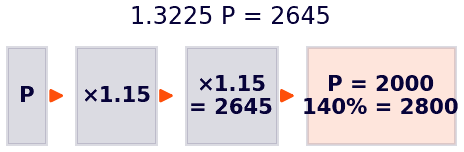 Two years at 15%: factor = 1.15 × 1.15 = 1.3225.
Principal = = ₹2,000.
140% of 2,000 = 1.4 × 2000.
= ₹2,800 — option (b).
Two years at 15%: factor = 1.15 × 1.15 = 1.3225.
Principal = = ₹2,000.
140% of 2,000 = 1.4 × 2000.
= ₹2,800 — option (b).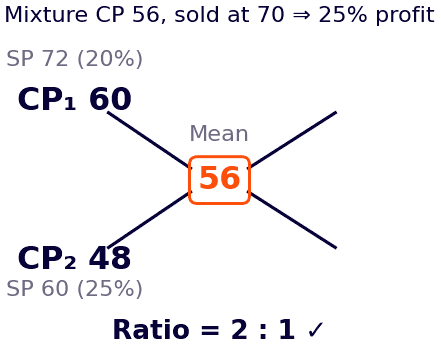 First find the COST of each variety from its selling price: CP₁ = = ₹60; CP₂ = = ₹48.
Mixture CP (2 : 1) = = = ₹56 per kg.
Selling at ₹70: profit = × 100 = .
= 25% profit — option (c).
First find the COST of each variety from its selling price: CP₁ = = ₹60; CP₂ = = ₹48.
Mixture CP (2 : 1) = = = ₹56 per kg.
Selling at ₹70: profit = × 100 = .
= 25% profit — option (c).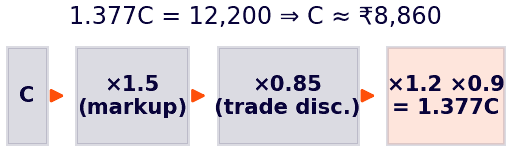 Chain the multipliers on cost C: markup 50% → ×1.5; trade discount 15% → ×0.85; retailer markup 20% → ×1.2; festival discount 10% → ×0.9.
Customer pays C × 1.5 × 0.85 × 1.2 × 0.9 = 1.377C.
1.377C = 12,200 ⇒ C = ≈ 8,859.8.
≈ ₹8,860 — option (a).
Chain the multipliers on cost C: markup 50% → ×1.5; trade discount 15% → ×0.85; retailer markup 20% → ×1.2; festival discount 10% → ×0.9.
Customer pays C × 1.5 × 0.85 × 1.2 × 0.9 = 1.377C.
1.377C = 12,200 ⇒ C = ≈ 8,859.8.
≈ ₹8,860 — option (a).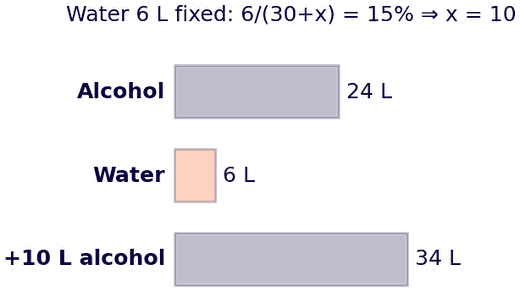 Water in the solution = 20% of 30 = 6 L — and adding alcohol does not change this 6 L.
After adding x litres of alcohol, water must be 15%: = 0.15.
30 + x = = 40 ⇒ x = 10.
Hence 10 litres — option (a).
Water in the solution = 20% of 30 = 6 L — and adding alcohol does not change this 6 L.
After adding x litres of alcohol, water must be 15%: = 0.15.
30 + x = = 40 ⇒ x = 10.
Hence 10 litres — option (a).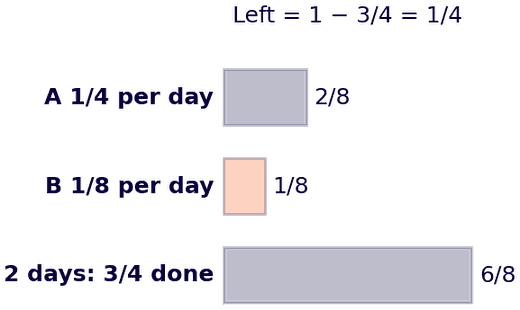 One-day work together = + = .
In 2 days they finish 2 × = = .
Work left = 1 − = .
Hence option (a).
One-day work together = + = .
In 2 days they finish 2 × = = .
Work left = 1 − = .
Hence option (a).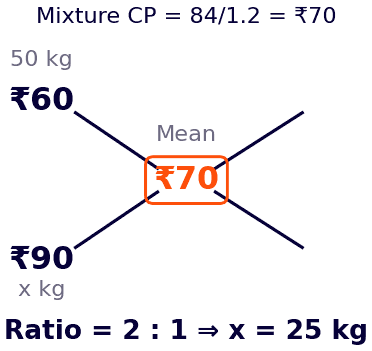 First find the mixture’s COST price: SP ₹84 with 20% profit ⇒ CP = = ₹70 per kg.
Alligation between ₹60 and ₹90 around mean ₹70: ratio = (90 − 70) : (70 − 60) = 20 : 10 = 2 : 1.
So cheap : costly = 2 : 1; with 50 kg of the cheap sugar, costly sugar = × 1 = 25 kg.
Hence 25 kg — option (b).
First find the mixture’s COST price: SP ₹84 with 20% profit ⇒ CP = = ₹70 per kg.
Alligation between ₹60 and ₹90 around mean ₹70: ratio = (90 − 70) : (70 − 60) = 20 : 10 = 2 : 1.
So cheap : costly = 2 : 1; with 50 kg of the cheap sugar, costly sugar = × 1 = 25 kg.
Hence 25 kg — option (b).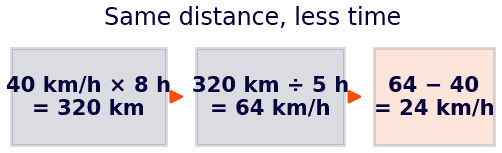 Distance = 40 × 8 = 320 km.
Required speed for 5 hours = = 64 km/h.
Increase needed = 64 − 40 = 24 km/h.
Hence option (a).
Distance = 40 × 8 = 320 km.
Required speed for 5 hours = = 64 km/h.
Increase needed = 64 − 40 = 24 km/h.
Hence option (a).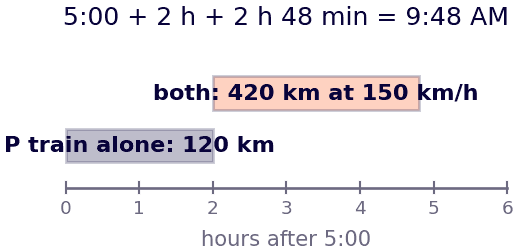 By 7:00 AM the first train has already covered 2 × 60 = 120 km, leaving 540 − 120 = 420 km between them.
From 7:00 AM they close the gap at 60 + 90 = 150 km/h.
Time to meet = = 2.8 hours = 2 hours 48 minutes.
7:00 AM + 2 h 48 min = 9:48 AM — option (d).
By 7:00 AM the first train has already covered 2 × 60 = 120 km, leaving 540 − 120 = 420 km between them.
From 7:00 AM they close the gap at 60 + 90 = 150 km/h.
Time to meet = = 2.8 hours = 2 hours 48 minutes.
7:00 AM + 2 h 48 min = 9:48 AM — option (d).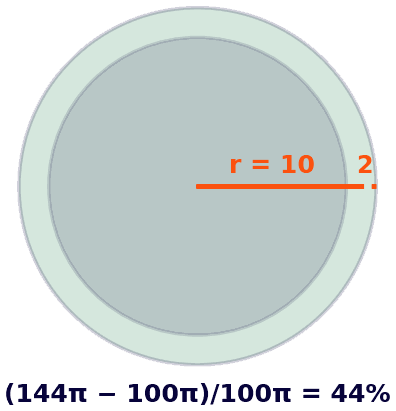 Garden radius = = 10 m; with the 2 m path, outer radius = 12 m.
Garden area = × 10² = 100; total area = × 12² = 144.
Increase = 144 − 100 = 44 on a base of 100.
= 44% — option (c).
Garden radius = = 10 m; with the 2 m path, outer radius = 12 m.
Garden area = × 10² = 100; total area = × 12² = 144.
Increase = 144 − 100 = 44 on a base of 100.
= 44% — option (c).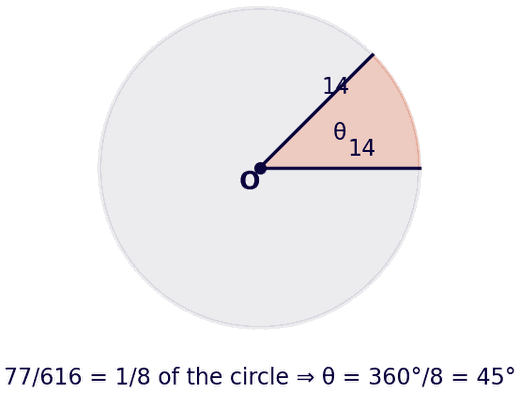 Sector area formula: Area = × r².
Full circle area = × 14 × 14 = 616 cm².
So = = ⇒ θ = = 45°.
Hence 45° — option (b).
Sector area formula: Area = × r².
Full circle area = × 14 × 14 = 616 cm².
So = = ⇒ θ = = 45°.
Hence 45° — option (b).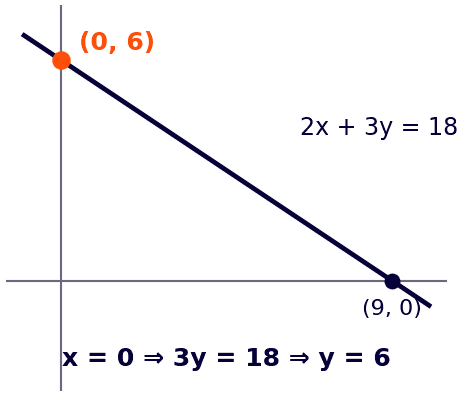 The y-intercept is where the line crosses the y-axis — that is, where x = 0.
Put x = 0: 2(0) + 3y = 18.
3y = 18 ⇒ y = 6.
Hence 6 — option (d).
The y-intercept is where the line crosses the y-axis — that is, where x = 0.
Put x = 0: 2(0) + 3y = 18.
3y = 18 ⇒ y = 6.
Hence 6 — option (d).