SSC CGL 14 September 2025 · Shift 2 · General Intelligence & Reasoning — questions with answers · ShikshaSphere
Chapter 29 of 192
14 September 2025 · Shift 2
General Intelligence & Reasoning
25 questions ~25 min readFree
25 questions
A
1
Select the letter-cluster from among the given options that can replace the question mark (?) in the following series.
HIY, IJX, JKW, KLV, ?
A.JHG
B.LMU
C.KMN
D.HGK
Solution
Letter series (+1, +1, −1)
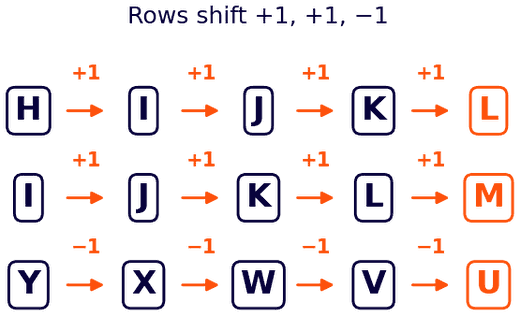
Track each position separately.
1st letters: H, I, J, K — +1 each time ⇒ next is L; 2nd letters: I, J, K, L — +1 ⇒ next is M.
3rd letters: Y, X, W, V — −1 each time ⇒ next is U.
Hence LMU — option (b).
2
Select the letter-cluster from among the given options that can replace the question mark (?) in the following series.
RUJ, RRP, ROV, RLB, ?
A.RLC
B.RDA
C.RDF
D.RIH
Solution
Letter series (−3, +6)
The 1st letter R stays constant in every cluster.
2nd letters: U, R, O, L — −3 each time ⇒ next is I.
3rd letters: J, P, V, B — +6 each time (cyclic) ⇒ next is H.
Hence RIH — option (d).
3
If '÷' means '+', '−' means '×', '+' means '−' and '×' means '÷', then which of the following equations is CORRECT?
A.40×13−26÷43+43=80
B.40×13−26÷43+43=50
C.40×13−26÷43+43=48
D.40×13−26÷43+43=45
Solution
Sign substitution
Replace every sign as instructed: the left side 40×13−26÷43+43 becomes 40 ÷ 13 × 26 + 43 − 43.
BODMAS: × 26 = = 80.
Then 80 + 43 − 43 = 80 — which matches the right side of option (a) exactly.
Hence option (a).
4
What comes next?
8, 18, 35, 61, 98, ?
A.158
B.148
C.197
D.160
Solution
Series — growing differences
Write the differences: 18−8 = 10, 35−18 = 17, 61−35 = 26, 98−61 = 37.
The differences 10, 17, 26, 37 rise by +7, +9, +11 — so the next rise is +13.
Next difference = 37 + 13 = 50; next term = 98 + 50.
= 148 — option (b).
5
Identify the assumptions that must hold for the statement to be valid, then choose the correct option.Statement: The rapid advancement of automation and artificial intelligence could lead to significant job displacement, but it also presents an opportunity to create new jobs in emerging industries.
Assumptions:
I. Automation and AI could cause job losses in some sectors.
II. New industries will emerge as a result of automation and AI.
III. The displacement caused by automation is temporary and will be reversed by new industries.
A.Only II and III are implicit
B.All are implicit
C.Only I is implicit
D.Only I and II are implicit
Solution
Statement — assumptions
The statement itself speaks of 'significant job displacement' — so I is implicit.
It also speaks of 'new jobs in emerging industries' — so II is implicit.
III goes FURTHER than the statement: nothing says the displacement is temporary or will be fully reversed.
Hence Only I and II — option (d).
6
The position of how many letters will remain unchanged if each of the letters in the word FOREIGN is arranged in alphabetical order?
A.Zero
B.Four
C.Three
D.Five
Solution
Alphabetical arrangement — FOREIGN
Write both forms one below the other.
Original: F O R E I G N; Alphabetical: E F G I N O R.
Compare position by position: F/E, O/F, R/G, E/I, I/N, G/O, N/R — every single letter has moved.
No letter keeps its place — Zero — option (a).
7
Identify the similar address:
Shraya Bansal E-66, Palm Greens, Faridabad, 121002
Address matching
Compare each option word by word with the given address.
Option (a) drops the s of 'Greens'; option (c) scrambles the PIN to 121200; option (d) misspells the surname as 'Bansel'.
Option (b) matches every word and the PIN 121002 exactly.
Hence option (b).
8
Each of the letters in the word UBIQUITIN is arranged in alphabetical order. How many letters are there in the English alphabetical series between the letter that is second from the left and the one that is fifth from the right in the new letter-cluster formed?
A.7
B.4
C.6
D.9
Solution
Alphabetical arrangement — UBIQUITIN
UBIQUITIN arranged alphabetically: B, I, I, I, N, Q, T, U, U (9 letters).
Second from the left = I (position 2); fifth from the right = position 9 − 5 + 1 = 5th letter = N.
Letters between I and N in the alphabet: J, K, L, M — count 4.
Hence option (b).
9
Find the odd one out from the given alternatives:
A.Windows
B.macOS
C.Android
D.Photoshop
Solution
Odd one out — software
Windows, macOS and Android are all OPERATING SYSTEMS — the base software that runs a device.
Photoshop is an APPLICATION (image-editing software) that runs on top of an operating system.
So the category breaks at Photoshop.
Hence option (d).
10
In each of the following questions, a specific pattern of alphabetic transformation has been applied to the first word to produce the second. Identify that pattern and apply it to the third word to determine the correct option.
EFWJM : BCTGJ :: PUIGS : ?
A.NSGDQ
B.SXLIV
C.MRFDP
D.MSGDP
Solution
Coding (−3 each)
Compare the first pair letter by letter: E→B, F→C, W→T, J→G, M→J — every letter moves −3.
Apply −3 to PUIGS:
P→M, U→R, I→F, G→D, S→P.
Hence MRFDP — option (c).
11
In each of the following questions, the second word is derived from the first word by applying a specific letter-coding pattern, such as shifting letters forward or backward in the alphabet. Identify the pattern and apply it to the third word to choose the correct answer from the options given.
NBTUFR : PDVWHT :: MBCPVS : ?
A.ODERXU
B.OEFSXU
C.OCDSXU
D.OFESXU
Solution
Coding (+2 each)
Compare the first pair: N→P, B→D, T→V, U→W, F→H, R→T — every letter moves +2.
Apply +2 to MBCPVS:
M→O, B→D, C→E, P→R, V→X, S→U.
Hence ODERXU — option (a).
12
Complete the series.
13, 17, 19, 23, ?
A.21
B.29
C.25
D.27
Solution
Prime series
13, 17, 19 and 23 are consecutive PRIME numbers.
The next prime after 23: 24 ✗, 25 = 5×5 ✗, 26 ✗, 27 ✗, 28 ✗, 29 ✓.
So the series continues with 29.
Hence option (b).
13
In each of the following questions, a group of three numbers/symbols is given in each option. Identify the group that does NOT follow the same pattern as the others.
A.B2α : D4β : F6β
B.C3ρ : E5ϕ : G7η
C.D4λ : F6Ω : H8⊕
D.E5° : G7α : J10η
Solution
Letter–place-value–symbol
Pattern in (a), (b), (c): the letters move +2 each step (B→D→F, C→E→G, D→F→H) and each number equals the place value of its own letter (B2, D4, F6 …).
In option (d): E5 and G7 fit, but then G→J is a jump of +3.
The +2 letter chain breaks at J10.
Hence option (d).
14
A box has 6 red, 4 blue, 5 green balls. Probability of drawing a non-green ball?
A.0.55
B.0.88
C.0.66
D.0.77
Solution
Probability — non-green
Total balls = 6 + 4 + 5 = 15.
Non-green balls = 6 red + 4 blue = 10.
Probability = = = 0.666…
≈ 0.66 — option (c).
15
If 10 @ 4 = 56 and 7 @ 3 = 30, then 9 @ 3 = ?
A.36
B.38
C.39
D.37
Solution
Number puzzle ((a+b)×b)
Test the rule a @ b = (a + b) × b.
Check: (10 + 4) × 4 = 56 ✓ and (7 + 3) × 3 = 30 ✓.
Apply: 9 @ 3 = (9 + 3) × 3 = 12 × 3.
= 36 — option (a).
16
In a code language, "He plays football daily" is coded as "ra sa ta ka", "He plays cricket daily" is coded as "ra sa pa ka", and "She plays football well" is coded as "ma sa ta ja".
Question: What is the code for "She plays cricket daily"?
A.pa sa ma ka
B.ra sa ta ja
C.ma sa pa ka
D.ka sa ra ma
Solution
Code language
Compare sentences 1 and 2: common words He/plays/daily ↔ common codes ra/sa/ka; the changed word gives cricket = pa (and football = ta).
Compare sentences 1 and 3: common plays/football ↔ sa/ta; so She = ma (and He = ra, daily = ka, well = ja).
Now build "She plays cricket daily" = ma + sa + pa + ka.
Hence ma sa pa ka — option (c).
17
If 'BCDEF' is coded as 'FEDCB', 'GHIJK' is coded as 'KJIHG', and 'LMNOP' is coded as 'PONML', then how is 'QRSTU' coded?
A.UTSRQ
B.UTSRR
C.UTTRQ
D.UTSSQ
Solution
Coding — reversal
In every pair the code is simply the word written BACKWARDS.
BCDEF → FEDCB ✓, GHIJK → KJIHG ✓, LMNOP → PONML ✓.
Reverse QRSTU: U-T-S-R-Q.
Hence UTSRQ — option (a).
18
If 8 $ 2 = 12, 7 $ 1 = 6, then what is 5 $ 3?
A.6
B.10
C.12
D.14
Solution
Number puzzle ((a−b)×b)
Test the rule a $ b = (a − b) × b.
Check: (8 − 2) × 2 = 12 ✓ and (7 − 1) × 1 = 6 ✓.
Apply: 5 $ 3 = (5 − 3) × 3 = 2 × 3.
= 6 — option (a).
19
A 35 L solution has milk : water = 4 : 3. How much water to make milk : water = 1 : 1?
A.3.5 L
B.5 L
C.9 L
D.12 L
Solution
Ratio — add water
Ratio 4 : 3 means 7 units = 35 L, so 1 unit = 5 L ⇒ milk = 20 L, water = 15 L.
Milk stays 20 L; for a 1 : 1 mix, water must also become 20 L.
Water to add = 20 − 15 = 5 L.
Hence option (b).
20
Rohit is married to Ritika. Ritika's brother is Rakesh. Rakesh's wife is Rani. Rani's son is Ram. How is Ram related to Rohit?
A.Nephew
B.Son
C.Cousin
D.Brother-in-law
Solution
Blood relation
Ram is the son of Rani and Rakesh.
Rakesh is Ritika's brother — so Ram is Ritika's brother's son, i.e. her nephew.
Rohit is Ritika's husband, so her nephew is Rohit's nephew too.
Hence Nephew — option (a).
21
Pointing to a man, Rekha said, 'His mother is the only daughter of my mother's father.' How is the man related to Rekha?
A.Cousin
B.Nephew
C.Brother
D.Son
Solution
Blood relation
Work inside out: 'my mother's father' is Rekha's maternal grandfather.
His ONLY daughter must be Rekha's own mother.
So the man's mother is Rekha's mother — the man is Rekha's brother.
Hence option (c).
22
After interchanging + & × and 10 & 25, which of the following equations will hold true?
In the following questions, the symbols @, #, $, ∘ and % are used with the following meaning as illustrated below:
A @ B ⇒ A ≥ B; A # B ⇒ A ≤ B; A $ B ⇒ A < B; A ∘ B ⇒ A > B; A % B ⇒ A = B
Statements: P ∘ Q, Q # R
Conclusions:
I. P ∘ R
II. P @ R
A.If only conclusion I is true.
B.If only conclusion II is true.
C.If only conclusion III is true.
D.Neither I nor II is true
Solution
Symbolic inequality
Decode the statements: P ∘ Q means P > Q, and Q # R means Q ≤ R.
Combine: P > Q ≤ R — the inequality changes direction at Q, so P and R CANNOT be compared.
Conclusion I (P > R) and Conclusion II (P ≥ R) both remain unproven — R could even be larger than P.
Hence Neither I nor II — option (d).
24
If '+' means '×', '×' means '−', '−' means '÷', then 25 + 10 × 18 − 9 = ?
A two-digit number is 4 times the sum of its digits. If the digits are reversed, the new number is 27 more than the original. What is the number?
A.26
B.28
C.36
D.42
Solution
Two-digit number puzzle
Let the number be 10x + y. Condition 1: 10x + y = 4(x + y) ⇒ 6x = 3y ⇒ y = 2x.
Condition 2: reversing adds 27, and (10y + x) − (10x + y) = 9(y − x) = 27 ⇒ y − x = 3.
With y = 2x: 2x − x = 3 ⇒ x = 3, y = 6 — the number is 36.
Check: 3 + 6 = 9, 4 × 9 = 36 ✓ and 63 − 36 = 27 ✓. Hence option (c).
Finished reading? Now test yourself.
The same 25 questions, but with a timer and the answers hidden — 15 minutes.

 Track each position separately.
1st letters: H, I, J, K — +1 each time ⇒ next is L; 2nd letters: I, J, K, L — +1 ⇒ next is M.
3rd letters: Y, X, W, V — −1 each time ⇒ next is U.
Hence LMU — option (b).
Track each position separately.
1st letters: H, I, J, K — +1 each time ⇒ next is L; 2nd letters: I, J, K, L — +1 ⇒ next is M.
3rd letters: Y, X, W, V — −1 each time ⇒ next is U.
Hence LMU — option (b).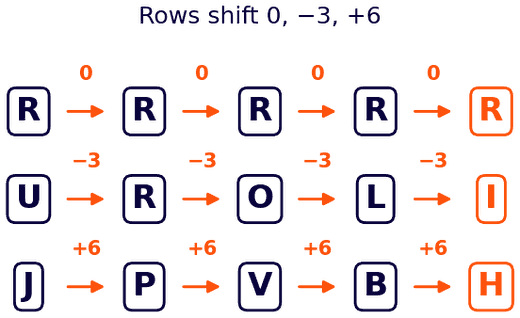 The 1st letter R stays constant in every cluster.
2nd letters: U, R, O, L — −3 each time ⇒ next is I.
3rd letters: J, P, V, B — +6 each time (cyclic) ⇒ next is H.
Hence RIH — option (d).
The 1st letter R stays constant in every cluster.
2nd letters: U, R, O, L — −3 each time ⇒ next is I.
3rd letters: J, P, V, B — +6 each time (cyclic) ⇒ next is H.
Hence RIH — option (d). Write the differences: 18−8 = 10, 35−18 = 17, 61−35 = 26, 98−61 = 37.
The differences 10, 17, 26, 37 rise by +7, +9, +11 — so the next rise is +13.
Next difference = 37 + 13 = 50; next term = 98 + 50.
= 148 — option (b).
Write the differences: 18−8 = 10, 35−18 = 17, 61−35 = 26, 98−61 = 37.
The differences 10, 17, 26, 37 rise by +7, +9, +11 — so the next rise is +13.
Next difference = 37 + 13 = 50; next term = 98 + 50.
= 148 — option (b).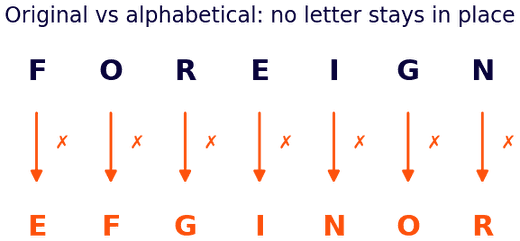 Write both forms one below the other.
Original: F O R E I G N; Alphabetical: E F G I N O R.
Compare position by position: F/E, O/F, R/G, E/I, I/N, G/O, N/R — every single letter has moved.
No letter keeps its place — Zero — option (a).
Write both forms one below the other.
Original: F O R E I G N; Alphabetical: E F G I N O R.
Compare position by position: F/E, O/F, R/G, E/I, I/N, G/O, N/R — every single letter has moved.
No letter keeps its place — Zero — option (a).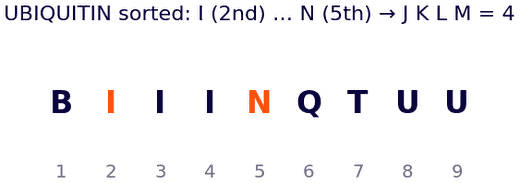 UBIQUITIN arranged alphabetically: B, I, I, I, N, Q, T, U, U (9 letters).
Second from the left = I (position 2); fifth from the right = position 9 − 5 + 1 = 5th letter = N.
Letters between I and N in the alphabet: J, K, L, M — count 4.
Hence option (b).
UBIQUITIN arranged alphabetically: B, I, I, I, N, Q, T, U, U (9 letters).
Second from the left = I (position 2); fifth from the right = position 9 − 5 + 1 = 5th letter = N.
Letters between I and N in the alphabet: J, K, L, M — count 4.
Hence option (b).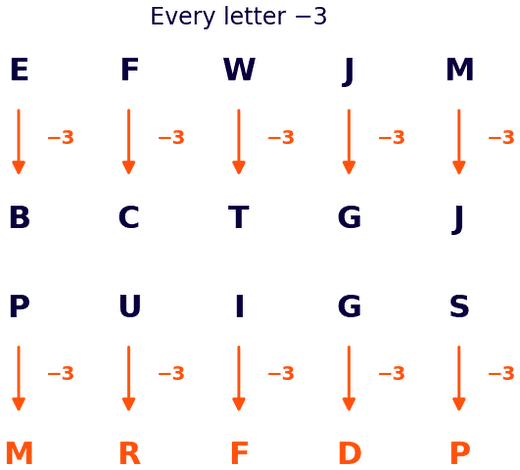 Compare the first pair letter by letter: E→B, F→C, W→T, J→G, M→J — every letter moves −3.
Apply −3 to PUIGS:
P→M, U→R, I→F, G→D, S→P.
Hence MRFDP — option (c).
Compare the first pair letter by letter: E→B, F→C, W→T, J→G, M→J — every letter moves −3.
Apply −3 to PUIGS:
P→M, U→R, I→F, G→D, S→P.
Hence MRFDP — option (c).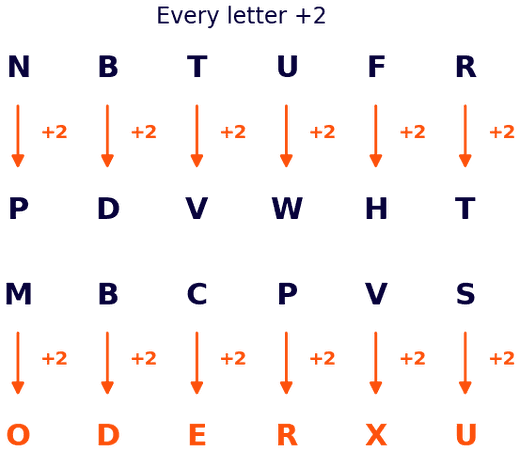 Compare the first pair: N→P, B→D, T→V, U→W, F→H, R→T — every letter moves +2.
Apply +2 to MBCPVS:
M→O, B→D, C→E, P→R, V→X, S→U.
Hence ODERXU — option (a).
Compare the first pair: N→P, B→D, T→V, U→W, F→H, R→T — every letter moves +2.
Apply +2 to MBCPVS:
M→O, B→D, C→E, P→R, V→X, S→U.
Hence ODERXU — option (a).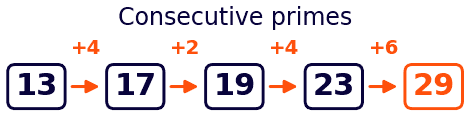 13, 17, 19 and 23 are consecutive PRIME numbers.
The next prime after 23: 24 ✗, 25 = 5×5 ✗, 26 ✗, 27 ✗, 28 ✗, 29 ✓.
So the series continues with 29.
Hence option (b).
13, 17, 19 and 23 are consecutive PRIME numbers.
The next prime after 23: 24 ✗, 25 = 5×5 ✗, 26 ✗, 27 ✗, 28 ✗, 29 ✓.
So the series continues with 29.
Hence option (b).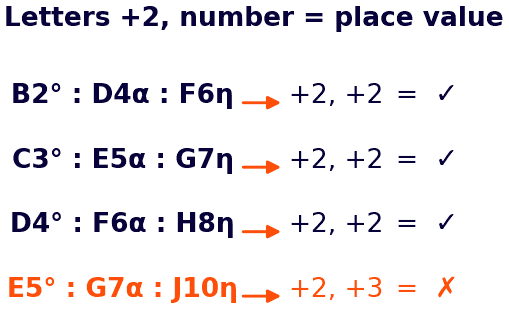 Pattern in (a), (b), (c): the letters move +2 each step (B→D→F, C→E→G, D→F→H) and each number equals the place value of its own letter (B2, D4, F6 …).
In option (d): E5 and G7 fit, but then G→J is a jump of +3.
The +2 letter chain breaks at J10.
Hence option (d).
Pattern in (a), (b), (c): the letters move +2 each step (B→D→F, C→E→G, D→F→H) and each number equals the place value of its own letter (B2, D4, F6 …).
In option (d): E5 and G7 fit, but then G→J is a jump of +3.
The +2 letter chain breaks at J10.
Hence option (d).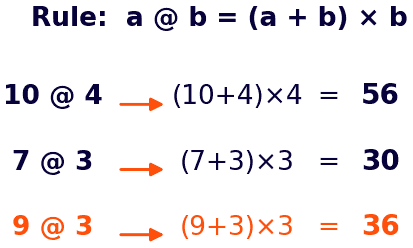 Test the rule a @ b = (a + b) × b.
Check: (10 + 4) × 4 = 56 ✓ and (7 + 3) × 3 = 30 ✓.
Apply: 9 @ 3 = (9 + 3) × 3 = 12 × 3.
= 36 — option (a).
Test the rule a @ b = (a + b) × b.
Check: (10 + 4) × 4 = 56 ✓ and (7 + 3) × 3 = 30 ✓.
Apply: 9 @ 3 = (9 + 3) × 3 = 12 × 3.
= 36 — option (a).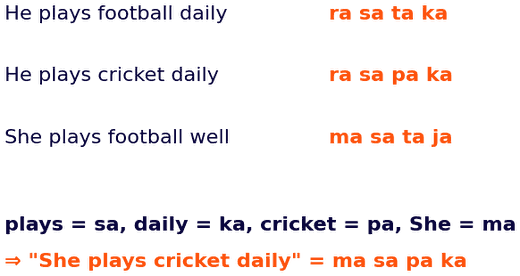 Compare sentences 1 and 2: common words He/plays/daily ↔ common codes ra/sa/ka; the changed word gives cricket = pa (and football = ta).
Compare sentences 1 and 3: common plays/football ↔ sa/ta; so She = ma (and He = ra, daily = ka, well = ja).
Now build "She plays cricket daily" = ma + sa + pa + ka.
Hence ma sa pa ka — option (c).
Compare sentences 1 and 2: common words He/plays/daily ↔ common codes ra/sa/ka; the changed word gives cricket = pa (and football = ta).
Compare sentences 1 and 3: common plays/football ↔ sa/ta; so She = ma (and He = ra, daily = ka, well = ja).
Now build "She plays cricket daily" = ma + sa + pa + ka.
Hence ma sa pa ka — option (c).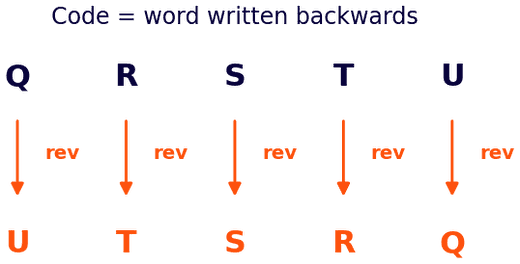 In every pair the code is simply the word written BACKWARDS.
BCDEF → FEDCB ✓, GHIJK → KJIHG ✓, LMNOP → PONML ✓.
Reverse QRSTU: U-T-S-R-Q.
Hence UTSRQ — option (a).
In every pair the code is simply the word written BACKWARDS.
BCDEF → FEDCB ✓, GHIJK → KJIHG ✓, LMNOP → PONML ✓.
Reverse QRSTU: U-T-S-R-Q.
Hence UTSRQ — option (a).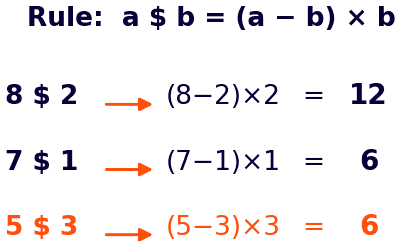 Test the rule a $ b = (a − b) × b.
Check: (8 − 2) × 2 = 12 ✓ and (7 − 1) × 1 = 6 ✓.
Apply: 5 $ 3 = (5 − 3) × 3 = 2 × 3.
= 6 — option (a).
Test the rule a $ b = (a − b) × b.
Check: (8 − 2) × 2 = 12 ✓ and (7 − 1) × 1 = 6 ✓.
Apply: 5 $ 3 = (5 − 3) × 3 = 2 × 3.
= 6 — option (a).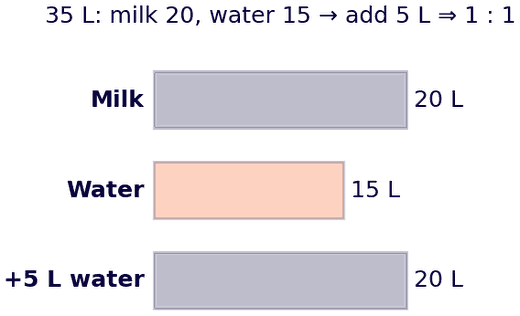 Ratio 4 : 3 means 7 units = 35 L, so 1 unit = 5 L ⇒ milk = 20 L, water = 15 L.
Milk stays 20 L; for a 1 : 1 mix, water must also become 20 L.
Water to add = 20 − 15 = 5 L.
Hence option (b).
Ratio 4 : 3 means 7 units = 35 L, so 1 unit = 5 L ⇒ milk = 20 L, water = 15 L.
Milk stays 20 L; for a 1 : 1 mix, water must also become 20 L.
Water to add = 20 − 15 = 5 L.
Hence option (b).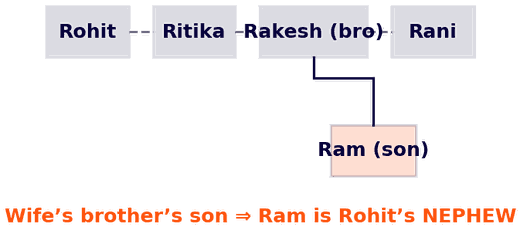 Ram is the son of Rani and Rakesh.
Rakesh is Ritika's brother — so Ram is Ritika's brother's son, i.e. her nephew.
Rohit is Ritika's husband, so her nephew is Rohit's nephew too.
Hence Nephew — option (a).
Ram is the son of Rani and Rakesh.
Rakesh is Ritika's brother — so Ram is Ritika's brother's son, i.e. her nephew.
Rohit is Ritika's husband, so her nephew is Rohit's nephew too.
Hence Nephew — option (a).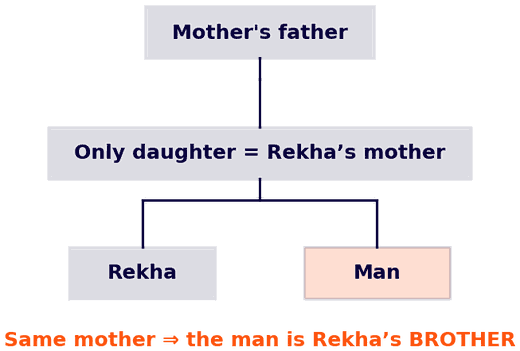 Work inside out: 'my mother's father' is Rekha's maternal grandfather.
His ONLY daughter must be Rekha's own mother.
So the man's mother is Rekha's mother — the man is Rekha's brother.
Hence option (c).
Work inside out: 'my mother's father' is Rekha's maternal grandfather.
His ONLY daughter must be Rekha's own mother.
So the man's mother is Rekha's mother — the man is Rekha's brother.
Hence option (c).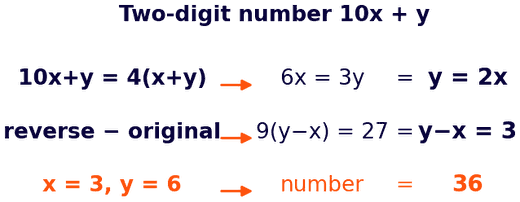 Let the number be 10x + y. Condition 1: 10x + y = 4(x + y) ⇒ 6x = 3y ⇒ y = 2x.
Condition 2: reversing adds 27, and (10y + x) − (10x + y) = 9(y − x) = 27 ⇒ y − x = 3.
With y = 2x: 2x − x = 3 ⇒ x = 3, y = 6 — the number is 36.
Check: 3 + 6 = 9, 4 × 9 = 36 ✓ and 63 − 36 = 27 ✓. Hence option (c).
Let the number be 10x + y. Condition 1: 10x + y = 4(x + y) ⇒ 6x = 3y ⇒ y = 2x.
Condition 2: reversing adds 27, and (10y + x) − (10x + y) = 9(y − x) = 27 ⇒ y − x = 3.
With y = 2x: 2x − x = 3 ⇒ x = 3, y = 6 — the number is 36.
Check: 3 + 6 = 9, 4 × 9 = 36 ✓ and 63 − 36 = 27 ✓. Hence option (c).