SSC CGL 14 September 2025 · Shift 2 · Quantitative Aptitude — questions with answers · ShikshaSphere
Chapter 31 of 192
14 September 2025 · Shift 2
Quantitative Aptitude
25 questions ~25 min readFree
25 questions
A
51
If M : N = 3 : 4, N : O = 5 : 6, and O : P = 8 : 10, then find N : P.
A.5 : 7
B.2 : 3
C.4 : 5
D.3 : 2
Solution
Chained ratios
Only N, O, P matter here — link them through the common term O.
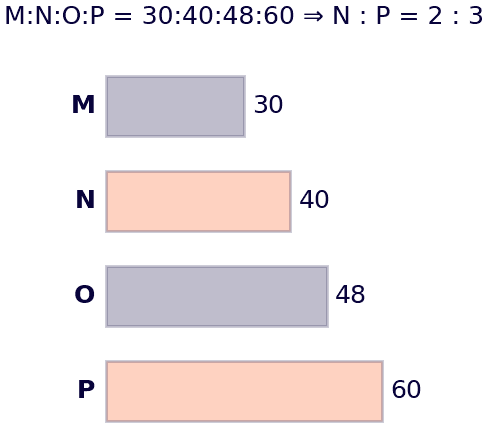
N : O = 5 : 6 (×4) = 20 : 24 and O : P = 8 : 10 (×3) = 24 : 30 — now O = 24 in both.
So N : O : P = 20 : 24 : 30, giving N : P = 20 : 30.
= 2 : 3 — option (b).
52
What is the result of 3 ÷ 0.5?
A.3.25
B.6.5
C.2.75
D.6.25
Solution
Mixed fraction ÷ decimal
Convert the mixed fraction: 3 = 3.25.
Dividing by 0.5 is the same as multiplying by 2.
3.25 × 2 = 6.5.
Hence option (b).
53
What should be subtracted from 52, 47, 20, 19 so that the remaining numbers may be proportional?
If 48% of a number is 0.8 more than 40% of it, what is the number?
A.6
B.7
C.8
D.10
Solution
Percent difference
The difference between 48% and 40% of the number equals 0.8.
So 8% of the number = 0.8.
Number = = 10.
Hence option (d).
55
Sohan started a business with ₹80,000. After 5 months, Rohan joined with ₹1,60,000. After another 4 months, Sohan withdrew ₹40,000. What is the ratio of their profits at the end of the year?
A.2 : 5
B.5 : 6
C.1 : 5
D.3 : 4
Solution
Partnership — timeline
Track capital-months. Sohan: ₹80,000 for the first 9 months (5 + 4), then ₹40,000 for the last 3 months.
Sohan = 80×9 + 40×3 = 720 + 120 = 840 (thousand-months).
Rohan joined after 5 months, so his money worked 7 months: 160 × 7 = 1120.
Ratio = 840 : 1120 = 3 : 4 — option (d).
56
Two individuals, A and B, rent a pasture together. A has 9 horses that they graze for 2 months. B grazes 12 cows for 3 months and 18 sheep for 2 months. The following relationships are given:
1. 3 horses are equivalent to 6 cows,
2. 2 cows are equivalent to 4 sheep.
What amount of rent should A pay?
X, Y, and Z started a business with capitals in the ratio 3 : 5 : 8. After 4 months, Z withdrew 50% of his capital. After another 4 months, Y withdrew half of his capital. The business continued for a total of 18 months. If total profit is ₹9,44,955, find the ratio of profit shares of X : Y : Z.
A.33 : 33 : 53
B.54 : 65 : 88
C.81 : 72 : 62
D.15 : 63 : 17
Solution
Partnership — 18 months
Careful — the business runs for 18 months, not 12. Take capitals 3, 5, 8.
X: 3 × 18 = 54 capital-months.
Y: 5 for the first 8 months, then 2.5 for the remaining 10: 5×8 + 2.5×10 = 40 + 25 = 65.
Z: 8 for 4 months, then 4 for 14 months: 8×4 + 4×14 = 32 + 56 = 88. Ratio = 54 : 65 : 88 — option (b).
58
The average age of 30 students in a class is 15 years. When a new student is admitted, the average increases by 0.3 years. What is the age of the new student?
A.24.3
B.20.3
C.19.3
D.16.3
Solution
Average — new entrant
Old total = 30 × 15 = 450 years.
New average = 15.3 with 31 students ⇒ new total = 31 × 15.3 = 474.3.
New student’s age = 474.3 − 450 = 24.3 years.
Hence option (a).
59
The monthly average salary for 9 employees plus one supervisor is ₹12,000. If the supervisor earns ₹30,000, what is the average salary of the 9 employees?
A.₹10,750
B.₹10,000
C.₹10,700
D.₹10,500
Solution
Average — remove supervisor
Total of all 10 people = 10 × 12,000 = ₹1,20,000.
Remove the supervisor: 1,20,000 − 30,000 = ₹90,000 — this belongs to the 9 employees.
Their average = = ₹10,000.
Hence ₹10,000 — option (b).
60
A company has 60 employees, of whom 45% are women. The average monthly salary of the women is ₹60,000, while that of the men is ₹78,000. What is the overall average monthly salary (in ₹ thousands)?
A.70.8
B.699.4
C.245.4
D.69.9
Solution
Weighted average
Women = 45% of 60 = 27; men = 60 − 27 = 33.
Total salary = 27 × 60,000 + 33 × 78,000 = 16,20,000 + 25,74,000 = ₹41,94,000.
Overall average = = ₹69,900.
= 69.9 (in thousands) — option (c).
61
A dress is marked at ₹4,500. A discount offer changes from 12% to 17%. How much extra discount does a customer get?
A.₹225
B.₹185
C.₹195
D.₹200
Solution
Extra discount
Both discounts apply to the same marked price of ₹4,500.
Extra discount = 17% − 12% = 5% of the marked price.
5% of 4,500 = = 225.
Hence ₹225 — option (a).
62
Rohan ordered 5 kg of premium coffee and some additional kilograms of ordinary coffee. The price of the premium coffee per kg was three times that of the ordinary coffee. When the order was delivered, it was found that the quantities of premium and ordinary coffee had been swapped. This change increased his bill by 40%. Find the ratio of the original quantity of premium coffee to the original quantity of ordinary coffee.
A.4 : 1
B.1 : 4
C.1 : 2
D.5 : 1
Solution
Swapped order — ratio
Let ordinary coffee cost ₹p per kg (premium = ₹3p) and let ordinary quantity = S kg.
Original bill = 5(3p) + S(p) = (15 + S)p; after the swap: S(3p) + 5(p) = (3S + 5)p.
Bill rose 40%: (3S + 5)p = 1.4(15 + S)p ⇒ 3S + 5 = 21 + 1.4S ⇒ 1.6S = 16 ⇒ S = 10.
Ratio = 5 : 10 = 1 : 2 — option (c).
63
A certain amount grows to ₹7400 in 2 years and ₹8140 in 3 years. Determine the interest rate.
A.10%
B.9%
C.8%
D.11%
Solution
CI — successive years
From year 2 to year 3, the amount grows by one year’s interest on ₹7400.
That growth = 8140 − 7400 = ₹740.
Rate = × 100 = 10%.
Hence option (a).
64
A bookseller sells 12 pens for ₹240, but in doing so, he incurs a loss equal to the cost price of 6 pens. The loss percent is:
A.40%
B.70%
C.60%
D.50%
Solution
Loss in terms of CP
Let each pen cost ₹c. Loss = CP − SP, so: 12c − 240 = 6c.
Solve: 6c = 240 ⇒ c = 40.
CP of 12 pens = ₹480; loss = 480 − 240 = ₹240.
Loss% = × 100 = 50% — option (d).
65
A fruit seller buys three varieties of mangoes. The first variety is bought at 8 for ₹20, the second at 10 for ₹24, and the third at 4 for ₹10. He mixes them in the ratio 2 : 3 : 1 respectively. If he sells all the mangoes at 6 for ₹14, what is his approximate gain or loss percentage?
A.Profit of 4.76%
B.Loss of 4.76%
C.Loss of 6%
D.Profit of 6%
Solution
Mangoes — mixture P/L
Cost per mango of each variety: = ₹2.50, = ₹2.40, = ₹2.50.
Mix ratio 2 : 3 : 1 — take 6 mangoes: CP = 2(2.50) + 3(2.40) + 1(2.50) = 5 + 7.2 + 2.5 = ₹14.70.
SP of those 6 mangoes = ₹14 — a loss of ₹0.70.
Loss% = × 100 ≈ 4.76% loss — option (b).
66
A dealer sets the marked price of a television 40% higher than its cost price. If he gives a discount of 25% and makes a profit of ₹600, what is the cost price of the television?
A.₹10,000
B.₹12,500
C.₹12,000
D.₹18,000
Solution
Markup–discount → CP
Chain the multipliers on cost C: marked price = 1.4C; after 25% discount, SP = 1.4C × 0.75 = 1.05C.
Profit = SP − CP = 1.05C − C = 0.05C.
0.05C = 600 ⇒ C = = 12,000.
Hence ₹12,000 — option (c).
67
A merchant marked an article such that its price was 30% above its cost price. He offered two consecutive discounts of 20% and 12.5% to a buyer. If he incurred a loss of ₹540, what was the marked price of the article?
A.₹7800
B.₹5000
C.₹7500
D.₹6800
Solution
Two discounts → MP
Let CP = C. Marked price = 1.3C; after discounts of 20% and 12.5%: SP = 1.3C × 0.80 × 0.875 = 0.91C.
Loss = C − 0.91C = 0.09C, and this equals ₹540.
C = = 6,000.
Marked price = 1.3 × 6,000 = ₹7,800 — option (a).
68
A drum contains a blend of three chemicals: P, Q, and R, in the ratio of 3 : 5 : 2. 60 litres of this blend are removed, and then 12 litres of chemical P and 8 litres of chemical Q are poured into the drum. If the resultant quantity of chemical Q is 40 litres more than the resultant quantity of chemical P, what was the initial total quantity of the mixture in the drum (in litres)?
A.300
B.320
C.280
D.380
Solution
Mixture — remove & add
Let the initial volume be V. Fractions: P = 0.3V, Q = 0.5V, R = 0.2V. The 60 L removed carries the same ratio: 18 L of P and 30 L of Q.
After removal and addition: P = 0.3V − 18 + 12 = 0.3V − 6; Q = 0.5V − 30 + 8 = 0.5V − 22.
Given Q − P = 40: (0.5V − 22) − (0.3V − 6) = 0.2V − 16 = 40.
0.2V = 56 ⇒ V = 280 litres — option (c).
69
Mohan borrowed a sum of money at simple interest of 7% per annum for the first 3 years, 5% per annum for the next 5 years, and 11% per annum for the period beyond 8 years. If he pays a total of ₹6800 as interest only at the end of 10 years, how much money did he borrow?
A.₹8000
B.₹9000
C.₹10000
D.₹12000
Solution
SI — slab rates
Add the interest percentages year-wise on the same principal P.
First 3 years: 7 × 3 = 21%; next 5 years: 5 × 5 = 25%; beyond 8 years (i.e. years 9 and 10): 11 × 2 = 22%.
Total = 21 + 25 + 22 = 68% of P = ₹6800.
P = = ₹10,000 — option (c).
70
A cone is such that the area of its base equals its lateral surface area. If slant height is l, find the radius r.
A.l
B.2l
C.3l
D.4l
Solution
Cone — base area = LSA
Formulas: base area = r²; lateral (curved) surface area = rl.
Set them equal: r² = rl.
Cancel r from both sides: r = l.
Hence option (a).
71
A square field of side 24 m has a circular pond in the center. If the area of the pond is 484 m², what is the area of the remaining field?
A.48 m²
B.92 m²
C.78 m²
D.82 m²
Solution
Square minus pond
Area of the square field = 24 × 24 = 576 m².
The pond occupies 484 m² of it.
Remaining field = 576 − 484 = 92 m².
Hence option (b).
72
If the height of a right prism is increased by 60% and base area remains the same, what is the percentage increase in volume?
A.25%
B.60%
C.75%
D.100%
Solution
Prism — volume scaling
Volume of a prism = base area × height.
Volume is directly proportional to height when the base area is fixed.
So a 60% rise in height gives exactly a 60% rise in volume.
Hence option (b).
73
A circular decorative wall clock with a radius of 30 cm has a design where a chord connects two points on the circumference. This chord, along with two radii, forms an equilateral triangle at the center of the clock face. The smaller segment created by this chord is painted in a contrasting color. What percentage of the clock's total area does this smaller painted segment represent? (Use π = 3.14, ≈ 1.732)
A.2.88%
B.5.6%
C.9.08%
D.12.5%
Solution
Clock — minor segment %
An equilateral triangle at the centre means the chord subtends a 60° angle, so the minor segment sits inside a 60° sector.
Sector area = × 3.14 × 30² = × 2826 = 471 cm²; triangle area = × 30² = 0.433 × 900 = 389.7 cm².
Segment = 471 − 389.7 = 81.3 cm²; clock area = 3.14 × 900 = 2826 cm².
Percentage = × 100 ≈ 2.88% — option (a).
74
A cylinder (r = 8 cm, h = 20 cm) is bored through by a hole (r = 4 cm, full height). What percentage of original volume is removed?
A.25%
B.50%
C.75%
D.37.5%
Solution
Cylinder with bored hole
Both cylinders share the same height, so the volume ratio depends only on r².
Removed fraction = = = .
That is one-quarter of the original volume.
= 25% — option (a).
75
A sector of a circle with a radius of 12 cm has a central angle of 60°. Another sector of the same circle has a central angle of radians. What is the ratio of the areas of the two sectors?
A.1 : 2
B.2 : 3
C.1 : 1
D.3 : 4
Solution
Degrees vs radians
Convert the radian angle: radians = = 60°.
Both sectors belong to the SAME circle, so area depends only on the central angle.
Both angles are 60° — the sectors are equal in area.
Ratio = 1 : 1 — option (c).
Finished reading? Now test yourself.
The same 25 questions, but with a timer and the answers hidden — 15 minutes.

 Only N, O, P matter here — link them through the common term O.
N : O = 5 : 6 (×4) = 20 : 24 and O : P = 8 : 10 (×3) = 24 : 30 — now O = 24 in both.
So N : O : P = 20 : 24 : 30, giving N : P = 20 : 30.
= 2 : 3 — option (b).
Only N, O, P matter here — link them through the common term O.
N : O = 5 : 6 (×4) = 20 : 24 and O : P = 8 : 10 (×3) = 24 : 30 — now O = 24 in both.
So N : O : P = 20 : 24 : 30, giving N : P = 20 : 30.
= 2 : 3 — option (b).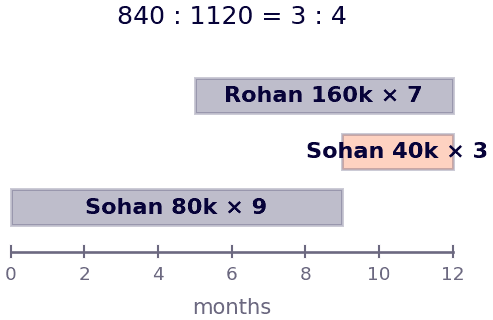 Track capital-months. Sohan: ₹80,000 for the first 9 months (5 + 4), then ₹40,000 for the last 3 months.
Sohan = 80×9 + 40×3 = 720 + 120 = 840 (thousand-months).
Rohan joined after 5 months, so his money worked 7 months: 160 × 7 = 1120.
Ratio = 840 : 1120 = 3 : 4 — option (d).
Track capital-months. Sohan: ₹80,000 for the first 9 months (5 + 4), then ₹40,000 for the last 3 months.
Sohan = 80×9 + 40×3 = 720 + 120 = 840 (thousand-months).
Rohan joined after 5 months, so his money worked 7 months: 160 × 7 = 1120.
Ratio = 840 : 1120 = 3 : 4 — option (d).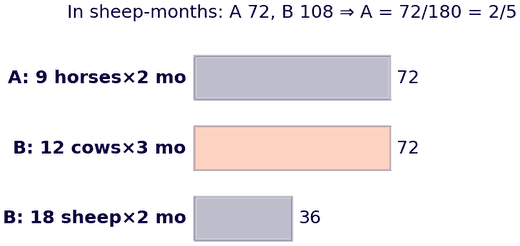 Convert everything to SHEEP: 2 cows = 4 sheep ⇒ 1 cow = 2 sheep; 3 horses = 6 cows ⇒ 1 horse = 2 cows = 4 sheep.
A: 9 horses × 2 months = 18 horse-months = 18 × 4 = 72 sheep-months.
B: 12 cows × 3 = 36 cow-months = 72 sheep-months, plus 18 sheep × 2 = 36 — total 108 sheep-months.
A's share = = = — option (a).
Convert everything to SHEEP: 2 cows = 4 sheep ⇒ 1 cow = 2 sheep; 3 horses = 6 cows ⇒ 1 horse = 2 cows = 4 sheep.
A: 9 horses × 2 months = 18 horse-months = 18 × 4 = 72 sheep-months.
B: 12 cows × 3 = 36 cow-months = 72 sheep-months, plus 18 sheep × 2 = 36 — total 108 sheep-months.
A's share = = = — option (a).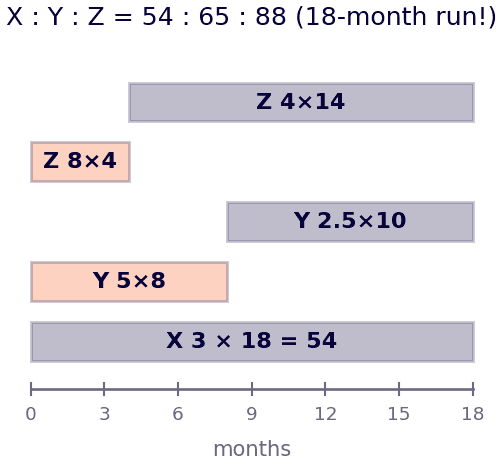 Careful — the business runs for 18 months, not 12. Take capitals 3, 5, 8.
X: 3 × 18 = 54 capital-months.
Y: 5 for the first 8 months, then 2.5 for the remaining 10: 5×8 + 2.5×10 = 40 + 25 = 65.
Z: 8 for 4 months, then 4 for 14 months: 8×4 + 4×14 = 32 + 56 = 88. Ratio = 54 : 65 : 88 — option (b).
Careful — the business runs for 18 months, not 12. Take capitals 3, 5, 8.
X: 3 × 18 = 54 capital-months.
Y: 5 for the first 8 months, then 2.5 for the remaining 10: 5×8 + 2.5×10 = 40 + 25 = 65.
Z: 8 for 4 months, then 4 for 14 months: 8×4 + 4×14 = 32 + 56 = 88. Ratio = 54 : 65 : 88 — option (b).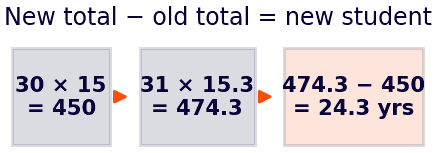 Old total = 30 × 15 = 450 years.
New average = 15.3 with 31 students ⇒ new total = 31 × 15.3 = 474.3.
New student’s age = 474.3 − 450 = 24.3 years.
Hence option (a).
Old total = 30 × 15 = 450 years.
New average = 15.3 with 31 students ⇒ new total = 31 × 15.3 = 474.3.
New student’s age = 474.3 − 450 = 24.3 years.
Hence option (a).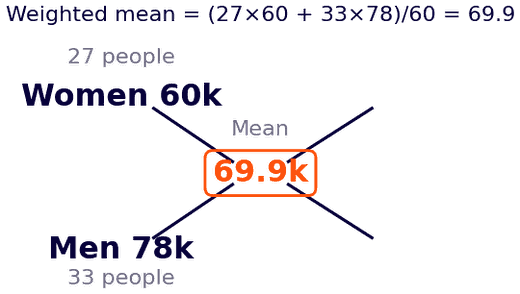 Women = 45% of 60 = 27; men = 60 − 27 = 33.
Total salary = 27 × 60,000 + 33 × 78,000 = 16,20,000 + 25,74,000 = ₹41,94,000.
Overall average = = ₹69,900.
= 69.9 (in thousands) — option (c).
Women = 45% of 60 = 27; men = 60 − 27 = 33.
Total salary = 27 × 60,000 + 33 × 78,000 = 16,20,000 + 25,74,000 = ₹41,94,000.
Overall average = = ₹69,900.
= 69.9 (in thousands) — option (c).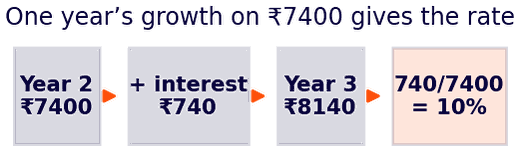 From year 2 to year 3, the amount grows by one year’s interest on ₹7400.
That growth = 8140 − 7400 = ₹740.
Rate = × 100 = 10%.
Hence option (a).
From year 2 to year 3, the amount grows by one year’s interest on ₹7400.
That growth = 8140 − 7400 = ₹740.
Rate = × 100 = 10%.
Hence option (a).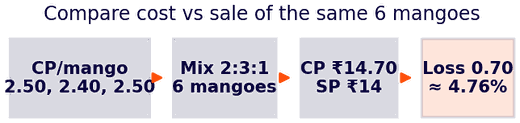 Cost per mango of each variety: = ₹2.50, = ₹2.40, = ₹2.50.
Mix ratio 2 : 3 : 1 — take 6 mangoes: CP = 2(2.50) + 3(2.40) + 1(2.50) = 5 + 7.2 + 2.5 = ₹14.70.
SP of those 6 mangoes = ₹14 — a loss of ₹0.70.
Loss% = × 100 ≈ 4.76% loss — option (b).
Cost per mango of each variety: = ₹2.50, = ₹2.40, = ₹2.50.
Mix ratio 2 : 3 : 1 — take 6 mangoes: CP = 2(2.50) + 3(2.40) + 1(2.50) = 5 + 7.2 + 2.5 = ₹14.70.
SP of those 6 mangoes = ₹14 — a loss of ₹0.70.
Loss% = × 100 ≈ 4.76% loss — option (b).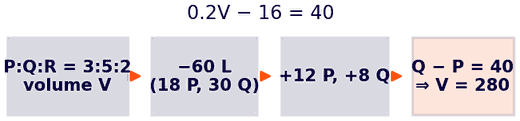 Let the initial volume be V. Fractions: P = 0.3V, Q = 0.5V, R = 0.2V. The 60 L removed carries the same ratio: 18 L of P and 30 L of Q.
After removal and addition: P = 0.3V − 18 + 12 = 0.3V − 6; Q = 0.5V − 30 + 8 = 0.5V − 22.
Given Q − P = 40: (0.5V − 22) − (0.3V − 6) = 0.2V − 16 = 40.
0.2V = 56 ⇒ V = 280 litres — option (c).
Let the initial volume be V. Fractions: P = 0.3V, Q = 0.5V, R = 0.2V. The 60 L removed carries the same ratio: 18 L of P and 30 L of Q.
After removal and addition: P = 0.3V − 18 + 12 = 0.3V − 6; Q = 0.5V − 30 + 8 = 0.5V − 22.
Given Q − P = 40: (0.5V − 22) − (0.3V − 6) = 0.2V − 16 = 40.
0.2V = 56 ⇒ V = 280 litres — option (c).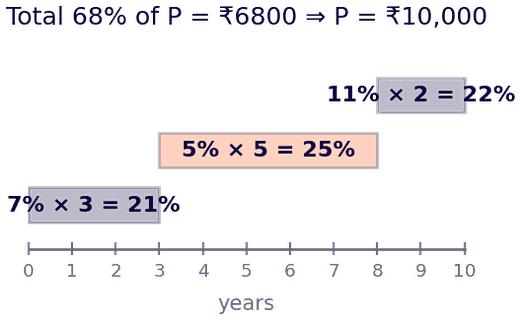 Add the interest percentages year-wise on the same principal P.
First 3 years: 7 × 3 = 21%; next 5 years: 5 × 5 = 25%; beyond 8 years (i.e. years 9 and 10): 11 × 2 = 22%.
Total = 21 + 25 + 22 = 68% of P = ₹6800.
P = = ₹10,000 — option (c).
Add the interest percentages year-wise on the same principal P.
First 3 years: 7 × 3 = 21%; next 5 years: 5 × 5 = 25%; beyond 8 years (i.e. years 9 and 10): 11 × 2 = 22%.
Total = 21 + 25 + 22 = 68% of P = ₹6800.
P = = ₹10,000 — option (c).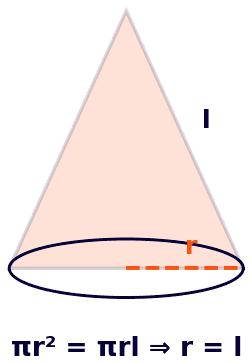 Formulas: base area = r²; lateral (curved) surface area = rl.
Set them equal: r² = rl.
Cancel r from both sides: r = l.
Hence option (a).
Formulas: base area = r²; lateral (curved) surface area = rl.
Set them equal: r² = rl.
Cancel r from both sides: r = l.
Hence option (a).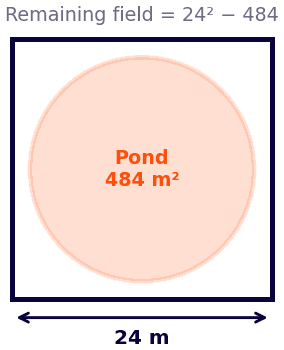 Area of the square field = 24 × 24 = 576 m².
The pond occupies 484 m² of it.
Remaining field = 576 − 484 = 92 m².
Hence option (b).
Area of the square field = 24 × 24 = 576 m².
The pond occupies 484 m² of it.
Remaining field = 576 − 484 = 92 m².
Hence option (b).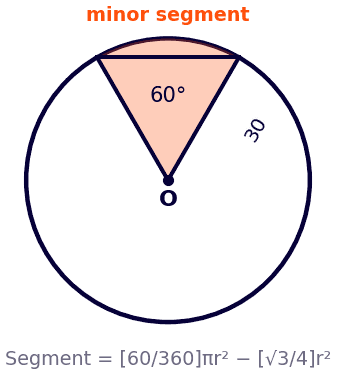 An equilateral triangle at the centre means the chord subtends a 60° angle, so the minor segment sits inside a 60° sector.
Sector area = × 3.14 × 30² = × 2826 = 471 cm²; triangle area = × 30² = 0.433 × 900 = 389.7 cm².
Segment = 471 − 389.7 = 81.3 cm²; clock area = 3.14 × 900 = 2826 cm².
Percentage = × 100 ≈ 2.88% — option (a).
An equilateral triangle at the centre means the chord subtends a 60° angle, so the minor segment sits inside a 60° sector.
Sector area = × 3.14 × 30² = × 2826 = 471 cm²; triangle area = × 30² = 0.433 × 900 = 389.7 cm².
Segment = 471 − 389.7 = 81.3 cm²; clock area = 3.14 × 900 = 2826 cm².
Percentage = × 100 ≈ 2.88% — option (a).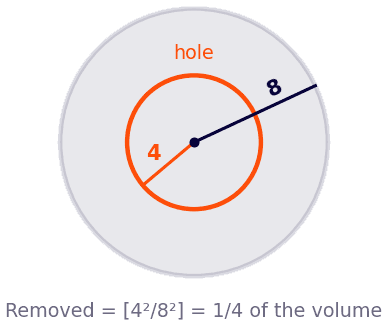 Both cylinders share the same height, so the volume ratio depends only on r².
Removed fraction = = = .
That is one-quarter of the original volume.
= 25% — option (a).
Both cylinders share the same height, so the volume ratio depends only on r².
Removed fraction = = = .
That is one-quarter of the original volume.
= 25% — option (a). Convert the radian angle: radians = = 60°.
Both sectors belong to the SAME circle, so area depends only on the central angle.
Both angles are 60° — the sectors are equal in area.
Ratio = 1 : 1 — option (c).
Convert the radian angle: radians = = 60°.
Both sectors belong to the SAME circle, so area depends only on the central angle.
Both angles are 60° — the sectors are equal in area.
Ratio = 1 : 1 — option (c).