SSC CGL 15 September 2025 · Shift 3 · Quantitative Aptitude — questions with answers · ShikshaSphere
Chapter 47 of 192
15 September 2025 · Shift 3
Quantitative Aptitude
25 questions ~25 min readFree
25 questions
A
51
Simplify: (3.2 − 1) + (2 ÷ 0.5)
A.9.2
B.6.5
C.8.7
D.9.5
Solution
Mixed fractions & decimals
1 = 1.2, so the first bracket = 3.2 − 1.2 = 2.
2 = 2.25, and dividing by 0.5 means multiplying by 2.
2.25 × 2 = 4.5.
2 + 4.5 = 6.5 — option (b).
52
A ₹48,000 annual bonus is distributed among Sales, Marketing, and Operations in a 5 : 4 : 3 ratio. Marketing uses ₹3,000 for team building and ₹1,500 for an intern, then allocates the rest to two top performers in a 3 : 2 ratio. How much does the top performer with the smaller share receive?
A.₹5,833.33
B.₹5,250
C.₹4,600
D.₹4,200
Solution
Ratio share — bonus
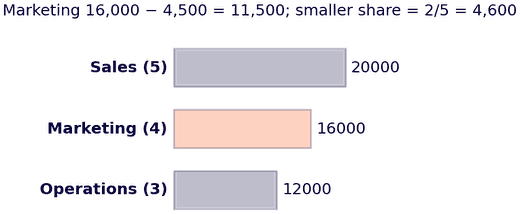
Total parts = 5 + 4 + 3 = 12, so Marketing gets × 4 = ₹16,000.
After spending 3,000 + 1,500 = ₹4,500, the balance is ₹11,500.
Split 3 : 2 — the smaller share is of 11,500.
= ₹4,600 — option (c).
53
Which of the following represents the correct simplified value of the continued fraction:
x = 1 +
A.
B.
C.
D.
Solution
Continued fraction
Innermost: 1 + = ; its reciprocal is .
Next level: 3 + = ; reciprocal = .
x = 1 + .
= — option (a).
54
Amit invested ₹90,000 in a business. After 3 months, Sumit joined the partnership with ₹60,000. After another 3 months, Amit withdrew ₹30,000. Find the ratio of their profits at the end of the year.
A.3 : 2
B.4 : 3
C.5 : 3
D.2 : 1
Solution
Partnership — capital changes
Amit: ₹90,000 for the first 6 months, then ₹60,000 for the remaining 6 months.
Amit = 90,000×6 + 60,000×6 = 5,40,000 + 3,60,000 = 9,00,000.
Sumit joined after 3 months: 60,000 × 9 = 5,40,000.
Ratio = 9,00,000 : 5,40,000 = 5 : 3 — option (c).
55
Ram invests ₹60,000 while Shyam invests ₹90,000, with Ram's investment lasting for 10 months and Shyam's for 8 months. The total profit amounts to ₹40,000. What is Ram's share?
The overall average salary for all employees in an office is ₹32,000. Officers earn an average salary of ₹56,000, while non-officers make an average of ₹20,000. If there are 17 officers, determine the number of non-officers.
A.34
B.40
C.50
D.60
Solution
Alligation — salaries
Alligation about the mean 32,000: officers (56,000) and non-officers (20,000).
Ratio of numbers = (32 − 20) : (56 − 32) = 12 : 24 = 1 : 2.
Officers : non-officers = 1 : 2, and officers = 17.
Non-officers = 2 × 17 = 34 — option (a).
57
Three numbers are such that when the sum of any two of them is added to half of the third, the results are 225, 213, and 192 respectively. What is the average of the three numbers?
A.84
B.70
C.60
D.50
Solution
Three numbers — clever sum
Let the numbers be a, b, c: (a+b) + = 225, (b+c) + = 213, (c+a) + = 192.
Add all three: 2(a+b+c) + = 630 ⇒ (a+b+c) × = 630.
a + b + c = = 252.
Average = = 84 — option (a).
58
In a competitive exam with 120 questions, there are three sections: Math (20 questions), Hindi (50 questions), and Science (50 questions). A candidate answered 70% of Math, 60% of Hindi, and 60% of Science questions correctly. If the minimum passing score is 80%, how many more questions did the candidate need to answer correctly?
A.20
B.15
C.21
D.22
Solution
Exam — extra correct answers
Passing requirement = 80% of 120 = 96 questions.
Correct: Math 0.7 × 20 = 14, Hindi 0.6 × 50 = 30, Science 0.6 × 50 = 30 — total 74.
Shortfall = 96 − 74.
= 22 — option (d).
59
Find the compound interest on ₹8,000 at 9% p.a. for 1 year 8 months, compounded annually.
A.₹2,087.80
B.₹1243.20
C.₹1,087.80
D.₹2,000.80
Solution
CI — 1 year 8 months
First year: 8,000 × 1.09 = ₹8,720.
Next 8 months = year at simple growth: 8,720 × (1 + 0.09 × ) = 8,720 × 1.06 = ₹9,243.20.
CI = 9,243.20 − 8,000.
= ₹1,243.20 — option (b).
60
If the amount at the end of the 2nd year and 3rd year on a certain principal at compound interest is ₹11,000 and ₹12,100 respectively, find the rate of interest per annum.
A.8%
B.7%
C.10%
D.5%
Solution
CI — rate from amounts
The growth from year 2 to year 3 is one year’s interest on ₹11,000.
Interest = 12,100 − 11,000 = ₹1,100.
Rate = × 100.
= 10% — option (c).
61
A stationery shop owner buys three types of pencils. The first type costs him 10 pencils for ₹20, the second 3 pencils for ₹9, and the third 9 pencils for ₹45. He mixes them in the ratio 3 : 4 : 3. If he sells all the pencils at 4 for ₹21, what is his approximate gain or loss percentage?
A.Loss of 59.09%
B.Profit of 59.09%
C.Profit of 60%
D.Loss of 60%
Solution
Pencils — mixture profit%
Cost per pencil: ₹2, ₹3 and ₹5 respectively.
Take 10 pencils in the ratio 3 : 4 : 3 — CP = 3(2) + 4(3) + 3(5) = 6 + 12 + 15 = ₹33.
SP of those 10 = 10 × = ₹52.50, so profit = ₹19.50.
Profit% = × 100 ≈ 59.09% — option (b).
62
A seller bought three different types of mobile covers, M1, M2, and M3. The ratio of their selling prices was 3 : 4 : 5. He made a profit of 25% on M1, 10% on M2, but incurred a loss of 20% on M3. What was his approximate percent gain or loss in the entire transaction?
A.profit of 3.3%
B.loss of 2.3%
C.loss of 2.6%
D.profit of 3.6%
Solution
Three covers — overall %
Take SPs as 3k, 4k and 5k (total 12k).
Work back to cost: CP₁ = = 2.4k; CP₂ = = 3.63k; CP₃ = = 6.25k — total 12.28k.
Loss = 12.28k − 12k = 0.28k.
Loss% = × 100 ≈ 2.3% — option (b).
63
A high-end watch is initially marked up by 60% above its cost price. During a sale, it is offered at a discount of 25% on its marked price. However, a special customer receives an additional discount of y% on the discounted price, bringing the final selling price to ₹6480. If the shopkeeper still makes a profit of 8% on the cost price, find the cost price and y.
A.CP = ₹6000, y = 10%
B.CP = ₹6500, y = 5%
C.CP = ₹6800, y = 12.5%
D.CP = ₹6000, y = 8%
Solution
Markup, discount, extra discount
Final SP gives 8% profit: 1.08 × CP = 6480 ⇒ CP = ₹6,000.
Price chain: 6000 × 1.60 × 0.75 = ₹7,200 before the extra discount.
7200 × = 6480 ⇒ 100 − y = 90.
y = 10% with CP ₹6,000 — option (a).
64
Vinay and Ram can complete a task in 12 days and 18 days, respectively. They begin the work together, but Ram leaves after 4 days. How many more days will Vinay take to finish the remaining work?
A.5 days
B.2 days
C.1 days
D.8 days
Solution
Work — one leaves
Total work = LCM(12, 18) = 36 units ⇒ Vinay = 3 units/day, Ram = 2 units/day.
In 4 days together they do 4 × 5 = 20 units; remaining = 36 − 20 = 16 units.
Vinay alone needs days.
= 5 days — option (a).
65
A shopkeeper mixes two qualities of Rice. The first quality costs ₹150 per kg and is mixed with the second quality in the ratio 4 : 5. If the mixture is sold at ₹130 per kg (at no profit, no loss), what is the cost per kg of the second quality of Rice?
A.₹100
B.₹110
C.₹114
D.₹120
Solution
Mixture — second price
No profit, no loss means mixture CP = ₹130 per kg.
Take 4 kg + 5 kg = 9 kg: 4(150) + 5x = 9(130).
600 + 5x = 1170 ⇒ 5x = 570.
x = ₹114 per kg — option (c).
66
A and B can complete a certain task together in 20 days. After A works for 10 days, B is left to finish the remaining work by himself in 30 days. How many days would it take for B to complete the entire task on his own?
A.40 days
B.50 days
C.60 days
D.70 days
Solution
Work — B alone
A worked 10 days instead of 20, i.e. he did 10 days’ worth less.
B took 30 days instead of 20, i.e. 10 days extra — so 10 days of A = 10 days of B.
Their efficiencies are equal (1 : 1), so total work = 20 × 2 = 40 units with B doing 1 unit/day.
B alone = 40 days — option (a).
67
A container holds a mixture of Mango, Apple, and Pomegranate juices in the ratio of 5 : 7 : 4 respectively. 24 litres of this mixture is taken out, and then 10 litres of Mango juice and 6 litres of Pomegranate juice are added to the vessel. If the resultant quantity of apple juice is 14 litres more than the resultant quantity of Mango juice, what was the total initial quantity (in litres)?
A.216
B.210
C.214
D.235
Solution
Mixture — remove & add
Let the total be 16x litres (5 + 7 + 4 = 16 parts). Removing 24 L leaves (16x − 24) in the same ratio.
Apple = × 7; Mango = × 5 + 10.
Given the difference is 14: × 2 = 24 ⇒ = 12.
16x = 192 + 24 = 216 litres — option (a).
68
A delivery van travels at a constant speed of 84 km/h to cover a certain route in 1 hour and 45 minutes. If traffic increases the time taken by 15 minutes, by what percentage must the van's average speed decrease to complete the route?
A.12.5%
B.16.25%
C.15%
D.20%
Solution
Speed decrease %
Distance = 84 × 1.75 = 147 km.
New time = 1.75 + 0.25 = 2 hours ⇒ new speed = = 73.5 km/h.
Decrease = 84 − 73.5 = 10.5 km/h.
× 100 = 12.5% — option (a).
69
A student walks from his home to school at a speed of 6 km/h and reaches 15 minutes late. If he increases his speed to 8 km/h, he reaches 5 minutes early. What is the distance (in km) from his home to school?
A.4 km
B.6 km
C.8 km
D.10 km
Solution
Late/early — distance
Time difference between the two speeds = 15 + 5 = 20 minutes = hour.
Distance = × time difference.
= × = 24 × .
= 8 km — option (c).
70
The cost of building a wall around a circular field at the rate of ₹120 per metre is ₹3,768. Find the diameter of the field.
A.5 m
B.10 m
C.15 m
D.20 m
Solution
Circumference → diameter
Length of the wall = circumference = = 31.4 m.
2πr = 31.4 ⇒ r = = 5 m.
Diameter = 2r.
= 10 m — option (b).
71
A circular logo of radius 7 cm is fitted perfectly inside a square plaque. Find the area of unused square space around the circle.
A.42 cm²
B.48 cm²
C.50.54 cm²
D.55 cm²
Solution
Square minus inscribed circle
The circle just fits, so the square’s side = diameter = 14 cm.
Square area = 14² = 196 cm².
Circle area = × 7 × 7 = 154 cm².
Unused = 196 − 154 = 42 cm² — option (a).
72
A circular clock has a radius of 28 cm. Calculate the distance covered by the tip of the minute hand in 30 minutes, assuming it is positioned at the edge of the clock face. (Use π = )
A.88 cm
B.84 cm
C.82 cm
D.44 cm
Solution
Minute hand — half circle
In 60 minutes the tip covers the full circumference 2πr.
In 30 minutes it covers half of that = πr.
= × 28 = 88.
Hence 88 cm — option (a).
73
What is the slope of the line perpendicular to y = −5x + 2?
A.−
B.5
C.
D.−5
Solution
Perpendicular slope
The given line has slope m₁ = −5.
For perpendicular lines m₁ × m₂ = −1.
m₂ = = .
Hence option (c).

 Total parts = 5 + 4 + 3 = 12, so Marketing gets × 4 = ₹16,000.
After spending 3,000 + 1,500 = ₹4,500, the balance is ₹11,500.
Split 3 : 2 — the smaller share is of 11,500.
= ₹4,600 — option (c).
Total parts = 5 + 4 + 3 = 12, so Marketing gets × 4 = ₹16,000.
After spending 3,000 + 1,500 = ₹4,500, the balance is ₹11,500.
Split 3 : 2 — the smaller share is of 11,500.
= ₹4,600 — option (c).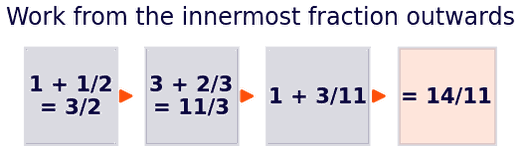 Innermost: 1 + = ; its reciprocal is .
Next level: 3 + = ; reciprocal = .
x = 1 + .
= — option (a).
Innermost: 1 + = ; its reciprocal is .
Next level: 3 + = ; reciprocal = .
x = 1 + .
= — option (a).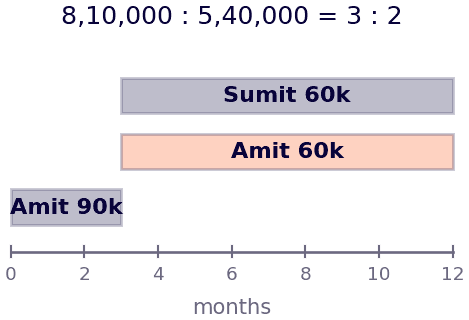 Amit: ₹90,000 for the first 6 months, then ₹60,000 for the remaining 6 months.
Amit = 90,000×6 + 60,000×6 = 5,40,000 + 3,60,000 = 9,00,000.
Sumit joined after 3 months: 60,000 × 9 = 5,40,000.
Ratio = 9,00,000 : 5,40,000 = 5 : 3 — option (c).
Amit: ₹90,000 for the first 6 months, then ₹60,000 for the remaining 6 months.
Amit = 90,000×6 + 60,000×6 = 5,40,000 + 3,60,000 = 9,00,000.
Sumit joined after 3 months: 60,000 × 9 = 5,40,000.
Ratio = 9,00,000 : 5,40,000 = 5 : 3 — option (c).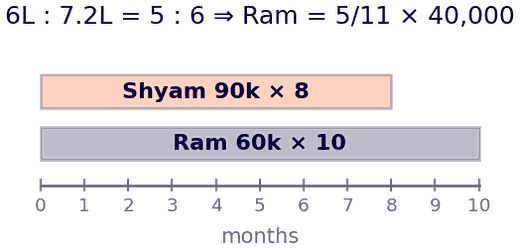 Capital × time: Ram = 60,000 × 10 = 6,00,000; Shyam = 90,000 × 8 = 7,20,000.
Ratio = 60 : 72 = 5 : 6 (11 parts).
Ram’s share = × 40,000.
= ₹18,181.82 — option (d).
Capital × time: Ram = 60,000 × 10 = 6,00,000; Shyam = 90,000 × 8 = 7,20,000.
Ratio = 60 : 72 = 5 : 6 (11 parts).
Ram’s share = × 40,000.
= ₹18,181.82 — option (d).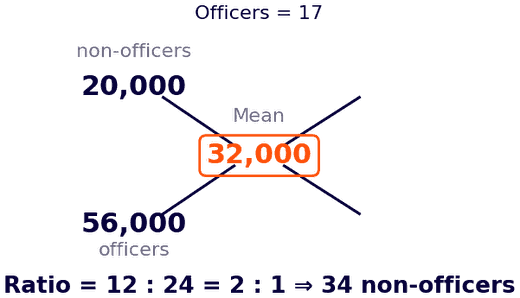 Alligation about the mean 32,000: officers (56,000) and non-officers (20,000).
Ratio of numbers = (32 − 20) : (56 − 32) = 12 : 24 = 1 : 2.
Officers : non-officers = 1 : 2, and officers = 17.
Non-officers = 2 × 17 = 34 — option (a).
Alligation about the mean 32,000: officers (56,000) and non-officers (20,000).
Ratio of numbers = (32 − 20) : (56 − 32) = 12 : 24 = 1 : 2.
Officers : non-officers = 1 : 2, and officers = 17.
Non-officers = 2 × 17 = 34 — option (a).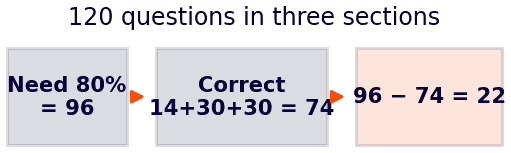 Passing requirement = 80% of 120 = 96 questions.
Correct: Math 0.7 × 20 = 14, Hindi 0.6 × 50 = 30, Science 0.6 × 50 = 30 — total 74.
Shortfall = 96 − 74.
= 22 — option (d).
Passing requirement = 80% of 120 = 96 questions.
Correct: Math 0.7 × 20 = 14, Hindi 0.6 × 50 = 30, Science 0.6 × 50 = 30 — total 74.
Shortfall = 96 − 74.
= 22 — option (d).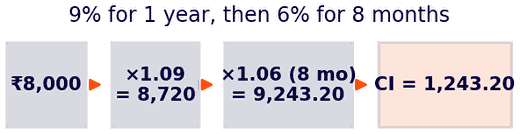 First year: 8,000 × 1.09 = ₹8,720.
Next 8 months = year at simple growth: 8,720 × (1 + 0.09 × ) = 8,720 × 1.06 = ₹9,243.20.
CI = 9,243.20 − 8,000.
= ₹1,243.20 — option (b).
First year: 8,000 × 1.09 = ₹8,720.
Next 8 months = year at simple growth: 8,720 × (1 + 0.09 × ) = 8,720 × 1.06 = ₹9,243.20.
CI = 9,243.20 − 8,000.
= ₹1,243.20 — option (b).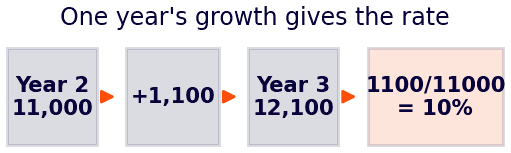 The growth from year 2 to year 3 is one year’s interest on ₹11,000.
Interest = 12,100 − 11,000 = ₹1,100.
Rate = × 100.
= 10% — option (c).
The growth from year 2 to year 3 is one year’s interest on ₹11,000.
Interest = 12,100 − 11,000 = ₹1,100.
Rate = × 100.
= 10% — option (c).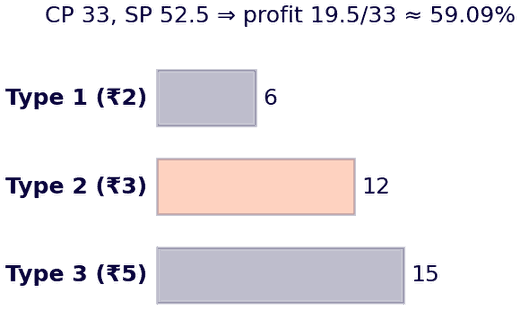 Cost per pencil: ₹2, ₹3 and ₹5 respectively.
Take 10 pencils in the ratio 3 : 4 : 3 — CP = 3(2) + 4(3) + 3(5) = 6 + 12 + 15 = ₹33.
SP of those 10 = 10 × = ₹52.50, so profit = ₹19.50.
Profit% = × 100 ≈ 59.09% — option (b).
Cost per pencil: ₹2, ₹3 and ₹5 respectively.
Take 10 pencils in the ratio 3 : 4 : 3 — CP = 3(2) + 4(3) + 3(5) = 6 + 12 + 15 = ₹33.
SP of those 10 = 10 × = ₹52.50, so profit = ₹19.50.
Profit% = × 100 ≈ 59.09% — option (b).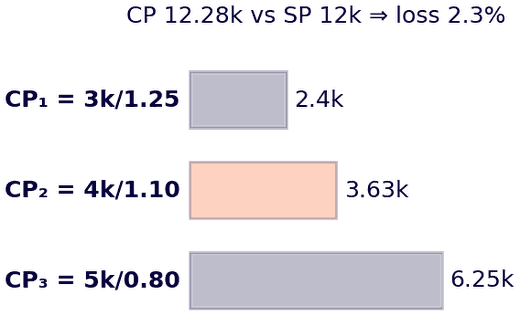 Take SPs as 3k, 4k and 5k (total 12k).
Work back to cost: CP₁ = = 2.4k; CP₂ = = 3.63k; CP₃ = = 6.25k — total 12.28k.
Loss = 12.28k − 12k = 0.28k.
Loss% = × 100 ≈ 2.3% — option (b).
Take SPs as 3k, 4k and 5k (total 12k).
Work back to cost: CP₁ = = 2.4k; CP₂ = = 3.63k; CP₃ = = 6.25k — total 12.28k.
Loss = 12.28k − 12k = 0.28k.
Loss% = × 100 ≈ 2.3% — option (b).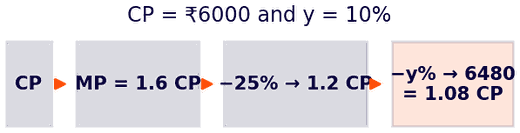 Final SP gives 8% profit: 1.08 × CP = 6480 ⇒ CP = ₹6,000.
Price chain: 6000 × 1.60 × 0.75 = ₹7,200 before the extra discount.
7200 × = 6480 ⇒ 100 − y = 90.
y = 10% with CP ₹6,000 — option (a).
Final SP gives 8% profit: 1.08 × CP = 6480 ⇒ CP = ₹6,000.
Price chain: 6000 × 1.60 × 0.75 = ₹7,200 before the extra discount.
7200 × = 6480 ⇒ 100 − y = 90.
y = 10% with CP ₹6,000 — option (a).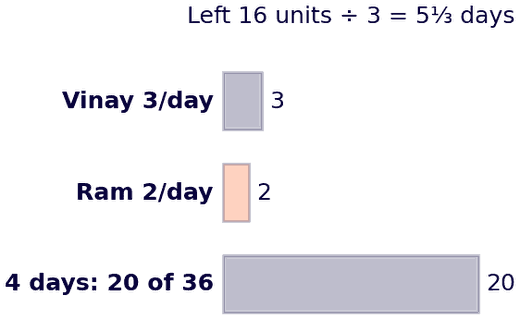 Total work = LCM(12, 18) = 36 units ⇒ Vinay = 3 units/day, Ram = 2 units/day.
In 4 days together they do 4 × 5 = 20 units; remaining = 36 − 20 = 16 units.
Vinay alone needs days.
= 5 days — option (a).
Total work = LCM(12, 18) = 36 units ⇒ Vinay = 3 units/day, Ram = 2 units/day.
In 4 days together they do 4 × 5 = 20 units; remaining = 36 − 20 = 16 units.
Vinay alone needs days.
= 5 days — option (a).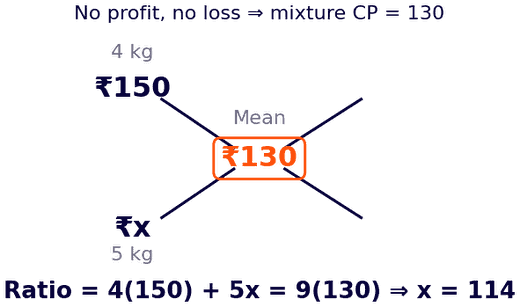 No profit, no loss means mixture CP = ₹130 per kg.
Take 4 kg + 5 kg = 9 kg: 4(150) + 5x = 9(130).
600 + 5x = 1170 ⇒ 5x = 570.
x = ₹114 per kg — option (c).
No profit, no loss means mixture CP = ₹130 per kg.
Take 4 kg + 5 kg = 9 kg: 4(150) + 5x = 9(130).
600 + 5x = 1170 ⇒ 5x = 570.
x = ₹114 per kg — option (c).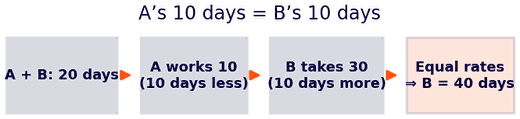 A worked 10 days instead of 20, i.e. he did 10 days’ worth less.
B took 30 days instead of 20, i.e. 10 days extra — so 10 days of A = 10 days of B.
Their efficiencies are equal (1 : 1), so total work = 20 × 2 = 40 units with B doing 1 unit/day.
B alone = 40 days — option (a).
A worked 10 days instead of 20, i.e. he did 10 days’ worth less.
B took 30 days instead of 20, i.e. 10 days extra — so 10 days of A = 10 days of B.
Their efficiencies are equal (1 : 1), so total work = 20 × 2 = 40 units with B doing 1 unit/day.
B alone = 40 days — option (a).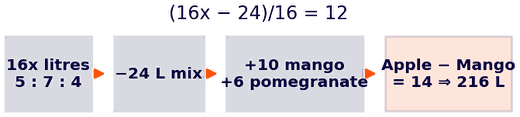 Let the total be 16x litres (5 + 7 + 4 = 16 parts). Removing 24 L leaves (16x − 24) in the same ratio.
Apple = × 7; Mango = × 5 + 10.
Given the difference is 14: × 2 = 24 ⇒ = 12.
16x = 192 + 24 = 216 litres — option (a).
Let the total be 16x litres (5 + 7 + 4 = 16 parts). Removing 24 L leaves (16x − 24) in the same ratio.
Apple = × 7; Mango = × 5 + 10.
Given the difference is 14: × 2 = 24 ⇒ = 12.
16x = 192 + 24 = 216 litres — option (a).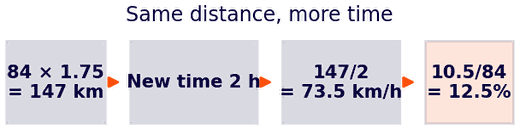 Distance = 84 × 1.75 = 147 km.
New time = 1.75 + 0.25 = 2 hours ⇒ new speed = = 73.5 km/h.
Decrease = 84 − 73.5 = 10.5 km/h.
× 100 = 12.5% — option (a).
Distance = 84 × 1.75 = 147 km.
New time = 1.75 + 0.25 = 2 hours ⇒ new speed = = 73.5 km/h.
Decrease = 84 − 73.5 = 10.5 km/h.
× 100 = 12.5% — option (a).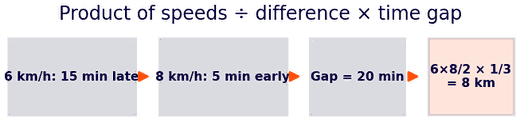 Time difference between the two speeds = 15 + 5 = 20 minutes = hour.
Distance = × time difference.
= × = 24 × .
= 8 km — option (c).
Time difference between the two speeds = 15 + 5 = 20 minutes = hour.
Distance = × time difference.
= × = 24 × .
= 8 km — option (c).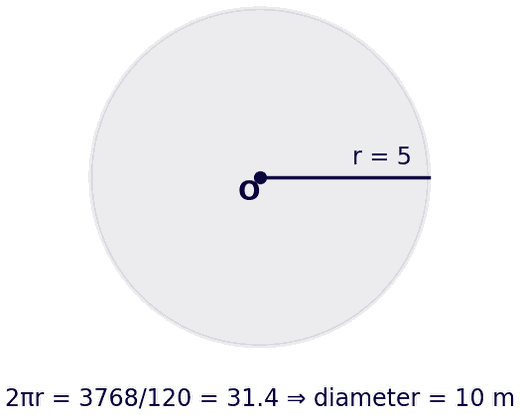 Length of the wall = circumference = = 31.4 m.
2πr = 31.4 ⇒ r = = 5 m.
Diameter = 2r.
= 10 m — option (b).
Length of the wall = circumference = = 31.4 m.
2πr = 31.4 ⇒ r = = 5 m.
Diameter = 2r.
= 10 m — option (b).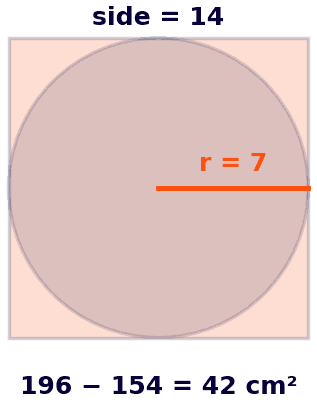 The circle just fits, so the square’s side = diameter = 14 cm.
Square area = 14² = 196 cm².
Circle area = × 7 × 7 = 154 cm².
Unused = 196 − 154 = 42 cm² — option (a).
The circle just fits, so the square’s side = diameter = 14 cm.
Square area = 14² = 196 cm².
Circle area = × 7 × 7 = 154 cm².
Unused = 196 − 154 = 42 cm² — option (a).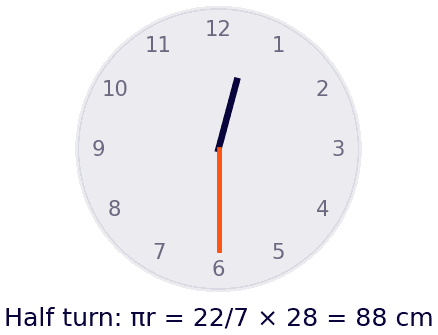 In 60 minutes the tip covers the full circumference 2πr.
In 30 minutes it covers half of that = πr.
= × 28 = 88.
Hence 88 cm — option (a).
In 60 minutes the tip covers the full circumference 2πr.
In 30 minutes it covers half of that = πr.
= × 28 = 88.
Hence 88 cm — option (a).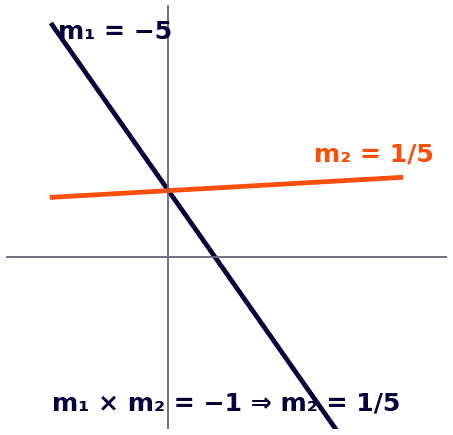 The given line has slope m₁ = −5.
For perpendicular lines m₁ × m₂ = −1.
m₂ = = .
Hence option (c).
The given line has slope m₁ = −5.
For perpendicular lines m₁ × m₂ = −1.
m₂ = = .
Hence option (c).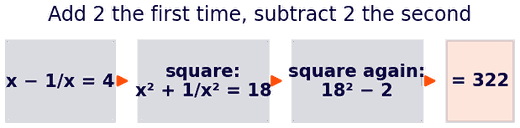 Square the given: x² + = 4² + 2 = 18.
Square again: (x² + )² = x⁴ + + 2.
18² = 324, so x⁴ + = 324 − 2.
= 322 — option (a).
Square the given: x² + = 4² + 2 = 18.
Square again: (x² + )² = x⁴ + + 2.
18² = 324, so x⁴ + = 324 − 2.
= 322 — option (a).