SSC CGL 17 September 2025 · Shift 3 · Quantitative Aptitude — questions with answers · ShikshaSphere
Chapter 71 of 192
17 September 2025 · Shift 3
Quantitative Aptitude
25 questions ~25 min readFree
25 questions
A
51
A gardener plants his trees in equal rows to form a square, but finds that 16 trees are left out. If the total number of trees is 4112, then what is the number of trees in each row?
A.42
B.54
C.64
D.65
Solution
Square formation of trees
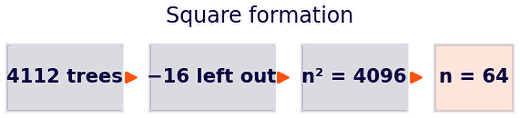
Let each row have n trees, so the square uses n² trees.
n² = 4112 − 16 = 4096.
n = .
= 64 — option (c).
52
If P is 25% more than Q, and Q is 20% more than R, then what is P : R?
A.3 : 2
B.4 : 3
C.7 : 4
D.3 : 4
Solution
Successive percentages
Take R = 100 ⇒ Q = 120 (20% more).
P = 1.25 × 120 = 150.
P : R = 150 : 100.
= 3 : 2 — option (a).
53
Evaluate
A.3
B.5
C.4
D.6
Solution
Infinite nested root
Let the value be x: x = ⇒ x² = x + 30.
x² − x − 30 = 0 ⇒ (x − 6)(x + 5) = 0.
Only the positive root is valid (short trick: 30 = 5 × 6, take the larger factor).
x = 6 — option (d).
54
The cost price of an article is ₹200. A shopkeeper sells it at a discount of 20% on the marked price. If the marked price is ₹400, what is the shopkeeper's profit or loss percentage?
Pipes A and B can fill a tank in 15 minutes and 30 minutes, respectively. Meanwhile, a drainpipe C can empty the tank in 60 minutes. If all three pipes are opened simultaneously, how long will it take to fill the tank?
A.12 min
B.20 min
C.25 min
D.10 min
Solution
Pipes with a leak
Take the tank as LCM(15, 30, 60) = 60 units.
A = 4 units/min, B = 2 units/min, C drains 1 unit/min.
Net rate = 4 + 2 − 1 = 5 units per minute.
60 ÷ 5 = 12 minutes — option (a).
56
Given a + b + c = 0, and a³ + b³ + c³ = 3abc, evaluate (a − b)³ + (b − c)³ + (c − a)³.
A.27abc
B.9(a − b)(b − c)(c − a)
C.0
D.3(a − b)(b − c)(c − a)
Solution
Identity — cubes
Note that (a − b) + (b − c) + (c − a) = 0.
Whenever three quantities add up to zero, the sum of their cubes equals three times their product.
So the expression = 3(a − b)(b − c)(c − a).
Hence option (d).
57
A sum of ₹9,000 is lent out in two parts, one at 6% simple interest and the other at 9% simple interest. If the annual interest is ₹630, the sum lent at 6% is:
A.₹6000
B.₹6500
C.₹3000
D.₹3500
Solution
SI — two parts
Overall rate = × 100 = 7%.
Alligation between 6% and 9% about 7%: (9 − 7) : (7 − 6) = 2 : 1.
The part at 6% is the larger share = × 9,000.
= ₹6,000 — option (a).
58
Ramesh has ₹15,000. He lends a part of it to Asha for 3 years at 10% simple interest and the remaining to Meena for 3 years at 12% simple interest. If the total interest received from both after 3 years is ₹4,950, find the amount lent to Asha.
A.₹9,000
B.₹7,500
C.₹8,000
D.₹6,500
Solution
SI — Asha and Meena
Interest for one year = = ₹1,650.
Overall rate = × 100 = 11%.
Alligation between 10% and 12% about 11% gives 1 : 1.
Asha’s share = = ₹7,500 — option (b).
59
A steel cable is tied from the top of a vertical flagpole to a point on the ground 20 metres away from its base. If the cable makes an angle of 60° with the ground, find the length of the cable.
A.10 m
B.10 m
C.40 m
D.20 m
Solution
Trigonometry — cable
In a 30°-60°-90° triangle the sides are in the ratio 1 : : 2.
The base (adjacent to 60°) is the smallest side = 1 unit = 20 m.
The cable is the hypotenuse = 2 units.
2 × 20 = 40 m — option (c).
60
A cone and a sphere have equal volumes. If the cone's height is thrice its radius, what is the ratio of the cone's radius to the sphere's radius?
A.∛2 : ∛3
B.∛4 : ∛3
C.∛4 : ∛2
D.∛3 : ∛4
Solution
Cone and sphere — equal volumes
Cone: πR² × 3R = πR³. Sphere: πr³.
Equating: πR³ = πr³ ⇒ = .
Take the cube root of both sides.
R : r = ∛4 : ∛3 — option (b).
61
A sphere and a cylinder of equal radii have equal total surface areas. Find the ratio of cylinder height to radius.
A.1 : 1
B.7 : 4
C.6 : 5
D.2 : 5
Solution
Sphere and cylinder — equal TSA
Sphere TSA = 4πr²; cylinder TSA = 2πr² + 2πrh.
Equate: 4πr² = 2πr² + 2πrh ⇒ 2πr² = 2πrh.
Cancel 2πr: r = h.
h : r = 1 : 1 — option (a).
62
A large cubical cake needs to be cut into 27 smaller, identical cubical pieces. What is the minimum number of straight cuts required?
A.8
B.6
C.4
D.5
Solution
Cuts for 27 cubes
27 = 3 × 3 × 3, so each edge must be divided into 3 parts.
Minimum cuts = (3−1) + (3−1) + (3−1).
= 2 + 2 + 2.
= 6 — option (b).
63
The radius of a cone is raised by 25%, while the height is reduced by 10%. What is the percentage change in the volume of the cone?
If sinA = and A lies in the second quadrant, find the value of (sinA + cosA)².
A.0
B.1
C.
D.
Solution
Second quadrant
With (5, 12, 13), cosA = − because cosine is negative in the second quadrant.
(sinA + cosA)² = sin²A + cos²A + 2 sinA cosA = 1 + 2()(−).
= 1 − = .
= — option (c).
65
If sinA = , then what is the value of (1 + tan²A)?
A.
B.
C.
D.
Solution
1 + tan²A
sinA = means perpendicular p and hypotenuse q, so base = .
1 + tan²A = sec²A = ()².
cosA = , so sec²A = .
Hence option (a).
66
What is the slope of the line passing through points (3, 4) and (5, 8)?
A.2
B.3
C.5
D.4
Solution
Slope from two points
Slope m = .
= .
= .
= 2 — option (a).
67
A sector has a central angle of 180° and a radius of 24 cm. Another sector has a central angle of radians and the same radius. What is the ratio of the area of the first sector to the area of the second sector?
A.3 : 2
B.2 : 1
C.1 : 2
D.1 : 3
Solution
Sectors — 180° vs π/2
radians = 90°.
With the same radius, sector area is proportional to the angle.
180° : 90°.
= 2 : 1 — option (b).
68
What is the total measure of all interior angles in an 8-sided polygon?
A.1540°
B.1080°
C.1220°
D.900°
Solution
Interior angles of octagon
Sum of interior angles = (n − 2) × 180°.
For n = 8: (8 − 2) × 180°.
= 6 × 180°.
= 1080° — option (b).
69
What is the equation of the perpendicular bisector of the line segment connecting the points (4, 8) and (2, 6)?
A.y = −x − 10
B.y = x − 3
C.y = −x + 10
D.y = x + 4
Solution
Perpendicular bisector
Midpoint = (, ) = (3, 7).
Slope of the segment = = 1, so the perpendicular slope = −1.
Equation: y − 7 = −1(x − 3).
y = −x + 10 — option (c).
70
The ratios of the perimeters of two similar triangles are expressed as 5 : 7. Together, their areas total 74 cm². What is the area of the larger triangle?
A.39 cm²
B.45 cm²
C.49 cm²
D.35 cm²
Solution
Similar triangles — areas
In similar triangles the areas vary as the square of the perimeters.
Area ratio = 5² : 7² = 25 : 49, i.e. 74 parts in all.
74 parts = 74 cm², so 1 part = 1 cm².
Larger area = 49 cm² — option (c).
A tangent line PA is drawn from an external point P to a circle. If the radius is 7 cm and the distance from P to the centre is 25 cm, what is the length of the tangent PA?
A.19 cm
B.26 cm
C.24 cm
D.28 cm
Solution
Length of tangent
The radius meets the tangent at 90°, so △APO is right-angled at A.
OP² = OA² + PA² ⇒ 25² = 7² + PA².
PA² = 625 − 49 = 576.
PA = 24 cm — option (c).
74
When two tangents, PA and PB, are drawn to a circle from a point P outside the circle, and the angle between them is 90°, what is the distance from P to the centre (O) of the circle, if the radius is 6 cm?
A.6 cm
B.6 cm
C.12 cm
D.6 cm
Solution
Tangents at 90°
In quadrilateral AOBP the angles at A and B are 90° each and ∠APB = 90°.
So ∠AOB = 360° − 270° = 90°, making OAPB a square of side 6.
OP is its diagonal = 6.
= 6 cm — option (b).
75
Multiply 0.48 by 0.7 and express the result as a decimal.
A.0.386
B.0.336
C.0.236
D.0.254
Solution
Decimal multiplication
Multiply without decimals: 48 × 7 = 336.
The two numbers have 2 + 1 = 3 decimal places in all.
So place the decimal three digits from the right.
= 0.336 — option (b).
Finished reading? Now test yourself.
The same 25 questions, but with a timer and the answers hidden — 15 minutes.

 Let each row have n trees, so the square uses n² trees.
n² = 4112 − 16 = 4096.
n = .
= 64 — option (c).
Let each row have n trees, so the square uses n² trees.
n² = 4112 − 16 = 4096.
n = .
= 64 — option (c).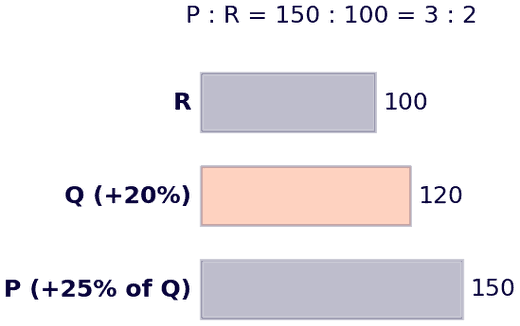 Take R = 100 ⇒ Q = 120 (20% more).
P = 1.25 × 120 = 150.
P : R = 150 : 100.
= 3 : 2 — option (a).
Take R = 100 ⇒ Q = 120 (20% more).
P = 1.25 × 120 = 150.
P : R = 150 : 100.
= 3 : 2 — option (a).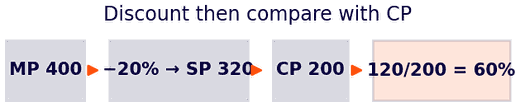 SP = 400 × = ₹320.
Profit = 320 − 200 = ₹120.
Profit% = × 100.
= 60% profit — option (a).
SP = 400 × = ₹320.
Profit = 320 − 200 = ₹120.
Profit% = × 100.
= 60% profit — option (a).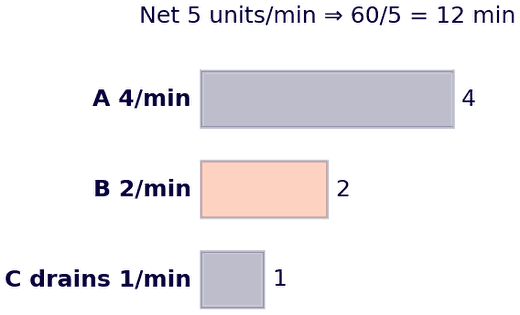 Take the tank as LCM(15, 30, 60) = 60 units.
A = 4 units/min, B = 2 units/min, C drains 1 unit/min.
Net rate = 4 + 2 − 1 = 5 units per minute.
60 ÷ 5 = 12 minutes — option (a).
Take the tank as LCM(15, 30, 60) = 60 units.
A = 4 units/min, B = 2 units/min, C drains 1 unit/min.
Net rate = 4 + 2 − 1 = 5 units per minute.
60 ÷ 5 = 12 minutes — option (a).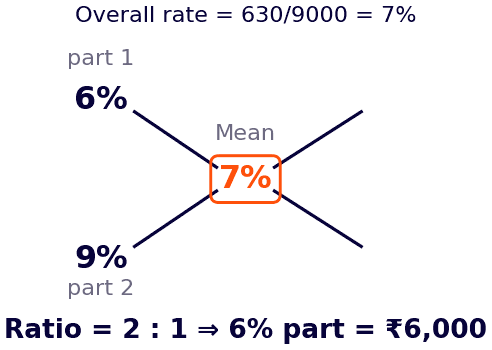 Overall rate = × 100 = 7%.
Alligation between 6% and 9% about 7%: (9 − 7) : (7 − 6) = 2 : 1.
The part at 6% is the larger share = × 9,000.
= ₹6,000 — option (a).
Overall rate = × 100 = 7%.
Alligation between 6% and 9% about 7%: (9 − 7) : (7 − 6) = 2 : 1.
The part at 6% is the larger share = × 9,000.
= ₹6,000 — option (a).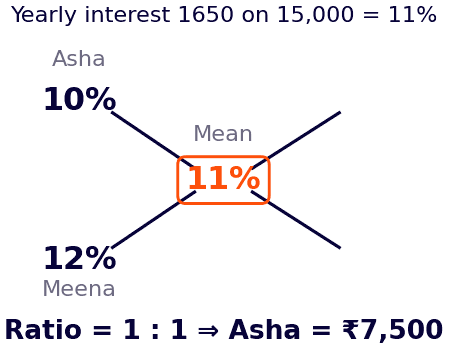 Interest for one year = = ₹1,650.
Overall rate = × 100 = 11%.
Alligation between 10% and 12% about 11% gives 1 : 1.
Asha’s share = = ₹7,500 — option (b).
Interest for one year = = ₹1,650.
Overall rate = × 100 = 11%.
Alligation between 10% and 12% about 11% gives 1 : 1.
Asha’s share = = ₹7,500 — option (b).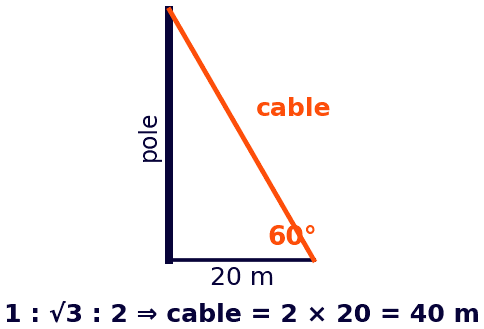 In a 30°-60°-90° triangle the sides are in the ratio 1 : : 2.
The base (adjacent to 60°) is the smallest side = 1 unit = 20 m.
The cable is the hypotenuse = 2 units.
2 × 20 = 40 m — option (c).
In a 30°-60°-90° triangle the sides are in the ratio 1 : : 2.
The base (adjacent to 60°) is the smallest side = 1 unit = 20 m.
The cable is the hypotenuse = 2 units.
2 × 20 = 40 m — option (c).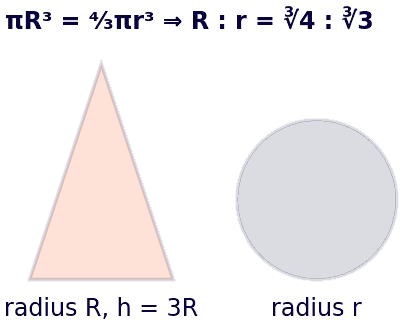 Cone: πR² × 3R = πR³. Sphere: πr³.
Equating: πR³ = πr³ ⇒ = .
Take the cube root of both sides.
R : r = ∛4 : ∛3 — option (b).
Cone: πR² × 3R = πR³. Sphere: πr³.
Equating: πR³ = πr³ ⇒ = .
Take the cube root of both sides.
R : r = ∛4 : ∛3 — option (b).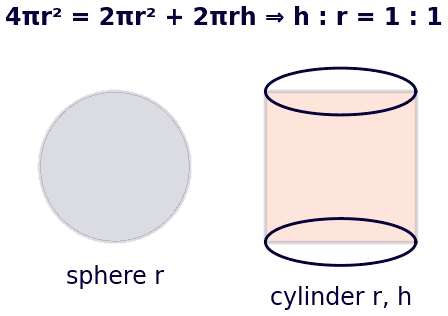 Sphere TSA = 4πr²; cylinder TSA = 2πr² + 2πrh.
Equate: 4πr² = 2πr² + 2πrh ⇒ 2πr² = 2πrh.
Cancel 2πr: r = h.
h : r = 1 : 1 — option (a).
Sphere TSA = 4πr²; cylinder TSA = 2πr² + 2πrh.
Equate: 4πr² = 2πr² + 2πrh ⇒ 2πr² = 2πrh.
Cancel 2πr: r = h.
h : r = 1 : 1 — option (a).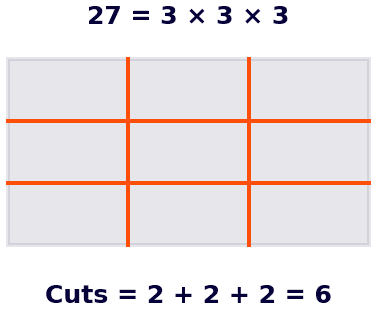 27 = 3 × 3 × 3, so each edge must be divided into 3 parts.
Minimum cuts = (3−1) + (3−1) + (3−1).
= 2 + 2 + 2.
= 6 — option (b).
27 = 3 × 3 × 3, so each edge must be divided into 3 parts.
Minimum cuts = (3−1) + (3−1) + (3−1).
= 2 + 2 + 2.
= 6 — option (b). Volume ∝ r²h.
New factor = (1.25)² × 0.90 = 1.5625 × 0.90 = 1.40625.
Change = 1.40625 − 1 = 0.40625.
≈ 40.6% increase — option (b).
Volume ∝ r²h.
New factor = (1.25)² × 0.90 = 1.5625 × 0.90 = 1.40625.
Change = 1.40625 − 1 = 0.40625.
≈ 40.6% increase — option (b).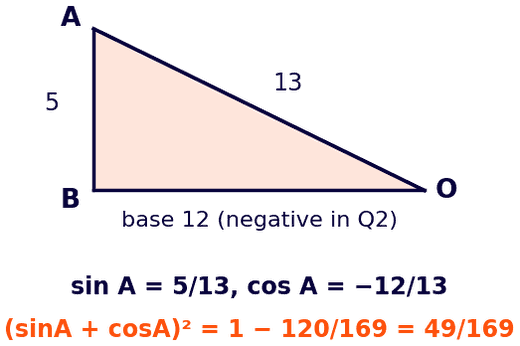 With (5, 12, 13), cosA = − because cosine is negative in the second quadrant.
(sinA + cosA)² = sin²A + cos²A + 2 sinA cosA = 1 + 2()(−).
= 1 − = .
= — option (c).
With (5, 12, 13), cosA = − because cosine is negative in the second quadrant.
(sinA + cosA)² = sin²A + cos²A + 2 sinA cosA = 1 + 2()(−).
= 1 − = .
= — option (c).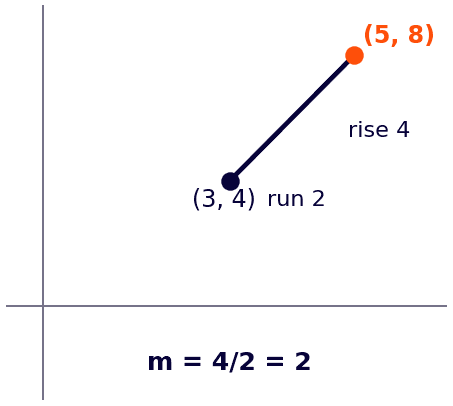 Slope m = .
= .
= .
= 2 — option (a).
Slope m = .
= .
= .
= 2 — option (a).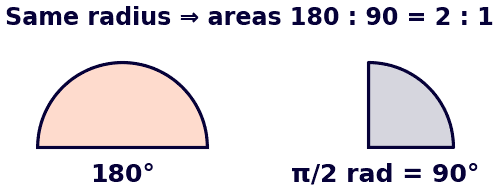 radians = 90°.
With the same radius, sector area is proportional to the angle.
180° : 90°.
= 2 : 1 — option (b).
radians = 90°.
With the same radius, sector area is proportional to the angle.
180° : 90°.
= 2 : 1 — option (b).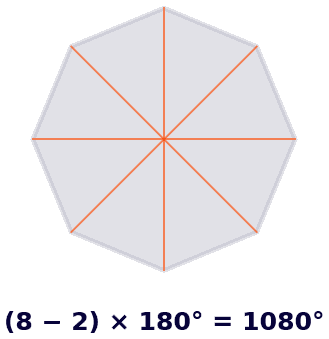 Sum of interior angles = (n − 2) × 180°.
For n = 8: (8 − 2) × 180°.
= 6 × 180°.
= 1080° — option (b).
Sum of interior angles = (n − 2) × 180°.
For n = 8: (8 − 2) × 180°.
= 6 × 180°.
= 1080° — option (b).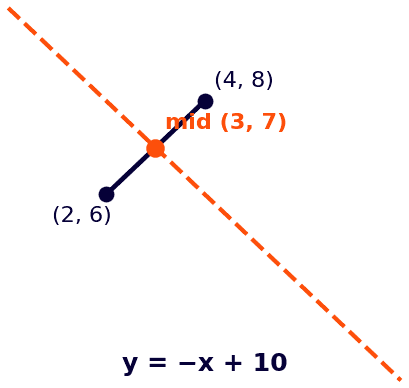 Midpoint = (, ) = (3, 7).
Slope of the segment = = 1, so the perpendicular slope = −1.
Equation: y − 7 = −1(x − 3).
y = −x + 10 — option (c).
Midpoint = (, ) = (3, 7).
Slope of the segment = = 1, so the perpendicular slope = −1.
Equation: y − 7 = −1(x − 3).
y = −x + 10 — option (c).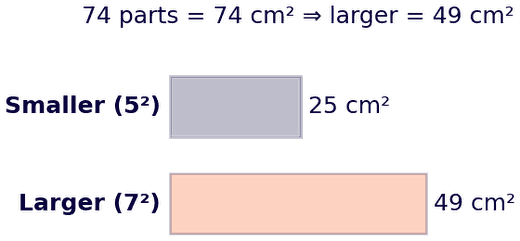 In similar triangles the areas vary as the square of the perimeters.
Area ratio = 5² : 7² = 25 : 49, i.e. 74 parts in all.
74 parts = 74 cm², so 1 part = 1 cm².
Larger area = 49 cm² — option (c).
In similar triangles the areas vary as the square of the perimeters.
Area ratio = 5² : 7² = 25 : 49, i.e. 74 parts in all.
74 parts = 74 cm², so 1 part = 1 cm².
Larger area = 49 cm² — option (c).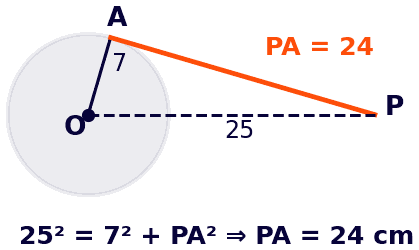 The radius meets the tangent at 90°, so △APO is right-angled at A.
OP² = OA² + PA² ⇒ 25² = 7² + PA².
PA² = 625 − 49 = 576.
PA = 24 cm — option (c).
The radius meets the tangent at 90°, so △APO is right-angled at A.
OP² = OA² + PA² ⇒ 25² = 7² + PA².
PA² = 625 − 49 = 576.
PA = 24 cm — option (c).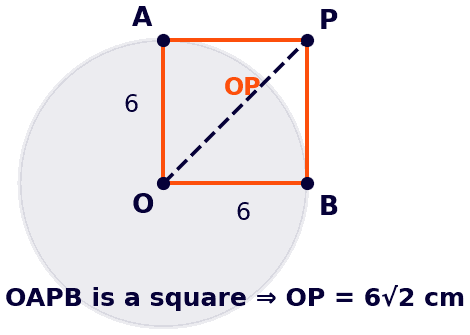 In quadrilateral AOBP the angles at A and B are 90° each and ∠APB = 90°.
So ∠AOB = 360° − 270° = 90°, making OAPB a square of side 6.
OP is its diagonal = 6.
= 6 cm — option (b).
In quadrilateral AOBP the angles at A and B are 90° each and ∠APB = 90°.
So ∠AOB = 360° − 270° = 90°, making OAPB a square of side 6.
OP is its diagonal = 6.
= 6 cm — option (b).