SSC CGL 18 September 2025 · Shift 1 · General Intelligence & Reasoning — questions with answers · ShikshaSphere
Chapter 73 of 192
18 September 2025 · Shift 1
General Intelligence & Reasoning
25 questions ~25 min readFree
25 questions
A
1
Select the letter-cluster from among the given options that can replace the question mark (?) in the following series.
FIM, ILP, LOS, ?
A.ORU
B.ORV
C.OVU
D.NOU
Solution
Letter series (+3)
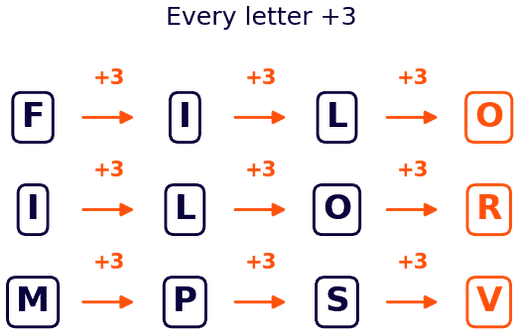
Every letter of a cluster moves +3 in the next cluster.
1st letters: F, I, L → O; 2nd letters: I, L, O → R.
3rd letters: M, P, S → V.
Hence ORV — option (b).
2
A statement is given followed by two conclusions. Find which conclusion is TRUE based on the given statement.Statement: P ≥ L; X = Y ≥ M; R ≥ Y < Z; L ≥ X
Conclusions:
I. X ≤ M
II. P ≥ R
A.Either I or II
B.Only II
C.Only I
D.Neither I nor II
Solution
Coded inequality
For I: X = Y ≥ M means X is greater than or equal to M, so X ≤ M cannot be established — I is false.
For II: P ≥ L ≥ X = Y and R ≥ Y — both P and R stand above Y, so no definite relation between them.
Hence II is false too.
Neither I nor II — option (d).
3
R is the wife of S. S is the son of T. U is the daughter of R. How is U related to T?
A.Granddaughter
B.Daughter
C.Sister
D.Niece
Solution
Blood relation
S is T’s son and R is S’s wife, so R is T’s daughter-in-law.
U is the daughter of R (and S).
So U belongs to the generation below S — she is T’s granddaughter.
Hence option (a).
4
Solve: TIME : ? :: LEAF : FAEL
A.EMIS
B.EMIT
C.EMTI
D.ETMI
Solution
Word reversal
LEAF written backwards gives FAEL — the letters are simply reversed.
Reverse TIME letter by letter: E, M, I, T.
That is EMIT.
Hence option (b).
5
What comes next: 2, 4, 12, 48, ?
A.240
B.250
C.290
D.210
Solution
Series (×2, ×3, ×4, ×5)
The multipliers rise by one each time: ×2, ×3, ×4, …
2×2 = 4, 4×3 = 12, 12×4 = 48 ✓.
Next: 48 × 5.
= 240 — option (a).
6
Read the following statement carefully and identify the conclusion that follows.Statement: All drivers must wear seat belts while driving.
Conclusions:
I. Drivers who do not wear seat belts are violating the law.
II. Wearing a seat belt ensures safety while driving.
A.Only I
B.Only II
C.Both follow
D.Neither follows
Solution
Statement — conclusions
The statement makes seat belts compulsory, so not wearing one is a violation — I follows.
II claims a seat belt ENSURES safety; the statement never promises complete safety.
Belts reduce injury but cannot guarantee it.
Hence Only I — option (a).
7
Identify the assumptions that must hold for the statement to be valid, then choose the correct option.Statement: To reduce traffic congestion in metropolitan cities, authorities should enhance public transportation facilities, even though it involves large initial investments.
Assumptions:
I. Better public transport can reduce traffic congestion.
II. Large investments in public transport are worth making.
III. People will readily give up their private vehicles.
A.Only I and II are implicit
B.Only II and III are implicit
C.All I, II and III are implicit
D.Only I is implicit
Solution
Statement — assumptions
The recommendation makes sense only if better transport can cut congestion — I is implicit.
Saying it should be done "even though it involves large investments" assumes the spending is worthwhile — II is implicit.
III speaks of people’s willingness, which the statement never touches.
Hence Only I and II — option (a).
8
Read the following statement carefully and identify the conclusion that follows.Statement: Millions of candidates registered for the national scholarship test this year.
Conclusions:
I. The test is widely taken and competitive.
II. All candidates who registered will receive the scholarship.
A.Only Conclusion I follows
B.Only Conclusion II follows
C.Both I and II follow
D.Neither I nor II follows
Solution
Statement — conclusions
Millions of registrations show the test is popular and therefore competitive — I follows.
Scholarships are limited; nothing suggests every registrant will get one — II does not follow.
So only the first conclusion holds.
Hence option (a).
9
Read the following statements carefully and identify the conclusion that follows.Statements:
All triangles are shapes.
Some shapes are rectangles.
All rectangles are polygons.
Conclusions:
I. Some shapes are polygons.
II. Some polygons are triangles.
A.Only I follows
B.Only II follows
C.Both I and II follow
D.Neither I nor II follows
Solution
Syllogism
Some shapes are rectangles and all rectangles are polygons, so those shapes are polygons — I follows.
Triangles are shapes, but nothing links them to the rectangle-polygon group — II is not certain.
So only the first conclusion holds.
Hence option (a).
10
Find the odd one out:
Rose, Jasmine, Banyan, Lily, Daffodil
A.Rose
B.Jasmine
C.Banyan
D.Lily
Solution
Flowers vs tree
Rose, jasmine, lily and daffodil are all FLOWERS.
Banyan is a tree.
It belongs to a different category.
Hence option (c).
11
In each of the following questions, the second word is formed by applying a specific rearrangement or transformation to the first. Identify the same pattern and apply it to the third word to find the correct answer from the given alternatives.
FRUITS : STIURF :: FLOWER : ?
A.REWOFL
B.REWOLF
C.REWFLO
D.REFLOW
Solution
Word reversal
FRUITS written backwards gives STIURF.
Reverse FLOWER letter by letter: R, E, W, O, L, F.
That is REWOLF.
Hence option (b).
12
If MANGO is coded as LZODO, how is LEMON written?
A.KDNLN
B.LZLFP
C.LZMFQ
D.LZLFO
Solution
Coding (−1, −1, +1, −3, 0)
MANGO → LZODO: M−1 = L, A−1 = Z, N+1 = O, G−3 = D, O+0 = O.
So the shifts by position are −1, −1, +1, −3, 0.
LEMON: L−1 = K, E−1 = D, M+1 = N, O−3 = L, N+0 = N.
Hence KDNLN — option (a).
13
Rearrange the letters of the word "NAILS" to form the name of an animal.
A.SLAIN
B.SNAIL
C.LAINS
D.NILAS
Solution
Jumbled word — SNAIL
The letters N, A, I, L, S are to be rearranged.
They form the word SNAIL.
A snail is a small shelled animal (the others are not animals).
Hence option (b).
Letter series (+1)
Every letter of the cluster moves +1 each time.
1st letters: N, O, P, Q → R; 2nd letters: P, Q, R, S → T.
3rd letters: B, C, D, E → F.
Hence RTF — option (d).
16
Find the odd one out from the given alternatives:
A.Dholavira
B.Kalibangan
C.Mohenjodaro
D.Vikramashila
Solution
Indus sites
Dholavira, Kalibangan and Mohenjodaro are all Indus Valley Civilization sites.
Vikramashila was an ancient Buddhist university in Bihar.
It belongs to a different period and category.
Hence option (d).
17
Find the odd one out from the given alternatives.
A.Guitar
B.Violin
C.Sarangi
D.Tabla
Solution
String vs percussion
Guitar, violin and sarangi are all STRING instruments.
Tabla is a percussion instrument played by striking.
So it differs in category.
Hence option (d).
18
Which of the following groups does not follow the same arithmetic rule?
A.6, 18, 54
B.5, 10, 20
C.2, 4, 8
D.3, 6, 12
Solution
Doubling groups
In (b), (c) and (d) each number is TWICE the previous one.
5→10→20 ✓, 2→4→8 ✓, 3→6→12 ✓.
In (a) the numbers triple: 6→18→54 ✗.
Hence option (a).
In a code language, "The plants grow tall" is coded as "to ko co po", "The plants grow short" is coded as "to ko do po", "The grass grows tall" is coded as "bo to co po".
Question: What is the code for "The grass grows short"?
A.bo to po do
B.so lo to fo
C.po ko go jo
D.no ko mo no
Solution
Code language
Comparing the first two lines, only "tall/short" differ: co = tall and do = short.
Comparing lines 1 and 3, ko = plants and bo = grass; to and po are the common words.
So "The grass grows short" uses bo (grass), do (short) and the two common codes to, po.
= bo to po do — option (a).
21
A boat travels 60 km upstream in 2 hours and covers the same distance of 60 kilometres downstream in 1 hour. What is the speed of the boat in still water?
A.39 km/h
B.48 km/h
C.45 km/h
D.40 km/h
Solution
Boat and stream
Upstream speed = = 30 km/h; downstream speed = = 60 km/h.
Speed in still water = .
= = .
= 45 km/h — option (c).
22
Ram says, "The son of my wife's brother is my ____".
A.Brother-in-law
B.Nephew
C.Cousin
D.Son-in-law
Solution
Blood relation
Ram's wife's brother is his brother-in-law.
That brother-in-law’s son belongs to the next generation.
A brother-in-law’s son is one’s nephew.
Hence option (b).
23
If '×' means '−', '−' means '+', '+' means '÷', then 18 + 9 × 3 − 6 = ?
If the sum of 27 and 15 is multiplied by 8, what is the result?
A.323
B.332
C.341
D.336
Solution
Sum then multiply
First add: 27 + 15 = 42.
Then multiply by 8.
42 × 8 = 336.
Hence option (d).
25
The series given below contains a sequence of numbers. Accordingly identify the incorrect number.
4, 5, 14, 12, 34, 32, 74, 68
A.34
B.14
C.12
D.32
Solution
Wrong term in series
Split the series into two chains. Odd places: 4, 14, 34, 74 — each term is ×2 + 6 ✓.
Even places: 5, 12, 32, 68 — the rule should be ×2 + 4.
5×2+4 = 14 (not 12); then 14×2+4 = 32 ✓ and 32×2+4 = 68 ✓.
So 12 is the incorrect term — option (c).
Finished reading? Now test yourself.
The same 25 questions, but with a timer and the answers hidden — 15 minutes.

 Every letter of a cluster moves +3 in the next cluster.
1st letters: F, I, L → O; 2nd letters: I, L, O → R.
3rd letters: M, P, S → V.
Hence ORV — option (b).
Every letter of a cluster moves +3 in the next cluster.
1st letters: F, I, L → O; 2nd letters: I, L, O → R.
3rd letters: M, P, S → V.
Hence ORV — option (b).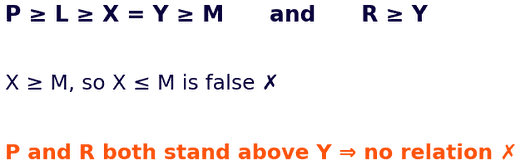 For I: X = Y ≥ M means X is greater than or equal to M, so X ≤ M cannot be established — I is false.
For II: P ≥ L ≥ X = Y and R ≥ Y — both P and R stand above Y, so no definite relation between them.
Hence II is false too.
Neither I nor II — option (d).
For I: X = Y ≥ M means X is greater than or equal to M, so X ≤ M cannot be established — I is false.
For II: P ≥ L ≥ X = Y and R ≥ Y — both P and R stand above Y, so no definite relation between them.
Hence II is false too.
Neither I nor II — option (d).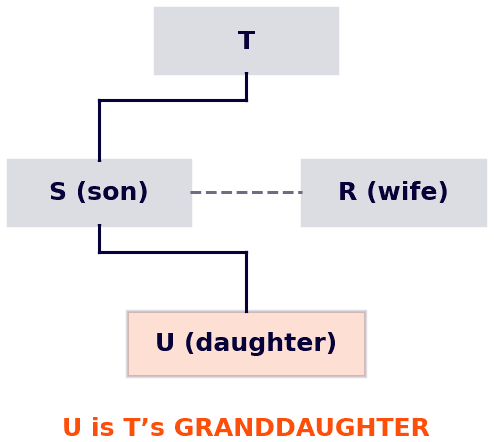 S is T’s son and R is S’s wife, so R is T’s daughter-in-law.
U is the daughter of R (and S).
So U belongs to the generation below S — she is T’s granddaughter.
Hence option (a).
S is T’s son and R is S’s wife, so R is T’s daughter-in-law.
U is the daughter of R (and S).
So U belongs to the generation below S — she is T’s granddaughter.
Hence option (a).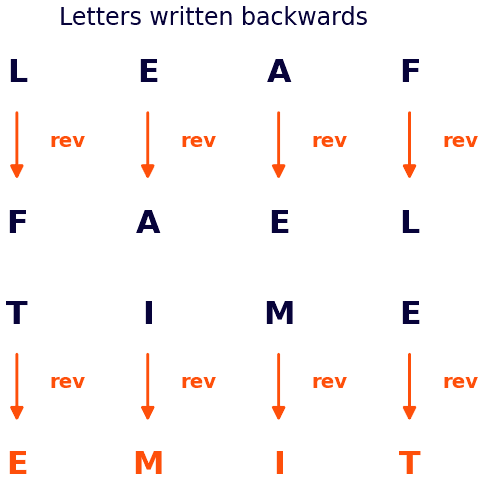 LEAF written backwards gives FAEL — the letters are simply reversed.
Reverse TIME letter by letter: E, M, I, T.
That is EMIT.
Hence option (b).
LEAF written backwards gives FAEL — the letters are simply reversed.
Reverse TIME letter by letter: E, M, I, T.
That is EMIT.
Hence option (b).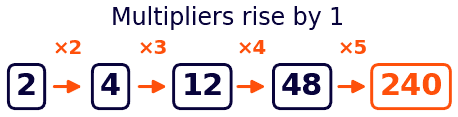 The multipliers rise by one each time: ×2, ×3, ×4, …
2×2 = 4, 4×3 = 12, 12×4 = 48 ✓.
Next: 48 × 5.
= 240 — option (a).
The multipliers rise by one each time: ×2, ×3, ×4, …
2×2 = 4, 4×3 = 12, 12×4 = 48 ✓.
Next: 48 × 5.
= 240 — option (a).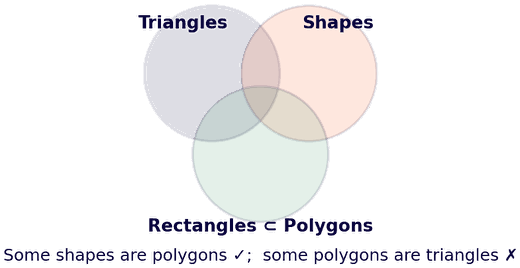 Some shapes are rectangles and all rectangles are polygons, so those shapes are polygons — I follows.
Triangles are shapes, but nothing links them to the rectangle-polygon group — II is not certain.
So only the first conclusion holds.
Hence option (a).
Some shapes are rectangles and all rectangles are polygons, so those shapes are polygons — I follows.
Triangles are shapes, but nothing links them to the rectangle-polygon group — II is not certain.
So only the first conclusion holds.
Hence option (a).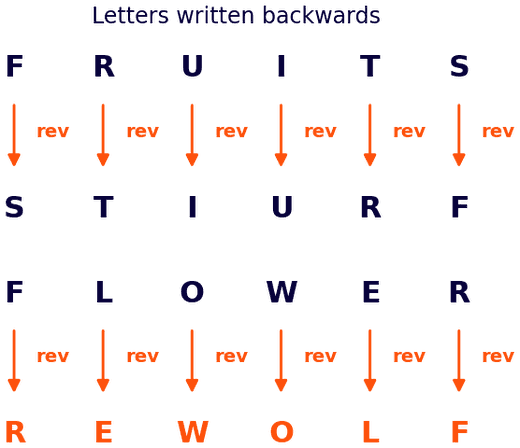 FRUITS written backwards gives STIURF.
Reverse FLOWER letter by letter: R, E, W, O, L, F.
That is REWOLF.
Hence option (b).
FRUITS written backwards gives STIURF.
Reverse FLOWER letter by letter: R, E, W, O, L, F.
That is REWOLF.
Hence option (b).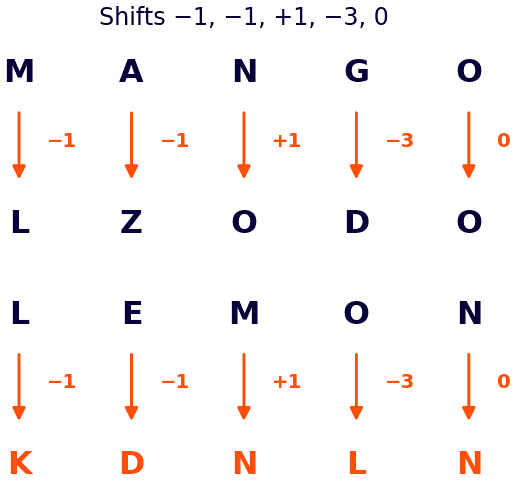 MANGO → LZODO: M−1 = L, A−1 = Z, N+1 = O, G−3 = D, O+0 = O.
So the shifts by position are −1, −1, +1, −3, 0.
LEMON: L−1 = K, E−1 = D, M+1 = N, O−3 = L, N+0 = N.
Hence KDNLN — option (a).
MANGO → LZODO: M−1 = L, A−1 = Z, N+1 = O, G−3 = D, O+0 = O.
So the shifts by position are −1, −1, +1, −3, 0.
LEMON: L−1 = K, E−1 = D, M+1 = N, O−3 = L, N+0 = N.
Hence KDNLN — option (a). The operations alternate: +2, ×2, +2, ×2, …
3 + 2 = 5, 5 × 2 = 10, 10 + 2 = 12 ✓.
Next: 12 × 2 = 24, then 24 + 2 = 26 and 26 × 2 = 52 ✓.
Hence 24 — option (a).
The operations alternate: +2, ×2, +2, ×2, …
3 + 2 = 5, 5 × 2 = 10, 10 + 2 = 12 ✓.
Next: 12 × 2 = 24, then 24 + 2 = 26 and 26 × 2 = 52 ✓.
Hence 24 — option (a).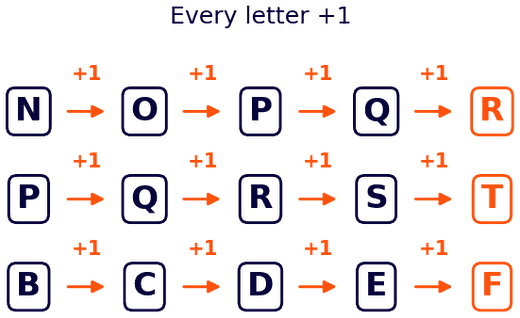 Every letter of the cluster moves +1 each time.
1st letters: N, O, P, Q → R; 2nd letters: P, Q, R, S → T.
3rd letters: B, C, D, E → F.
Hence RTF — option (d).
Every letter of the cluster moves +1 each time.
1st letters: N, O, P, Q → R; 2nd letters: P, Q, R, S → T.
3rd letters: B, C, D, E → F.
Hence RTF — option (d).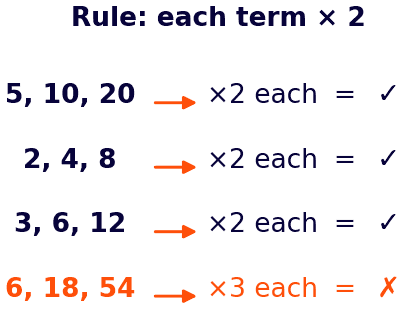 In (b), (c) and (d) each number is TWICE the previous one.
5→10→20 ✓, 2→4→8 ✓, 3→6→12 ✓.
In (a) the numbers triple: 6→18→54 ✗.
Hence option (a).
In (b), (c) and (d) each number is TWICE the previous one.
5→10→20 ✓, 2→4→8 ✓, 3→6→12 ✓.
In (a) the numbers triple: 6→18→54 ✗.
Hence option (a).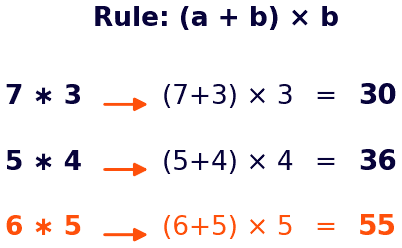 Rule: (first + second) × second.
Check: (7+3)×3 = 30 ✓; (5+4)×4 = 36 ✓.
6 ∗ 5 = (6+5) × 5 = 11 × 5.
= 55 — option (c).
Rule: (first + second) × second.
Check: (7+3)×3 = 30 ✓; (5+4)×4 = 36 ✓.
6 ∗ 5 = (6+5) × 5 = 11 × 5.
= 55 — option (c).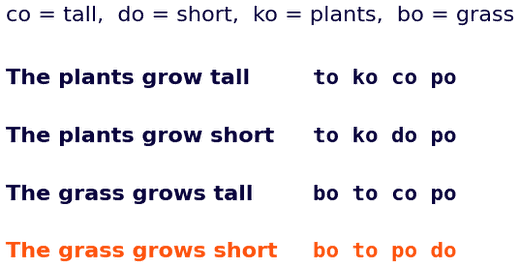 Comparing the first two lines, only "tall/short" differ: co = tall and do = short.
Comparing lines 1 and 3, ko = plants and bo = grass; to and po are the common words.
So "The grass grows short" uses bo (grass), do (short) and the two common codes to, po.
= bo to po do — option (a).
Comparing the first two lines, only "tall/short" differ: co = tall and do = short.
Comparing lines 1 and 3, ko = plants and bo = grass; to and po are the common words.
So "The grass grows short" uses bo (grass), do (short) and the two common codes to, po.
= bo to po do — option (a).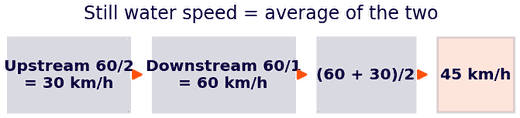 Upstream speed = = 30 km/h; downstream speed = = 60 km/h.
Speed in still water = .
= = .
= 45 km/h — option (c).
Upstream speed = = 30 km/h; downstream speed = = 60 km/h.
Speed in still water = .
= = .
= 45 km/h — option (c).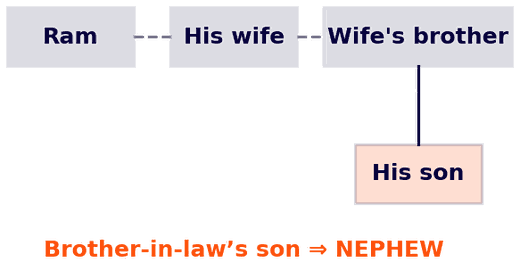 Ram's wife's brother is his brother-in-law.
That brother-in-law’s son belongs to the next generation.
A brother-in-law’s son is one’s nephew.
Hence option (b).
Ram's wife's brother is his brother-in-law.
That brother-in-law’s son belongs to the next generation.
A brother-in-law’s son is one’s nephew.
Hence option (b).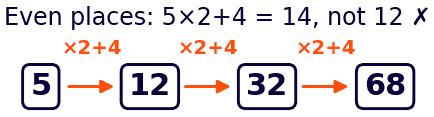 Split the series into two chains. Odd places: 4, 14, 34, 74 — each term is ×2 + 6 ✓.
Even places: 5, 12, 32, 68 — the rule should be ×2 + 4.
5×2+4 = 14 (not 12); then 14×2+4 = 32 ✓ and 32×2+4 = 68 ✓.
So 12 is the incorrect term — option (c).
Split the series into two chains. Odd places: 4, 14, 34, 74 — each term is ×2 + 6 ✓.
Even places: 5, 12, 32, 68 — the rule should be ×2 + 4.
5×2+4 = 14 (not 12); then 14×2+4 = 32 ✓ and 32×2+4 = 68 ✓.
So 12 is the incorrect term — option (c).