SSC CGL 18 September 2025 · Shift 3 · General Intelligence & Reasoning — questions with answers · ShikshaSphere
Chapter 81 of 192
18 September 2025 · Shift 3
General Intelligence & Reasoning
25 questions ~25 min readFree
25 questions
A
1
Select the letter-cluster from among the given options that can replace the question mark (?) in the following series.
INS, NSX, SXC, XCH, ?
A.CHN
B.ENM
C.FHM
D.CHM
Solution
Letter series (+5)
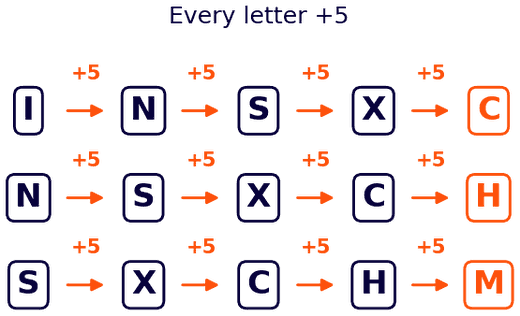
Every letter of a cluster moves +5 in the next cluster.
1st letters: I, N, S, X → C (cyclic); 2nd letters: N, S, X, C → H.
3rd letters: S, X, C, H → M.
Hence CHM — option (d).
2
If 4 @ 2 = 4, 15 @ 3 = 125, then 8 @ 4 = ?
A.4
B.8
C.16
D.10
Solution
Number puzzle (a/b)^b
Rule: () raised to the power of the second number.
Check: ()² = 2² = 4 ✓; ()³ = 5³ = 125 ✓.
8 @ 4 = ()⁴ = 2⁴.
= 16 — option (c).
3
Choose the correct signs to swap.
31 ÷ 48 × 7 − 322 + 23 = 353
A.÷ and −
B.− and ×
C.÷ and +
D.× and +
Solution
Swap signs
Swap ÷ and + : the equation becomes 31 + 48 × 7 − 322 ÷ 23.
BODMAS: 48 × 7 = 336 and 322 ÷ 23 = 14.
31 + 336 − 14 = 353 ✓ — it matches the right-hand side.
Hence ÷ and + — option (c).
4
P is the brother of Q. Q is the sister of R. R is the brother of S. How is Q related to S?
A.Sister
B.Aunt
C.Niece
D.Can't say
Solution
Blood relation
P, Q, R and S all belong to the same generation — they are siblings.
Q is stated to be a sister.
So Q is the sister of S as well.
Hence option (a).
5
Solve: GE : LI :: SN : ?
A.XQ
B.WT
C.XR
D.VR
Solution
Analogy (+5, +4)
G(7) + 5 = L(12) and E(5) + 4 = I(9).
So the first letter moves +5 and the second +4.
S(19) + 5 = X(24) and N(14) + 4 = R(18).
Hence XR — option (c).
6
What comes next: 16, 21, 30, 45, 68, ?
A.80
B.105
C.102
D.101
Solution
Series — rising gaps
Differences: 5, 9, 15, 23 — these rise by 4, 6, 8.
So the next difference rises by 10: 23 + 10 = 33.
68 + 33 = 101.
Hence option (d).
7
Read the following statement carefully and identify the conclusion that follows.Statement: Increased air pollution in cities is linked to higher rates of respiratory diseases.
Conclusions:
I. Urban residents are more prone to respiratory diseases.
II. Reducing air pollution can help decrease respiratory diseases.
A.Only I follows
B.Only II follows
C.Both follow
D.Neither follows
Solution
Statement — conclusions
Cities have higher pollution, so their residents face a higher risk — I follows.
If pollution causes the rise, cutting it should bring the rates down — II follows.
Both flow directly from the stated link.
Hence Both — option (c).
8
Identify the odd one out:
A.121
B.232
C.555
D.766
Solution
Palindromic numbers
121, 232 and 555 read the same forwards and backwards — they are palindromes.
766 reversed becomes 667, which is different.
So it breaks the pattern.
Hence option (d).
9
Identify the assumptions that must hold for the statement to be valid, then choose the correct option.Statement: The integration of renewable energy sources into power grids can reduce carbon emissions, but its large-scale adoption may lead to grid stability issues.
Assumptions:
I. Renewable energy sources can decrease carbon emissions.
II. The technical challenges of integrating renewable energy into power grids are substantial.
III. Renewable energy will completely replace fossil fuels in the near future.
A.Only I and II are implicit
B.Only II and III are implicit
C.All I, II and III are implicit
D.Only I is implicit
Solution
Statement — assumptions
The statement itself credits renewables with reducing carbon emissions — I is implicit.
Warning of grid stability issues assumes the technical challenges are real and sizeable — II is implicit.
III claims a COMPLETE replacement of fossil fuels, which the statement never suggests.
Hence Only I and II — option (a).
10
Read the following statement carefully and identify the conclusion that follows.Statement: All public libraries have internet access for their patrons.
Conclusions:
I. Patrons can use the internet for research at these libraries.
II. All patrons are experts in using the internet.
A.Only Conclusion I follows
B.Only Conclusion II follows
C.Both I and II follow
D.Neither I nor II follows
Solution
Statement — conclusions
If the facility exists for patrons, they can indeed use it for research — I follows.
Having access says nothing about skill; II makes an extreme claim about ALL patrons.
So only the first conclusion holds.
Hence option (a).
11
Study the information carefully and answer the given question.
Eight people — Ankit, Pankaj, Kuldeep, Navin, Sachin, Ashish, Harish and Ajit — live in an eight-storey building, but not necessarily in the same order. The ground floor is numbered 1 and the floor above it 2, and so on up to the topmost floor numbered 8.
Kuldeep lives on the lowermost floor. Only three people live between Kuldeep and Ajit. Ankit lives on the 4th floor. Only two people live between Ankit and Pankaj. Only five people live between Navin and Sachin. Harish lives on an odd numbered floor. Only one person lives between Ashish and Navin.
Who lives three floors below the one who lives immediately below Pankaj?
A.Harish
B.Ankit
C.Kuldeep
D.Sachin
Solution
Floor puzzle
Kuldeep is on floor 1 and Ankit on 4; three people between Kuldeep and Ajit puts Ajit on 5.
Two between Ankit and Pankaj gives Pankaj floor 7; five between Navin and Sachin gives Navin 8 and Sachin 2.
One between Ashish and Navin puts Ashish on 6, leaving floor 3 for Harish (odd) ✓.
Below Pankaj (7) is Ashish (6); three floors below 6 is floor 3 — Harish, option (a).
12
Read the following statements carefully and identify the conclusion that follows.Statements:
No musicians are engineers.
Some artists are engineers.
Some musicians are artists.
Conclusions:
I. Some musicians are engineers.
II. Some engineers are not musicians.
A.Only I follows
B.Only II follows
C.Both I and II follow
D.Neither I nor II follows
Solution
Syllogism
"No musicians are engineers" rules out any overlap, so I directly contradicts the statement.
From the same universal negative, every engineer lies outside the musician group.
So some (indeed all) engineers are not musicians — II follows.
Hence Only II — option (b).
13
Find the odd one out:
Amazon, Nile, Ganges, Mississippi, Sahara
A.Amazon
B.Nile
C.Ganges
D.Sahara
Solution
Rivers vs desert
Amazon, Nile, Ganges and Mississippi are all major RIVERS.
The Sahara is the world’s largest hot desert.
So it belongs to a different category.
Hence option (d).
14
If STORM is coded as RSNQL, how is RAINY written?
A.QZHMX
B.QZHLX
C.QZHLW
D.QZHMV
Solution
Coding (−1)
Each letter moves one step BACK: S−1 = R, T−1 = S, O−1 = N, R−1 = Q, M−1 = L.
Apply to RAINY: R−1 = Q, A−1 = Z, I−1 = H.
N−1 = M, Y−1 = X.
Hence QZHMX — option (a).
15
In each of the following questions, a specific alphabetical pattern is applied to the first set of letters to form the second. Apply the same logic to find the missing term.
BFGK : LPQU :: ? : QUVZ
A.FLKP
B.GLKP
C.GKLP
D.FKLP
Solution
Letter series (+10, +5)
BFGK → LPQU: every letter moves +10.
So the missing set must be QUVZ with each letter moved BACK 10.
Q−10 = G, U−10 = K, V−10 = L, Z−10 = P.
Hence GKLP — option (c).
16
CHEF is to KITCHEN as ARTIST is to:
A.BRUSH
B.CANVAS
C.PAINT
D.STUDIO
Solution
Worker : workplace
The relationship is between a professional and the place where he works.
A chef works in a kitchen.
An artist works in a studio (brush, canvas and paint are only tools).
Hence option (d).
17
What is the sum of the first 20 terms of the series 1, 3, 5, 7, …?
A.450
B.400
C.350
D.300
Solution
Sum of odd numbers
This is an AP with a = 1 and d = 2.
Sₙ = [2a + (n − 1)d] = [2 + 38].
= 10 × 40 (or simply 20² for the first n odd numbers).
= 400 — option (b).
18
What comes next?
BYD, DWF, FUH, HSJ, ?
A.JQL
B.IQK
C.HQJ
D.JQM
Solution
Letter series (+2, −2, +2)
1st letters: B, D, F, H — +2 each ⇒ next is J.
2nd letters: Y, W, U, S — −2 each ⇒ next is Q.
3rd letters: D, F, H, J — +2 each ⇒ next is L.
Hence JQL — option (a).
19
Find the odd one out from the given alternatives:
A.Troposphere
B.Stratosphere
C.Mesosphere
D.Asthenosphere
Solution
Atmospheric layers
Troposphere, stratosphere and mesosphere are layers of the ATMOSPHERE.
The asthenosphere is a layer of the Earth’s upper mantle.
So it belongs to the interior, not the atmosphere.
Hence option (d).
20
Find the odd one out from the given alternatives:
A.Cornea
B.Lens
C.Retina
D.Pons
Solution
Parts of the eye
Cornea, lens and retina are all parts of the EYE involved in vision.
The pons is a part of the brainstem.
So it belongs to the nervous system.
Hence option (d).
21
In a certain code, CLOUD is written as DKRVC. How will LIGHT be written?
A.MHJIS
B.MJHIS
C.MIHIS
D.MIAIS
Solution
Coding (+1, −1, +3, +1, −1)
CLOUD → DKRVC: C+1 = D, L−1 = K, O+3 = R, U+1 = V, D−1 = C.
So the shifts by position are +1, −1, +3, +1, −1.
LIGHT: L+1 = M, I−1 = H, G+3 = J, H+1 = I, T−1 = S.
Hence MHJIS — option (a).
22
Pointing to a woman, Manoj says, "She is the wife of my uncle's only son." How is the woman related to Manoj?
A.Sister
B.Cousin
C.Sister-in-law
D.Daughter
Solution
Blood relation
Manoj's uncle's only son is Manoj's cousin brother.
The woman is that cousin’s wife.
A cousin brother’s wife is addressed as one’s sister-in-law.
Hence option (c).
23
If '×' = '+', '+' = '−', '−' = '×'; then 6 × 5 + 2 − 3 = ?
If the sum of 17 and 39 is multiplied by 2, what is the result?
A.102
B.112
C.105
D.110
Solution
Sum then multiply
First add: 17 + 39 = 56.
Then multiply by 2.
56 × 2 = 112.
Hence option (b).
25
The series given below contains a sequence of numbers. Accordingly identify the incorrect number.
25, 32, 46, 66, 95, 130
A.130
B.46
C.95
D.66
Solution
Wrong term in series
Differences: 32 − 25 = 7, 46 − 32 = 14, then the gaps should follow 7, 14, 21, 28, 35.
46 + 21 = 67, but the series shows 66.
Continuing correctly: 67 + 28 = 95 ✓ and 95 + 35 = 130 ✓.
So 66 is the incorrect term — option (d).
Finished reading? Now test yourself.
The same 25 questions, but with a timer and the answers hidden — 15 minutes.

 Every letter of a cluster moves +5 in the next cluster.
1st letters: I, N, S, X → C (cyclic); 2nd letters: N, S, X, C → H.
3rd letters: S, X, C, H → M.
Hence CHM — option (d).
Every letter of a cluster moves +5 in the next cluster.
1st letters: I, N, S, X → C (cyclic); 2nd letters: N, S, X, C → H.
3rd letters: S, X, C, H → M.
Hence CHM — option (d).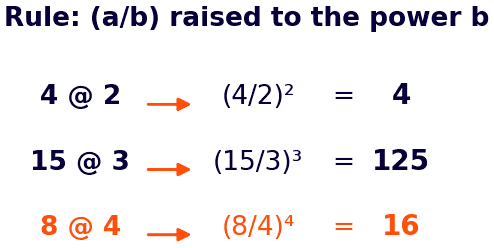 Rule: () raised to the power of the second number.
Check: ()² = 2² = 4 ✓; ()³ = 5³ = 125 ✓.
8 @ 4 = ()⁴ = 2⁴.
= 16 — option (c).
Rule: () raised to the power of the second number.
Check: ()² = 2² = 4 ✓; ()³ = 5³ = 125 ✓.
8 @ 4 = ()⁴ = 2⁴.
= 16 — option (c).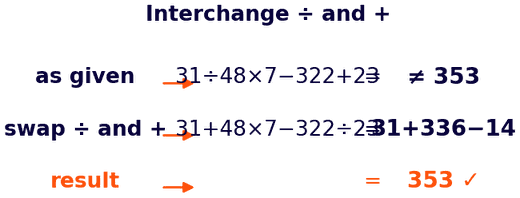 Swap ÷ and + : the equation becomes 31 + 48 × 7 − 322 ÷ 23.
BODMAS: 48 × 7 = 336 and 322 ÷ 23 = 14.
31 + 336 − 14 = 353 ✓ — it matches the right-hand side.
Hence ÷ and + — option (c).
Swap ÷ and + : the equation becomes 31 + 48 × 7 − 322 ÷ 23.
BODMAS: 48 × 7 = 336 and 322 ÷ 23 = 14.
31 + 336 − 14 = 353 ✓ — it matches the right-hand side.
Hence ÷ and + — option (c).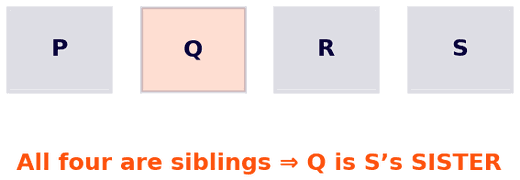 P, Q, R and S all belong to the same generation — they are siblings.
Q is stated to be a sister.
So Q is the sister of S as well.
Hence option (a).
P, Q, R and S all belong to the same generation — they are siblings.
Q is stated to be a sister.
So Q is the sister of S as well.
Hence option (a).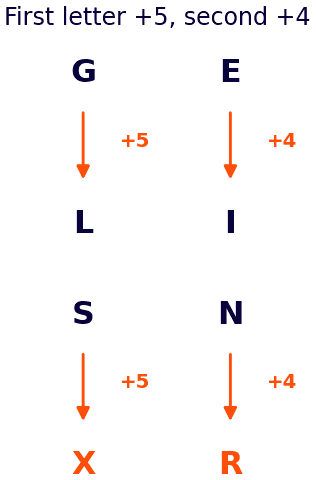 G(7) + 5 = L(12) and E(5) + 4 = I(9).
So the first letter moves +5 and the second +4.
S(19) + 5 = X(24) and N(14) + 4 = R(18).
Hence XR — option (c).
G(7) + 5 = L(12) and E(5) + 4 = I(9).
So the first letter moves +5 and the second +4.
S(19) + 5 = X(24) and N(14) + 4 = R(18).
Hence XR — option (c). Differences: 5, 9, 15, 23 — these rise by 4, 6, 8.
So the next difference rises by 10: 23 + 10 = 33.
68 + 33 = 101.
Hence option (d).
Differences: 5, 9, 15, 23 — these rise by 4, 6, 8.
So the next difference rises by 10: 23 + 10 = 33.
68 + 33 = 101.
Hence option (d).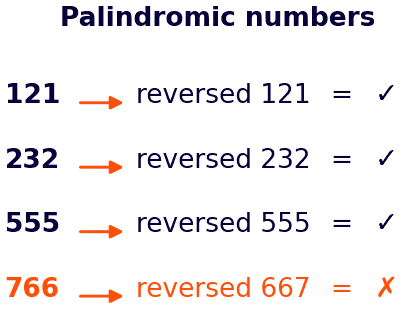 121, 232 and 555 read the same forwards and backwards — they are palindromes.
766 reversed becomes 667, which is different.
So it breaks the pattern.
Hence option (d).
121, 232 and 555 read the same forwards and backwards — they are palindromes.
766 reversed becomes 667, which is different.
So it breaks the pattern.
Hence option (d).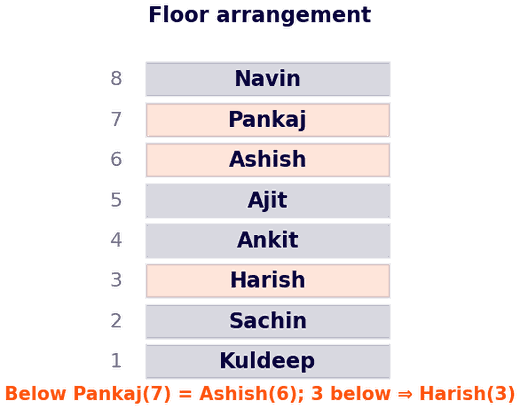 Kuldeep is on floor 1 and Ankit on 4; three people between Kuldeep and Ajit puts Ajit on 5.
Two between Ankit and Pankaj gives Pankaj floor 7; five between Navin and Sachin gives Navin 8 and Sachin 2.
One between Ashish and Navin puts Ashish on 6, leaving floor 3 for Harish (odd) ✓.
Below Pankaj (7) is Ashish (6); three floors below 6 is floor 3 — Harish, option (a).
Kuldeep is on floor 1 and Ankit on 4; three people between Kuldeep and Ajit puts Ajit on 5.
Two between Ankit and Pankaj gives Pankaj floor 7; five between Navin and Sachin gives Navin 8 and Sachin 2.
One between Ashish and Navin puts Ashish on 6, leaving floor 3 for Harish (odd) ✓.
Below Pankaj (7) is Ashish (6); three floors below 6 is floor 3 — Harish, option (a).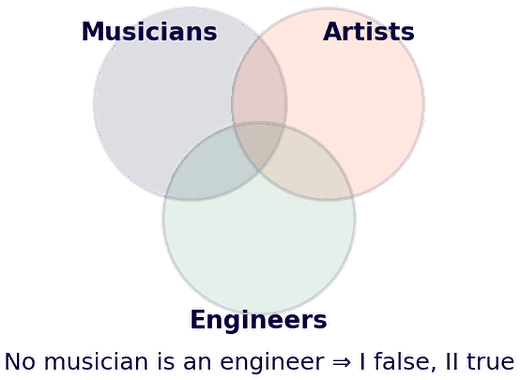 "No musicians are engineers" rules out any overlap, so I directly contradicts the statement.
From the same universal negative, every engineer lies outside the musician group.
So some (indeed all) engineers are not musicians — II follows.
Hence Only II — option (b).
"No musicians are engineers" rules out any overlap, so I directly contradicts the statement.
From the same universal negative, every engineer lies outside the musician group.
So some (indeed all) engineers are not musicians — II follows.
Hence Only II — option (b).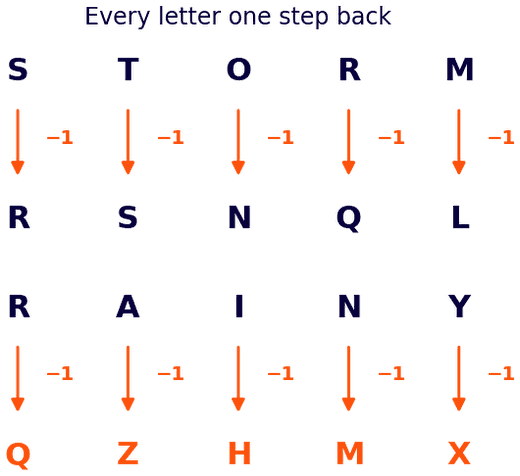 Each letter moves one step BACK: S−1 = R, T−1 = S, O−1 = N, R−1 = Q, M−1 = L.
Apply to RAINY: R−1 = Q, A−1 = Z, I−1 = H.
N−1 = M, Y−1 = X.
Hence QZHMX — option (a).
Each letter moves one step BACK: S−1 = R, T−1 = S, O−1 = N, R−1 = Q, M−1 = L.
Apply to RAINY: R−1 = Q, A−1 = Z, I−1 = H.
N−1 = M, Y−1 = X.
Hence QZHMX — option (a).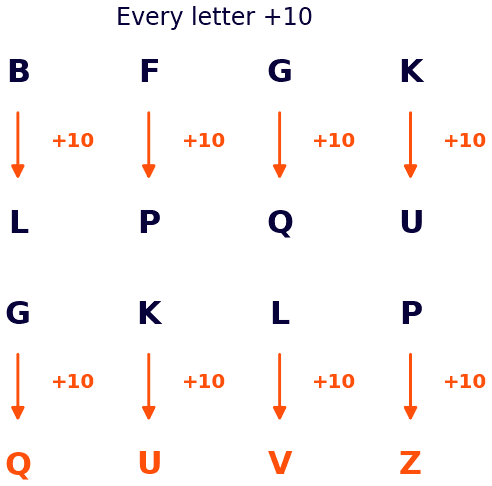 BFGK → LPQU: every letter moves +10.
So the missing set must be QUVZ with each letter moved BACK 10.
Q−10 = G, U−10 = K, V−10 = L, Z−10 = P.
Hence GKLP — option (c).
BFGK → LPQU: every letter moves +10.
So the missing set must be QUVZ with each letter moved BACK 10.
Q−10 = G, U−10 = K, V−10 = L, Z−10 = P.
Hence GKLP — option (c).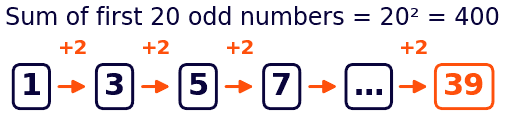 This is an AP with a = 1 and d = 2.
Sₙ = [2a + (n − 1)d] = [2 + 38].
= 10 × 40 (or simply 20² for the first n odd numbers).
= 400 — option (b).
This is an AP with a = 1 and d = 2.
Sₙ = [2a + (n − 1)d] = [2 + 38].
= 10 × 40 (or simply 20² for the first n odd numbers).
= 400 — option (b).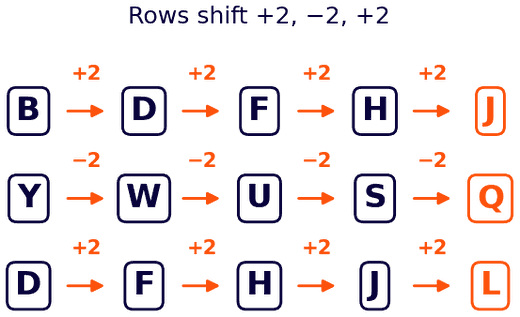 1st letters: B, D, F, H — +2 each ⇒ next is J.
2nd letters: Y, W, U, S — −2 each ⇒ next is Q.
3rd letters: D, F, H, J — +2 each ⇒ next is L.
Hence JQL — option (a).
1st letters: B, D, F, H — +2 each ⇒ next is J.
2nd letters: Y, W, U, S — −2 each ⇒ next is Q.
3rd letters: D, F, H, J — +2 each ⇒ next is L.
Hence JQL — option (a).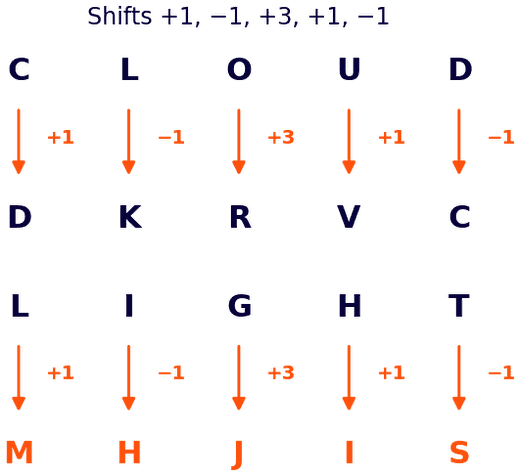 CLOUD → DKRVC: C+1 = D, L−1 = K, O+3 = R, U+1 = V, D−1 = C.
So the shifts by position are +1, −1, +3, +1, −1.
LIGHT: L+1 = M, I−1 = H, G+3 = J, H+1 = I, T−1 = S.
Hence MHJIS — option (a).
CLOUD → DKRVC: C+1 = D, L−1 = K, O+3 = R, U+1 = V, D−1 = C.
So the shifts by position are +1, −1, +3, +1, −1.
LIGHT: L+1 = M, I−1 = H, G+3 = J, H+1 = I, T−1 = S.
Hence MHJIS — option (a).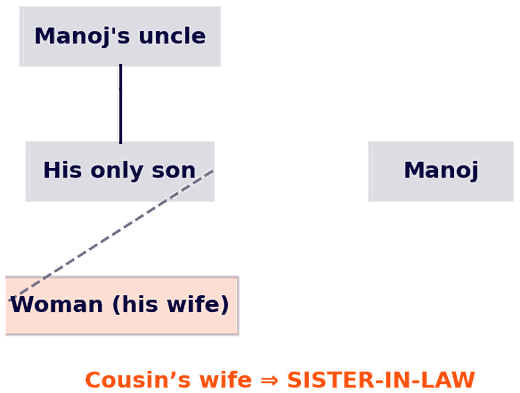 Manoj's uncle's only son is Manoj's cousin brother.
The woman is that cousin’s wife.
A cousin brother’s wife is addressed as one’s sister-in-law.
Hence option (c).
Manoj's uncle's only son is Manoj's cousin brother.
The woman is that cousin’s wife.
A cousin brother’s wife is addressed as one’s sister-in-law.
Hence option (c). Differences: 32 − 25 = 7, 46 − 32 = 14, then the gaps should follow 7, 14, 21, 28, 35.
46 + 21 = 67, but the series shows 66.
Continuing correctly: 67 + 28 = 95 ✓ and 95 + 35 = 130 ✓.
So 66 is the incorrect term — option (d).
Differences: 32 − 25 = 7, 46 − 32 = 14, then the gaps should follow 7, 14, 21, 28, 35.
46 + 21 = 67, but the series shows 66.
Continuing correctly: 67 + 28 = 95 ✓ and 95 + 35 = 130 ✓.
So 66 is the incorrect term — option (d).