SSC CGL 21 September 2025 · Shift 3 · General Intelligence & Reasoning — questions with answers · ShikshaSphere
Chapter 117 of 192
21 September 2025 · Shift 3
General Intelligence & Reasoning
25 questions ~25 min readFree
25 questions
A
1
In the sequence C, E, H, L, …, which letter is the 6th?
A.U
B.W
C.N
D.M
Solution
Series — rising gaps
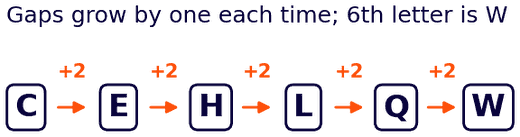
Positions: C(3), E(5), H(8), L(12) — the gaps are +2, +3, +4.
So the next gaps are +5 and +6: 12 + 5 = 17 (Q) and 17 + 6 = 23.
The 23rd letter is W.
Hence option (b).
2
Choose the address that is the same as the one given below.
Plot No. 29, Kamala Nehru Park, Walkeshwar Road, Malabar Hill, Mumbai, Maharashtra 400006
A.Plot No. 29, Kamala Nehru Park, Walkeshwar Road, Malabar Hill, Mumbai, Maharashtra 400006
B.Plot No. 29, Kamala Nehru Park, Walkeshwar R, Malabar Hill, Mumbai, Maharashtra 400006
C.Plot No. 92, Kamala Nehru Park, Walkeshwar Road, Malabar Hill, Mumbai, Maharashtra 400006
Address matching
(b) shortens 'Road' to 'R'; (c) changes the plot number to 92.
(d) shortens 'Park' to 'Pk'.
Only (a) reproduces the address exactly.
Hence option (a).
3
Consider the following statement and choose the option that follows.Statement: The city library has decided to provide free access to digital books and magazines for all its members.
Inferences:
I. The library aims to expand its reach and attract more readers.
II. The maintenance cost of printed books has become unaffordable for the library.
A.Only I follows
B.Only II follows
C.Both I and II follow
D.Neither I nor II follows
Solution
Statement — inferences
Free digital access naturally widens the library’s reach and draws more readers — I follows.
The statement says nothing about printed-book costs; II is an unsupported assumption.
A new facility does not imply the old one has become unaffordable.
Hence Only I — option (a).
4
Select the letter-cluster from among the given options that can replace the question mark (?) in the following series:
JHN, GMQ, DRT, AWW, ?
A.AES
B.IJS
C.XBZ
D.RDS
Solution
Letter series (−3, +5, +3)
1st letters: J, G, D, A — each −3 ⇒ next is X.
2nd letters: H, M, R, W — each +5 ⇒ next is B (cyclic).
3rd letters: N, Q, T, W — each +3 ⇒ next is Z.
Hence XBZ — option (c).
5
Select the CORRECT sequence of mathematical signs to sequentially replace A and B to balance the given equation.
30 A 10 B 8 = 110
A.×, −
B.÷, −
C.+, ×
D.÷, ×
Solution
Signs in equation
Put + for A and × for B: 30 + 10 × 8.
BODMAS: 10 × 8 = 80.
30 + 80 = 110 ✓.
Hence +, × — option (c).
6
Find the WRONG number in the given series.
720, 120, 142, 6, 2, 1
A.6
B.120
C.142
D.2
Solution
Wrong term (÷ chain)
The terms are divided by 6, 5, 4, 3, 2 in turn.
720 ÷ 6 = 120 ✓; 120 ÷ 5 = 24, but the series shows 142 ✗.
Continuing correctly: 24 ÷ 4 = 6 ✓, 6 ÷ 3 = 2 ✓, 2 ÷ 2 = 1 ✓.
So 142 is the wrong number — option (c).
7
A statement is given followed by two conclusions. Find which conclusion is TRUE based on the given statement.Statement: D < B ≤ U = E ≤ P; H ≤ E < T; U ≥ B
Conclusions:
I. U ≤ P
II. E < U
A.Both I and II
B.Neither I nor II
C.Only I
D.Only II
Solution
Coded inequality
From U = E ≤ P we get U ≤ P directly — I is true.
The statement fixes U = E, so E cannot be strictly less than U — II is false.
Equality rules out the strict inequality.
Only I — option (c).
8
Choose the odd one out.
A.Apple
B.Mango
C.Lotus
D.Banana
Solution
Fruits vs flower
Apple, mango and banana are all fruits.
The lotus is a flower.
So it belongs to a different category.
Hence option (c).
9
Identify the roll number that doesn't fit this rule.
Last 2 digits = First 2 digits + 70
A.20K90
B.15K85
C.25K95
D.10K85
Solution
Roll number rule
Check each: 20 + 70 = 90 ✓, 15 + 70 = 85 ✓, 25 + 70 = 95 ✓.
For 10K85: 10 + 70 = 80, but the number shows 85 ✗.
So this one breaks the rule.
Hence option (d).
10
Identify the odd crop.
Wheat, Rice, Millet, Coffee
A.Wheat
B.Rice
C.Millet
D.Coffee
Solution
Food vs beverage crop
Wheat, rice and millet are food (cereal) crops.
Coffee is a beverage crop.
So it differs in use.
Hence option (d).
11
P is the son of Q. R is the wife of Q. S is the son of R. How is P related to S?
A.Uncle
B.Brother
C.Cousin
D.Son
Solution
Blood relation
Q and R are husband and wife.
P is Q’s son and S is R’s son, so both are sons of the same couple.
Hence they are brothers.
Option (b).
12
M is the father of N. N is the brother of O. How is M related to O?
A.Uncle
B.Father
C.Brother
D.Grandfather
Solution
Blood relation
N and O are siblings, so they share the same parents.
M is the father of N.
Therefore M is also the father of O.
Hence option (b).
13
What comes next: 17, 26, 37, 50, 65, ?
A.83
B.54
C.76
D.82
Solution
Series — odd gaps
Differences: 9, 11, 13, 15 — each rises by 2.
So the next difference is 17.
65 + 17 = 82.
Hence option (d).
14
You are asked to lead a team project, but you are facing a personal conflict with one of your team members. What is the best course of action for you?
A.Remove the team member from the project.
B.Ignore the personal conflict and hope it resolves itself.
C.Speak privately with the team member and address the issue.
D.Delegate the project leadership to someone else.
Solution
Workplace conflict
A leader is expected to resolve issues, not avoid them.
Speaking privately addresses the problem without embarrassing the person or disturbing the team.
Removing the member or stepping aside avoids the real issue.
Hence option (c).
15
Complete the series: 7, 26, 63, 124, ?
A.100
B.125
C.216
D.215
Solution
Cubes minus one
Each term is a cube minus 1: 2³ − 1 = 7, 3³ − 1 = 26, 4³ − 1 = 63, 5³ − 1 = 124.
So the next term is 6³ − 1.
216 − 1 = 215.
Hence option (d).
16
Study the information carefully and answer the question.
Seven persons have to attend a seminar in seven different months — January, March, April, May, July, August and September. Each of them works in a different profession — Dentist, Surgeon, Police officer, Boxer, Journalist, Singer and Engineer — but not necessarily in the same order.
F is an engineer and attended the seminar in the month which has 30 days. Two persons attend seminars between F and the one who is a police officer. D attends the seminar just before the one who is a journalist. Three persons attend the seminar between C and B, and neither of them attends in March or May. The boxer attends the seminar just after the dentist. The surgeon attends the seminar just after the engineer. C attends the seminar after F. Neither B nor D is the police officer. The boxer attends the seminar in March. E attends the seminar after A but before G.
Who attends the seminar in May?
A.D
B.F
C.B
D.C
Solution
Month scheduling puzzle
F is the engineer and April is the only listed month with 30 days, so F is in April; the surgeon follows him in May.
The boxer is in March and the dentist just before him, i.e. in January; two persons between F and the police officer puts the police officer in August.
Three between C and B with neither in March or May gives B in January and C in July; D is just before the journalist, so D is in May and C is the journalist.
So D — the surgeon — attends in May, option (a).
17
These questions are based on the following information.
'R @ S' means 'S is the mother of R'.
'R $ S' means 'S is the husband of R'.
'R # S' means 'S is the sister of R'.
'R & S' means 'S is the son of R'.
If 'A & B @ C & D # E', then how is A related to E?
A.Father
B.Son
C.Daughter
D.Mother
Solution
Symbol relations
A & B: B is the son of A. B @ C: C is the mother of B, so C is A’s wife and A is male.
C & D: D is the son of C, hence also A’s son. D # E: E is the sister of D.
So E is a daughter of A and C.
A is the father of E — option (a).
18
Read the following statements carefully and identify the conclusion that follows.Statements:
All boys are students.
Some students are boxers.
No boxer is a scholar.
Conclusions:
I. Some boys may be boxers.
II. No boy is a scholar.
A.Only I follows
B.Only II follows
C.Both I and II follow
D.Neither I nor II follows
Solution
Syllogism
Boys lie inside students, and some students are boxers — so an overlap between boys and boxers is POSSIBLE.
Conclusion I only claims a possibility, so it follows.
Nothing links boys to scholars; boys who are not boxers may well be scholars, so II is not certain.
Only I — option (a).
19
Which word cannot be formed from the letters of the word MEASUREMENT using each letter only once?
A.RUSTLE
B.TEAMS
C.METER
D.SURE
Solution
Letters available
MEASUREMENT contains M, E, A, S, U, R, E, M, E, N, T — there is no letter L.
RUSTLE needs an L, so it cannot be formed.
TEAMS, METER and SURE can each be made from the available letters.
Hence option (a).
20
If RMZJD is written as QLYIC, how is YDAQZ written?
A.XCZPY
B.XCAQY
C.XCZQZ
D.YDAQX
Solution
Coding (−1)
Each letter moves one step BACK: R−1 = Q, M−1 = L, Z−1 = Y, J−1 = I, D−1 = C.
Apply to YDAQZ: Y−1 = X, D−1 = C, A−1 = Z (cyclic).
Q−1 = P, Z−1 = Y.
Hence XCZPY — option (a).
21
What comes next in the series? I, N, S, X, ?
A.Z
B.B
C.D
D.C
Solution
Letter series (+5)
Positions: I(9), N(14), S(19), X(24) — each +5.
Next is 24 + 5 = 29.
Counting cyclically, 29 − 26 = 3, which is C.
Hence option (d).
A train 220 metres long takes 12 seconds to cross a man. What is the speed of the train in km/h?
A.72
B.66
C.67
D.88
Solution
Speed of train
To cross a man the train covers its own length: 220 m in 12 s.
Speed = m/s.
Convert: × to get km/h.
= 66 km/h — option (b).
24
What should come at the place of the question mark?
5, 10, 17, 26, 37, ?
A.35
B.49
C.50
D.38
Solution
Series — odd gaps
Differences: 5, 7, 9, 11 — each rises by 2.
So the next difference is 13.
37 + 13 = 50.
Hence option (c).
25
If "DSBOF" is coded as "ETCPG", how is "ETCPG" coded?
A.FUDQH
B.FUDHQ
C.FUDPF
D.DTCPF
Solution
Coding (+1)
D+1 = E, S+1 = T, B+1 = C, O+1 = P, F+1 = G — every letter moves +1.
Apply the same rule to ETCPG: E+1 = F, T+1 = U, C+1 = D.
P+1 = Q, G+1 = H.
Hence FUDQH — option (a).
Finished reading? Now test yourself.
The same 25 questions, but with a timer and the answers hidden — 15 minutes.

 Positions: C(3), E(5), H(8), L(12) — the gaps are +2, +3, +4.
So the next gaps are +5 and +6: 12 + 5 = 17 (Q) and 17 + 6 = 23.
The 23rd letter is W.
Hence option (b).
Positions: C(3), E(5), H(8), L(12) — the gaps are +2, +3, +4.
So the next gaps are +5 and +6: 12 + 5 = 17 (Q) and 17 + 6 = 23.
The 23rd letter is W.
Hence option (b).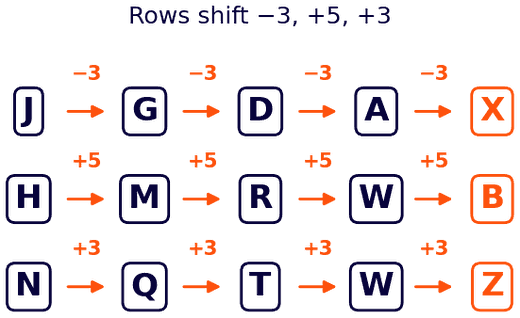 1st letters: J, G, D, A — each −3 ⇒ next is X.
2nd letters: H, M, R, W — each +5 ⇒ next is B (cyclic).
3rd letters: N, Q, T, W — each +3 ⇒ next is Z.
Hence XBZ — option (c).
1st letters: J, G, D, A — each −3 ⇒ next is X.
2nd letters: H, M, R, W — each +5 ⇒ next is B (cyclic).
3rd letters: N, Q, T, W — each +3 ⇒ next is Z.
Hence XBZ — option (c).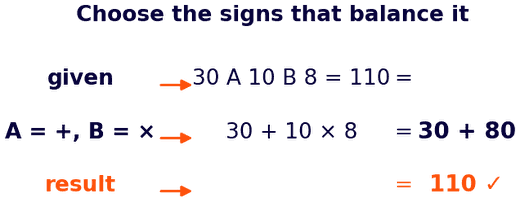 Put + for A and × for B: 30 + 10 × 8.
BODMAS: 10 × 8 = 80.
30 + 80 = 110 ✓.
Hence +, × — option (c).
Put + for A and × for B: 30 + 10 × 8.
BODMAS: 10 × 8 = 80.
30 + 80 = 110 ✓.
Hence +, × — option (c).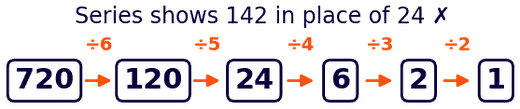 The terms are divided by 6, 5, 4, 3, 2 in turn.
720 ÷ 6 = 120 ✓; 120 ÷ 5 = 24, but the series shows 142 ✗.
Continuing correctly: 24 ÷ 4 = 6 ✓, 6 ÷ 3 = 2 ✓, 2 ÷ 2 = 1 ✓.
So 142 is the wrong number — option (c).
The terms are divided by 6, 5, 4, 3, 2 in turn.
720 ÷ 6 = 120 ✓; 120 ÷ 5 = 24, but the series shows 142 ✗.
Continuing correctly: 24 ÷ 4 = 6 ✓, 6 ÷ 3 = 2 ✓, 2 ÷ 2 = 1 ✓.
So 142 is the wrong number — option (c).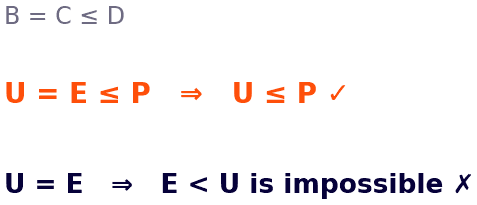 From U = E ≤ P we get U ≤ P directly — I is true.
The statement fixes U = E, so E cannot be strictly less than U — II is false.
Equality rules out the strict inequality.
Only I — option (c).
From U = E ≤ P we get U ≤ P directly — I is true.
The statement fixes U = E, so E cannot be strictly less than U — II is false.
Equality rules out the strict inequality.
Only I — option (c).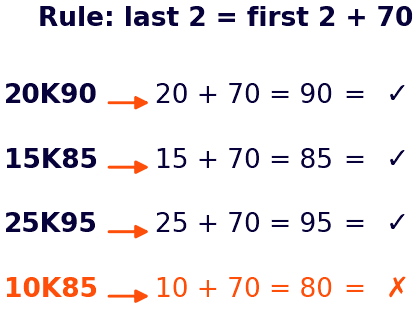 Check each: 20 + 70 = 90 ✓, 15 + 70 = 85 ✓, 25 + 70 = 95 ✓.
For 10K85: 10 + 70 = 80, but the number shows 85 ✗.
So this one breaks the rule.
Hence option (d).
Check each: 20 + 70 = 90 ✓, 15 + 70 = 85 ✓, 25 + 70 = 95 ✓.
For 10K85: 10 + 70 = 80, but the number shows 85 ✗.
So this one breaks the rule.
Hence option (d).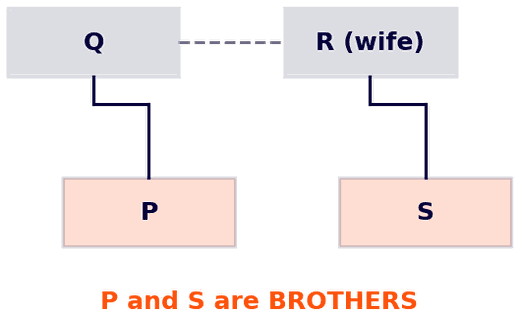 Q and R are husband and wife.
P is Q’s son and S is R’s son, so both are sons of the same couple.
Hence they are brothers.
Option (b).
Q and R are husband and wife.
P is Q’s son and S is R’s son, so both are sons of the same couple.
Hence they are brothers.
Option (b).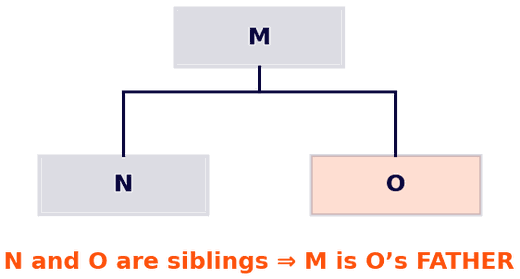 N and O are siblings, so they share the same parents.
M is the father of N.
Therefore M is also the father of O.
Hence option (b).
N and O are siblings, so they share the same parents.
M is the father of N.
Therefore M is also the father of O.
Hence option (b). Differences: 9, 11, 13, 15 — each rises by 2.
So the next difference is 17.
65 + 17 = 82.
Hence option (d).
Differences: 9, 11, 13, 15 — each rises by 2.
So the next difference is 17.
65 + 17 = 82.
Hence option (d).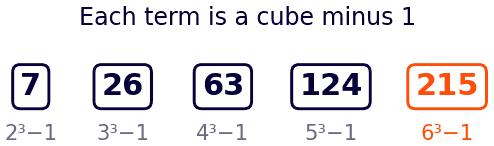 Each term is a cube minus 1: 2³ − 1 = 7, 3³ − 1 = 26, 4³ − 1 = 63, 5³ − 1 = 124.
So the next term is 6³ − 1.
216 − 1 = 215.
Hence option (d).
Each term is a cube minus 1: 2³ − 1 = 7, 3³ − 1 = 26, 4³ − 1 = 63, 5³ − 1 = 124.
So the next term is 6³ − 1.
216 − 1 = 215.
Hence option (d).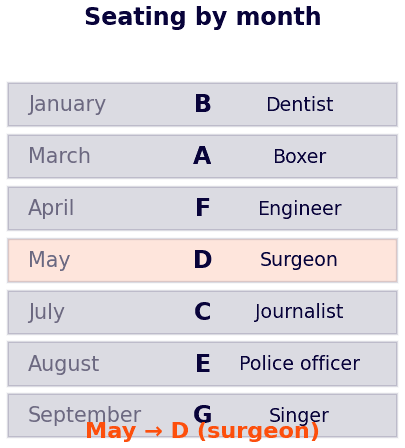 F is the engineer and April is the only listed month with 30 days, so F is in April; the surgeon follows him in May.
The boxer is in March and the dentist just before him, i.e. in January; two persons between F and the police officer puts the police officer in August.
Three between C and B with neither in March or May gives B in January and C in July; D is just before the journalist, so D is in May and C is the journalist.
So D — the surgeon — attends in May, option (a).
F is the engineer and April is the only listed month with 30 days, so F is in April; the surgeon follows him in May.
The boxer is in March and the dentist just before him, i.e. in January; two persons between F and the police officer puts the police officer in August.
Three between C and B with neither in March or May gives B in January and C in July; D is just before the journalist, so D is in May and C is the journalist.
So D — the surgeon — attends in May, option (a).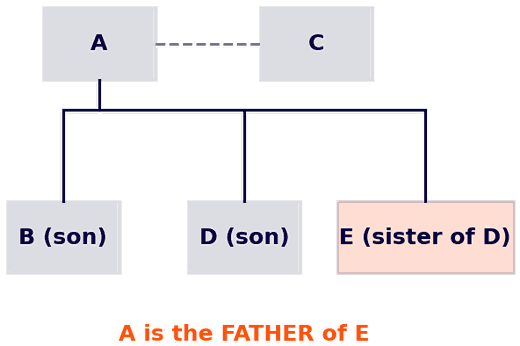 A & B: B is the son of A. B @ C: C is the mother of B, so C is A’s wife and A is male.
C & D: D is the son of C, hence also A’s son. D # E: E is the sister of D.
So E is a daughter of A and C.
A is the father of E — option (a).
A & B: B is the son of A. B @ C: C is the mother of B, so C is A’s wife and A is male.
C & D: D is the son of C, hence also A’s son. D # E: E is the sister of D.
So E is a daughter of A and C.
A is the father of E — option (a).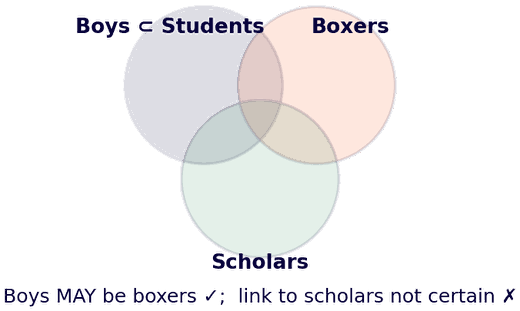 Boys lie inside students, and some students are boxers — so an overlap between boys and boxers is POSSIBLE.
Conclusion I only claims a possibility, so it follows.
Nothing links boys to scholars; boys who are not boxers may well be scholars, so II is not certain.
Only I — option (a).
Boys lie inside students, and some students are boxers — so an overlap between boys and boxers is POSSIBLE.
Conclusion I only claims a possibility, so it follows.
Nothing links boys to scholars; boys who are not boxers may well be scholars, so II is not certain.
Only I — option (a).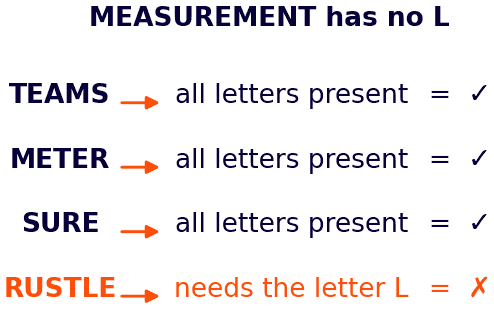 MEASUREMENT contains M, E, A, S, U, R, E, M, E, N, T — there is no letter L.
RUSTLE needs an L, so it cannot be formed.
TEAMS, METER and SURE can each be made from the available letters.
Hence option (a).
MEASUREMENT contains M, E, A, S, U, R, E, M, E, N, T — there is no letter L.
RUSTLE needs an L, so it cannot be formed.
TEAMS, METER and SURE can each be made from the available letters.
Hence option (a).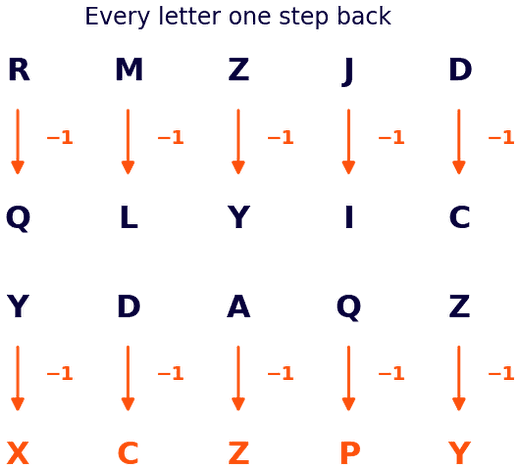 Each letter moves one step BACK: R−1 = Q, M−1 = L, Z−1 = Y, J−1 = I, D−1 = C.
Apply to YDAQZ: Y−1 = X, D−1 = C, A−1 = Z (cyclic).
Q−1 = P, Z−1 = Y.
Hence XCZPY — option (a).
Each letter moves one step BACK: R−1 = Q, M−1 = L, Z−1 = Y, J−1 = I, D−1 = C.
Apply to YDAQZ: Y−1 = X, D−1 = C, A−1 = Z (cyclic).
Q−1 = P, Z−1 = Y.
Hence XCZPY — option (a).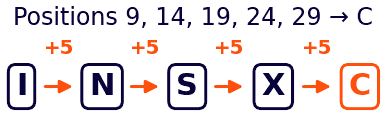 Positions: I(9), N(14), S(19), X(24) — each +5.
Next is 24 + 5 = 29.
Counting cyclically, 29 − 26 = 3, which is C.
Hence option (d).
Positions: I(9), N(14), S(19), X(24) — each +5.
Next is 24 + 5 = 29.
Counting cyclically, 29 − 26 = 3, which is C.
Hence option (d).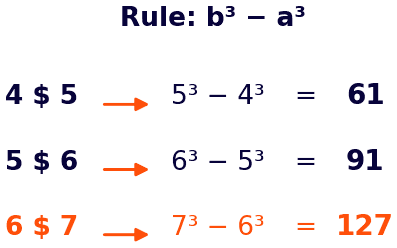 Rule: a $ b = b³ − a³.
Check: 5³ − 4³ = 125 − 64 = 61 ✓; 6³ − 5³ = 216 − 125 = 91 ✓.
6 $ 7 = 7³ − 6³ = 343 − 216.
= 127 — option (b).
Rule: a $ b = b³ − a³.
Check: 5³ − 4³ = 125 − 64 = 61 ✓; 6³ − 5³ = 216 − 125 = 91 ✓.
6 $ 7 = 7³ − 6³ = 343 − 216.
= 127 — option (b). To cross a man the train covers its own length: 220 m in 12 s.
Speed = m/s.
Convert: × to get km/h.
= 66 km/h — option (b).
To cross a man the train covers its own length: 220 m in 12 s.
Speed = m/s.
Convert: × to get km/h.
= 66 km/h — option (b).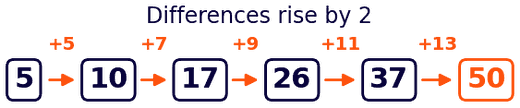 Differences: 5, 7, 9, 11 — each rises by 2.
So the next difference is 13.
37 + 13 = 50.
Hence option (c).
Differences: 5, 7, 9, 11 — each rises by 2.
So the next difference is 13.
37 + 13 = 50.
Hence option (c).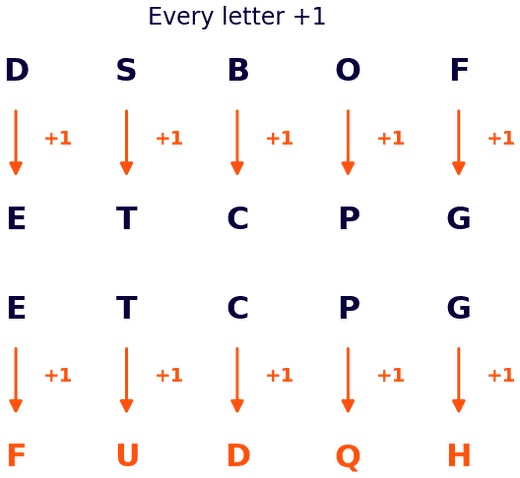 D+1 = E, S+1 = T, B+1 = C, O+1 = P, F+1 = G — every letter moves +1.
Apply the same rule to ETCPG: E+1 = F, T+1 = U, C+1 = D.
P+1 = Q, G+1 = H.
Hence FUDQH — option (a).
D+1 = E, S+1 = T, B+1 = C, O+1 = P, F+1 = G — every letter moves +1.
Apply the same rule to ETCPG: E+1 = F, T+1 = U, C+1 = D.
P+1 = Q, G+1 = H.
Hence FUDQH — option (a).