
1
Which sentence is grammatically correct?
- A.Neither of the boys are misbehaving.
- B.Everyone is deeply concerned about the deteriorating air quality.
- C.Many a man has sacrificed for the safety of this nation.
- D.The number of emigrants has reduced significantly.
Solution
Subject-verb agreement
Each of the four sentences rests on a subject-verb agreement rule, so test them one at a time.
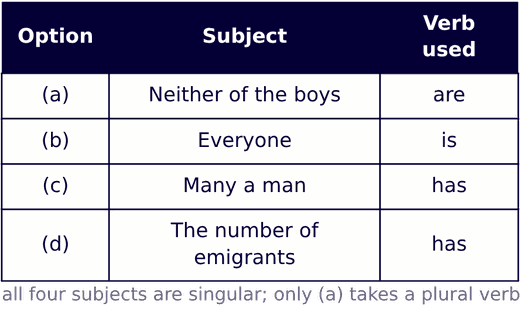 'Neither of + plural noun' points to one of two persons, so the subject is singular and demands 'is': Neither of the boys is misbehaving.
'Everyone' is a singular indefinite pronoun, 'Many a + singular noun' is always treated as singular, and in 'The number of ...' the head word is the singular 'number' - so (b), (c) and (d) each carry the singular verb their subject requires.
Only option (a) places the plural 'are' after a singular subject, so option (a) is the answer.
'Neither of + plural noun' points to one of two persons, so the subject is singular and demands 'is': Neither of the boys is misbehaving.
'Everyone' is a singular indefinite pronoun, 'Many a + singular noun' is always treated as singular, and in 'The number of ...' the head word is the singular 'number' - so (b), (c) and (d) each carry the singular verb their subject requires.
Only option (a) places the plural 'are' after a singular subject, so option (a) is the answer.
'Neither of + plural noun' points to one of two persons, so the subject is singular and demands 'is': Neither of the boys is misbehaving.
'Everyone' is a singular indefinite pronoun, 'Many a + singular noun' is always treated as singular, and in 'The number of ...' the head word is the singular 'number' - so (b), (c) and (d) each carry the singular verb their subject requires.
Only option (a) places the plural 'are' after a singular subject, so option (a) is the answer.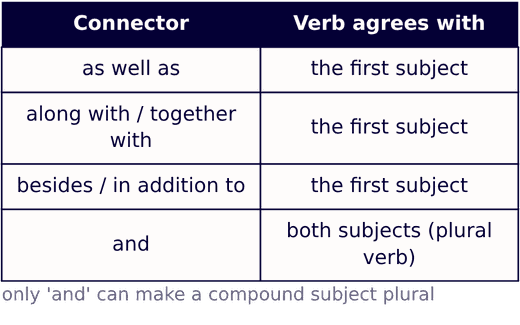 The real subject here is 'The manager', which is singular, so the verb has to be 'is responsible' and not 'are responsible'.
The error therefore lies in part (c), and the corrected sentence reads: The manager, as well as the employees, is responsible for the project's success.
The real subject here is 'The manager', which is singular, so the verb has to be 'is responsible' and not 'are responsible'.
The error therefore lies in part (c), and the corrected sentence reads: The manager, as well as the employees, is responsible for the project's success.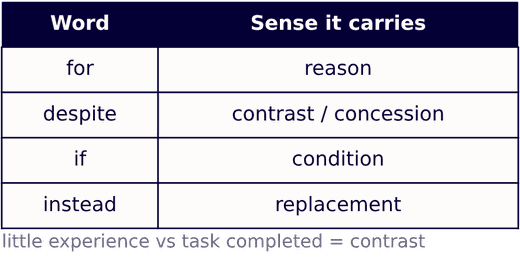 'Despite' is the word of concession and is followed by a noun or an -ing form, which is exactly what 'having very little experience' is.
'For' introduces a reason, 'if' sets a condition and 'instead' offers a replacement, so none of them can mark this contrast.
'Despite' is the word of concession and is followed by a noun or an -ing form, which is exactly what 'having very little experience' is.
'For' introduces a reason, 'if' sets a condition and 'instead' offers a replacement, so none of them can mark this contrast.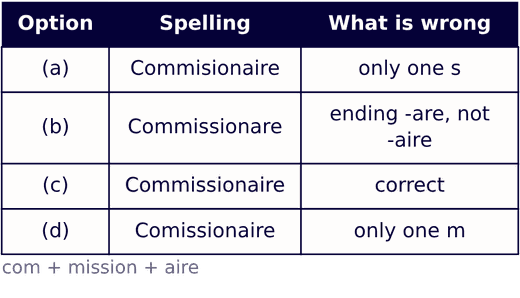 Every other option drops one of those parts, so only option (c) is spelt correctly.
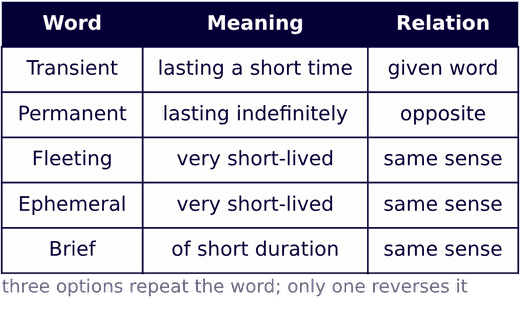 'Fleeting', 'ephemeral' and 'brief' merely repeat that idea, so they are synonyms and cannot be the answer.
Only 'permanent', meaning lasting or intended to last indefinitely, reverses the sense, so option (a) is correct.
'Fleeting', 'ephemeral' and 'brief' merely repeat that idea, so they are synonyms and cannot be the answer.
Only 'permanent', meaning lasting or intended to last indefinitely, reverses the sense, so option (a) is correct.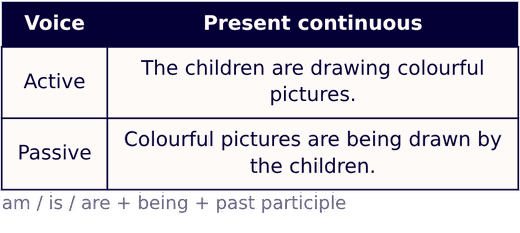 The object 'colourful pictures' moves to the front as the new subject, giving: Colourful pictures are being drawn by the children.
Option (a) drops 'being' and turns the sentence into simple present, while (b) and (d) shift it to past and present perfect, so all three change the tense.
The object 'colourful pictures' moves to the front as the new subject, giving: Colourful pictures are being drawn by the children.
Option (a) drops 'being' and turns the sentence into simple present, while (b) and (d) shift it to past and present perfect, so all three change the tense.