
1
Select the most appropriate synonym of the word: Contract
- A.Diminish
- B.Lessen
- C.Enlarge
- D.Shrink
Solution
Word meaning: Contract
Contract (verb) means to decrease in size, number or range — to become smaller.
Diminish, Lessen and Shrink all carry exactly this same sense of becoming smaller, so none of them can be singled out from the other two.
Enlarge means to make or become larger or more extensive, and it is the one word in the set that stands apart from the sense of 'Contract'.
Hence, option (c) is the correct answer.
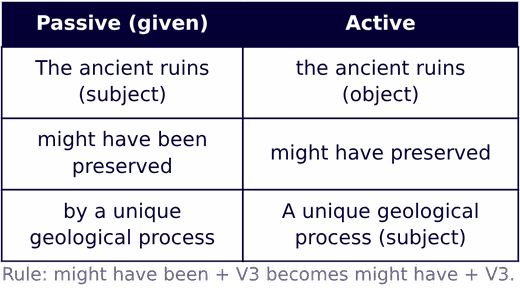 The modal 'might' must be kept as it is: changing it to 'should' in (b) or 'would' in (c) changes the meaning.
Option (d) is still passive, so it is no transformation at all.
Active: A unique geological process might have preserved the ancient ruins. Hence, option (a) is correct.
The modal 'might' must be kept as it is: changing it to 'should' in (b) or 'would' in (c) changes the meaning.
Option (d) is still passive, so it is no transformation at all.
Active: A unique geological process might have preserved the ancient ruins. Hence, option (a) is correct.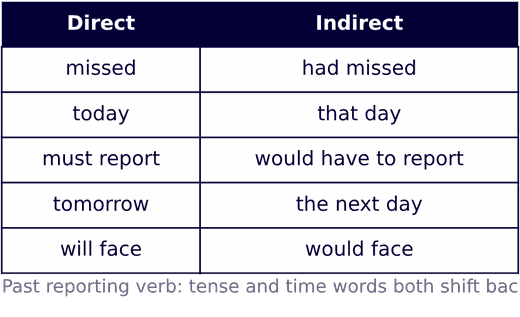 Option (a) changes nothing, (c) keeps 'must … tomorrow … will', and (d) keeps 'tomorrow' and wrongly makes 'today' into 'the day before'.
Only option (b) applies every change, so option (b) is correct.
Option (a) changes nothing, (c) keeps 'must … tomorrow … will', and (d) keeps 'tomorrow' and wrongly makes 'today' into 'the day before'.
Only option (b) applies every change, so option (b) is correct.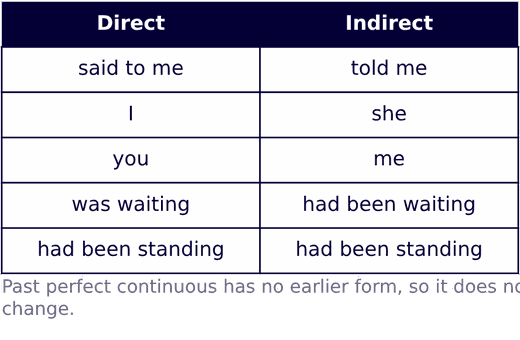 'had been standing' is already past perfect continuous, which has no earlier form, so it stays unchanged — that rules out (a) and (d), which use 'has been standing'.
Option (c) alters the sense by turning 'the bus didn't arrive' into 'the bus had arrived late'.
Hence, option (b) is correct.
'had been standing' is already past perfect continuous, which has no earlier form, so it stays unchanged — that rules out (a) and (d), which use 'has been standing'.
Option (c) alters the sense by turning 'the bus didn't arrive' into 'the bus had arrived late'.
Hence, option (b) is correct.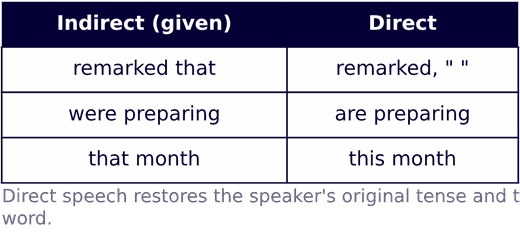 The reporting verb 'remarked' itself is not changed, so (c) with 'said' is wrong on two counts.
Options (b) and (d) keep a past-tense verb inside the quotation, which cannot be the speaker's original words.
Direct: The teacher remarked, "The students are preparing for an important examination this month." Hence, option (a) is correct.
The reporting verb 'remarked' itself is not changed, so (c) with 'said' is wrong on two counts.
Options (b) and (d) keep a past-tense verb inside the quotation, which cannot be the speaker's original words.
Direct: The teacher remarked, "The students are preparing for an important examination this month." Hence, option (a) is correct.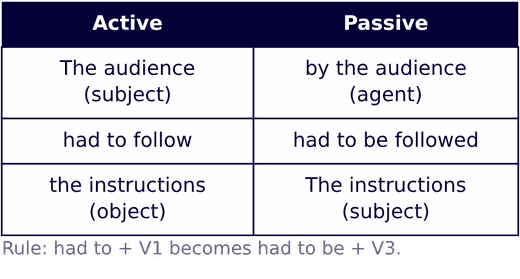 Option (a) adds 'have been' and gives 'had to have been followed', which shifts the action into a completed past.
Option (b) drops the idea of obligation completely, and (c) turns the sentence into a plain past perfect passive.
Passive: The instructions had to be followed very carefully by the audience. Hence, option (d) is correct.
Option (a) adds 'have been' and gives 'had to have been followed', which shifts the action into a completed past.
Option (b) drops the idea of obligation completely, and (c) turns the sentence into a plain past perfect passive.
Passive: The instructions had to be followed very carefully by the audience. Hence, option (d) is correct.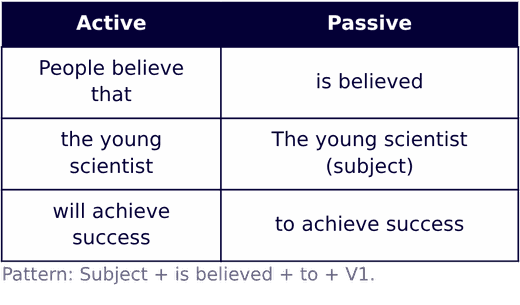 So 'the young scientist' becomes the subject and 'will achieve' becomes the infinitive 'to achieve', while 'in the future' already carries the sense of futurity.
Option (c) mixes the two structures and keeps 'that he will achieve' after 'is believed', which is ungrammatical.
Option (d) shifts the reporting verb to 'was believed' and then uses 'has achieved … in the future', a clear tense clash.
Passive: The young scientist is believed to achieve remarkable success in the future. Hence, option (a) is correct.
So 'the young scientist' becomes the subject and 'will achieve' becomes the infinitive 'to achieve', while 'in the future' already carries the sense of futurity.
Option (c) mixes the two structures and keeps 'that he will achieve' after 'is believed', which is ungrammatical.
Option (d) shifts the reporting verb to 'was believed' and then uses 'has achieved … in the future', a clear tense clash.
Passive: The young scientist is believed to achieve remarkable success in the future. Hence, option (a) is correct.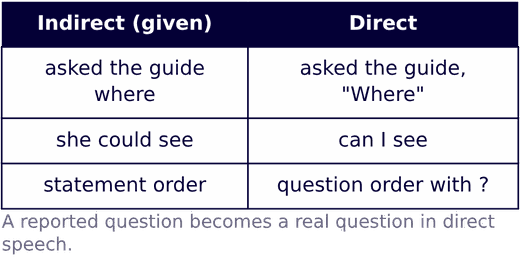 The pronoun goes back to the speaker's own words: 'she' becomes 'I', and the back-shifted 'could' returns to 'can'.
Option (a) keeps 'could' and 'she', (b) drops the listener and keeps 'she', and (d) keeps 'could' and omits 'the guide'.
Direct: The visitor asked the guide, "Where can I see the ancient artefacts?" Hence, option (c) is correct.
The pronoun goes back to the speaker's own words: 'she' becomes 'I', and the back-shifted 'could' returns to 'can'.
Option (a) keeps 'could' and 'she', (b) drops the listener and keeps 'she', and (d) keeps 'could' and omits 'the guide'.
Direct: The visitor asked the guide, "Where can I see the ancient artefacts?" Hence, option (c) is correct.