SSC CHSL 22 November 2025 · Shift 1 · English Language — questions with answers · ShikshaSphere
Chapter 108 of 200
22 November 2025 · Shift 1
English Language
25 questions ~25 min readFree
25 questions
A
1
Choose the one word substitute for the below sentence.
The student was well known throughout the school for breaking rules and getting into minor trouble so often that teachers mentioned his name with a sigh and classmates instantly recognised his reputation.
A.Notorious
B.Wanderer
C.Insolent
D.Truant
Solution
One word substitution
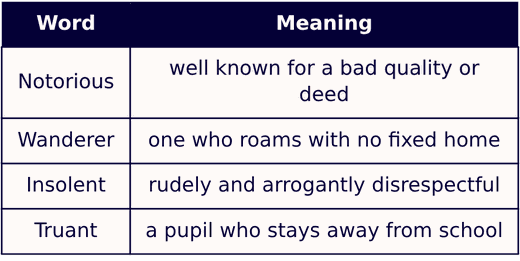
The sentence describes a student who is widely known, but known for something bad - breaking rules and getting into trouble again and again.
'Notorious' means famous or well known precisely for a bad quality or deed, which is exactly the idea of 'teachers mentioned his name with a sigh'.
'Truant' is the tempting choice, but a truant stays away from school, whereas this student is very much present and misbehaving.
Hence, option (a) is the most appropriate answer.
2
The sentence below has errors in two parts which are highlighted in bold. Identify the same.
It is difficult to measure the number of individuals who are offered, (A) and continue to offer, (B) their skills, dedication, resources, ( ) and energy in the support (D) against discrimination.
A.BD
B.AB
C.AC
D.AD
Solution
Error spotting
Read each labelled part separately and test it against the rest of the sentence.
Part A: the individuals themselves give their skills, so the passive 'who are offered' is wrong; it must be the active 'who have offered', which then runs parallel with 'and continue to offer'.
Part D: 'support' takes the preposition 'for', never 'against'. The fixed expression here is 'in the fight against discrimination'.
Parts B and C are free from error, so the two faulty parts are A and D.
Correct sentence: It is difficult to measure the number of individuals who have offered, and continue to offer, their skills, dedication, resources, and energy in the fight against discrimination.
Hence, option (d) is the most appropriate answer.
3
Choose the grammatically correct sentence.
A.They did nothing but argue.
B.They did nothing but to argue.
C.They did nothing but argued.
D.They do nothing than argue.
Solution
Bare infinitive after 'but'
The pattern 'do nothing but' is always followed by the bare infinitive, that is the first form of the verb without 'to'.
The tense of the sentence is already carried by the operator 'did', so the verb after 'but' stays in its plain base form: 'They did nothing but argue.'
(b) wrongly inserts 'to', and (c) marks the past tense a second time on 'argued'.
(d) replaces 'but' with 'than', which the structure does not allow, and also shifts the tense to 'do'.
Hence, option (a) is the most appropriate answer.
4
Complete the sentence with the most appropriate phrase.
The two sides were unable to during the negotiations, which led to the cancellation of the agreement.
A.come around
B.see eye to eye
C.break down
D.carry out
Solution
Idioms and phrases
The second half of the sentence, 'which led to the cancellation of the agreement', shows that the two sides could not reach agreement.
'See eye to eye' means to be in complete agreement with someone, so 'unable to see eye to eye' says exactly that they disagreed.
'Come around' means to change one's mind and finally accept, 'break down' means to fail or collapse, and 'carry out' means to perform a task - none of these expresses mutual agreement.
Hence, option (b) is the most appropriate answer.
5
Fill in the blank with the most appropriate option:
The play depicts the central character as a person, imperfect yet morally aware and capable of making mistakes.
A.invincible
B.fallible
C.malevolent
D.indifferent
Solution
Vocabulary in context
The words right after the blank explain it: 'imperfect yet morally aware and capable of making mistakes'.
'Fallible' means liable to make mistakes or be wrong, so it restates that description in a single adjective.
'Invincible' means impossible to defeat, which contradicts 'imperfect'.
'Malevolent' means wishing evil to others and 'indifferent' means showing no interest; neither fits a character who is 'morally aware'.
Hence, option (b) is the most appropriate answer.
6
Select the most appropriate synonym of the word: TERROR
A.Comfort
B.Stimulation
C.Fright
D.Victory
Solution
Synonyms
'Terror' means extreme, overwhelming fear.
'Fright' is a sudden and intense feeling of fear, so it carries the same core idea and is the closest synonym.
'Comfort' is the very opposite of fear, 'stimulation' is the arousing of interest or excitement, and 'victory' is success in a contest.
Hence, option (c) is the most appropriate answer.
7
Select the incorrectly spelt word in the given sentence.
Despite repeated warnings from the doctor, he remained obstinate and refused to change his unheathy eating habits.
A.repeated
B.warnings
C.obstinate
D.unheathy
Solution
Spelling
'Unheathy' is misspelt; the correct spelling is 'unhealthy'.
The word is built as un + health + y, so the 'l' of 'health' must stay: un-heal-thy.
'Repeated', 'warnings' and 'obstinate' are all spelt correctly.
Hence, option (d) is the incorrectly spelt word.
8
Select the option which contains the correct homonym of the highlighted word in the sentence:
She went on a short (trip) to the hills during the summer break.
A.A journey taken for pleasure or a specific purpose
B.A brief travel from one place to another
C.An excursion planned for relaxation
D.To stumble or lose balance while walking
Solution
Homonyms
A homonym is a word with the same spelling and sound but a completely different meaning.
In the given sentence 'trip' is a noun meaning a short journey made for pleasure.
Options (a), (b) and (c) only restate that same journey sense in different words, so none of them is a homonym.
Option (d), 'to stumble or lose balance while walking', is 'trip' used as a verb with an entirely different meaning.
Hence, option (d) is the most appropriate answer.
9
Select the most appropriate antonym of the word: Defection
A.Blasphemy
B.Renunciation
C.Conformist
D.Demur
Solution
Antonyms
'Defection' is desertion - abandoning one's party, cause or country in order to join another.
Its opposite is loyal adherence to the accepted group and its beliefs, and a 'conformist' is exactly the person who keeps to accepted rules and practices.
'Renunciation', the formal giving up of something, and 'demur', to object, both lean towards defection rather than away from it.
'Blasphemy' is disrespect shown towards what is sacred, which is unrelated to loyalty.
Hence, option (c) is the most appropriate answer.
10
Select the most appropriate meaning of the word: Bastion.
A.a building where military personnel live.
B.a defensive wall
C.a projecting part of a fortification
D.a castle that is part of a city
Solution
Word meaning
A 'bastion' is the part of a fortification that juts out from the main wall so that defenders can cover the wall face from the side.
Because it is the strongest projecting point, the word is also used figuratively for a stronghold, as in 'a bastion of free speech'.
The other three options are the definitions of barracks, bulwark and citadel respectively, so they describe different parts of military architecture.
Hence, option (c) is the most appropriate answer.
11
Choose the correct indirect narration of the following statement from the given alternatives:
The coach said, "Will you join the practice session of my team today?"
A.The coach asked whether they would join the practice session of his team that day.
B.The coach asked that they will join the practice session of his team today.
C.The coach asked whether they would joined the practice session of his team that day.
D.The coach asked whether they would have joined the practice session of his team that day.
Solution
Direct and indirect speech
The quoted sentence is a yes/no question, so in indirect speech 'said' becomes 'asked' and the two clauses are joined by 'whether' or 'if'.
The question mark disappears and the word order becomes that of a statement, so 'Will you join' turns into 'they would join'.
'Will' backshifts to 'would', the possessive 'my' becomes 'his' and the time word 'today' becomes 'that day'.
Only (a) makes all these changes; (b) keeps 'will' and 'today' and uses 'that' after 'asked', (c) puts 'joined' after 'would', and (d) adds a perfect form that alters the meaning.
Hence, option (a) is the most appropriate answer.
12
Change the following sentence into the Active form.
Her miserable condition is said to have been a consequence of her reckless spending.
A.People say that her miserable condition has been a consequence of her reckless spending.
B.People said that her miserable condition was a consequence of her reckless spending.
C.They are saying her miserable condition was a consequence of her reckless spending.
D.Her reckless spending caused her miserable condition, it is said.
Solution
Active and passive voice
The pattern 'X is said to have been Y' is the passive of 'People say that X has been Y'.
The reporting verb 'is said' is in the present tense, so the active version must also stay in the present: 'People say that'.
'To have been' is a perfect infinitive; when it is unpacked under a present reporting verb it becomes the present perfect 'has been'.
(b) shifts the report into the past, (c) turns it into the present continuous, and (d) keeps the passive tag 'it is said' instead of removing it.
Hence, option (a) is the most appropriate answer.
13
Select the sentence containing an incorrectly spelt word.
A.The belligerent player argued loudly with the referee after the decision.
B.He sat desconsolite in the waiting room after hearing the bad news.
C.The pulchritude of the mountain landscape left the visitors speechless.
D.She felt an ineffable sense of joy when she saw her name on the merit list.
Solution
Spelling
'Desconsolite' is misspelt; the correct word is 'disconsolate', meaning so unhappy that one cannot be comforted.
It is built from the prefix dis- (not des-) and ends in -ate like 'considerate', so the sense of the sentence about hearing bad news is right but the spelling is not.
'Belligerent', 'pulchritude' and 'ineffable' in the other three sentences are all spelt correctly.
Hence, option (b) contains the incorrectly spelt word.
14
Select the option that expresses the given sentence in direct voice. The supervisor stated that the workers had finished the repair work the previous evening.
A.The supervisor said, 'The workers have finished the repair work yesterday evening."
B.The supervisor stated, "The workers had finished the repair work yesterday evening."
C.The supervisor said, "The workers finished the repair work yesterday evening."
D.The supervisor said, 'The workers finished the repair work the previous evening."
Solution
Direct and indirect speech
Turning an indirect sentence into direct speech simply reverses the backshift that was applied when it was reported.
So the past perfect 'had finished' goes back to the simple past 'finished', and the reported time phrase 'the previous evening' goes back to 'yesterday evening'.
The spoken words are then placed inside double inverted commas after a comma, beginning with a capital letter.
(a) pairs 'have finished' with 'yesterday evening', which cannot stand together; (b) keeps the backshifted 'had finished'; (d) keeps the reported time phrase.
Hence, option (c) is the most appropriate answer.
15
Choose the correct passive voice transformation of the sentence: The court cannot permit such a vicious criminal in the country to go unpunished.
A.Such a vicious criminal in the country cannot be permitted to go unpunished by the court.
B.Such a vicious criminal in the country cannot be permitted to be unpunished by the court.
C.It cannot be permitted by the court that such a vicious criminal in the country goes unpunished.
D.Such a vicious criminal in the country must not be permitted to go unpunished by the court.
Solution
Active and passive voice
The object of 'permit' is 'such a vicious criminal in the country', so that phrase becomes the subject of the passive sentence.
With a modal, the passive is formed as modal + be + past participle, so 'cannot permit' becomes 'cannot be permitted' and the modal itself is never changed.
The doer, 'the court', moves to the end with 'by', and the infinitive 'to go unpunished' is carried over untouched because it is not the object being shifted.
(b) alters that infinitive to 'to be unpunished', (c) recasts the sentence with a dummy 'it', and (d) replaces 'cannot' with the different modal 'must not'.
Hence, option (a) is the most appropriate answer.
16
Directions (Qs. 16-20): Read the following passage carefully and answer the questions that follow.
Children with autism often perceive and respond to the world differently, which can affect their communication, learning patterns, and social interactions. These differences may create challenges in everyday situations, but they also highlight the need for understanding and acceptance. growing awareness, society is beginning to move away from stereotypes and towards a more empathetic approach that values diversity.
An inclusive environment in schools and communities plays a crucial role in the development of children with autism. Inclusive practices encourage interaction, reduce feelings of isolation, and promote mutual respect among peers. Continuous encouragement from parents, teachers, and caregivers helps build confidence and emotional strength.
Equally important is structured support, such as specialised teaching methods, trained professionals, and supportive policies. When society works collectively to provide care and understanding, children with autism are empowered to overcome challenges, grow in confidence, and thrive, meaningful and fulfilling lives.
Identify the correct form of the verb:
"When society works collectively to provide care and understanding, children with autism are empowered to overcome challenges, grow in confidence, and thrive, meaningful and fulfilling lives."
A.lead
B.leads
C.leading
D.led
Solution
Participles
After 'are empowered to' the sentence lists three infinitives - overcome, grow and thrive - and the conjunction 'and' before 'thrive' closes that list.
The blank therefore cannot start a fourth infinitive; it has to show the result that goes along with thriving.
That job is done by the present participle, so 'leading meaningful and fulfilling lives' becomes a participial phrase describing the children.
'Lead' and 'leads' would need a fresh subject of their own, and 'led' would make a finite past verb, which the sentence has no room for.
Hence, option (c) is the most appropriate answer.
17
Directions (Qs. 16-20): Read the following passage carefully and answer the questions that follow.
Children with autism often perceive and respond to the world differently, which can affect their communication, learning patterns, and social interactions. These differences may create challenges in everyday situations, but they also highlight the need for understanding and acceptance. growing awareness, society is beginning to move away from stereotypes and towards a more empathetic approach that values diversity.
An inclusive environment in schools and communities plays a crucial role in the development of children with autism. Inclusive practices encourage interaction, reduce feelings of isolation, and promote mutual respect among peers. Continuous encouragement from parents, teachers, and caregivers helps build confidence and emotional strength.
Equally important is structured support, such as specialised teaching methods, trained professionals, and supportive policies. When society works collectively to provide care and understanding, children with autism are empowered to overcome challenges, grow in confidence, and thrive, meaningful and fulfilling lives.
* growing awareness, society is beginning to move away from stereotypes and towards a more empathetic approach that values diversity."
A.Into
B.Since
C.With
D.Over
Solution
Prepositions
The blank has to link 'growing awareness' with the change that happens alongside it.
'With' expresses accompanying circumstance - as awareness grows, society moves away from stereotypes at the same time.
'Since' would need a fixed point of time after it, 'into' shows movement inwards, and 'over' shows position above or a stretch of time.
Hence, option (c) is the most appropriate answer.
18
Directions (Qs. 16-20): Read the following passage carefully and answer the questions that follow.
Children with autism often perceive and respond to the world differently, which can affect their communication, learning patterns, and social interactions. These differences may create challenges in everyday situations, but they also highlight the need for understanding and acceptance. growing awareness, society is beginning to move away from stereotypes and towards a more empathetic approach that values diversity.
An inclusive environment in schools and communities plays a crucial role in the development of children with autism. Inclusive practices encourage interaction, reduce feelings of isolation, and promote mutual respect among peers. Continuous encouragement from parents, teachers, and caregivers helps build confidence and emotional strength.
Equally important is structured support, such as specialised teaching methods, trained professionals, and supportive policies. When society works collectively to provide care and understanding, children with autism are empowered to overcome challenges, grow in confidence, and thrive, meaningful and fulfilling lives.
Select the word from the passage that means "showing an ability to understand and share the feelings of another".
A.inclusive
B.stereotypes
C.empathetic
D.autism
Solution
Word meaning from passage
'Showing an ability to understand and share the feelings of another' is the dictionary meaning of 'empathetic'.
The first paragraph uses it in 'a more empathetic approach that values diversity', that is an approach that feels with others instead of judging them.
'Inclusive' means taking everyone in and treating them equally, 'stereotypes' are fixed oversimplified ideas about a group, and 'autism' names the condition itself.
Hence, option (c) is the most appropriate answer.
19
Directions (Qs. 16-20): Read the following passage carefully and answer the questions that follow.
Children with autism often perceive and respond to the world differently, which can affect their communication, learning patterns, and social interactions. These differences may create challenges in everyday situations, but they also highlight the need for understanding and acceptance. growing awareness, society is beginning to move away from stereotypes and towards a more empathetic approach that values diversity.
An inclusive environment in schools and communities plays a crucial role in the development of children with autism. Inclusive practices encourage interaction, reduce feelings of isolation, and promote mutual respect among peers. Continuous encouragement from parents, teachers, and caregivers helps build confidence and emotional strength.
Equally important is structured support, such as specialised teaching methods, trained professionals, and supportive policies. When society works collectively to provide care and understanding, children with autism are empowered to overcome challenges, grow in confidence, and thrive, meaningful and fulfilling lives.
Which word in the passage means 'to grow and succeed'.
A.thrive
B.perceive
C.highlight
D.overcome
Solution
Word meaning from passage
'Thrive' means to grow vigorously and to do well, which is exactly 'to grow and succeed'.
The last paragraph reads 'grow in confidence, and thrive, leading meaningful and fulfilling lives', where thriving is the flourishing that follows growth.
'Perceive' means to become aware of something, 'highlight' means to draw special attention to it, and 'overcome' means to deal successfully with a difficulty.
Hence, option (a) is the most appropriate answer.
20
Directions (Qs. 16-20): Read the following passage carefully and answer the questions that follow.
Children with autism often perceive and respond to the world differently, which can affect their communication, learning patterns, and social interactions. These differences may create challenges in everyday situations, but they also highlight the need for understanding and acceptance. growing awareness, society is beginning to move away from stereotypes and towards a more empathetic approach that values diversity.
An inclusive environment in schools and communities plays a crucial role in the development of children with autism. Inclusive practices encourage interaction, reduce feelings of isolation, and promote mutual respect among peers. Continuous encouragement from parents, teachers, and caregivers helps build confidence and emotional strength.
Equally important is structured support, such as specialised teaching methods, trained professionals, and supportive policies. When society works collectively to provide care and understanding, children with autism are empowered to overcome challenges, grow in confidence, and thrive, meaningful and fulfilling lives.
What is the central idea of the passage?
A.Autism prevents children from learning
B.Society should avoid responsibility for children with autism
C.Awareness, encouragement, and support help children with autism succeed
D.Children with autism should be educated separately
Solution
Central idea of passage
The central idea must cover all three paragraphs, not just one of them.
Awareness, encouragement and structured support are the three threads, and every one of them ends in the same result - children with autism overcome challenges and lead fulfilling lives.
(a) and (d) contradict the passage, which never says autism prevents learning or asks for separate schooling, and (b) reverses its whole appeal for collective responsibility.
Hence, option (c) is the most appropriate answer.
21
Rearrange the following sentence parts to form a meaningful and grammatically correct paragraph:
P. In search of the rare orchid, she carefully explored the greenhouse and examined the plants.
Q. She gently removed the flower from its pot to inspect its petals and leaves.
R. She placed the orchid in a special humid chamber to preserve its delicate fragrance.
S. As a satisfying result of her efforts, she displayed the beautiful orchid in a glass vase.
A.P, Q, R, S
B.Q, P, R, S
C.R, Q, P, S
D.S, Q, R, P
Solution
Para jumble
P must open the paragraph: it names the subject of the whole passage - the search for the rare orchid - and shows her exploring the greenhouse.
Q continues that search, because the flower can be taken out of its pot for inspection only after the plants have been examined.
R follows next: once the orchid has been inspected, it is moved to the humid chamber to protect its fragrance.
S carries the closing marker 'As a satisfying result of her efforts', so it must come last.
The correct sequence is P, Q, R, S. Hence, option (a) is the correct answer.
22
Rearrange the following sentences to form a meaningful and grammatically correct paragraph:
P. He steered the kayak towards the river bend when he noticed a strong current approaching.
Q. In search of the best rapids, he paddled his kayak further into the flowing water.
R. He leaned forward carefully, adjusting his balance while navigating the swift water.
S. He glided through the rapids to the calm pool, enjoying a thrilling ride.
A.S, P, Q, R
B.R, P, Q, S
C.Q, P, R, S
D.S, P, R, Q
Solution
Para jumble
Q is the opening sentence: 'In search of the best rapids' states the purpose of the whole ride and sets him paddling.
P follows, because the strong current is noticed only after he has moved further into the flowing water.
R comes next - he leans forward and adjusts his balance to deal with that swift water.
S is the natural close: he finally glides out of the rapids into the calm pool.
The correct sequence is Q, P, R, S. Hence, option (c) is the correct answer.
23
What is the antonym of "unlike"?
A.Divergent
B.Split
C.Unrelated
D.Identical
Solution
Antonyms
'Unlike' means different from each other, dissimilar.
Its exact opposite is 'identical', which means alike in every detail.
'Divergent' (moving apart) and 'unrelated' (having no connection) are synonyms of unlike, not antonyms, and 'split' means to divide.
Hence, option (d) is the correct answer.
24
Select the correct pair of words to complete the following sentence.
The cold wind across the cliff, loosening dust and leaves, while clung stubbornly to the ancient rocks.
A.blue, likens
B.blew, likens
C.blue, lichens
D.blew, lichens
Solution
Homophones
The first blank needs the verb of the sentence - the past tense of 'blow' is 'blew'; 'blue' is only a colour and cannot act as a verb.
The second blank is the subject of 'clung', so a noun is needed. 'Lichens' is a noun - the small plant-like growths found on old rocks.
'Likens' is a verb meaning 'compares', so it cannot be the subject of another verb.
Hence, option (d) is the correct answer.
25
Select the correctly spelt word.
A.mischeif
B.monogamus
C.Precedore
D.commemorate
Solution
Spelling
'Commemorate' - to keep the memory of a person or an event alive - is spelt correctly, with a double m in the middle.
The other three are misspelt: the rule 'i before e except after c' gives mischief, the adjective from monogamy is monogamous, and the noun from proceed is procedure.
Hence, option (d) is the correct answer.
Finished reading? Now test yourself.
The same 25 questions, but with a timer and the answers hidden — 15 minutes.

 'Notorious' means famous or well known precisely for a bad quality or deed, which is exactly the idea of 'teachers mentioned his name with a sigh'.
'Truant' is the tempting choice, but a truant stays away from school, whereas this student is very much present and misbehaving.
Hence, option (a) is the most appropriate answer.
'Notorious' means famous or well known precisely for a bad quality or deed, which is exactly the idea of 'teachers mentioned his name with a sigh'.
'Truant' is the tempting choice, but a truant stays away from school, whereas this student is very much present and misbehaving.
Hence, option (a) is the most appropriate answer.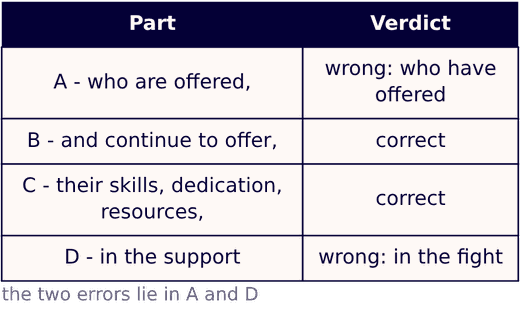 Part A: the individuals themselves give their skills, so the passive 'who are offered' is wrong; it must be the active 'who have offered', which then runs parallel with 'and continue to offer'.
Part D: 'support' takes the preposition 'for', never 'against'. The fixed expression here is 'in the fight against discrimination'.
Parts B and C are free from error, so the two faulty parts are A and D.
Correct sentence: It is difficult to measure the number of individuals who have offered, and continue to offer, their skills, dedication, resources, and energy in the fight against discrimination.
Hence, option (d) is the most appropriate answer.
Part A: the individuals themselves give their skills, so the passive 'who are offered' is wrong; it must be the active 'who have offered', which then runs parallel with 'and continue to offer'.
Part D: 'support' takes the preposition 'for', never 'against'. The fixed expression here is 'in the fight against discrimination'.
Parts B and C are free from error, so the two faulty parts are A and D.
Correct sentence: It is difficult to measure the number of individuals who have offered, and continue to offer, their skills, dedication, resources, and energy in the fight against discrimination.
Hence, option (d) is the most appropriate answer.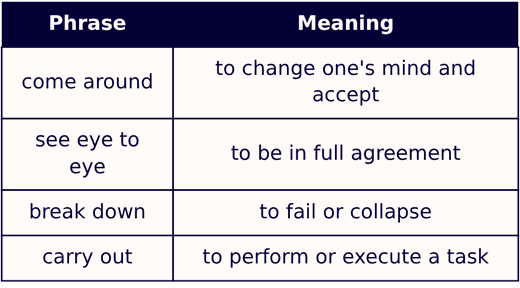 'See eye to eye' means to be in complete agreement with someone, so 'unable to see eye to eye' says exactly that they disagreed.
'Come around' means to change one's mind and finally accept, 'break down' means to fail or collapse, and 'carry out' means to perform a task - none of these expresses mutual agreement.
Hence, option (b) is the most appropriate answer.
'See eye to eye' means to be in complete agreement with someone, so 'unable to see eye to eye' says exactly that they disagreed.
'Come around' means to change one's mind and finally accept, 'break down' means to fail or collapse, and 'carry out' means to perform a task - none of these expresses mutual agreement.
Hence, option (b) is the most appropriate answer.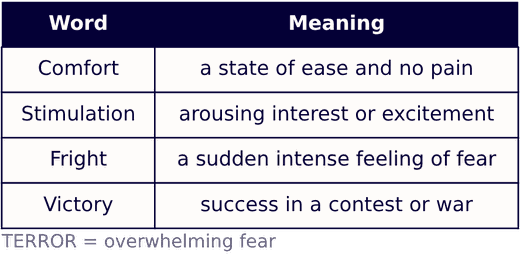 'Fright' is a sudden and intense feeling of fear, so it carries the same core idea and is the closest synonym.
'Comfort' is the very opposite of fear, 'stimulation' is the arousing of interest or excitement, and 'victory' is success in a contest.
Hence, option (c) is the most appropriate answer.
'Fright' is a sudden and intense feeling of fear, so it carries the same core idea and is the closest synonym.
'Comfort' is the very opposite of fear, 'stimulation' is the arousing of interest or excitement, and 'victory' is success in a contest.
Hence, option (c) is the most appropriate answer.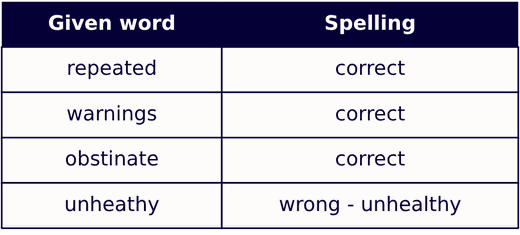 The word is built as un + health + y, so the 'l' of 'health' must stay: un-heal-thy.
'Repeated', 'warnings' and 'obstinate' are all spelt correctly.
Hence, option (d) is the incorrectly spelt word.
The word is built as un + health + y, so the 'l' of 'health' must stay: un-heal-thy.
'Repeated', 'warnings' and 'obstinate' are all spelt correctly.
Hence, option (d) is the incorrectly spelt word.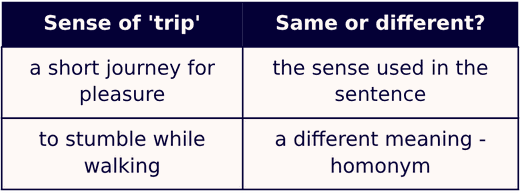 Options (a), (b) and (c) only restate that same journey sense in different words, so none of them is a homonym.
Option (d), 'to stumble or lose balance while walking', is 'trip' used as a verb with an entirely different meaning.
Hence, option (d) is the most appropriate answer.
Options (a), (b) and (c) only restate that same journey sense in different words, so none of them is a homonym.
Option (d), 'to stumble or lose balance while walking', is 'trip' used as a verb with an entirely different meaning.
Hence, option (d) is the most appropriate answer.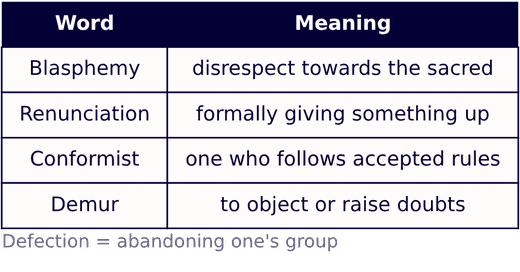 Its opposite is loyal adherence to the accepted group and its beliefs, and a 'conformist' is exactly the person who keeps to accepted rules and practices.
'Renunciation', the formal giving up of something, and 'demur', to object, both lean towards defection rather than away from it.
'Blasphemy' is disrespect shown towards what is sacred, which is unrelated to loyalty.
Hence, option (c) is the most appropriate answer.
Its opposite is loyal adherence to the accepted group and its beliefs, and a 'conformist' is exactly the person who keeps to accepted rules and practices.
'Renunciation', the formal giving up of something, and 'demur', to object, both lean towards defection rather than away from it.
'Blasphemy' is disrespect shown towards what is sacred, which is unrelated to loyalty.
Hence, option (c) is the most appropriate answer.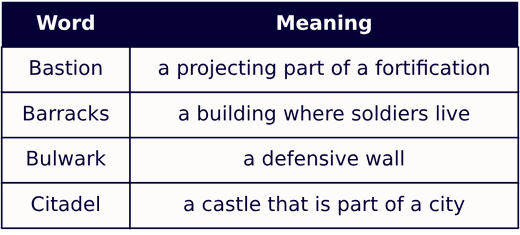 Because it is the strongest projecting point, the word is also used figuratively for a stronghold, as in 'a bastion of free speech'.
The other three options are the definitions of barracks, bulwark and citadel respectively, so they describe different parts of military architecture.
Hence, option (c) is the most appropriate answer.
Because it is the strongest projecting point, the word is also used figuratively for a stronghold, as in 'a bastion of free speech'.
The other three options are the definitions of barracks, bulwark and citadel respectively, so they describe different parts of military architecture.
Hence, option (c) is the most appropriate answer.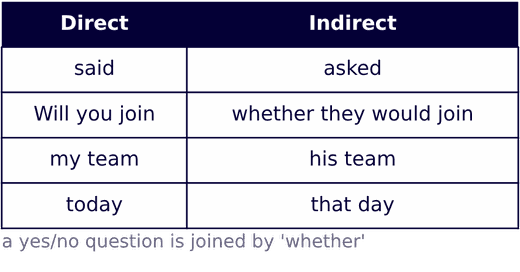 The question mark disappears and the word order becomes that of a statement, so 'Will you join' turns into 'they would join'.
'Will' backshifts to 'would', the possessive 'my' becomes 'his' and the time word 'today' becomes 'that day'.
Only (a) makes all these changes; (b) keeps 'will' and 'today' and uses 'that' after 'asked', (c) puts 'joined' after 'would', and (d) adds a perfect form that alters the meaning.
Hence, option (a) is the most appropriate answer.
The question mark disappears and the word order becomes that of a statement, so 'Will you join' turns into 'they would join'.
'Will' backshifts to 'would', the possessive 'my' becomes 'his' and the time word 'today' becomes 'that day'.
Only (a) makes all these changes; (b) keeps 'will' and 'today' and uses 'that' after 'asked', (c) puts 'joined' after 'would', and (d) adds a perfect form that alters the meaning.
Hence, option (a) is the most appropriate answer.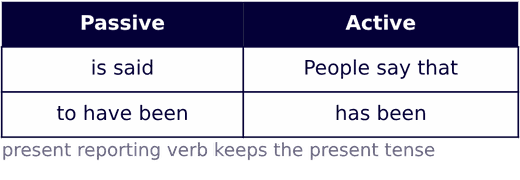 The reporting verb 'is said' is in the present tense, so the active version must also stay in the present: 'People say that'.
'To have been' is a perfect infinitive; when it is unpacked under a present reporting verb it becomes the present perfect 'has been'.
(b) shifts the report into the past, (c) turns it into the present continuous, and (d) keeps the passive tag 'it is said' instead of removing it.
Hence, option (a) is the most appropriate answer.
The reporting verb 'is said' is in the present tense, so the active version must also stay in the present: 'People say that'.
'To have been' is a perfect infinitive; when it is unpacked under a present reporting verb it becomes the present perfect 'has been'.
(b) shifts the report into the past, (c) turns it into the present continuous, and (d) keeps the passive tag 'it is said' instead of removing it.
Hence, option (a) is the most appropriate answer.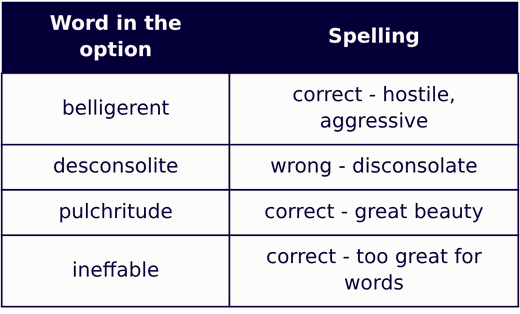 It is built from the prefix dis- (not des-) and ends in -ate like 'considerate', so the sense of the sentence about hearing bad news is right but the spelling is not.
'Belligerent', 'pulchritude' and 'ineffable' in the other three sentences are all spelt correctly.
Hence, option (b) contains the incorrectly spelt word.
It is built from the prefix dis- (not des-) and ends in -ate like 'considerate', so the sense of the sentence about hearing bad news is right but the spelling is not.
'Belligerent', 'pulchritude' and 'ineffable' in the other three sentences are all spelt correctly.
Hence, option (b) contains the incorrectly spelt word.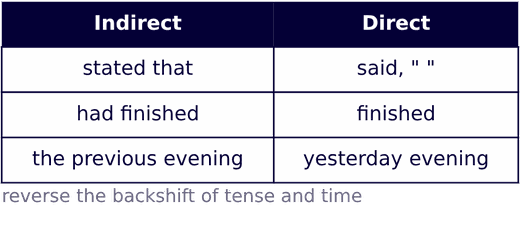 So the past perfect 'had finished' goes back to the simple past 'finished', and the reported time phrase 'the previous evening' goes back to 'yesterday evening'.
The spoken words are then placed inside double inverted commas after a comma, beginning with a capital letter.
(a) pairs 'have finished' with 'yesterday evening', which cannot stand together; (b) keeps the backshifted 'had finished'; (d) keeps the reported time phrase.
Hence, option (c) is the most appropriate answer.
So the past perfect 'had finished' goes back to the simple past 'finished', and the reported time phrase 'the previous evening' goes back to 'yesterday evening'.
The spoken words are then placed inside double inverted commas after a comma, beginning with a capital letter.
(a) pairs 'have finished' with 'yesterday evening', which cannot stand together; (b) keeps the backshifted 'had finished'; (d) keeps the reported time phrase.
Hence, option (c) is the most appropriate answer.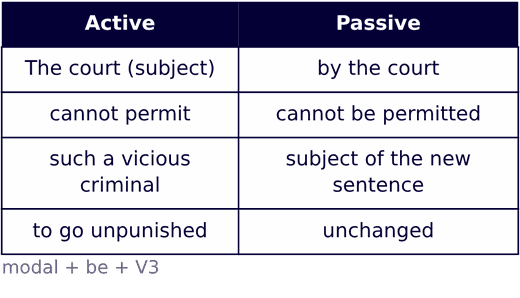 With a modal, the passive is formed as modal + be + past participle, so 'cannot permit' becomes 'cannot be permitted' and the modal itself is never changed.
The doer, 'the court', moves to the end with 'by', and the infinitive 'to go unpunished' is carried over untouched because it is not the object being shifted.
(b) alters that infinitive to 'to be unpunished', (c) recasts the sentence with a dummy 'it', and (d) replaces 'cannot' with the different modal 'must not'.
Hence, option (a) is the most appropriate answer.
With a modal, the passive is formed as modal + be + past participle, so 'cannot permit' becomes 'cannot be permitted' and the modal itself is never changed.
The doer, 'the court', moves to the end with 'by', and the infinitive 'to go unpunished' is carried over untouched because it is not the object being shifted.
(b) alters that infinitive to 'to be unpunished', (c) recasts the sentence with a dummy 'it', and (d) replaces 'cannot' with the different modal 'must not'.
Hence, option (a) is the most appropriate answer.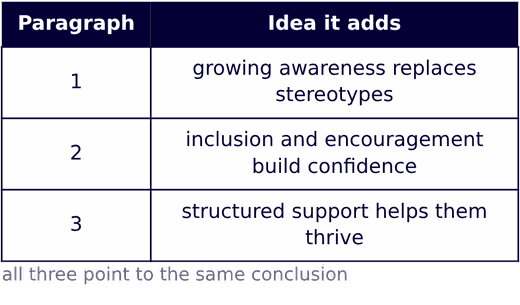 Awareness, encouragement and structured support are the three threads, and every one of them ends in the same result - children with autism overcome challenges and lead fulfilling lives.
(a) and (d) contradict the passage, which never says autism prevents learning or asks for separate schooling, and (b) reverses its whole appeal for collective responsibility.
Hence, option (c) is the most appropriate answer.
Awareness, encouragement and structured support are the three threads, and every one of them ends in the same result - children with autism overcome challenges and lead fulfilling lives.
(a) and (d) contradict the passage, which never says autism prevents learning or asks for separate schooling, and (b) reverses its whole appeal for collective responsibility.
Hence, option (c) is the most appropriate answer.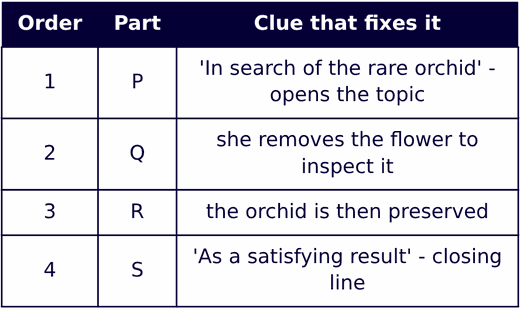 R follows next: once the orchid has been inspected, it is moved to the humid chamber to protect its fragrance.
S carries the closing marker 'As a satisfying result of her efforts', so it must come last.
The correct sequence is P, Q, R, S. Hence, option (a) is the correct answer.
R follows next: once the orchid has been inspected, it is moved to the humid chamber to protect its fragrance.
S carries the closing marker 'As a satisfying result of her efforts', so it must come last.
The correct sequence is P, Q, R, S. Hence, option (a) is the correct answer.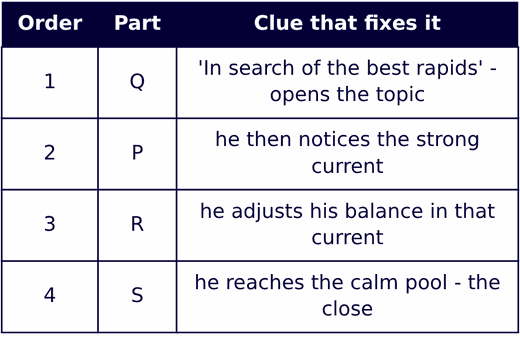 R comes next - he leans forward and adjusts his balance to deal with that swift water.
S is the natural close: he finally glides out of the rapids into the calm pool.
The correct sequence is Q, P, R, S. Hence, option (c) is the correct answer.
R comes next - he leans forward and adjusts his balance to deal with that swift water.
S is the natural close: he finally glides out of the rapids into the calm pool.
The correct sequence is Q, P, R, S. Hence, option (c) is the correct answer.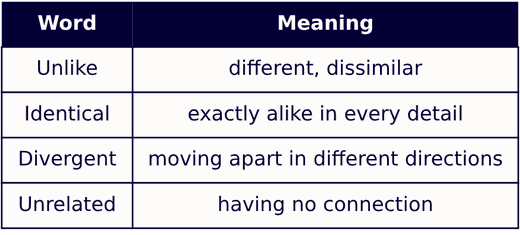 Its exact opposite is 'identical', which means alike in every detail.
'Divergent' (moving apart) and 'unrelated' (having no connection) are synonyms of unlike, not antonyms, and 'split' means to divide.
Hence, option (d) is the correct answer.
Its exact opposite is 'identical', which means alike in every detail.
'Divergent' (moving apart) and 'unrelated' (having no connection) are synonyms of unlike, not antonyms, and 'split' means to divide.
Hence, option (d) is the correct answer.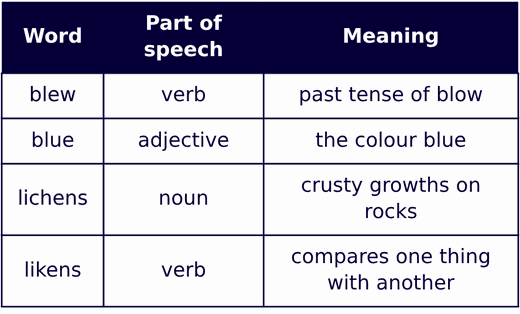 The second blank is the subject of 'clung', so a noun is needed. 'Lichens' is a noun - the small plant-like growths found on old rocks.
'Likens' is a verb meaning 'compares', so it cannot be the subject of another verb.
Hence, option (d) is the correct answer.
The second blank is the subject of 'clung', so a noun is needed. 'Lichens' is a noun - the small plant-like growths found on old rocks.
'Likens' is a verb meaning 'compares', so it cannot be the subject of another verb.
Hence, option (d) is the correct answer.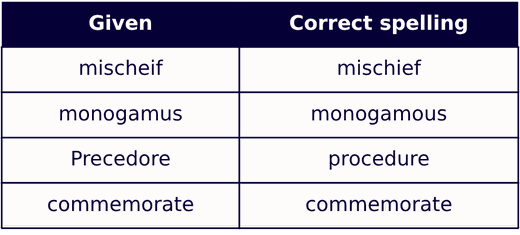 The other three are misspelt: the rule 'i before e except after c' gives mischief, the adjective from monogamy is monogamous, and the noun from proceed is procedure.
Hence, option (d) is the correct answer.
The other three are misspelt: the rule 'i before e except after c' gives mischief, the adjective from monogamy is monogamous, and the noun from proceed is procedure.
Hence, option (d) is the correct answer.