SSC CHSL 24 November 2025 · Shift 1 · English Language — questions with answers · ShikshaSphere
Chapter 120 of 200
24 November 2025 · Shift 1
English Language
25 questions ~25 min readFree
25 questions
A
1
Choose the one word substitute for the below sentence.
Sia asked her brother what a person who is in charge of a museum is called.
A.Director
B.Conservator
C.Curator
D.Historian
Solution
One word substitution
The sentence asks for the title of the officer who has charge of a museum and its collection.
A curator is exactly that person: he or she selects, catalogues, arranges and looks after the objects displayed in a museum or gallery.
A conservator only repairs and preserves objects, a director heads an organisation of any kind, and a historian merely studies and writes about the past, so none of them names the museum post itself.
2
Identify the incorrect sentence.
A.Twenty percent of the students in the class speak three languages.
B.Thirty-five minutes is a very long coffee break.
C.Her advice was perfect for the situation.
D.The selection committee were undivided in their decision to hire the new recruits.
Solution
Collective noun agreement
A collective noun such as 'committee' takes a singular verb and a singular pronoun when the group acts as one body, and a plural verb only when its members act separately.
In option (d) the word 'undivided' itself states that the committee acted as a single unit, so the plural 'were ... their' contradicts the meaning of the sentence.
The correct form is: The selection committee was undivided in its decision to hire the new recruits.
The other three are sound: a percentage of a plural noun takes a plural verb, a stretch of time treated as one block takes a singular verb, and 'advice' is an uncountable noun used correctly.
3
Fill in the blank with the most appropriate phrase:
The management's sudden choice to cancel the proposal came entirely for the investors.
A.off the wall
B.out of the blue
C.behind closed doors
D.under fire
Solution
Idiom in context
The blank must describe a decision that reached the investors with no warning at all.
'Out of the blue' means suddenly and unexpectedly, which is exactly how a sudden cancellation of the proposal would strike them.
Hence option (b) completes the sentence correctly.
4
Fill in the blank with the most appropriate phrasal verb:
Ankita's speech was so moving that it
strong emotions in the audience.
A.put up
B.brought out
C.stirred up
D.gave off
Solution
Phrasal verb
The blank needs a phrasal verb meaning 'to arouse or awaken feelings in people'.
'Stir up' means to excite or provoke emotions, which is precisely what a moving speech does to its audience.
Hence option (c) is the correct choice.
5
Select the most appropriate synonym of the word:
MALICIOUS
A.Harmless
B.Benevolent
C.Pernicious
D.Helpful
Solution
Synonym
Malicious means showing a deliberate wish to harm somebody out of ill will.
Pernicious means harmful or destructive, especially in a gradual and hidden way, so it shares the core idea of causing harm.
Harmless, benevolent and helpful all describe kindness or the absence of harm, so they are antonyms of the given word rather than synonyms.
6
Select the most appropriate synonym of the word:
PHILOSOPHICAL
A.Decorative
B.Practical
C.Cosmic
D.Existential
Solution
Synonym
Philosophical describes thinking that deals with the deep questions of existence, meaning and reality.
Existential relates to existence itself and to questions about the purpose of human life, so it belongs to the same field of reflective thought.
Decorative concerns ornament, practical concerns action rather than theory, and cosmic concerns the physical universe; none of them touches reflection on existence.
7
Choose the best option to replace the underlined part to improve the given sentence. If no substitution is required, select 'No substitution.'
His birthday is in the 11th of August.
A.on the 9th of August
B.during the 9th of August
C.at the 9th of August
D.No substitution
Solution
Preposition of time
An exact date or a particular day always takes the preposition 'on': on Monday, on the 9th of August.
'in' is reserved for longer periods such as months, years and seasons (in August, in 2025), so the underlined part uses the wrong preposition.
Only option (a) supplies 'on' before the date; 'during' points to a stretch of time and 'at' is used for clock time, so neither fits a single dated day.
8
Choose the best option to replace the underlined part to improve the given sentence. If no substitution is required, select 'No substitution.'
Please ensure that your assignments are submitted by Friday.
A.till Friday
B.until Friday
C.at Friday
D.No substitution
Solution
By vs till / until
'By' before a point of time means 'at or before that moment, not later than it', which is exactly the sense of a submission deadline.
'Till' and 'until' describe an action that continues right up to a moment, so they cannot go with a single completed act such as submitting an assignment.
'at' is used for clock time, not for a day of the week, so the given sentence is already correct and no substitution is required.
9
Select the sentence containing the homonym of the highlighted word: She used a hand file to smooth the metal's rough edges.
A.She used the new file to smooth the wood.
B.He put all the important papers in a single file.
C.She had to file his nails before applying the nailpaint.
D.The Mechanic used a special file to shape the plastic.
Solution
Homonyms
A homonym is a word spelt and pronounced in the same way but carrying a completely different meaning.
In the given sentence 'file' is a hand tool of hardened steel used to rub a rough surface smooth.
In option (b) 'file' means a folder or a set of papers kept together, an entirely different sense, so this is the homonym.
In (a), (c) and (d) the word still refers to smoothing or shaping with the same tool, so the meaning has not changed at all.
10
Choose the correct passive voice transformation of the sentence: The gardner watered the plants every morning.
A.The plants was watered by the gardner every morning.
B.The plants were watered by the gardner every morning.
C.The plants are watered by the gardner every morning.
D.The plants had been watered by the gardner every morning.
Solution
Passive voice
The active verb 'watered' is in the simple past, so the passive must be 'was/were + past participle'.
The object 'the plants' becomes the subject of the passive sentence; it is plural, so the auxiliary has to be 'were'.
The sentence therefore reads: The plants were watered by the gardner every morning.
'was' does not agree with a plural subject, 'are' shifts the sentence to the present and 'had been' shifts it to the past perfect, so (a), (c) and (d) are all wrong.
11
Choose the correct one-word substitute for:
A formal expression of praise for someone who has died.
A.Panegyric
B.Sermon
C.Eulogy
D.Editorial
Solution
One word substitution
The two clues in the definition are 'formal praise' and 'someone who has died'.
A eulogy is the formal speech or piece of writing delivered in praise of a person who has just died, usually at the funeral or memorial service.
A panegyric is elaborate praise of a living person or an institution, a sermon is a religious address and an editorial is a newspaper's opinion piece, so none of them carries the sense of mourning.
12
Select the most appropriate antonym of the word:
Quash
A.Rescind
B.Retract
C.Foment
D.Abrogate
Solution
Antonym
Quash means to put down or crush something completely, as when a court quashes a verdict or a government quashes a revolt.
Its opposite must therefore mean to stir something up instead of crushing it.
Foment means to instigate or encourage unrest and trouble, which is the exact reverse of suppressing it.
Rescind, retract and abrogate all mean to cancel, withdraw or repeal, so they stand close to 'quash' in sense and are synonyms, not antonyms.
13
Choose the correct indirect narration of the following statement from the given alternatives:
The man said to his colleague, "When was the bridge built here on this river?"
A.The man asked his colleague when the bridge had been built there on this river.
B.The man asked his colleague when the bridge had been built there on that river.
C.The man asked her colleague when the bridge was built there on that river.
D.The man asked her colleague when the bridge have been built there on that river.
Solution
Indirect narration
A 'wh-' question in reported speech keeps its question word but takes normal statement order, with no question mark at the end.
The reporting verb 'said to' becomes 'asked', and the past simple 'was built' back-shifts one step to the past perfect 'had been built'.
The words of place and pointing also change: 'here' becomes 'there' and 'this river' becomes 'that river'.
Option (a) keeps 'this', option (c) leaves the tense unchanged and calls a man 'her', and option (d) uses 'have been', so only (b) applies every change.
14
Change the following sentence into the Active form.
It has been being debated for years whether the new policy will be enacted or not.
A.They have been debating for years whether the new policy will be enacted or not.
B.The new policy will be enacted or not, which they have been debating for years.
C.Whether the new policy will be enacted or not has been debated for years.
D.They have been being debated for years whether the new policy will be enacted or not.
Solution
Active voice
The given sentence is passive: 'It has been being debated ...', where the doer is left unnamed and is understood to be people in general, that is 'they'.
In the active form the doer becomes the subject while the tense stays the same, the present perfect continuous, so 'has been being debated' turns into 'have been debating'.
The whole clause 'whether the new policy will be enacted or not' is the object of the debating and is carried over unchanged.
Option (b) turns the sentence into an awkward relative clause, option (c) is still passive, and option (d) keeps the passive 'been being', so only (a) is a true active form.
15
Select the option that expresses the given sentence in indirect voice. Peter said, "What are you doing today?"
A.Peter asked what I was doing that day.
B.Peter asked what was I doing that day.
C.Peter asked me what I was doing today.
D.Peter asked what I was doing today.
Solution
Indirect narration
A question is reported with 'asked'; the question word stays in front but the clause after it takes statement order, subject before verb.
The present continuous 'are doing' back-shifts to the past continuous 'was doing', and 'you' becomes 'I' because the speaker was addressing the reporter.
The word of time also shifts: 'today' becomes 'that day'.
Option (b) keeps the interrogative order 'was I', while (c) and (d) both leave 'today' unchanged, so only (a) is fully correct.
16
One of these words is spelled incorrectly. Which one is it?
A.Resilient
B.Obfucsate
C.Accommodate
D.Perseverance
Solution
Spelling
The word printed as 'Obfucsate' is spelt wrongly; the correct spelling is 'obfuscate', which comes from the Latin obfuscare, to darken, and means to make something deliberately unclear.
In the correct form the letters run o-b-f-u-s-c-a-t-e, so the option has interchanged the 's' and the 'c'.
Resilient, accommodate (double c and double m) and perseverance are all spelt correctly, which leaves option (b) as the misspelt word.
17
Choose the correct passive voice transformation of the sentence: They have visited China many times.
A.China was visited by them many times.
B.China has been visited by them many times.
C.China had been visited by them many times.
D.China is visited by them many times.
Solution
Passive voice
'have visited' is the present perfect active, whose passive pattern is 'has/have been + past participle'.
The object 'China' becomes the subject and is singular, so the auxiliary needed is 'has been'.
The sentence therefore becomes: China has been visited by them many times.
'was visited' is simple past, 'had been visited' is past perfect and 'is visited' is simple present, so each of the other options changes the tense of the original.
18
Select the option that expresses the given sentence in direct voice. Ruksar said that she would not leave her job.
A.Ruksar said, "I will not leave my job."
B.Ruksar said, "She would not leave her job."
C.Ruksar said, 'I would not leave my job."
D.Ruksar said, "She will not leave her job."
Solution
Direct narration
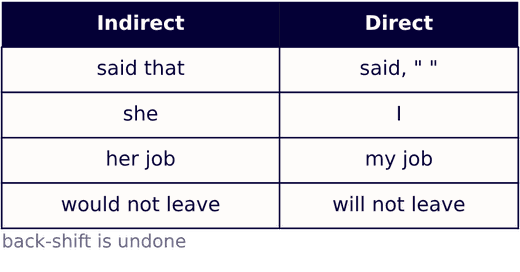
Turning indirect speech back into direct speech reverses every change that was made while reporting it.
The reported pronouns 'she' and 'her' go back to the speaker's own words 'I' and 'my', and the back-shifted 'would' returns to 'will'.
Inside the inverted commas the sentence therefore reads: I will not leave my job.
Options (b) and (d) keep the third-person pronouns and option (c) keeps the back-shifted 'would', so only (a) restores the speaker's original words.
19
Directions (Qs. 19-23): Read the following passage carefully and answer the questions that follow.
Social media usage has become increasingly pervasive in recent decades, with billions of individuals logging on daily to share their personal experiences. While improvements in digital connectivity have made communication faster and more global, there are still notable dangers linked to curating one's life digitally.
One of the primary adverse impacts of
social networking is the risk of security breaches such as hacking, phishing, and even identity theft in extreme instances. Furthermore, constant scrolling can disrupt the mind's natural sleep cycle. Aside from digital threats, social media can also trigger emotional disturbances. Countless users cultivate a distorted reality, which frequently results in jealousy, loneliness, and poor self-image when their lives seem dull by comparison.
Furthermore, a relentless emphasis on online popularity can foster shallow connections in communities, urging folks to value themselves and peers merely on engagement metrics. Over time, this fixation may harm emotional well-being and destroy authentic self-worth. Consequently, it is crucial to assess the habits and limits before deciding to immerse oneself in virtual platforms.
Which of the following conjunctions is NOT used in the passage?
A.While
B.Aside from
C.Because
D.And
Solution
Conjunctions in a passage
Go through the passage and mark every linking word offered in the options.
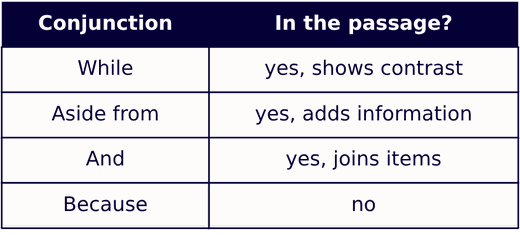
'While' opens the second sentence of the first paragraph to show contrast, and 'Aside from' introduces the sentence about emotional disturbances to add information.
'And' appears several times joining items, as in 'hacking, phishing, and even identity theft'.
No sentence in the passage gives a reason with 'because', so that is the conjunction not used.
20
Directions (Qs. 19-23): Read the following passage carefully and answer the questions that follow.
Social media usage has become increasingly pervasive in recent decades, with billions of individuals logging on daily to share their personal experiences. While improvements in digital connectivity have made communication faster and more global, there are still notable dangers linked to curating one's life digitally.
One of the primary adverse impacts of
social networking is the risk of security breaches such as hacking, phishing, and even identity theft in extreme instances. Furthermore, constant scrolling can disrupt the mind's natural sleep cycle. Aside from digital threats, social media can also trigger emotional disturbances. Countless users cultivate a distorted reality, which frequently results in jealousy, loneliness, and poor self-image when their lives seem dull by comparison.
Furthermore, a relentless emphasis on online popularity can foster shallow connections in communities, urging folks to value themselves and peers merely on engagement metrics. Over time, this fixation may harm emotional well-being and destroy authentic self-worth. Consequently, it is crucial to assess the habits and limits before deciding to immerse oneself in virtual platforms.
Identify the sentence from the passage that contains a relative pronoun, and choose the correct type of pronoun used.
A.Social media usage has become increasingly pervasive in recent decades.
B.While improvements in digital connectivity have made communication faster.
C.Countless users cultivate a distorted reality, which frequently results in jealousy.
D.A relentless emphasis on online popularity can foster shallow connections in communities.
Solution
Relative pronoun
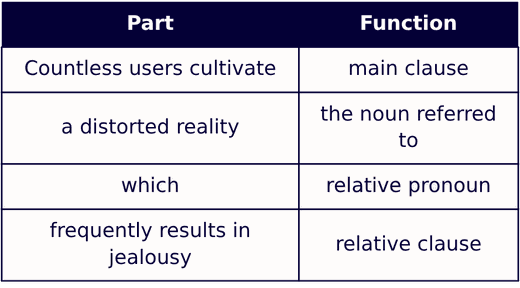
A relative pronoun — who, whom, whose, which or that — joins a clause to a noun already mentioned and tells us more about it.
In option (c) the word 'which' introduces the clause 'which frequently results in jealousy' and points back to the noun phrase 'a distorted reality'.
Options (a) and (d) contain no pronoun at all, and 'While' in option (b) is a subordinating conjunction, not a pronoun, so only (c) fits.
21
Directions (Qs. 19-23): Read the following passage carefully and answer the questions that follow.
Social media usage has become increasingly pervasive in recent decades, with billions of individuals logging on daily to share their personal experiences. While improvements in digital connectivity have made communication faster and more global, there are still notable dangers linked to curating one's life digitally.
One of the primary adverse impacts of
social networking is the risk of security breaches such as hacking, phishing, and even identity theft in extreme instances. Furthermore, constant scrolling can disrupt the mind's natural sleep cycle. Aside from digital threats, social media can also trigger emotional disturbances. Countless users cultivate a distorted reality, which frequently results in jealousy, loneliness, and poor self-image when their lives seem dull by comparison.
Furthermore, a relentless emphasis on online popularity can foster shallow connections in communities, urging folks to value themselves and peers merely on engagement metrics. Over time, this fixation may harm emotional well-being and destroy authentic self-worth. Consequently, it is crucial to assess the habits and limits before deciding to immerse oneself in virtual platforms.
What does "shallow" mean in this passage?
A.Deep and meaningful
B.Lacking depth or seriousness
C.Physically low
D.Educational and smart
Solution
Vocabulary in context
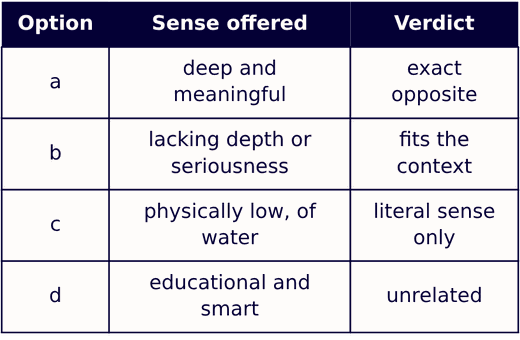
In the last paragraph the writer says that a relentless emphasis on online popularity can foster shallow connections in communities.
The very next clause explains it: people value themselves and their peers 'merely on engagement metrics', so the bonds formed have no real substance behind them.
'Shallow' is therefore used figuratively here for something lacking depth or seriousness, option (b); (a) is its opposite and (c) is the literal sense of shallow water, which the context rules out.
22
Directions (Qs. 19-23): Read the following passage carefully and answer the questions that follow.
Social media usage has become increasingly pervasive in recent decades, with billions of individuals logging on daily to share their personal experiences. While improvements in digital connectivity have made communication faster and more global, there are still notable dangers linked to curating one's life digitally.
One of the primary adverse impacts of
social networking is the risk of security breaches such as hacking, phishing, and even identity theft in extreme instances. Furthermore, constant scrolling can disrupt the mind's natural sleep cycle. Aside from digital threats, social media can also trigger emotional disturbances. Countless users cultivate a distorted reality, which frequently results in jealousy, loneliness, and poor self-image when their lives seem dull by comparison.
Furthermore, a relentless emphasis on online popularity can foster shallow connections in communities, urging folks to value themselves and peers merely on engagement metrics. Over time, this fixation may harm emotional well-being and destroy authentic self-worth. Consequently, it is crucial to assess the habits and limits before deciding to immerse oneself in virtual platforms.
The word "fixation" means:
A.A temporary dislike
B.A balanced approach
C.An intense and unhealthy focus
D.A rare occurrence
Solution
Vocabulary in context
'Over time, this fixation may harm emotional well-being' points back to the relentless emphasis on online popularity described in the sentence before it.
A fixation is an obsessive preoccupation — a focus so strong that it stops being healthy, which is exactly why the writer says it destroys authentic self-worth.
Hence option (c); a temporary dislike, a balanced approach and a rare occurrence all contradict the obsessive and harmful sense the sentence needs.
23
Directions (Qs. 19-23): Read the following passage carefully and answer the questions that follow.
Social media usage has become increasingly pervasive in recent decades, with billions of individuals logging on daily to share their personal experiences. While improvements in digital connectivity have made communication faster and more global, there are still notable dangers linked to curating one's life digitally.
One of the primary adverse impacts of
social networking is the risk of security breaches such as hacking, phishing, and even identity theft in extreme instances. Furthermore, constant scrolling can disrupt the mind's natural sleep cycle. Aside from digital threats, social media can also trigger emotional disturbances. Countless users cultivate a distorted reality, which frequently results in jealousy, loneliness, and poor self-image when their lives seem dull by comparison.
Furthermore, a relentless emphasis on online popularity can foster shallow connections in communities, urging folks to value themselves and peers merely on engagement metrics. Over time, this fixation may harm emotional well-being and destroy authentic self-worth. Consequently, it is crucial to assess the habits and limits before deciding to immerse oneself in virtual platforms.
What are two major downsides associated with social media, according to the passage?
A.Improved global communication and faster news
B.Security breaches and emotional disturbances
C.Increased popularity and better sleep cycles
D.Enhanced community values and authentic self-worth
Solution
Comprehension detail
The second paragraph opens with the first danger: 'the risk of security breaches such as hacking, phishing, and even identity theft'.
The same paragraph then turns to the second: 'Aside from digital threats, social media can also trigger emotional disturbances', illustrated by jealousy, loneliness and poor self-image.
So the two major downsides the passage itself names are security breaches and emotional disturbances, option (b).
Option (a) lists a benefit, and options (c) and (d) state the very things the passage says social media damages, so none of them can be a downside.
24
Which of the following pairs of homonyms can be used to fill in the blanks most suitably?
The woman sat down to the note but kept shivering from the terrible seeping in through the broken window.
A.parse; pars
B.draught; draft
C.draft; draught
D.pars; parse
Solution
Homonyms
Homonyms are words that sound alike but differ in meaning, and here also in spelling, so each blank must be filled by meaning.
The first blank follows 'sat down to', so it needs a verb meaning 'to write a first version of something' — that is 'draft'.
The second blank names a thing 'seeping in through the broken window' that makes her shiver, so it must be 'draught', a current of cold air.
'Parse' means to analyse a sentence grammatically and 'pars' is merely the plural of 'par', so neither pair fits; hence option (c) is correct.
25
Which part of the following sentence contains a spelling error?
The renowned pianist (1) enthralled audiences across the globe with performances that were technically precise (2) and emotionally transcendant (3) in every respect (4).
A.(4)
B.(1)
C.(3)
D.(2)
Solution
Spelling error
Test the key word of each numbered part against its correct spelling.
Part (3) carries 'transcendant'; the adjective formed from the verb 'transcend' ends in -ent, so the correct spelling is 'transcendent'.
'Renowned' in (1), 'precise' in (2) and 'respect' in (4) are all spelt correctly, so the error is in part (3), option (c).
Finished reading? Now test yourself.
The same 25 questions, but with a timer and the answers hidden — 15 minutes.

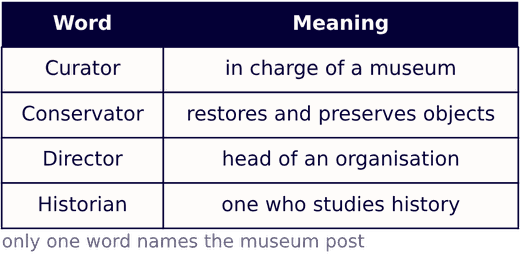 A conservator only repairs and preserves objects, a director heads an organisation of any kind, and a historian merely studies and writes about the past, so none of them names the museum post itself.
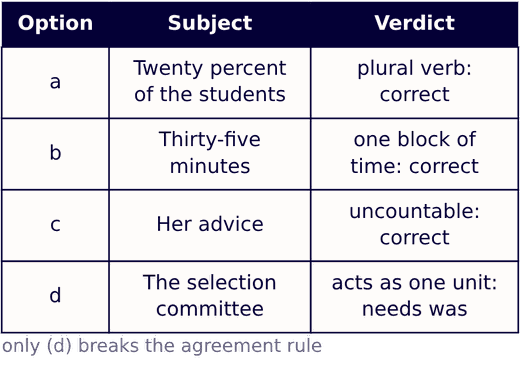 The other three are sound: a percentage of a plural noun takes a plural verb, a stretch of time treated as one block takes a singular verb, and 'advice' is an uncountable noun used correctly.
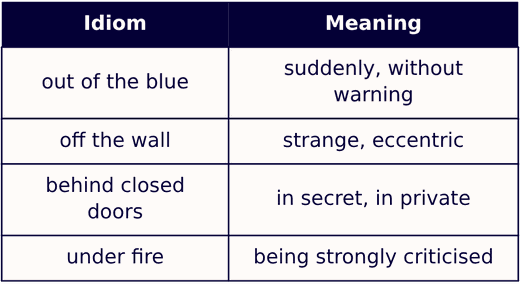 Hence option (b) completes the sentence correctly.
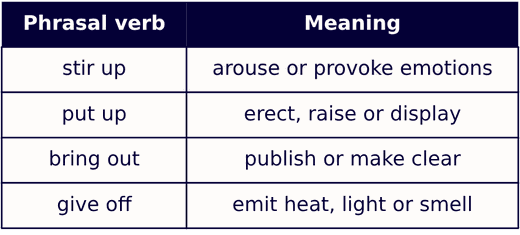 Hence option (c) is the correct choice.
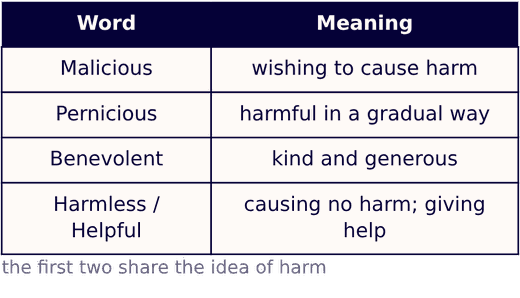 Harmless, benevolent and helpful all describe kindness or the absence of harm, so they are antonyms of the given word rather than synonyms.
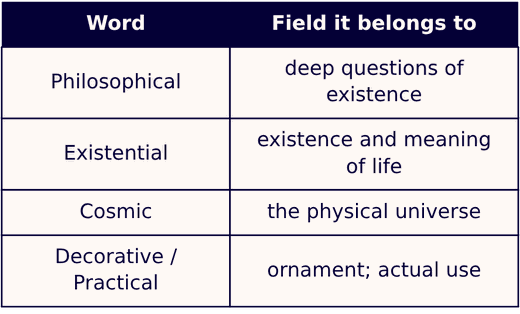 Decorative concerns ornament, practical concerns action rather than theory, and cosmic concerns the physical universe; none of them touches reflection on existence.
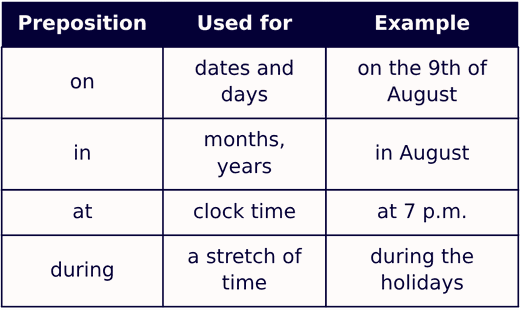 Only option (a) supplies 'on' before the date; 'during' points to a stretch of time and 'at' is used for clock time, so neither fits a single dated day.
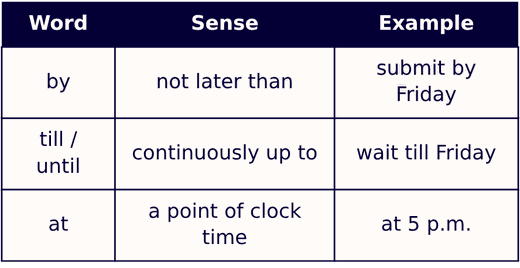 'at' is used for clock time, not for a day of the week, so the given sentence is already correct and no substitution is required.
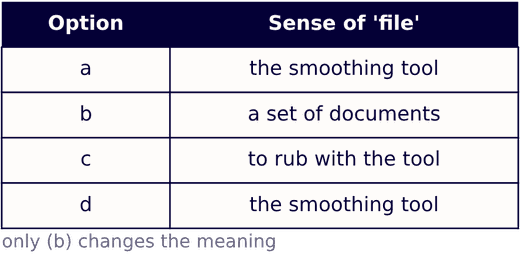 In (a), (c) and (d) the word still refers to smoothing or shaping with the same tool, so the meaning has not changed at all.
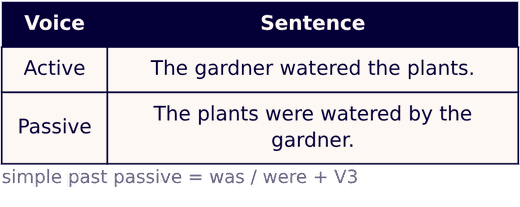 'was' does not agree with a plural subject, 'are' shifts the sentence to the present and 'had been' shifts it to the past perfect, so (a), (c) and (d) are all wrong.
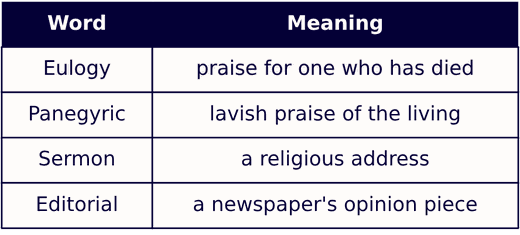 A panegyric is elaborate praise of a living person or an institution, a sermon is a religious address and an editorial is a newspaper's opinion piece, so none of them carries the sense of mourning.
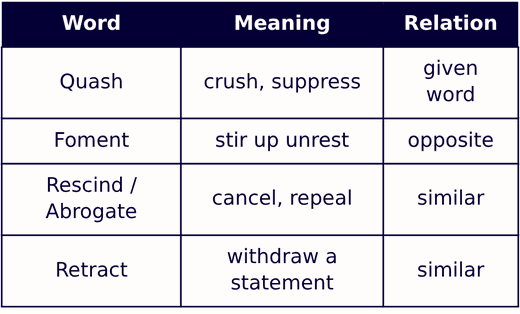 Rescind, retract and abrogate all mean to cancel, withdraw or repeal, so they stand close to 'quash' in sense and are synonyms, not antonyms.
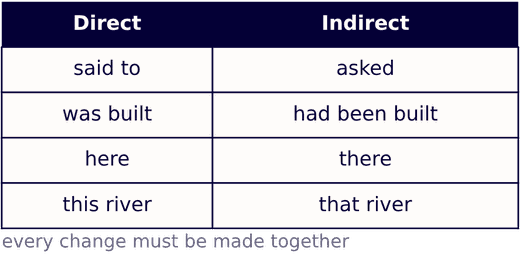 Option (a) keeps 'this', option (c) leaves the tense unchanged and calls a man 'her', and option (d) uses 'have been', so only (b) applies every change.
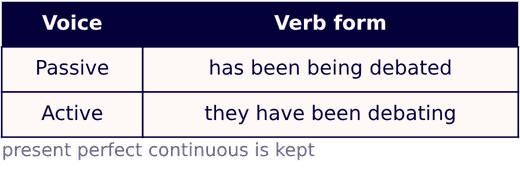 Option (b) turns the sentence into an awkward relative clause, option (c) is still passive, and option (d) keeps the passive 'been being', so only (a) is a true active form.
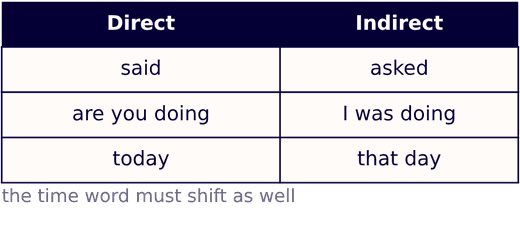 Option (b) keeps the interrogative order 'was I', while (c) and (d) both leave 'today' unchanged, so only (a) is fully correct.
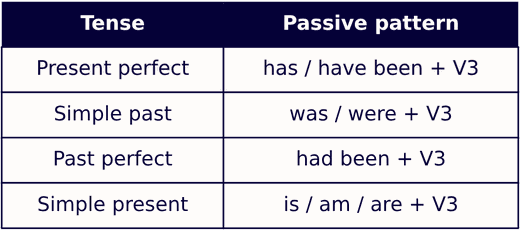 'was visited' is simple past, 'had been visited' is past perfect and 'is visited' is simple present, so each of the other options changes the tense of the original.
 Options (b) and (d) keep the third-person pronouns and option (c) keeps the back-shifted 'would', so only (a) restores the speaker's original words.
 No sentence in the passage gives a reason with 'because', so that is the conjunction not used.
 Options (a) and (d) contain no pronoun at all, and 'While' in option (b) is a subordinating conjunction, not a pronoun, so only (c) fits.
 'Shallow' is therefore used figuratively here for something lacking depth or seriousness, option (b); (a) is its opposite and (c) is the literal sense of shallow water, which the context rules out.
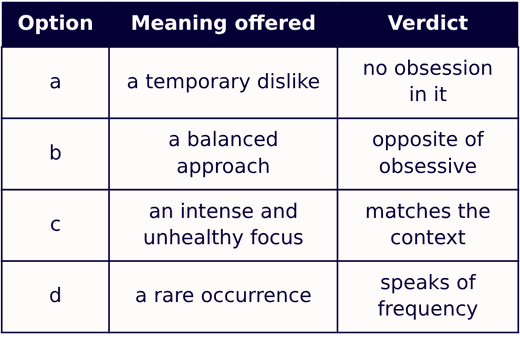 Hence option (c); a temporary dislike, a balanced approach and a rare occurrence all contradict the obsessive and harmful sense the sentence needs.
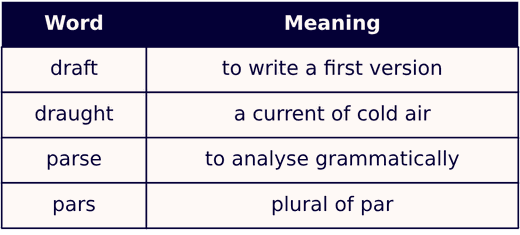 'Parse' means to analyse a sentence grammatically and 'pars' is merely the plural of 'par', so neither pair fits; hence option (c) is correct.
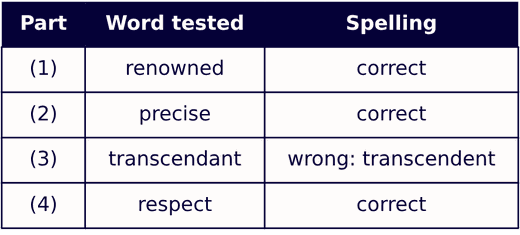 'Renowned' in (1), 'precise' in (2) and 'respect' in (4) are all spelt correctly, so the error is in part (3), option (c).