SSC CHSL 24 November 2025 · Shift 2 · English Language — questions with answers · ShikshaSphere
Chapter 124 of 200
24 November 2025 · Shift 2
English Language
25 questions ~25 min readFree
25 questions
A
1
Choose the one word substitute for the below sentence.
Kavita often showed a deep dislike for humanity, withdrawing from social interactions and choosing to live in solitude.
A.Misanthrope
B.Misogynist
C.Cynic
D.Narcissist
Solution
One-word substitution
The clue words are 'deep dislike for humanity' and withdrawal from all social contact.
Misanthrope - a person who hates or distrusts human beings in general and prefers to live apart from them.
Misogynist - one who hates women; Cynic - one who believes people act only out of self-interest; Narcissist - one absorbed in self-admiration.
Only 'Misanthrope' covers dislike of humanity as a whole, so option (a) is correct.
2
Choose the correct option to specify the meaning of the highlighted idiom.
Ravi decided to bite the bullet and finally agreed to undergo surgery, as it was the option left for his survival.
A.To keep the past hanging with you always
B.To get something over with because it is inevitable
C.To avoid getting into something at all
D.To not get over with anything in life at all
Solution
Idiom meaning
'Bite the bullet' means to accept and go through something painful or unpleasant that cannot be avoided.
Ravi agrees to surgery only because it is the one option left for his survival - he faces the inevitable bravely.
Option (c) states the very opposite (avoiding it altogether), so option (b) is correct.
3
Identify the meaning of the phrase highlighted in bold.
In hushed anonymity, Shruti burned the midnight oil and prepared woolen blankets for the beggars around the street.
A.Go early to bed
B.Work for a few minutes
C.Work hard for a long time
D.Wake up very early
Solution
Idiomatic phrase
'Burn the midnight oil' means to study or work late into the night, that is, to work hard for a long time.
Shruti quietly stayed up preparing woollen blankets, so long hours of sustained effort are meant.
The phrase has nothing to do with sleeping early or rising early, so option (c) is correct.
4
Identify Spot the error in the given sentence.
"Neither of the two girls have completed her assignment."
A.Neither of the two
B.girls have
C.completed their
D.assignment
Solution
Subject-verb agreement
'Neither of + plural noun' is treated as a singular subject, so it must take a singular verb.
Words of this family - each, every, either, neither, everyone, nothing - are all singular in the same way.
Hence 'Neither of the two girls have completed' should read 'has completed'.
The faulty segment is therefore 'girls have', option (b).
5
Identify Spot the error in the given sentence.
"Neither the teacher nor the students has arrived yet."
A.Neither the teacher
B.nor the students
C.has arrived
D.yet
Solution
Neither-nor agreement
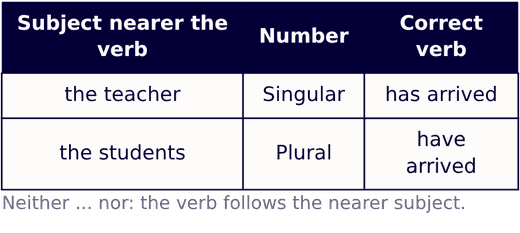
With the pair 'Neither ... nor' the verb agrees with the subject that stands nearer to it (proximity rule).
Here the nearer subject is 'the students', which is plural, so the singular verb 'has' is wrong.
'has arrived' must become 'have arrived', so the error lies in segment (c).
6
Fill in the blank with the most appropriate option:
The bill was passed with support, uniting parties across the political spectrum.
A.nominal
B.perfunctory
C.Partisan
D.unanimous
Solution
Vocabulary: fill in blank
The blank must describe support that united parties right across the political spectrum.
'Unanimous' means agreed to by everyone, with not a single dissenting voice - exactly that idea.
'Nominal' = in name only, 'perfunctory' = done carelessly as a formality, 'partisan' = favouring one side; all three clash with 'uniting parties'.
Hence option (d) is correct.
7
Choose the best option to replace the underlined part to improve the given sentence. If no substitution is required, select 'No substitution.'
She is angry at you for losing her ring.
A.angry with you
B.angry on you
C.angry about you
D.No substitution
Solution
Preposition with adjective
The adjective 'angry' takes 'with' before a person, and 'at' or 'about' before a thing, act or situation.
Here the anger is directed at a person ('you'), so 'angry with you' is required; 'angry at' would suit 'angry at the delay'.
'Angry on' is never used, so the underlined part is replaced by option (a).
8
From the alternatives given below, select the correct passive voice of the following sentence.
The staff have to leave the door of the building open for all the visitors to get in.
A.The door of the building has been left open by the staff for all the visitors to get in.
B.The door of the building has to be left open by the staff for all the visitors to get in.
C.The door of the building has to be left opened by the staff for all the visitors to get in.
D.The door of the building has to be left open for all the visitors by the staff to get in.
Solution
Active to passive voice
In a 'have to + V1' sentence the passive form is 'has/have to be + V3'.
The object 'the door of the building' becomes the subject; being singular it takes 'has to be left'.
'Open' here is a complement adjective describing the door, so 'left open' is right and 'left opened' in (c) is wrong.
Option (a) drops 'to be' and changes the sense, and (d) misplaces 'by the staff'.
Hence option (b) is correct.
9
Choose the correct indirect narration of the following statement from the given alternatives:
The boy said, "I am eight years old."
A.The boy said that he has been eight years old.
B.The boy said that he had been eight years old.
C.The boy said that he was eight years old.
D.The boy said that he is eight years old.
Solution
Direct to indirect speech
The reporting verb 'said' is in the past tense, so the reported verb back-shifts one step.
'I am eight years old' therefore becomes 'he was eight years old', and the pronoun 'I' changes to 'he'.
Options (a) and (b) use tenses that no rule produces from a simple present, so option (c) is correct.
10
Change the following sentence into the Active form.
It is being claimed that a new organism has been discovered in Africa.
A.Someone is claiming that a new organism has been discovered in Africa.
B.A new organism has been discovered in Africa, it is being claimed.
C.Someone claims that a new organism has been discovered in Africa.
D.Someone is claiming that they have discovered a new organism in Africa.
Solution
Passive to active voice
Only the introductory clause 'It is being claimed' has to be turned into the active voice.
No agent is named, so an indefinite subject 'Someone' is supplied: 'Someone is claiming that ...'.
The tense must stay present continuous, which rules out the simple present in (c).
The subordinate clause is not what the instruction asks about, so it is kept word for word - (d) rewrites it and (b) leaves the main clause passive.
Hence option (a) is correct.
11
Which sentence contains a misspelled word?
A.The painter's work exists on a continuum between abstract and realistic styles.
B.The Professor explained that learning is a continum, not a series of isolated steps.
C.The debate mapped multiple viewpoints across an extensive continuum of perspectives.
D.They regarded time as an unbroken continuum extending infinitely forward and backward.
Solution
Spelling error
The correct spelling is 'continuum' - a Latin-derived noun meaning an unbroken whole, with a double 'u' before the final 'm'.
Option (b) writes 'continum', dropping one 'u'.
Options (a), (c) and (d) all spell the word correctly, so the sentence with the misspelt word is (b).
12
Choose the most suitable option to replace the highlighted part of the sentence:
As Shreya wanted to be selected in the team, so she worked very hard.
A.so she work very hard
B.she worked very hard
C.and she worked very hard
D.because she worked very hard
Solution
Double conjunction error
'As' already introduces the reason, so a second connector 'so' cannot be used in the same sentence - one clause needs only one conjunction.
The correct sentence is: As Shreya wanted to be selected in the team, she worked very hard.
Option (a) also keeps 'so' and uses the wrong verb form, while (c) and (d) add fresh conjunctions.
Only option (b) removes the extra conjunction and keeps the past tense, so (b) is correct.
13
Choose the correct passive voice transformation of the sentence:
What is the teacher explaining?
A.What has been explained by the teacher ?
B.What is being explained by the teacher ?
C.What was explained by the teacher ?
D.What did the teacher explain?
Solution
Passive of interrogative
The sentence is in the Present Continuous tense, whose passive form is 'is/are being + V3'.
The question word 'What' stays at the front and the doer moves to 'by the teacher'.
Options (a) and (c) change the tense and (d) is not passive at all, so option (b) is correct.
14
Select the option that expresses the given sentence in direct voice.
The archaeologist determined that the early civilization had developed advanced irrigation techniques long before its demise.
A.The archaeologist said, "The early civilization had developed advanced irrigation techniques long before its demise."
B.The archaeologist said, "The early civilization developed advanced irrigation techniques long before its demise."
C.The archaeologist determined, "The early civilization develops advanced irrigation techniques."
D.The archaeologist said, "The early civilization has developed advanced irrigation techniques."
Solution
Indirect to direct speech
Turning reported speech back into direct speech means undoing the back-shift of tense.
The past perfect 'had developed' therefore returns to the simple past 'developed', and 'determined that' becomes 'said, "..."'.
The rest of the words, including 'long before its demise', must be kept, which rules out (c) and (d); (a) keeps the back-shifted tense.
Hence option (b) is correct.
15
Directions (Qs. 15-19): Read the following passage carefully and answer the questions that follow.
The discussion regarding whether reading digital books is superior to reading printed books has escalated, particularly following the technological surge in recent years. While digital reading offers convenience and saves physical space, many enthusiasts claim that printed books remain more satisfying for various reasons.
Physical books provide a tactile experience where individuals can disconnect from screens and notifications.
Turning paper pages fosters deep comprehension, focused attention, and better memory retention elements often harder to achieve electronically. Holding a book also helps sustain focus and minimizes interruptions typical on devices, such as alerts or low battery.
Another significant aspect is the sensory appeal. For many, the distinct smell of
ink, paper, and binding evokes nostalgia and establishes a sense of ownership. It also helps avoid the eye-strain that digital readers frequently encounter. While tablets facilitate portable collections, emotional attachment and shelf aesthetics often flourish better with physical copies. Tangible volumes support collection-building and permit owners to share and lend stories more personally. Therefore, while e-books have merits like portability and access, the classic book still holds a vital place in learning, relaxation, and cultural preservation.
A flexible habit, utilizing both digital and physical formats might provide the optimal solution, satisfying distinct situations while ensuring enjoyment and knowledge.
In the sentence:
"While digital reading offers convenience and saves physical space, many enthusiasts claim that printed books remain more satisfying for various reasons."
What is the part of speech of the word "convenience"?
A.Verb
B.Adjective
C.Adverb
D.Noun
Solution
Parts of speech
Ask 'digital reading offers what?' - the answer is 'convenience'.
A word that names a quality or an abstract thing, and that works as the object of a verb, is a noun.
The adjective form would be 'convenient' and the adverb 'conveniently', neither of which is used here.
Hence 'convenience' is a noun, option (d).
16
Directions (Qs. 15-19): Read the following passage carefully and answer the questions that follow.
The discussion regarding whether reading digital books is superior to reading printed books has escalated, particularly following the technological surge in recent years. While digital reading offers convenience and saves physical space, many enthusiasts claim that printed books remain more satisfying for various reasons.
Physical books provide a tactile experience where individuals can disconnect from screens and notifications.
Turning paper pages fosters deep comprehension, focused attention, and better memory retention elements often harder to achieve electronically. Holding a book also helps sustain focus and minimizes interruptions typical on devices, such as alerts or low battery.
Another significant aspect is the sensory appeal. For many, the distinct smell of
ink, paper, and binding evokes nostalgia and establishes a sense of ownership. It also helps avoid the eye-strain that digital readers frequently encounter. While tablets facilitate portable collections, emotional attachment and shelf aesthetics often flourish better with physical copies. Tangible volumes support collection-building and permit owners to share and lend stories more personally. Therefore, while e-books have merits like portability and access, the classic book still holds a vital place in learning, relaxation, and cultural preservation.
A flexible habit, utilizing both digital and physical formats might provide the optimal solution, satisfying distinct situations while ensuring enjoyment and knowledge.
In the sentence:
"Another significant aspect is the sensory appeal."
What type of adjective is the word "sensory"?
A.Demonstrative adjective
B.Descriptive adjective
C.Quantitative adjective
D.Interrogative adjective
Solution
Types of adjective
'Sensory' stands before the noun 'appeal' and tells us what kind of appeal it is.
An adjective that names a quality of the noun is a descriptive (qualitative) adjective.
A demonstrative adjective points out (this, that), a quantitative one shows how much (some, little), and an interrogative one asks (which, whose).
Hence option (b) is correct.
17
Directions (Qs. 15-19): Read the following passage carefully and answer the questions that follow.
The discussion regarding whether reading digital books is superior to reading printed books has escalated, particularly following the technological surge in recent years. While digital reading offers convenience and saves physical space, many enthusiasts claim that printed books remain more satisfying for various reasons.
Physical books provide a tactile experience where individuals can disconnect from screens and notifications.
Turning paper pages fosters deep comprehension, focused attention, and better memory retention elements often harder to achieve electronically. Holding a book also helps sustain focus and minimizes interruptions typical on devices, such as alerts or low battery.
Another significant aspect is the sensory appeal. For many, the distinct smell of
ink, paper, and binding evokes nostalgia and establishes a sense of ownership. It also helps avoid the eye-strain that digital readers frequently encounter. While tablets facilitate portable collections, emotional attachment and shelf aesthetics often flourish better with physical copies. Tangible volumes support collection-building and permit owners to share and lend stories more personally. Therefore, while e-books have merits like portability and access, the classic book still holds a vital place in learning, relaxation, and cultural preservation.
A flexible habit, utilizing both digital and physical formats might provide the optimal solution, satisfying distinct situations while ensuring enjoyment and knowledge.
Which of the following word pairs is a correct collocation found in the passage?
A.Evokes nostalgia
B.Minimizes aesthetics
C.Creates retention
D.Builds convenience
Solution
Collocation
The passage says that the smell of ink, paper and binding 'evokes nostalgia'.
'Evoke' habitually pairs with feelings and memories - evoke nostalgia, evoke sympathy - so this is a natural collocation.
The passage uses 'minimizes interruptions', not 'minimizes aesthetics', and speaks of 'memory retention' and 'offers convenience', so (b), (c) and (d) are invented pairings.
Hence option (a) is correct.
18
Directions (Qs. 15-19): Read the following passage carefully and answer the questions that follow.
The discussion regarding whether reading digital books is superior to reading printed books has escalated, particularly following the technological surge in recent years. While digital reading offers convenience and saves physical space, many enthusiasts claim that printed books remain more satisfying for various reasons.
Physical books provide a tactile experience where individuals can disconnect from screens and notifications.
Turning paper pages fosters deep comprehension, focused attention, and better memory retention elements often harder to achieve electronically. Holding a book also helps sustain focus and minimizes interruptions typical on devices, such as alerts or low battery.
Another significant aspect is the sensory appeal. For many, the distinct smell of
ink, paper, and binding evokes nostalgia and establishes a sense of ownership. It also helps avoid the eye-strain that digital readers frequently encounter. While tablets facilitate portable collections, emotional attachment and shelf aesthetics often flourish better with physical copies. Tangible volumes support collection-building and permit owners to share and lend stories more personally. Therefore, while e-books have merits like portability and access, the classic book still holds a vital place in learning, relaxation, and cultural preservation.
A flexible habit, utilizing both digital and physical formats might provide the optimal solution, satisfying distinct situations while ensuring enjoyment and knowledge.
In the sentence:
Turning paper pages fosters comprehension and better memory retention.
A.Brief
B.Shallow
C.Deep
D.Sudden
Solution
Comprehension: fill in blank
The passage reads: 'Turning paper pages fosters deep comprehension, focused attention, and better memory retention.'
The blank is paired with 'better memory retention', so a word of positive strength is needed, and 'foster' itself suggests growth in depth.
'Brief', 'shallow' and 'sudden' all weaken or contradict that sense.
Hence 'Deep', option (c), is correct.
19
Directions (Qs. 15-19): Read the following passage carefully and answer the questions that follow.
The discussion regarding whether reading digital books is superior to reading printed books has escalated, particularly following the technological surge in recent years. While digital reading offers convenience and saves physical space, many enthusiasts claim that printed books remain more satisfying for various reasons.
Physical books provide a tactile experience where individuals can disconnect from screens and notifications.
Turning paper pages fosters deep comprehension, focused attention, and better memory retention elements often harder to achieve electronically. Holding a book also helps sustain focus and minimizes interruptions typical on devices, such as alerts or low battery.
Another significant aspect is the sensory appeal. For many, the distinct smell of
ink, paper, and binding evokes nostalgia and establishes a sense of ownership. It also helps avoid the eye-strain that digital readers frequently encounter. While tablets facilitate portable collections, emotional attachment and shelf aesthetics often flourish better with physical copies. Tangible volumes support collection-building and permit owners to share and lend stories more personally. Therefore, while e-books have merits like portability and access, the classic book still holds a vital place in learning, relaxation, and cultural preservation.
A flexible habit, utilizing both digital and physical formats might provide the optimal solution, satisfying distinct situations while ensuring enjoyment and knowledge.
What is the main idea of the passage?
A.E-books are always better than physical books
B.Reading digitally is perfect for everyone
C.Reading printed books has clear advantages over digital reading
D.People should stop reading altogether
Solution
Comprehension: main idea
The writer concedes that digital reading is convenient, but every paragraph that follows lists a strength of printed books.
Deeper comprehension, better memory retention, less eye-strain, sensory appeal and emotional attachment are all put on the side of print.
The passage never says e-books are always better, that digital reading suits everyone, or that people should stop reading - so (a), (b) and (d) fail.
Hence option (c) is correct.
20
What is the antonym of "Clear"?
A.Obvious
B.Evident
C.Abstruse
D.Comprehensible
Solution
Antonym
'Clear' here means easy to see, plain and easy to understand.
'Abstruse' means hard to understand, obscure and difficult - the exact opposite.
'Obvious' (easily perceived), 'Evident' (plainly seen) and 'Comprehensible' (able to be understood) are all synonyms of 'clear', not antonyms.
Hence option (c) is correct.
21
Which of the following pairs of homonyms can be used to fill in the blanks most suitably?
Rahul is facing a difficult but these problems cannot him.
A.model; modal
B.modal; model
C.phase; faze
D.faze; phase
Solution
Homophone pair
The two blanks need a pair of homophones - words that sound alike but differ in spelling and meaning.
The first blank comes after 'a difficult', so a noun is needed: 'phase' means a stage or period of time.
The second blank comes after 'cannot', so a verb is needed: 'faze' means to disturb or unsettle someone.
'Model' (a design or example) and 'modal' (a type of auxiliary verb) fit neither slot in this sentence, so option (c) is correct.
22
Which word is nearest in meaning to dubiously?
He studied the relic dubiously, uncertain about the tale surrounding it.
A.Skeptically
B.Definitely
C.Confidently
D.Gladly
Solution
Synonym
The sentence itself explains the word - he was 'uncertain about the tale', that is, full of doubt.
Dubiously - in a doubtful, hesitant or suspicious manner.
Skeptically also means with doubt or with a questioning attitude, so it is nearest in meaning.
Definitely (without doubt), Confidently (with self-assurance) and Gladly (willingly) carry the opposite or an unrelated sense, so option (a) is correct.
23
Which word is closest in meaning to ominous?
The captain lowered his voice to an ominous murmur, heavy with threat.
A.Cheerful
B.Harmless
C.Uplifting
D.Threatening
Solution
Synonym
'Ominous' means giving the impression that something bad or harmful is about to happen.
The clue lies in the sentence itself - the murmur is 'heavy with threat'.
So 'Threatening' is closest in meaning; Cheerful, Harmless and Uplifting are all opposite in tone.
Hence option (d) is correct.
24
Fill in the blank with the correctly spelt word.
The intellectual elaborated on patterns in human behavior.
A.anthropomorphus
B.anthropomorphous
C.anthropamorphous
D.anthropomorhous
Solution
Correct spelling
The word required is the adjective meaning 'having a human form or human characteristics'.
It is built from Greek anthropos (man) + morphe (form) + the adjective ending -ous: anthropo + morph + ous.
The correct spelling is therefore 'anthropomorphous'.
Option (a) ends in -us instead of -ous, (c) writes 'anthropa-' for 'anthropo-', and (d) drops the 'p' of 'morph', so option (b) is correct.
25
Which part of the following sentence contains a spelling error?
The scientist's disputed (1) study on cosmic vacuums (2) was surprisingly acceptad (3) by the review panel (4).
A.(3)
B.(2)
C.(4)
D.(1)
Solution
Spelling error
Check the spelling of each numbered part: 'disputed' (1), 'vacuums' (2), 'acceptad' (3), 'panel' (4).
'Acceptad' is wrong - the past participle of 'accept' is formed with -ed, giving 'accepted'.
The other three parts are correctly spelt, so the spelling error lies in part (3), option (a).
Finished reading? Now test yourself.
The same 25 questions, but with a timer and the answers hidden — 15 minutes.

 Here the nearer subject is 'the students', which is plural, so the singular verb 'has' is wrong.
'has arrived' must become 'have arrived', so the error lies in segment (c).
Here the nearer subject is 'the students', which is plural, so the singular verb 'has' is wrong.
'has arrived' must become 'have arrived', so the error lies in segment (c).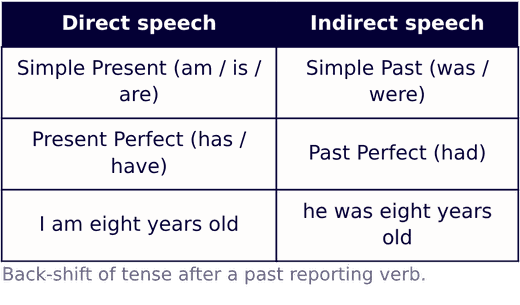 'I am eight years old' therefore becomes 'he was eight years old', and the pronoun 'I' changes to 'he'.
Options (a) and (b) use tenses that no rule produces from a simple present, so option (c) is correct.
'I am eight years old' therefore becomes 'he was eight years old', and the pronoun 'I' changes to 'he'.
Options (a) and (b) use tenses that no rule produces from a simple present, so option (c) is correct.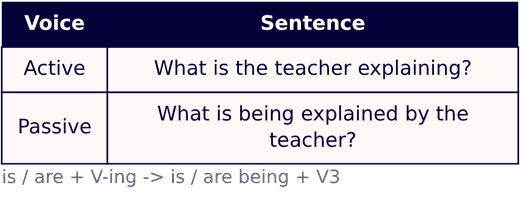 The question word 'What' stays at the front and the doer moves to 'by the teacher'.
Options (a) and (c) change the tense and (d) is not passive at all, so option (b) is correct.
The question word 'What' stays at the front and the doer moves to 'by the teacher'.
Options (a) and (c) change the tense and (d) is not passive at all, so option (b) is correct.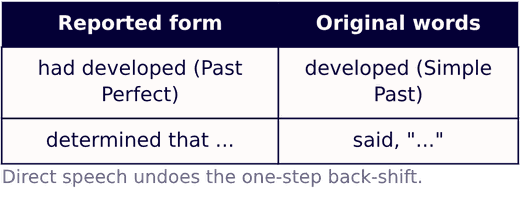 The past perfect 'had developed' therefore returns to the simple past 'developed', and 'determined that' becomes 'said, "..."'.
The rest of the words, including 'long before its demise', must be kept, which rules out (c) and (d); (a) keeps the back-shifted tense.
Hence option (b) is correct.
The past perfect 'had developed' therefore returns to the simple past 'developed', and 'determined that' becomes 'said, "..."'.
The rest of the words, including 'long before its demise', must be kept, which rules out (c) and (d); (a) keeps the back-shifted tense.
Hence option (b) is correct.