SSC CHSL 25 November 2025 · Shift 1 · General Intelligence — questions with answers · ShikshaSphere
Chapter 129 of 200
25 November 2025 · Shift 1
General Intelligence
25 questions ~25 min readFree
25 questions
A
26
If January 1, 2020, was a Wednesday, what day of the week was January 1, 2021?
A.Thursday
B.Friday
C.Saturday
D.Sunday
Solution
Calendar and odd days
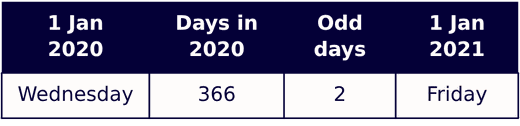
From 1 January 2020 to 1 January 2021 the whole of 2020 is covered, and 2020 is a leap year, so 366 days pass.
Odd days: , so 52 complete weeks and 2 odd days are left.
The day of the week therefore moves 2 places forward: Wednesday + 2 days = Friday.
Hence option (b) is correct.
27
In this type of questions, question is provided with substitutes for various mathematical symbols, followed by a question involving calculation of an expression or choosing the correct/incorrect equation. You have to put the real signs in the given equation and then solve the questions as required. If '$' stands for '+', '#' stands for '÷', '%' stands for '-', '@' stands for '×', then find the value of:
24 # 6 @ 4 $ ?
A.25
B.20
C.19
D.17
Solution
Symbol substitution
Replace every symbol by the sign it stands for, exactly as the question directs.
The expression becomes .
By BODMAS, division and multiplication are done first, from left to right: and then .
Now the addition and subtraction: 16 + 9 - 8 = 25 - 8 = 17.
Hence option (d) is correct.
28
A person walks 10 km North, then 12 km East, and finally 5 km South. How far is he from his starting point?
A.12 km
B.13 km
C.17 km
D.27 km
Solution
Direction and distance
Take the northward direction as positive.
He walks 10 km north and later 5 km south, so his net northward shift is 10 - 5 = 5 km.
Nothing cancels the eastward walk, so his eastward shift is the full 12 km.
The two shifts are at right angles, so the required distance km.
Hence option (b) is correct.
29
A piece of paper is folded and punched as shown below in the question figures. From the given option figures, indicate how it will appear when opened.
A.
B.
C.
D.
Solution
Paper folding and punching
The sheet is folded twice: first the top half comes down on the bottom half, then the left half comes across on to the right half, so only the bottom-right quarter is left.
Two punches are made in that quarter — one triangle pointing up near its top-left and one pointing down near its bottom-right.
Undo the second fold first: both punches are mirrored in the vertical centre line, and a mirror in a vertical line does not change which way a triangle points, so the bottom half now carries 4 punches.
Undo the first fold: those 4 punches are mirrored in the horizontal centre line, and a mirror in a horizontal line turns an up triangle into a down triangle and a down triangle into an up triangle.
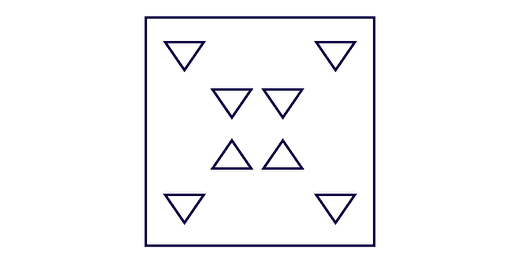
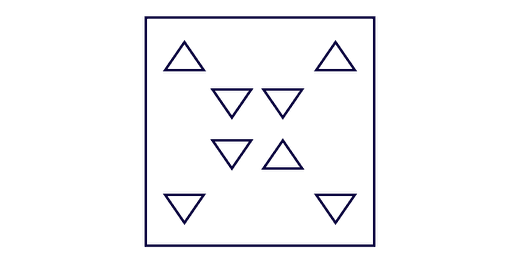
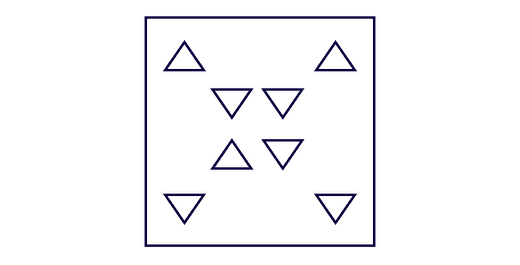
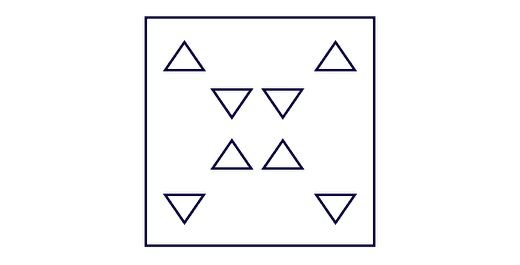
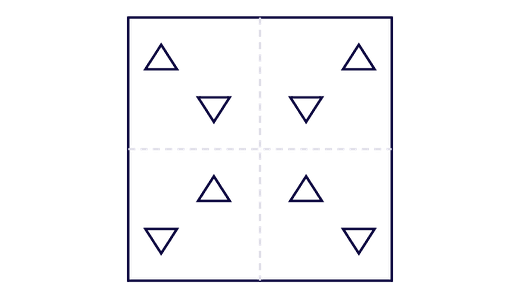
So the opened sheet carries 8 punches — two up triangles at the top corners, two down triangles just below them, two up triangles under those and two down triangles at the bottom corners.
Hence option (d) is correct.
30
Select the correct option from the given alternatives:
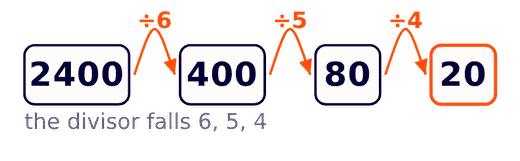
2400, 400, 80, ?
A.16
B.20
C.25
D.40
Solution
Number series
The terms fall steeply, so test division rather than subtraction.
and , so the divisor drops by 1 at every step.
The next divisor is therefore 4, and the missing term is .
Hence option (b) is correct.
31
Pick the correct options from below.
A.
B.
C.
D.
Solution
Fraction series
Every term has the same denominator 3, so the pattern can only be in the numerators.
The numerators are 9, 25, ?, 81, 121, that is — the squares of consecutive odd numbers.
The odd number missing between 5 and 9 is 7, so the numerator is .
The required term is therefore .
Hence option (d) is correct.
32
Complete the following series from the given options.
p_rpp_qrr_ppqqq_rr
A.pqpr
B.qqpr
C.qrpp
D.pqrq
Solution
Letter series completion
Split the string into blocks in which p, q and r each appear one time more than in the block before.
The complete string is pqr / ppqqrr / pppqqqrrr, which has 18 letters — exactly the length of the given series.
The four blanks stand at the 2nd, 6th, 10th and 16th places of that string.
Those places carry q, q, p and r, so the missing letters are qqpr.
Hence option (b) is correct.
33
Select the option which is related to the fifth term in the same way as the second term is related to the first term and the fourth term is related to the third term.
HELP : ICOL :: SAVE : TYYA :: MIND : ?
A.OGRY
B.NGQZ
C.MHQA
D.LHPA
Solution
Letter analogy
Compare the two words of each pair letter by letter.
In HELP → ICOL the letters move +1, -2, +3, -4, and SAVE → TYYA follows exactly the same moves.
Apply them to MIND: M+1 = N, I-2 = G, N+3 = Q and D-4 = Z, because counting back from D wraps round the alphabet to Z.
So MIND gives NGQZ.
Hence option (b) is correct.
34
You are given a Master Address (MA) from official records. Your task is to identify the correct candidate address that matches exactly with the master address in terms of formatting, punctuation, spelling, and structure.
Master Address (MA): Shop No. 12-C, Silver Oak Complex, M.G. Road, Pune - 411001
Candidate Addresses:
B.Shop No. 12/C, Silver Oak Complex, M.G. Road, Pune - 411001
C.Shop No. 12-C, Silver Oak Complex, M.G. Road, Pune - 411001
D.Shop No. 12-C, Silver Oak Complex, M.G. Rd, Pune - 411001
Solution
Address matching
Read the master address in four parts — shop number, complex, road, and city with PIN — and check every candidate part by part.
Option (a) writes 'Silver Oaks', option (b) writes '12/C' in place of '12-C', and option (d) shortens 'Road' to 'Rd'.
Only option (c) reproduces every letter, hyphen and comma of the master address.
Hence option (c) is correct.
35
In the following question, select the number which can be placed at the sign of question mark (?) from the given alternatives.
A.61
B.52
C.51
D.47
Solution
Number grid
Read the grid column by column: the number in the last row is built from the three numbers above it.
Rule: (first number × second number) − third number.
First column: , which matches the given entry.
Third column: , which matches as well.
Second column: .
Hence option (c) is correct.
36
In the following question, select the number which can be placed at the sign of question mark (?) from the given alternatives.
A.48
B.44
C.36
D.34
Solution
Number grid
Here the grid is read row by row: the last number of a row is built from the first three.
Rule: (first number × second number) − third number.
Row 1: , which matches.
Row 2: , which matches too.
Row 3: .
Hence option (c) is correct.
37
In the following question, select the number which can be placed at the sign of question mark (?) from the given alternatives.
A.1
B.2
C.3
D.4
Solution
Number boxes
In each box link the two numbers of the top row with the two of the bottom row.
Rule: (top-left × top-right) + bottom-right = bottom-left.
Box 1: , which matches.
Box 2: , which matches as well.
Box 3: , so ? = 24 - 20 = 4.
Hence option (d) is correct.
38
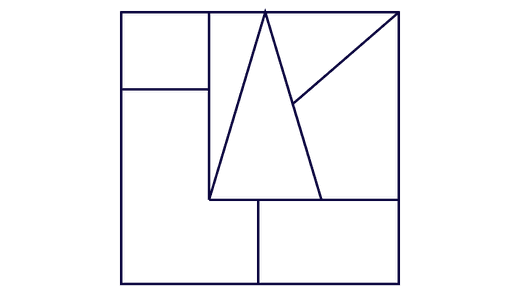
How many triangles are there in the given figure?
A.18
B.22
C.20
D.24
Solution
Counting triangles
Let O be the centre of the rectangle, the point where the line from the top-right corner meets the main diagonal.
Above O the top edge and the three lines drawn parallel to it give 4 levels, and every level closes into a triangle with apex O.
The vertical line from the mid-point of the top edge down to O cuts each of these into two halves, so every level supplies 3 triangles — the whole one and its two halves.
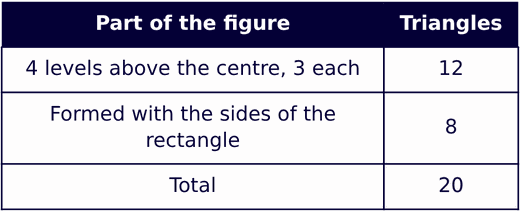
Upper count .
Below O the main diagonal, the line joining the mid-point of the right side to the mid-point of the bottom side, and the short vertical below their crossing supply 8 more triangles.
Total = 12 + 8 = 20.
Hence option (c) is correct.
39
How many triangles are there in the given figure?
A.20
B.22
C.24
D.23
Solution
Counting triangles
Let M be the mid-point of the upper horizontal line and N the mid-point of the lower one; the vertical line runs from the top vertex through M and N to the bottom vertex.
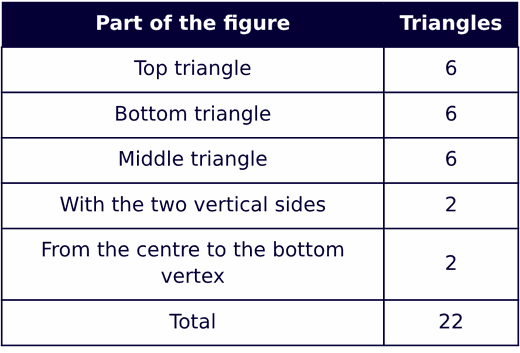
Top triangle: the chord drawn inside it makes 2 levels and the vertical halves each level, so it gives triangles.
Bottom triangle: the same arrangement gives another 6.
Middle band: M joined to the two lower corners makes a triangle with the lower horizontal, and its own chord plus the vertical again give .
Two more triangles use the vertical left and right sides of the figure, and two more run from M along a slanting side down to the bottom vertex.
Total = 6 + 6 + 6 + 2 + 2 = 22.
Hence option (b) is correct.
40
The weights of 5 boxes J, K, L, M, and N are compared. No two boxes have the same weight. The weight of L is more than K but less than M . The weight of N is the maximum. The weight of K is 25 kg and the weight of J is 20 kg . What will be the possible weight (in kg ) of box L ?
A.22
B.25
C.20
D.28
Solution
Ordering by weight
Write the two comparisons as one chain: L is heavier than K but lighter than M, and N is the heaviest of all.
So K < L < M < N, with K = 25 kg and J = 20 kg.
L must therefore be more than 25 kg, and no two boxes may weigh the same.
Among the choices, 22 kg and 20 kg are below 25 kg and 25 kg equals K, so only 28 kg is possible.
Hence option (d) is correct.
41
A person is walking towards the North. After taking 15 Right turns and 13 Left turns, in which direction is he moving now?
A.East
B.West
C.North
D.South
Solution
Direction and turns
One right turn and one left turn cancel each other, so only the excess of one kind of turn matters.
15 right turns and 13 left turns leave 15-13=2 net right turns.
Each right turn swings the man through 90° clockwise.
Starting from North, the first net right turn faces him East and the second faces him South.
Hence option (d) is correct.
42
Which option figure will complete the pattern in the question figure?
(Rotation is not allowed)
A.
B.
C.
D.
Solution
Figure completion
The rectangle is symmetrical about the vertical line down its middle: every line in the right half is repeated in the left half as its mirror image.
The lower half already shows this — the triangle on the left points up exactly like the triangle on the right, and the long horizontals run across both halves.
So the missing top-left piece must be the left-to-right mirror of the top-right piece.
In the top-right piece a short stub hangs from the middle of the top edge, a long horizontal starts at the centre line, a tall vertical stands at the far end of that horizontal, and a triangle points downwards with its apex on the central horizontal.
Mirrored, the piece needs the stub in the middle of the top edge, the horizontal running to the centre line, the tall vertical on the left starting at that horizontal, and the same downward triangle.
Since rotation is not allowed, only option (c) matches every line of that mirror image.
43
In the following figure series, select the figure which can be placed at the sign of question mark (?) from the given alternatives.
A.
B.
C.
D.
Solution
Figure series
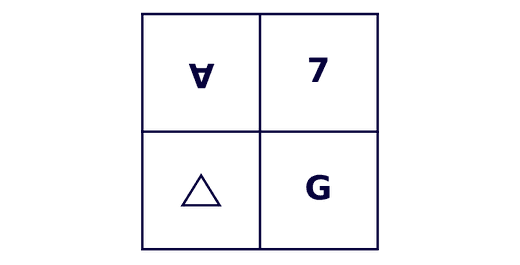
Every figure of the series is a square cut into four cells that always carry the same four symbols in the same places — A at the top-left, 7 at the top-right, a small triangle at the bottom-left and G at the bottom-right.
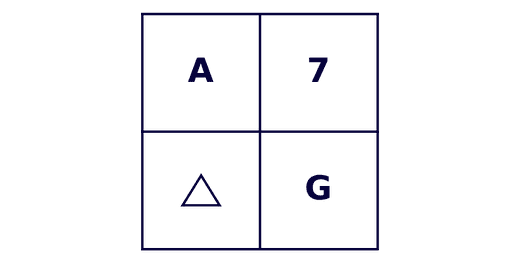
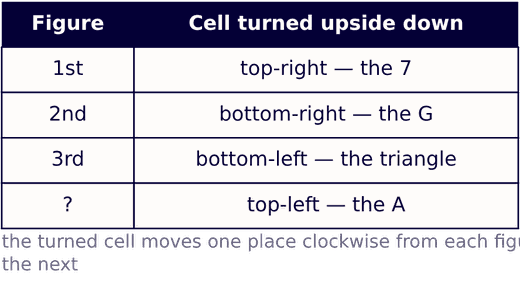
Nothing moves from cell to cell; in each figure exactly one of the four symbols is turned upside down through 180°, and that turned cell shifts one place clockwise as the series advances.
The first figure turns 7 (top-right), the second turns G (bottom-right) and the third turns the triangle (bottom-left), so the next turn must fall on the top-left cell.
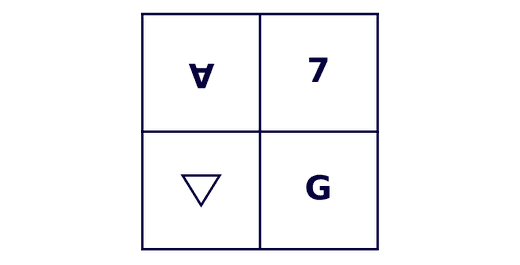
The missing figure therefore shows A standing upside down while 7, the triangle and G stay upright.
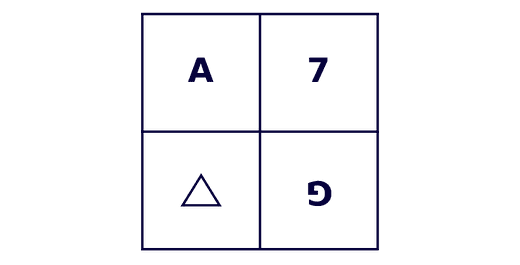
Option (a) turns nothing, option (b) turns the triangle as well as A and option (c) turns G instead of A, so none of them obeys the rule.
Hence the correct option is (d).
44
In the following figure series, select the figure which can be placed at the sign of question mark (?) from the given alternatives.
A.
B.
C.
D.
Solution
Figure series
Read every figure as four horizontal lines, one below the other, each carrying one symbol at one of its ends.
In every figure the ends alternate in the same way — rows 1 and 3 carry their symbol at the right end, rows 2 and 4 at the left end.
Going from one figure to the next, each symbol climbs one row: the symbol of row 2 moves to row 1, row 3 moves to row 2, row 4 moves to row 3, and one fresh symbol enters at row 4.
Figure 5 carries a filled square, a star, a hollow triangle and a hollow square, so the answer must carry the star, the hollow triangle and the hollow square in rows 1, 2 and 3.
With the ends alternating as usual, the star sits at the right, the hollow triangle at the left, the hollow square at the right and the new symbol at the left.
Only option (c) shows exactly this arrangement, so option (c) is correct.
45
If ' + ' means ' ' means ' ', ' ' means ' and ' means ', then ?
A.10
B.12
C.14
D.16
Solution
Symbol substitution
The four signs are exchanged in a chain: + becomes -, - becomes , becomes and becomes +.
So has to be read as .
By BODMAS the division and the multiplication come first: and .
The expression is now 4+16-8.
4+16-8=12, so option (b) is correct.
46
If ' P ' means '+', ' Q ' means ' - , ' R ' means ' ' and ' ' means ' ', then which of the following equations is correct?
I. 24 R 6 S 5 P 10 Q
II. 50 Q 20 R 4 S 3 P 5 = 45
A.Only I
B.Only II
C.Both I and II
D.Neither I nor II
Solution
Symbol substitution
Replace the letters by their signs: P is +, Q is -, R is and S is .
Statement I becomes .
By BODMAS, and then , so the value is 20+10-8=22 — exactly what I claims.
Statement II becomes .
Here and then , so the value is 50-15+5=40, and not 45.
Only statement I holds, so option (a) is correct.
47
In a certain coded language 'JUMP' is coded as 'MXPS' and 'WIND' is coded as 'ZLQG'. How will 'COAL' be coded in the same code language?
A.FRDO
B.EQCP
C.FPDO
D.ERDP
Solution
Letter coding
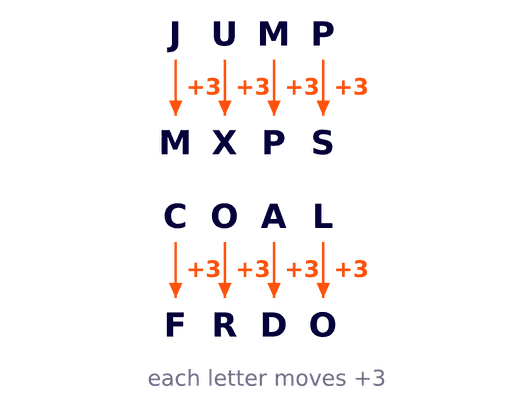
Compare JUMP with MXPS letter by letter: J+3=M, U+3=X, M+3=P and P+3=S.
WIND obeys the same rule: W+3=Z, I+3=L, N+3=Q and D+3=G.
So every letter simply moves three places forward in the alphabet.
Applying +3 to COAL gives , , and .
The code is FRDO, so option (a) is correct.
48
In a certain code language, 'PACK' is coded as '62', 'BACK' is coded as '34'. How will 'SEND' be coded in that code language?
A.80
B.42
C.84
D.76
Solution
Number coding
Add the alphabetical positions of the four letters and see how the sum is related to the code.
For PACK, 16+1+3+11=31, and the code 62 is .
For BACK, 2+1+3+11=17, and the code 34 is .
So the rule is: code = twice the sum of the place values.
For SEND, 19+5+14+4=42, so the code is .
Hence option (c) is correct.
49
From the given alternatives, select the word that CANNOT be formed by using the letters of the given word. CONSTRUCTION
A.SUCTION
B.COINS
C.CAUTION
D.STRICT
Solution
Word formation
CONSTRUCTION supplies the letters C, C, O, O, N, N, S, T, T, R, U and I.
SUCTION and COINS use only these letters, and STRICT is possible too because two T's are available.
CAUTION needs the letter A, and there is no A anywhere in CONSTRUCTION.
So CAUTION is the word that cannot be formed, and option (c) is correct.
50
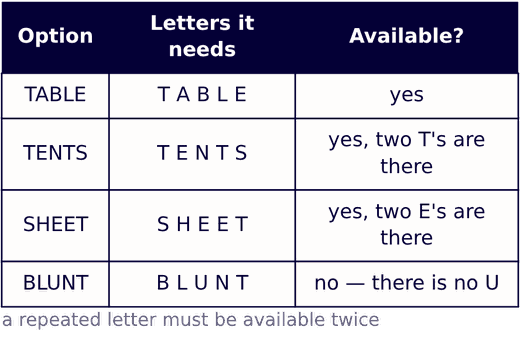
From the given alternatives, select the word that CANNOT be formed by using the letters of the given word. ESTABLISHMENT
A.TABLE
B.TENTS
C.SHEET
D.BLUNT
Solution
Word formation
ESTABLISHMENT supplies E, E, S, S, T, T, A, B, L, I, H, M and N.
TABLE, TENTS and SHEET are all possible — TENTS needs two T's and SHEET needs two E's, and both pairs are there.
BLUNT needs the letter U, which does not occur anywhere in ESTABLISHMENT.
So BLUNT cannot be formed, and option (d) is correct.
Finished reading? Now test yourself.
The same 25 questions, but with a timer and the answers hidden — 15 minutes.

 The day of the week therefore moves 2 places forward: Wednesday + 2 days = Friday.
Hence option (b) is correct.
The day of the week therefore moves 2 places forward: Wednesday + 2 days = Friday.
Hence option (b) is correct. The expression becomes .
By BODMAS, division and multiplication are done first, from left to right: and then .
Now the addition and subtraction: 16 + 9 - 8 = 25 - 8 = 17.
Hence option (d) is correct.
The expression becomes .
By BODMAS, division and multiplication are done first, from left to right: and then .
Now the addition and subtraction: 16 + 9 - 8 = 25 - 8 = 17.
Hence option (d) is correct.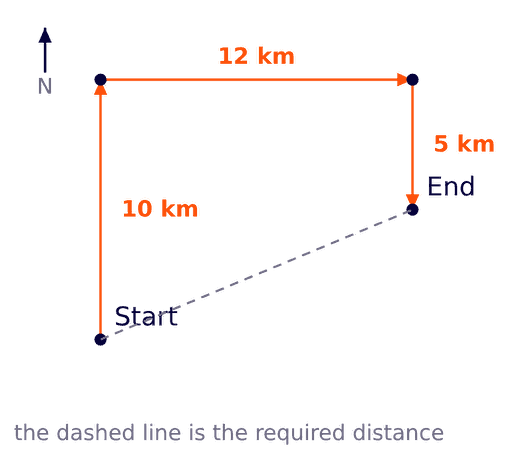 The two shifts are at right angles, so the required distance km.
Hence option (b) is correct.
The two shifts are at right angles, so the required distance km.
Hence option (b) is correct.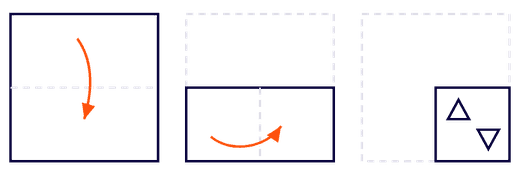
 Hence option (d) is correct.
 The next divisor is therefore 4, and the missing term is .
Hence option (b) is correct.
The next divisor is therefore 4, and the missing term is .
Hence option (b) is correct.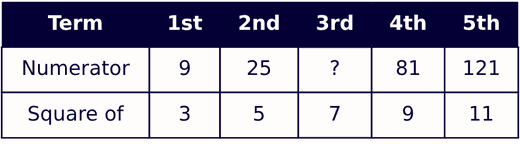 The odd number missing between 5 and 9 is 7, so the numerator is .
The required term is therefore .
Hence option (d) is correct.
The odd number missing between 5 and 9 is 7, so the numerator is .
The required term is therefore .
Hence option (d) is correct.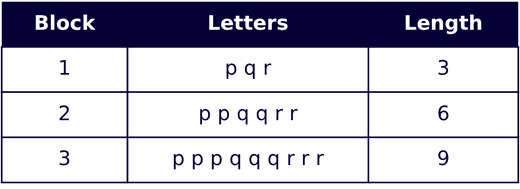 The complete string is pqr / ppqqrr / pppqqqrrr, which has 18 letters — exactly the length of the given series.
The four blanks stand at the 2nd, 6th, 10th and 16th places of that string.
Those places carry q, q, p and r, so the missing letters are qqpr.
Hence option (b) is correct.
The complete string is pqr / ppqqrr / pppqqqrrr, which has 18 letters — exactly the length of the given series.
The four blanks stand at the 2nd, 6th, 10th and 16th places of that string.
Those places carry q, q, p and r, so the missing letters are qqpr.
Hence option (b) is correct.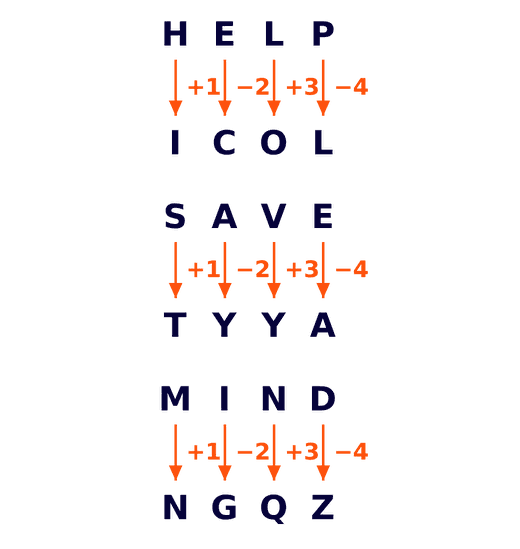 In HELP → ICOL the letters move +1, -2, +3, -4, and SAVE → TYYA follows exactly the same moves.
Apply them to MIND: M+1 = N, I-2 = G, N+3 = Q and D-4 = Z, because counting back from D wraps round the alphabet to Z.
So MIND gives NGQZ.
Hence option (b) is correct.
In HELP → ICOL the letters move +1, -2, +3, -4, and SAVE → TYYA follows exactly the same moves.
Apply them to MIND: M+1 = N, I-2 = G, N+3 = Q and D-4 = Z, because counting back from D wraps round the alphabet to Z.
So MIND gives NGQZ.
Hence option (b) is correct.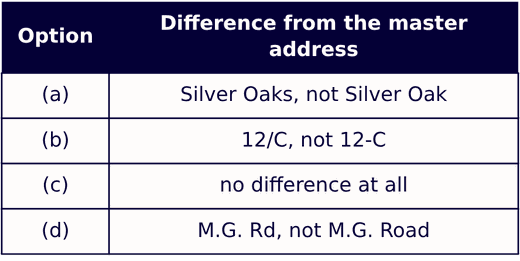 Option (a) writes 'Silver Oaks', option (b) writes '12/C' in place of '12-C', and option (d) shortens 'Road' to 'Rd'.
Only option (c) reproduces every letter, hyphen and comma of the master address.
Hence option (c) is correct.
Option (a) writes 'Silver Oaks', option (b) writes '12/C' in place of '12-C', and option (d) shortens 'Road' to 'Rd'.
Only option (c) reproduces every letter, hyphen and comma of the master address.
Hence option (c) is correct.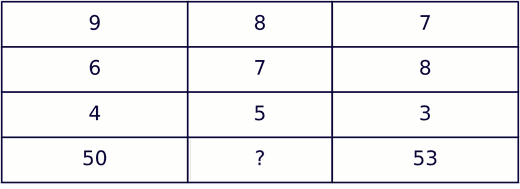 Read the grid column by column: the number in the last row is built from the three numbers above it.
Rule: (first number × second number) − third number.
First column: , which matches the given entry.
Third column: , which matches as well.
Second column: .
Hence option (c) is correct.
Read the grid column by column: the number in the last row is built from the three numbers above it.
Rule: (first number × second number) − third number.
First column: , which matches the given entry.
Third column: , which matches as well.
Second column: .
Hence option (c) is correct.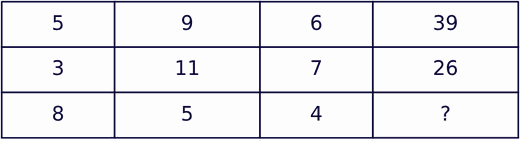 Here the grid is read row by row: the last number of a row is built from the first three.
Rule: (first number × second number) − third number.
Row 1: , which matches.
Row 2: , which matches too.
Row 3: .
Hence option (c) is correct.
Here the grid is read row by row: the last number of a row is built from the first three.
Rule: (first number × second number) − third number.
Row 1: , which matches.
Row 2: , which matches too.
Row 3: .
Hence option (c) is correct.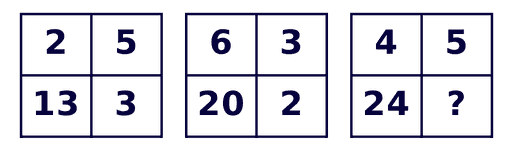 In each box link the two numbers of the top row with the two of the bottom row.
Rule: (top-left × top-right) + bottom-right = bottom-left.
Box 1: , which matches.
Box 2: , which matches as well.
Box 3: , so ? = 24 - 20 = 4.
Hence option (d) is correct.
In each box link the two numbers of the top row with the two of the bottom row.
Rule: (top-left × top-right) + bottom-right = bottom-left.
Box 1: , which matches.
Box 2: , which matches as well.
Box 3: , so ? = 24 - 20 = 4.
Hence option (d) is correct.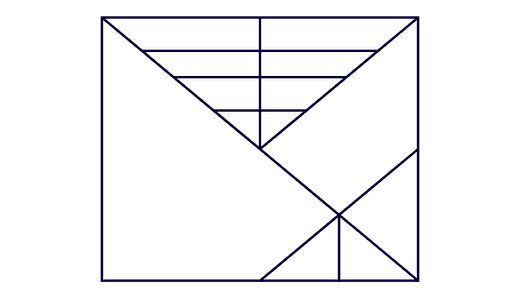
 Below O the main diagonal, the line joining the mid-point of the right side to the mid-point of the bottom side, and the short vertical below their crossing supply 8 more triangles.
Total = 12 + 8 = 20.
Hence option (c) is correct.
Below O the main diagonal, the line joining the mid-point of the right side to the mid-point of the bottom side, and the short vertical below their crossing supply 8 more triangles.
Total = 12 + 8 = 20.
Hence option (c) is correct.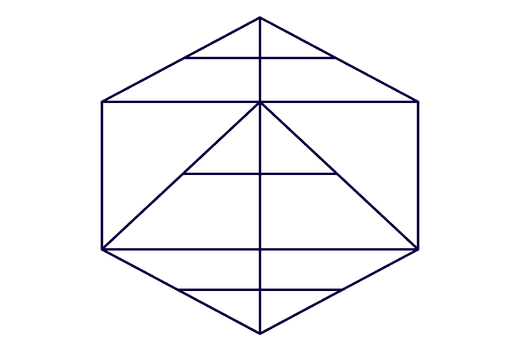
 Two more triangles use the vertical left and right sides of the figure, and two more run from M along a slanting side down to the bottom vertex.
Total = 6 + 6 + 6 + 2 + 2 = 22.
Hence option (b) is correct.
Two more triangles use the vertical left and right sides of the figure, and two more run from M along a slanting side down to the bottom vertex.
Total = 6 + 6 + 6 + 2 + 2 = 22.
Hence option (b) is correct.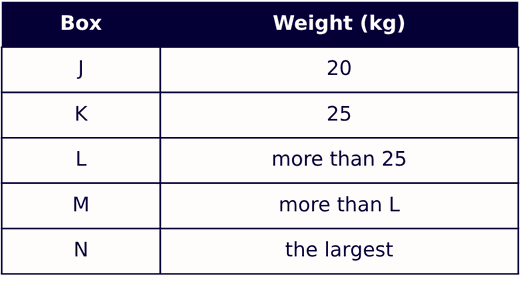 L must therefore be more than 25 kg, and no two boxes may weigh the same.
Among the choices, 22 kg and 20 kg are below 25 kg and 25 kg equals K, so only 28 kg is possible.
Hence option (d) is correct.
L must therefore be more than 25 kg, and no two boxes may weigh the same.
Among the choices, 22 kg and 20 kg are below 25 kg and 25 kg equals K, so only 28 kg is possible.
Hence option (d) is correct.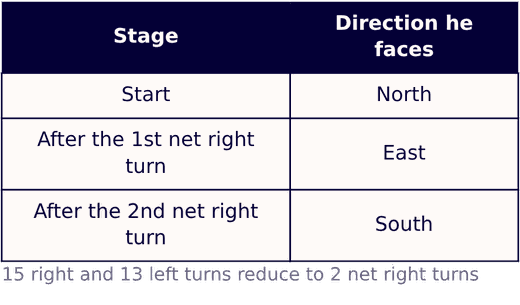 Starting from North, the first net right turn faces him East and the second faces him South.
Hence option (d) is correct.
Starting from North, the first net right turn faces him East and the second faces him South.
Hence option (d) is correct.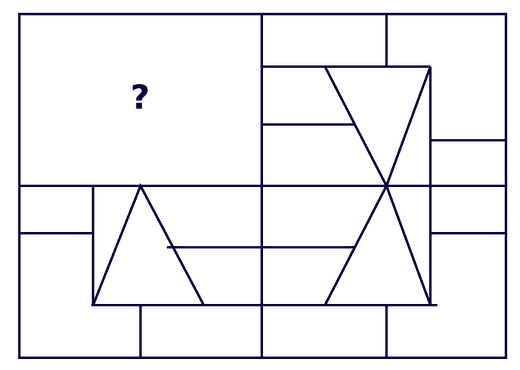
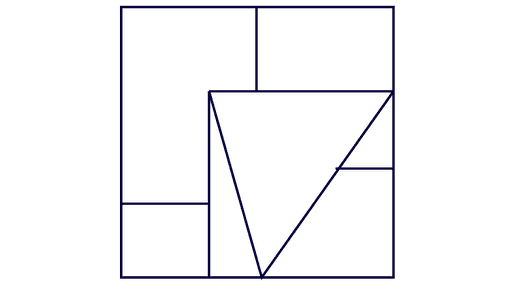
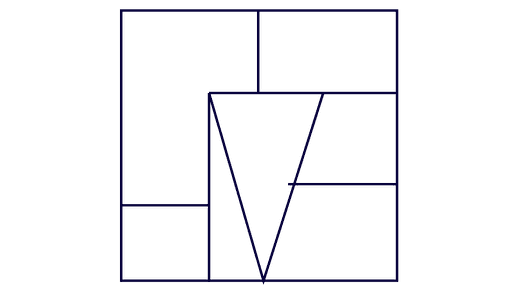
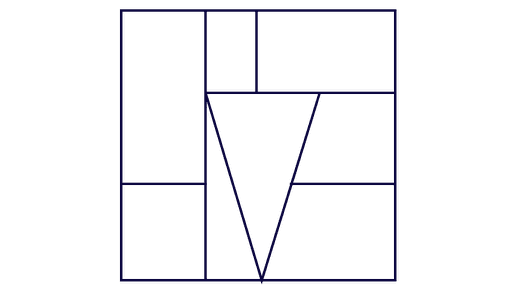
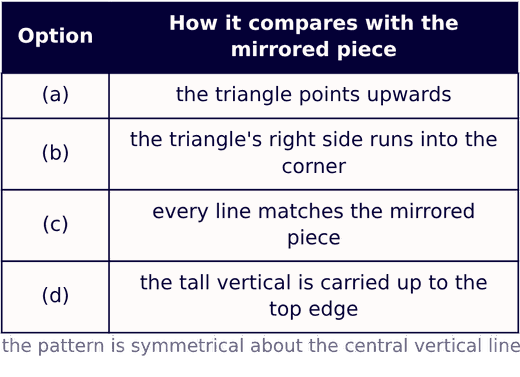 Since rotation is not allowed, only option (c) matches every line of that mirror image.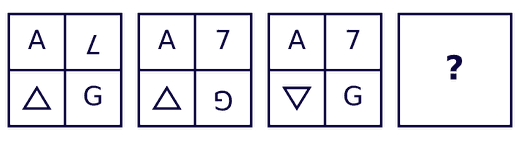
 The first figure turns 7 (top-right), the second turns G (bottom-right) and the third turns the triangle (bottom-left), so the next turn must fall on the top-left cell.
The missing figure therefore shows A standing upside down while 7, the triangle and G stay upright.
Option (a) turns nothing, option (b) turns the triangle as well as A and option (c) turns G instead of A, so none of them obeys the rule.
Hence the correct option is (d).
The first figure turns 7 (top-right), the second turns G (bottom-right) and the third turns the triangle (bottom-left), so the next turn must fall on the top-left cell.
The missing figure therefore shows A standing upside down while 7, the triangle and G stay upright.
Option (a) turns nothing, option (b) turns the triangle as well as A and option (c) turns G instead of A, so none of them obeys the rule.
Hence the correct option is (d).
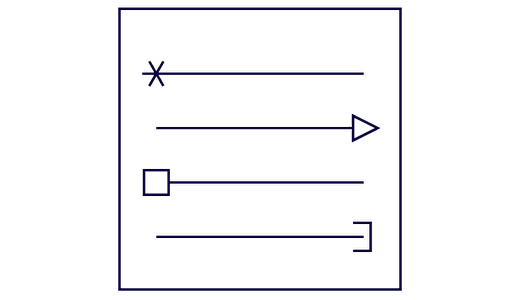
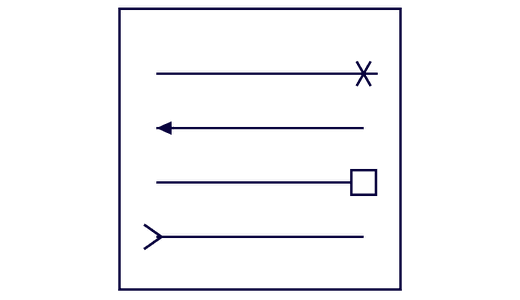
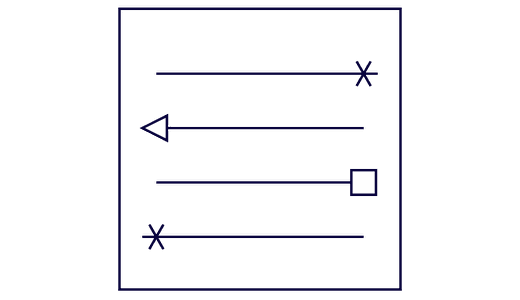
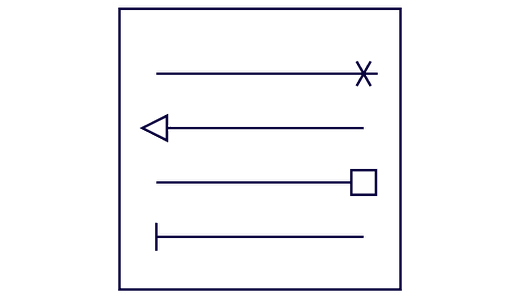
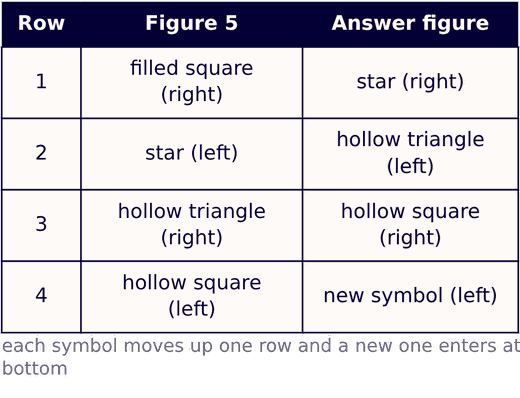 Figure 5 carries a filled square, a star, a hollow triangle and a hollow square, so the answer must carry the star, the hollow triangle and the hollow square in rows 1, 2 and 3.
With the ends alternating as usual, the star sits at the right, the hollow triangle at the left, the hollow square at the right and the new symbol at the left.
Only option (c) shows exactly this arrangement, so option (c) is correct.
Figure 5 carries a filled square, a star, a hollow triangle and a hollow square, so the answer must carry the star, the hollow triangle and the hollow square in rows 1, 2 and 3.
With the ends alternating as usual, the star sits at the right, the hollow triangle at the left, the hollow square at the right and the new symbol at the left.
Only option (c) shows exactly this arrangement, so option (c) is correct.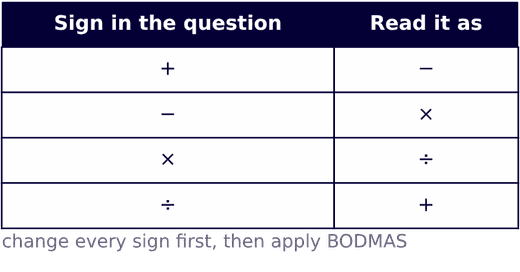 So has to be read as .
By BODMAS the division and the multiplication come first: and .
The expression is now 4+16-8.
4+16-8=12, so option (b) is correct.
So has to be read as .
By BODMAS the division and the multiplication come first: and .
The expression is now 4+16-8.
4+16-8=12, so option (b) is correct.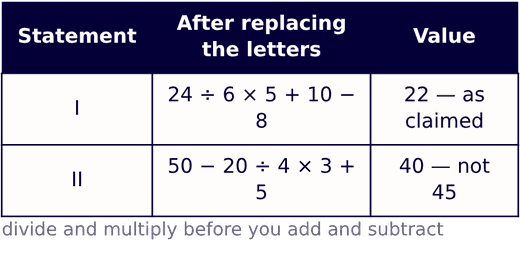 Only statement I holds, so option (a) is correct.
 Applying +3 to COAL gives , , and .
The code is FRDO, so option (a) is correct.
Applying +3 to COAL gives , , and .
The code is FRDO, so option (a) is correct.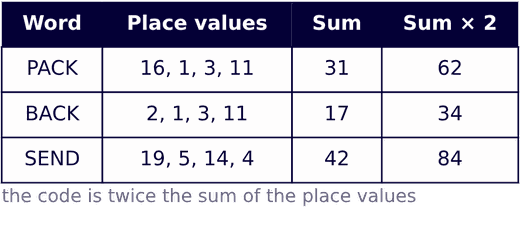 For SEND, 19+5+14+4=42, so the code is .
Hence option (c) is correct.
For SEND, 19+5+14+4=42, so the code is .
Hence option (c) is correct.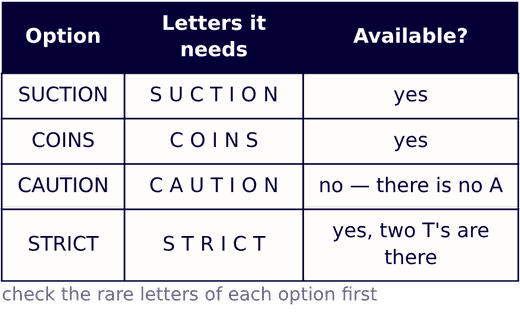 So CAUTION is the word that cannot be formed, and option (c) is correct.
 So BLUNT cannot be formed, and option (d) is correct.