SSC CHSL 25 November 2025 · Shift 3 · English Language — questions with answers · ShikshaSphere
Chapter 140 of 200
25 November 2025 · Shift 3
English Language
25 questions ~25 min readFree
25 questions
A
1
Choose the one word substitute for the below sentence.
Susan asked her husband, a person who is highly knowledgeable in a particular field?
A.Amateur
B.Novice
C.Expert
D.Prodigy
Solution
One word substitution
The sentence defines a person who is 'highly knowledgeable in a particular field'.
Expert - a person who has special skill or deep knowledge in one particular field.
Amateur - one who does something for pleasure and not as a profession; Novice - a beginner with little experience; Prodigy - a young person with extraordinary talent.
Only 'Expert' carries the sense of proven, specialised knowledge, so option (c) is correct.
2
Choose the one word substitute for the below sentence.
Robert was curious about what a person who abandons his religion is called.
A.Apostate
B.Agnostic
C.Devotee
D.Infidel
Solution
One word substitution
The definition asked for is 'a person who abandons his religion'.
Apostate - one who renounces or gives up the religion or belief he formerly held.
Agnostic - one who holds that the existence of God cannot be known; Devotee - a strong follower of a faith; Infidel - one who does not accept a particular religion at all.
Giving up a faith one already professed is apostasy, so option (a) is correct.
3
Identify the grammatically incorrect sentence.
A.The basic principles of science is hard to grasp.
B.Responses to the annual play have been favourable.
C.The writer of the stories in these books is Mary Gomes.
D.Several lines in the poem are particularly good.
Solution
Subject-verb agreement
Test each option for subject-verb agreement, ignoring the phrase that comes between the subject and the verb.
In (a) the real subject is 'principles' (plural); 'of science' is only a modifier, so the verb must be 'are', not 'is'.
Correct form: 'The basic principles of science are hard to grasp.'
In (c) the head noun is the singular 'The writer', so 'is' is right; (b) 'Responses ... have been' and (d) 'Several lines ... are' also agree correctly.
Hence the grammatically incorrect sentence is option (a).
4
Fill in the blank with the most appropriate preposition:
The professor insisted absolute silence during class.
A.over
B.with
C.on
D.at
Solution
Prepositions
The verb 'insist' takes the fixed preposition 'on' when a person firmly demands something.
So the sentence reads: 'The professor insisted on absolute silence during class.'
'Insist over', 'insist with' and 'insist at' are not standard collocations in English.
Hence option (c) is correct.
5
Choose the best option to replace the underlined part to improve the given sentence. If no substitution is required, select 'No substitution.'
People applauded as Rohit stepped from the car.
A.stepped out of
B.stepped off the car
C.stepped out the car
D.No substitution
Solution
Sentence improvement
One gets 'out of' an enclosed vehicle such as a car or a taxi, and 'off' an open one such as a bus platform or a bike.
'Stepped from the car' is unidiomatic; the natural phrase is 'stepped out of the car'.
Putting the correct phrase in place gives: 'People applauded as Rohit stepped out of the car.'
Options (b) and (c) repeat 'the car', which already stands in the sentence, and 'stepped out the car' also drops the necessary 'of'.
Hence option (a) is correct.
6
Select the sentence containing the homonym of the highlighted word:
He gave him a small wave before departing.
A.The crowd gave a cheerful wave to the president.
B.A huge wave crashed onto the shore.
C.Anita gave him a friendly wave as she walked out the door.
D.Anwar gave a final wave to his family as the plane took off.
Solution
Homonyms
Homonyms are words with the same spelling and pronunciation but altogether different meanings.
In the given sentence 'wave' means a movement of the hand in greeting or farewell.
In option (b), 'A huge wave crashed onto the shore', 'wave' means a moving ridge of water - a completely different meaning.
Options (a), (c) and (d) all use 'wave' in the same hand-gesture sense, so they merely repeat the meaning instead of giving a homonym.
Hence option (b) is correct.
7
From the alternatives given below, select the correct passive voice of the following sentence.
Do not put your arm over the stove lest you should burn your skin.
A.Let your arm be not put over the stove lest your skin should be burnt.
B.Lest your arm be not put over the stove let your skin should be burnt.
C.Let your arm not put over the stove lest your skin should be burnt.
D.Let your arm be not put over the stove lest your skin should burn.
Solution
Passive of imperative
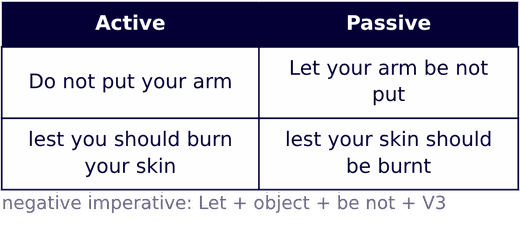
A negative imperative of the form 'Do not + V1 + object' becomes 'Let + object + be not + V3' in the passive.
So 'Do not put your arm' becomes 'Let your arm be not put', and the clause 'lest you should burn your skin' becomes 'lest your skin should be burnt'.
Option (c) drops the auxiliary 'be', option (d) leaves the second clause active ('should burn'), and option (b) interchanges 'lest' and 'let', destroying the sense.
Hence option (a) is correct.
8
From the alternatives given below, select the correct passive voice of the following sentence.
Let her wrap the gift with that blue paper kept on the shelf.
A.Let the paper be wrapped with by her the gift with that blue paper kept on the shelf.
B.Let the gift wrapped by her with that blue paper be kept on the shelf.
C.Let the gift be wrapped with that blue paper by her kept on the shelf.
D.Let the gift be wrapped by her with that blue paper kept on the shelf.
Solution
Passive of imperative
A sentence of the form 'Let + object + V1' becomes 'Let + object + be + V3 + by + agent' in the passive.
The object of 'wrap' is 'the gift', so it becomes the passive subject: 'Let the gift be wrapped by her ...'.
The phrase 'with that blue paper kept on the shelf' must stay together, because 'kept on the shelf' describes the paper, not the gift.
Option (b) omits 'be' before 'wrapped'; option (c) pushes 'by her' between the paper and its describing phrase; option (a) makes 'the paper' the subject and is structurally jumbled.
Hence option (d) is correct.
9
Choose the correct indirect narration of the following statement from the given alternatives:
Priya said to her father, 'Please help me with my homework."
A.Priya requested her father to help her with her homework.
B.Priya requested her father to please help her with her homework.
C.Priya requested her father to help me with her homework.
D.Priya requested her father to help me with my homework.
Solution
Narration of a request
A request in direct speech is reported with 'requested + object + to + V1'.
'Please' is dropped, because the reporting verb 'requested' already carries the politeness.
The pronoun 'me' stands for the speaker Priya, so it becomes 'her', and 'my homework' becomes 'her homework'.
This gives: 'Priya requested her father to help her with her homework.'
Option (b) keeps the redundant 'please'; options (c) and (d) keep the first-person 'me'.
Hence option (a) is correct.
10
Choose the correct indirect narration of the following statement from the given alternatives:
He said to Mohit, 'What is the matter with you that you look so cross today?'
A.He asked Mohit what was the matter with him that he looked so cross today.
B.He asked Mohit what was the matter with him that he looked so cross that day.
C.He asked Mohit what was the matter with him that he looks so cross that day.
D.He asked Mohit what is the matter with him that he looked so cross that day.
Solution
Narration of wh-question
In a reported wh-question the reporting verb becomes 'asked', the wh-word is retained, the word order becomes that of a statement and the question mark is dropped.
The present tense backshifts one step: 'is' becomes 'was' and 'look' becomes 'looked'; the adverb 'today' becomes 'that day'.
Option (a) keeps 'today', option (c) keeps the present 'looks' and option (d) keeps the present 'is'.
Hence option (b) is correct.
11
Choose the correct indirect narration of the following statement from the given alternatives:
The teacher said to the student, "What were you doing in the library at 9:00 am on Friday when the event took place?"
A.The teacher asked the student what he was doing in the library at 9:00 am on Friday when the event had taken place.
B.The teacher asked the student what he had been doing in the library at 9:00 am on Friday when the event took place.
C.The teacher asked the student what he had been doing in the library at 9:00 am on Friday when the event had taken place.
D.The teacher asked the student what was doing in the library at 9:00 am on Friday when the event took place.
Solution
Narration: tense backshift
When the reporting verb is in the past, every verb inside the speech moves one step back.
The past continuous 'were you doing' therefore becomes the past perfect continuous 'had been doing'.
The simple past 'took place' becomes the past perfect 'had taken place'.
'You' refers to the student, so it becomes 'he', and after 'asked' the wh-clause takes statement order.
Only option (c) makes both backshifts; (a) fails the first, (b) fails the second and (d) drops the subject 'he' altogether.
Hence option (c) is correct.
12
Change the following sentence into the Active form.
The prize will be presented to the champion.
A.They will present the prize to the champion.
B.The champion will be presented with the prize.
C.The prize is presented to the champion.
D.The prize was presented to the champion.
Solution
Passive to active voice
The passive sentence names no agent, so the active takes the indefinite subject 'They'.
The passive 'will be + V3' corresponds to the active 'will + V1', so 'will be presented' becomes 'will present'.
The passive subject 'The prize' becomes the object: 'They will present the prize to the champion.'
Options (c) and (d) are still passive and also change the tense, and option (b) is merely another passive form.
Hence option (a) is correct.
13
Change the following sentence into the Active form.
The project had been completed by the engineers.
A.The engineers completed the project.
B.The project was completed by the engineers.
C.The engineers had completed the project.
D.The engineers have completed the project.
Solution
Passive to active voice
The agent 'by the engineers' becomes the subject of the active sentence.
The past perfect passive 'had been + V3' corresponds to the active 'had + V3'.
So the active form is 'The engineers had completed the project.'
Option (a) lowers the tense to the simple past, option (d) raises it to the present perfect and option (b) is still passive.
Hence option (c) is correct.
14
Choose the option that is the most appropriate conversion of the following sentence into Direct Speech.
The researcher commented that the survey results had evidently been misunderstood, which might have distorted the findings.
A.The researcher said, "The survey results are evidently misunderstood, which might have distorted the findings."
B.The researcher said, "The survey results had evidently been misunderstood, which has distorted the findings."
C.The researcher said, "The survey results have evidently been misunderstood, which may have distorted the findings."
D.The researcher said, "The survey results were evidently misunderstood, which distorted the findings."
Solution
Indirect to direct speech
Turning indirect speech into direct speech simply undoes the backshift, moving each verb one step forward.
'Had evidently been misunderstood' therefore goes back to 'have evidently been misunderstood', and 'might have distorted' to 'may have distorted'.
The reporting verb becomes 'said', followed by a comma and the exact words inside quotation marks.
Options (a), (b) and (d) alter the verbs in other ways instead of merely undoing the backshift.
Hence option (c) is correct.
15
Directions (Qs. 15-19): Read the following passage carefully and answer the questions that follow.
In a world shifting towards flexible work, managing remote productivity has become a significant topic for companies and employees alike. While telecommuting has transformed how business is conducted and expanded, excessive isolation can have adverse effects on workers. Various reports have suggested that unchecked isolation may lead to burnout, lower job satisfaction, and weakened team cohesion.
Conversely, when managed effectively, remote work can boost autonomy, efficiency, and work-life balance. Thus, managers argue for a structured framework, highlighting the necessity for regular check-ins and shared goals. Promoting social interaction, tracking progress, and defining boundaries are key methods recommended to ensure that flexibility acts as a benefit rather than a hurdle to an organization's success.
Choose the option that correctly converts this sentence into passive voice:
"Managers argue for a structured framework."
A.A structured framework was argued by managers.
B.A structured framework has been arguing by managers.
C.A structured framework is argued for by managers.
D.A structured framework argues managers.
Solution
Passive of prepositional verb
'Argue for' is a prepositional verb, and in the passive the preposition must stay attached to the verb.
The given sentence is in the simple present, so its passive is also simple present: 'is/are + V3'.
The object of 'argue for' is the singular 'a structured framework', so the passive reads 'A structured framework is argued for by managers.'
Option (a) shifts the tense to the past and loses 'for', option (b) uses the -ing form after 'has been', and option (d) is not a passive at all.
Hence option (c) is correct.
16
Directions (Qs. 15-19): Read the following passage carefully and answer the questions that follow.
In a world shifting towards flexible work, managing remote productivity has become a significant topic for companies and employees alike. While telecommuting has transformed how business is conducted and expanded, excessive isolation can have adverse effects on workers. Various reports have suggested that unchecked isolation may lead to burnout, lower job satisfaction, and weakened team cohesion.
Conversely, when managed effectively, remote work can boost autonomy, efficiency, and work-life balance. Thus, managers argue for a structured framework, highlighting the necessity for regular check-ins and shared goals. Promoting social interaction, tracking progress, and defining boundaries are key methods recommended to ensure that flexibility acts as a benefit rather than a hurdle to an organization's success.
Which of the following sentences from the passage contains a present perfect tense verb?
A.Managing remote productivity has become a significant topic.
B.Promoting social interaction, tracking progress, and defining boundaries are key methods.
C.Managers argue for a structured framework.
D.Excessive isolation can have adverse effects on workers.
Solution
Present perfect tense
The present perfect tense is formed with 'has/have + past participle'.
In option (a), 'Managing remote productivity has become a significant topic', the verb 'has become' is exactly this form.
Options (b) and (c) use the simple present ('are', 'argue') and option (d) uses a modal with the base verb ('can have').
Hence option (a) is correct.
17
Directions (Qs. 15-19): Read the following passage carefully and answer the questions that follow.
In a world shifting towards flexible work, managing remote productivity has become a significant topic for companies and employees alike. While telecommuting has transformed how business is conducted and expanded, excessive isolation can have adverse effects on workers. Various reports have suggested that unchecked isolation may lead to burnout, lower job satisfaction, and weakened team cohesion.
Conversely, when managed effectively, remote work can boost autonomy, efficiency, and work-life balance. Thus, managers argue for a structured framework, highlighting the necessity for regular check-ins and shared goals. Promoting social interaction, tracking progress, and defining boundaries are key methods recommended to ensure that flexibility acts as a benefit rather than a hurdle to an organization's success.
What does the word "adverse" most nearly mean as used in the passage?
A.Helpful
B.Unfavorable
C.Invisible
D.Temporary
Solution
Vocabulary in context
The passage says excessive isolation 'can have adverse effects on workers' and then lists burnout, lower job satisfaction and weakened team cohesion.
That context shows 'adverse' means harmful, working against the worker.
Unfavourable - not helpful and likely to cause problems - carries exactly this sense.
'Helpful' is the opposite, while 'Invisible' and 'Temporary' say nothing about the quality of the effect.
Hence option (b) is correct.
18
Directions (Qs. 15-19): Read the following passage carefully and answer the questions that follow.
In a world shifting towards flexible work, managing remote productivity has become a significant topic for companies and employees alike. While telecommuting has transformed how business is conducted and expanded, excessive isolation can have adverse effects on workers. Various reports have suggested that unchecked isolation may lead to burnout, lower job satisfaction, and weakened team cohesion.
Conversely, when managed effectively, remote work can boost autonomy, efficiency, and work-life balance. Thus, managers argue for a structured framework, highlighting the necessity for regular check-ins and shared goals. Promoting social interaction, tracking progress, and defining boundaries are key methods recommended to ensure that flexibility acts as a benefit rather than a hurdle to an organization's success.
Which word is the closest synonym for "hurdle" as used in the passage?
A.Obstacle
B.Advantage
C.Pathway
D.Strategy
Solution
Synonym in context
The passage sets 'a benefit' against 'a hurdle', so 'hurdle' must mean the opposite of a benefit.
Hurdle - a difficulty or barrier that has to be overcome.
Obstacle carries the same sense of something that blocks progress, so it is the closest synonym.
'Advantage' is the opposite, and 'Pathway' and 'Strategy' have nothing to do with difficulty.
Hence option (a) is correct.
19
Directions (Qs. 15-19): Read the following passage carefully and answer the questions that follow.
In a world shifting towards flexible work, managing remote productivity has become a significant topic for companies and employees alike. While telecommuting has transformed how business is conducted and expanded, excessive isolation can have adverse effects on workers. Various reports have suggested that unchecked isolation may lead to burnout, lower job satisfaction, and weakened team cohesion.
Conversely, when managed effectively, remote work can boost autonomy, efficiency, and work-life balance. Thus, managers argue for a structured framework, highlighting the necessity for regular check-ins and shared goals. Promoting social interaction, tracking progress, and defining boundaries are key methods recommended to ensure that flexibility acts as a benefit rather than a hurdle to an organization's success.
According to the passage, what is one way to ensure remote work benefits the organization?
A.Avoid any use of telecommuting tools entirely.
B.Allow employees to work in total isolation.
C.Define boundaries and promote social interaction.
D.Encourage employees to ignore shared goals.
Solution
Reading comprehension
The last sentence of the passage names the recommended methods.
It says: 'Promoting social interaction, tracking progress, and defining boundaries are key methods recommended to ensure that flexibility acts as a benefit rather than a hurdle to an organization's success.'
Option (c) restates two of these very methods - defining boundaries and promoting social interaction.
Options (a), (b) and (d) contradict the passage, which supports telecommuting, warns against unchecked isolation and stresses shared goals.
Hence option (c) is correct.
20
Which word is nearest in meaning to imbued?
Her speech was powerful, as if imbued with deep emotion.
A.Lacking
B.Removed
C.Infused
D.Depleted
Solution
Synonym
'Imbued with deep emotion' describes a speech that is filled through and through with feeling.
Imbue - to fill somebody or something with a strong feeling, opinion or quality.
Infused - filled or permeated with a quality or emotion - is therefore the closest synonym.
'Lacking', 'Removed' and 'Depleted' all suggest absence or reduction, the very opposite of the sense required.
Hence option (c) is correct.
21
Which word can best replace groped?
In the darkness, she groped through her bag to find the keys.
A.Threw
B.Fumbled
C.Observed
D.Arranged
Solution
Synonym in context
'Grope' means to feel about with the hands for something you cannot see, which is exactly what she does inside the bag in the darkness.
'Fumble' carries the same idea — to search or handle clumsily with the hands — so it replaces 'groped' without changing the sense of the sentence.
'Threw' is a sudden throwing action, 'observed' needs sight (impossible in the dark) and 'arranged' means putting things in order.
Hence option (b) is correct.
22
Which of the following options is NOT a meaning of the homonym 'content'?
A.The subject matter or information included in a book, document, or programme
B.A feeling of satisfaction or quiet happiness
C.The quantity or proportion of a particular substance present in something
D.A vessel or container used for holding liquids
Solution
Homonym meanings
'Content' is a homonym with three common senses: the material inside a book, document or programme; the feeling of quiet satisfaction; and the amount of a substance present in something.
Options (a), (b) and (c) name exactly those three senses, so all of them are genuine meanings.
A vessel used for holding liquids is a 'container' — a different word that only looks similar — so it is not a meaning of 'content'.
Hence option (d) is correct.
23
Fill in the blank with the correctly spelt word.
The doctor diagnosed a rare inherited
condition during the examination.
A.hemaglobinopathy
B.hemoglobinapathy
C.haemoglobinopathi
D.hemoglobinopathy
Solution
Correct spelling
The word is built from three parts: 'hemo-' (blood) + 'globin' + '-pathy' (disease), so the full American spelling is 'hemoglobinopathy'.
The link vowel before '-pathy' is always 'o', which is why the ending reads '-opathy', as in neuropathy and myopathy.
(a) turns the 'o' of 'hemo-' into 'a', (b) changes '-opathy' to '-apathy', and (c) mixes the British form 'haemo-' with the wrong ending '-pathi'.
Hence option (d) is correct.
24
Fill in the blank with the correctly spelt word.
The archaeologist studied the layers of the ancient site.
A.stratographic
B.stratigraphic
C.strategraphic
D.stratigrafik
Solution
Correct spelling
The word comes from 'stratum' (a layer) plus '-graphy' (writing, description), so the adjective describing layers of an archaeological site is 'stratigraphic'.
The combining form of 'stratum' is 'strati-', not 'strato-' or 'strate-', and English keeps 'ph' in '-graphic'.
So (a) 'stratographic' and (c) 'strategraphic' use the wrong link vowel, and (d) 'stratigrafik' replaces 'ph' with 'f' and 'c' with 'k'.
Hence option (b) is correct.
25
Which part of the following sentence contains a spelling error?
The scholar's thesis (1) on modern histriography (2) received acclaim for its clarity, insight, (3) and analytical approach (4).
A.(4)
B.(3)
C.(2)
D.(1)
Solution
Spotting the spelling error
Part (2) reads 'histriography', but the study of the writing of history is spelt 'historiography'.
The word is 'histori-' (from history) + '-ography'; the syllable 'to' must not be dropped, exactly as it is kept in 'historical'.
Parts (1), (3) and (4) — 'thesis', 'clarity, insight' and 'analytical approach' — are all spelt correctly.
Hence option (c) is correct.
Finished reading? Now test yourself.
The same 25 questions, but with a timer and the answers hidden — 15 minutes.

 So 'Do not put your arm' becomes 'Let your arm be not put', and the clause 'lest you should burn your skin' becomes 'lest your skin should be burnt'.
Option (c) drops the auxiliary 'be', option (d) leaves the second clause active ('should burn'), and option (b) interchanges 'lest' and 'let', destroying the sense.
Hence option (a) is correct.
So 'Do not put your arm' becomes 'Let your arm be not put', and the clause 'lest you should burn your skin' becomes 'lest your skin should be burnt'.
Option (c) drops the auxiliary 'be', option (d) leaves the second clause active ('should burn'), and option (b) interchanges 'lest' and 'let', destroying the sense.
Hence option (a) is correct.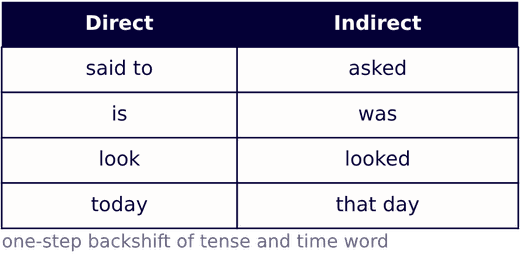 The present tense backshifts one step: 'is' becomes 'was' and 'look' becomes 'looked'; the adverb 'today' becomes 'that day'.
Option (a) keeps 'today', option (c) keeps the present 'looks' and option (d) keeps the present 'is'.
Hence option (b) is correct.
The present tense backshifts one step: 'is' becomes 'was' and 'look' becomes 'looked'; the adverb 'today' becomes 'that day'.
Option (a) keeps 'today', option (c) keeps the present 'looks' and option (d) keeps the present 'is'.
Hence option (b) is correct.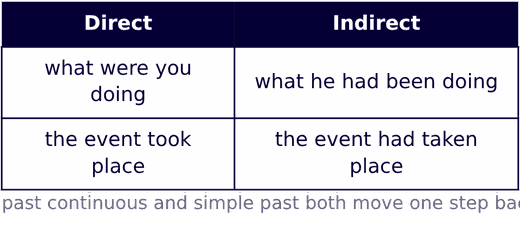 'You' refers to the student, so it becomes 'he', and after 'asked' the wh-clause takes statement order.
Only option (c) makes both backshifts; (a) fails the first, (b) fails the second and (d) drops the subject 'he' altogether.
Hence option (c) is correct.
'You' refers to the student, so it becomes 'he', and after 'asked' the wh-clause takes statement order.
Only option (c) makes both backshifts; (a) fails the first, (b) fails the second and (d) drops the subject 'he' altogether.
Hence option (c) is correct.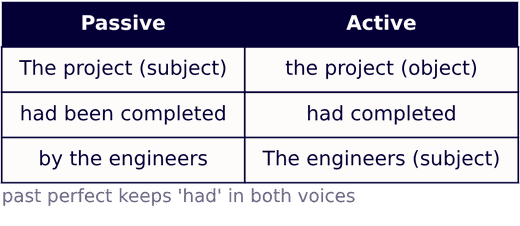 So the active form is 'The engineers had completed the project.'
Option (a) lowers the tense to the simple past, option (d) raises it to the present perfect and option (b) is still passive.
Hence option (c) is correct.
So the active form is 'The engineers had completed the project.'
Option (a) lowers the tense to the simple past, option (d) raises it to the present perfect and option (b) is still passive.
Hence option (c) is correct.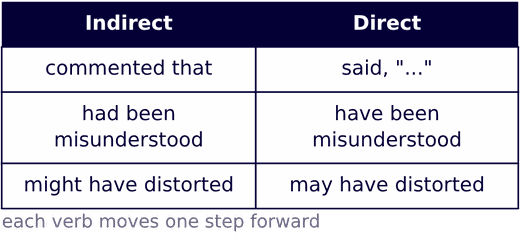 'Had evidently been misunderstood' therefore goes back to 'have evidently been misunderstood', and 'might have distorted' to 'may have distorted'.
The reporting verb becomes 'said', followed by a comma and the exact words inside quotation marks.
Options (a), (b) and (d) alter the verbs in other ways instead of merely undoing the backshift.
Hence option (c) is correct.
'Had evidently been misunderstood' therefore goes back to 'have evidently been misunderstood', and 'might have distorted' to 'may have distorted'.
The reporting verb becomes 'said', followed by a comma and the exact words inside quotation marks.
Options (a), (b) and (d) alter the verbs in other ways instead of merely undoing the backshift.
Hence option (c) is correct.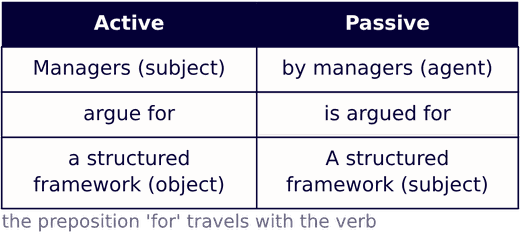 The object of 'argue for' is the singular 'a structured framework', so the passive reads 'A structured framework is argued for by managers.'
Option (a) shifts the tense to the past and loses 'for', option (b) uses the -ing form after 'has been', and option (d) is not a passive at all.
Hence option (c) is correct.
The object of 'argue for' is the singular 'a structured framework', so the passive reads 'A structured framework is argued for by managers.'
Option (a) shifts the tense to the past and loses 'for', option (b) uses the -ing form after 'has been', and option (d) is not a passive at all.
Hence option (c) is correct.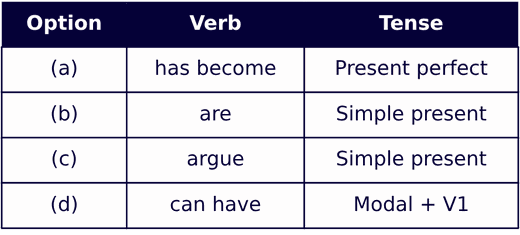 In option (a), 'Managing remote productivity has become a significant topic', the verb 'has become' is exactly this form.
Options (b) and (c) use the simple present ('are', 'argue') and option (d) uses a modal with the base verb ('can have').
Hence option (a) is correct.
In option (a), 'Managing remote productivity has become a significant topic', the verb 'has become' is exactly this form.
Options (b) and (c) use the simple present ('are', 'argue') and option (d) uses a modal with the base verb ('can have').
Hence option (a) is correct.