SSC CHSL 27 November 2025 · Shift 2 · English Language — questions with answers · ShikshaSphere
Chapter 160 of 200
27 November 2025 · Shift 2
English Language
25 questions ~25 min readFree
25 questions
A
1
Choose the correct word from the options given showing a synonym of the word below.
Reticent
A.Talkative
B.Reserved
C.Garrulous
D.Loquacious
Solution
Synonym
'Reticent' means unwilling to speak freely; a reticent person holds his thoughts and feelings back.
'Reserved' - keeping one's feelings and opinions to oneself - carries exactly that sense of restraint, so it is the synonym.
'Talkative', 'Garrulous' and 'Loquacious' all mean fond of talking a great deal, so all three are antonyms of the given word.
Hence option (b) is correct.
2
Choose the option that has an error in the sentence.
Nowadays, academic pressure makes students devote too much times resting.
A.Nowadays, academic pressure
B.makes students devote
C.too much times resting.
D.No correction required
Solution
Countable-uncountable noun
In the sense of duration, 'time' is an uncountable noun, so it takes 'much' and stays singular.
The plural 'times' is used only for the number of occasions - 'three times a week' - which is not the meaning here.
So 'devote too much times resting' must read 'devote too much time resting'.
The faulty part is therefore option (c).
3
Identify the incorrect sentence.
A.He damage his health by eating too much junk food every day.
B.Most people do not like being interrupted while they are studying.
C.For a long time, people believed that the earth was round.
D.You need a lot of money to buy luxury brands. Everything there is very costly.
Solution
Subject-verb agreement
In the simple present a singular subject takes the -s form of the verb.
Option (a) has the singular subject 'He' with the bare verb 'damage'; with 'every day' it should be 'He damages his health'.
The other three sentences are grammatically sound - 'being interrupted' is a correct passive gerund and 'believed that the earth was round' keeps the reported verb in the past.
Hence the incorrect sentence is option (a).
4
Fill in the blank with the most appropriate option:
The resolution was approved with support, uniting members across the committee.
A.partisan
B.unanimous
C.perfunctory
D.nominal
Solution
Contextual vocabulary
The clue lies in 'uniting members across the committee' - every member was in agreement.
'Unanimous' means agreed to by every single person concerned, which fits the blank exactly.
'Partisan' means one-sided or biased, 'perfunctory' means done carelessly as a mere formality, and 'nominal' means in name only - none of them expresses full agreement.
Hence option (b) is correct.
5
Correct the homonym in the sentence.
Sentence: She is the only hair to the property.
Correct word:
A.Hare
B.Heir
C.Hire
D.Hier
Solution
Homophones
'Hair' (the strands that grow on the head) and 'heir' (a person who inherits) sound alike but differ in meaning.
The sentence speaks of a claim to property, so the word needed is 'heir'.
'Hare' is an animal, 'hire' means to employ or take on rent, and 'Hier' is not an English word at all.
Hence option (b) is correct.
6
Select the incorrect spelling.
A.Hurricane
B.Enviorment
C.Atmosphere
D.Storm
Solution
Spelling
The correct spelling is 'Environment' - e-n-v-i-r-o-n-m-e-n-t.
The option writes it as 'Enviorment': the letters 'ron' have been turned into 'or' and one 'n' is missing.
'Hurricane', 'Atmosphere' and 'Storm' are all spelt correctly.
Hence the incorrectly spelt word is option (b).
7
Choose the best option to replace the underlined part to improve the given sentence. If no substitution is required, select No substitution.
The van was loaded in boxes of medical supplies for the hospital.
A.loaded with
B.loaded from
C.loaded into
D.No substitution
Solution
Preposition with 'load'
When the container is the subject, 'load' is followed by 'with' before the thing that fills it - the van was loaded with boxes.
'Load into' works the other way round, with the goods as the subject - the boxes were loaded into the van.
Here the subject is 'The van', so 'loaded in' must become 'loaded with'; 'loaded from' would wrongly show a source.
Hence option (a) is correct.
8
Choose the best option to replace the underlined part to improve the given sentence. If no substitution is required, select No substitution.
She was blamed with leaking sensitive information.
A.blamed by
B.accused of
C.convicted to
D.No substitution
Solution
Verb-preposition collocation
'Blame' is followed by 'for' before the offence - blamed for leaking - and never by 'with', so the underlined phrase is wrong.
The verb 'accuse' always takes the fixed preposition 'of' before the offence: accused of leaking sensitive information.
'Convict' also takes 'of', not 'to', so option (c) is faulty as well, and (a) 'blamed by' would point to the person doing the blaming.
Hence option (b) is correct.
9
Choose the correct passive voice transformation of the sentence: The workers will have completed the task by evening.
A.The task will have being completed by the workers by evening.
B.The task would have been completed by the workers by evening.
C.The task will be completed by the workers by evening.
D.The task will have been completed by the workers by evening.
Solution
Future perfect passive
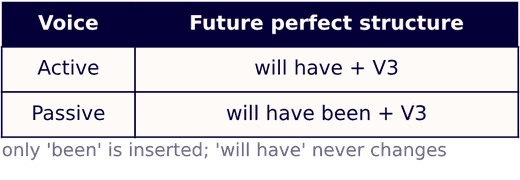
'The workers will have completed the task' is in the future perfect: will have + V3.
The passive of the future perfect is formed by inserting 'been' - will have been + V3.
So the object 'the task' becomes the subject: The task will have been completed by the workers by evening.
Option (a) puts 'being' after 'have', (b) replaces 'will' with 'would', and (c) drops the perfect aspect altogether.
Hence option (d) is correct.
10
Choose the correct indirect narration of the following statement from the given alternatives: He said to me, "I am going to start working on the project from next week until my colleague finishes his part.
A.He told me that he is going to start working on the project from the next week until his colleague finishes his part.
B.He told me that he was going to start working on the project from the following week until his colleague finished his part.
C.He told me that they were going to start working on the project from the following week until his colleague finished his part.
D.He told me that he was going to start working on the project from the next week until my colleague finished his part.
Solution
Direct to indirect speech
The reporting verb 'said to me' becomes 'told me', and 'that' replaces the quotation marks.
The reporting verb is in the past, so the tenses move one step back: 'am going' becomes 'was going' and 'finishes' becomes 'finished'.
The pronouns of the speaker change from first to third person: 'I' becomes 'he' and 'my colleague' becomes 'his colleague'.
The time expression 'next week' becomes 'the following week'.
Option (a) keeps the present tense, (c) turns 'he' into 'they', and (d) keeps 'next week' and 'my colleague'.
Only option (b) makes every change correctly, so it is the answer.
11
Change the following sentence into the Active form:
The new novel was published by a famous author.
A.A famous author published the new novel.
B.The new novel publishes a famous author.
C.A famous author has published the new novel.
D.The new novel was being published by a famous author.
Solution
Passive to active voice
In the passive sentence the agent after 'by' - 'a famous author' - becomes the subject of the active sentence.
'Was published' is the simple past passive, so the active verb is the simple past 'published'.
The passive subject 'the new novel' becomes the object: A famous author published the new novel.
Option (c) shifts the tense to the present perfect and (d) is still passive, so option (a) is correct.
12
Choose the option that is the most appropriate conversion of the following sentence into Direct Speech:
The teacher advised the students not to ignore their homework.
A.The teacher advises the students, "Don't ignore your homework."
B.The teacher told the students, "You should not ignore your homework."
C.The teacher said to the students, "Do not ignore your homework."
D.The teacher advised, 'The students must not ignore their homework.*
Solution
Indirect to direct speech
The indirect sentence reports an order or advice, so inside the quotation marks direct speech needs an imperative.
'advised the students not to ignore' therefore becomes the negative imperative 'Do not ignore', and 'their homework' becomes 'your homework'.
The reporting verb must stay in the past and must be followed by the listener: 'The teacher said to the students, ...'.
Option (a) shifts the reporting verb to the present 'advises', (b) turns the order into a mere suggestion with 'should', and (d) keeps the reported form 'The students must not ignore their homework' inside the quotes.
Hence option (c) is correct.
13
Choose the most suitable preposition from the given options to fill in the blank in the following sentence: She has a reputation speaking clearly and confidently.
A.by
B.at
C.of
D.for
Solution
Preposition with 'reputation'
'Reputation' takes the preposition 'for' when the activity that makes a person well known is stated.
So the sentence reads: She has a reputation for speaking clearly and confidently.
'Reputation of' is used for the possessor or for a quality-noun (the reputation of the school), not before a gerund like this.
'By' and 'at' never collocate with 'reputation', so option (d) is correct.
14
Choose the correct passive voice transformation of the sentence: The committee, after thorough discussion, has finally approved the new policy.
A.The new policy has finally been approved by the committee after thorough discussion.
B.The new policy was finally approved by the committee after thorough discussion.
C.The new policy had been finally approved by the committee after thorough discussion.
D.The new policy is approved by the committee after thorough discussion.
Solution
Present perfect passive
The active sentence is in the present perfect: has + V3 ('has finally approved').
The passive of the present perfect is has/have been + V3, and the adverb 'finally' keeps its place before the main verb.
So the object 'the new policy' becomes the subject: The new policy has finally been approved by the committee after thorough discussion.
Option (b) shifts to the simple past, (c) to the past perfect and (d) to the simple present, so only option (a) keeps the tense unchanged.
15
Directions (Qs. 15-19): Read the following passage carefully and answer the questions that follow.
embedding demanding thinking tasks within enjoyable formats, these activities make learning internally rewarding rather than externally forced.
In the end, games that challenge the mind are far from trivial pastimes; they actively shape thinking patterns in ways that offer long-term educational and personal benefits.
In the sentence "Online platforms, when carefully selected, can also function as drivers of cognitive progress," the phrase "when carefully selected" functions as:
A.Noun clause
B.Adverbial clause of time
C.Adjective clause
D.Absolute phrase
Solution
Clause identification
'When carefully selected' is an elliptical clause in which the subject and the verb are understood - when (they are) carefully selected.
It opens with the subordinating conjunction 'when' and tells us on what occasion, or under what condition of time, the platforms can drive cognitive progress.
A clause introduced by when / while / before / after that modifies the verb of the main clause is an adverbial clause of time.
It names no thing, so it is not a noun clause, and it modifies no noun, so it is not an adjective clause.
Hence option (b) is correct.
16
Directions (Qs. 15-19): Read the following passage carefully and answer the questions that follow.
embedding demanding thinking tasks within enjoyable formats, these activities make learning internally rewarding rather than externally forced.
In the end, games that challenge the mind are far from trivial pastimes; they actively shape thinking patterns in ways that offer long-term educational and personal benefits.
Identify the tense in "can also function as drivers of cognitive progress."
A.Simple present
B.Present continuous
C.Future simple
D.Present perfect
Solution
Tense identification
'Can function' is a modal verb followed by the bare infinitive, and 'can' is the present-tense form of the modal.
The clause states a general possibility that is true at all times, not an action going on now or one already finished.
There is no 'is/are + -ing' for the present continuous, no 'will' for the future simple and no 'has/have + V3' for the present perfect.
Hence the tense is the simple present, option (a).
17
Directions (Qs. 15-19): Read the following passage carefully and answer the questions that follow.
embedding demanding thinking tasks within enjoyable formats, these activities make learning internally rewarding rather than externally forced.
In the end, games that challenge the mind are far from trivial pastimes; they actively shape thinking patterns in ways that offer long-term educational and personal benefits.
The word "fluency" in the sentence "Language-oriented games... expand vocabulary and verbal fluency." most nearly means:
A.Clumsiness
B.ease and accuracy
C.Laziness
D.Curiosity
Solution
Word meaning in context
'Fluency' is the ability to use a language smoothly, without hesitation and without mistakes.
Paired here with 'vocabulary', it clearly stands for ease and accuracy in speaking.
'Clumsiness' is its very opposite, while 'laziness' and 'curiosity' have nothing to do with command over language.
Hence option (b) is correct.
18
Directions (Qs. 15-19): Read the following passage carefully and answer the questions that follow.
embedding demanding thinking tasks within enjoyable formats, these activities make learning internally rewarding rather than externally forced.
In the end, games that challenge the mind are far from trivial pastimes; they actively shape thinking patterns in ways that offer long-term educational and personal benefits.
Which word from the passage means making something less harmful, unpleasant, or bad?
A.Worsening
B.Preventing
C.mitigating
D.Ignoring
Solution
Word from the passage
To mitigate is to make something less severe, less harmful or less unpleasant - exactly the definition given in the question.
'Mitigating' is the very word used in the passage, so it is the one being asked for.
'Worsening' is the opposite; 'preventing' means stopping something before it happens at all, not merely reducing it; 'ignoring' means paying no attention to it.
Hence option (c) is correct.
19
Directions (Qs. 15-19): Read the following passage carefully and answer the questions that follow.
embedding demanding thinking tasks within enjoyable formats, these activities make learning internally rewarding rather than externally forced.
In the end, games that challenge the mind are far from trivial pastimes; they actively shape thinking patterns in ways that offer long-term educational and personal benefits.
According to the passage, what ensures the maximum benefit of learning-focused digital games?
A.Playing them for long hours
B.Combining them with face-to-face activities
C.Using only offline versions
D.Avoiding all puzzles and strategy games
Solution
Reading comprehension
The passage says that the gains from learning-focused digital games are greatest when screen play is balanced with real-world, face-to-face interaction.
So it is the combination of the two, not the amount of play, that ensures the maximum benefit.
Long hours (a) are nowhere recommended, and the passage never asks for offline-only versions (c) or for puzzles and strategy games to be avoided (d) - it praises them.
Hence option (b) is correct.
20
Rearrange the following sentence parts to form a meaningful and grammatically correct paragraph:
P. She collected water from a river into a clean container.
Q. She heated the water until it reached a rolling boil, making it safe to drink.
R. She drank the clear, boiled water, feeling refreshed and hydrated.
S. She strained the water through a cloth to remove any dirt or debris.
A.P, Q, S, R
B.R, Q, S, P
C.Q, P, S, R
D.R, S, Q, P
Solution
Para jumble
The four parts describe one continuous procedure, so they must follow the order in which the actions are performed.
P introduces the water and the container, so it has to open the paragraph; R, the drinking of the finished water, has to close it.
That fixes the frame P ... R, and the two treatment steps Q (heating to a rolling boil) and S (straining through a cloth) fill the middle.
Among the options only (a) begins with P and ends with R; (b) and (d) start with R and (c) starts with Q.
Hence the correct sequence is P, Q, S, R - option (a).
21
Rearrange the following sentences to form a meaningful and grammatically correct paragraph:
P. As a result, they were able to harvest fruits that would nourish the growing population.
Q. The ancient farmers built raised beds on the steep hillsides to prevent soil erosion.
R. Where there had previously been unusable slopes, these raised beds created fertile land.
S. Their community's prosperity and food security were largely due to their innovative farming techniques.
A.Q, R, P, S
B.S, R, P, Q
C.R, Q, P, S
D.P, R, Q, S
Solution
Para jumble
Q is the opening sentence: it introduces the subject of the paragraph — the ancient farmers and the raised beds they built on the steep hillsides.
R must follow Q, because the phrase 'these raised beds' points back to the beds just mentioned and tells us what they achieved: fertile land where the slopes had been unusable.
P comes next; its linker 'As a result' needs the fertile land of R before it, and it gives the outcome — fruits that nourished the growing population.
S rounds the paragraph off with the overall comment on the community's prosperity and food security.
So the correct sequence is Q, R, P, S, and the correct option is (a).
22
What is the antonym of Permanent?
A.Eternal
B.Forever
C.Long-lasting
D.Ephemeral
Solution
Antonym
'Permanent' means lasting for ever or for a very long time, so the antonym must carry the idea of 'short-lived'.
'Ephemeral' means lasting for a very short time — an ephemeral fashion, an ephemeral bloom — which is exactly the opposite of permanent.
'Eternal', 'Forever' and 'Long-lasting' all repeat the idea of lasting, so they are synonyms of permanent, not antonyms.
Hence the correct option is (d).
23
What is the antonym of "Murky" ?
A.Bright
B.Tenebrous
C.Sombre
D.Gloomy
Solution
Antonym
'Murky' means dark, dim and unclear — murky water, a murky sky, a murky past.
The opposite of darkness and dimness is 'Bright', which means full of light and clear.
'Tenebrous' (dark and shadowy), 'Sombre' (dark or dull) and 'Gloomy' (dark, depressing) all mean much the same as murky, so they are synonyms.
Hence the correct option is (a).
24
Select the incorrectly spelt word.
A.Apocriphal
B.Historian
C.Mainstream
D.Scholar
Solution
Spelling error
Option (a) is misspelt: the correct form is 'Apocryphal', written with 'y' after the 'r', not 'i'.
'Apocryphal' describes a story that is widely circulated but of doubtful authenticity.
'Historian', 'Mainstream' and 'Scholar' are all spelt correctly.
Hence the correct option is (a).
25
Which word describes the action of making amends for a wrong or injury ?
A.Penitence
B.Atonement
C.Acquittal
D.Salvation
Solution
One word substitution
'Atonement' is the act of making amends or reparation for a wrong or an injury — doing something to set the wrong right.
'Penitence' is only the feeling of sorrow and regret for having done wrong; the regret may never be turned into any act of repair, so it is not 'making amends'.
'Acquittal' is a court's verdict that a person is not guilty, and 'Salvation' is deliverance from sin or harm — neither is an act of compensation.
Hence the correct option is (b).
Finished reading? Now test yourself.
The same 25 questions, but with a timer and the answers hidden — 15 minutes.

 So the object 'the task' becomes the subject: The task will have been completed by the workers by evening.
Option (a) puts 'being' after 'have', (b) replaces 'will' with 'would', and (c) drops the perfect aspect altogether.
Hence option (d) is correct.
So the object 'the task' becomes the subject: The task will have been completed by the workers by evening.
Option (a) puts 'being' after 'have', (b) replaces 'will' with 'would', and (c) drops the perfect aspect altogether.
Hence option (d) is correct.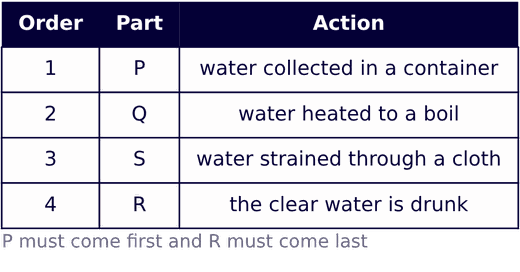 Among the options only (a) begins with P and ends with R; (b) and (d) start with R and (c) starts with Q.
Hence the correct sequence is P, Q, S, R - option (a).
Among the options only (a) begins with P and ends with R; (b) and (d) start with R and (c) starts with Q.
Hence the correct sequence is P, Q, S, R - option (a).