
76
Who authored the three-volume historical account of Emperor Akbar's reign ?
- A.Abul Fazl
- B.Al-Biruni
- C.Ziauddin Barani
- D.Minhaj-us-Siraj
Solution
Mughal court historian
Abul Fazl, one of the nine gems (Navaratnas) of Akbar's court, wrote the Akbarnama, the official history of Akbar's reign in three volumes.
Volume I covers the Timurid ancestry and Akbar's birth, Volume II the events of the reign up to 1602, and Volume III, the Ain-i-Akbari, describes the administration, revenue, army and geography of the empire.
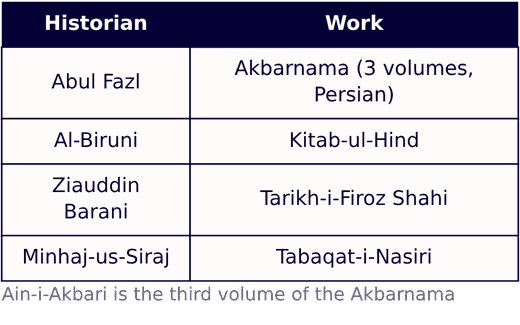 It was written in Persian, the court language of the Mughals; Abul Fazl was killed in 1602 by Bir Singh Bundela.
Al-Biruni wrote the Kitab-ul-Hind, Ziauddin Barani the Tarikh-i-Firoz Shahi and Minhaj-us-Siraj the Tabaqat-i-Nasiri, so option (a) is correct.
It was written in Persian, the court language of the Mughals; Abul Fazl was killed in 1602 by Bir Singh Bundela.
Al-Biruni wrote the Kitab-ul-Hind, Ziauddin Barani the Tarikh-i-Firoz Shahi and Minhaj-us-Siraj the Tabaqat-i-Nasiri, so option (a) is correct.
It was written in Persian, the court language of the Mughals; Abul Fazl was killed in 1602 by Bir Singh Bundela.
Al-Biruni wrote the Kitab-ul-Hind, Ziauddin Barani the Tarikh-i-Firoz Shahi and Minhaj-us-Siraj the Tabaqat-i-Nasiri, so option (a) is correct.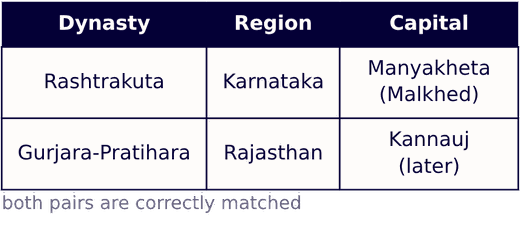 The Rashtrakuta king Krishna I built the monolithic Kailasa temple at Ellora, and Amoghavarsha I wrote the Kavirajamarga in Kannada.
Both pairs are correctly matched, so option (c) is correct.
The Rashtrakuta king Krishna I built the monolithic Kailasa temple at Ellora, and Amoghavarsha I wrote the Kavirajamarga in Kannada.
Both pairs are correctly matched, so option (c) is correct.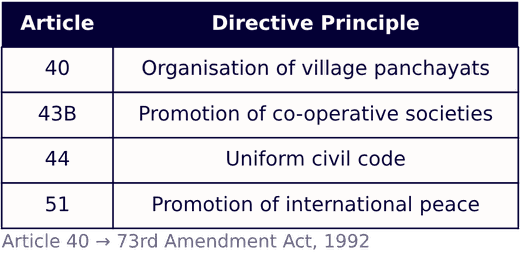 Rajasthan (Nagaur) was the first state to launch Panchayati Raj, on 2 October 1959, on the recommendation of the Balwant Rai Mehta Committee.
The uniform civil code is Article 44 and promotion of international peace is Article 51, while the right to information rests on the RTI Act, 2005, so option (a) is correct.
Rajasthan (Nagaur) was the first state to launch Panchayati Raj, on 2 October 1959, on the recommendation of the Balwant Rai Mehta Committee.
The uniform civil code is Article 44 and promotion of international peace is Article 51, while the right to information rests on the RTI Act, 2005, so option (a) is correct.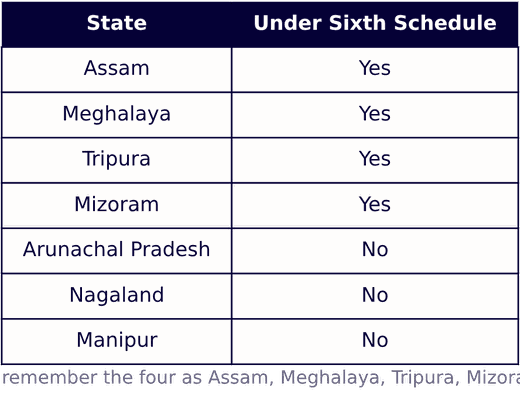 Of the four options only Mizoram belongs to that list.
It works through Autonomous District and Regional Councils that make laws on land, forests, water, agriculture, inheritance and social custom, under Articles 244(2) and 275(1).
Arunachal Pradesh, Nagaland and Manipur are outside the Sixth Schedule, so option (c) is correct.
Of the four options only Mizoram belongs to that list.
It works through Autonomous District and Regional Councils that make laws on land, forests, water, agriculture, inheritance and social custom, under Articles 244(2) and 275(1).
Arunachal Pradesh, Nagaland and Manipur are outside the Sixth Schedule, so option (c) is correct.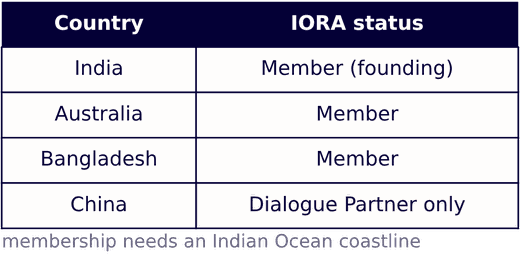 IORA was set up on 7 March 1997, the idea having grown out of Nelson Mandela's visit to India in 1995, and its secretariat is in Mauritius.
Australia, Bangladesh and India are all member states of the grouping, so the country asked for is option (c).
IORA was set up on 7 March 1997, the idea having grown out of Nelson Mandela's visit to India in 1995, and its secretariat is in Mauritius.
Australia, Bangladesh and India are all member states of the grouping, so the country asked for is option (c).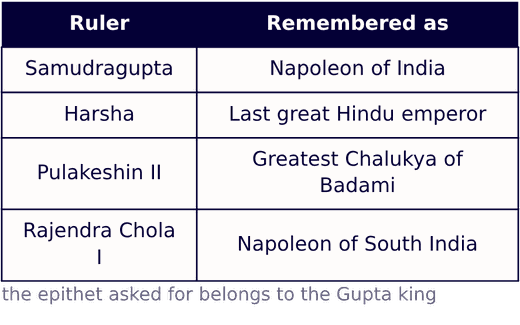 Harsha ruled the Pushyabhuti dynasty and Pulakeshin II was the greatest Chalukya of Badami, while Rajendra Chola I is called the "Napoleon of South India", so option (b) is correct.
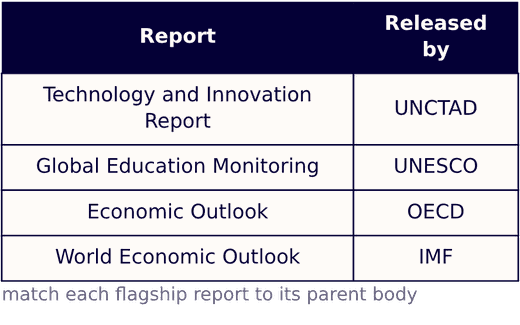 UNESCO brings out the Global Education Monitoring Report and the IMF the World Economic Outlook, so option (a) is correct.
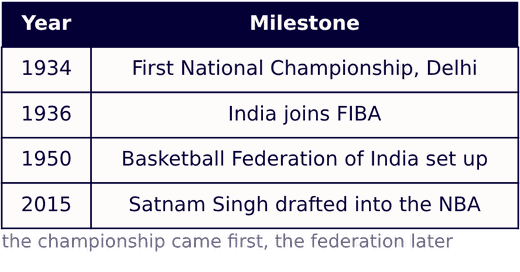 So the correct year is 1934 and option (b) is correct.
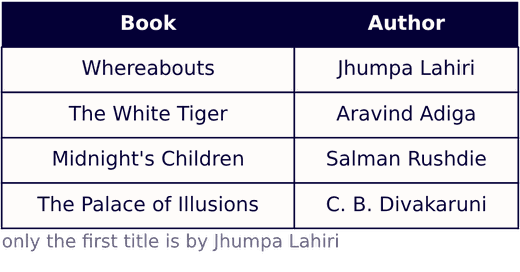 The other three titles belong to different writers, so option (a) is correct.
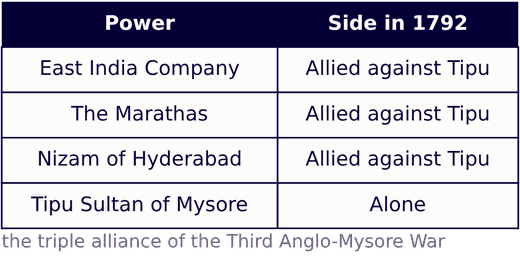 The allies besieged Srirangapatnam and forced the Treaty of Seringapatam (1792), by which Tipu surrendered nearly half his territory, paid an indemnity of about three crore rupees and gave two of his sons as hostages.
Hence option (d) is correct.
The allies besieged Srirangapatnam and forced the Treaty of Seringapatam (1792), by which Tipu surrendered nearly half his territory, paid an indemnity of about three crore rupees and gave two of his sons as hostages.
Hence option (d) is correct.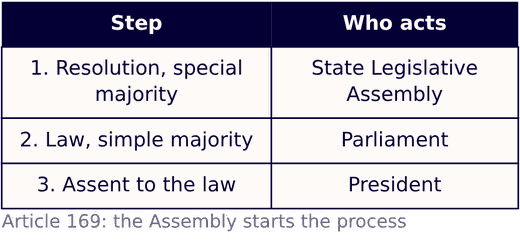 Parliament then passes the law by a simple majority, and such a law is not treated as a constitutional amendment under Article 368.
The Governor and the Prime Minister have no power of recommendation here, so option (d) is correct.
Parliament then passes the law by a simple majority, and such a law is not treated as a constitutional amendment under Article 368.
The Governor and the Prime Minister have no power of recommendation here, so option (d) is correct.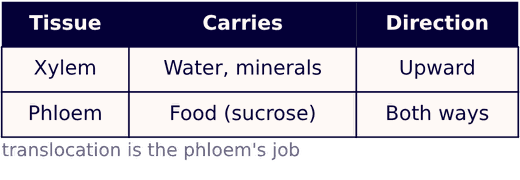 Respiration releases energy from food and evaporation is only loss of water, so option (b) is correct.