SSC GD Constable 7 February 2025 · Shift 1 · Elementary Mathematics — questions with answers · ShikshaSphere
Chapter 48 of 210
7 February 2025 · Shift 1
Elementary Mathematics
20 questions ~20 min readFree
20 questions
A
41
The average of thirteen numbers is 57. The average of first three numbers is 48, and that of the next seven numbers is 58. The 11th number is two times the 12th number and 12th number is 3 less than the 13th number. What is the average of the 11th and 13th numbers?
A.18
B.72
C.27
D.36
Solution
Average of grouped numbers
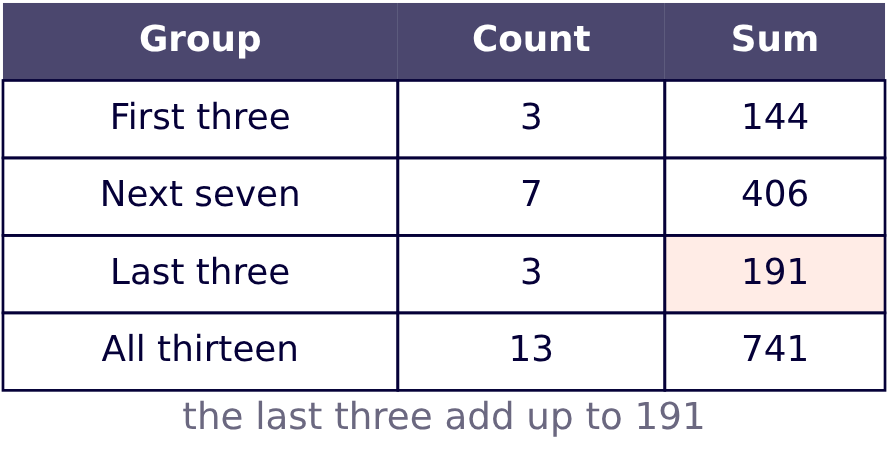
Sum of all thirteen numbers
Sum of the first three
Sum of the next seven
Sum of the last three =741-144-406=191
Let the 12th number be x, then the 11th =2x and the 13th =x+3
2x+x+x+3=191
4x=188
x=47, so the 11th =94 and the 13th =50
Required average
42
The mean proportional between 68 and 272 is:
A.114
B.136
C.126
D.124
Solution
Mean proportional
Mean proportional between a and b
Here a=68 and
So the mean proportional is 136.
43
The LCM of 40, 20, 120 and 335 is:
A.8101
B.8040
C.8003
D.7991
Solution
LCM by prime factors
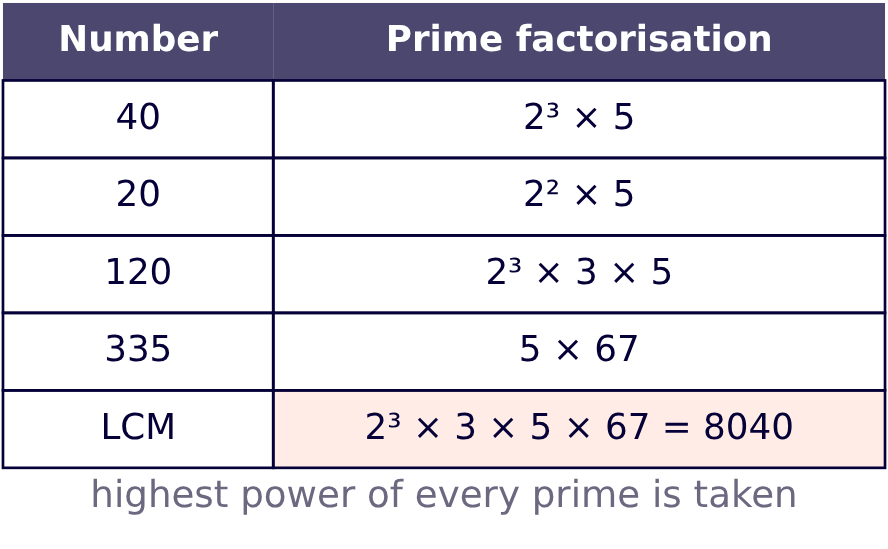
Break every number into its prime factors.
LCM takes the highest power of each prime
44
The average age of 59 students of a class is 22 years. If the age of the teacher is also included, the average age of the whole group becomes 23 years. The age (in years) of the teacher is:
A.81
B.83
C.84
D.82
Solution
Average with a new member
Total age of 59 students years
Total age of the 60 persons years
Age of the teacher =1380-1298=82 years
Shortcut: teacher's age = new average + students rise years
45
Two trains having lengths of 150 m and 350 m are running at speeds of 60 km/h and 120 km/h, respectively, in the same direction. The time taken (in minutes) by the faster train, coming from behind, to completely cross the other train is:
A.2
B.1.2
C.3.5
D.0.5
Solution
Train crossing a train
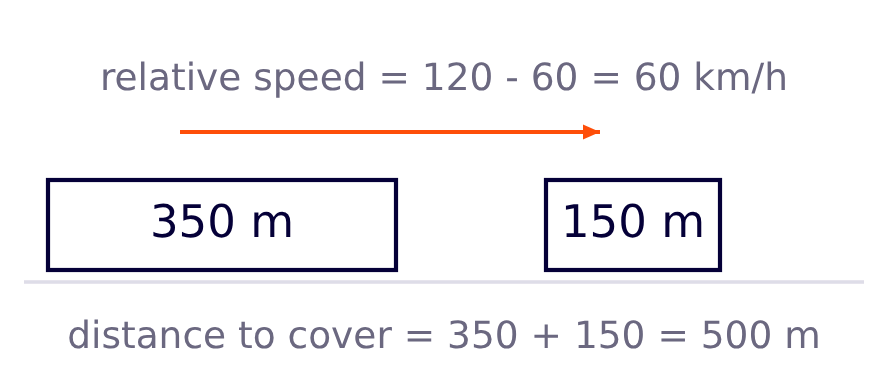
Both move the same way, so relative speed =120-60=60 km/h
60 km/h m/s
Distance to cover = sum of the lengths =150+350=500 m
Time seconds
30 seconds minute
46
What is the correct descending order of the ratios 17 : 42, 19 : 21, 1 : 7, 11 : 13, 23 : 26?
A.23 : 26, 19 : 21, 11 : 13, 17 : 42, 1 : 7
B.19 : 21, 23 : 26, 11 : 13, 1 : 7, 17 : 42
C.19 : 21, 11 : 13, 23 : 26, 17 : 42, 1 : 7
D.19 : 21, 23 : 26, 11 : 13, 17 : 42, 1 : 7
Solution
Comparing ratios
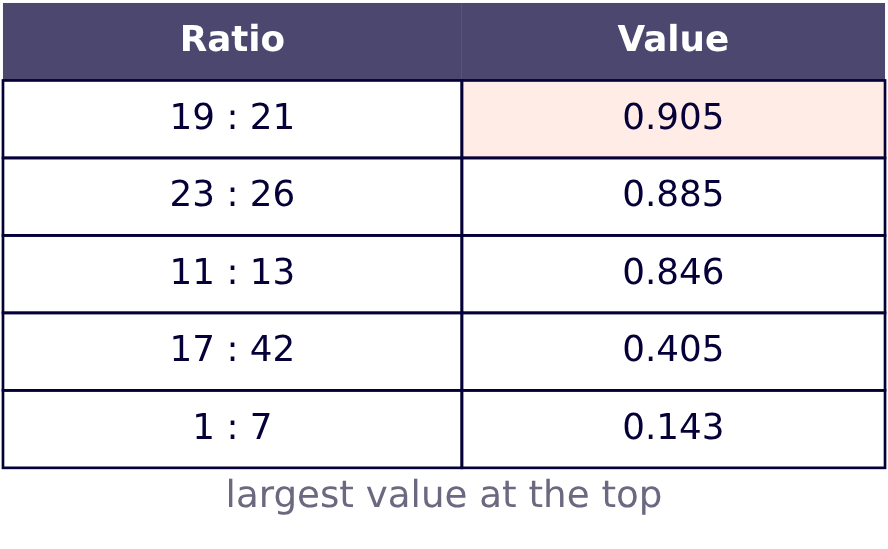
Turn every ratio into a decimal.
Largest first: 0.905>0.885>0.846>0.405>0.143
So the descending order is 19 : 21, 23 : 26, 11 : 13, 17 : 42, 1 : 7.
47
What is the smallest number which when divided by 64 and 80 leaves remainder 9 in each case?
A.337
B.329
C.320
D.311
Solution
LCM and a common remainder
A number leaving the same remainder with both divisors = (a multiple of their LCM) + remainder.
and
LCM
Smallest such number =320+9=329
Check: and
48
In a circular race of 800 m length, Ram and Mohan start at speeds of 25 m/sec and 40 m/sec, respectively, at the same time from the same point. After how much time will they meet for the first time at the starting point, when running in the same direction?
A.136 seconds
B.120 seconds
C.152 seconds
D.160 seconds
Solution
Meeting on a circular track
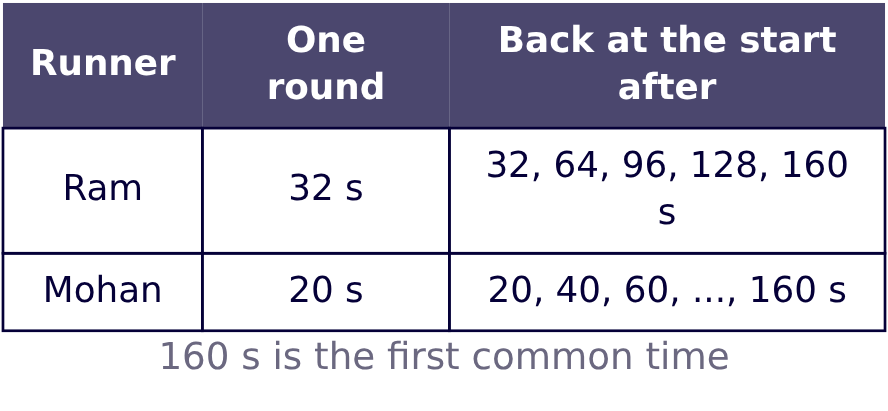
Time taken by Ram for one round seconds
Time taken by Mohan for one round seconds
Both stand at the starting point again after the LCM of these two times.
and
LCM
So they meet first at the starting point after 160 seconds.
49
Find the value of
A.1349
B.1368
C.1382
D.1353
Solution
BODMAS simplification
Open the innermost bracket first (BODMAS).
16-12=4, so
Curly bracket
Value
50
The price of fuel decreases by 35%, 10% and 30% in three successive months, but increases by 65% in the fourth month. What is the percentage increase/decrease in the price of fuel in the fourth month as compared to its original price?
A.Decreases by 33.75%
B.Decreases by 32.43%
C.Increases by 31.14%
D.Increases by 32.84%
Solution
Successive percentage change
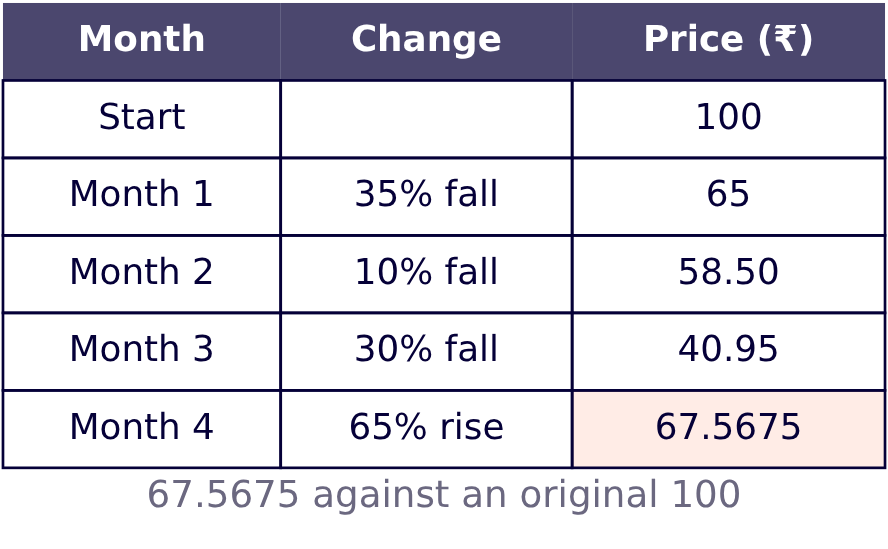
Take the original price as ₹100.
After the 35% fall:
After the 10% fall:
After the 30% fall:
After the 65% rise:
Net change =67.5675-100=-32.4325
So the price decreases by about 32.43%.
51
If 2% of x = 324, then x is equal to:
A.16200
B.32400
C.16300
D.32500
Solution
Percentage of a number
2% of x means
52
Find the volume of a hemisphere whose diameter is 7 cm. (Take π = 22/7) (Rounded up to two decimal places)
A.89.83 cm³
B.94.83 cm³
C.99.83 cm³
D.84.83 cm³
Solution
Volume of a hemisphere
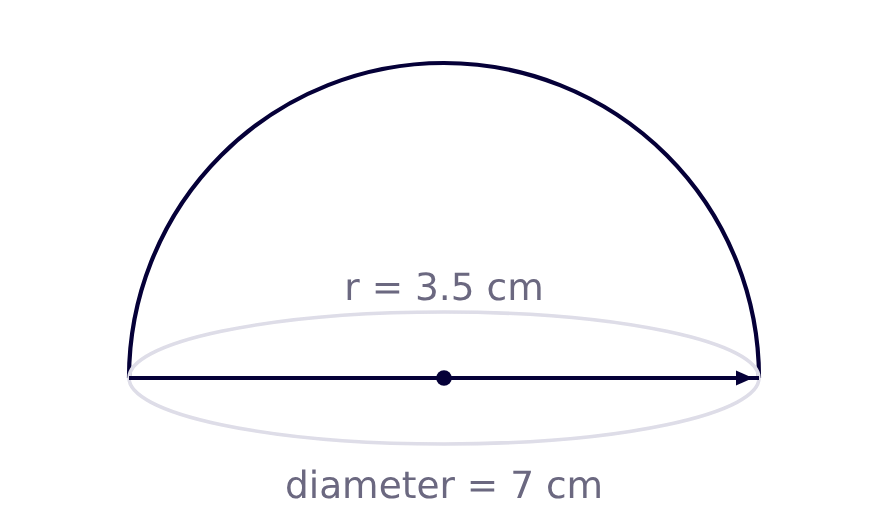
Radius cm
Volume of a hemisphere
=89.83 (to two decimal places)
So the volume is 89.83 cm³.
53
400 chickooes were bought at ₹1260 per hundred and were sold at a profit of ₹860. Find the selling price (in ₹) per dozen of chickooes.
A.167
B.177
C.187
D.192
Solution
Profit and selling price
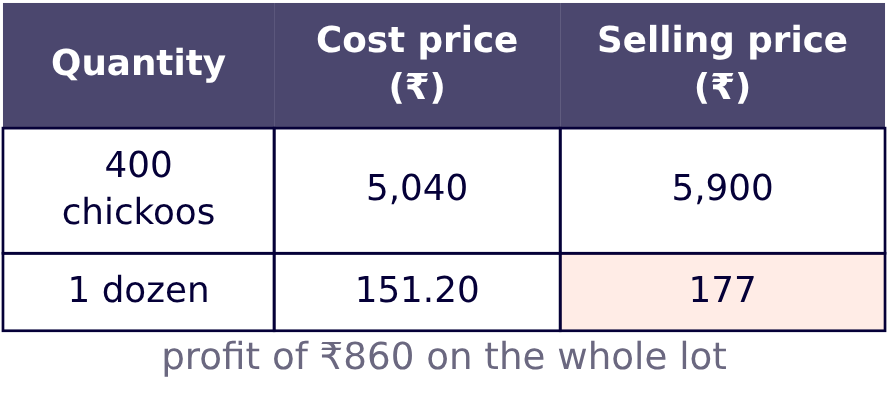
Cost of 100 chickoos = ₹1,260
Cost of 400 chickoos , i.e. ₹5,040
Selling price of 400 chickoos =5040+860=5900, i.e. ₹5,900
Selling price of one chickoo
Selling price per dozen
So one dozen chickoos sell for ₹177.
54
When difference between compound and simple interest for three years is ₹183 at 5% interest per annum, the principal is ₹ ____
A.24420
B.23425
C.24000
D.25200
Solution
Difference of CI and SI
For three years, difference
Here the difference is ₹183 and r=5
P=24000
So the principal is ₹24,000.
55
Evaluate:
A.11
B.12
C.15
D.14
Solution
Order of operations
BODMAS: do and before + and -.
16+2-6=12
56
Abhishek and Deepanshi undertake to do a piece of work for ₹1,000. Abhishek alone can do it in 5 days and Deepanshi alone can do it in 10 days. With the help of Chitransh, they finish it in 2 days. How much should Chitransh be paid for his contribution?
A.₹200
B.₹500
C.₹300
D.₹400
Solution
Work and wages
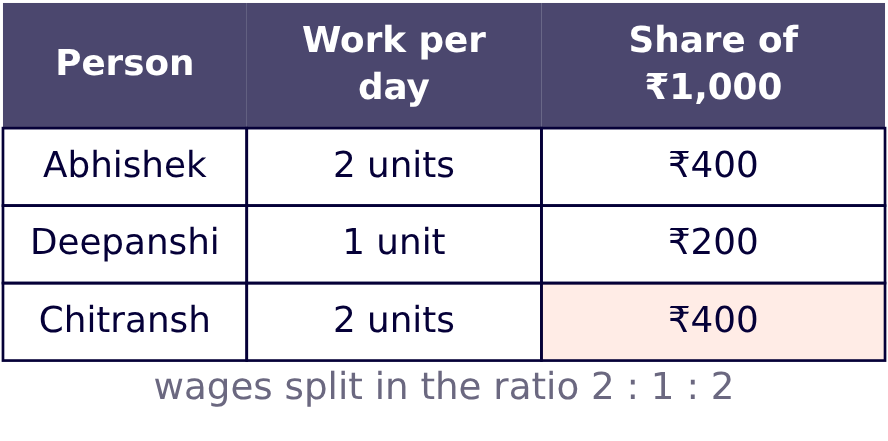
Let the whole work be LCM of 5 and 10 =10 units.
Abhishek does units a day
Deepanshi does unit a day
All three finish in 2 days, so together they do units a day
Chitransh does 5-(2+1)=2 units a day
Wages are shared in the ratio of work done =2:1:2
Chitransh's share , i.e. ₹400
57
Govind invested some money in HDFC at 4% per annum rate of interest. What would be the corresponding simple interest (in ₹) if after 2 years, Govind got ₹178.5 as compound interest, considering annual compounding?
A.175
B.185
C.170
D.190
Solution
CI and SI for two years
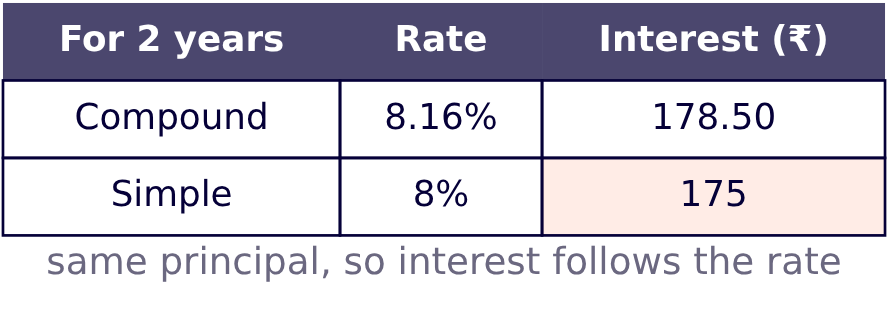
For 2 years the compound rate
, so the CI is 8.16% of the principal
For 2 years the simple rate , so the SI is 8% of the principal
The principal is the same, so SI : CI =8:8.16
SI
So the simple interest is ₹175.
58
A man sold an article for ₹216, there by gaining 20%. The cost of the article (in ₹) was:
A.172
B.180
C.270
D.260
Solution
Cost price from gain percent
Let the cost price be x.
A gain of 20% makes the selling price of the cost price.
So the cost of the article is ₹180.
59
A washing machine is marked at ₹30,000. A customer gets two successive discounts of 20% and 10%. What is the final price (in ₹) that the customer has to pay?
A.23,400
B.22,800
C.22,900
D.21,600
Solution
Successive discounts
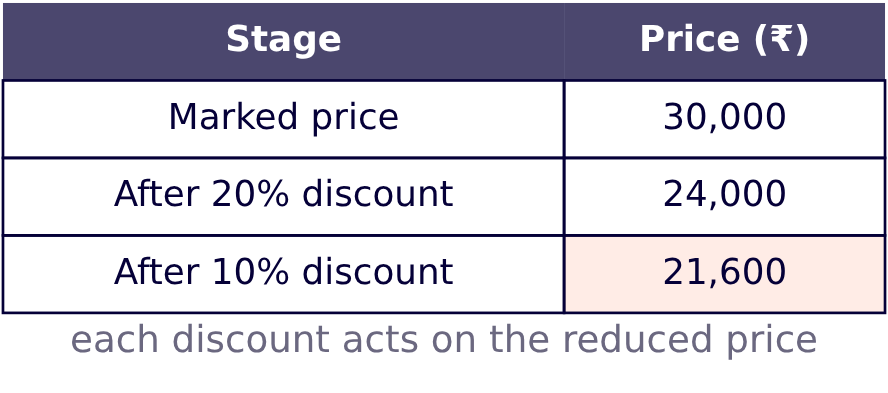
Marked price = ₹30,000
After the first discount of 20%:
After the second discount of 10%:
So the customer pays ₹21,600.
60
Mukund invests a sum of ₹5400 and Sachin invests a sum of ₹9400 at the same rate of simple interest per annum. If, at the end of 5 years, Sachin gets ₹960 more interest than Mukund, then find the rate of interest per annum (in percentage).
A.3.8
B.6.8
C.2.8
D.4.8
Solution
Rate of simple interest
, with the same R and T=5 for both.
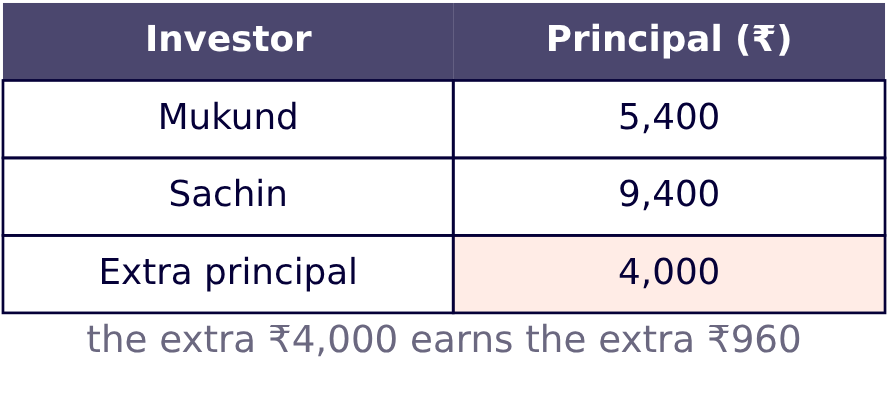
Extra principal with Sachin =9400-5400=4000
This extra principal alone earns the extra interest of ₹960.
200R=960
R=4.8
So the rate of interest is 4.8% per annum.
Finished reading? Now test yourself.
The same 20 questions, but with a timer and the answers hidden — 15 minutes.