
41
400 apples were bought at ₹1210 per hundred and were sold at a profit of ₹860. Find the selling price (in ₹) per dozen of apples.
- A.181
- B.161
- C.171
- D.186
Solution
Profit and selling price
The rate is ₹1210 per hundred apples, so 400 apples cost , i.e. ₹4,840.
Selling price = cost price + profit =4840+860=5700, i.e. ₹5,700.
400 apples dozen.
Selling price per dozen .
Hence the selling price is ₹171 per dozen, so option (c) is correct.
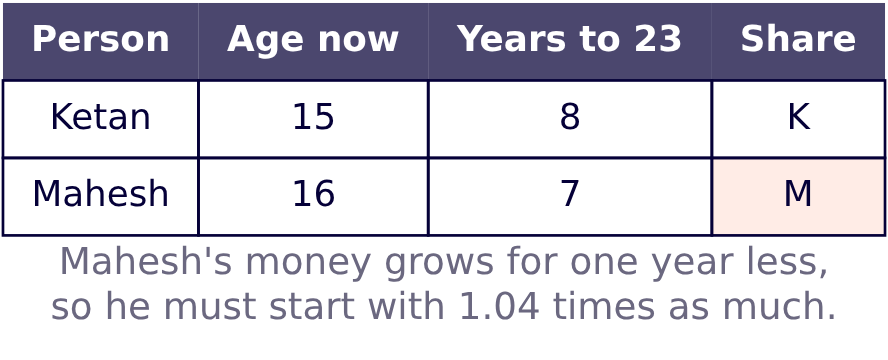 Cancelling from both sides: .
.
, so M=25500-12500=13000.
Mahesh was given ₹13,000 initially, so option (d) is correct.
Cancelling from both sides: .
.
, so M=25500-12500=13000.
Mahesh was given ₹13,000 initially, so option (d) is correct.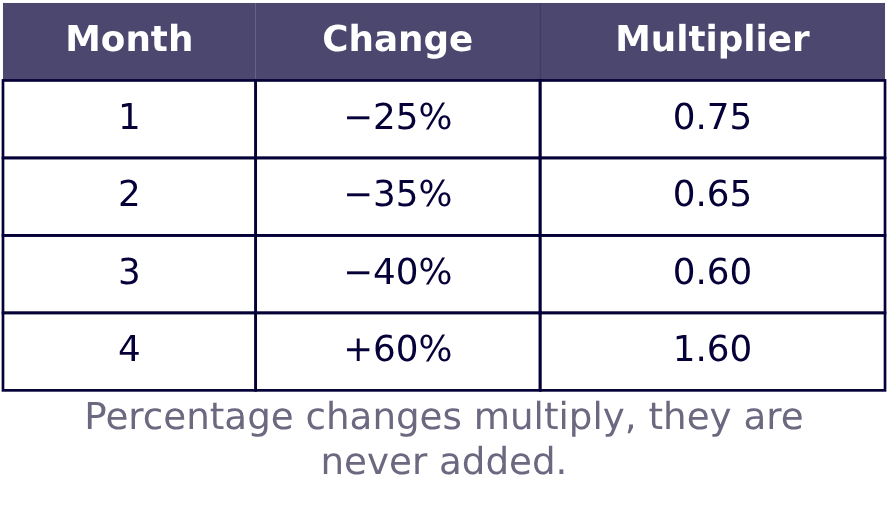 Final price .
.
Net change =46.8-100=-53.2 on a base of 100, i.e. a fall of 53.2%.
So the price decreases by 53.2%, and option (b) is correct.
Final price .
.
Net change =46.8-100=-53.2 on a base of 100, i.e. a fall of 53.2%.
So the price decreases by 53.2%, and option (b) is correct.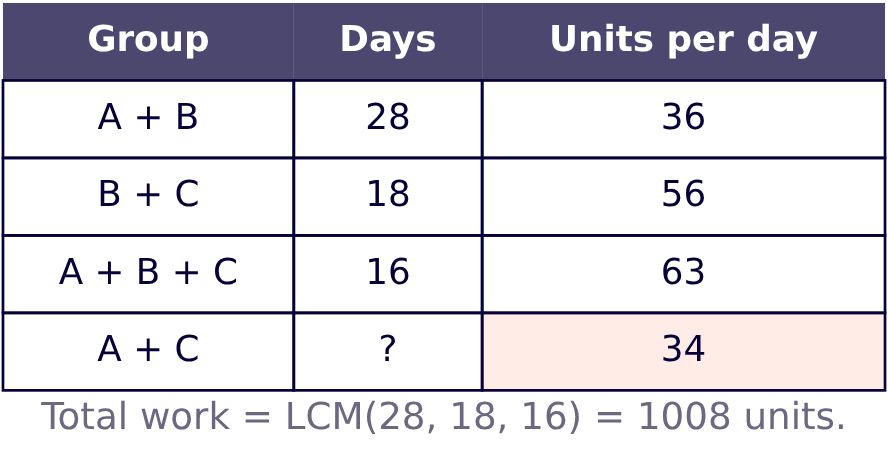 Then , and units per day.
So C=63-36=27 units per day and A=63-56=7 units per day.
A+C=7+27=34 units per day.
Time days.
Hence option (a) is correct.
Then , and units per day.
So C=63-36=27 units per day and A=63-56=7 units per day.
A+C=7+27=34 units per day.
Time days.
Hence option (a) is correct.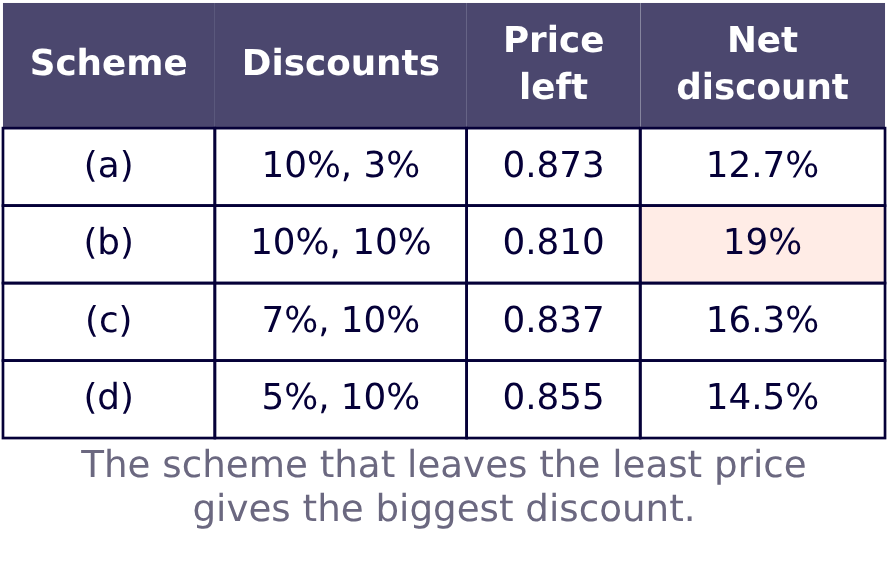 (a) , a net discount of 12.7%.
(b) , a net discount of 19%.
(c) , a net discount of 16.3%.
(d) , a net discount of 14.5%.
The scheme that leaves the least price gives the greatest discount, so two discounts of 10% each are best and option (b) is correct.
(a) , a net discount of 12.7%.
(b) , a net discount of 19%.
(c) , a net discount of 16.3%.
(d) , a net discount of 14.5%.
The scheme that leaves the least price gives the greatest discount, so two discounts of 10% each are best and option (b) is correct.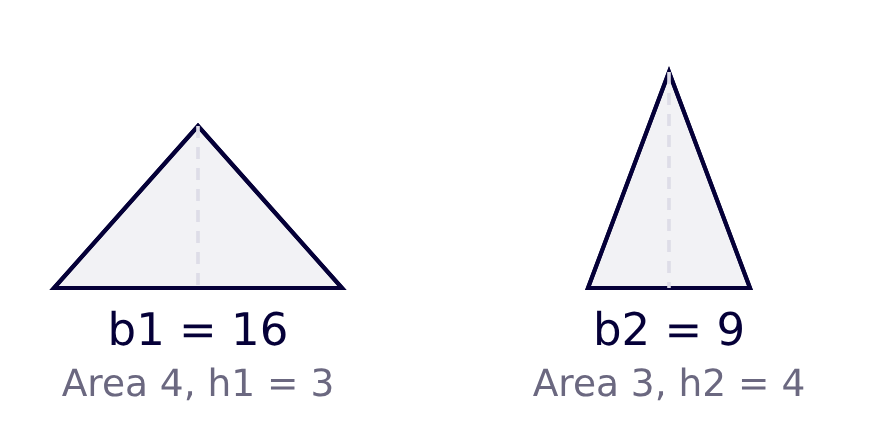 Therefore .
So the bases are in the ratio 16 : 9, and option (a) is correct.
Therefore .
So the bases are in the ratio 16 : 9, and option (a) is correct.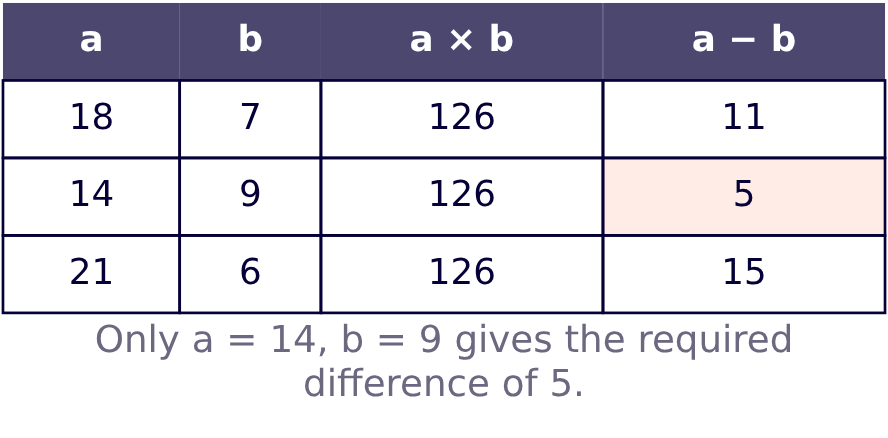 Among the factor pairs of 126, only gives a-b=5, and 14 and 9 are indeed co-prime.
The numbers are and , so their sum =98+63=161 and option (c) is correct.
Among the factor pairs of 126, only gives a-b=5, and 14 and 9 are indeed co-prime.
The numbers are and , so their sum =98+63=161 and option (c) is correct.