SSC GD Constable 25 February 2025 · Shift 1 · Elementary Mathematics — questions with answers · ShikshaSphere
Chapter 198 of 210
25 February 2025 · Shift 1
Elementary Mathematics
20 questions ~20 min readFree
20 questions
A
41
A's and B's salaries are respectively 40% and 70% rupees more than C's salary. What is the ratio of B's salary to A's salary ?
A.17 : 14
B.18 : 13
C.9 : 5
D.23 : 20
Solution
Percentage to ratio
Both salaries are compared with C's salary, so make C's salary the base.
Let C's salary be 100 units.
A is 40% more than C, so A =100+40=140 units.
B is 70% more than C, so B =100+70=170 units.
B:A=170:140=17:14 (dividing both terms by 10).
Hence the correct option is (a).
42
While selling 15 balls for ₹1,220, there is loss equal to the cost price of 5 balls. The cost price (in ₹) of one ball is:
A.145
B.122
C.112
D.120
Solution
Loss stated in units
Let the cost price of one ball be x (in ₹).
Cost price of 15 balls =15x and selling price of 15 balls =1220.
Loss = CP - SP =15x-1220, and the question says this loss equals the CP of 5 balls =5x.
15x-1220=5x
10x=1220
Hence the cost price of one ball is ₹122, option (b).
43
If of , then is equal to:
A.36100
B.36000
C.18000
D.18100
Solution
Basic percentage
'2% of x' means .
Hence the correct option is (c).
44
A, B, C and D can do a piece of work separately in 30 days, 33 days, 36 days and 44 days, respectively. In how many days can A and B together complete the work, if A and B together are assisted by C and D on alternate two-two days starting with C for first two days, then D on next two days and again C on next two days and so on ?
A. days
B. days
C. days
D. days
Solution
Work with alternating helpers
Take the total work as the LCM of 30, 33, 36 and 44, i.e. 1980 units.
One day's work: , , , units.
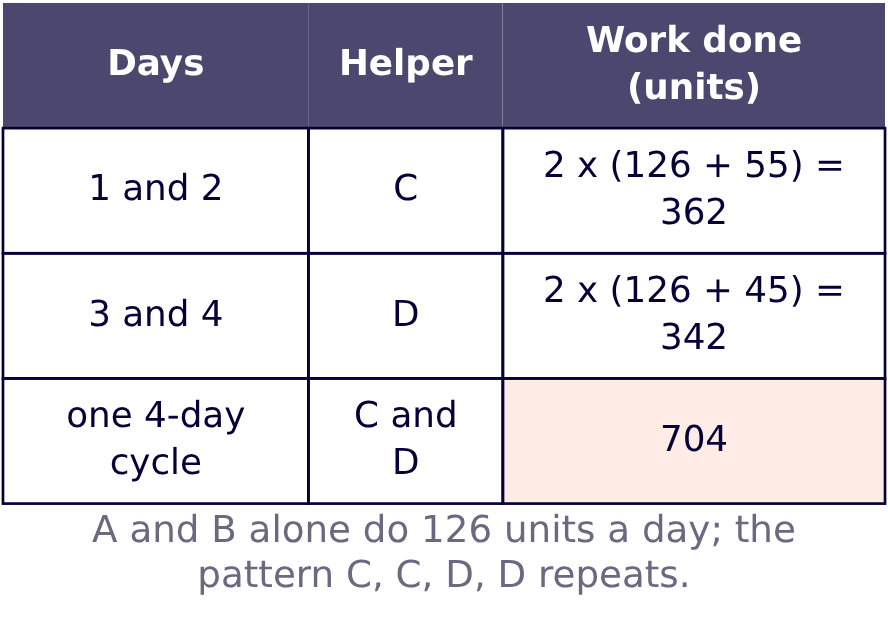
A and B together do 66+60=126 units a day, and the helper changes every two days.
One full cycle of 4 days does 362+342=704 units, so 8 days (two cycles) do 1408 units.
Days 9 and 10 are C days: 1408+362=1770 units done, so 1980-1770=210 units are left.
Day 11 is a D day and gives 171 units, leaving 210-171=39 units.
Day 12 is also a D day, so the last bit needs of a day.
Total time days.
Hence the correct option is (c).
45
The value of ] is:
A.59
B.63
C.55
D.57
Solution
BODMAS with brackets
Open the brackets from the inside out: round, then curly, then square.
Round bracket: 6-5=1, so .
Curly bracket: .
Now , so the square bracket becomes [2+0]=2.
Hence the correct option is (a).
46
A merchant fixes the marked price of his goods at 50% above the cost price. He sells his goods at 12% discount. His percentage of profit is:
A.
B.
C.
D.35%
Solution
Marked price, discount, profit
Take the cost price as 100 units, because both percentages are easy on 100.
Marked price =100+50=150 units.
The 12% discount is on the marked price, not on the cost price, so SP units.
Profit =132-100=32 units.
Profit
Hence the correct option is (b).
47
Evaluate:
A.2
B.-3
C.-6
D.0
Solution
Simplification of brackets
Innermost round bracket first: 6-4+6=8.
Curly bracket: .
Square bracket: [3-(-2)]=3+2=5.
2-5=-3
Hence the correct option is (b).
48
A cube of side 9 cm made of iron is melted and recast into 8 small cubes. Find the side (in cm ) of each small cube.
A.4
B.4.5
C.5.5
D.5
Solution
Melting and recasting a cube
Melting changes the shape but not the volume, so the big cube's volume equals the total volume of the 8 small cubes.
Volume of the big cube cm³.
Let the side of a small cube be a, so .
Hence each small cube has a side of 4.5 cm, option (b).
49
Find the value of
A.84
B.81
C.78
D.98
Solution
Order of operations
Innermost bracket first: 6-5=1.
Curly bracket: .
Round bracket: .
Hence the correct option is (a).
50
The average age of 28 students of a class is 40 years. If the age of the teacher is also included, the average age of the whole group becomes 41 years. The age (in years) of the teacher is:
A.74
B.67
C.70
D.69
Solution
Average and a new member
Total age of the 28 students years.
With the teacher the group has 29 people, so their total age years.
Age of the teacher =1189-1120=69 years.
Shortcut: the teacher's age = new average + (number of students rise in average) .
Hence the correct option is (d).
51
Ravi decided to cover a distance of 24 km in 2 hours 24 minutes. Further he decided to cover the initial one-third of the total distance at and the remaining at some different speed. What is the speed (in km/hr) of Ravi after one-third distance is covered?
A.
B.12
C.
D.11
Solution
Speed for the remaining distance
Total time =2 hours 24 minutes hours.
One-third of 24 km =8 km, and this part is covered at 8 km/hr.
Time for the first part hour.
Remaining distance =24-8=16 km and remaining time =2.4-1=1.4 hours.
Required speed km/hr.
Hence the correct option is (a).
52
Evaluate:
A.9
B.12
C.13
D.10
Solution
BODMAS left to right
Division and multiplication rank equally, so they are done left to right, before the subtraction.
16-6=10
Hence the correct option is (d).
53
The students in the three sections A, B and C of Class X are in the ratio 5 : 4 : 7. If 15, 16 and 9 new students are admitted to sections A, B and C, respectively, the ratio changes to 10 : 9 : 11. What is the total number of students in Class after the new admissions?
A.210
B.120
C.150
D.90
Solution
Ratio after new admissions
Let the sections hold 5x, 4x and 7x students.
After the admissions they hold 5x+15, 4x+16 and 7x+9, and these are in the ratio 10:9:11.
Two of the three parts are enough: .
9(5x+15)=10(4x+16)
45x+135=40x+160
5x=25, so x=5.
The third part checks out too, since 40:36:44=10:9:11.
Total =40+36+44=120
Hence the correct option is (b).
54
Yogesh invested some money in HDFC at 4% per annum rate of interest. What would be the corresponding simple interest (in ₹) if after 2 years, Yogesh got ₹229.5 as compound interest, considering annual compounding ?
A.235
B.225
C.240
D.220
Solution
Compound interest to simple interest
The two interests share the same principal, rate and time, so first find the principal from the compound interest.
For 2 years, CI .
SI
Check: for 2 years CI - SI = 4% of the first year's interest , and 225+4.5=229.5.
Hence the simple interest is ₹225, option (b).
55
Rakesh sold 150 chairs and had a gain equal to the selling price of 75 chairs. What is his profit percentage?
A.110%
B.95%
C.100%
D.105%
Solution
Gain given as selling price
Let the selling price of one chair be s and its cost price be c.
Gain on 150 chairs =150s-150c, and this equals the SP of 75 chairs =75s.
150s-150c=75s
75s=150c, so s=2c.
Profit on one chair =2c-c=c, so profit .
Hence the correct option is (c).
56
12 chairs and 6 tables were bought for ₹12,600. If the average cost of a table is ₹1,500, then find the average cost of a chair.
A.₹350
B.₹500
C.₹250
D.₹300
Solution
Average cost from a total
Cost of 6 tables .
So the 12 chairs together cost 12600-9000=3600.
Average cost of one chair .
Hence the average cost of a chair is ₹300, option (d).
57
The population of a district is 327000, out of which 224000 are males. 65% of the population is literate. If 65% males are literate, then what percentage of females are literate?
A.68%
B.
C.65%
D.66%
Solution
Literacy percentage of females
Number of females =327000-224000=103000.
Literate people of 327000=212550.
Literate males of 224000=145600.
Literate females =212550-145600=66950.
Required percentage .
The male rate is already equal to the overall rate, so the female rate has to match it as well - a quick way to spot the answer.
Hence the correct option is (c).
58
Two trains having lengths of 210 m and 440 m are running at speeds of 60 and , respectively, in the same direction. The time taken (in minutes) by the faster train, coming from behind, to completely cross the other train is:
A.1.3
B.2.2
C.3
D.1.9
Solution
Trains crossing in the same direction
For two trains moving in the same direction the relative speed is the difference: 90-60=30 km/h.
30 km/h m/s.
To cross completely, the faster train has to cover the sum of the two lengths =210+440=650 m.
Time seconds.
78 seconds minutes.
Hence the correct option is (a).
59
A sum of ₹ x amounts to ₹ 75867 in years at p.a., interest compounded after every 10 months. What is the value of ?
A.56000
B.58000
C.55000
D.57000
Solution
Compounding over 10-month periods
Interest is added every 10 months, so one conversion period is 10 months, not one year.
Rate for one period .
years =30 months, which is periods.
Hence the correct option is (d).
60
Gopal invests a sum of ₹5400 and Akshay invests a sum of ₹9400 at the same rate of simple interest per annum. If, at the end of 6 years, Akshay gets ₹720 more interest than Gopal, then find the rate of interest per annum (in percentage).
A.5
B.2
C.3
D.4
Solution
Simple interest from a difference
In simple interest, , and here R and T are the same for both men.
So the extra interest comes only from the extra principal: 9400-5400=4000.
240R=720
Hence the rate of interest is 3% per annum, option (c).
Finished reading? Now test yourself.
The same 20 questions, but with a timer and the answers hidden — 15 minutes.

 One full cycle of 4 days does 362+342=704 units, so 8 days (two cycles) do 1408 units.
Days 9 and 10 are C days: 1408+362=1770 units done, so 1980-1770=210 units are left.
Day 11 is a D day and gives 171 units, leaving 210-171=39 units.
Day 12 is also a D day, so the last bit needs of a day.
Total time days.
Hence the correct option is (c).
One full cycle of 4 days does 362+342=704 units, so 8 days (two cycles) do 1408 units.
Days 9 and 10 are C days: 1408+362=1770 units done, so 1980-1770=210 units are left.
Day 11 is a D day and gives 171 units, leaving 210-171=39 units.
Day 12 is also a D day, so the last bit needs of a day.
Total time days.
Hence the correct option is (c).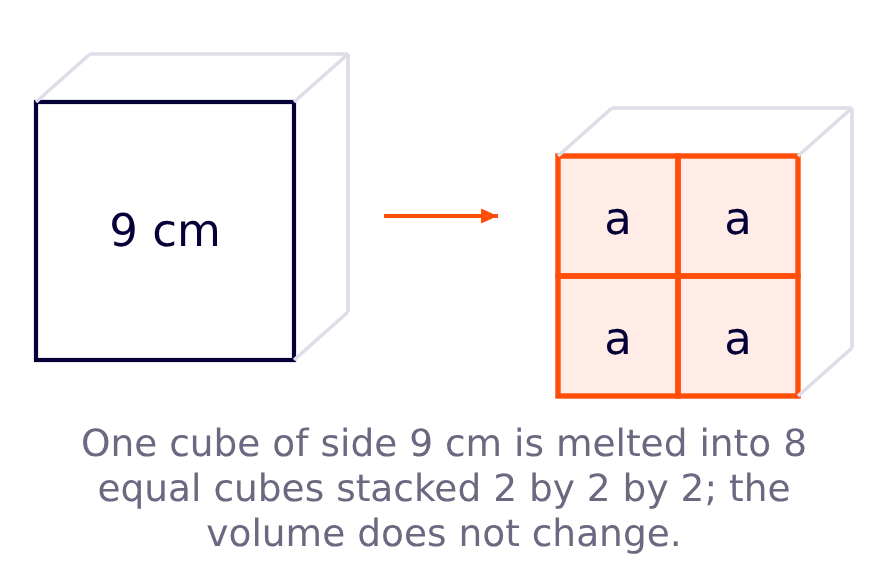 Let the side of a small cube be a, so .
Hence each small cube has a side of 4.5 cm, option (b).
Let the side of a small cube be a, so .
Hence each small cube has a side of 4.5 cm, option (b).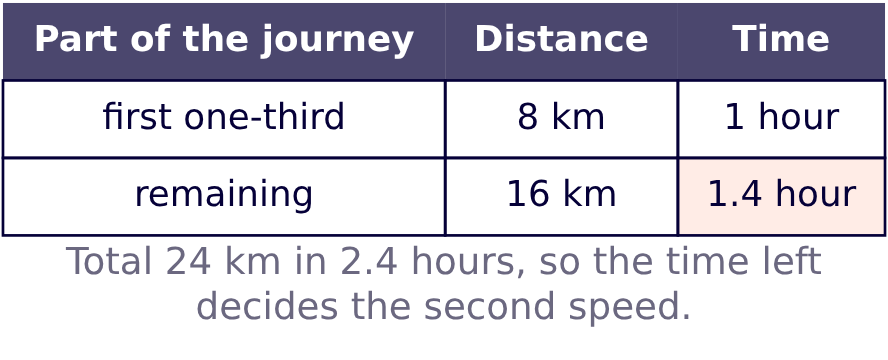 Remaining distance =24-8=16 km and remaining time =2.4-1=1.4 hours.
Required speed km/hr.
Hence the correct option is (a).
Remaining distance =24-8=16 km and remaining time =2.4-1=1.4 hours.
Required speed km/hr.
Hence the correct option is (a).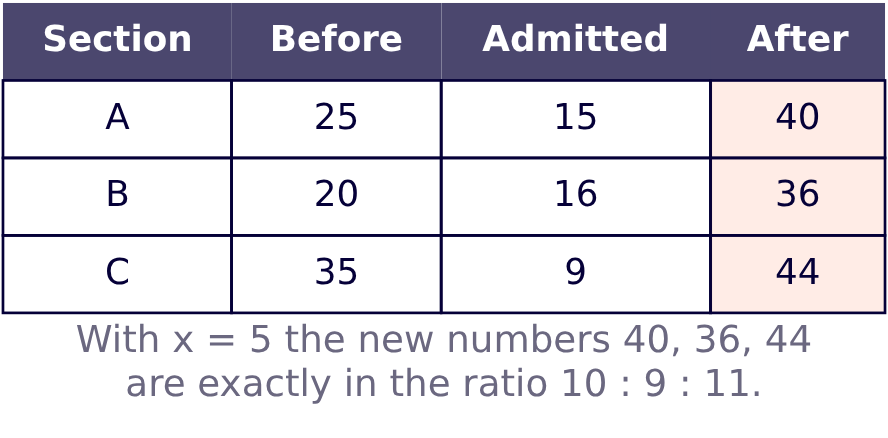 The third part checks out too, since 40:36:44=10:9:11.
Total =40+36+44=120
Hence the correct option is (b).
The third part checks out too, since 40:36:44=10:9:11.
Total =40+36+44=120
Hence the correct option is (b).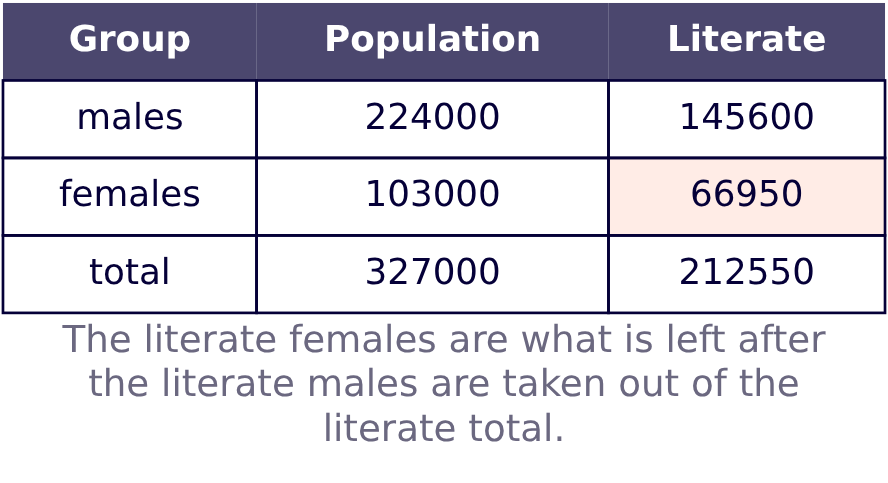 Required percentage .
The male rate is already equal to the overall rate, so the female rate has to match it as well - a quick way to spot the answer.
Hence the correct option is (c).
Required percentage .
The male rate is already equal to the overall rate, so the female rate has to match it as well - a quick way to spot the answer.
Hence the correct option is (c).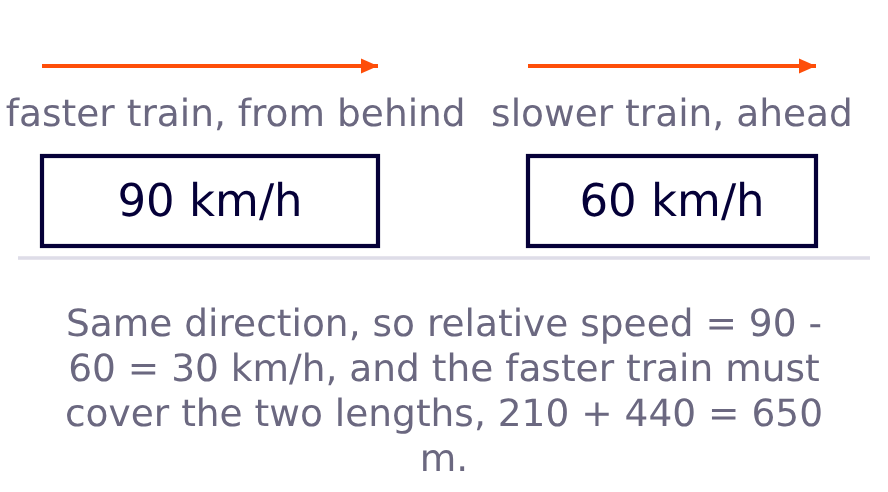 To cross completely, the faster train has to cover the sum of the two lengths =210+440=650 m.
Time seconds.
78 seconds minutes.
Hence the correct option is (a).
To cross completely, the faster train has to cover the sum of the two lengths =210+440=650 m.
Time seconds.
78 seconds minutes.
Hence the correct option is (a).