SSC CGL 14 September 2025 · Shift 3 · Quantitative Aptitude — questions with answers · ShikshaSphere
Chapter 35 of 192
14 September 2025 · Shift 3
Quantitative Aptitude
25 questions ~25 min readFree
25 questions
A
51
If a = − , and b = − , then which of the following is true?
A.a = b
B.a < b
C.a > b
D.Cannot be determined
Solution
Surd comparison
Use approximate values: ≈ 2.236, ≈ 1.732, ≈ 1.414.
a = 2.236 − 1.732 = 0.504.
b = 1.732 − 1.414 = 0.318.
Since 0.504 > 0.318, a > b — option (c).
52
Evaluate the expression: ( ÷ ) ÷ ( + 1 − )
A.5
B.6
C.3
D.2
Solution
Fraction expression
First bracket: ÷ = × 3 = .
Second bracket (LCM 30): + − = = .
Now divide: ÷ = × 6.
= 2 — option (d).
53
The number of red, blue, and green balls in a bag is in the ratio 2 : 3 : 5. If 10 red balls, 10 blue balls, and an unknown number of green balls are added to the bag, the ratio of red, blue, and green balls becomes 3 : 4 : 6. Determine the number of green balls added.
A.3
B.6
C.7
D.10
Solution
Ratio — balls added
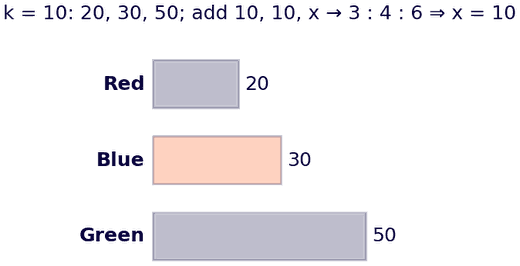
Let the balls be 2k, 3k, 5k and the added green balls = x.
From red and blue: = ⇒ 8k + 40 = 9k + 30 ⇒ k = 10.
So the new red : green gives = ⇒ 50 + x = 60.
x = 10 — option (d).
54
Rohit invests ₹50,000 for 12 months, Ramesh invests ₹1,00,000 for 6 months. What is Rohit's share of ₹20,000 profit?
A.₹10,000
B.₹12,000
C.₹15,000
D.₹18,000
Solution
Partnership — equal products
Profit divides in the ratio of capital × time.
Rohit: 50,000 × 12 = 6,00,000; Ramesh: 1,00,000 × 6 = 6,00,000.
The ratio is 1 : 1 — equal shares.
Rohit's share = = ₹10,000 — option (a).
55
A and B start a business with capitals in the ratio 5 : 3. After 6 months, A withdraws ₹10,000 and B doubles his investment. If the initial investment of A was ₹50,000, and the total profit after 1 year is ₹90,000, find the profit share of A.
A.₹42,000
B.₹50,000
C.₹60,000
D.₹45,000
Solution
Partnership — mid-year changes
Initial capitals: A = ₹50,000, so B = × 50,000 = ₹30,000.
A: 50,000 for 6 months, then 40,000 for 6 months = 50×6 + 40×6 = 540 (thousand-months).
B: 30,000 for 6 months, then 60,000 for 6 months = 30×6 + 60×6 = 540 — the ratio is 1 : 1.
A's share = = ₹45,000 — option (d).
56
What is the average of all three-digit numbers divisible by 19?
A.752
B.551
C.552
D.352
Solution
Average of AP
The three-digit multiples of 19 run from 19 × 6 = 114 to 19 × 52 = 988.
They form an arithmetic progression, and the average of an AP = .
Average = = .
= 551 — option (b).
57
Two containers of the same volume are 30% and 50% full of milk, respectively. They are then filled completely with water. If the contents of both containers are mixed in a larger vessel, what percentage of the mixture is water?
A.45%
B.50%
C.55%
D.60%
Solution
Mixtures — equal volumes
Take each container as 100 units.
Milk: 30 + 50 = 80 units; total mixture = 200 units.
Water = 200 − 80 = 120 units ⇒ × 100 = 60%.
Hence option (d).
58
A stationery shop ordered 8 dozen red balls and some additional dozen blue balls. The price of the red balls per dozen was two times that of the blue ones. When the order was delivered, it was found that the number of dozens of the two colours had been interchanged. This increased the bill by 40%. Find the ratio of the number of dozens of red balls to the number of dozens of blue balls in the original order.
A.1 : 3
B.1 : 2
C.2 : 3
D.3 : 4
Solution
Interchanged order — ratio
Let blue cost ₹p per dozen (red = ₹2p) and blue quantity = S dozen.
Original bill = 8(2p) + S(p) = (16 + S)p; after the swap: S(2p) + 8(p) = (2S + 8)p.
Bill rose 40%: 2S + 8 = 1.4(16 + S) ⇒ 2S + 8 = 22.4 + 1.4S ⇒ 0.6S = 14.4 ⇒ S = 24.
Ratio = 8 : 24 = 1 : 3 — option (a).
59
A flower vendor bought 300 flowers for ₹900. 90 flowers withered and became unsellable. At what price per flower should he sell the remaining flowers to earn a profit of 40% on his total cost?
A.₹7
B.₹6
C.₹5
D.₹3
Solution
Profit on total cost
Required revenue = total cost + 40% = 900 × 1.4 = ₹1,260.
Sellable flowers = 300 − 90 = 210.
Price per flower = .
= ₹6 — option (b).
60
A furniture store sells a chair for ₹Z, making a 20% loss. During a festive season, they increase the marked price of the same chair to ₹2.6Z. They then offer a special discount of 40% on this increased marked price. What will be the percentage profit made by the store during the festive season?
A solution consists of milk and water in the ratio 3 : 5. If 8 litres of water is added, the new ratio becomes 3 : 7. What is the original quantity of milk in the solution?
A.12 litres
B.15 litres
C.20 litres
D.30 litres
Solution
Ratio — add water
Let milk = 3k and water = 5k.
After adding 8 L of water: = .
21k = 15k + 24 ⇒ 6k = 24 ⇒ k = 4.
Milk = 3 × 4 = 12 litres — option (a).
62
Ram alone can complete a job in 12 days and Shyam alone in 18 days. Ram and Shyam agree to do the work for ₹3600. With Ghanshyam's help they finished it in 5 days. How much is Ghanshyam's share?
A.₹1,800
B.₹1,400
C.₹1,600
D.₹1,100
Solution
Work — helper’s wage
Wages divide by work DONE. In 5 days: Ram does , Shyam does .
With LCM 36: Ram = , Shyam = — together .
Ghanshyam did the rest: 1 − = .
His share = × 3600 = ₹1,100 — option (d).
63
A tank has a mixture of solutions A, B, and C in the respective ratio of 5 : 3 : 2. 10 litres of this mixture is drained out, and subsequently, 5 litres of solution A and 3 litres of solution C are added to the tank. If the resultant quantity of solution A is 25 litres more than the resultant quantity of solution B, what was the initial quantity of mixture in the tank (in litres)?
A.140
B.240
C.120
D.110
Solution
Mixture — remove & add
Let the initial volume be V. Fractions: A = 0.5V, B = 0.3V, C = 0.2V. The 10 L drained carries the same ratio: 5 L of A and 3 L of B.
After draining and adding: A = 0.5V − 5 + 5 = 0.5V; B = 0.3V − 3 (nothing added to B).
Given A − B = 25: 0.5V − (0.3V − 3) = 0.2V + 3 = 25.
0.2V = 22 ⇒ V = 110 litres — option (d).
64
The ratio of the time taken by A and B to complete a task is 5 : 4. If B can complete the task alone in 18 hours, how many hours will they take to complete the task if they work together?
A.12 hours
B.10 hours
C.9 hours
D.11 hours
Solution
Work — time ratio
Time ratio A : B = 5 : 4 and B = 18 h, so 4 units = 18 ⇒ 1 unit = 4.5 ⇒ A = 22.5 h.
One-hour work: + = + = = .
Together they finish in the reciprocal of that.
= 10 hours — option (b).
65
Three friends, X, Y, and Z, are cycling on a circular track with a circumference of 3 km. They all start from the same point at 9:00 a.m. and travel in the same direction with speeds of 15 km/h, 10 km/h, and 12 km/h respectively. How many times will all three of them meet at the starting point if they continue cycling until 3:00 p.m.?
A.1 time
B.2 times
C.3 times
D.4 times
Solution
Circular track — meetings
Time per lap: X = × 60 = 12 min; Y = × 60 = 18 min; Z = × 60 = 15 min.
All three are together at the start point at every common multiple: LCM(12, 18, 15) = 180 min = 3 hours.
From 9:00 a.m. to 3:00 p.m. (6 hours) they are all at the starting point at 9:00 a.m., 12:00 noon and 3:00 p.m.
That is 3 times in all — option (c).
66
A circular path of 3 m width runs around a circular park with radius 7 m. What is the area of the path?
A.160.28 m²
B.161.29 m²
C.158.02 m²
D.164.05 m²
Solution
Circular path area
Inner radius r = 7 m; outer radius R = 7 + 3 = 10 m.
Path area = (R² − r²) = × (100 − 49).
= × 51 = .
≈ 160.28 m² — option (a).
67
Find the slope of the line perpendicular to y = x + 7
A.−3
B.3
C.−
D.
Solution
Perpendicular slope
Compare with y = mx + c: the slope of the given line is m = .
Perpendicular lines have slopes whose product is −1.
Required slope = − = −1 ÷ .
= −3 — option (a).
A sector of a circle having a radius of 5 cm has a central angle of radians. What is the area of the sector?
A.13.09 cm²
B.8.33 cm²
C.10.47 cm²
D.12.5 cm²
Solution
Sector area (radians)
For an angle θ in RADIANS, sector area = r²θ.
= × 25 × = .
With π ≈ 3.1416: ≈ 13.09.
= 13.09 cm² — option (a).
70
If sin A = cos(2A − 30°), then what is the value of A?
A.40°
B.25°
C.18°
D.30°
Solution
sin = cos → complementary
If sin A = cos B, then A + B = 90° (complementary angles).
So A + (2A − 30°) = 90°.
3A = 120°.
A = 40° — option (a).
71
In similar triangles, the ratio of corresponding altitudes is 3 : 4. What is the ratio of their areas?
A.2 : 5
B.9 : 16
C.2 : 25
D.5 : 2
Solution
Similar triangles — areas
In similar triangles, ALL corresponding lengths (sides, altitudes, medians) share the same ratio.
Areas are in the ratio of the SQUARES of corresponding lengths.
Area ratio = 3² : 4².
= 9 : 16 — option (b).
72
Given, b = , what is (b + 1)² + (b − 1)²?
A.13
B.12
C.14
D.16
Solution
Algebraic identity
Use the identity: (b + 1)² + (b − 1)² = 2b² + 2.
Here b² = ()² = 7.
So the value = 2 × 7 + 2.
= 16 — option (d).
The diameter of a circle measures 15 cm. What is the maximum length of a chord in this circle?
A.15 cm
B.35 cm
C.65 cm
D.90 cm
Solution
Longest chord
The longest chord of any circle is its DIAMETER.
Every other chord is shorter, since it lies farther from the centre.
Here the diameter is 15 cm.
Hence 15 cm — option (a).
75
If sin A + cos A = cos A, then what is the value of cot A?
A.
B.1
C. + 1
D. − 1
Solution
Trig — cot from equation
Rearrange: sin A = ( − 1) cos A ⇒ tan A = − 1.
cot A = .
Rationalise: multiply by ⇒ .
= + 1 — option (c).
Finished reading? Now test yourself.
The same 25 questions, but with a timer and the answers hidden — 15 minutes.

 Let the balls be 2k, 3k, 5k and the added green balls = x.
From red and blue: = ⇒ 8k + 40 = 9k + 30 ⇒ k = 10.
So the new red : green gives = ⇒ 50 + x = 60.
x = 10 — option (d).
Let the balls be 2k, 3k, 5k and the added green balls = x.
From red and blue: = ⇒ 8k + 40 = 9k + 30 ⇒ k = 10.
So the new red : green gives = ⇒ 50 + x = 60.
x = 10 — option (d).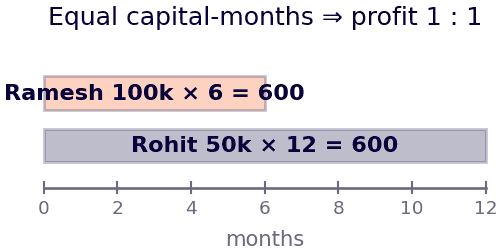 Profit divides in the ratio of capital × time.
Rohit: 50,000 × 12 = 6,00,000; Ramesh: 1,00,000 × 6 = 6,00,000.
The ratio is 1 : 1 — equal shares.
Rohit's share = = ₹10,000 — option (a).
Profit divides in the ratio of capital × time.
Rohit: 50,000 × 12 = 6,00,000; Ramesh: 1,00,000 × 6 = 6,00,000.
The ratio is 1 : 1 — equal shares.
Rohit's share = = ₹10,000 — option (a).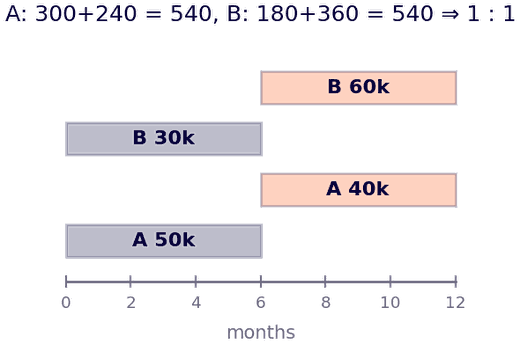 Initial capitals: A = ₹50,000, so B = × 50,000 = ₹30,000.
A: 50,000 for 6 months, then 40,000 for 6 months = 50×6 + 40×6 = 540 (thousand-months).
B: 30,000 for 6 months, then 60,000 for 6 months = 30×6 + 60×6 = 540 — the ratio is 1 : 1.
A's share = = ₹45,000 — option (d).
Initial capitals: A = ₹50,000, so B = × 50,000 = ₹30,000.
A: 50,000 for 6 months, then 40,000 for 6 months = 50×6 + 40×6 = 540 (thousand-months).
B: 30,000 for 6 months, then 60,000 for 6 months = 30×6 + 60×6 = 540 — the ratio is 1 : 1.
A's share = = ₹45,000 — option (d). The three-digit multiples of 19 run from 19 × 6 = 114 to 19 × 52 = 988.
They form an arithmetic progression, and the average of an AP = .
Average = = .
= 551 — option (b).
The three-digit multiples of 19 run from 19 × 6 = 114 to 19 × 52 = 988.
They form an arithmetic progression, and the average of an AP = .
Average = = .
= 551 — option (b).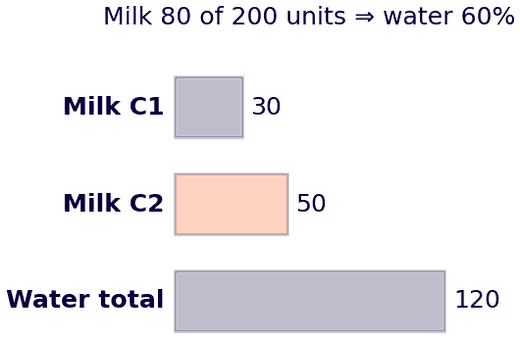 Take each container as 100 units.
Milk: 30 + 50 = 80 units; total mixture = 200 units.
Water = 200 − 80 = 120 units ⇒ × 100 = 60%.
Hence option (d).
Take each container as 100 units.
Milk: 30 + 50 = 80 units; total mixture = 200 units.
Water = 200 − 80 = 120 units ⇒ × 100 = 60%.
Hence option (d).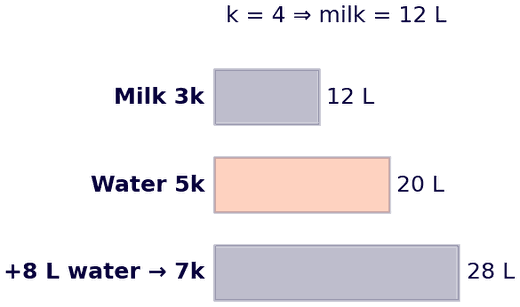 Let milk = 3k and water = 5k.
After adding 8 L of water: = .
21k = 15k + 24 ⇒ 6k = 24 ⇒ k = 4.
Milk = 3 × 4 = 12 litres — option (a).
Let milk = 3k and water = 5k.
After adding 8 L of water: = .
21k = 15k + 24 ⇒ 6k = 24 ⇒ k = 4.
Milk = 3 × 4 = 12 litres — option (a).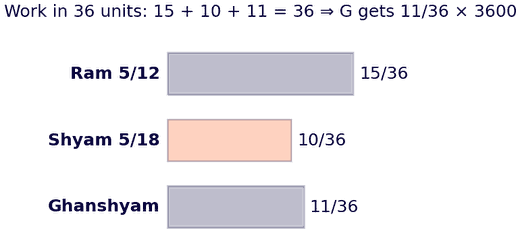 Wages divide by work DONE. In 5 days: Ram does , Shyam does .
With LCM 36: Ram = , Shyam = — together .
Ghanshyam did the rest: 1 − = .
His share = × 3600 = ₹1,100 — option (d).
Wages divide by work DONE. In 5 days: Ram does , Shyam does .
With LCM 36: Ram = , Shyam = — together .
Ghanshyam did the rest: 1 − = .
His share = × 3600 = ₹1,100 — option (d).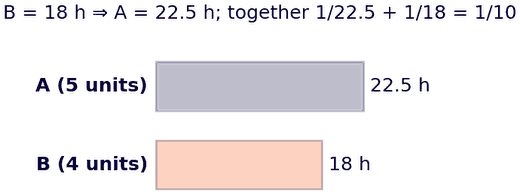 Time ratio A : B = 5 : 4 and B = 18 h, so 4 units = 18 ⇒ 1 unit = 4.5 ⇒ A = 22.5 h.
One-hour work: + = + = = .
Together they finish in the reciprocal of that.
= 10 hours — option (b).
Time ratio A : B = 5 : 4 and B = 18 h, so 4 units = 18 ⇒ 1 unit = 4.5 ⇒ A = 22.5 h.
One-hour work: + = + = = .
Together they finish in the reciprocal of that.
= 10 hours — option (b).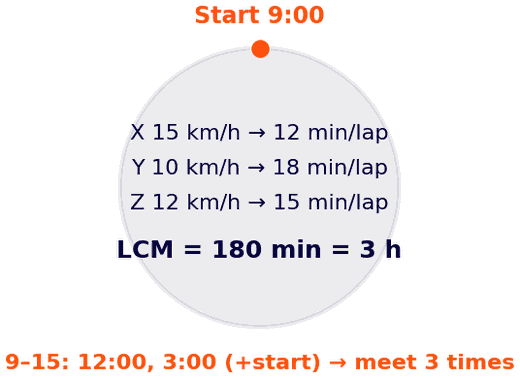 Time per lap: X = × 60 = 12 min; Y = × 60 = 18 min; Z = × 60 = 15 min.
All three are together at the start point at every common multiple: LCM(12, 18, 15) = 180 min = 3 hours.
From 9:00 a.m. to 3:00 p.m. (6 hours) they are all at the starting point at 9:00 a.m., 12:00 noon and 3:00 p.m.
That is 3 times in all — option (c).
Time per lap: X = × 60 = 12 min; Y = × 60 = 18 min; Z = × 60 = 15 min.
All three are together at the start point at every common multiple: LCM(12, 18, 15) = 180 min = 3 hours.
From 9:00 a.m. to 3:00 p.m. (6 hours) they are all at the starting point at 9:00 a.m., 12:00 noon and 3:00 p.m.
That is 3 times in all — option (c).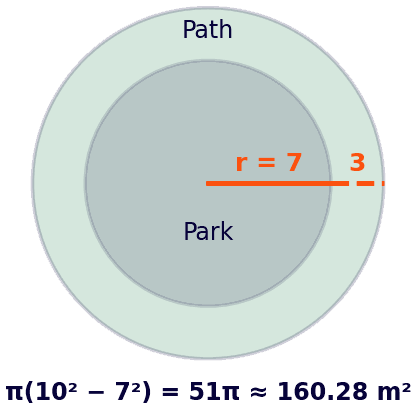 Inner radius r = 7 m; outer radius R = 7 + 3 = 10 m.
Path area = (R² − r²) = × (100 − 49).
= × 51 = .
≈ 160.28 m² — option (a).
Inner radius r = 7 m; outer radius R = 7 + 3 = 10 m.
Path area = (R² − r²) = × (100 − 49).
= × 51 = .
≈ 160.28 m² — option (a).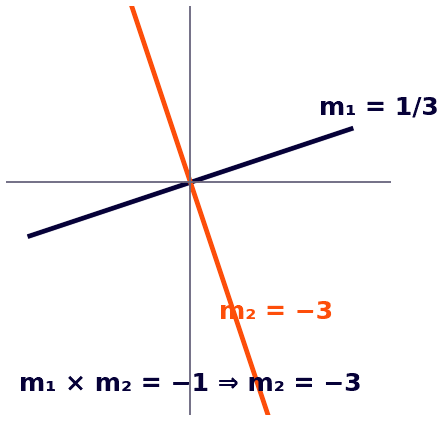 Compare with y = mx + c: the slope of the given line is m = .
Perpendicular lines have slopes whose product is −1.
Required slope = − = −1 ÷ .
= −3 — option (a).
Compare with y = mx + c: the slope of the given line is m = .
Perpendicular lines have slopes whose product is −1.
Required slope = − = −1 ÷ .
= −3 — option (a).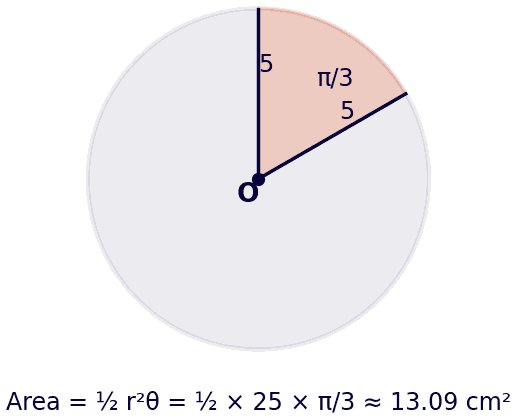 For an angle θ in RADIANS, sector area = r²θ.
= × 25 × = .
With π ≈ 3.1416: ≈ 13.09.
= 13.09 cm² — option (a).
For an angle θ in RADIANS, sector area = r²θ.
= × 25 × = .
With π ≈ 3.1416: ≈ 13.09.
= 13.09 cm² — option (a).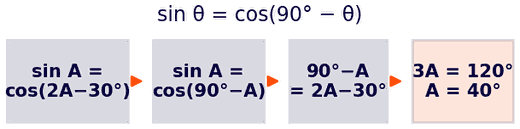 If sin A = cos B, then A + B = 90° (complementary angles).
So A + (2A − 30°) = 90°.
3A = 120°.
A = 40° — option (a).
If sin A = cos B, then A + B = 90° (complementary angles).
So A + (2A − 30°) = 90°.
3A = 120°.
A = 40° — option (a).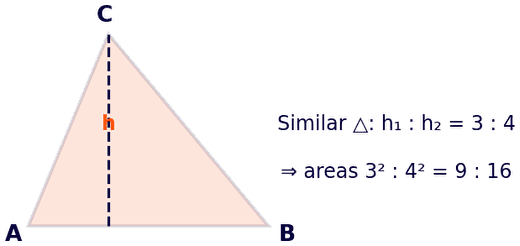 In similar triangles, ALL corresponding lengths (sides, altitudes, medians) share the same ratio.
Areas are in the ratio of the SQUARES of corresponding lengths.
Area ratio = 3² : 4².
= 9 : 16 — option (b).
In similar triangles, ALL corresponding lengths (sides, altitudes, medians) share the same ratio.
Areas are in the ratio of the SQUARES of corresponding lengths.
Area ratio = 3² : 4².
= 9 : 16 — option (b).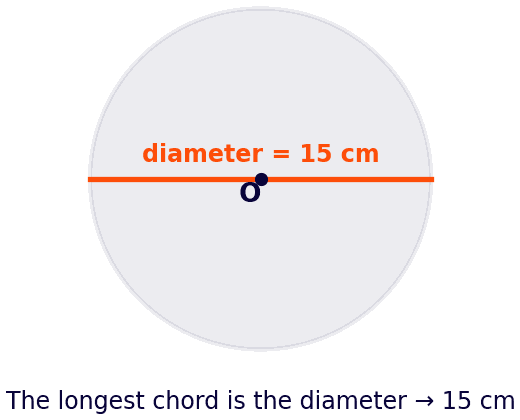 The longest chord of any circle is its DIAMETER.
Every other chord is shorter, since it lies farther from the centre.
Here the diameter is 15 cm.
Hence 15 cm — option (a).
The longest chord of any circle is its DIAMETER.
Every other chord is shorter, since it lies farther from the centre.
Here the diameter is 15 cm.
Hence 15 cm — option (a).