SSC CGL 15 September 2025 · Shift 1 · Quantitative Aptitude — questions with answers · ShikshaSphere
Chapter 39 of 192
15 September 2025 · Shift 1
Quantitative Aptitude
25 questions ~25 min readFree
25 questions
A
51
If P : Q = 7 : 5, Q : R = 2 : 3, and R : S = 4 : 5, find the ratio P : S.
A.28 : 25
B.56 : 75
C.30 : 25
D.70 : 56
Solution
Chained ratios
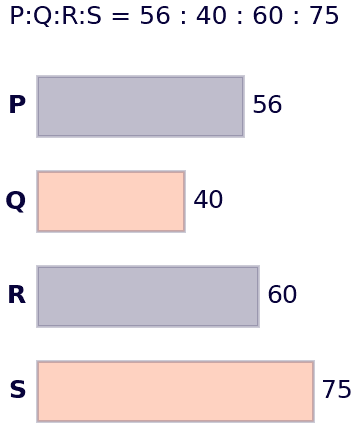
Chain through the common terms: P : Q : R : S.
P:Q = 7:5, Q:R = 2:3 ⇒ P:Q:R = 14:10:15; with R:S = 4:5 (×) ⇒ S = units.
Multiply all by 4: P : Q : R : S = 56 : 40 : 60 : 75.
P : S = 56 : 75 — option (b).
A container holds a mixture of three liquids P, Q, and R in ratio 4 : 6 : 10. If 6 liters of liquid P, 12 liters of liquid Q, and a certain amount of liquid R are added to the container, the new ratio of liquids P, Q, and R becomes 6 : 10 : 16. Find the quantity (in liters) of liquid R added.
A.12 liters
B.18 liters
C.16 liters
D.10 liters
Solution
Mixture — ratio update
Let the initial amounts be 4k, 6k, 10k litres.
New ratio: = ⇒ 40k + 60 = 36k + 72 ⇒ 4k = 12 ⇒ k = 3.
New P = 18 L = 6 units ⇒ 1 unit = 3 L ⇒ new R = 16 × 3 = 48 L.
Old R = 30 L, so R added = 48 − 30 = 18 litres — option (b).
56
Ashish started a business with a sum of ₹60,000. Sachin joined him 8 months later with a sum of ₹35,000. At what respective ratio will the two share the profit after two years?
A.5 : 7
B.14 : 7
C.16 : 7
D.18 : 7
Solution
Partnership — 2 years
Two years = 24 months; Sachin’s money worked 24 − 8 = 16 months.
Ashish: 60,000 × 24 = 14,40,000 capital-months.
Sachin: 35,000 × 16 = 5,60,000 capital-months.
Ratio = 1440 : 560 = 18 : 7 — option (d).
57
The average weight of 13 people is 65 kg. If one person leaves and the new average becomes 65.5 kg, what is the weight of the person who left?
A.59
B.65
C.70
D.64
Solution
Average — person leaves
Total of 13 people = 13 × 65 = 845 kg.
Total of remaining 12 = 12 × 65.5 = 786 kg.
Weight of the person who left = 845 − 786 = 59 kg.
Hence option (a).
58
What are the average weekly sales of Q?
Salesperson
Mon
Tue
Wed
Thurs
P
40
60
50
55
Q
75
64
62
68
A.₹63.5
B.₹67.25
C.₹65.75
D.₹65
Solution
Table — average of Q
Weekly Sales (in ₹000). Pick out Q’s four values: 75, 64, 62, 68.
Sum = 75 + 64 + 62 + 68 = 269.
Average = = 67.25.
Hence ₹67.25 (thousand) — option (b).
59
At what amount will ₹50,000 become after 3 years at 10% compound interest per annum?
The ratio of the profit to the cost price of a product is 3 : 8. What is the ratio of its selling price to its profit?
A.7 : 2
B.11 : 10
C.5 : 15
D.11 : 3
Solution
Profit:CP ratio
Let profit = 3 units and CP = 8 units.
SP = CP + profit = 8 + 3 = 11 units.
SP : profit = 11 : 3.
Hence option (d).
61
A mobile shop owner buys 10 boxes of mobiles for the price of 8 boxes from a wholesaler. If he sells each box at a 2% discount on its marked price, what is his profit percentage?
A.10%
B.24.36%
C.22.5%
D.23.86%
Solution
Boxes — profit%
Take the marked price of each box as ₹M — the wholesale list price.
CP of 10 boxes = price of 8 boxes = 8M; SP of 10 boxes at 2% discount = 10 × 0.98M = 9.8M.
Profit = 9.8M − 8M = 1.8M on 8M.
Profit% = × 100 = 22.5% — option (c).
62
A fruit seller offers mangoes to a retailer at a 30% discount on the marked price. However, they charge an additional 5% on the discounted price for shipping. The retailer sells the mangoes for ₹1620 more, earning a profit of 40%. What was the marked price of the mangoes?
A.₹5,510.20
B.₹9,254.62
C.₹8,181.82
D.₹20,654.67
Solution
Discount + shipping → MP
Retailer’s cost = M × 0.70 × 1.05 = 0.735M.
Selling ₹1620 MORE means the profit itself is ₹1620, at a 40% rate.
So 0.40 × 0.735M = 1620 ⇒ 0.294M = 1620.
M = ≈ ₹5,510.20 — option (a).
63
A cistern contains 200 liters of pure syrup. 20 liters of syrup are drawn out and replaced by water. Then, 20 liters of the mixture are drawn out and replaced by water again. What is the ratio of water to syrup in the final mixture?
A.19 : 1
B.19 : 14
C.19 : 81
D.18 : 19
Solution
Replacement — two draws
Each draw removes = of whatever syrup is present.
Syrup left after two replacements = 200 × (1 − )² = 200 × = 162 L.
Water = 200 − 162 = 38 L.
Water : Syrup = 38 : 162 = 19 : 81 — option (c).
64
A metal sphere having a radius of 20 centimeters is melted down and molded into 64 identical smaller solid spheres. What is the ratio of the surface area of the original sphere to the total surface area of all 64 smaller spheres?
A.1 : 2
B.2 : 1
C.1 : 4
D.1 : 1
Solution
Sphere → 64 spheres (SA)
Volume is conserved: 64 × r³ = 20³ ⇒ r³ = = 125 ⇒ r = 5 cm.
Original SA = 4π × 20² = 1600π.
Total small SA = 64 × 4π × 5² = 6400π.
Ratio = 1600 : 6400 = 1 : 4 — option (c).
65
How many hemispheres with a radius of 6 cm can be produced by melting down a hemisphere with a radius of 24 cm?
A.32
B.64
C.12
D.54
Solution
Hemisphere melting
Volume of a hemisphere ∝ r³, so count = ()³.
= 4.
4³ = 64.
Hence 64 — option (b).
66
A cylinder and hemisphere have the same radius. Their combined height is 35 cm. If the cylinder and hemisphere have equal volumes, find the radius.
A.14 cm
B.13 cm
C.10 cm
D.21 cm
Solution
Cylinder + hemisphere
Equal volumes: πr²h = πr³ ⇒ h = .
The hemisphere’s own height equals its radius r, so combined height = h + r = + r = .
= 35 ⇒ r = 21.
Hence 21 cm — option (d).
67
A pyramid has a base area of 120 cm² and height 18 cm. What is its volume?
A.720 cm³
B.780 cm³
C.540 cm³
D.460 cm³
Solution
Pyramid volume
Volume of a pyramid = × base area × height.
= × 120 × 18.
= 40 × 18 = 720.
Hence 720 cm³ — option (a).
68
A circular disc of diameter 14 cm is inscribed inside an equilateral triangle. What is the approximate area of the remaining portion of the triangle?
A.155.6 cm²
B.168.2 cm²
C.250.3 cm²
D.100.56 cm²
Solution
Incircle in equilateral △
Inradius r = 7 cm. For an equilateral triangle, r = ⇒ side a = 2 × 7 = 14 cm.
Triangle area = × (14)² = × 588 = 147 ≈ 254.6 cm².
Circle area = × 7² = 154 cm².
Remaining ≈ 254.6 − 154 = 100.6 cm² — option (d).
69
In triangle PQR, medians PS, QT, and RU intersect at the centroid G. What is the ratio of the area of triangle GPQ to the area of triangle PQR?
A.2 : 1
B.1 : 3
C.3 : 1
D.3 : 4
Solution
Centroid — area split
The three medians of a triangle meet at the centroid G.
They divide the triangle into three triangles — GPQ, GQR, GRP — of EQUAL area.
So area(GPQ) = × area(PQR).
Ratio = 1 : 3 — option (b).
70
In △PQR, a line segment DE is parallel to PQ, with D on PQ and E on QR. If the ratio of the area of △PDE to the area of the trapezoid DERQ is 4 : 21, what is the ratio of PD to DQ?
A.2 : 3
B.2 : 7
C.2 : 5
D.4 : 7
Solution
Similar △ — area ratio
The small triangle and the whole triangle are similar (DE parallel to the base).
Area(small) : Area(whole) = 4 : (4 + 21) = 4 : 25.
Sides scale as the square root: : = 2 : 5 — so PD : (full side) = 2 : 5.
PD : DQ = 2 : (5 − 2) = 2 : 3 — option (a).
71
A right triangle has sides 6, 8, and 10. A smaller triangle is drawn inside it with its vertices on the sides of the larger triangle, such that it is similar to the larger triangle. If its perimeter is 12, what is its area?
A.3.5
B.2.2
C.3
D.6
Solution
Similar right △
Perimeter of the big triangle = 6 + 8 + 10 = 24; its area = × 6 × 8 = 24.
Similarity ratio = = .
Areas scale as the square: ()² = .
Small area = 24 × = 6 — option (d).
72
Two circles have radii of 12 cm and 5 cm. If the length of a direct common tangent is 24 cm, what is the distance between their centers?
A.16 cm
B.22 cm
C.19 cm
D.25 cm
Solution
Direct common tangent
For a direct common tangent: L² = d² − (r₁ − r₂)².
24² = d² − (12 − 5)² ⇒ 576 = d² − 49.
d² = 625 ⇒ d = 25.
Hence 25 cm — option (d).
73
The distance between the centers of two circles is D. The lengths of their direct and transverse common tangents are P and Q, respectively. If P² + Q² = 400 and the sum of the squares of their radii is 200, what is the value of D?
Two parallel chords of a circle are 30 cm and 16 cm long. Both chords lie on the same side of the circle's center, and the distance between them is 7 cm. Find the diameter of the circle.
A.28 cm
B.30 cm
C.24 cm
D.34 cm
Solution
Parallel chords same side
Let the 30 cm chord be x cm from the centre; the 16 cm chord is then (x + 7) cm away.
Same radius: 15² + x² = 8² + (x + 7)².
225 + x² = 64 + x² + 14x + 49 ⇒ 225 = 113 + 14x ⇒ x = 8.
r² = 225 + 64 = 289 ⇒ r = 17, so diameter = 34 cm — option (d).
75
What is the area of the segment formed by a chord in a circle of radius 14 cm, if the angle subtended at the center is 90°?

 Chain through the common terms: P : Q : R : S.
P:Q = 7:5, Q:R = 2:3 ⇒ P:Q:R = 14:10:15; with R:S = 4:5 (×) ⇒ S = units.
Multiply all by 4: P : Q : R : S = 56 : 40 : 60 : 75.
P : S = 56 : 75 — option (b).
Chain through the common terms: P : Q : R : S.
P:Q = 7:5, Q:R = 2:3 ⇒ P:Q:R = 14:10:15; with R:S = 4:5 (×) ⇒ S = units.
Multiply all by 4: P : Q : R : S = 56 : 40 : 60 : 75.
P : S = 56 : 75 — option (b).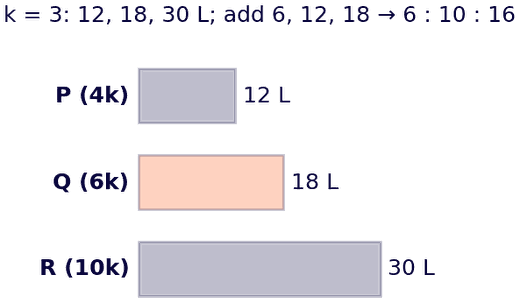 Let the initial amounts be 4k, 6k, 10k litres.
New ratio: = ⇒ 40k + 60 = 36k + 72 ⇒ 4k = 12 ⇒ k = 3.
New P = 18 L = 6 units ⇒ 1 unit = 3 L ⇒ new R = 16 × 3 = 48 L.
Old R = 30 L, so R added = 48 − 30 = 18 litres — option (b).
Let the initial amounts be 4k, 6k, 10k litres.
New ratio: = ⇒ 40k + 60 = 36k + 72 ⇒ 4k = 12 ⇒ k = 3.
New P = 18 L = 6 units ⇒ 1 unit = 3 L ⇒ new R = 16 × 3 = 48 L.
Old R = 30 L, so R added = 48 − 30 = 18 litres — option (b).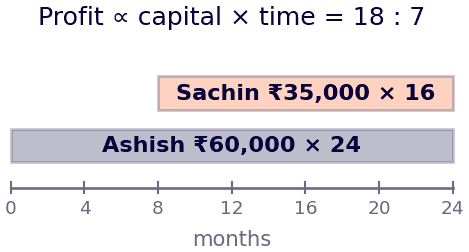 Two years = 24 months; Sachin’s money worked 24 − 8 = 16 months.
Ashish: 60,000 × 24 = 14,40,000 capital-months.
Sachin: 35,000 × 16 = 5,60,000 capital-months.
Ratio = 1440 : 560 = 18 : 7 — option (d).
Two years = 24 months; Sachin’s money worked 24 − 8 = 16 months.
Ashish: 60,000 × 24 = 14,40,000 capital-months.
Sachin: 35,000 × 16 = 5,60,000 capital-months.
Ratio = 1440 : 560 = 18 : 7 — option (d).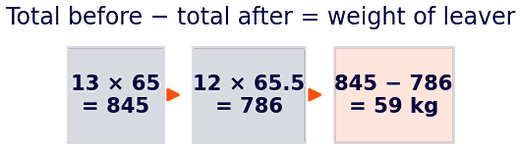 Total of 13 people = 13 × 65 = 845 kg.
Total of remaining 12 = 12 × 65.5 = 786 kg.
Weight of the person who left = 845 − 786 = 59 kg.
Hence option (a).
Total of 13 people = 13 × 65 = 845 kg.
Total of remaining 12 = 12 × 65.5 = 786 kg.
Weight of the person who left = 845 − 786 = 59 kg.
Hence option (a). Amount = P(1 + )ⁿ = 50,000 × (1.1)³.
(1.1)³ = 1.331.
50,000 × 1.331 = 66,550.
Hence ₹66,550 — option (c).
Amount = P(1 + )ⁿ = 50,000 × (1.1)³.
(1.1)³ = 1.331.
50,000 × 1.331 = 66,550.
Hence ₹66,550 — option (c).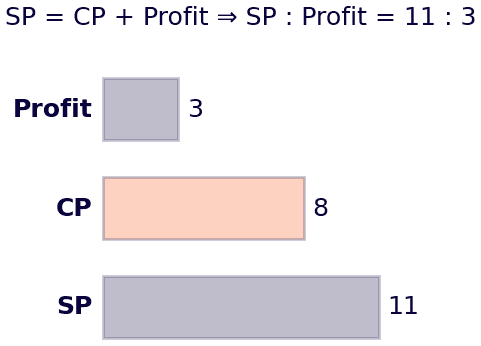 Let profit = 3 units and CP = 8 units.
SP = CP + profit = 8 + 3 = 11 units.
SP : profit = 11 : 3.
Hence option (d).
Let profit = 3 units and CP = 8 units.
SP = CP + profit = 8 + 3 = 11 units.
SP : profit = 11 : 3.
Hence option (d).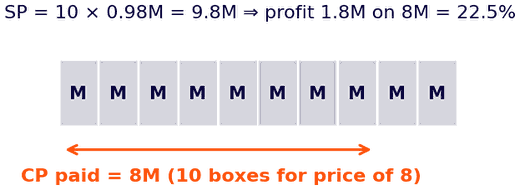 Take the marked price of each box as ₹M — the wholesale list price.
CP of 10 boxes = price of 8 boxes = 8M; SP of 10 boxes at 2% discount = 10 × 0.98M = 9.8M.
Profit = 9.8M − 8M = 1.8M on 8M.
Profit% = × 100 = 22.5% — option (c).
Take the marked price of each box as ₹M — the wholesale list price.
CP of 10 boxes = price of 8 boxes = 8M; SP of 10 boxes at 2% discount = 10 × 0.98M = 9.8M.
Profit = 9.8M − 8M = 1.8M on 8M.
Profit% = × 100 = 22.5% — option (c).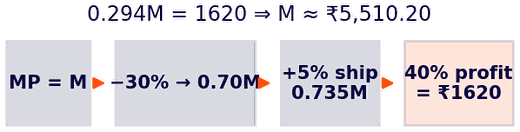 Retailer’s cost = M × 0.70 × 1.05 = 0.735M.
Selling ₹1620 MORE means the profit itself is ₹1620, at a 40% rate.
So 0.40 × 0.735M = 1620 ⇒ 0.294M = 1620.
M = ≈ ₹5,510.20 — option (a).
Retailer’s cost = M × 0.70 × 1.05 = 0.735M.
Selling ₹1620 MORE means the profit itself is ₹1620, at a 40% rate.
So 0.40 × 0.735M = 1620 ⇒ 0.294M = 1620.
M = ≈ ₹5,510.20 — option (a).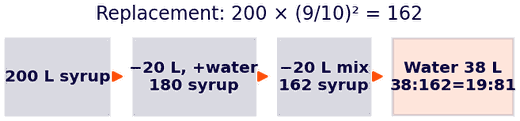 Each draw removes = of whatever syrup is present.
Syrup left after two replacements = 200 × (1 − )² = 200 × = 162 L.
Water = 200 − 162 = 38 L.
Water : Syrup = 38 : 162 = 19 : 81 — option (c).
Each draw removes = of whatever syrup is present.
Syrup left after two replacements = 200 × (1 − )² = 200 × = 162 L.
Water = 200 − 162 = 38 L.
Water : Syrup = 38 : 162 = 19 : 81 — option (c).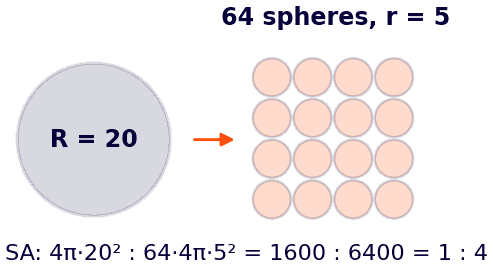 Volume is conserved: 64 × r³ = 20³ ⇒ r³ = = 125 ⇒ r = 5 cm.
Original SA = 4π × 20² = 1600π.
Total small SA = 64 × 4π × 5² = 6400π.
Ratio = 1600 : 6400 = 1 : 4 — option (c).
Volume is conserved: 64 × r³ = 20³ ⇒ r³ = = 125 ⇒ r = 5 cm.
Original SA = 4π × 20² = 1600π.
Total small SA = 64 × 4π × 5² = 6400π.
Ratio = 1600 : 6400 = 1 : 4 — option (c).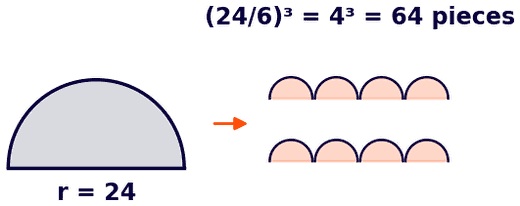 Volume of a hemisphere ∝ r³, so count = ()³.
= 4.
4³ = 64.
Hence 64 — option (b).
Volume of a hemisphere ∝ r³, so count = ()³.
= 4.
4³ = 64.
Hence 64 — option (b).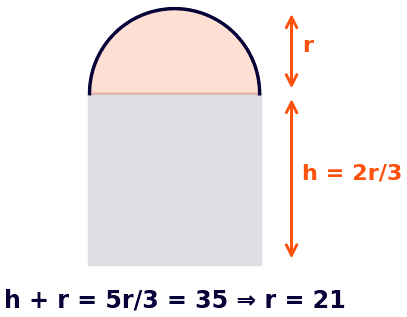 Equal volumes: πr²h = πr³ ⇒ h = .
The hemisphere’s own height equals its radius r, so combined height = h + r = + r = .
= 35 ⇒ r = 21.
Hence 21 cm — option (d).
Equal volumes: πr²h = πr³ ⇒ h = .
The hemisphere’s own height equals its radius r, so combined height = h + r = + r = .
= 35 ⇒ r = 21.
Hence 21 cm — option (d).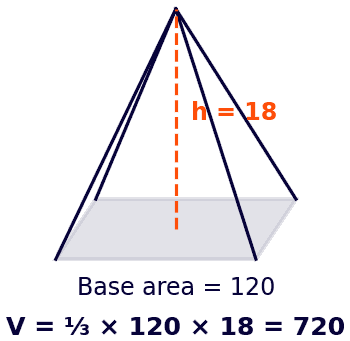 Volume of a pyramid = × base area × height.
= × 120 × 18.
= 40 × 18 = 720.
Hence 720 cm³ — option (a).
Volume of a pyramid = × base area × height.
= × 120 × 18.
= 40 × 18 = 720.
Hence 720 cm³ — option (a).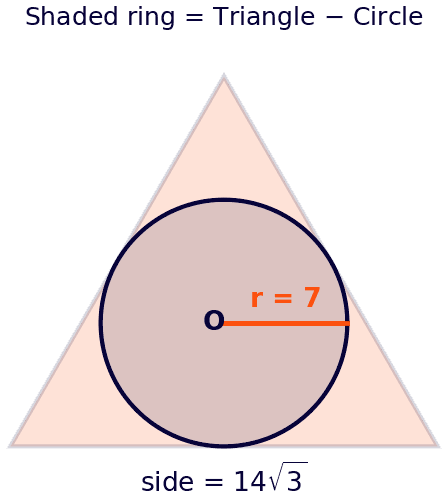 Inradius r = 7 cm. For an equilateral triangle, r = ⇒ side a = 2 × 7 = 14 cm.
Triangle area = × (14)² = × 588 = 147 ≈ 254.6 cm².
Circle area = × 7² = 154 cm².
Remaining ≈ 254.6 − 154 = 100.6 cm² — option (d).
Inradius r = 7 cm. For an equilateral triangle, r = ⇒ side a = 2 × 7 = 14 cm.
Triangle area = × (14)² = × 588 = 147 ≈ 254.6 cm².
Circle area = × 7² = 154 cm².
Remaining ≈ 254.6 − 154 = 100.6 cm² — option (d).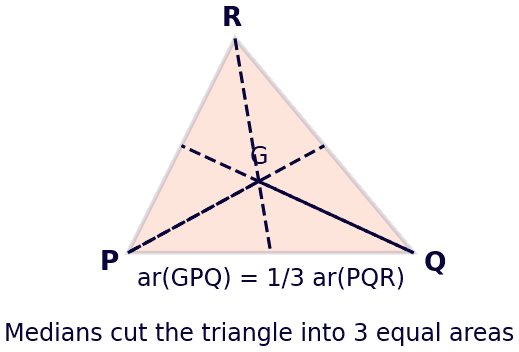 The three medians of a triangle meet at the centroid G.
They divide the triangle into three triangles — GPQ, GQR, GRP — of EQUAL area.
So area(GPQ) = × area(PQR).
Ratio = 1 : 3 — option (b).
The three medians of a triangle meet at the centroid G.
They divide the triangle into three triangles — GPQ, GQR, GRP — of EQUAL area.
So area(GPQ) = × area(PQR).
Ratio = 1 : 3 — option (b).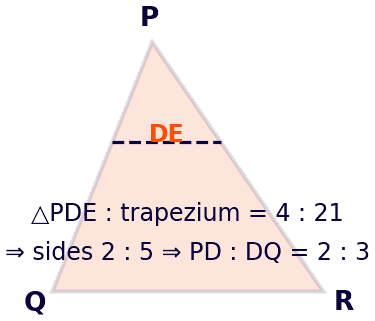 The small triangle and the whole triangle are similar (DE parallel to the base).
Area(small) : Area(whole) = 4 : (4 + 21) = 4 : 25.
Sides scale as the square root: : = 2 : 5 — so PD : (full side) = 2 : 5.
PD : DQ = 2 : (5 − 2) = 2 : 3 — option (a).
The small triangle and the whole triangle are similar (DE parallel to the base).
Area(small) : Area(whole) = 4 : (4 + 21) = 4 : 25.
Sides scale as the square root: : = 2 : 5 — so PD : (full side) = 2 : 5.
PD : DQ = 2 : (5 − 2) = 2 : 3 — option (a).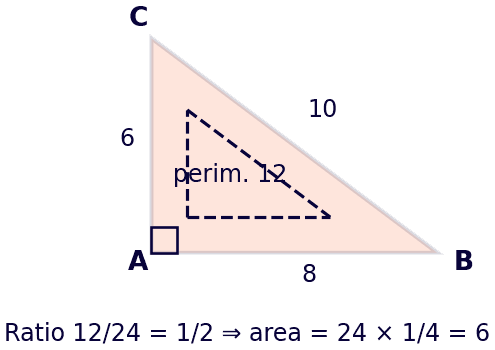 Perimeter of the big triangle = 6 + 8 + 10 = 24; its area = × 6 × 8 = 24.
Similarity ratio = = .
Areas scale as the square: ()² = .
Small area = 24 × = 6 — option (d).
Perimeter of the big triangle = 6 + 8 + 10 = 24; its area = × 6 × 8 = 24.
Similarity ratio = = .
Areas scale as the square: ()² = .
Small area = 24 × = 6 — option (d).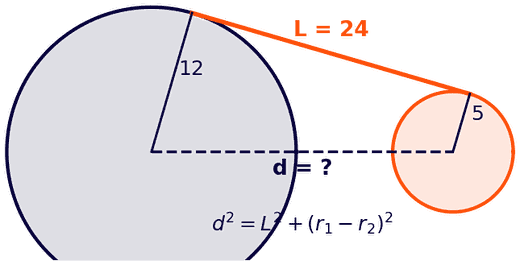 For a direct common tangent: L² = d² − (r₁ − r₂)².
24² = d² − (12 − 5)² ⇒ 576 = d² − 49.
d² = 625 ⇒ d = 25.
Hence 25 cm — option (d).
For a direct common tangent: L² = d² − (r₁ − r₂)².
24² = d² − (12 − 5)² ⇒ 576 = d² − 49.
d² = 625 ⇒ d = 25.
Hence 25 cm — option (d).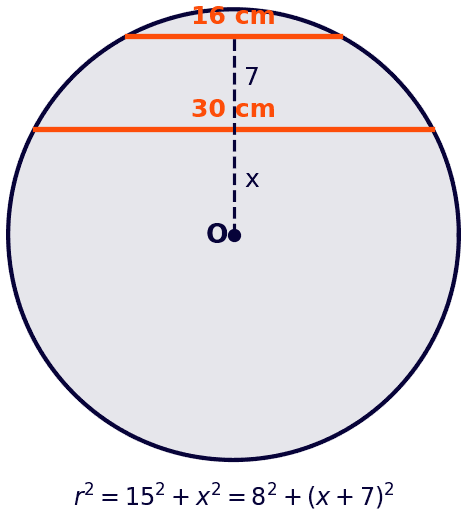 Let the 30 cm chord be x cm from the centre; the 16 cm chord is then (x + 7) cm away.
Same radius: 15² + x² = 8² + (x + 7)².
225 + x² = 64 + x² + 14x + 49 ⇒ 225 = 113 + 14x ⇒ x = 8.
r² = 225 + 64 = 289 ⇒ r = 17, so diameter = 34 cm — option (d).
Let the 30 cm chord be x cm from the centre; the 16 cm chord is then (x + 7) cm away.
Same radius: 15² + x² = 8² + (x + 7)².
225 + x² = 64 + x² + 14x + 49 ⇒ 225 = 113 + 14x ⇒ x = 8.
r² = 225 + 64 = 289 ⇒ r = 17, so diameter = 34 cm — option (d).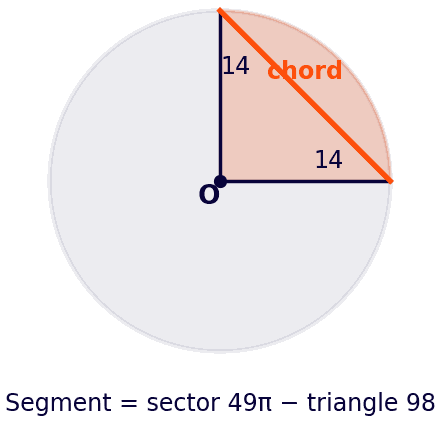 Segment area = sector area − triangle area.
Sector (90°) = × π × 14² = 49π.
Triangle = × 14 × 14 = 98.
Segment = 49π − 98 — option (b).
Segment area = sector area − triangle area.
Sector (90°) = × π × 14² = 49π.
Triangle = × 14 × 14 = 98.
Segment = 49π − 98 — option (b).