SSC CGL 23 September 2025 · Shift 1 · General Intelligence & Reasoning — questions with answers · ShikshaSphere
Chapter 133 of 192
23 September 2025 · Shift 1
General Intelligence & Reasoning
25 questions ~25 min readFree
25 questions
A
1
Using the reverse code (Z = 1 to A = 26), what is the sum of the reverse positions of the first and last letters of "INTELLIGENCE"?
A.35
B.40
C.48
D.38
Solution
Reverse place values
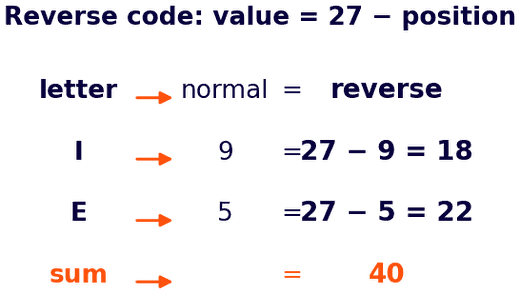
In the reverse code, value = 27 − normal position.
First letter I is 9th, so its reverse value = 27 − 9 = 18.
Last letter E is 5th, so its reverse value = 27 − 5 = 22.
18 + 22 = 40 — option (b).
2
Choose the address that is the same as the one given below.
Flat 505, Tower-B, Shastri Nagar, Jaipur, Rajasthan - 302001
Address matching
Only the state name differs across the four options.
(a) has Gujarat, (c) Madhya Pradesh and (d) Uttar Pradesh.
The sample names Rajasthan, which only (b) carries.
Hence option (b).
3
The seminar in Nagpur was 3 days after Aurangabad, and Nashik hosted its seminar 1 day before Nagpur. If Aurangabad was on 2nd March, when was Nashik's seminar?
A.3rd March
B.4th March
C.5th March
D.6th March
Solution
Date reasoning
Aurangabad was on 2 March.
Nagpur was 3 days later: 2 + 3 = 5 March.
Nashik was 1 day before Nagpur.
5 − 1 = 4 March — option (b).
4
If 3 * 3 = 27 and 4 * 4 = 256, then 5 * 5 = ?
A.3125
B.2090
C.900
D.2048
Solution
Self-power pattern
Rule: a * a = aᵃ, the number raised to its own power.
Check: 3³ = 27 ✓ and 4⁴ = 256 ✓.
So 5 * 5 = 5⁵.
5 × 5 × 5 × 5 × 5 = 3125 — option (a).
5
Read the given statement and conclusions carefully. Decide which of the given conclusions is/are definitely true from the statement.Statement: A = B ≥ D > E = C ≥ F > G
Conclusion I: B ≥ F
Conclusion II: E = F
A.Both Conclusion I and Conclusion II are true
B.Both Conclusion I and Conclusion II are false
C.Only Conclusion I is true
D.Only Conclusion II is true
Solution
Coded inequality
Chain: B ≥ D > E = C ≥ F, so B is strictly greater than F.
"B > F" certainly satisfies "B ≥ F" — Conclusion I is true.
From E = C ≥ F we only get E ≥ F; equality is not forced, so II is not definite.
Only Conclusion I — option (c).
6
X is the father of Y and Z. How are Y and Z related?
A.Father
B.Grandmother
C.Siblings
D.Mother
Solution
Blood relation
Y and Z share the same father, X.
Children of the same parent are siblings.
Their genders are not given, so no closer term can be used.
Hence siblings — option (c).
7
Find the missing number:
16 : 4097 :: 18 : ?
A.5833
B.5802
C.5912
D.5824
Solution
Cube + 1
Rule: the second number is the cube of the first, plus 1.
16³ = 4096, and 4096 + 1 = 4097 ✓.
18³ = 5832.
5832 + 1 = 5833 — option (a).
8
Read the following statements carefully and identify the conclusion that follows.Statements:
All chairs are tables.
Some tables are desks.
Conclusions:
I. Some chairs are desks.
II. All desks are tables.
A.Only I follows
B.Only II follows
C.Both I and II follow
D.Neither I nor II follows
Solution
Syllogism
Chairs lie inside tables, and only SOME tables are desks.
Those desks may lie entirely outside the chair part, so I is not certain.
"Some tables are desks" does not tell us about ALL desks, so II is not certain either.
Neither follows — option (d).
9
If "JAPAN" is written as MDSDQ, how will "CHINA" be written?
A.KLQDF
B.FKLQD
C.FKLQE
D.GDTDE
Solution
Coding (+3)
Every letter moves +3: J+3 = M, A+3 = D, P+3 = S, A+3 = D, N+3 = Q.
Apply to CHINA: C+3 = F, H+3 = K, I+3 = L.
N+3 = Q, A+3 = D.
Hence FKLQD — option (b).
10
Find the pair that does NOT follow the double-step pattern.
R4, S6, T8, U10, W14
A.R4
B.T8
C.S6
D.W14
Solution
Letter–number pairs
The letters should run consecutively: R, S, T, U, then V.
The numbers should rise by 2: 4, 6, 8, 10, then 12.
The last pair gives W instead of V and 14 instead of 12 — both parts break.
Hence W14 — option (d).
11
What comes next?
C25, X2, D24, W3, ?
A.V5
B.D24
C.E23
D.W4
Solution
Two interleaved series
Odd terms: C(3) with 25, D(4) with 24 — the letter moves +1 and the number −1.
So the next odd term is E(5) with 23.
(The even terms X2, W3 form the other chain, moving −1 and +1.)
Hence E23 — option (c).
12
Which number breaks the pattern?
6, 11, 16, 37, 70
A.16
B.11
C.37
D.70
Solution
Doubling chain
The rule is × 2 with a subtraction that grows by one each step: × 2 − 1, × 2 − 2, × 2 − 3, × 2 − 4.
6 × 2 − 1 = 11 ✓, then 11 × 2 − 2 = 20 — but the series shows 16 ✗.
Putting 20 back, the chain runs on perfectly: 20 × 2 − 3 = 37 ✓ and 37 × 2 − 4 = 70 ✓.
So exactly one term breaks the pattern — 16, option (a).
13
Choose the odd one out from the given options.
A.Kathak
B.Bharatanatyam
C.Kuchipudi
D.Karate
Solution
Dance vs martial art
Kathak, Bharatanatyam and Kuchipudi are all Indian classical DANCE forms.
Karate is a martial art of Japanese origin.
So it belongs to a different category.
Hence option (d).
14
What should come at the place of the question mark?
9, 19, 39, 79, 159, ?
Statements:
Some balls are Bat.
All Bat are Stamp.
Conclusions:
I. Some balls are Stamp.
II. All stamps are balls.
A.Only I follows
B.Only II follows
C.Both I and II follow
D.Neither I nor II follows
Solution
Syllogism
Some balls are bats, and every bat is a stamp.
So those balls are certainly stamps — I follows.
Nothing says the stamp group is limited to balls, so II is not certain.
Only I — option (a).
20
A person spends 60% of his income and saves ₹4,000. What is his income?
A.₹10,005
B.₹7,500
C.₹10,000
D.₹9,000
Solution
Income and savings
Expenditure + savings = income, so savings = 100% − 60% = 40%.
40% of the income = ₹4,000.
Income = .
= ₹10,000 — option (c).
21
If 20 cats can catch 20 mice in 20 minutes, how many cats are needed to catch 200 mice in 200 minutes?
A.20
B.10
C.100
D.200
Solution
Cats and mice
From the first case, one cat catches one mouse in 20 minutes.
In 200 minutes, therefore, one cat catches 10 mice.
To catch 200 mice we need cats.
= 20 cats — option (a).
22
If 'MAKER' is coded as '13-1-11-5-18', how will 'JOKAR' be coded?
A.15-4-4-17-12
B.10-23-26-13-22
C.10-15-11-1-18
D.10-15-11-16-8
Solution
Place values
Each letter is replaced by its position: M = 13, A = 1, K = 11, E = 5, R = 18.
Apply to JOKAR: J = 10, O = 15, K = 11.
A = 1, R = 18.
= 10-15-11-1-18 — option (c).
23
If NBSLFS is coded as OCTMGT, how is OCTMGT coded?
A.PDUNHU
B.PDUNUJ
C.PDUNHI
D.PDUNUH
Solution
Coding (+1)
Every letter moves +1: N+1 = O, B+1 = C, S+1 = T, L+1 = M, F+1 = G, S+1 = T.
Apply the same rule again to OCTMGT: O+1 = P, C+1 = D, T+1 = U.
M+1 = N, G+1 = H, T+1 = U.
Hence PDUNHU — option (a).
24
If IFMNFU is coded as JGNOGV, how is JGNOGV coded?
A.KHOPHW
B.KHOPHG
C.KHOPCW
D.KHOPWH
Solution
Coding (+1)
Every letter moves +1: I+1 = J, F+1 = G, M+1 = N, N+1 = O, F+1 = G, U+1 = V.
Apply the same rule again: J+1 = K, G+1 = H, N+1 = O.
O+1 = P, G+1 = H, V+1 = W.
Hence KHOPHW — option (a).
25
If in a code language 'FDW' is written as 'IGB', then 'EDY' is written as?
A.HGD
B.HGX
C.XGH
D.FBY
Solution
Position-wise shifts
Compare FDW with IGB: F+3 = I and D+3 = G, but W+5 = B (counting cyclically past Z).
So the shifts by position are +3, +3, +5.
Apply the same to EDY: E+3 = H, D+3 = G.
Y+5 = D (cyclically) ⇒ HGD — option (a).
Finished reading? Now test yourself.
The same 25 questions, but with a timer and the answers hidden — 15 minutes.

 In the reverse code, value = 27 − normal position.
First letter I is 9th, so its reverse value = 27 − 9 = 18.
Last letter E is 5th, so its reverse value = 27 − 5 = 22.
18 + 22 = 40 — option (b).
In the reverse code, value = 27 − normal position.
First letter I is 9th, so its reverse value = 27 − 9 = 18.
Last letter E is 5th, so its reverse value = 27 − 5 = 22.
18 + 22 = 40 — option (b). Aurangabad was on 2 March.
Nagpur was 3 days later: 2 + 3 = 5 March.
Nashik was 1 day before Nagpur.
5 − 1 = 4 March — option (b).
Aurangabad was on 2 March.
Nagpur was 3 days later: 2 + 3 = 5 March.
Nashik was 1 day before Nagpur.
5 − 1 = 4 March — option (b).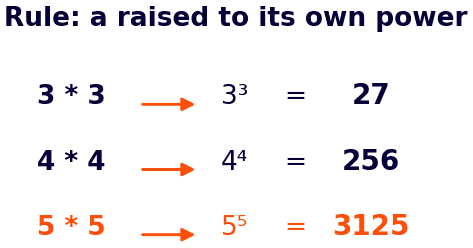 Rule: a * a = aᵃ, the number raised to its own power.
Check: 3³ = 27 ✓ and 4⁴ = 256 ✓.
So 5 * 5 = 5⁵.
5 × 5 × 5 × 5 × 5 = 3125 — option (a).
Rule: a * a = aᵃ, the number raised to its own power.
Check: 3³ = 27 ✓ and 4⁴ = 256 ✓.
So 5 * 5 = 5⁵.
5 × 5 × 5 × 5 × 5 = 3125 — option (a).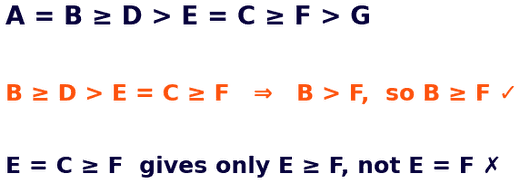 Chain: B ≥ D > E = C ≥ F, so B is strictly greater than F.
"B > F" certainly satisfies "B ≥ F" — Conclusion I is true.
From E = C ≥ F we only get E ≥ F; equality is not forced, so II is not definite.
Only Conclusion I — option (c).
Chain: B ≥ D > E = C ≥ F, so B is strictly greater than F.
"B > F" certainly satisfies "B ≥ F" — Conclusion I is true.
From E = C ≥ F we only get E ≥ F; equality is not forced, so II is not definite.
Only Conclusion I — option (c).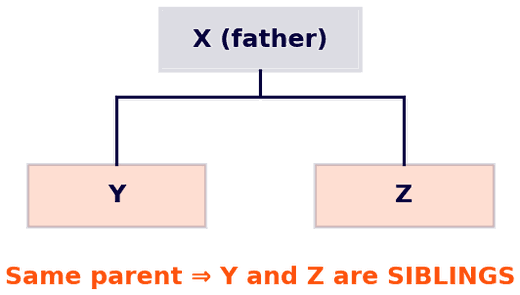 Y and Z share the same father, X.
Children of the same parent are siblings.
Their genders are not given, so no closer term can be used.
Hence siblings — option (c).
Y and Z share the same father, X.
Children of the same parent are siblings.
Their genders are not given, so no closer term can be used.
Hence siblings — option (c).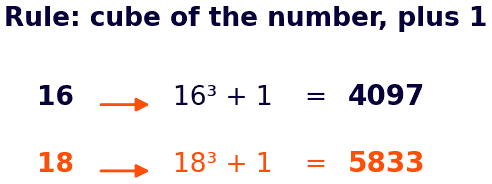 Rule: the second number is the cube of the first, plus 1.
16³ = 4096, and 4096 + 1 = 4097 ✓.
18³ = 5832.
5832 + 1 = 5833 — option (a).
Rule: the second number is the cube of the first, plus 1.
16³ = 4096, and 4096 + 1 = 4097 ✓.
18³ = 5832.
5832 + 1 = 5833 — option (a).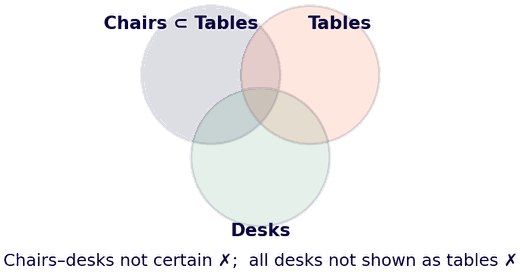 Chairs lie inside tables, and only SOME tables are desks.
Those desks may lie entirely outside the chair part, so I is not certain.
"Some tables are desks" does not tell us about ALL desks, so II is not certain either.
Neither follows — option (d).
Chairs lie inside tables, and only SOME tables are desks.
Those desks may lie entirely outside the chair part, so I is not certain.
"Some tables are desks" does not tell us about ALL desks, so II is not certain either.
Neither follows — option (d).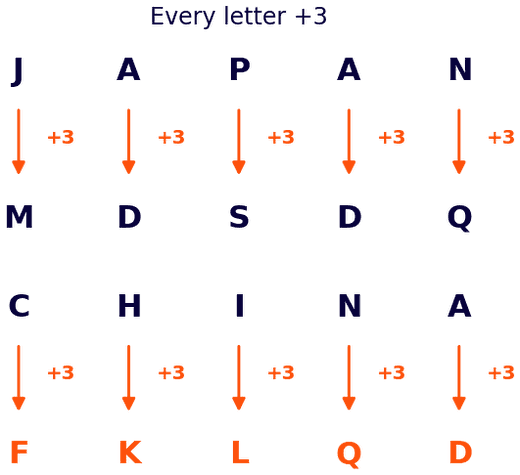 Every letter moves +3: J+3 = M, A+3 = D, P+3 = S, A+3 = D, N+3 = Q.
Apply to CHINA: C+3 = F, H+3 = K, I+3 = L.
N+3 = Q, A+3 = D.
Hence FKLQD — option (b).
Every letter moves +3: J+3 = M, A+3 = D, P+3 = S, A+3 = D, N+3 = Q.
Apply to CHINA: C+3 = F, H+3 = K, I+3 = L.
N+3 = Q, A+3 = D.
Hence FKLQD — option (b).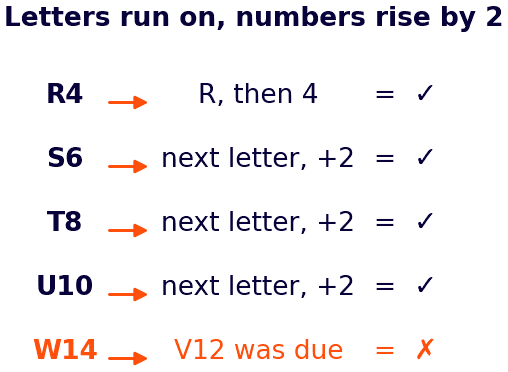 The letters should run consecutively: R, S, T, U, then V.
The numbers should rise by 2: 4, 6, 8, 10, then 12.
The last pair gives W instead of V and 14 instead of 12 — both parts break.
Hence W14 — option (d).
The letters should run consecutively: R, S, T, U, then V.
The numbers should rise by 2: 4, 6, 8, 10, then 12.
The last pair gives W instead of V and 14 instead of 12 — both parts break.
Hence W14 — option (d).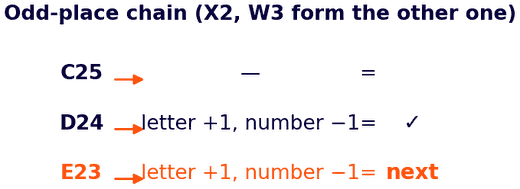 Odd terms: C(3) with 25, D(4) with 24 — the letter moves +1 and the number −1.
So the next odd term is E(5) with 23.
(The even terms X2, W3 form the other chain, moving −1 and +1.)
Hence E23 — option (c).
Odd terms: C(3) with 25, D(4) with 24 — the letter moves +1 and the number −1.
So the next odd term is E(5) with 23.
(The even terms X2, W3 form the other chain, moving −1 and +1.)
Hence E23 — option (c).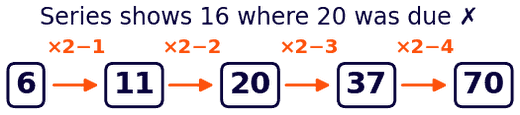 The rule is × 2 with a subtraction that grows by one each step: × 2 − 1, × 2 − 2, × 2 − 3, × 2 − 4.
6 × 2 − 1 = 11 ✓, then 11 × 2 − 2 = 20 — but the series shows 16 ✗.
Putting 20 back, the chain runs on perfectly: 20 × 2 − 3 = 37 ✓ and 37 × 2 − 4 = 70 ✓.
So exactly one term breaks the pattern — 16, option (a).
The rule is × 2 with a subtraction that grows by one each step: × 2 − 1, × 2 − 2, × 2 − 3, × 2 − 4.
6 × 2 − 1 = 11 ✓, then 11 × 2 − 2 = 20 — but the series shows 16 ✗.
Putting 20 back, the chain runs on perfectly: 20 × 2 − 3 = 37 ✓ and 37 × 2 − 4 = 70 ✓.
So exactly one term breaks the pattern — 16, option (a).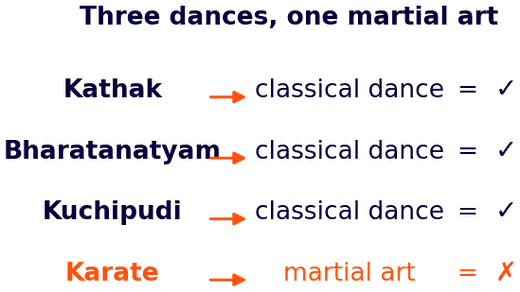 Kathak, Bharatanatyam and Kuchipudi are all Indian classical DANCE forms.
Karate is a martial art of Japanese origin.
So it belongs to a different category.
Hence option (d).
Kathak, Bharatanatyam and Kuchipudi are all Indian classical DANCE forms.
Karate is a martial art of Japanese origin.
So it belongs to a different category.
Hence option (d). Each term = previous × 2 + 1.
9×2+1 = 19, 19×2+1 = 39, 39×2+1 = 79, 79×2+1 = 159 ✓.
Next: 159 × 2 + 1 = 318 + 1.
= 319 — option (b).
Each term = previous × 2 + 1.
9×2+1 = 19, 19×2+1 = 39, 39×2+1 = 79, 79×2+1 = 159 ✓.
Next: 159 × 2 + 1 = 318 + 1.
= 319 — option (b). Take the principal as 100; doubling means the interest earned is also 100.
SI = ⇒ 100 = .
100 = 10R.
R = 10% — option (d).
Take the principal as 100; doubling means the interest earned is also 100.
SI = ⇒ 100 = .
100 = 10R.
R = 10% — option (d).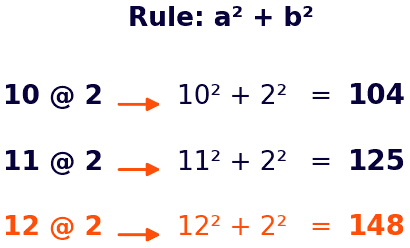 Rule: a @ b = a² + b².
Check: 10² + 2² = 100 + 4 = 104 ✓; 11² + 2² = 121 + 4 = 125 ✓.
12 @ 2 = 12² + 2² = 144 + 4.
= 148 — option (a).
Rule: a @ b = a² + b².
Check: 10² + 2² = 100 + 4 = 104 ✓; 11² + 2² = 121 + 4 = 125 ✓.
12 @ 2 = 12² + 2² = 144 + 4.
= 148 — option (a).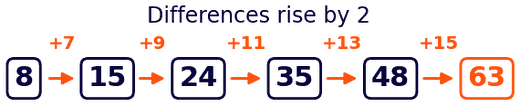 Differences: 7, 9, 11, 13 — each rises by 2.
So the next difference is 15.
48 + 15 = 63.
Hence option (a).
Differences: 7, 9, 11, 13 — each rises by 2.
So the next difference is 15.
48 + 15 = 63.
Hence option (a).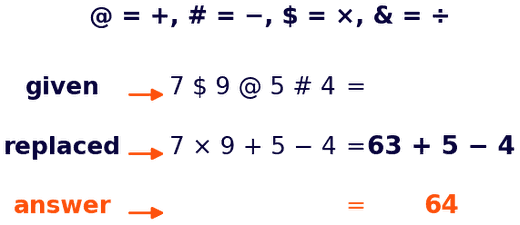 Replace the symbols: 7 × 9 + 5 − 4.
BODMAS: 7 × 9 = 63.
63 + 5 − 4 = 68 − 4.
= 64 — option (a).
Replace the symbols: 7 × 9 + 5 − 4.
BODMAS: 7 × 9 = 63.
63 + 5 − 4 = 68 − 4.
= 64 — option (a).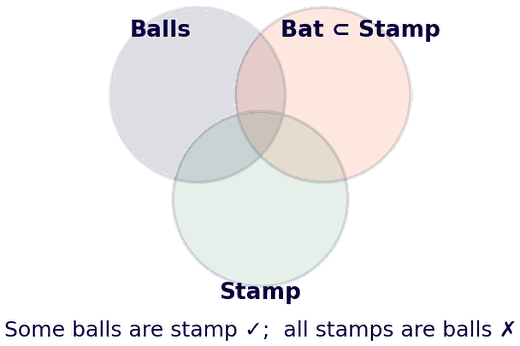 Some balls are bats, and every bat is a stamp.
So those balls are certainly stamps — I follows.
Nothing says the stamp group is limited to balls, so II is not certain.
Only I — option (a).
Some balls are bats, and every bat is a stamp.
So those balls are certainly stamps — I follows.
Nothing says the stamp group is limited to balls, so II is not certain.
Only I — option (a). Expenditure + savings = income, so savings = 100% − 60% = 40%.
40% of the income = ₹4,000.
Income = .
= ₹10,000 — option (c).
Expenditure + savings = income, so savings = 100% − 60% = 40%.
40% of the income = ₹4,000.
Income = .
= ₹10,000 — option (c). From the first case, one cat catches one mouse in 20 minutes.
In 200 minutes, therefore, one cat catches 10 mice.
To catch 200 mice we need cats.
= 20 cats — option (a).
From the first case, one cat catches one mouse in 20 minutes.
In 200 minutes, therefore, one cat catches 10 mice.
To catch 200 mice we need cats.
= 20 cats — option (a).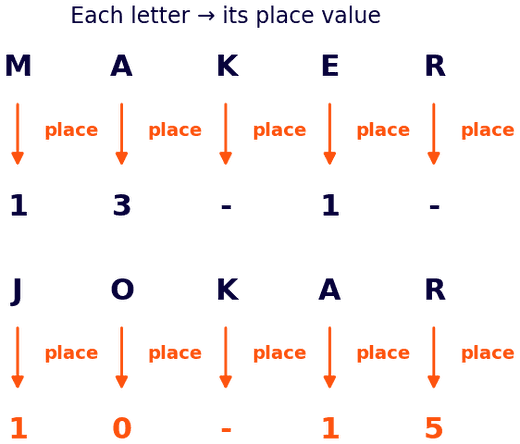 Each letter is replaced by its position: M = 13, A = 1, K = 11, E = 5, R = 18.
Apply to JOKAR: J = 10, O = 15, K = 11.
A = 1, R = 18.
= 10-15-11-1-18 — option (c).
Each letter is replaced by its position: M = 13, A = 1, K = 11, E = 5, R = 18.
Apply to JOKAR: J = 10, O = 15, K = 11.
A = 1, R = 18.
= 10-15-11-1-18 — option (c).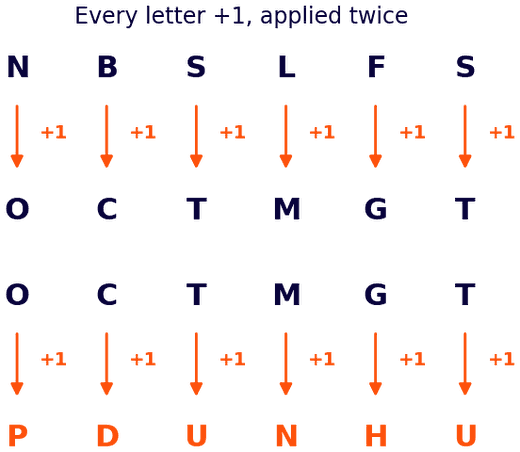 Every letter moves +1: N+1 = O, B+1 = C, S+1 = T, L+1 = M, F+1 = G, S+1 = T.
Apply the same rule again to OCTMGT: O+1 = P, C+1 = D, T+1 = U.
M+1 = N, G+1 = H, T+1 = U.
Hence PDUNHU — option (a).
Every letter moves +1: N+1 = O, B+1 = C, S+1 = T, L+1 = M, F+1 = G, S+1 = T.
Apply the same rule again to OCTMGT: O+1 = P, C+1 = D, T+1 = U.
M+1 = N, G+1 = H, T+1 = U.
Hence PDUNHU — option (a).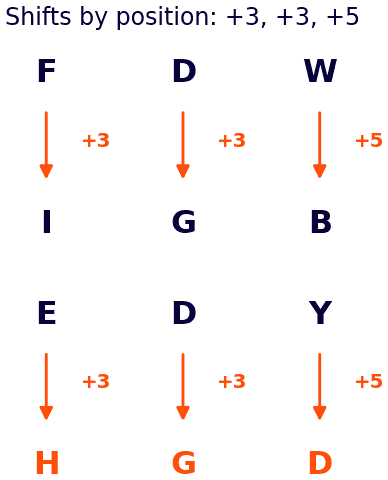 Compare FDW with IGB: F+3 = I and D+3 = G, but W+5 = B (counting cyclically past Z).
So the shifts by position are +3, +3, +5.
Apply the same to EDY: E+3 = H, D+3 = G.
Y+5 = D (cyclically) ⇒ HGD — option (a).
Compare FDW with IGB: F+3 = I and D+3 = G, but W+5 = B (counting cyclically past Z).
So the shifts by position are +3, +3, +5.
Apply the same to EDY: E+3 = H, D+3 = G.
Y+5 = D (cyclically) ⇒ HGD — option (a).