SSC CHSL 12 November 2025 · Shift 2 · English Language — questions with answers · ShikshaSphere
Chapter 4 of 200
12 November 2025 · Shift 2
English Language
25 questions ~25 min readFree
25 questions
A
1
Identify the part of the sentence that contains a grammatical error.
A. The team, B. was confident about their strategy, C. and hoped it, D. would succeed
A.The team
B.was confident about their strategy
C.and hoped it
D.would succeed
Solution
Collective noun agreement
'Team' is a collective noun and here it is treated as one single unit, shown by the singular verb 'was'.
Whatever pronoun refers back to it must therefore also be singular.
Part C already calls the team 'it', so the plural 'their' in part B breaks the agreement; it must be 'its strategy'.
The corrected sentence reads: 'The team was confident about its strategy and hoped it would succeed.'
Hence the error lies in part B, option (b).
2
Fill in the blank with the most appropriate phrase:
All hiring decisions for the new department will be made strictly .
A.under the table
B.on merit
C.in the red
D.on the rocks
Solution
Appropriate phrase
The blank must name the basis on which the hiring decisions are taken, and the word 'strictly' shows that the basis is a fair and fixed one.
'On merit' means judged purely on ability, qualification and performance, with no favouritism - it fits perfectly.
'Under the table' means secretly or dishonestly, 'in the red' means in debt, and 'on the rocks' means likely to fail; none of these can describe a hiring policy.
Hence option (b) is correct.
3
Select the most appropriate synonym of the word: PEAK
A.Abyss
B.Nadir
C.Top
D.Low point
Solution
Synonym
'Peak' means the highest point, summit or maximum level of something.
'Top' carries exactly that sense - the highest point or position - so it is the synonym.
'Nadir' is the lowest point, 'Abyss' is a bottomless depth and 'Low point' is the worst level; all three are opposites of 'peak'.
Hence option (c) is correct.
4
Fill in the blank with the most appropriate idiom:
Rahul's abrupt decision to step down caught everyone .
A.off guard
B.red handed
C.storm in a teacup
D.heywire
Solution
Idiom completion
The sentence speaks of an 'abrupt decision' that 'caught everyone' - so the idiom must express sudden surprise.
'Catch someone off guard' means to surprise a person who was completely unprepared for it.
'Red handed' is used only for catching a person in the act of wrongdoing, 'a storm in a teacup' is a needless fuss over a small matter, and 'haywire' means out of order - none of them completes 'caught everyone ...'.
Hence option (a) is correct.
5
Directions (Qs. 5-9): Read the following passage carefully and answer the questions that follow.
In recent years, environmental awareness has become an essential part of modern education. Schools now emphasise sustainable practices to help students understand their responsibility towards the planet. Lessons on recycling, conservation of resources, and renewable energy encourage learners to adopt eco-friendly habits in their daily lives. Project-based learning, such as tree plantation drives and waste management activities, allows students to apply theoretical knowledge in real-life situations. Teachers play a vital role by integrating environmental topics across subjects, helping students see the connection between human actions and ecological balance. Although challenges like limited resources and lack of awareness still exist, environmental education empowers young minds to contribute positively to a sustainable future.
What is the main focus of modern education as mentioned in the passage?
A.Competitive examinations
B.Environmental awareness
C.Technological advancement
D.Career-oriented training
Solution
Comprehension - main idea
The very first line of the passage answers the question.
It states that 'environmental awareness has become an essential part of modern education'.
Competitive examinations, technological advancement and career training are nowhere named as the focus of modern education.
Hence option (b) is correct.
6
Directions (Qs. 5-9): Read the following passage carefully and answer the questions that follow.
In recent years, environmental awareness has become an essential part of modern education. Schools now emphasise sustainable practices to help students understand their responsibility towards the planet. Lessons on recycling, conservation of resources, and renewable energy encourage learners to adopt eco-friendly habits in their daily lives. Project-based learning, such as tree plantation drives and waste management activities, allows students to apply theoretical knowledge in real-life situations. Teachers play a vital role by integrating environmental topics across subjects, helping students see the connection between human actions and ecological balance. Although challenges like limited resources and lack of awareness still exist, environmental education empowers young minds to contribute positively to a sustainable future.
How do schools encourage eco - friendly habits among students?
A.By conducting regular tests
B.By teaching only theoretical concepts
C.By emphasising recycling and conservation
D.By reducing classroom activities
Solution
Comprehension - detail
The question asks what schools actually teach to build eco-friendly habits.
The passage says that lessons on recycling, conservation of resources and renewable energy 'encourage learners to adopt eco-friendly habits in their daily lives'.
Regular tests, purely theoretical teaching and fewer classroom activities are the opposite of what the passage describes.
Hence option (c) is correct.
7
Directions (Qs. 5-9): Read the following passage carefully and answer the questions that follow.
In recent years, environmental awareness has become an essential part of modern education. Schools now emphasise sustainable practices to help students understand their responsibility towards the planet. Lessons on recycling, conservation of resources, and renewable energy encourage learners to adopt eco-friendly habits in their daily lives. Project-based learning, such as tree plantation drives and waste management activities, allows students to apply theoretical knowledge in real-life situations. Teachers play a vital role by integrating environmental topics across subjects, helping students see the connection between human actions and ecological balance. Although challenges like limited resources and lack of awareness still exist, environmental education empowers young minds to contribute positively to a sustainable future.
What method helps students apply their knowledge in real-life situations?
A.Online assessments
B.Project-based learning
C.Lecture-based teaching
D.Memorisation techniques
Solution
Comprehension - detail
Trace the phrase 'real-life situations' in the passage.
It appears with project-based learning - tree plantation drives and waste management activities - which 'allows students to apply theoretical knowledge in real-life situations'.
Online assessments, lecture-based teaching and memorisation are not mentioned at all.
Hence option (b) is correct.
8
Directions (Qs. 5-9): Read the following passage carefully and answer the questions that follow.
In recent years, environmental awareness has become an essential part of modern education. Schools now emphasise sustainable practices to help students understand their responsibility towards the planet. Lessons on recycling, conservation of resources, and renewable energy encourage learners to adopt eco-friendly habits in their daily lives. Project-based learning, such as tree plantation drives and waste management activities, allows students to apply theoretical knowledge in real-life situations. Teachers play a vital role by integrating environmental topics across subjects, helping students see the connection between human actions and ecological balance. Although challenges like limited resources and lack of awareness still exist, environmental education empowers young minds to contribute positively to a sustainable future.
What role do teachers play in environmental education?
A.They focus on a single subject
B.They avoid practical activities
C.They integrate environmental topics across subjects
D.They limit student participation
Solution
Comprehension - detail
One sentence of the passage is devoted entirely to teachers.
It says teachers 'play a vital role by integrating environmental topics across subjects', so that students see the link between human actions and ecological balance.
Nothing suggests that they stick to one subject, avoid practical work or limit participation.
Hence option (c) is correct.
9
Directions (Qs. 5-9): Read the following passage carefully and answer the questions that follow.
In recent years, environmental awareness has become an essential part of modern education. Schools now emphasise sustainable practices to help students understand their responsibility towards the planet. Lessons on recycling, conservation of resources, and renewable energy encourage learners to adopt eco-friendly habits in their daily lives. Project-based learning, such as tree plantation drives and waste management activities, allows students to apply theoretical knowledge in real-life situations. Teachers play a vital role by integrating environmental topics across subjects, helping students see the connection between human actions and ecological balance. Although challenges like limited resources and lack of awareness still exist, environmental education empowers young minds to contribute positively to a sustainable future.
What challenge related to environmental education is mentioned in the passage ?
A.Lack of student interest
B.Overloaded curriculum
C.Limited resources and awareness
D.Absence of government support
Solution
Comprehension - detail
The concluding sentence is the only place where difficulties are named.
It begins 'Although challenges like limited resources and lack of awareness still exist ...'.
Student interest, an overloaded curriculum and government support are never mentioned as problems.
Hence option (c) is correct.
10
Select the sentence that contains the homonym of the word 'bank' as highlighted in the sentence.
She opened a new account at the bank.
A.I deposited my paycheck at the bank.
B.The bank is located on the corner.
C.The fisherman stood quietly on the grassy bank.
D.My bank offers a great interest rate.
Solution
Homonyms
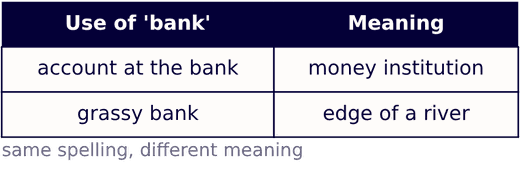
Homonyms are words spelt and pronounced alike but carrying entirely different meanings.
In the given sentence 'bank' means a financial institution where an account is opened.
So the answer must be the sentence that uses 'bank' in some other sense.
Options (a), (b) and (d) all keep the money sense; only (c), 'the grassy bank', means the sloping land along a river.
Hence option (c) is correct.
11
Choose the incorrectly spelt word:
A.Documentary
B.Sanitary
C.Optional
D.Voluntry
Solution
Spelling
'Voluntry' is the misspelt word; the correct form is 'Voluntary', meaning done of one's own free will.
The word ends in -ary (volunt + ary), so the letter 'a' before the final -ry must not be dropped.
'Documentary', 'Sanitary' and 'Optional' are all spelt correctly.
Hence option (d) is correct.
12
Choose the incorrectly spelt word:
A.Legume
B.Broken
C.Vaccume
D.Sustained
Solution
Spelling
'Vaccume' is the misspelt word; the correct spelling is 'Vacuum' - a single 'c' followed by a double 'u', with no final 'e'.
It means a space entirely empty of matter or air.
'Legume', 'Broken' and 'Sustained' are all spelt correctly.
Hence option (c) is correct.
13
Choose the correct meaning of the highlighted idiom:
The job is perfect, and the short commute is icing on the cake.
A.Something that makes a good situation even better
B.A difficult problem that ruins a good plan
C.An unnecessary and useless addition
D.A sweet dish served at celebrations
Solution
Idiom meaning
'Icing on the cake' means an extra advantage that makes an already good thing even better.
The cake itself is good - here, the perfect job; the icing is the additional bonus - the short commute.
Option (b) turns it into a problem, (c) calls it useless and (d) reads the idiom literally as a dessert.
Hence option (a) is correct.
14
Choose the correct one - word substitute for:
A person who is very interested in films
A.Flask
B.Cinephile
C.Seer
D.Contrast
Solution
One-word substitution
Break the word up: 'cine-' comes from cinema and the suffix '-phile' means a lover of something.
'Cinephile' therefore means a person who is very interested in, or devoted to, films.
'Flask' is a container for liquids, 'Seer' is one who foretells the future, and 'Contrast' is a striking difference between two things - none of them refers to a person fond of films.
Hence option (b) is correct.
15
Select the most appropriate antonym of the word: Hazardous
A.Beneficial
B.Lethal
C.Deadly
D.Noxious
Solution
Antonym
'Hazardous' means risky or dangerous, likely to cause harm or loss.
Its opposite must carry the idea of being helpful or safe.
'Beneficial' means producing good and favourable results, so it is the antonym.
'Lethal' and 'Deadly' both mean capable of killing, and 'Noxious' means harmful or poisonous - all three are synonyms of 'hazardous'.
Hence option (a) is correct.
16
Select the most appropriate antonym of the word: Perilous
A.Dangerous
B.Beneficial
C.Pernicious
D.Hazardous
Solution
Antonym
'Perilous' means full of danger or risk, as in a perilous journey.
The antonym must mean advantageous or safe: 'Beneficial' means bringing good results.
'Dangerous', 'Pernicious' (having a gradual but very harmful effect) and 'Hazardous' all repeat the idea of danger, so they are synonyms, not opposites.
Hence option (b) is correct.
17
Choose the correct one-word substitute for:
A person who studies birds.
A.Botanist
B.Lepidopterist
C.Ornithologist
D.Zoologist
Solution
One-word substitution
The Greek root 'ornith-' means bird and the suffix '-logist' means one who studies a subject.
'Ornithologist' therefore means a person who studies birds.
'Botanist' studies plants and 'Lepidopterist' studies butterflies and moths, so both are off the mark.
'Zoologist' studies animals in general and is not specific to birds, so it is the less exact choice.
Hence option (c) is correct.
18
Change the following sentence into the Active form.
Let the political lies be exposed to the public before the election.
A.You should expose the political lies to the public before the elections.
B.Expose the political lies to the public before the elections.
C.The political lies must be exposed to the public before the elections.
D.Let the public expose the political lies before the elections.
Solution
Passive to active - imperative
The pattern 'Let + object + be + V3' is the passive form of an imperative (command) sentence.
To restore the active voice, drop 'Let ... be' and begin directly with the base verb, keeping the same object: 'Expose the political lies to the public ...'.
Option (a) adds 'You should', which turns the command into an assertive sentence; option (c) is still passive ('must be exposed'); option (d) invents a new doer, 'the public', which the original never names.
Hence option (b) is correct.
19
Select the option that expresses the given sentence in indirect voice.
The athlete said, have been training rigorously for the tournament for weeks, but I am still anxious because my opponents are highly experienced."
A.The athlete said that he has been training rigorously for the tournament for weeks, but he is still anxious because his opponents are highly experienced.
B.The athlete said that he had been training rigorously for the tournament for weeks, but he was still anxious because his opponents were highly experienced.
C.The athlete said that he had been training rigorously for the tournament for weeks, but he is still anxious because his opponents are highly experienced.
D.The athlete said that he was training rigorously for the tournament for weeks, but he was still anxious because his opponents were highly experienced.
Solution
Direct to indirect speech
The reporting verb 'said' is in the past tense, so every verb inside the reported speech moves one step back in time.
'have been training' becomes 'had been training', 'am' becomes 'was', and 'are' becomes 'were'.
The pronouns also change with the speaker: 'I' becomes 'he' and 'my' becomes 'his'.
Options (a) and (c) leave present-tense verbs untouched, and (d) drops the perfect continuous form, changing the meaning of weeks of training.
Hence option (b) is correct.
20
Choose the most suitable option to replace the highlighted part of the sentence:
One must follow a balanced diet and regular exercise routine to maintaining good health.
A.maintain health good
B.maintaining good health
C.maintain good health
D.maintained healthy
Solution
Infinitive after 'to'
Here 'to' expresses purpose, so it is the sign of the infinitive and must be followed by the base form of the verb (V1), never by the -ing form.
'to maintaining' is therefore wrong; it has to become 'to maintain'.
In English an adjective is placed before the noun it describes, so 'good health' is right and 'health good' in option (a) is wrong.
Option (d) uses the past form 'maintained', which cannot follow the infinitive 'to' either.
Hence 'to maintain good health' - option (c) - is correct.
21
Choose the most suitable option to replace the highlighted part of the sentence:
He is a FBI agent.
A.FBI
B.an FBI
C.never FBI
D.neither FBI
Solution
Article a / an
The choice between 'a' and 'an' depends on the sound that follows the article, not on the letter that is written.
FBI is an abbreviation read letter by letter, so it is pronounced 'ef-bee-eye' and begins with the vowel sound of 'ef'.
A word beginning with a vowel sound takes 'an', so 'a FBI agent' must be corrected to 'an FBI agent'.
Option (a) drops the article altogether, while 'never' and 'neither' are not articles at all, so option (b) is correct.
22
Choose the correct passive voice transformation of the sentence:
Citizens speak English in several parts of the world.
A.English was spoken by citizens in several parts of the world.
B.English is spoken by citizens in several parts of the world.
C.English has spoken by citizens in several parts of the world.
D.English has been spoke in several parts of the world.
Solution
Active to passive voice
The active sentence is in the simple present tense: subject 'Citizens', verb 'speak', object 'English'.
Passive of the simple present = object + is/am/are + third form of the verb + by + subject.
'English' is singular, so the helping verb is 'is', and the third form of 'speak' is 'spoken'.
This gives 'English is spoken by citizens in several parts of the world'.
Option (a) shifts the tense to the past, (c) has no 'been' after 'has', and (d) uses 'spoke' in place of 'spoken', so option (b) is correct.
23
Select the option that expresses the given sentence in direct voice.
The principal stated that the school had implemented new rules that year and that they were taking strict measures to ensure discipline.
A.The principal stated, "The school has implemented new rules this year, and we are taking strict measures to ensure discipline."
B.The principal stated, *The school had implemented new rules this year, and we were taking strict measures to ensure discipline."
C.The principal stated, "The school implements new rules that year, and we are taking strict measures to ensure discipline."
D.The principal stated, "The school implemented new rules the previous year, and we were taking strict measures to ensure discipline."
Solution
Indirect to direct speech
Turning indirect speech into direct speech means undoing the backshift of tense and the change of the time and person words.
The reported 'had implemented' comes from the present perfect 'has implemented', and 'that year' comes from the speaker's 'this year'.
The reported 'they were taking' comes from the principal's own words 'we are taking'.
The restored words are then placed inside quotation marks after a comma: The principal stated, "The school has implemented new rules this year, and we are taking strict measures to ensure discipline."
Options (b), (c) and (d) keep the reported forms of the verbs, which the speaker never used, so option (a) is correct.
24
Rearrange the following sentences to form a meaningful and grammatically correct paragraph:
P. She tested the cobs by pressing a fingernail into the kernels to check their firmness.
Q. The maize plants stood tall, their leaves dry and slightly curled under the sun.
R. She twisted each ripe cob downward and pulled it free from the stalk.
S. She knew the crop was ready and would soon be gathered for storage.
A.Q, P, R, S
B.P, Q, R, S
C.Q, R, P, S
D.P, R, Q, S
Solution
Para jumble
Find the opening sentence first: only Q sets the scene without pointing back to anything - the maize plants standing tall with dry, curled leaves.
P then starts the woman's action, testing the cobs with a fingernail, which is the natural first step after seeing the plants.
R must follow P, because she twists a cob free only after the test has shown that it is firm and ripe.
S closes the paragraph with the conclusion she draws - the crop is ready and will soon be gathered for storage.
The sequence is therefore Q, P, R, S, so option (a) is correct.
25
Rearrange the following sentence parts to form a meaningful and grammatically correct paragraph:
P. It guides individuals to distinguish between right and wrong in their actions.
Q. Moral philosophy examines the principles that govern human conduct.
R. These principles influence personal choices as well as social responsibilities.
S. Through ethical reflection, societies aim to promote justice and fairness.
A.R, Q, P, S
B.P, R, Q, S
C.Q, R, P, S
D.Q, P, R, S
Solution
Para jumble
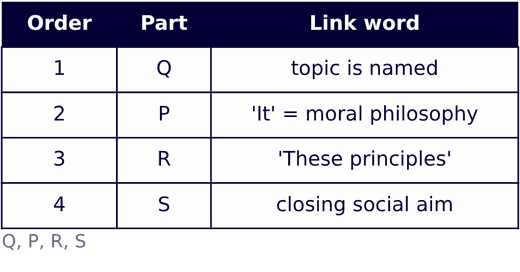
Q has to open the paragraph because it names the topic itself - moral philosophy and the principles that govern human conduct.
P begins with the pronoun 'It', which can refer only to moral philosophy, so P comes straight after Q.
R begins with 'These principles', pointing back to the principles already mentioned, and widens the idea from personal choice to social responsibility.
S closes with the largest idea of all - societies aiming at justice and fairness through ethical reflection.
The sequence is Q, P, R, S, so option (d) is correct.
Finished reading? Now test yourself.
The same 25 questions, but with a timer and the answers hidden — 15 minutes.

 Options (a), (b) and (d) all keep the money sense; only (c), 'the grassy bank', means the sloping land along a river.
Hence option (c) is correct.
Options (a), (b) and (d) all keep the money sense; only (c), 'the grassy bank', means the sloping land along a river.
Hence option (c) is correct.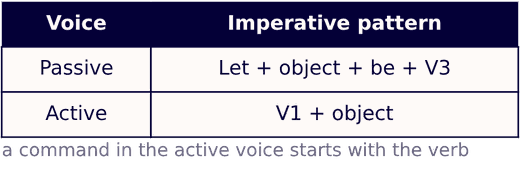 To restore the active voice, drop 'Let ... be' and begin directly with the base verb, keeping the same object: 'Expose the political lies to the public ...'.
Option (a) adds 'You should', which turns the command into an assertive sentence; option (c) is still passive ('must be exposed'); option (d) invents a new doer, 'the public', which the original never names.
Hence option (b) is correct.
To restore the active voice, drop 'Let ... be' and begin directly with the base verb, keeping the same object: 'Expose the political lies to the public ...'.
Option (a) adds 'You should', which turns the command into an assertive sentence; option (c) is still passive ('must be exposed'); option (d) invents a new doer, 'the public', which the original never names.
Hence option (b) is correct.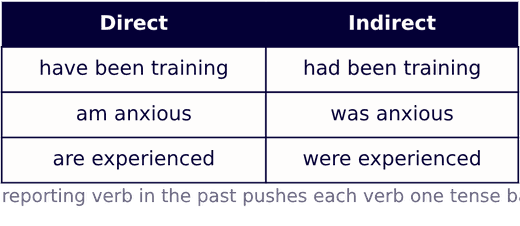 'have been training' becomes 'had been training', 'am' becomes 'was', and 'are' becomes 'were'.
The pronouns also change with the speaker: 'I' becomes 'he' and 'my' becomes 'his'.
Options (a) and (c) leave present-tense verbs untouched, and (d) drops the perfect continuous form, changing the meaning of weeks of training.
Hence option (b) is correct.
'have been training' becomes 'had been training', 'am' becomes 'was', and 'are' becomes 'were'.
The pronouns also change with the speaker: 'I' becomes 'he' and 'my' becomes 'his'.
Options (a) and (c) leave present-tense verbs untouched, and (d) drops the perfect continuous form, changing the meaning of weeks of training.
Hence option (b) is correct. The reported 'had implemented' comes from the present perfect 'has implemented', and 'that year' comes from the speaker's 'this year'.
The reported 'they were taking' comes from the principal's own words 'we are taking'.
The restored words are then placed inside quotation marks after a comma: The principal stated, "The school has implemented new rules this year, and we are taking strict measures to ensure discipline."
Options (b), (c) and (d) keep the reported forms of the verbs, which the speaker never used, so option (a) is correct.
The reported 'had implemented' comes from the present perfect 'has implemented', and 'that year' comes from the speaker's 'this year'.
The reported 'they were taking' comes from the principal's own words 'we are taking'.
The restored words are then placed inside quotation marks after a comma: The principal stated, "The school has implemented new rules this year, and we are taking strict measures to ensure discipline."
Options (b), (c) and (d) keep the reported forms of the verbs, which the speaker never used, so option (a) is correct.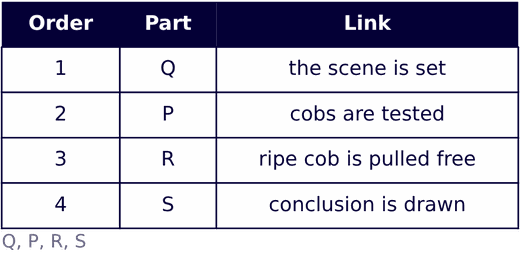 The sequence is therefore Q, P, R, S, so option (a) is correct.
 The sequence is Q, P, R, S, so option (d) is correct.