SSC CHSL 12 November 2025 · Shift 3 · English Language — questions with answers · ShikshaSphere
Chapter 8 of 200
12 November 2025 · Shift 3
English Language
25 questions ~25 min readFree
25 questions
A
1
Identify the part of the sentence that contains a grammatical error.
A. A herd of cattle
B. were grazing in
C. the large field
D. behind the farm.
A.A herd of cattle
B.were grazing in
C.the large field
D.behind the farm.
Solution
Subject-verb agreement
A collective noun such as herd, flock, team or committee is treated as one single unit, so it takes a singular verb.
The subject of the sentence is 'A herd', not 'cattle' — the phrase 'of cattle' only describes the herd and can never decide the verb.
So the plural verb 'were' is wrong; the sentence needs 'was grazing in'.
Parts A, C and D contain no error, so the error lies in part B.
Correct sentence: A herd of cattle was grazing in the large field behind the farm.
2
Fill in the blank with the most appropriate preposition:
The resolution was passed unanimous support and confidence.
A.by
B.over
C.under
D.with
Solution
Prepositions
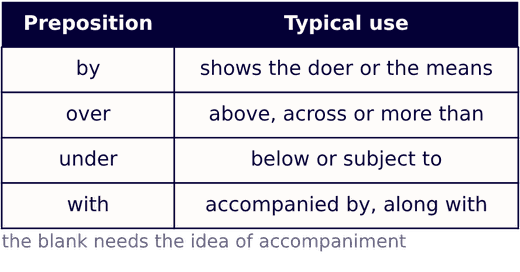
The blank needs a preposition that links the passing of the resolution with the support and confidence that went along with it.
'With' expresses accompaniment, so 'passed with unanimous support' means the support and confidence accompanied the passing.
'By' would need a doer after it (passed by the members), while 'over' and 'under' show position or control, neither of which fits here.
Correct sentence: The resolution was passed with unanimous support and confidence.
3
Select the most appropriate synonym of the word:
Argumentation
A.Dialectic
B.Conversation
C.Logic
D.Imagination
Solution
Synonyms
'Argumentation' is the systematic process of reasoning — putting forward arguments and answering counter-arguments.
'Dialectic' names exactly that method of reaching the truth through argument and counter-argument, so it is the closest synonym.
'Logic' is the science of correct reasoning rather than the act of arguing, and 'Conversation' and 'Imagination' have nothing to do with debate.
Hence, option (a) is the most appropriate answer.
4
Choose the incorrectly spelt word:
A.Introvert
B.Amicable
C.Recluse
D.Gregarios
Solution
Spelling
'Gregarios' is misspelt; the correct spelling is 'Gregarious', which means fond of company or sociable.
The adjective ends in -ous, exactly like 'various' and 'curious'; the other three words are spelt correctly.
Hence, option (d) is the incorrectly spelt word.
5
Which of the following sentences uses the word "park" with the same meaning as in the following sentence?
You should park the truck near the entrance.
A.We decided to have a picnic at the national park.
B.Please park your car in the designated driveway.
C.We can park this project until next month.
D.The batsman hit the ball out of the park.
Solution
Word used in context
In the given sentence 'park' is a verb meaning to bring a vehicle to a stop and leave it in a particular place.
Option (b), 'Please park your car in the designated driveway', uses 'park' in exactly this sense.
In (a) and (d) 'park' is a noun (a public garden, a playing field), and in (c) it means to postpone something.
Hence, option (b) is the most appropriate answer.
6
Choose the incorrectly spelt word:
A.Procure
B.Recieve
C.Achieve
D.Obtain
Solution
Spelling
'Recieve' is misspelt; the correct spelling is 'Receive'.
The rule is 'i before e, except after c' — after c the order becomes c-e-i, as in receive, deceive and ceiling.
Hence, option (b) is the incorrectly spelt word.
7
Directions (Qs. 7-11): Read the following passage carefully and answer the questions that follow.
Artificial intelligence ethics boards (AEBs) have a significant and varied function in guiding technological advancement, operating as vital forums for oversight, regulation, and ethical alignment. Developers can discuss risks, establish guidelines, and ensure algorithmic fairness within inclusive environments provided by international consortia, academic institutions, and tech watchdogs. To secure public trust in digital systems, AEBs regularly conduct impact assessments to monitor biases, protect privacy, and assist in transparent software deployment. They also work to uphold ethical principles and data rights,
making corporations answerable for their software's impact and fostering a culture of responsible innovation. Although their influence is limited by commercial interests, lack of enforcement power, and rapid technological shifts, AEBs are fundamental for organizing ethical responses to digital threats, gathering expert consensus to prevent misuse, and building the framework for trustworthy technology in an automated society.
What is one of the primary roles of Al ethics boards (AEBs) in guiding technology ?
A.To accelerate the development of biased algorithms
B.To operate as vital forums for oversight, regulation, and ethical alignment
C.To prevent developers from discussing potential risks
D.To eliminate the need for public trust in software
Solution
Reading comprehension
The opening sentence itself states the role: AEBs guide technological advancement by 'operating as vital forums for oversight, regulation, and ethical alignment'.
That is precisely option (b).
Options (a), (c) and (d) reverse the passage: the boards check bias, invite developers to discuss risks, and work to secure public trust rather than remove it.
Hence, option (b) is the most appropriate answer.
8
Directions (Qs. 7-11): Read the following passage carefully and answer the questions that follow.
Artificial intelligence ethics boards (AEBs) have a significant and varied function in guiding technological advancement, operating as vital forums for oversight, regulation, and ethical alignment. Developers can discuss risks, establish guidelines, and ensure algorithmic fairness within inclusive environments provided by international consortia, academic institutions, and tech watchdogs. To secure public trust in digital systems, AEBs regularly conduct impact assessments to monitor biases, protect privacy, and assist in transparent software deployment. They also work to uphold ethical principles and data rights,
making corporations answerable for their software's impact and fostering a culture of responsible innovation. Although their influence is limited by commercial interests, lack of enforcement power, and rapid technological shifts, AEBs are fundamental for organizing ethical responses to digital threats, gathering expert consensus to prevent misuse, and building the framework for trustworthy technology in an automated society.
How do ethics boards contribute to public trust in digital systems, as mentioned in the passage?
A.By hiding software biases from the general public
B.By conducting impact assessments to monitor biases and protect privacy
C.By promoting unregulated data collection practices
D.By discouraging transparency in software deployment
Solution
Reading comprehension
The passage says: 'To secure public trust in digital systems, AEBs regularly conduct impact assessments to monitor biases, protect privacy, and assist in transparent software deployment.'
So public trust is built through impact assessments that watch for bias and guard privacy, which is option (b).
The other options contradict the passage — nothing is hidden from the public, data collection is not left unregulated, and transparency is assisted, not discouraged.
Hence, option (b) is the most appropriate answer.
9
Directions (Qs. 7-11): Read the following passage carefully and answer the questions that follow.
Artificial intelligence ethics boards (AEBs) have a significant and varied function in guiding technological advancement, operating as vital forums for oversight, regulation, and ethical alignment. Developers can discuss risks, establish guidelines, and ensure algorithmic fairness within inclusive environments provided by international consortia, academic institutions, and tech watchdogs. To secure public trust in digital systems, AEBs regularly conduct impact assessments to monitor biases, protect privacy, and assist in transparent software deployment. They also work to uphold ethical principles and data rights,
making corporations answerable for their software's impact and fostering a culture of responsible innovation. Although their influence is limited by commercial interests, lack of enforcement power, and rapid technological shifts, AEBs are fundamental for organizing ethical responses to digital threats, gathering expert consensus to prevent misuse, and building the framework for trustworthy technology in an automated society.
What is a key challenge faced by Al ethics boards, according to the passage?
A.A lack of new technological developments
B.Commercial interests, lack of enforcement power, and rapid technological shifts
C.Total cooperation from all global corporations
D.Decreasing complexity in digital threats
Solution
Reading comprehension
The word 'Although' signals the limitation: 'Although their influence is limited by commercial interests, lack of enforcement power, and rapid technological shifts...'
These three together form the key challenge, so option (b) is correct.
(a) and (d) are the opposite of what the passage describes, and (c), total cooperation from corporations, would be a help and not a challenge.
Hence, option (b) is the most appropriate answer.
10
Directions (Qs. 7-11): Read the following passage carefully and answer the questions that follow.
Artificial intelligence ethics boards (AEBs) have a significant and varied function in guiding technological advancement, operating as vital forums for oversight, regulation, and ethical alignment. Developers can discuss risks, establish guidelines, and ensure algorithmic fairness within inclusive environments provided by international consortia, academic institutions, and tech watchdogs. To secure public trust in digital systems, AEBs regularly conduct impact assessments to monitor biases, protect privacy, and assist in transparent software deployment. They also work to uphold ethical principles and data rights,
making corporations answerable for their software's impact and fostering a culture of responsible innovation. Although their influence is limited by commercial interests, lack of enforcement power, and rapid technological shifts, AEBs are fundamental for organizing ethical responses to digital threats, gathering expert consensus to prevent misuse, and building the framework for trustworthy technology in an automated society.
According to the passage, how do these boards help promote responsible innovation?
A.By allowing corporations to ignore data rights
B.By making corporations answerable for their software's impact
C.By restricting the flow of information to academic institutions
D.By focusing only on the profitability of new tech
Solution
Reading comprehension
The passage states that the boards 'work to uphold ethical principles and data rights, making corporations answerable for their software's impact and fostering a culture of responsible innovation'.
Responsible innovation therefore grows out of holding corporations answerable, which is option (b).
(a) contradicts 'uphold ethical principles and data rights', while (c) and (d) find no support anywhere in the passage.
Hence, option (b) is the most appropriate answer.
11
Directions (Qs. 7-11): Read the following passage carefully and answer the questions that follow.
Artificial intelligence ethics boards (AEBs) have a significant and varied function in guiding technological advancement, operating as vital forums for oversight, regulation, and ethical alignment. Developers can discuss risks, establish guidelines, and ensure algorithmic fairness within inclusive environments provided by international consortia, academic institutions, and tech watchdogs. To secure public trust in digital systems, AEBs regularly conduct impact assessments to monitor biases, protect privacy, and assist in transparent software deployment. They also work to uphold ethical principles and data rights,
making corporations answerable for their software's impact and fostering a culture of responsible innovation. Although their influence is limited by commercial interests, lack of enforcement power, and rapid technological shifts, AEBs are fundamental for organizing ethical responses to digital threats, gathering expert consensus to prevent misuse, and building the framework for trustworthy technology in an automated society.
What is the meaning of "fundamental" as used in the passage?
A.Easily replaceable
B.Essential or absolutely necessary
C.Optional but useful
D.Unlikely to succeed
Solution
Vocabulary in context
The passage says that AEBs 'are fundamental for organizing ethical responses to digital threats'.
'Fundamental' means forming the necessary base of something, that is, essential or absolutely necessary.
The contrast with 'Although their influence is limited' shows that the writer is stressing their importance, so 'optional but useful' and 'easily replaceable' are far too weak.
Hence, option (b) is the most appropriate answer.
12
Choose the correct meaning of the idiom:
Everyone was surprised when she announced that she had a bun in the oven.
A.A new employee
B.An unfit person
C.A pregnancy
D.A mischief
Solution
Idioms and phrases
'To have a bun in the oven' is an informal idiom meaning to be pregnant.
The image is of something already baking inside, that is, a baby on the way, and the surprise of the listeners fits the announcement of a pregnancy.
Hence, option (c) is the most appropriate answer.
13
Choose the correct one-word substitute for:
An institution providing medical and surgical treatment and nursing care for sick or injured people.
A.Dispensary
B.Hospital
C.Pharmacy
D.Pantry
Solution
One-word substitution
An institution that gives medical and surgical treatment together with nursing care is a hospital.
A dispensary or a pharmacy only prepares or sells medicines and a pantry is a store for food, so none of them offers surgery or nursing care.
Hence, option (b) is the most appropriate answer.
14
Select the most appropriate antonym of the word:
Disturbing
A.Pleasant
B.Tedious
C.Bothersome
D.Vexatious
Solution
Antonyms
'Disturbing' means causing worry, anxiety or discomfort.
Its opposite must give comfort or enjoyment, and that word is 'Pleasant'.
'Tedious', 'Bothersome' and 'Vexatious' all carry the same negative sense, so they are near-synonyms of the given word, not antonyms.
Hence, option (a) is the most appropriate answer.
15
Choose the correct one-word substitute for the highlighted group of words.
Ramesh asked his friend who is a poet about a technique that creates narrative rhythm.
A.Plot
B.Repetition
C.Personification
D.Humour
Solution
One-word substitution
The highlighted words describe a literary device that gives a piece of writing its rhythm by bringing the same word, phrase or sound back again and again.
That device is 'Repetition'.
'Plot' is the sequence of events in a story, 'Personification' gives human qualities to non-human things and 'Humour' is the quality of being funny, so none of them creates rhythm.
Hence, option (b) is the most appropriate answer.
16
Change the following sentence into the Active form.
The last piece of cake was eaten by my brother.
A.My brother ate the last piece of cake.
B.The last piece of cake was eating my brother.
C.My brother eats the last piece of cake.
D.The last piece of cake had been eaten by my brother.
Solution
Passive to active voice
The given sentence is passive: 'was eaten' is the simple past passive and the doer appears as 'by my brother'.
To make it active, the doer becomes the subject, the passive subject becomes the object, and 'was eaten' becomes the simple past 'ate'.
This gives 'My brother ate the last piece of cake'; (c) wrongly shifts to the present tense, while (b) and (d) do not change the voice at all.
Hence, option (a) is the most appropriate answer.
17
Select the option that expresses the given sentence in indirect voice.
She will tell him, "I have already booked the tickets."
A.She will tell him that she had already booked the tickets.
B.She will tell him that she has already booked the tickets.
C.She will tell him that she already booked the tickets.
D.She will tell him that she would have booked the tickets.
Solution
Direct to indirect speech
The reporting verb 'will tell' is in the future tense.
When the reporting verb is in the present or the future, the tense of the reported speech is not changed at all; only the pronoun is adjusted.
So 'I have already booked' simply becomes 'she has already booked', giving 'She will tell him that she has already booked the tickets'.
Hence, option (b) is the most appropriate answer.
18
Choose the most suitable option to replace the highlighted part of the sentence:
Radhika, the artist and sculptor, were displaying her art at the gallery.
A.are displaying her art at the gallery
B.where displaying her art at the gallery
C.is displaying her art at the gallery
D.displays her art at the gallery
Solution
Subject-verb agreement
The article 'the' is used only once before 'artist and sculptor', which shows that the artist and the sculptor are one and the same person, Radhika.
The words between the commas are only an appositive describing Radhika; an appositive can never make the verb plural.
The subject is therefore singular and needs 'is displaying', a reading confirmed by the singular possessive 'her'.
'are' and 'where' are plainly wrong, and 'displays' destroys the continuous sense of the original sentence.
Hence, option (c) is the most appropriate answer.
19
Choose the most suitable option to replace the highlighted part of the sentence:
It is hard to identify the timber because its grain patterns are similar to any oak tree.
A.are similar to all trees
B.are similar to those of any oak tree
C.is similar to those of any other oak tree
D.is similar to those of any oak trees
Solution
Faulty comparison
A comparison must be made between things of the same kind, so the grain patterns of the timber have to be compared with the grain patterns of an oak tree, not with the tree itself.
The phrase 'those of' stands for 'the grain patterns of' and keeps the comparison parallel without repeating the words.
The subject 'its grain patterns' is plural, so the plural verb 'are' must be retained; options (c) and (d) put the singular 'is'.
Option (a) drops the oak altogether and compares the timber with all trees, which changes the meaning.
Hence, 'are similar to those of any oak tree', option (b), is the most appropriate answer.
20
Choose the correct passive voice transformation of the sentence:
The experienced chef has prepared a delicious and healthy meal to satisfy the hungry guests.
A.A delicious and healthy meal was prepared by the experienced chef to satisfy the hungry guests.
B.A delicious and healthy meal has been prepared by the experienced chef to satisfy the hungry guests.
C.A delicious and healthy meal has been being prepared by the experienced chef to satisfy the hungry guests.
D.A delicious and healthy meal is prepared by the experienced chef to satisfy the hungry guests.
Solution
Active to passive voice
The active sentence is in the present perfect tense: 'has prepared'.
The object 'a delicious and healthy meal' becomes the subject, 'has prepared' becomes 'has been prepared', and the doer takes 'by' before it.
The infinitive phrase 'to satisfy the hungry guests' is left untouched, so option (b) is the exact conversion; (a), (c) and (d) all change the tense.
Hence, option (b) is the most appropriate answer.
21
Choose the correct passive voice transformation of the sentence:
What had the authorities organized to manage the traffic flow before the festival began?
A.What was organized by the authorities to manage the traffic flow before the festival began?
B.What had been organized by the authorities to manage the traffic flow before the festival began?
C.What has been organized by the authorities to manage the traffic flow before the festival began?
D.What had been organizing by the authorities to manage the traffic flow before the festival began?
Solution
Active to passive voice
The active sentence is a question in the past perfect tense — 'had + V3' (had organized) — and it opens with the object word 'What'.
Rule: active 'had + V3' becomes passive 'had been + V3', and the doer 'the authorities' moves into a 'by' phrase.
So 'What had the authorities organized …?' becomes 'What had been organized by the authorities …?'
Option (a) drops the perfect form ('was organized') and option (c) shifts it to the present perfect ('has been organized'), so both change the time of the action.
Option (d) writes 'had been organizing', which is an active continuous form and can never be a passive.
22
Select the option that expresses the given sentence in direct voice.
The strict coach, with a loud voice, said that he had warned that lazy player many times in the past.
A.The strict coach said, "I warned that lazy player many times in the past."
B.The strict coach said, "He had warned that lazy player many times in the past."
C.The strict coach said, "I have warned this lazy player many times in the past.'
D.The strict coach said, "I had warned this lazy player many times in the past.'
Solution
Indirect to direct speech
To move from indirect to direct speech, drop 'that', put the speaker's exact words inside inverted commas and undo every backshift.
The reporting verb 'said' is in the past, so the reported past perfect 'had warned' must come from the present perfect 'have warned'.
'He' stands for the coach himself, so in his own words the pronoun becomes 'I'.
The distant demonstrative 'that lazy player' was produced by the shift, so it goes back to the near form 'this lazy player'.
Only option (c) makes all three changes: The strict coach said, "I have warned this lazy player many times in the past."
Option (a) keeps 'that' and uses the simple past, option (b) keeps the third-person 'He', and option (d) leaves the verb in the past perfect.
23
Select the option that expresses the given sentence in direct voice.
The coach told the players that their dedication had been remarkable, but that they had to now train for the finals which was a tough battle, and he was sure that they would win it.
A."Your dedication was remarkable, but you must now train for the finals which is a tough battle, and I am sure that you will win it," the coach said to the players.
B."Your dedication has been remarkable, but you have to now train for the finals which is a tough battle, and I am sure that you will win it," the coach said to the players.
C."Your dedication has been remarkable, but you must now train for the finals which is a tough battle, and I am sure that you will win it," the coach said to the players.
D."Their dedication was remarkable, but they had to now train for the finals which was a tough battle, and he was sure that they would win it," the coach said to the players.
Solution
Indirect to direct speech
Turning indirect speech into direct speech means undoing each backshift and putting the words back into the speaker's own person.
'told the players that' becomes 'the coach said to the players', with the real words inside inverted commas.
'Their dedication' refers to the listeners, so it becomes 'Your dedication'; 'he was sure' becomes 'I am sure'; 'they would win' becomes 'you will win'.
'Had been remarkable' goes back to the present perfect 'has been remarkable', and 'which was a tough battle' goes back to 'which is a tough battle'.
'They had to now train' carries an obligation felt at that very moment, which in the coach's own words is 'you must now train'.
Option (c) carries out every one of these changes, so it is correct.
Option (a) keeps 'was remarkable', option (b) weakens the obligation to 'you have to', and option (d) never converts the pronouns or the tenses at all.
24
Rearrange the following sentence parts to form a meaningful and grammatically correct paragraph:
P. She carefully measured the dry ingredients and sifted them into a large mixing bowl.
Q. She whisked in the eggs and melted butter until the batter was smooth and creamy.
R. She poured the mixture into a tin and baked it in the oven until it was golden brown.
S. The cake was finally ready to be served and looked absolutely delicious for the party.
A.Q, R, P, S
B.S, Q, R, P
C.P, Q, R, S
D.P, S, R, Q
Solution
Para jumble
The paragraph describes the baking of a cake, so the parts must follow the order in which the work is actually done.
P opens it: the dry ingredients are measured and sifted, which is the first step of any baking.
Q follows, because the eggs and melted butter are whisked into those dry ingredients to make the batter.
R comes next: the batter that Q has just produced is poured into a tin and baked.
S closes the paragraph by telling us that the finished cake is ready to be served.
The order is P, Q, R, S, which is option (c).
25
Rearrange the following sentence parts to form a meaningful and grammatically correct paragraph:
P. The problem highlights how excessive brightness can disrupt natural ecosystems and human biological rhythms.
Q. In many urban environments, citizens are increasingly exposed to high levels of artificial light during the night.
R. This environmental issue is formally identified by scientists as "light pollution."
S. It suggests that while we require illumination for safety, an excess of it can be biologically harmful.
A.S, R, P, Q
B.P, R, Q, S
C.R, S, P, Q
D.Q, R, P, S
Solution
Para jumble
First find the part that can open the paragraph without depending on anything said earlier.
Q does that: it introduces the situation, city dwellers exposed to strong artificial light at night.
R follows, because 'This environmental issue' points straight back to that situation and gives it a name — 'light pollution'.
P then speaks of 'The problem', the one just named, and states its effect on ecosystems and on human biological rhythms.
S closes with 'It suggests …', drawing the balanced lesson from that problem.
The sequence is Q, R, P, S, which is option (d).
Finished reading? Now test yourself.
The same 25 questions, but with a timer and the answers hidden — 15 minutes.

 'With' expresses accompaniment, so 'passed with unanimous support' means the support and confidence accompanied the passing.
'By' would need a doer after it (passed by the members), while 'over' and 'under' show position or control, neither of which fits here.
Correct sentence: The resolution was passed with unanimous support and confidence.
'With' expresses accompaniment, so 'passed with unanimous support' means the support and confidence accompanied the passing.
'By' would need a doer after it (passed by the members), while 'over' and 'under' show position or control, neither of which fits here.
Correct sentence: The resolution was passed with unanimous support and confidence.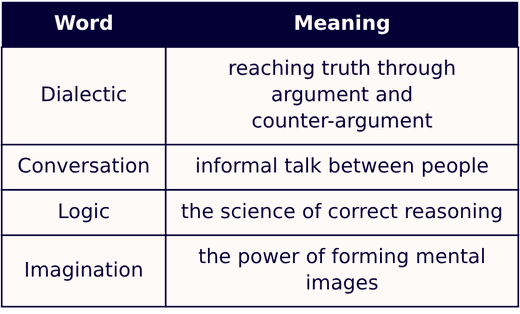 'Dialectic' names exactly that method of reaching the truth through argument and counter-argument, so it is the closest synonym.
'Logic' is the science of correct reasoning rather than the act of arguing, and 'Conversation' and 'Imagination' have nothing to do with debate.
Hence, option (a) is the most appropriate answer.
'Dialectic' names exactly that method of reaching the truth through argument and counter-argument, so it is the closest synonym.
'Logic' is the science of correct reasoning rather than the act of arguing, and 'Conversation' and 'Imagination' have nothing to do with debate.
Hence, option (a) is the most appropriate answer.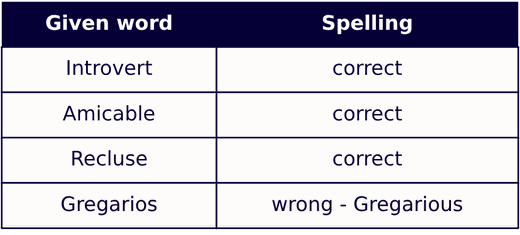 The adjective ends in -ous, exactly like 'various' and 'curious'; the other three words are spelt correctly.
Hence, option (d) is the incorrectly spelt word.
The adjective ends in -ous, exactly like 'various' and 'curious'; the other three words are spelt correctly.
Hence, option (d) is the incorrectly spelt word.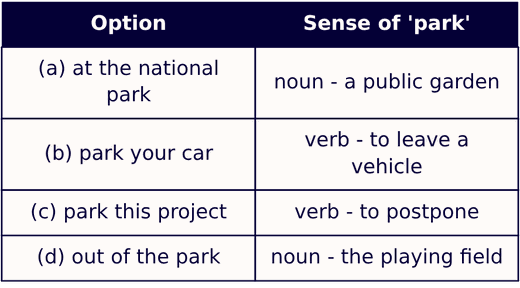 Option (b), 'Please park your car in the designated driveway', uses 'park' in exactly this sense.
In (a) and (d) 'park' is a noun (a public garden, a playing field), and in (c) it means to postpone something.
Hence, option (b) is the most appropriate answer.
Option (b), 'Please park your car in the designated driveway', uses 'park' in exactly this sense.
In (a) and (d) 'park' is a noun (a public garden, a playing field), and in (c) it means to postpone something.
Hence, option (b) is the most appropriate answer.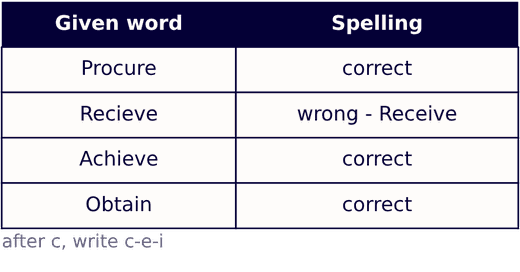 The rule is 'i before e, except after c' — after c the order becomes c-e-i, as in receive, deceive and ceiling.
Hence, option (b) is the incorrectly spelt word.
The rule is 'i before e, except after c' — after c the order becomes c-e-i, as in receive, deceive and ceiling.
Hence, option (b) is the incorrectly spelt word.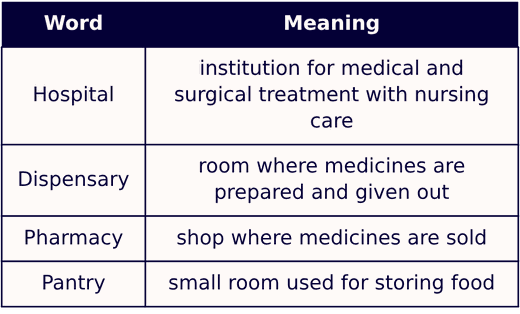 A dispensary or a pharmacy only prepares or sells medicines and a pantry is a store for food, so none of them offers surgery or nursing care.
Hence, option (b) is the most appropriate answer.
A dispensary or a pharmacy only prepares or sells medicines and a pantry is a store for food, so none of them offers surgery or nursing care.
Hence, option (b) is the most appropriate answer.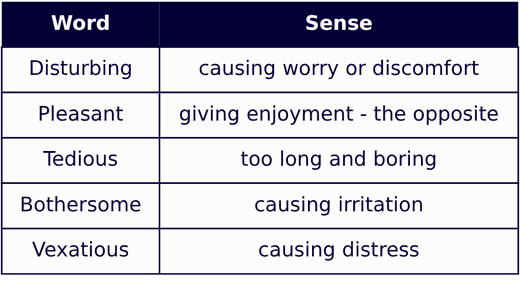 Its opposite must give comfort or enjoyment, and that word is 'Pleasant'.
'Tedious', 'Bothersome' and 'Vexatious' all carry the same negative sense, so they are near-synonyms of the given word, not antonyms.
Hence, option (a) is the most appropriate answer.
Its opposite must give comfort or enjoyment, and that word is 'Pleasant'.
'Tedious', 'Bothersome' and 'Vexatious' all carry the same negative sense, so they are near-synonyms of the given word, not antonyms.
Hence, option (a) is the most appropriate answer.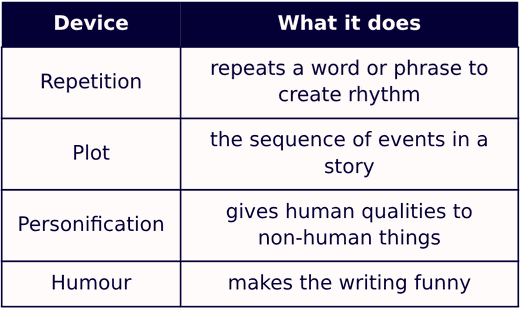 That device is 'Repetition'.
'Plot' is the sequence of events in a story, 'Personification' gives human qualities to non-human things and 'Humour' is the quality of being funny, so none of them creates rhythm.
Hence, option (b) is the most appropriate answer.
That device is 'Repetition'.
'Plot' is the sequence of events in a story, 'Personification' gives human qualities to non-human things and 'Humour' is the quality of being funny, so none of them creates rhythm.
Hence, option (b) is the most appropriate answer.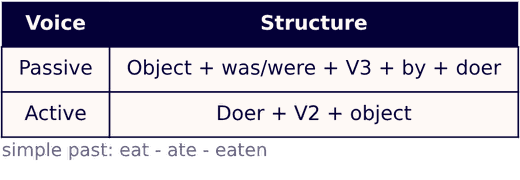 To make it active, the doer becomes the subject, the passive subject becomes the object, and 'was eaten' becomes the simple past 'ate'.
This gives 'My brother ate the last piece of cake'; (c) wrongly shifts to the present tense, while (b) and (d) do not change the voice at all.
Hence, option (a) is the most appropriate answer.
To make it active, the doer becomes the subject, the passive subject becomes the object, and 'was eaten' becomes the simple past 'ate'.
This gives 'My brother ate the last piece of cake'; (c) wrongly shifts to the present tense, while (b) and (d) do not change the voice at all.
Hence, option (a) is the most appropriate answer.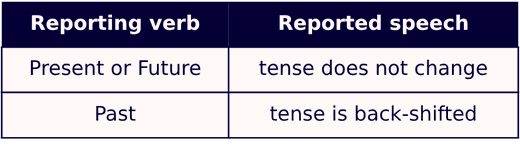 When the reporting verb is in the present or the future, the tense of the reported speech is not changed at all; only the pronoun is adjusted.
So 'I have already booked' simply becomes 'she has already booked', giving 'She will tell him that she has already booked the tickets'.
Hence, option (b) is the most appropriate answer.
When the reporting verb is in the present or the future, the tense of the reported speech is not changed at all; only the pronoun is adjusted.
So 'I have already booked' simply becomes 'she has already booked', giving 'She will tell him that she has already booked the tickets'.
Hence, option (b) is the most appropriate answer.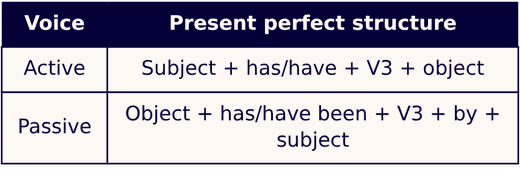 The object 'a delicious and healthy meal' becomes the subject, 'has prepared' becomes 'has been prepared', and the doer takes 'by' before it.
The infinitive phrase 'to satisfy the hungry guests' is left untouched, so option (b) is the exact conversion; (a), (c) and (d) all change the tense.
Hence, option (b) is the most appropriate answer.
The object 'a delicious and healthy meal' becomes the subject, 'has prepared' becomes 'has been prepared', and the doer takes 'by' before it.
The infinitive phrase 'to satisfy the hungry guests' is left untouched, so option (b) is the exact conversion; (a), (c) and (d) all change the tense.
Hence, option (b) is the most appropriate answer.