SSC CHSL 13 November 2025 · Shift 1 · General Intelligence — questions with answers · ShikshaSphere
Chapter 9 of 200
13 November 2025 · Shift 1
General Intelligence
25 questions ~25 min readFree
25 questions
A
26
If CABBAGES is coded as FDEEDJHV, how will DELICATA be writen:
A.GHOLFDWD
B.GHOLGDWD
C.GHOLFDWE
D.GHOLFDVD
Solution
Letter coding
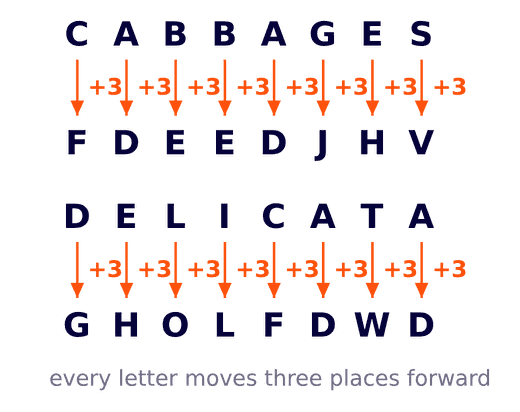
Place CABBAGES above FDEEDJHV and compare the letters one by one.
C → F, A → D, B → E, B → E, A → D, G → J, E → H, S → V — every letter moves three places forward, so the rule is +3.
Apply +3 to DELICATA: D → G, E → H, L → O, I → L, C → F, A → D, T → W, A → D.
The code is GHOLFDWD, so the correct option is (a).
27
In a certain code system, if PSYCHOANALYZES is coded as QTZDIPBOBMZAFT and BAMBOOZLEMENT is coded as CBNCPPAMFNFOU, then what is the code for NONJUDGEMENTAL?
A.OPOLVEHFNFOUBM
B.OPOKVEHFNFOUBM
C.PPOKVEHFNFOUBM
D.OPOKVEHFNFOUBL
Solution
Letter coding
Line up PSYCHOANALYZES with QTZDIPBOBMZAFT: P → Q, S → T, Y → Z, C → D, H → I — each letter moves one place forward, so the rule is +1.
The second pair confirms it (B → C, A → B, M → N …), and the pair Z → A shows that the alphabet is treated as a circle.
Apply +1 to NONJUDGEMENTAL: N → O, O → P, N → O, J → K, U → V, D → E, G → H, E → F, M → N, E → F, N → O, T → U, A → B, L → M.
The code is OPOKVEHFNFOUBM, so option (b) is correct.
The traps differ in a single letter: (a) puts L where J must give K, (c) starts with P instead of O, and (d) ends with L instead of M.
28
In a particular code language, if THERMOCHEMICAL is coded as UIFSNPDIFNJDBM and CHEMOTAXONOMIC is coded as DIFNPUBYPOPNJD, then what is the code for IMMUNOCHEMICAL ?
A.JNNVOPDIFNJDBN
B.JONVOPDIFNJDBM
C.JNMVOPDIFNJDBM
D.JNNVOPDIFNJDBM
Solution
Letter coding
Compare THERMOCHEMICAL with UIFSNPDIFNJDBM: T → U, H → I, E → F, R → S, M → N — every letter moves one place forward.
The second pair follows the same rule (C → D, H → I, E → F …), so the code is simply +1.
Apply +1 to IMMUNOCHEMICAL: I → J, M → N, M → N, U → V, N → O, O → P, C → D, H → I, E → F, M → N, I → J, C → D, A → B, L → M.
The code is JNNVOPDIFNJDBM, so option (d) is correct.
(a) ends in N instead of M, (b) codes the second M as O, and (c) leaves the third letter as M; all three break the +1 rule at exactly one place.
29
Here some problem or solution of the problem is given in the statement you deduction for given statement.Statement: With the increasing use of digital payments, many people prefer cashless transactions for their convenience and speed. However, cash is still widely used in rural areas and by older generations due to lack of digital literacy and limited internet access.
Conclusions:
I. Digital payments are preferred by everyone over cash.
II. The use of cash depends on factors like location and user familiarity with technology.
III. Rural areas will completely stop using cash in the near future.
Which conclusion necessarily follows?
A.Only I follows
B.Only II follows
C.Only III follows
D.Both I and III follow
Solution
Statement and conclusions
A conclusion follows only if the statement itself carries it; anything wider or stronger than the statement must be rejected.
Conclusion I says everyone prefers digital payment, but the statement says only 'many people' do and then names whole groups that still use cash, so I does not follow.
Conclusion II is exactly what the statement reports: cash survives in rural areas (location) and among older generations who lack digital literacy (familiarity with technology).
Conclusion III predicts that rural areas will stop using cash completely; the statement makes no forecast at all, so this is an assumption, not a conclusion.
Hence only II follows — option (b).
30
Each item describes a situation and is followed by four possible responses. Indicate the response you find most appropriate. Choose only one response for each item. The responses will be evaluated based on the level of appropriateness for the given situation. Rohit has an important project deadline tomorrow, but his friend is feeling anxious and asks for help preparing for an interview scheduled the same day. What is the most balanced decision?
A.Ignore the friend completely and focus only on the project
B.Spend the entire day helping the friend
C.Set aside limited time to support the friend while prioritizing the project
D.Cancel the project work and attend the interview with the friend
Solution
Situational judgement
A balanced decision protects the commitment that cannot be moved and still answers the person who asked for help.
Rohit's deadline is fixed and is his own responsibility, so it has to stay first; his anxious friend needs focused help, not a whole day of it.
Setting aside a limited, planned slot for the friend and giving the rest of the time to the project meets both needs, so option (c) is the most appropriate.
(a) is unkind and needlessly so, (b) sacrifices his own deadline, and (d) drops the work for an interview that is not even his to attend.
31
In this type of questions, question is provided with substitutes for various mathematical symbols, followed by a question involving calculation of an expression or choosing the correct/incorrect equation. You have to put the real signs in the given equation and then solve the questions as required. If '?' stands for '+', '$' stands for '÷', '@' stands for ' - ', ' ' stands for ' ', then find the value of:
A.
B.
C.
D.
Solution
Symbol substitution
First replace each symbol by the sign it stands for.
The given expression therefore becomes .
Under BODMAS, and have equal rank and are worked from left to right.
Hence the required value is , which is option (b).
32
During a team project, one member frequently misses meetings and submits work late, citing personal issues. How should you handle this situation in a socially intelligent manner?
A.Ignore the issue and complete the work alone
B.Discuss the concerns privately, clarify needed
C.Publicly criticize the member during a team meeting
D.Remove the member from the project without discussion
Solution
Social intelligence
Social intelligence means solving the problem while protecting the other person's dignity.
A private conversation lets the member explain the personal difficulty, lets you state clearly what the team needs by when, and lets support be offered — the delay is tackled without humiliating anyone.
So option (b) is the correct response.
(a) leaves the cause untouched and quietly overloads you, (c) shames a colleague in public and damages the whole team, and (d) punishes a person who was never even heard.
33
There are 30 people in a queue. Aman is 12th from the front and Sunita is 8th from the back. Find the number of people standing between Aman and Sunita.
A.8
B.10
C.17
D.12
Solution
Ranking in a queue
Bring both positions to the same end of the queue before subtracting.
Sunita is 8th from the back, so her position from the front = 30 - 8 + 1 = 23.
Aman is already given as 12th from the front.
People standing strictly between the 12th and the 23rd place = 23 - 12 - 1 = 10.
So 10 people stand between them, which is option (b).
34
Mona arranges lamps in a line. A star lamp is 12th from left, and a round lamp is 19th from right. If they are the same lamp, how many total lamps are there?
A.32
B.30
C.31
D.28
Solution
Position and total
Both descriptions point to the same lamp, so that one lamp is counted 12th from the left and 19th from the right.
Lamps to its left = 12 - 1 = 11, and lamps to its right = 19 - 1 = 18.
Total = 11 + 1 + 18 = 30.
The short rule is: total = 12 + 19 - 1 = 30, the 1 being subtracted because the common lamp is counted twice.
So there are 30 lamps — option (b).
35
In each question below is given a statement followed by two courses of action numbered I and II. You have to assume everything in the statement to be true and on the basis of the information given in the statement, decide which of the suggested courses of action logically follow(s) for pursuing.Statement: The number of road accidents in the city has increased significantly due to poor visibility during heavy fog.
Course of action I : Install proper street lighting and warning signboards immediately.
Course of action II : Encourage people to drive at higher speeds to reduce travel time.
A.Only I follows
B.Only II follows
C.Both I and II follow
D.Neither I nor II follows
Solution
Course of action
A course of action follows only if it removes the cause named in the statement or reduces the harm it does.
The cause here is poor visibility during heavy fog; street lighting and warning signboards improve visibility and alert drivers, so Course I follows.
Course II asks drivers to go faster in exactly the conditions that are causing crashes, which would raise the accident count instead of cutting it, so it does not follow.
Hence only I follows — option (a).
36
In each question below is given a statement followed by two courses of action numbered I and II. You have to assume everything in the statement to be true and on the basis of the information given in the statement, decide which of the suggested courses of action logically follow(s) for pursuing.Statement : The city is experiencing frequent power cuts due to overloading of the electricity grid during peak summer months.
Course of action I : Upgrade the power infrastructure and promote energy-saving practices.
Courses of action II : Ask citizens to use more electrical appliances to balance the load.
A.Only I follows
B.Only II follows
C.Both follow
D.Either I or II follows
Solution
Course of action
The stated cause is overloading of the grid in peak summer, so a valid action must either raise the grid's capacity or lower the demand on it.
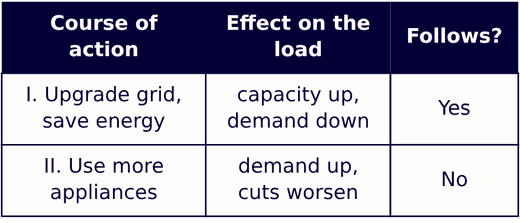
Course I does both — upgrading the infrastructure raises capacity and energy-saving practices cut demand — so it follows.
Course II tells citizens to use more appliances, which adds to the very overload that causes the cuts; 'balancing the load' by increasing it is self-contradictory, so it does not follow.
Hence only I follows — option (a).
37
Few of the letters are given letters are following a specific pattern you have to give the correct option which can replace question mark. Which letter should be next: Q, N, K, H, ?
A.E
B.F
C.G
D.H
Solution
Letter series
Write the alphabet position of each letter: Q = 17, N = 14, K = 11, H = 8.
Each term is 3 less than the one before it: 17 - 3 = 14, 14 - 3 = 11, 11 - 3 = 8.
The next position is 8 - 3 = 5, and the 5th letter of the alphabet is E.
So the answer is option (a).
38
Few of the letters are given followed by a question mark (?) these letters are following a specific pattern you have to give the correct option which can replace question mark. What comes after: C, H, N, U, ?
A.A
B.C
C.B
D.D
Solution
Letter series
Alphabet positions: C = 3, H = 8, N = 14, U = 21.
The gaps are 8 - 3 = 5, 14 - 8 = 6 and 21 - 14 = 7, so the jump grows by one each time.
The next jump must be +8, giving position 21 + 8 = 29.
There are only 26 letters, so continue round the circle: 29 - 26 = 3, and the 3rd letter is C.
Hence option (b) is correct.
39
In this question some conditions or circumstances is provided to you, you have to make logical judgement according to mentioned circumstances and mark the correct judgement for question. A hospital administrator receives complaints from patients about long waiting times in the outpatient department. However, doctors are handling a very high number of cases efficiently, and treatment outcomes remain excellent. The administrator must address patient concerns without affecting the quality of medical care.
A.Ignore the complaints since treatment outcomes are good.
B.Reduce the number of patients treated each day regardless of urgency.
C.Review scheduling processes, add support staff if possible, and monitor waiting times.
D.Ask patients to accept long waits as part of quality treatment.
Solution
Decision making
Two conditions are fixed: the complaint about waiting is genuine, and the quality of treatment must not be touched.
So the remedy has to lie in the process around the consultation, not in the consultation itself.
Reviewing how appointments are scheduled, adding support staff where possible and then monitoring the waiting time shortens the queue while the doctors keep working exactly as they do now.
So option (c) is the right judgement.
(a) and (d) merely dismiss a real grievance, and (b) cuts the number of patients seen each day, which reduces access and may turn away urgent cases.
40
Four meaningful words are given in the options you have to check that which of the following words cannot be formed from the letters. 'EAVESDROPPERS' ?
A.ERASER
B.VESSEL
C.DROPPER
D.PREPARE
Solution
Word formation
First list the stock of letters in EAVESDROPPERS: A(1), D(1), E(3), O(1), P(2), R(2), S(2), V(1).
A word can be formed only if every letter it needs is present and no letter is needed more often than it occurs.
ERASER needs E(2), R(2), A(1), S(1) — all within the stock.
DROPPER needs D(1), R(2), O(1), P(2), E(1) — all within the stock.
PREPARE needs P(2), R(2), E(2), A(1) — all within the stock.
VESSEL needs the letter L, which does not occur in EAVESDROPPERS at all, so this word alone cannot be formed — option (b).
41
In this type of questions, question is provided with some issues / disputes / problem, followed by few methods to resolve the problem in statement choosing the appropriate problem solving method that can be implemented.
A community hall is available for only one event on a particular day, but two local groups have booked it for important functions scheduled on the same date. What is the most fair solution?
A.Allow the group that booked first to use the hall
B.Cancel both bookings to avoid any conflict
C.Divide the available time equally between both groups
D.Let the larger group decide the outcome
Solution
Fair decision making
The hall can hold only one event, and both groups hold an equally valid booking for the very same date.
A solution is 'fair' only when it treats both parties alike instead of favouring one of them.
Splitting the available hours equally lets both functions actually take place and gives neither group an advantage, so it is the fairest course offered.
Handing the hall to whichever group booked first or cancelling both bookings kills at least one function outright, and letting the larger group decide rewards size rather than fairness.
Hence option (c) is correct.
42
In each of the following questions, there is a certain relationship between two given letter pairs on one side of (::) and pair is given on another side of (:) where another pair is to be found from the given alternatives, having the same relationship with this pair as the pairs of the given pair bear. Choose the best alternative.
DF : WU : : LH : ?
A.OT
B.RU
C.OV
D.OS
Solution
Letter-pair analogy
Write the alphabetical position of every letter: D = 4, F = 6, W = 23, U = 21.
Each letter is replaced by its opposite letter, since 4+23=27 and 6+21=27.
Apply the same rule to L and H. For L, 27-12=15, which is O.
For H, 27-8=19, which is S.
So LH becomes OS, and option (d) is correct.
43
In each of the following questions, there is a certain relationship between two given letter pairs on one side of (::) and pair is given on another side of (:) where another pair is to be found from the given alternatives, having the same relationship with this pair as the pairs of the given pair bear. Choose the best alternative.
BD : EC :: FH : ?
A.HG
B.II
C.IF
D.IG
Solution
Letter-pair analogy
Take the positions: B = 2, D = 4, E = 5, C = 3.
The first letter moves three places forward, 2+3=5 (B → E), and the second letter moves one place backward, 4-1=3 (D → C).
Apply the same two steps to FH. For F, 6+3=9, which is I.
For H, 8-1=7, which is G.
So FH becomes IG, and option (d) is correct.
44
Find the next element that replaces the ? Logically
3, 9, 21, 45, ?
A.99
B.93
C.96
D.101
Solution
Number series
Compare each term with the one before it: .
and , so the rule 'double it and add 3' holds all through.
The next term is therefore .
Hence option (b) is correct.
45
Find the next element that replace the ? Logically
2, 21, 116, 591, ?
A.1964
B.2966
C.4982
D.3967
Solution
Number series
The terms grow roughly five-fold, so test a rule of the form 'previous '.
, and , so c=11 works everywhere.
The missing term is .
Hence option (b) is correct.
46
Find the next element that replaces the ? Logically
11, 46, 221, 1096, ?
A.5543
B.5450
C.5471
D.5867
Solution
Number series
Again the terms grow about five times, so try 'previous '.
and the next term is 46, so c=-9; check it: and .
So the next term is .
Hence option (c) is correct.
47
In three of the following pairs are same by same pattern except one pair. Which pair does not follow this pattern?
A.15 : 22
B.28 : 35
C.44 : 51
D.17 : 25
Solution
Odd number pair
Look for the relation inside each pair by subtracting the first number from the second.
22-15=7, 35-28=7 and 51-44=7.
In 17 : 25 the difference is 25-17=8, which breaks the common pattern.
Hence option (d) is the odd pair.
48
In this type of questions, question is provided with substitutes for various mathematical symbols, followed by a question involving calculation of an expression or choosing the correct/incorrect equation. You have to put the real signs in the given equation and then solve the questions as required. If '?' stands for '÷', '#' stands for '×', ' stands for '+', '$' stands for '-', then find the value of:
14 # 6 ^ 8 $ ?
A.86
B.88
C.85
D.89
Solution
Symbol substitution
Replace every symbol by the sign it stands for: # becomes ×, ^ becomes +, and the dollar symbol becomes −.
The expression therefore becomes .
By BODMAS the multiplication is done first: .
Then 84+8=92 and 92-7=85.
Hence option (c) is correct.
49
Select the option that represents the correct order of the given words as they would appear in an English dictionary.
1. Quackishness
2. Quadrangular
3. Quadraplegic
4. Quadricepses
5. Quadraphonic
A.1, 3, 5, 2, 4
B.1, 2, 5, 3, 4
C.3, 1, 5, 2, 4
D.3, 5, 1, 2, 4
Solution
Dictionary order
All five words begin with 'Qua'. The 4th letter is c in Quackishness and d in the other four, and c comes before d, so Quackishness (1) is first.
The rest begin with 'Quadr'. The 6th letter is a in Quadrangular, Quadraphonic and Quadraplegic but i in Quadricepses, so Quadricepses (4) goes last.
Among the three 'Quadra…' words the 7th letters are n, p and p, so Quadrangular (2) comes next.
Quadraphonic and Quadraplegic agree up to 'Quadrap'; their 8th letters are h and l, so Quadraphonic (5) precedes Quadraplegic (3).
The order is 1, 2, 5, 3, 4, so option (b) is correct.
50
Select the option that represents the correct order of the given words as they would appear in an English dictionary.
6. Fabian
7. Fadges
8. Fading
9. Faerie
10. Fabric
11. Factum
A.1, 5, 6, 2, 3, 4
B.1, 2, 3, 4, 5, 6
C.
D.1, 5, 2, 4, 6, 3
Solution
Dictionary order
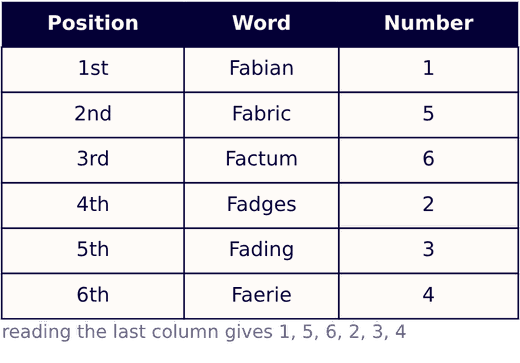
The options number the words 1 to 6 in the order in which they are listed: Fabian = 1, Fadges = 2, Fading = 3, Faerie = 4, Fabric = 5, Factum = 6.
All six begin with 'Fa'. The 3rd letter is b in Fabian and Fabric, c in Factum, d in Fadges and Fading, and e in Faerie, which fixes the four groups in that order.
Fabian and Fabric agree up to 'Fab'; their 4th letters are i and r, so Fabian (1) precedes Fabric (5).
Fadges and Fading agree up to 'Fad'; their 4th letters are g and i, so Fadges (2) precedes Fading (3).
The order is 1, 5, 6, 2, 3, 4, so option (a) is correct.
Finished reading? Now test yourself.
The same 25 questions, but with a timer and the answers hidden — 15 minutes.

 Apply +3 to DELICATA: D → G, E → H, L → O, I → L, C → F, A → D, T → W, A → D.
The code is GHOLFDWD, so the correct option is (a).
Apply +3 to DELICATA: D → G, E → H, L → O, I → L, C → F, A → D, T → W, A → D.
The code is GHOLFDWD, so the correct option is (a).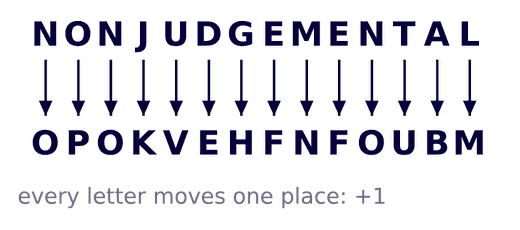 Apply +1 to NONJUDGEMENTAL: N → O, O → P, N → O, J → K, U → V, D → E, G → H, E → F, M → N, E → F, N → O, T → U, A → B, L → M.
The code is OPOKVEHFNFOUBM, so option (b) is correct.
The traps differ in a single letter: (a) puts L where J must give K, (c) starts with P instead of O, and (d) ends with L instead of M.
Apply +1 to NONJUDGEMENTAL: N → O, O → P, N → O, J → K, U → V, D → E, G → H, E → F, M → N, E → F, N → O, T → U, A → B, L → M.
The code is OPOKVEHFNFOUBM, so option (b) is correct.
The traps differ in a single letter: (a) puts L where J must give K, (c) starts with P instead of O, and (d) ends with L instead of M.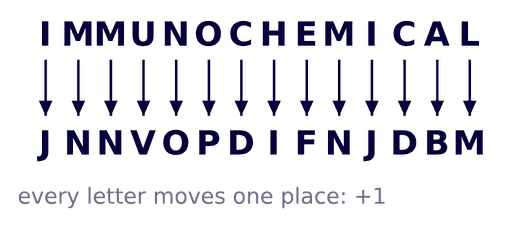 Apply +1 to IMMUNOCHEMICAL: I → J, M → N, M → N, U → V, N → O, O → P, C → D, H → I, E → F, M → N, I → J, C → D, A → B, L → M.
The code is JNNVOPDIFNJDBM, so option (d) is correct.
(a) ends in N instead of M, (b) codes the second M as O, and (c) leaves the third letter as M; all three break the +1 rule at exactly one place.
Apply +1 to IMMUNOCHEMICAL: I → J, M → N, M → N, U → V, N → O, O → P, C → D, H → I, E → F, M → N, I → J, C → D, A → B, L → M.
The code is JNNVOPDIFNJDBM, so option (d) is correct.
(a) ends in N instead of M, (b) codes the second M as O, and (c) leaves the third letter as M; all three break the +1 rule at exactly one place.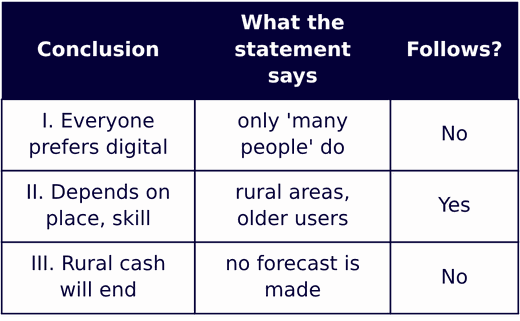 Conclusion I says everyone prefers digital payment, but the statement says only 'many people' do and then names whole groups that still use cash, so I does not follow.
Conclusion II is exactly what the statement reports: cash survives in rural areas (location) and among older generations who lack digital literacy (familiarity with technology).
Conclusion III predicts that rural areas will stop using cash completely; the statement makes no forecast at all, so this is an assumption, not a conclusion.
Hence only II follows — option (b).
Conclusion I says everyone prefers digital payment, but the statement says only 'many people' do and then names whole groups that still use cash, so I does not follow.
Conclusion II is exactly what the statement reports: cash survives in rural areas (location) and among older generations who lack digital literacy (familiarity with technology).
Conclusion III predicts that rural areas will stop using cash completely; the statement makes no forecast at all, so this is an assumption, not a conclusion.
Hence only II follows — option (b).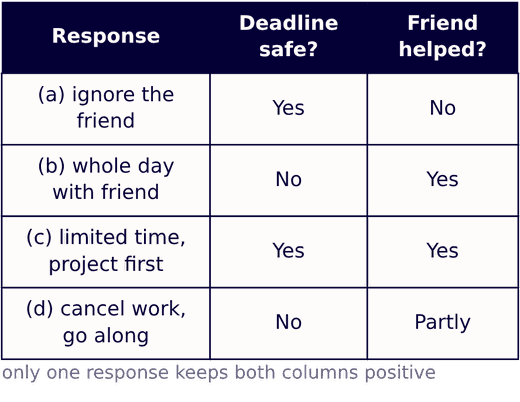 Setting aside a limited, planned slot for the friend and giving the rest of the time to the project meets both needs, so option (c) is the most appropriate.
(a) is unkind and needlessly so, (b) sacrifices his own deadline, and (d) drops the work for an interview that is not even his to attend.
Setting aside a limited, planned slot for the friend and giving the rest of the time to the project meets both needs, so option (c) is the most appropriate.
(a) is unkind and needlessly so, (b) sacrifices his own deadline, and (d) drops the work for an interview that is not even his to attend.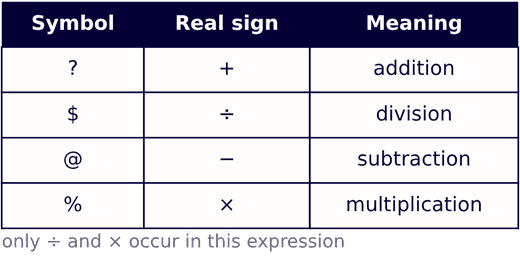 The given expression therefore becomes .
Under BODMAS, and have equal rank and are worked from left to right.
Hence the required value is , which is option (b).
The given expression therefore becomes .
Under BODMAS, and have equal rank and are worked from left to right.
Hence the required value is , which is option (b).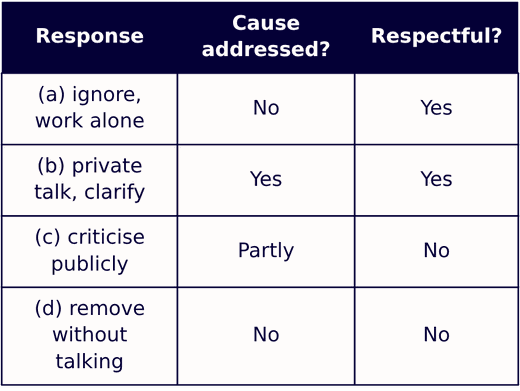 So option (b) is the correct response.
(a) leaves the cause untouched and quietly overloads you, (c) shames a colleague in public and damages the whole team, and (d) punishes a person who was never even heard.
So option (b) is the correct response.
(a) leaves the cause untouched and quietly overloads you, (c) shames a colleague in public and damages the whole team, and (d) punishes a person who was never even heard.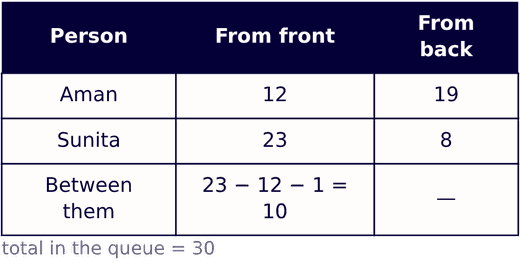 People standing strictly between the 12th and the 23rd place = 23 - 12 - 1 = 10.
So 10 people stand between them, which is option (b).
People standing strictly between the 12th and the 23rd place = 23 - 12 - 1 = 10.
So 10 people stand between them, which is option (b).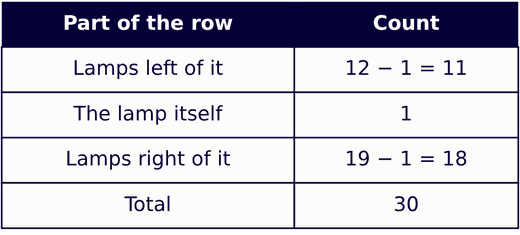 Total = 11 + 1 + 18 = 30.
The short rule is: total = 12 + 19 - 1 = 30, the 1 being subtracted because the common lamp is counted twice.
So there are 30 lamps — option (b).
Total = 11 + 1 + 18 = 30.
The short rule is: total = 12 + 19 - 1 = 30, the 1 being subtracted because the common lamp is counted twice.
So there are 30 lamps — option (b).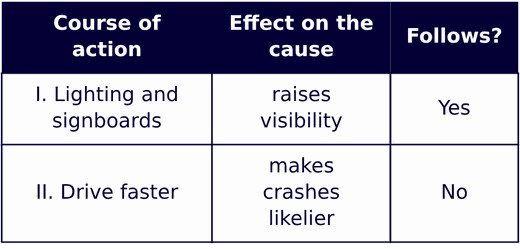 Hence only I follows — option (a).
 Hence only I follows — option (a).
 The next position is 8 - 3 = 5, and the 5th letter of the alphabet is E.
So the answer is option (a).
The next position is 8 - 3 = 5, and the 5th letter of the alphabet is E.
So the answer is option (a). The next jump must be +8, giving position 21 + 8 = 29.
There are only 26 letters, so continue round the circle: 29 - 26 = 3, and the 3rd letter is C.
Hence option (b) is correct.
The next jump must be +8, giving position 21 + 8 = 29.
There are only 26 letters, so continue round the circle: 29 - 26 = 3, and the 3rd letter is C.
Hence option (b) is correct.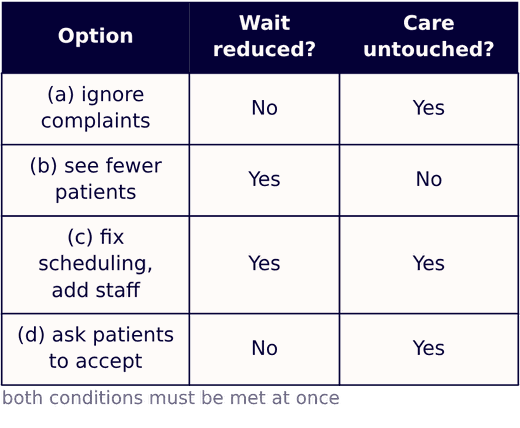 So option (c) is the right judgement.
(a) and (d) merely dismiss a real grievance, and (b) cuts the number of patients seen each day, which reduces access and may turn away urgent cases.
So option (c) is the right judgement.
(a) and (d) merely dismiss a real grievance, and (b) cuts the number of patients seen each day, which reduces access and may turn away urgent cases.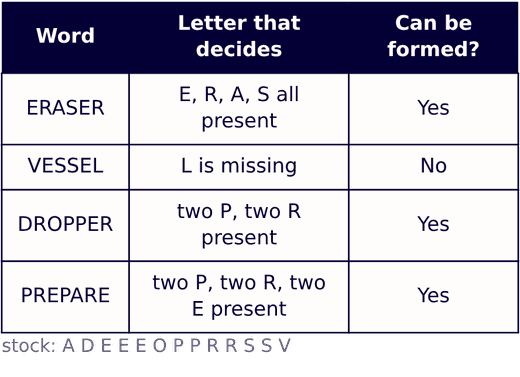 ERASER needs E(2), R(2), A(1), S(1) — all within the stock.
DROPPER needs D(1), R(2), O(1), P(2), E(1) — all within the stock.
PREPARE needs P(2), R(2), E(2), A(1) — all within the stock.
VESSEL needs the letter L, which does not occur in EAVESDROPPERS at all, so this word alone cannot be formed — option (b).
ERASER needs E(2), R(2), A(1), S(1) — all within the stock.
DROPPER needs D(1), R(2), O(1), P(2), E(1) — all within the stock.
PREPARE needs P(2), R(2), E(2), A(1) — all within the stock.
VESSEL needs the letter L, which does not occur in EAVESDROPPERS at all, so this word alone cannot be formed — option (b).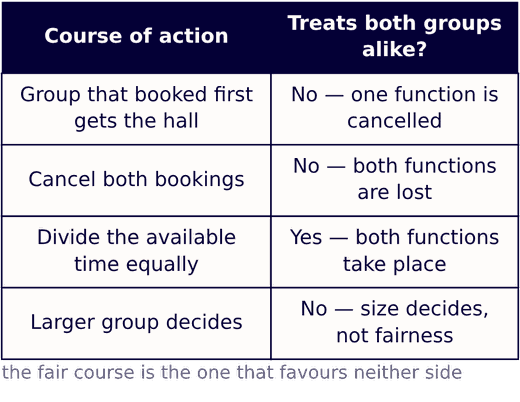 Splitting the available hours equally lets both functions actually take place and gives neither group an advantage, so it is the fairest course offered.
Handing the hall to whichever group booked first or cancelling both bookings kills at least one function outright, and letting the larger group decide rewards size rather than fairness.
Hence option (c) is correct.
Splitting the available hours equally lets both functions actually take place and gives neither group an advantage, so it is the fairest course offered.
Handing the hall to whichever group booked first or cancelling both bookings kills at least one function outright, and letting the larger group decide rewards size rather than fairness.
Hence option (c) is correct.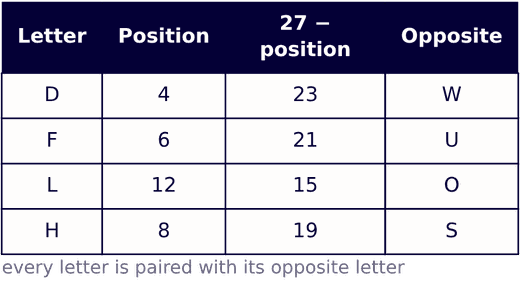 Apply the same rule to L and H. For L, 27-12=15, which is O.
For H, 27-8=19, which is S.
So LH becomes OS, and option (d) is correct.
Apply the same rule to L and H. For L, 27-12=15, which is O.
For H, 27-8=19, which is S.
So LH becomes OS, and option (d) is correct.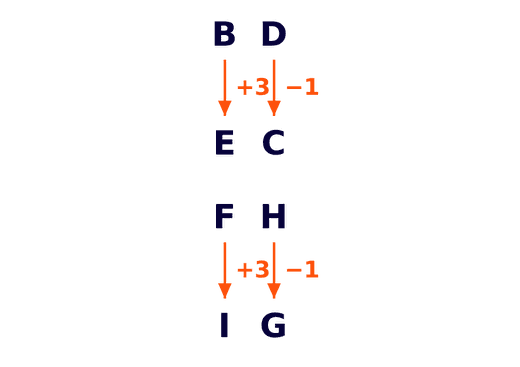 Apply the same two steps to FH. For F, 6+3=9, which is I.
For H, 8-1=7, which is G.
So FH becomes IG, and option (d) is correct.
Apply the same two steps to FH. For F, 6+3=9, which is I.
For H, 8-1=7, which is G.
So FH becomes IG, and option (d) is correct.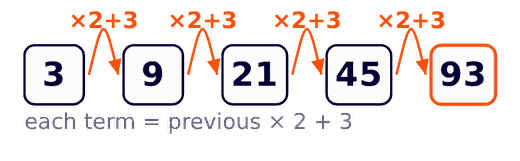 The next term is therefore .
Hence option (b) is correct.
The next term is therefore .
Hence option (b) is correct.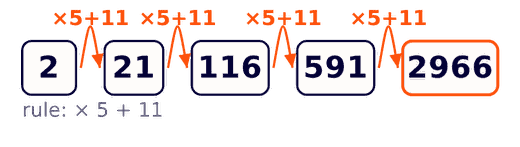 The missing term is .
Hence option (b) is correct.
The missing term is .
Hence option (b) is correct.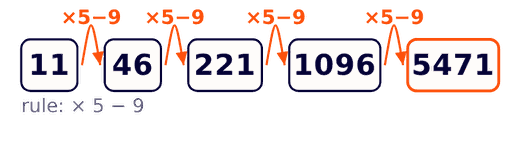 So the next term is .
Hence option (c) is correct.
So the next term is .
Hence option (c) is correct.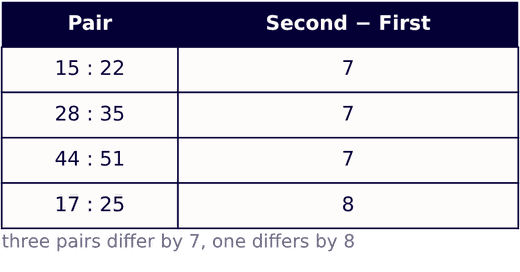 In 17 : 25 the difference is 25-17=8, which breaks the common pattern.
Hence option (d) is the odd pair.
In 17 : 25 the difference is 25-17=8, which breaks the common pattern.
Hence option (d) is the odd pair.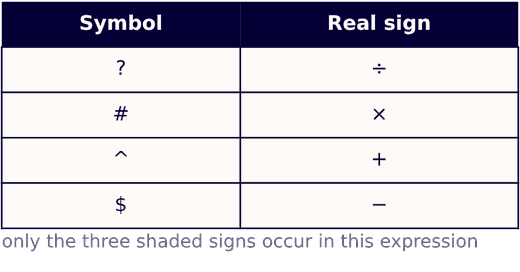 The expression therefore becomes .
By BODMAS the multiplication is done first: .
Then 84+8=92 and 92-7=85.
Hence option (c) is correct.
The expression therefore becomes .
By BODMAS the multiplication is done first: .
Then 84+8=92 and 92-7=85.
Hence option (c) is correct.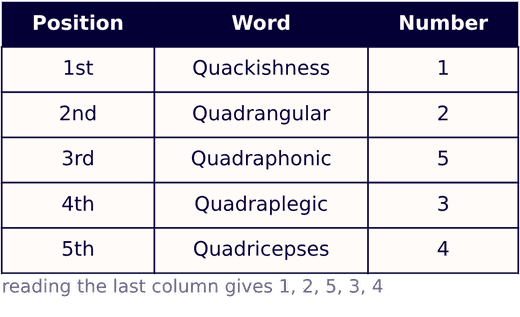 The order is 1, 2, 5, 3, 4, so option (b) is correct.
 The order is 1, 5, 6, 2, 3, 4, so option (a) is correct.