SSC CHSL 13 November 2025 · Shift 2 · Quantitative Aptitude — questions with answers · ShikshaSphere
Chapter 15 of 200
13 November 2025 · Shift 2
Quantitative Aptitude
25 questions ~25 min readFree
25 questions
A
51
P, Q, and R enter into a partnership. P invests Rs. invests Rs. 80,000, and R invests Rs. 60,000. After 6 months, Q increases his capital by , while R decreases his capital by . At the end of 1 year, the total profit is Rs .
. What is R's share in the profit? (approximate value)
A.₹50,000
B.₹31,240
C.₹40,000
D.₹65,780
Solution
Partnership with changing capital
Profit in a partnership is divided in the ratio of (capital time), so count each partner's money month by month.
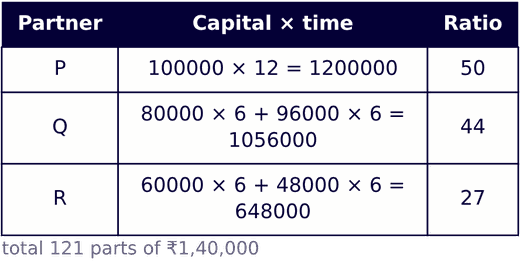
P keeps ₹1,00,000 for the whole year: .
Q keeps ₹80,000 for 6 months and then for 6 months: .
R keeps ₹60,000 for 6 months and then for 6 months: .
Ratio =1200000:1056000:648000=50:44:27, so the profit has 50+44+27=121 parts.
R's share .
Hence R gets about ₹31,240 and option (b) is correct.
52
If and , find :
A.
B.
C.0
D.
Solution
Trigonometric identity
From : .
From : .
So and (both angles come from the same 8, 15, 17 triangle).
Now .
The expression is exactly , and here A=B, so its value is 0; option (c) is correct.
53
A trader buys 60 kg of rice at ₹60 per kg and 40 kg of a different variety at ₹70 per kg. He mixes the two varieties and sells the entire mixture at ₹65 per kg. What is his total profit or loss?
A.₹200 profit
B.₹200 loss
C.₹100 profit
D.₹100 loss
Solution
Mixture, profit and loss
Cost of the first variety , i.e. ₹3,600.
Cost of the second variety , i.e. ₹2,800.
Total cost price =3600+2800=6400, i.e. ₹6,400 for 60+40=100 kg of the mixture.
Selling price of the mixture , i.e. ₹6,500.
Since SP is greater than CP, profit =6500-6400=100.
Hence he makes a profit of ₹100 and option (c) is correct.
54
Two numbers are respectively 30% less and 40% more than a third number. What is the ratio of the two numbers?
A.1 : 2
B.2 : 1
C.7 : 10
D.
Solution
Percentage and ratio
Let the third number be 100 (any convenient value works, because only a ratio is asked).
First number is 30% less: .
Second number is 40% more: .
Required ratio =70:140=1:2.
Hence option (a) is correct.
55
The average of 10 numbers is 55. If each of the first 5 numbers is increased by 6 and each of the last 5 numbers is decreased by 4, what will be the new average ?
A.55
B.57
C.56
D.58
Solution
Average after change
Sum of the 10 numbers .
The first five numbers add to this sum.
The last five numbers take away from it.
New sum =550+30-20=560.
New average .
Hence option (c) is correct.
56
The HCF of and is:
A.31
B.11
C.5
D.75
Solution
HCF from prime factors
The HCF keeps only those primes that occur in both numbers, each raised to the smaller of its two powers.
First number ; second number .
Common prime 3: powers are 3 and 1, so take .
Common prime 5: powers are 2 and 2, so take .
The primes 2, 11, 13 and 31 appear in only one of the two numbers, so they are dropped.
HCF , so option (d) is correct.
57
The population of a town increases by 25% in the first year, decreases by 20% in the second year, and again increases by 30% in the third year. If the population at the beginning was 60,000 , what will it be after 3 years?
A.64,000
B.53,200
C.78,000
D.84,000
Solution
Successive percentage change
A rise of 25% multiplies the population by , a fall of 20% by and a rise of 30% by .
After the first year: .
After the second year: .
After the third year: .
So the population after 3 years is 78,000 and option (c) is correct.
58
A thief escapes from a bank at 12:00 noon at a speed of . A police car starts chasing him at 12:30 PM at a speed of . At what time will the police car catch the thief?
A.01:00 PM
B.01:30 PM
C.02:00 PM
D.02:30 PM
Solution
Relative speed chase
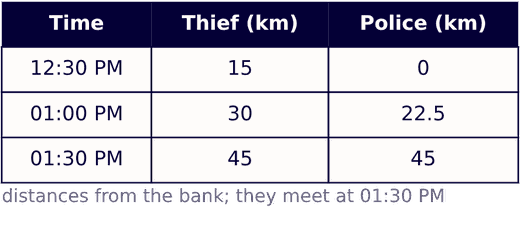
From 12:00 noon to 12:30 PM the thief runs alone, i.e. for hour.
Head start km.
Both then move in the same direction, so the gap closes at the relative speed =45-30=15 km/h.
Time needed to close the gap hour.
So the police car catches the thief at 12:30 PM + 1 hour = 01:30 PM, and option (b) is correct.
59
A can do a work in 30 days, B in 45 days. They start together but A leaves after 10 days. In how many more days will B complete the remaining work?
A.20 days
B.16 days
C.10 days
D.18 days
Solution
Time and work
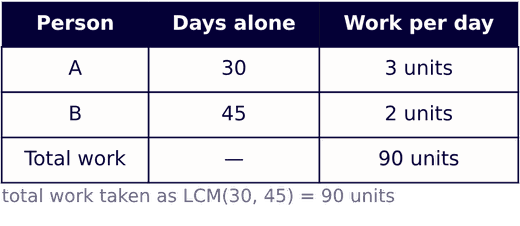
Take the total work as the LCM of 30 and 45, i.e. 90 units.
A's one day work units and B's one day work units.
Working together for 10 days they finish units.
Work left =90-50=40 units, and this is done by B alone.
Extra days needed days.
Hence option (a) is correct.
60
A jeweler marks a necklace at 40% above its cost price. She gives a cash discount of ₹200 on the marked price. If the necklace is sold for ₹2000 and she earns a profit of , what is the cost price of the necklace?
A.₹1800
B.₹1500
C.₹1650
D.₹1600
Solution
Cost price from profit
Let the cost price be x.
A profit of 25% means the selling price is of the cost price, i.e. SP .
The necklace is actually sold for ₹2,000, so .
.
Hence the cost price of the necklace is ₹1,600 and option (d) is correct.
61
A sum of money triple itself in 10 years at a certain rate of simple interest. In how many years will it become six times itself at the same rate ?
A.20 years
B.21 years
C.25 years
D.20 years
Solution
Simple interest — time
Let the sum be P. 'Triples itself' means the amount after 10 years is 3P, so the simple interest earned is 3P-P=2P.
Formula:
per annum.
To become six times, the interest required is 6P-P=5P.
Hence the sum becomes six times itself in 25 years, so option (c) is correct.
62
Shyam invests a portion of a total sum of ₹A in Scheme P for 6 years and the remaining amount in Scheme Q for 7 years. Scheme P offers a simple interest rate of r% per annum, while Scheme Q offers a simple interest rate of per annum. The amount invested in Scheme P is more than the amount invested in Scheme Q . If the total interest earned from both schemes is ₹2,625 and the amount invested in Scheme P is ₹2,100, what is the simple interest rate, ?
A.14%
B.13%
C.10%
D.16%
Solution
Simple interest — rate
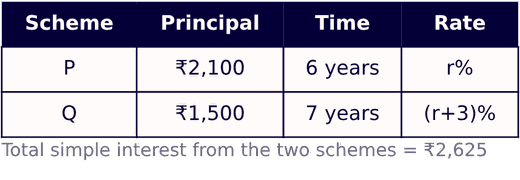
The amount put in Scheme P is ₹2,100 and it is more than the amount put in Scheme Q.
So , i.e. ₹1,500 goes into Scheme Q.
Interest from Scheme P
Interest from Scheme Q
Total interest: 126r+105(r+3)=2625
Hence the simple interest rate is , so option (c) is correct.
63
What is the value of , if and ?
A.94
B.96
C.86
D.256
Solution
Algebraic identity
Identity:
Rearranging it,
Substituting x+y+z=16 and xy+yz+zx=80:
Option (d) 256 is the trap — it is only , with 2(xy+yz+zx) not yet subtracted.
Hence the required value is 96, so option (b) is correct.
64
Which of the following numbers can possibly be a perfect square ?
A.364952
B.694828
C.268923
D.430336
Solution
Perfect squares — unit digit
The square of any whole number ends only in one of the digits 0, 1, 4, 5, 6 or 9.
So a number whose last digit is 2, 3, 7 or 8 can never be a perfect square.
364952 ends in 2, 694828 ends in 8 and 268923 ends in 3, so all three are ruled out at sight.
430336 ends in 6, so it survives the test — and indeed .
Hence option (d) is correct.
65
A shopkeeper mixes 6 liters of a milk solution containing fat with 8 liters of another milk solution containing fat. What is the fat percentage in the final mixture?
A.
B.32.50%
C.54.41%
D.65.00%
Solution
Mixture — percentage
Fat in the first solution litres
Fat in the second solution litres
Total fat =1.8+4=5.8 litres and total volume =6+8=14 litres
Fat percentage
Hence option (a) is correct.
66
If the radius of a sphere is increased by 10 percent, by what percentage will its volume increase?
A.
B.
C.
D.50.0%
Solution
Volume of a sphere
Volume of a sphere is , so V varies as .
Take the original radius as r=10; a rise makes it 11.
Increase
Hence option (a) is correct.
67
A 12 cm -radius solid metal sphere is melted and reshaped into smaller spheres, each with a 3 cm radius. From the original sphere, how many smaller spheres can be created?
A.64
B.68
C.62
D.65
Solution
Melting and recasting spheres
Melting does not change the metal, so the total volume of the small spheres equals the volume of the big sphere.
Number of spheres
Hence 64 small spheres can be made, so option (a) is correct.
68
The centroid of a triangle is the center of mass. If the coordinates of the vertices are , and what is the centroid of the triangle?
A.
B.
C.
D.
Solution
Centroid of a triangle
Formula: for vertices the centroid is
x-coordinate
y-coordinate
So the centroid is (6,7), and option (a) is correct.
Option (d) (6,8) is simply the vertex C, not the centroid.
69
If , what is ?
A.7
B.6
C.8
D.5
Solution
Laws of exponents
Bring every term to the same base 8: here .
So
Rule: , hence .
Comparing with equal bases gives y=6.
Hence option (b) is correct.
70
Two similar triangles have areas in the ratio of . What is the ratio of their corresponding altitudes?
A.625 : 4096
B.25 : 64
C.5 : 64
D.
Solution
Similar triangles — area ratio
Property: in two similar triangles the ratio of the areas is the square of the ratio of any pair of corresponding sides, medians or altitudes.
If are the areas and the corresponding altitudes, then
So the corresponding altitudes are in the ratio 5:8, and option (d) is correct.
Option (a) squares the area ratio and option (b) repeats it — both forget the square root.
71
If and , find
.
A.
B.
C.
D.
Solution
Algebraic identities
Square the first equation:
… (i)
Square the second equation:
… (ii)
Adding (i) and (ii):
Subtracting (ii) from (i):
Hence option (c) is correct.
72
Simplify:
A.
B.
C.
D.
Solution
Trigonometric identity
Expand the numerator:
Using the identity , the numerator becomes .
The denominator is left untouched, so the expression
This is exactly option (d).
It does not cancel down to 1, because the numerator carries while the denominator carries only .
73
If , find .
A.
B.
C.
D.
Solution
Trigonometric ratios
tells us that the side adjacent to A is 12 units and the hypotenuse is 13 units.
By the Pythagoras theorem the opposite side
is adjacent ÷ opposite, so
Hence option (b) is correct.
74
In a right triangle PQR , right-angled at Q , if , what is the value of 2 sin P cos P ?
A.
B.
C.
D.
Solution
Trigonometric ratios
and , so .
Then and
The same value follows in one step from the double-angle form
Hence option (a) is correct.
75
The equation of a line is 12. What is the slope of a line perpendicular to this line?
A.
B.
C.
D.2
Solution
Slope of perpendicular lines
Put the line in the slope–intercept form y=mx+c.
So the slope of the given line is .
For two perpendicular lines, .
Hence the required slope is , so option (b) is correct.
Option (d) 2 is the slope of the given line itself, not of the perpendicular.
Finished reading? Now test yourself.
The same 25 questions, but with a timer and the answers hidden — 15 minutes.

 Ratio =1200000:1056000:648000=50:44:27, so the profit has 50+44+27=121 parts.
R's share .
Hence R gets about ₹31,240 and option (b) is correct.
Ratio =1200000:1056000:648000=50:44:27, so the profit has 50+44+27=121 parts.
R's share .
Hence R gets about ₹31,240 and option (b) is correct.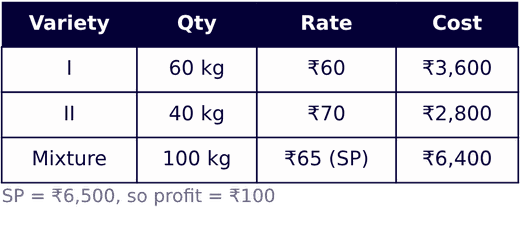 Selling price of the mixture , i.e. ₹6,500.
Since SP is greater than CP, profit =6500-6400=100.
Hence he makes a profit of ₹100 and option (c) is correct.
Selling price of the mixture , i.e. ₹6,500.
Since SP is greater than CP, profit =6500-6400=100.
Hence he makes a profit of ₹100 and option (c) is correct.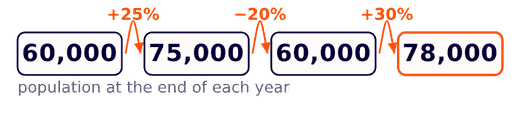 So the population after 3 years is 78,000 and option (c) is correct.
 So the police car catches the thief at 12:30 PM + 1 hour = 01:30 PM, and option (b) is correct.
 Working together for 10 days they finish units.
Work left =90-50=40 units, and this is done by B alone.
Extra days needed days.
Hence option (a) is correct.
Working together for 10 days they finish units.
Work left =90-50=40 units, and this is done by B alone.
Extra days needed days.
Hence option (a) is correct.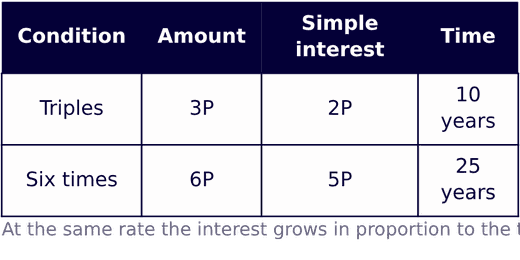 Hence the sum becomes six times itself in 25 years, so option (c) is correct.
 Interest from Scheme P
Interest from Scheme Q
Total interest: 126r+105(r+3)=2625
Hence the simple interest rate is , so option (c) is correct.
Interest from Scheme P
Interest from Scheme Q
Total interest: 126r+105(r+3)=2625
Hence the simple interest rate is , so option (c) is correct.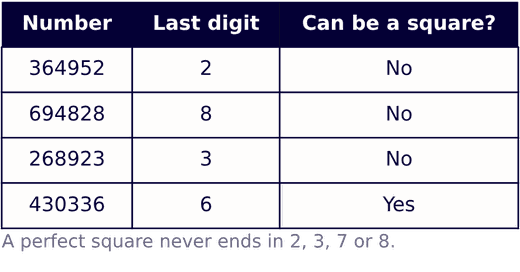 364952 ends in 2, 694828 ends in 8 and 268923 ends in 3, so all three are ruled out at sight.
430336 ends in 6, so it survives the test — and indeed .
Hence option (d) is correct.
364952 ends in 2, 694828 ends in 8 and 268923 ends in 3, so all three are ruled out at sight.
430336 ends in 6, so it survives the test — and indeed .
Hence option (d) is correct.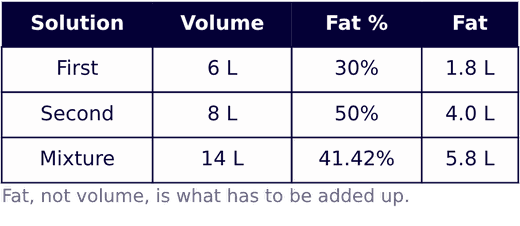 Fat percentage
Hence option (a) is correct.
Fat percentage
Hence option (a) is correct.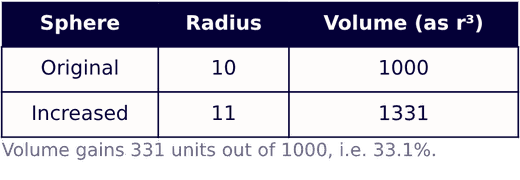 Increase
Hence option (a) is correct.
Increase
Hence option (a) is correct.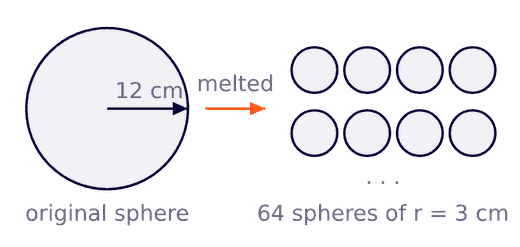 Number of spheres
Hence 64 small spheres can be made, so option (a) is correct.
Number of spheres
Hence 64 small spheres can be made, so option (a) is correct.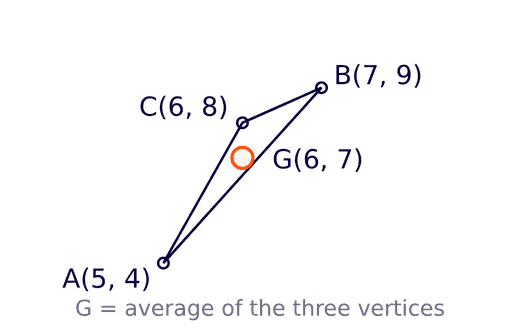 So the centroid is (6,7), and option (a) is correct.
Option (d) (6,8) is simply the vertex C, not the centroid.
So the centroid is (6,7), and option (a) is correct.
Option (d) (6,8) is simply the vertex C, not the centroid.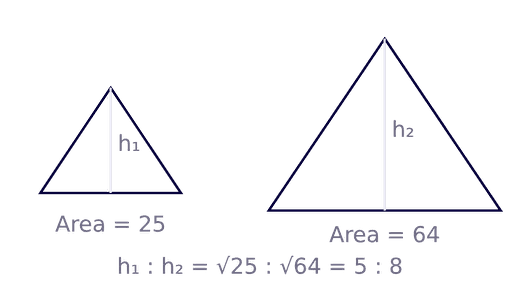 So the corresponding altitudes are in the ratio 5:8, and option (d) is correct.
Option (a) squares the area ratio and option (b) repeats it — both forget the square root.
So the corresponding altitudes are in the ratio 5:8, and option (d) is correct.
Option (a) squares the area ratio and option (b) repeats it — both forget the square root.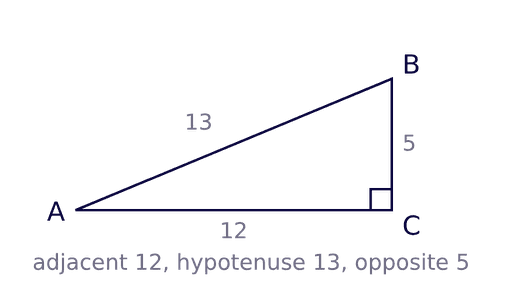 is adjacent ÷ opposite, so
Hence option (b) is correct.
is adjacent ÷ opposite, so
Hence option (b) is correct.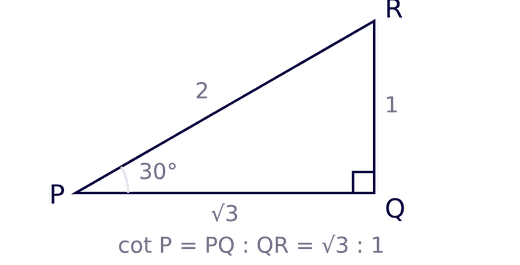 Then and
The same value follows in one step from the double-angle form
Hence option (a) is correct.
Then and
The same value follows in one step from the double-angle form
Hence option (a) is correct.