SSC CHSL 13 November 2025 · Shift 2 · English Language — questions with answers · ShikshaSphere
Chapter 16 of 200
13 November 2025 · Shift 2
English Language
25 questions ~25 min readFree
25 questions
A
1
Identify the part of the sentence that contains a grammatical error.
A. He apologized of B. his mistake and promised C. that he would be more D. careful in the future.
A.He apologised of
B.his mistake and promised
C.that he would be more
D.careful in the future
Solution
Preposition with 'apologise'
The verb 'apologise' takes 'for' before the fault and 'to' before the person: apologise to somebody for something.
Part A reads 'He apologized of', so the preposition is wrong; it should be 'He apologized for his mistake'.
Parts B, C and D are sound — 'promised that he would be more careful' keeps the correct past-future sequence.
Hence the error lies in part A, and option (a) is correct.
2
Select the idiom that means to complete a task as fast as possible before a deadline.
A.at sixes and sevens
B.by and large
C.against the clock
D.on cloud nine
Solution
Idiom meaning
'Against the clock' means to work in great haste so that a task is finished before a fixed deadline.
Example: The team worked against the clock to submit the report by midnight.
'At sixes and sevens' = in confusion; 'by and large' = on the whole; 'on cloud nine' = extremely happy.
Hence option (c) is correct.
3
Select the most appropriate synonym of the word: Unlucky
A.Morose
B.Hopeful
C.Hapless
D.Proud
Solution
Synonym
'Unlucky' means marked by bad fortune.
'Hapless' means unfortunate or luckless, so it carries exactly the same idea.
'Morose' = gloomy and sullen; 'Hopeful' = optimistic; 'Proud' = feeling satisfaction — none of these refers to bad luck.
Hence option (c) is correct.
4
Select the correct meaning of the idiom: Take something in stride.
A.To walk very quickly to reach a destination.
B.To deal with a problem calmly without letting it upset you.
C.To take a long step over an obstacle.
D.To ignore a situation completely and hope it goes away.
Solution
Idiom meaning
'Take something in stride' means to accept a difficulty calmly and carry on without letting it upset you.
Options (a) and (c) read 'stride' literally as a long step, which the idiom does not mean.
Option (d) describes avoiding a problem, not facing it calmly.
Hence option (b) is correct.
5
Which of the following sentences uses the word "saw" with the same meaning as in the following sentence? I saw a beautiful shooting star in the sky tonight.
A.He used a sharp hand saw to cut the wood.
B.She will saw the thick timber into smaller planks tomorrow.
C."Haste makes waste" is a very famous old wise saw.
D.We saw a massive whale across the ocean surface yesterday.
Solution
Word used in same sense
In the given sentence 'saw' is the past tense of the verb 'see' — to perceive with the eyes.
Option (d), 'We saw a massive whale across the ocean surface yesterday', uses it in exactly that sense.
In (a) 'saw' is a noun meaning a cutting tool, and in (c) it is a noun meaning an old proverb.
In (b) it is the verb 'to saw', that is, to cut with a saw.
Hence option (d) is correct.
6
Directions (Qs. 6-10): Read the following passage carefully and answer the questions that follow.
Dropshipping is an online selling model in which products are sold without being stored by the seller. Instead of keeping inventory, the seller transfers customer orders directly to a supplier, who then ships the goods to the buyer. This approach lowers initial investment requirements and reduces the risks associated with unsold stock. It also allows sellers to offer a wide range of products without managing storage or logistics. However, dropshipping has
certain limitations. Limited control over product quality and delivery timelines can lead to customer dissatisfaction. Profit margins are often thinner due to high competition, and reliance on third-party suppliers may create challenges in handling returns or resolving complaints efficiently.
What is the defining feature of dropshipping mentioned in the passage?
A.Products are manufactured by the seller
B.Inventory is stored and managed by the seller
C.Orders are passed to suppliers who ship directly to buyers
D.Goods are sold only through physical outlets
Solution
Reading comprehension
The passage defines dropshipping as a model in which the seller keeps no stock and instead transfers customer orders directly to a supplier, who then ships the goods to the buyer.
That routing of the order to a supplier who despatches it straight to the customer is the defining feature.
(a) and (b) state the opposite of the passage, and (d) contradicts 'an online selling model'.
Hence option (c) is correct.
7
Directions (Qs. 6-10): Read the following passage carefully and answer the questions that follow.
Dropshipping is an online selling model in which products are sold without being stored by the seller. Instead of keeping inventory, the seller transfers customer orders directly to a supplier, who then ships the goods to the buyer. This approach lowers initial investment requirements and reduces the risks associated with unsold stock. It also allows sellers to offer a wide range of products without managing storage or logistics. However, dropshipping has
certain limitations. Limited control over product quality and delivery timelines can lead to customer dissatisfaction. Profit margins are often thinner due to high competition, and reliance on third-party suppliers may create challenges in handling returns or resolving complaints efficiently.
Why does dropshipping require lower initial investment?
A.It eliminates the need for marketing
B.It avoids the cost of maintaining inventory
C.It guarantees higher profits
D.It reduces customer demand
Solution
Reading comprehension
The passage says the model 'lowers initial investment requirements' precisely because no inventory is kept.
The capital that would otherwise be locked up in buying and storing stock is simply never needed.
Marketing is never mentioned, higher profit is actually denied ('margins are often thinner'), and demand is not discussed.
Hence option (b) is correct.
8
Directions (Qs. 6-10): Read the following passage carefully and answer the questions that follow.
Dropshipping is an online selling model in which products are sold without being stored by the seller. Instead of keeping inventory, the seller transfers customer orders directly to a supplier, who then ships the goods to the buyer. This approach lowers initial investment requirements and reduces the risks associated with unsold stock. It also allows sellers to offer a wide range of products without managing storage or logistics. However, dropshipping has
certain limitations. Limited control over product quality and delivery timelines can lead to customer dissatisfaction. Profit margins are often thinner due to high competition, and reliance on third-party suppliers may create challenges in handling returns or resolving complaints efficiently.
What advantage of dropshipping allows sellers to offer many products?
A.Ownership of warehouses
B.Control over suppliers
C.Absence of inventory management
D.Exclusive supplier contracts
Solution
Reading comprehension
Since storage and logistics rest with the supplier, the seller manages no inventory at all.
The passage says this 'allows sellers to offer a wide range of products without managing storage or logistics'.
Warehouses, control over suppliers and exclusive contracts are nowhere claimed; the passage in fact stresses limited control.
Hence option (c) is correct.
9
Directions (Qs. 6-10): Read the following passage carefully and answer the questions that follow.
Dropshipping is an online selling model in which products are sold without being stored by the seller. Instead of keeping inventory, the seller transfers customer orders directly to a supplier, who then ships the goods to the buyer. This approach lowers initial investment requirements and reduces the risks associated with unsold stock. It also allows sellers to offer a wide range of products without managing storage or logistics. However, dropshipping has
certain limitations. Limited control over product quality and delivery timelines can lead to customer dissatisfaction. Profit margins are often thinner due to high competition, and reliance on third-party suppliers may create challenges in handling returns or resolving complaints efficiently.
Which issue related to customer experience is highlighted in the passage?
A.Faster delivery times
B.Improved quality control
C.Possible dissatisfaction due to delivery and quality issues
D.Increased personal interaction
Solution
Reading comprehension
The limitations part says that limited control over product quality and delivery timelines 'can lead to customer dissatisfaction'.
So the customer-experience issue raised is possible dissatisfaction arising from quality and delivery.
(a) and (b) claim advantages the passage never grants, and (d) is not discussed at all.
Hence option (c) is correct.
10
Directions (Qs. 6-10): Read the following passage carefully and answer the questions that follow.
Dropshipping is an online selling model in which products are sold without being stored by the seller. Instead of keeping inventory, the seller transfers customer orders directly to a supplier, who then ships the goods to the buyer. This approach lowers initial investment requirements and reduces the risks associated with unsold stock. It also allows sellers to offer a wide range of products without managing storage or logistics. However, dropshipping has
certain limitations. Limited control over product quality and delivery timelines can lead to customer dissatisfaction. Profit margins are often thinner due to high competition, and reliance on third-party suppliers may create challenges in handling returns or resolving complaints efficiently.
What is identified as a challenge affecting profits in dropshipping?
A.Limited product variety
B.Thin profit margins due to competition
C.Excessive storage costs
D.Low customer reach
Solution
Reading comprehension
The passage states plainly: 'Profit margins are often thinner due to high competition.'
Many sellers list identical products from the same suppliers, so prices are driven down and margins shrink.
Storage cost does not arise in this model at all, while variety and reach are presented as strengths.
Hence option (b) is correct.
11
Choose the incorrectly spelt word:
A.Blunder
B.Beautiful
C.Blatant
D.Beurokrat
Solution
Spelling
'Beurokrat' is misspelt; the correct form is 'bureaucrat', a government official.
Keep the chain in mind: bureau -> bureaucrat -> bureaucracy; the whole word 'bureau' survives in each.
Blunder, Beautiful and Blatant are all correctly spelt.
Hence option (d) is correct.
12
Choose the incorrectly spelt word:
A.Impurity
B.Irrisistable
C.Iteration
D.Imagination
Solution
Spelling
'Irrisistable' is wrong; the correct spelling is 'irresistible'.
Build it as ir + resist + ible — the root 'resist' stays whole and the ending is '-ible', not '-able'.
Impurity, Iteration and Imagination are all correctly spelt.
Hence option (b) is correct.
13
Select the correct meaning of the highlighted idiom:
Ever since they met in kindergarten, the two best friends have been as thick as thieves.
A.A group that argues frequently
B.People involved in illegal activities together
C.Extremely dishonest individuals
D.Very close or friendly
Solution
Idiom in context
'As thick as thieves' describes two people who are extremely close — intimate friends who share everything.
In the sentence the two best friends have been inseparable ever since kindergarten, which fits 'very close or friendly'.
The word 'thieves' tempts one towards (b) and (c), but the idiom carries no sense of crime or dishonesty.
Hence option (d) is correct.
14
Choose the correct one-word substitute for:
A person who studies insects.
A.Botanist
B.Entomologist
C.Ornithologist
D.Geologist
Solution
One-word substitution
A person who studies insects is an 'entomologist' (Greek entomon = insect).
A botanist studies plants, an ornithologist studies birds and a geologist studies the earth and its rocks.
Do not confuse entomology (the study of insects) with etymology (the study of word origins).
Hence option (b) is correct.
15
Select the most appropriate antonym of the word: Misery
A.Gloom
B.Sorrow
C.Felicity
D.Anger
Solution
Antonym
'Misery' means great unhappiness and suffering, so its antonym must express great happiness.
'Felicity' means intense happiness or bliss, which is the exact opposite.
Gloom, Sorrow and Anger are all negative states, so they are near-synonyms of misery rather than opposites.
Hence option (c) is correct.
16
Select the most appropriate antonym of the word: Disown
A.Accept
B.Reject
C.Ignore
D.Repudiate
Solution
Antonym
'Disown' means to refuse to acknowledge any connection with a person or thing.
'Accept' — to receive or acknowledge willingly — is its exact opposite.
'Reject' and 'Repudiate' mean almost the same as 'disown', and 'Ignore' merely means to pay no attention, which is not an opposite.
Hence option (a) is correct.
17
Choose the correct one-word substitute for:
A place where things are stored and can be found.
A.Repository
B.Archive
C.Registry
D.Cabinet
Solution
One-word substitution
A 'repository' is a place where things are stored and from which they can be found again when needed.
'Archive' is narrower — it means a collection of old records and documents preserved for their historical value.
'Registry' is a place where registers and official records are kept, and 'cabinet' is only a piece of furniture with shelves or drawers.
Only 'repository' covers storage together with easy retrieval of things of any kind.
Hence option (a) is correct.
18
Change the following sentence into the Active form.
Let the final announcement be made immediately.
A.Make the final announcement immediately.
B.The final announcement should be made immediatelv.
C.We shall make the final announcement immediately.
D.The final announcement is made immediately.
Solution
Passive to active voice
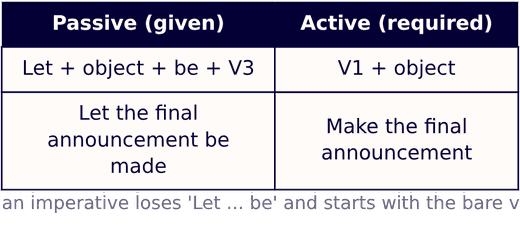
'Let + object + be + V3' is the passive pattern of an imperative sentence.
To turn it active, drop 'Let ... be' and begin with the bare verb (V1), followed by the object.
So 'Let the final announcement be made immediately' becomes 'Make the final announcement immediately.'
Options (b) and (d) are still passive, and (c) supplies a subject 'We shall', which an imperative does not have.
Hence option (a) is correct.
19
Select the option that expresses the given sentence in indirect voice.
The spokesperson said, "We cannot ignore the warning signs any longer, and this situation worries everyone involved, but corrective steps will be taken soon."
A.The spokesperson said that they cannot ignore the warning signs any longer, and that the situation worries everyone involved, but corrective steps will be taken soon.
B.The spokesperson said that they could not ignore the warning signs any longer, and that the situation worried everyone involved, but corrective steps would be taken soon.
C.The spokesperson said that they could not ignore the warning signs any longer, and that the situation worries everyone involved, but corrective steps would be taken soon.
D.The spokesperson said that they could not ignore the warning signs any longer, and that the situation worried everyone involved, but corrective steps will be taken soon.
Solution
Direct to indirect speech
The reporting verb 'said' is in the past tense, so every verb of the reported clause must move one step back.
'cannot' becomes 'could not', the simple present 'worries' becomes the simple past 'worried', and 'will be taken' becomes 'would be taken'; the pronoun 'we' becomes 'they'.
Only option (b) makes all of these changes; (a) keeps the present forms, (c) leaves 'worries' unchanged and (d) leaves 'will' unchanged.
Hence option (b) is correct.
20
Choose the most suitable option to replace the highlighted part of the sentence:
She is one of those writers who focuses on realistic themes.
A.focusing
B.focused
C.focus
D.to focus
Solution
Subject-verb agreement
In the pattern 'one of + plural noun + who/that + verb', the relative pronoun refers to the plural noun immediately before it, not to 'one'.
Here 'who' stands for 'those writers', which is plural, so the verb must be the plural form 'focus'.
'focusing', 'focused' and 'to focus' are non-finite forms and cannot act as the finite verb of the relative clause.
Hence option (c) is correct.
21
Choose the most suitable option to replace the highlighted part of the sentence:
The trained professionals with the capacity to adapt to changing conditions would be able to delivers consistent result.
A.would be able to deliver consistent results
B.would able to deliver consistent result
C.can be able delivering consistent results
D.would be abled to deliver consistent result
Solution
Modal + able to
The modal 'would' is always followed by the bare form of the verb, so the fixed pattern here is 'would be able to + V1'.
'Able' is an adjective and it takes a to-infinitive after it; after 'to' the verb must stay in its first form — 'deliver', never 'delivers'.
'Result' is a countable noun, and delivering the same standard again and again means more than one outcome, so the plural 'results' is needed.
Option (a) 'would be able to deliver consistent results' satisfies both requirements.
Option (b) drops 'be', option (c) writes the ungrammatical 'can be able delivering', and option (d) invents the form 'abled' and keeps the singular 'result'.
22
Choose the correct passive voice transformation of the sentence:
The researchers are analysing the collected data.
A.The collected data were analysed by the researchers.
B.The collected data are analysed by the researchers.
C.The collected data are being analysed by the researchers.
D.The collected data have been analysed by the researchers.
Solution
Active to passive voice
The active sentence is in the present continuous tense — 'are analysing'.
Rule: active 'is/are + V-ing' becomes passive 'is/are being + V3', and the doer moves into a 'by' phrase.
The object 'the collected data' becomes the subject; 'data' is taken as plural here, so the helping verb is 'are'.
The passive is therefore 'The collected data are being analysed by the researchers.', which is option (c).
Option (a) shifts the action to the past, option (b) drops 'being' and turns it into a simple present passive, and option (d) makes it a present perfect passive — all three change the time of the action.
23
Select the option that expresses the given sentence in direct voice.
The guide stated that the travellers had been waiting for hours and they had missed the last train that evening.
A.The guide stated, "The travellers were waiting for hours, and we missed the last train this evening."
B.The guide stated, "The travellers have been waiting for hours, and we had missed the last train this evening."
C.The guide stated, "The travellers have been waiting for hours, and we missed the last train this evening."
D.The guide stated, "The travellers had been waiting for hours, and we missed the last train this evening."
Solution
Indirect to direct speech
Moving from indirect to direct speech means removing 'that', putting the speaker's exact words inside inverted commas and undoing every backshift.
The reporting verb 'stated' is in the past, so the reported 'had been waiting' must have come from the present perfect continuous 'have been waiting'.
In the same way the reported past perfect 'had missed' must have come from the simple past 'missed'.
'That evening' is the shifted form of the near expression 'this evening', and the guide, being one of the party, refers to the group as 'we'.
Option (c) carries out all these changes: The guide stated, "The travellers have been waiting for hours, and we missed the last train this evening."
Option (a) reduces the continuous form to 'were waiting', option (b) keeps 'had missed', and option (d) leaves 'had been waiting' unchanged.
24
Rearrange the following sentence parts to form a meaningful and grammatically correct paragraph:
P. As night fell, the expedition struggled to find shelter in the unfamiliar terrain.
Q. Certain of a smooth journey, the explorers moved forward without adequate preparation.
R. The situation quickly turned critical when unexpected snowfall blocked all routes.
S. Their plan was to cross the region before dawn and avoid harsh weather conditions.
A.P, R, Q, S
B.Q, S, R, P
C.S, Q, P, R
D.R, P, S, Q
Solution
Para jumble
First look for the part that can open the paragraph without pointing back to anything said earlier.
Q does that: it introduces the explorers, who were certain of a smooth journey and so moved forward without adequate preparation.
S explains 'their plan' — to cross the region before dawn and avoid harsh weather — so it must come right after Q.
R supplies the turning point: unexpected snowfall blocks all the routes and the plan collapses.
P closes with the consequence — night falls and the expedition cannot find shelter in the unfamiliar terrain.
The order is Q, S, R, P, which is option (b).
25
Rearrange the following sentence parts to form a meaningful and grammatically correct paragraph:
P. As a result, many traditional occupations began to disappear rapidly.
Q. Technological innovations transformed the way goods were produced and distributed.
R. This shift created new opportunities while also demanding fresh skills from workers.
S. Over time, societies were forced to adapt to entirely new economic realities.
A.P, Q, R, S
B.Q, R, S, P
C.R, S, Q, P
D.S, Q, P, R
Solution
Para jumble
Q is the only part that introduces a subject without depending on anything before it — technological innovations changing the way goods were produced and distributed.
R opens with 'This shift', which points straight back to that change, so R follows Q.
S then widens the picture in time: 'Over time, societies were forced to adapt to entirely new economic realities.'
P states the visible outcome of that adaptation — many traditional occupations began to disappear rapidly — so it rounds the paragraph off.
The sequence is Q, R, S, P, which is option (b).
Finished reading? Now test yourself.
The same 25 questions, but with a timer and the answers hidden — 15 minutes.

 So 'Let the final announcement be made immediately' becomes 'Make the final announcement immediately.'
Options (b) and (d) are still passive, and (c) supplies a subject 'We shall', which an imperative does not have.
Hence option (a) is correct.
So 'Let the final announcement be made immediately' becomes 'Make the final announcement immediately.'
Options (b) and (d) are still passive, and (c) supplies a subject 'We shall', which an imperative does not have.
Hence option (a) is correct.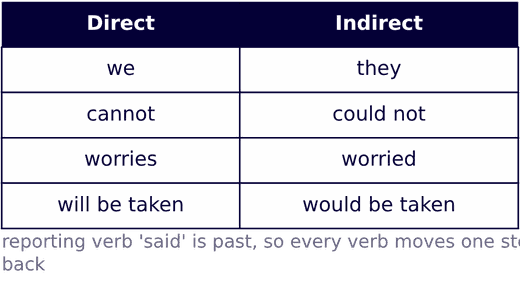 'cannot' becomes 'could not', the simple present 'worries' becomes the simple past 'worried', and 'will be taken' becomes 'would be taken'; the pronoun 'we' becomes 'they'.
Only option (b) makes all of these changes; (a) keeps the present forms, (c) leaves 'worries' unchanged and (d) leaves 'will' unchanged.
Hence option (b) is correct.
'cannot' becomes 'could not', the simple present 'worries' becomes the simple past 'worried', and 'will be taken' becomes 'would be taken'; the pronoun 'we' becomes 'they'.
Only option (b) makes all of these changes; (a) keeps the present forms, (c) leaves 'worries' unchanged and (d) leaves 'will' unchanged.
Hence option (b) is correct.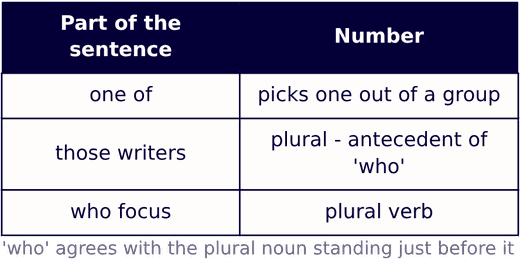 'focusing', 'focused' and 'to focus' are non-finite forms and cannot act as the finite verb of the relative clause.
Hence option (c) is correct.
'focusing', 'focused' and 'to focus' are non-finite forms and cannot act as the finite verb of the relative clause.
Hence option (c) is correct.