SSC CHSL 13 November 2025 · Shift 3 · English Language — questions with answers · ShikshaSphere
Chapter 20 of 200
13 November 2025 · Shift 3
English Language
25 questions ~25 min readFree
25 questions
A
1
Identify the part of the sentence that contains a grammatical error.
A. The legal advise B. given by the C. lawyer was very D. helpful to us.
A.The legal advise
B.given by the
C.lawyer was very
D.helpful to us
Solution
Error spotting: noun form
After the adjective 'legal' the sentence needs a noun, but part A supplies 'advise'.
'Advise' is a verb meaning to counsel; its noun form is 'advice' — the 'c' word is the thing given, the 's' word is the act of giving it.
Correct sentence: 'The legal advice given by the lawyer was very helpful to us.'
Parts B, C and D are grammatically sound, so the error lies in part A.
2
Fill in the blank with the most appropriate preposition:
The quiet environment was conducive
deep concentration and effective study.
A.for
B.in
C.to
D.with
Solution
Preposition after adjective
'Conducive' is always followed by the preposition 'to' — conducive to growth, conducive to sleep, conducive to study.
So the sentence reads: 'The quiet environment was conducive to deep concentration and effective study.'
'For', 'in' and 'with' never collocate with 'conducive', so they are all ruled out.
3
Select the most appropriate synonym of the word: TIMELESS
A.Transhistorical
B.Temporary
C.Contemporary
D.Momentary
Solution
Synonym
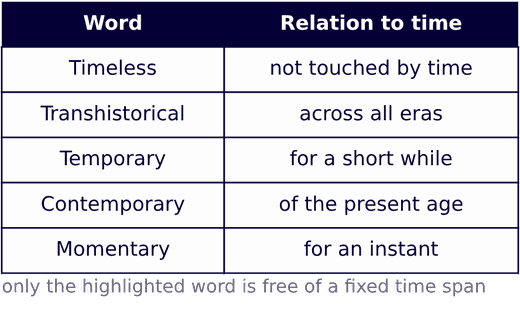
'Timeless' means untouched by the passage of time — eternal, valid in every age.
'Transhistorical' means cutting across and beyond all historical periods, so it carries the same 'not tied to any one era' sense.
'Temporary', 'contemporary' and 'momentary' each tie a thing to one limited stretch of time, so each is closer to an opposite than a synonym.
4
Choose the correctly spelt word:
A.Introvirseon
B.Introverison
C.Introversoin
D.Introversion
Solution
Correct spelling
The correct spelling is 'Introversion' — intro- (inward) + version (a turning).
The other three only shuffle the vowels at the end: 'Introvirseon', 'Introverison', 'Introversoin'.
It names the quality of being focused on one's own inner thoughts rather than on the outside world.
5
Which of the following sentences uses the word "minute" with the same meaning as in the following sentence?
Please wait just one minute while I finish this tack
A.He noticed a minute crack in the expensive glass vase.
B.The meeting will start in exactly one minute from now.
C.She spent hours studying the minute details of the painting.
D.There were minute traces of gold found within the sand.
Solution
Homograph usage
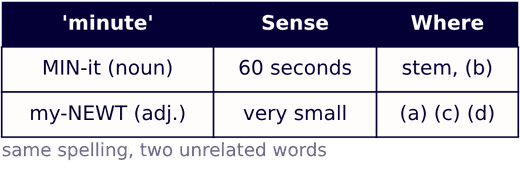
In the given sentence 'minute' is a noun meaning a unit of time of sixty seconds.
Option (b) uses exactly that sense: 'The meeting will start in exactly one minute from now.'
In (a), (c) and (d) 'minute' is an adjective meaning extremely small, a different word with a different stress and pronunciation.
6
Choose the incorrectly spelt word:
A.Blatant
B.Blister
C.Baffled
D.Busynis
Solution
Incorrect spelling
'Busynis' is not an English word at all; the correct spelling is 'business' (busi- + -ness).
'Blatant' (openly obvious), 'Blister' (a swelling on the skin) and 'Baffled' (puzzled) are all spelt correctly.
So the incorrectly spelt option is (d).
7
Directions (Qs. 7-11): Read the following passage carefully and answer the questions that follow.
The concept of urbanization has always been linked to economic growth and the modernization of society. Every industrial shift has triggered massive migrations that have redefined community life in history. From the Industrial Revolution to the rise of megacities, urban expansion has molded the way we reside, trade, and interact. But with our entry into an era of smart cities, high-density living, and digital infrastructure comes a growing contradiction: while these metropolises offer unmatched opportunities and amenities, they also strain traditional community bonds and erode the very
essence of connection with nature. Urban development, fundamentally, has provided access to resources much superior. Infrastructure improvements like mass transit and modern healthcare centers hold the potential to elevate lifestyles that were once considered unattainable. Cultural integration has made cities think collectively in ways that isolated regions could not have envisioned years ago, with diverse populations able to coexist across backgrounds with relative closeness. But the same urbanization has heavy repercussions. Gentrification is displacing residents from affordable housing, particularly where property values can be monetized. The pace of development has left many marginalized, and with it there is a feeling of alienation, anxiety about the environment. Furthermore, our reliance on dense urban systems is generating fundamental questions regarding sustainability, pollution, and mental well-being. As we embed concrete into every landscape, we must pause and ask ourselves: are we designing cities for people, or are people merely fueling the cities? The dilemma of urbanization, therefore, lies in its dual character. On one hand, the city stands as a beacon of economic hope for humanity's greatest aspirations, yet it also introduces ecological challenges that society must address to ensure development implies a more livable and balanced tomorrow.
What is the main contradiction introduced in the passage regarding urbanization?
A.Urbanization creates wealth but destroys all forms of employment
B.Urbanization leads to perfect equality among all citizens
C.Urbanization offers opportunities and amenities but strains community bonds and nature
D.Urbanization solves environmental issues but creates political instability
Solution
Reading comprehension
The contradiction is stated in the first paragraph: 'while these metropolises offer unmatched opportunities and amenities, they also strain traditional community bonds and erode the very essence of connection with nature.'
That is a gain on one side and a loss on the other, which is exactly what option (c) says.
(a) and (b) overstate the case with 'destroys all forms of employment' and 'perfect equality', neither of which the passage claims.
(d) reverses the passage, which says cities create ecological problems rather than solve them.
8
Directions (Qs. 7-11): Read the following passage carefully and answer the questions that follow.
The concept of urbanization has always been linked to economic growth and the modernization of society. Every industrial shift has triggered massive migrations that have redefined community life in history. From the Industrial Revolution to the rise of megacities, urban expansion has molded the way we reside, trade, and interact. But with our entry into an era of smart cities, high-density living, and digital infrastructure comes a growing contradiction: while these metropolises offer unmatched opportunities and amenities, they also strain traditional community bonds and erode the very
essence of connection with nature. Urban development, fundamentally, has provided access to resources much superior. Infrastructure improvements like mass transit and modern healthcare centers hold the potential to elevate lifestyles that were once considered unattainable. Cultural integration has made cities think collectively in ways that isolated regions could not have envisioned years ago, with diverse populations able to coexist across backgrounds with relative closeness. But the same urbanization has heavy repercussions. Gentrification is displacing residents from affordable housing, particularly where property values can be monetized. The pace of development has left many marginalized, and with it there is a feeling of alienation, anxiety about the environment. Furthermore, our reliance on dense urban systems is generating fundamental questions regarding sustainability, pollution, and mental well-being. As we embed concrete into every landscape, we must pause and ask ourselves: are we designing cities for people, or are people merely fueling the cities? The dilemma of urbanization, therefore, lies in its dual character. On one hand, the city stands as a beacon of economic hope for humanity's greatest aspirations, yet it also introduces ecological challenges that society must address to ensure development implies a more livable and balanced tomorrow.
According to the passage, what has been one of the beneficial outcomes of urban development?
A.It has reduced the need for mass transit systems
B.Infrastructure improvements and healthcare centers have elevated lifestyles
C.It has encouraged people to live in isolated regions
D.Urban development has had no impact on cultural integration
Solution
Reading comprehension
The passage says infrastructure improvements 'like mass transit and modern healthcare centers hold the potential to elevate lifestyles that were once considered unattainable.'
So the beneficial outcome it names is better infrastructure and healthcare raising the standard of living — option (b).
(a) and (c) contradict the passage, which praises mass transit and speaks of migration into cities, and (d) is wrong because cultural integration is credited to cities.
9
Directions (Qs. 7-11): Read the following passage carefully and answer the questions that follow.
The concept of urbanization has always been linked to economic growth and the modernization of society. Every industrial shift has triggered massive migrations that have redefined community life in history. From the Industrial Revolution to the rise of megacities, urban expansion has molded the way we reside, trade, and interact. But with our entry into an era of smart cities, high-density living, and digital infrastructure comes a growing contradiction: while these metropolises offer unmatched opportunities and amenities, they also strain traditional community bonds and erode the very
essence of connection with nature. Urban development, fundamentally, has provided access to resources much superior. Infrastructure improvements like mass transit and modern healthcare centers hold the potential to elevate lifestyles that were once considered unattainable. Cultural integration has made cities think collectively in ways that isolated regions could not have envisioned years ago, with diverse populations able to coexist across backgrounds with relative closeness. But the same urbanization has heavy repercussions. Gentrification is displacing residents from affordable housing, particularly where property values can be monetized. The pace of development has left many marginalized, and with it there is a feeling of alienation, anxiety about the environment. Furthermore, our reliance on dense urban systems is generating fundamental questions regarding sustainability, pollution, and mental well-being. As we embed concrete into every landscape, we must pause and ask ourselves: are we designing cities for people, or are people merely fueling the cities? The dilemma of urbanization, therefore, lies in its dual character. On one hand, the city stands as a beacon of economic hope for humanity's greatest aspirations, yet it also introduces ecological challenges that society must address to ensure development implies a more livable and balanced tomorrow.
What negative repercussion of urbanization is mentioned in the passage?
A.It creates a surplus of affordable housing
B.It leads to a feeling of alienation and anxiety about the environment
C.It prevents diverse populations from coexisting
D.It forces everyone to move back to rural areas
Solution
Reading comprehension
The passage lists the repercussions plainly: 'The pace of development has left many marginalized, and with it there is a feeling of alienation, anxiety about the environment.'
Option (b) reproduces that idea word for word in substance.
(a) is the reverse — gentrification displaces residents from affordable housing; (c) and (d) are never claimed anywhere in the passage.
10
Directions (Qs. 7-11): Read the following passage carefully and answer the questions that follow.
The concept of urbanization has always been linked to economic growth and the modernization of society. Every industrial shift has triggered massive migrations that have redefined community life in history. From the Industrial Revolution to the rise of megacities, urban expansion has molded the way we reside, trade, and interact. But with our entry into an era of smart cities, high-density living, and digital infrastructure comes a growing contradiction: while these metropolises offer unmatched opportunities and amenities, they also strain traditional community bonds and erode the very
essence of connection with nature. Urban development, fundamentally, has provided access to resources much superior. Infrastructure improvements like mass transit and modern healthcare centers hold the potential to elevate lifestyles that were once considered unattainable. Cultural integration has made cities think collectively in ways that isolated regions could not have envisioned years ago, with diverse populations able to coexist across backgrounds with relative closeness. But the same urbanization has heavy repercussions. Gentrification is displacing residents from affordable housing, particularly where property values can be monetized. The pace of development has left many marginalized, and with it there is a feeling of alienation, anxiety about the environment. Furthermore, our reliance on dense urban systems is generating fundamental questions regarding sustainability, pollution, and mental well-being. As we embed concrete into every landscape, we must pause and ask ourselves: are we designing cities for people, or are people merely fueling the cities? The dilemma of urbanization, therefore, lies in its dual character. On one hand, the city stands as a beacon of economic hope for humanity's greatest aspirations, yet it also introduces ecological challenges that society must address to ensure development implies a more livable and balanced tomorrow.
What question does the passage raise about our relationship with city planning?
A.How can we build taller skyscrapers?
B.Why are property values decreasing in cities?
C.Are we designing cities for people, or are people merely fueling the cities?
D.Should we abandon cities and return to nature?
Solution
Reading comprehension
The writer asks the question directly: 'are we designing cities for people, or are people merely fueling the cities?'
It challenges whether city planning serves human beings or consumes them, so option (c) is the answer.
The other options raise issues of height, property prices and abandoning cities, none of which the passage poses as a question.
11
Directions (Qs. 7-11): Read the following passage carefully and answer the questions that follow.
The concept of urbanization has always been linked to economic growth and the modernization of society. Every industrial shift has triggered massive migrations that have redefined community life in history. From the Industrial Revolution to the rise of megacities, urban expansion has molded the way we reside, trade, and interact. But with our entry into an era of smart cities, high-density living, and digital infrastructure comes a growing contradiction: while these metropolises offer unmatched opportunities and amenities, they also strain traditional community bonds and erode the very
essence of connection with nature. Urban development, fundamentally, has provided access to resources much superior. Infrastructure improvements like mass transit and modern healthcare centers hold the potential to elevate lifestyles that were once considered unattainable. Cultural integration has made cities think collectively in ways that isolated regions could not have envisioned years ago, with diverse populations able to coexist across backgrounds with relative closeness. But the same urbanization has heavy repercussions. Gentrification is displacing residents from affordable housing, particularly where property values can be monetized. The pace of development has left many marginalized, and with it there is a feeling of alienation, anxiety about the environment. Furthermore, our reliance on dense urban systems is generating fundamental questions regarding sustainability, pollution, and mental well-being. As we embed concrete into every landscape, we must pause and ask ourselves: are we designing cities for people, or are people merely fueling the cities? The dilemma of urbanization, therefore, lies in its dual character. On one hand, the city stands as a beacon of economic hope for humanity's greatest aspirations, yet it also introduces ecological challenges that society must address to ensure development implies a more livable and balanced tomorrow.
What does the passage suggest is essential to make development more livable and balanced?
A.Ignoring the ecological challenges
B.Addressing the ecological challenges and new issues
C.Stopping all new construction projects immediately
D.Focusing solely on economic hope
Solution
Reading comprehension
The closing sentence says the city 'introduces ecological challenges that society must address to ensure development implies a more livable and balanced tomorrow.'
So what is essential is addressing those ecological challenges and the related problems of sustainability, pollution and mental well-being — option (b).
(a) is the exact opposite of the advice given, (c) is never suggested, and (d) keeps only the economic half of the passage's argument.
12
Select the correct meaning of the highlighted idiom.
Practice and patience are part and parcel of learning a new language, as progress takes time and consistent effort.
A.An unrelated extra item
B.An essential part or feature
C.An expected element of a situation
D.A gift sent by post
Solution
Idiom meaning
'Part and parcel' means an essential, inseparable component of something.
The sentence says practice and patience cannot be separated from learning a language, which matches 'an essential part or feature' exactly.
(c) is weaker — something merely 'expected' need not be essential; (a) and (d) read the idiom literally as an extra item or a posted parcel.
13
Select the most appropriate antonym of the word: Skeptical
A.Dubious
B.Credulous
C.Cynical
D.Reserved
Solution
Antonym
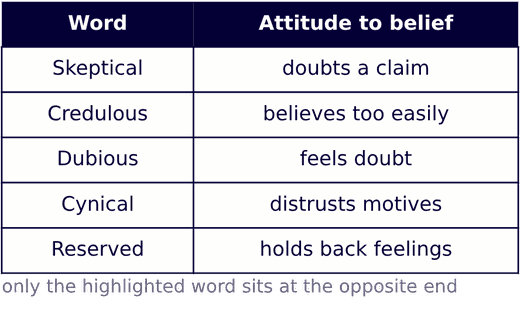
'Skeptical' means inclined to doubt, unwilling to believe a claim without proof.
Its opposite is a person who believes far too readily — 'credulous'.
'Dubious' and 'cynical' are near-synonyms of skeptical, and 'reserved' is about not showing one's feelings, which has nothing to do with belief.
14
Choose the correct one-word substitute for:
The killing of one's own sister.
A.Sororicide
B.Fratricide
C.Matricide
D.Suicide
Solution
One-word substitution
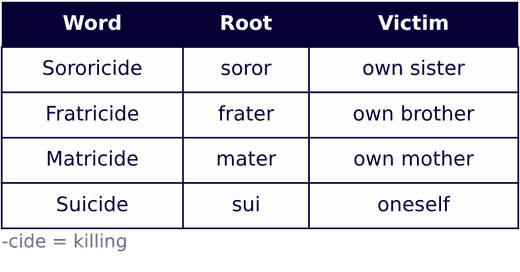
Latin soror means sister and the suffix -cide means killing, so 'sororicide' is the killing of one's own sister.
The remaining options only change the relative: frater (brother), mater (mother) and sui (oneself).
15
Choose the correct one-word substitute for:
A group of people travelling together, especially on a trade expedition.
A.Outflow
B.Exodus
C.Caravan
D.Sojourn
Solution
One-word substitution
A 'caravan' is a company of people journeying together, typically merchants crossing a desert on a trade route.
The key idea in the definition is the group itself, and only 'caravan' names a group.
'Outflow' is a movement away from a place, 'exodus' is a mass departure of people at one time, and 'sojourn' is a temporary stay.
16
Change the following sentence into the Active form.
A detailed map is being drawn by the architect.
A.The architect is drawing a detailed map.
B.A detailed map drew the architect.
C.The architect drew a detailed map.
D.The architect has drawn a detailed map.
Solution
Passive to active voice
The given verb 'is being drawn' is the present continuous passive.
Rule: the agent after 'by' becomes the subject, and 'is being + V3' becomes 'is/are + V-ing'.
So 'A detailed map is being drawn by the architect' turns into 'The architect is drawing a detailed map.'
(c) shifts to the simple past and (d) to the present perfect, while (b) makes the map the doer.
17
Select the most appropriate antonym of the word: Expressible
A.Ineffable
B.Relentless
C.Unsparing
D.Inflexible
Solution
Antonym
'Expressible' means capable of being put into words.
'Ineffable' means too great, too intense or too sacred to be expressed in words, which is the exact opposite.
The prefix in- here carries the sense of 'not', just as in 'inaudible' or 'invisible'.
'Relentless' (unyielding), 'unsparing' (withholding nothing) and 'inflexible' (rigid) have nothing to do with expression.
18
Select the option that expresses the given sentence in indirect voice. The captain said, "We will reach the summit by noon.'
A.The captain said that they would reach the summit by noon.
B.The captain said that we would reach the summit by noon.
C.The captain said that they will reach the summit by noon.
D.The captain said that we will reach the summit by noon.
Solution
Direct to indirect speech
The reporting verb 'said' is in the past tense, so the modal 'will' inside the quotation must shift back to 'would'.
'We', spoken by the captain about his own team, becomes 'they' when a third person reports it.
Applying both changes gives: 'The captain said that they would reach the summit by noon.'
(b) and (d) keep 'we' and (c) and (d) keep 'will', so each of them breaks one of the two rules.
19
Choose the most suitable option to replace the highlighted part of the sentence:Thirty miles have been the distance we drove to reach the beach house.
A.Thirty miles are the distance
B.Thirty miles is the distance
C.Thirty mile is the distance
D.Thirty miles are the distance covered
Solution
Subject-verb agreement
Expressions of distance, time, money and weight are treated as singular when they name one whole quantity.
'Thirty miles' here is one total distance, so it takes the singular verb, and the sentence states a present fact, so the plain present 'is' is needed rather than 'have been'.
Correct sentence: 'Thirty miles is the distance we drove to reach the beach house.'
(a) and (d) keep the plural 'are', and (c) wrongly drops the plural noun to 'thirty mile'.
20
Choose the most suitable option to replace the highlighted part of the sentence:
Versatility being the trend of the season, she altered the jacket to suit formal events even though it have originally stitched for casual one.
A.it has originally have been stitched for casual one
B.it has originally been stitched for casual ones
C.it has originally was stitched for casual ones
D.it has originally has been stitched to casual one
Solution
Sentence improvement
The clause needs a passive verb, because the jacket was stitched by somebody, so 'stitched' must follow a form of 'be'.
The subject 'it' is singular and the action is complete with respect to the present, so the present perfect passive 'has been stitched' is required.
The jacket now suits 'formal events' (plural), so the contrast must be 'casual ones', not 'casual one'.
That gives 'it has originally been stitched for casual ones'; (a), (c) and (d) each add a second, wrong auxiliary after 'has'.
21
Choose the correct active voice transformation of the sentence:
The diligent student's final thesis will have been submitted by the end of the semester.
A.The diligent student will have been submitting his final thesis by the end of the semester.
B.The diligent student will submit his final thesis by the end of the semester.
C.The diligent student will have submitted his final thesis by the end of the semester.
D.The diligent student has submitted his final thesis by the end of the semester.
Solution
Voice — active form
The given sentence is passive and its verb group is 'will have been submitted' — the future perfect tense.
In the active voice the future perfect keeps the pattern 'will have + V3', so 'will have been submitted' becomes 'will have submitted'.
The possessive 'the diligent student's' names the doer, so the student becomes the subject and 'his final thesis' becomes the object.
Hence: The diligent student will have submitted his final thesis by the end of the semester.
(a) turns it into the future perfect continuous, (b) into the simple future and (d) into the present perfect, so all three change the tense.
22
Choose the correct passive voice transformation of the sentence: The manager should have warned the staff about the changes in the schedule.
A.The staff should being warned about the changes in the schedule by the manager.
B.The staff should have been warned about the changes in the schedule by the manager.
C.The staff should have been warning about the changes in the schedule by the manager.
D.The staff should have warned about the changes in the schedule by the manager.
Solution
Voice — passive form
Active pattern here is: subject 'the manager' + modal perfect 'should have warned' + object 'the staff'.
A modal perfect turns passive as 'modal + have been + V3', so 'should have warned' becomes 'should have been warned'.
The object becomes the subject and the doer follows 'by': The staff should have been warned … by the manager.
Hence: The staff should have been warned about the changes in the schedule by the manager.
(c) keeps the -ing form 'warning' and (d) drops 'been', so neither is a passive structure; (a) has no finite passive verb at all.
23
Select the option that expresses the given sentence in direct voice. The director told the staff that their creative input and loyalty had been seen and admired.
A.The director said, "Your creative input and loyalty had been seen and admired."
B.The director said, "Your creative input and loyalty have been seen and admired."
C.The director told the staff, 'Their creative input and loyalty had been seen and admired.'
D.The director said, "Their creative input and loyalty were seen and admired."
Solution
Narration — direct speech
Moving from indirect to direct speech, the reporting verb 'told the staff … that' becomes 'said' and the spoken words go inside quotation marks.
The backshift of tense is undone: the past perfect 'had been seen and admired' returns to the present perfect 'have been seen and admired'.
The pronoun is re-set for the listener present: 'their' in the report becomes 'your' when the director speaks to the staff.
Hence: The director said, "Your creative input and loyalty have been seen and admired."
(a) keeps the backshifted 'had been', while (c) and (d) keep the third-person 'their', which belongs only to reported speech.
24
Select the option that expresses the given sentence in direct voice. She asked him if he would have been able to solve the puzzle that day if she had not given him the clue, which had been a very subtle hint.
A."Would you have been able to solve the puzzle today if I had not given you the clue, which was a very subtle hint?' she asked him.
B."Will you have been able to solve the puzzle today if I did not give you the clue, which was a very subtle hint?" she asked him.
C."Would you have been able to solve the puzzle that day if I had not given you the clue, which was a very subtle hint?' she asked him.
D."Could you solve the puzzle today if I had not given you the clue, which was a very subtle hint?" she asked him.
Solution
Narration — direct question
'She asked him if …' reports a yes/no question, so in direct speech it opens with the auxiliary: 'Would you have been able …?'
The reported changes are reversed: 'he' to 'you', 'she' to 'I', 'that day' to 'today' and 'had been a very subtle hint' to 'was a very subtle hint'.
'Would … have been able' is the main clause of a third conditional, so the modal itself must not change.
Hence: "Would you have been able to solve the puzzle today if I had not given you the clue, which was a very subtle hint?" she asked him.
(b) replaces 'would' with 'will' and (d) with 'could'; (c) keeps 'that day', which is the reported-speech form of 'today'.
25
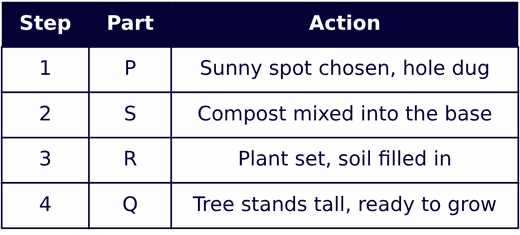
Rearrange the following sentence parts to form a meaningful and grammatically correct paragraph:
P. He selected a sunny spot and dug a deep hole in the nutrient-rich soil.
Q. The young tree stood tall and upright, ready to grow in the garden.
R. He carefully positioned the plant and filled the empty space with loose earth.
S. Before placing the sapling inside, he mixed some organic compost into the base.
A.S, P, R, Q
B.P, S, R, Q
C.Q, S, R, P
D.R, S, P, Q
Solution
Para jumble
The paragraph narrates the planting of a sapling, so the parts must follow the order in which the work is actually done.
P starts the action — a sunny spot is chosen and a deep hole is dug.
S must come next, because 'Before placing the sapling inside' points back to the hole that has just been dug.
R follows: the plant is positioned and the space around it is filled with loose earth.
Q closes the paragraph with the result of all this work — the young tree standing tall.
Hence the order is P, S, R, Q and option (b) is correct.
Finished reading? Now test yourself.
The same 25 questions, but with a timer and the answers hidden — 15 minutes.

 'Temporary', 'contemporary' and 'momentary' each tie a thing to one limited stretch of time, so each is closer to an opposite than a synonym.
 In (a), (c) and (d) 'minute' is an adjective meaning extremely small, a different word with a different stress and pronunciation.
 'Dubious' and 'cynical' are near-synonyms of skeptical, and 'reserved' is about not showing one's feelings, which has nothing to do with belief.
 The remaining options only change the relative: frater (brother), mater (mother) and sui (oneself).
 Hence the order is P, S, R, Q and option (b) is correct.