SSC CHSL 13 November 2025 · Shift 3 · General Awareness — questions with answers · ShikshaSphere
Chapter 18 of 200
13 November 2025 · Shift 3
General Awareness
25 questions ~25 min readFree
25 questions
A
76
Article 51 of the Indian Constitution primarily deals with which of the following objectives?
A.Development of rural cooperative institutions
B.Promotion of international peace and security
C.Implementation of a Uniform Civil Code
D.Regulation of agriculture and livestock activities
Solution
Directive Principles — Article 51
Article 51 lies in Part IV of the Constitution, which contains the Directive Principles of State Policy.
It directs the State to promote international peace and security, to maintain just and honourable relations between nations, to respect international law and treaty obligations and to encourage the settlement of international disputes by arbitration.
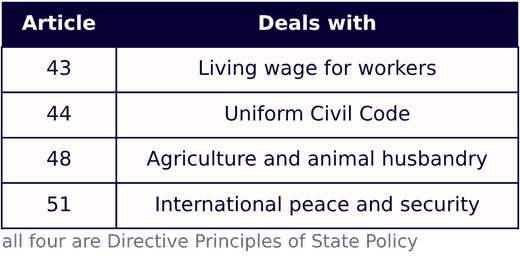
The other choices belong to different Articles: the Uniform Civil Code is Article 44 and the organisation of agriculture and animal husbandry is Article 48.
Hence option (b) is correct.
77
In September 2024, who assumed the position of Director General of the Narcotics Control Bureau (NCB) in India ?
A.Rakesh Singh
B.Anurag Garg
C.Vivek Sharma
D.Anil Verma
Solution
Appointments — NCB
Anurag Garg took charge as Director General of the Narcotics Control Bureau (NCB) in September 2024.
He is a 1993-batch IPS officer of the Himachal Pradesh cadre and his appointment was cleared by the Appointments Committee of the Cabinet; he succeeded S. N. Pradhan.
The NCB was constituted in 1986 under the NDPS Act, 1985, works under the Ministry of Home Affairs and is India's nodal agency against drug trafficking.
Hence option (b) is correct.
78
The Dharti Aaba Janjatiya Gram Utkarsh Abhiyan was launched on October 2, 2024, in which Indian state?
A.Chhattisgarh
B.Odisha
C.Jharkhand
D.Maharashtra
Solution
Government scheme — DAJGUA
The Dharti Aaba Janjatiya Gram Utkarsh Abhiyan was launched by Prime Minister Narendra Modi on 2 October 2024 from Hazaribagh in Jharkhand.
'Dharti Aaba', meaning 'Father of the Earth', is the popular name of the tribal freedom fighter Birsa Munda, who was born in Jharkhand.
The mission aims at saturation coverage of basic facilities in about 63,000 tribal-majority villages, benefiting nearly 5 crore tribal people.
Hence option (c) is correct.
79
In the World Competitiveness Index 2024, India holds which rank globally?
A.29th
B.46th
C.39th
D.52nd
Solution
Index and rank — competitiveness
India was placed 39th in the World Competitiveness Index 2024, an improvement of one place over its 40th rank in 2023.
The index is published every year by the International Institute for Management Development (IMD), Lausanne, and measures how well an economy manages its resources and competencies to create prosperity.
Singapore topped the 2024 ranking, followed by Switzerland and Denmark.
Hence option (c) is correct.
80
The State of the World's Children 2024 report is released by which international organization?
A.WHO
B.UNICEF
C.UNESCO
D.IMF
Solution
Reports and organisations
The State of the World's Children is the annual flagship report of UNICEF, the United Nations Children's Fund.
The 2024 edition, 'The Future of Childhood in a Changing World', examines how demographic change, the climate crisis and new technologies will shape children's lives by 2050.
UNICEF was created in 1946 and is headquartered in New York; the WHO, UNESCO and the IMF bring out other reports, not this one.
Hence option (b) is correct.
81
Allographa effusosoredica, a species recently discovered in the Western Ghats, belongs to which category?
A.Moss
B.Lichen
C.Frog
D.Beetle
Solution
Newly discovered species
Allographa effusosoredica is a newly described crustose lichen, reported from the Western Ghats.
A lichen is not one organism but a partnership — a fungus living with an alga; here the fungal partner grows with the green alga Trentepohlia.
Its name comes from its effuse soredia: loose, powdery bundles of algal cells wrapped in fungal threads, by which the lichen spreads vegetatively.
It also carries norstictic acid, one of the lichen substances that taxonomists use to tell closely related species apart.
Lichens absorb everything straight from the air, so they are sensitive indicators of clean air, and such a find adds to the biodiversity record of the Western Ghats.
82
The book "Above Average" is written by which author?
A.Chetan Bhagat
B.Amitabha Bagchi
C.Kiran Desai
D.Arundhati Roy
Solution
Authors and their books
Above Average (2007) is the debut novel of Amitabha Bagchi; it follows Arindam Chatterjee through coaching classes, IIT Delhi and the years after it.
Bagchi also wrote The Householder, This Place and Half the Night Is Gone, which won the DSC Prize for South Asian Literature in 2019.
The other three are well-known writers, but each is remembered for a different book, as the table shows.
83
'Mangal' folk songs, often performed during auspicious wedding ceremonies, are traditional to which Indian state?
A.Gujarat
B.Uttarakhand
C.Odisha
D.Karnataka
Solution
Folk songs of Uttarakhand
Mangal (Mangal geet) are the auspicious songs sung by the women of Uttarakhand at weddings, sacred-thread ceremonies and house-warmings.
They invoke the blessings of the local deities on the bride and the groom, and are sung in chorus with little or no instrumental support.
Mangal belongs to the ritual layer of Uttarakhand's folk music; other forms of the state are Jhoda, Chanchari, Bajuband, Chhopati and the invocatory ballad Jagar.
Gujarat, Odisha and Karnataka have their own wedding traditions, but the term Mangal geet is identified with the Himalayan belt of Uttarakhand.
84
The novel Pinjar, which depicts the hardships and trauma of the Partition of India, was authored by which writer?
A.Bhisham Sahni
B.Amrita Pritam
C.Rajinder Singh Bedi
D.Shashi Deshpande
Solution
Partition literature
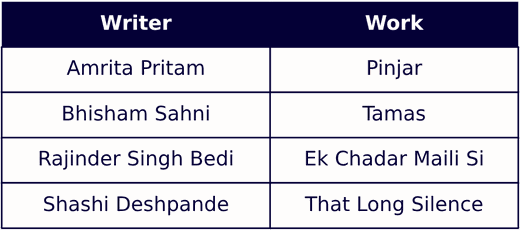
Pinjar (The Skeleton, 1950) is Amrita Pritam's Punjabi novel about Puro, a Hindu girl abducted on the eve of Partition and left belonging to neither community.
Amrita Pritam is also remembered for the poem 'Ajj Aakhaan Waris Shah Nu', her lament on the violence of 1947.
She was the first woman to receive the Sahitya Akademi Award in Punjabi (1956) and won the Jnanpith Award in 1981.
Bhisham Sahni and Rajinder Singh Bedi also wrote on Partition, but through Tamas and Ek Chadar Maili Si; Shashi Deshpande writes on quite different themes.
85
Which traditional dance is an important part of Sikkim's cultural heritage?
A.Garba
B.Snow Lion
C.Bihu
D.Lavani
Solution
Folk dances of states
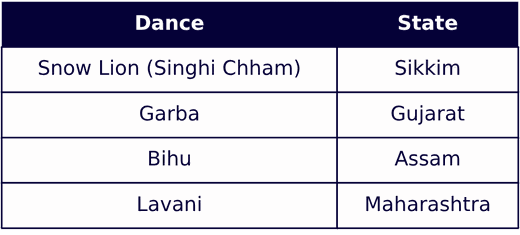
The Snow Lion dance — Singhi Chham — is a masked folk dance of Sikkim in which the dancers wear the costume of the mythical white snow lion of the Himalaya.
The snow lion stands for Mount Kanchenjunga, the guardian deity of Sikkim, so the dance is performed at Buddhist festivals such as Pang Lhabsol.
Sikkim's other traditional dances include Yak Chham, Chu Faat, Tamang Selo and the Sherpa dances.
Garba, Bihu and Lavani belong to Gujarat, Assam and Maharashtra respectively.
86
The widely accepted scientific explanation for the origin of the universe is known as the .
A.Steady State Theory
B.Big Bang Theory
C.Theory of Relativity
D.Multiverse Theory
Solution
Origin of the universe
The accepted account is the Big Bang Theory: about 13.8 billion years ago the universe began in an extremely hot, dense state and has been expanding ever since.
Two observations support it — the redshift of distant galaxies, which shows that they are all receding from us, and the cosmic microwave background radiation, the cooled afterglow of that early hot phase.
The Steady State Theory assumed instead that matter is created continuously so that the density of the expanding universe never changes; the discovery of the microwave background went against it.
The Theory of Relativity is Einstein's account of space, time and gravity, and the Multiverse is a speculative extension — neither is the accepted explanation of the origin.
87
When an object's speed or direction changes, it indicates which of the following?
A.Variation in its mass
B.Change in its state of motion
C.Alteration in its shape
D.Modification in its temperature
Solution
State of motion
The state of motion of a body is described by its velocity, and velocity has two parts — a magnitude, which is the speed, and a direction.
So if the speed changes, or the direction changes, or both change, the velocity has changed; that is exactly what is meant by a change in the state of motion.
Newton's first law says a body keeps its state of motion until an unbalanced external force acts on it, so such a change is the signal that a net force is acting.
Mass, shape and temperature are separate physical properties and none of them is what alters when the speed or the direction of a moving body changes.
88
India's first full-stack 25 -qubit quantum computer was developed by which startup?
A.Quantech Innovations
B.QpiAl
C.Photonix Labs
D.Qubit Solutions
Solution
Quantum computing in India
QpiAI, a Bengaluru deep-tech start-up founded in 2019 by Nagendra Nagaraja, built QpiAI-Indus, India's first full-stack 25-qubit superconducting quantum computer, unveiled in April 2025.
'Full stack' means the company made the whole chain itself — the qubit chip, the cryogenic system that cools it to near absolute zero, the control electronics and the software on top.
The machine was developed under the National Quantum Mission, approved in 2023, which funds quantum computing, communication, sensing and materials.
The remaining three names are not quantum-computing companies at all.
89
In the late 1980s, to manage the economic crisis, India approached which institution, also known as the International Bank for Reconstruction and Development?
A.Asian Development Bank
B.International Monetary Fund
C.World Bank
D.New Development Bank
Solution
World Bank and IBRD
The International Bank for Reconstruction and Development (IBRD) is the original and main lending arm of the World Bank Group, created at the Bretton Woods Conference of 1944.
It was set up to rebuild war-damaged Europe and now gives long-term loans to middle-income and creditworthy low-income countries.
Facing a widening balance-of-payments crisis at the end of the 1980s, India turned to the World Bank (IBRD) for development loans and to the IMF for balance-of-payments support.
The conditions attached to that assistance led to the New Economic Policy of 1991 — liberalisation, privatisation and globalisation.
The IMF is a separate Bretton Woods institution and does not carry the IBRD name; the ADB (1966) is a regional bank and the NDB (2014) is the BRICS bank.
90
As of July 2025, which central public sector enterprise has been granted the prestigious "Navratna" status?
A.Bharat Electronics Limited
B.Rashtriya Chemicals and Fertilizers Limited
C.Coal India Limited
D.Oil India Limited
Solution
Navratna CPSEs
Rashtriya Chemicals and Fertilizers Ltd (RCF) holds Navratna status, conferred on it by the Department of Public Enterprises.
RCF is a Mumbai-based fertiliser and industrial-chemicals CPSE working under the Ministry of Chemicals and Fertilizers; Ujjwala and Suphala are its well-known brands.
Navratna status lets a CPSE invest up to ₹1,000 crore, or 15% of its net worth in one project, without the government's prior approval.
To qualify, a company must already be a Miniratna Category-I with Schedule 'A' status and score at least 60 out of 100 on parameters such as net profit, net worth, manpower cost and earnings per share.
Coal India and Oil India are ruled out because both hold the higher Maharatna status.
91
The Khalsa was formally established in the year 1699 by which Sikh Guru ?
A.Guru Angad Dev
B.Guru Amar Das
C.Guru Har Rai
D.Guru Gobind Singh
Solution
Founding of the Khalsa
Guru Gobind Singh, the tenth and last human Sikh Guru, founded the Khalsa on Baisakhi day in 1699 at Anandpur Sahib.
He asked the gathering for volunteers ready to give their heads; the five who came forward were initiated with amrit (khande-di-pahul) as the Panj Pyare, and the Guru then took initiation from them in turn.
Members of the Khalsa took the surname Singh or Kaur and kept the five K's — kesh, kangha, kara, kachera and kirpan — turning the Sikh community into a disciplined and egalitarian order.
Guru Angad Dev popularised the Gurmukhi script, Guru Amar Das institutionalised the langar and the Manji system, and Guru Har Rai was the seventh Guru — none of them founded the Khalsa.
92
Which slogan is historically associated with the Indian nationalist leader Bal Gangadhar Tilak ?
A."Inquilab Zindabad"
B."Do or Die"
C."Freedom is my birthright and I shall have it!"
D."Vande Mataram"
Solution
Slogans of the freedom struggle
'Freedom (Swaraj) is my birthright and I shall have it!' is the declaration of Bal Gangadhar Tilak, made while he was defending the demand for self-rule.
Tilak, called Lokmanya, led the extremist wing of the Congress along with Lala Lajpat Rai and Bipin Chandra Pal — the trio known as Lal-Bal-Pal.
He started the Ganapati and Shivaji festivals and the papers Kesari and Maratha to carry the national idea to ordinary people.
The other three slogans belong to different figures, as the table shows.
93
Who has the constitutional authority to dissolve the House of the People (Lok Sabha) before the completion of its term?
A.The Election Commission of India
B.The Vice President of India
C.The Chief Minister of India
D.The President acting on the advice of the Prime Minister
Solution
Dissolution of the Lok Sabha
The Lok Sabha normally runs for five years from the date of its first sitting, but it may be dissolved earlier.
Article 85(2)(b) of the Constitution vests the power of dissolution in the President of India.
Article 74 requires the President to act on the aid and advice of the Council of Ministers headed by the Prime Minister, so in practice the House is dissolved when the Prime Minister advises it.
The Election Commission only conducts the elections that follow; the Vice-President is the ex-officio Chairman of the Rajya Sabha; and there is no office called 'Chief Minister of India'.
94
Which of the following crops is not typically grown under dryland farming conditions?
A.Sorghum (Jowar)
B.Pearl millet
C.Jute
D.Finger millet
Solution
Dryland farming crops
Dryland (rainfed) farming is practised where the annual rainfall is below about 750 mm and there is no assured irrigation.
Such land can carry only drought-hardy, short-duration crops — jowar (sorghum), bajra (pearl millet), ragi (finger millet), pulses and oilseeds — so options (a), (b) and (d) all fit.
Jute is the exception: it needs 120-150 cm of rainfall, high humidity and standing water for retting the stems.
That is why jute is grown in the Ganga-Brahmaputra delta — West Bengal, Assam and Bihar — and not on dry land.
95
What was the primary objective of land reform measures introduced in India after Independence?
A.To bring changes in the ownership and distribution of landholdings
B.To promote rapid urban development
C.To encourage foreign investment in the agricultural sector
D.To transfer agricultural land entirely to private corporations
Solution
Land reforms in India
At Independence India inherited the zamindari system, a heavy concentration of land in few hands and tenants with no security.
Land reform therefore attacked the landholding structure itself — abolition of intermediaries, security of tenure and fair rent for tenants, ceilings on holdings with the surplus redistributed, and consolidation of scattered plots.
The purpose was both social justice, expressed in the slogan 'land to the tiller', and higher output, since an owner-cultivator invests far more in his field.
Urban growth, foreign investment and corporate ownership of farmland were never the aim; ceiling laws in fact restricted large holdings.
96
In which financial year was Child Budgeting introduced for the first time by the Government of India?
A.2008-09
B.2005-06
C.2010-11
D.2016-17
Solution
Child Budgeting
Child Budgeting is the practice of tracking, across all ministries, how much of the Union Budget is actually spent on children, that is on persons below 18 years.
It was introduced for the first time in the Budget of 2008-09, when a separate statement on child-related schemes was placed in the Expenditure Budget.
The spending is grouped under four heads — child education, child health, child development and child protection — and is coordinated by the Ministry of Women and Child Development.
It follows the earlier model of Gender Budgeting, whose statement was introduced in 2005-06, which is why that year is the tempting wrong choice here.
97
Which type of deficit accounts exclusively for transactions related to the government's current income and current expenditure?
A.Budgetary deficit
B.Revenue deficit
C.Capital deficit
D.Primary deficit
Solution
Types of budget deficit
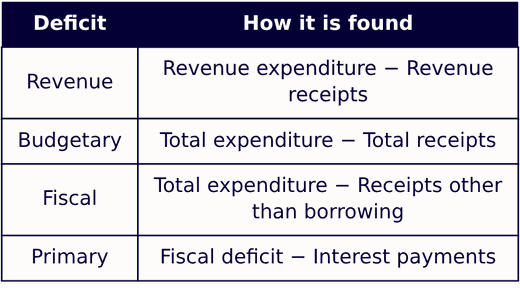
Revenue receipts (taxes, interest, dividends) and revenue expenditure (salaries, subsidies, interest payments) form the government's current account — they neither create assets nor reduce liabilities.
The gap between the two is the revenue deficit: .
It is the only deficit confined to current income and current expenditure, and it warns that the government is borrowing merely to meet its running costs.
'Capital deficit' is not a term used in the Indian budget at all.
98
When air enters the human respiratory system, how is it filtered at the initial stage?
A.By fine hairs present in the nostrils
B.By the alveoli of the lungs
C.By the epiglottis
D.By the tracheal cartilage rings
Solution
Human respiratory system
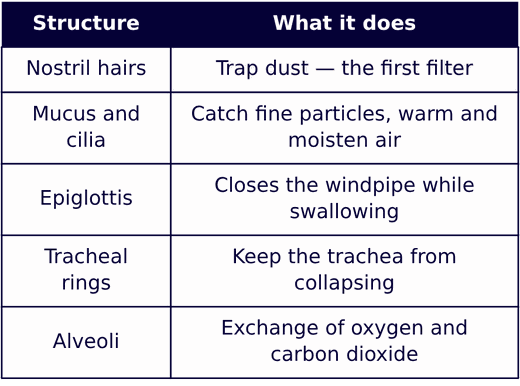
Air enters the body through the nostrils, and the first cleaning it gets is from the fine hairs (vibrissae) that line them, which hold back dust and other large particles.
Deeper in, the nasal passage is lined with mucus and cilia that trap finer particles and microbes and also warm and moisten the air before it reaches the lungs.
The other three structures act later or do other work, so none of them is the initial filter.
99
With reference to the phloem in plants, consider the following statements:
I. The movement of food through phloem requires energy.
II. Substances are loaded into the phloem using ATP.
Which of the statements given above is/are correct?
A.Statement I only
B.Statement II only
C.Both I and II
D.Neither statement is correct
Solution
Translocation in phloem
Translocation, the transport of food through the phloem, is an active process — unlike water in the xylem, which is pulled up passively by transpiration.
At the source, usually a leaf, sugars are loaded into the sieve tubes against a concentration gradient, and the energy for this loading comes from ATP, so Statement II is correct.
The loading raises the solute concentration in the sieve tube, water therefore moves in from the neighbouring xylem, and the pressure that builds up pushes the sap towards the sink — root, fruit or growing tissue.
Since the whole movement depends on that energy-driven step, Statement I is correct as well, and both statements together describe the process.
This is why food can travel in phloem in either direction, upward or downward, while water in xylem moves only upward.
100
In Jaina ethical philosophy, what does the vow of aparigraha signify?
A.Observing extreme fasting
B.Avoiding the act of stealing
C.Practising absolute truthfulness
D.non-possession of things more than one's requirement
Solution
Jaina philosophy: vows
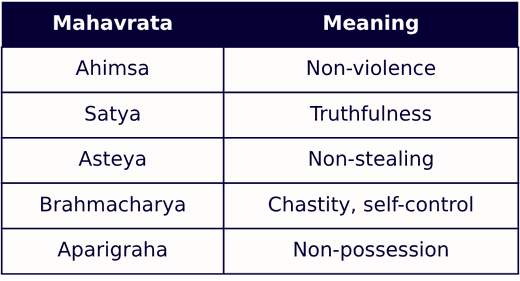
Aparigraha means non-possession — keeping no more than one actually needs and giving up attachment to what one owns.
It is one of the five great vows (pancha mahavrata) of Jainism; Parshvanatha had taught four restraints and Mahavira added brahmacharya as the fifth.
Possessions breed greed and attachment, which bind fresh karma to the soul, so limiting them is treated as a step towards liberation.
The other options name different things: extreme fasting is the separate practice of sallekhana, non-stealing is asteya and truthfulness is satya.
Finished reading? Now test yourself.
The same 25 questions, but with a timer and the answers hidden — 15 minutes.

 The other choices belong to different Articles: the Uniform Civil Code is Article 44 and the organisation of agriculture and animal husbandry is Article 48.
Hence option (b) is correct.
The other choices belong to different Articles: the Uniform Civil Code is Article 44 and the organisation of agriculture and animal husbandry is Article 48.
Hence option (b) is correct.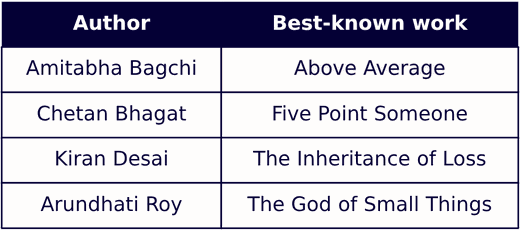 The other three are well-known writers, but each is remembered for a different book, as the table shows.
 Bhisham Sahni and Rajinder Singh Bedi also wrote on Partition, but through Tamas and Ek Chadar Maili Si; Shashi Deshpande writes on quite different themes.
 Sikkim's other traditional dances include Yak Chham, Chu Faat, Tamang Selo and the Sherpa dances.
Garba, Bihu and Lavani belong to Gujarat, Assam and Maharashtra respectively.
Sikkim's other traditional dances include Yak Chham, Chu Faat, Tamang Selo and the Sherpa dances.
Garba, Bihu and Lavani belong to Gujarat, Assam and Maharashtra respectively.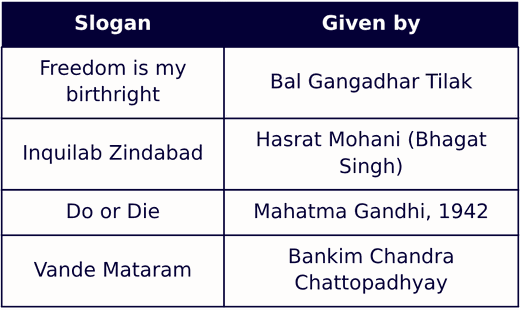 The other three slogans belong to different figures, as the table shows.
 'Capital deficit' is not a term used in the Indian budget at all.
 The other three structures act later or do other work, so none of them is the initial filter.
 Possessions breed greed and attachment, which bind fresh karma to the soul, so limiting them is treated as a step towards liberation.
The other options name different things: extreme fasting is the separate practice of sallekhana, non-stealing is asteya and truthfulness is satya.
Possessions breed greed and attachment, which bind fresh karma to the soul, so limiting them is treated as a step towards liberation.
The other options name different things: extreme fasting is the separate practice of sallekhana, non-stealing is asteya and truthfulness is satya.