SSC CHSL 14 November 2025 · Shift 1 · English Language — questions with answers · ShikshaSphere
Chapter 24 of 200
14 November 2025 · Shift 1
English Language
25 questions ~25 min readFree
25 questions
A
1
Identify the part of the sentence that contains a grammatical error.
A. I couldn't
B. find my keys
C. nowhere
D. in the room.
A.I couldn't
B.find my keys
C.nowhere
D.in the room.
Solution
Double negative error
Part C is the faulty part: 'couldn't' is itself a negative form, so a second negative word cannot follow it.
English does not allow two negatives in the same clause; the negative idea is already carried by 'could not'.
With a negative verb the correct indefinite adverb of place is 'anywhere', not 'nowhere'.
Corrected sentence: I couldn't find my keys anywhere in the room.
Hence the correct option is (c).
2
Fill in the blank with the most appropriate phrase:
The senators couldn't agree, so they decided to meet and pass a modified energy bill.
A.off my chest
B.cold feet
C.under the weather
D.halfway
Solution
Idiomatic phrase
The blank must hold a phrase that goes with the verb 'meet' and explains how senators who could not agree still passed a modified bill.
'To meet halfway' means to compromise — each side gives up a part of its demand so that an agreement becomes possible.
The word 'modified' is the clue: the bill was changed to suit both sides, which is exactly what a compromise produces.
'Get something off my chest' = to confess a worry; 'cold feet' = sudden nervousness; 'under the weather' = slightly unwell — none of these can follow 'decided to meet'.
Hence the correct option is (d).
3
Select the most appropriate synonym of the word:
Sincere
A.Verbose
B.Genuine
C.Glib
D.Articulate
Solution
Synonym
'Sincere' means free from pretence or deceit — honest in what one feels and says.
'Genuine' carries the same sense of being real and truthful, so it is the required synonym.
'Verbose' = using more words than necessary; 'Glib' = fluent but insincere, which is the opposite idea; 'Articulate' = able to express ideas clearly, a matter of skill and not of honesty.
Hence the correct option is (b).
4
Fill in the blank with the most appropriate idiom:
After a year of she finally got the promotion she deserved.
A.the grapevine
B.the skin of my teeth
C.thick and thin
D.keeping her nose to the grindstone
Solution
Idiom in context
The blank needs an idiom describing what she did for a whole year before the deserved promotion finally came.
'To keep one's nose to the grindstone' means to work hard, steadily and without a break — precisely the effort that earns a promotion.
'Through the grapevine' = by rumour; 'by the skin of one's teeth' = only just, barely; 'through thick and thin' = in good times and bad — none of them describes sustained hard work.
Hence the correct option is (d).
5
Which of the following sentences uses the word "tire" with the same meaning as in the following sentence?
The driver checked the tire for any signs of wear before starting the race.
A.The toddler began to tire after a long afternoon of playing at the park.
B.After hitting a large pothole, I had to pull over to change a flat tire.
C.If you don't take a break soon, you will quickly tire yourself out.
D.The long walk made him tire.
Solution
Homonym usage
In the given sentence 'tire' is a noun — the rubber covering of a wheel, which the driver checks for signs of wear.
Option (b) uses the same noun: a 'flat tire' is changed after the car hits a pothole.
In (a), (c) and (d) 'tire' is a verb meaning 'to become or make weary', an entirely different sense.
Hence the correct option is (b).
6
Directions (Qs. 6-10): Read the following passage carefully and answer the questions that follow.
Literature, being a timeless vessel of human expression, holds a profound sway over civilization, shaping ethical standards, collective wisdom, and personal beliefs. Books are far more than a source of leisure; they embody and critique historical truths and serve as a reflection of the shared soul of humanity. Literature can unveil fresh perspectives, question established dogmas, and spark vital conversations regarding moral dilemmas. Iconic protagonists and narratives can resonate across centuries, influencing language, philosophy, and
even aspirations. The descriptive and intellectual depth of reading offers a unique form of connection, immersing readers in diverse minds and cultures, thereby fostering understanding and broadening outlooks. However, this influence carries a burden; books can cement biases, propagate dangerous propaganda, or present distorted views of reality, which is why it is essential to engage deeply and analytically with the texts we consume.
What is one of the primary impacts of literature on civilization according to the text?
A.It serves only as a distraction and has no real value
B.It shapes ethical standards, collective wisdom, and personal beliefs
C.It is used mainly for academic grading purposes
D.It focuses entirely on fiction and imaginary worlds
Solution
Reading comprehension
The very first sentence answers this: literature 'holds a profound sway over civilization, shaping ethical standards, collective wisdom, and personal beliefs'.
So its primary impact is on ethics, on shared wisdom and on individual belief — exactly option (b).
(a) and (c) contradict the passage, which calls books 'far more than a source of leisure'; (d) is wrong because the passage nowhere limits literature to fiction.
Hence the correct option is (b).
7
Directions (Qs. 6-10): Read the following passage carefully and answer the questions that follow.
Literature, being a timeless vessel of human expression, holds a profound sway over civilization, shaping ethical standards, collective wisdom, and personal beliefs. Books are far more than a source of leisure; they embody and critique historical truths and serve as a reflection of the shared soul of humanity. Literature can unveil fresh perspectives, question established dogmas, and spark vital conversations regarding moral dilemmas. Iconic protagonists and narratives can resonate across centuries, influencing language, philosophy, and
even aspirations. The descriptive and intellectual depth of reading offers a unique form of connection, immersing readers in diverse minds and cultures, thereby fostering understanding and broadening outlooks. However, this influence carries a burden; books can cement biases, propagate dangerous propaganda, or present distorted views of reality, which is why it is essential to engage deeply and analytically with the texts we consume.
How does literature question established dogmas according to the text?
A.By cementing biases
B.By focusing solely on leisure
C.By unveiling fresh perspectives and sparking conversations
D.By avoiding moral dilemmas
Solution
Reading comprehension
The third sentence states: 'Literature can unveil fresh perspectives, question established dogmas, and spark vital conversations regarding moral dilemmas.'
Dogmas are questioned through the two things named beside them — new perspectives and the vital conversations they set off.
(a) cementing biases is listed later as a danger, not a method; (b) contradicts 'far more than a source of leisure'; (d) is the reverse, since literature engages with moral dilemmas rather than avoiding them.
Hence the correct option is (c).
8
Directions (Qs. 6-10): Read the following passage carefully and answer the questions that follow.
Literature, being a timeless vessel of human expression, holds a profound sway over civilization, shaping ethical standards, collective wisdom, and personal beliefs. Books are far more than a source of leisure; they embody and critique historical truths and serve as a reflection of the shared soul of humanity. Literature can unveil fresh perspectives, question established dogmas, and spark vital conversations regarding moral dilemmas. Iconic protagonists and narratives can resonate across centuries, influencing language, philosophy, and
even aspirations. The descriptive and intellectual depth of reading offers a unique form of connection, immersing readers in diverse minds and cultures, thereby fostering understanding and broadening outlooks. However, this influence carries a burden; books can cement biases, propagate dangerous propaganda, or present distorted views of reality, which is why it is essential to engage deeply and analytically with the texts we consume.
What aspect of reading contributes to its unique form of connection?
A.Its use of simple vocabulary and short sentences
B.Its descriptive and intellectual depth
C.Its focus on unrealistic plot twists
D.Its reliance on visual illustrations and covers
Solution
Reading comprehension
The relevant line is: 'The descriptive and intellectual depth of reading offers a unique form of connection.'
So the connection springs from depth — of description and of thought — which immerses the reader in other minds and cultures.
Simple vocabulary, plot twists and visual illustrations are never mentioned anywhere in the passage.
Hence the correct option is (b).
9
Directions (Qs. 6-10): Read the following passage carefully and answer the questions that follow.
Literature, being a timeless vessel of human expression, holds a profound sway over civilization, shaping ethical standards, collective wisdom, and personal beliefs. Books are far more than a source of leisure; they embody and critique historical truths and serve as a reflection of the shared soul of humanity. Literature can unveil fresh perspectives, question established dogmas, and spark vital conversations regarding moral dilemmas. Iconic protagonists and narratives can resonate across centuries, influencing language, philosophy, and
even aspirations. The descriptive and intellectual depth of reading offers a unique form of connection, immersing readers in diverse minds and cultures, thereby fostering understanding and broadening outlooks. However, this influence carries a burden; books can cement biases, propagate dangerous propaganda, or present distorted views of reality, which is why it is essential to engage deeply and analytically with the texts we consume.
What necessity regarding reading is mentioned in the text ?
A.To read without analyzing the content
B.To reinforce stereotypes and spread propaganda
C.To offer a distorted view of reality and avoid thought
D.To engage deeply and analytically with the texts
Solution
Reading comprehension
The passage closes with a caution: books can cement biases and distort reality, 'which is why it is essential to engage deeply and analytically with the texts we consume'.
That is the necessity the writer states — reading actively and critically, not passively.
(a), (b) and (c) name the very dangers the writer warns against, so none of them can be what he recommends.
Hence the correct option is (d).
10
Directions (Qs. 6-10): Read the following passage carefully and answer the questions that follow.
Literature, being a timeless vessel of human expression, holds a profound sway over civilization, shaping ethical standards, collective wisdom, and personal beliefs. Books are far more than a source of leisure; they embody and critique historical truths and serve as a reflection of the shared soul of humanity. Literature can unveil fresh perspectives, question established dogmas, and spark vital conversations regarding moral dilemmas. Iconic protagonists and narratives can resonate across centuries, influencing language, philosophy, and
even aspirations. The descriptive and intellectual depth of reading offers a unique form of connection, immersing readers in diverse minds and cultures, thereby fostering understanding and broadening outlooks. However, this influence carries a burden; books can cement biases, propagate dangerous propaganda, or present distorted views of reality, which is why it is essential to engage deeply and analytically with the texts we consume.
What is a potential adverse effect of books, according to the text ?
A.They have no influence on personal views
B.They can cement biases and propagate dangerous propaganda
C.They are always objective records of history
D.They only focus on linguistic appeal without any moral influence
Solution
Reading comprehension
The last sentence lists the burden that literature's influence carries: books 'can cement biases, propagate dangerous propaganda, or present distorted views of reality'.
Option (b) reproduces two of these adverse effects word for word.
(a) and (d) deny the influence that the whole passage asserts, and (c) is refuted by 'they embody and critique historical truths'.
Hence the correct option is (b).
11
Choose the incorrectly spelt word:
A.Impermanence
B.Transitory
C.Ephemeral
D.Evanesense
Solution
Spelling
'Evanesense' is the misspelt word; the correct spelling is 'Evanescence'.
It is formed from the adjective 'evanescent', so the -sc- of the stem is kept and the noun ends in -ence, not -sense.
'Impermanence', 'Transitory' and 'Ephemeral' are all spelt correctly, and all four words belong to the idea of something that does not last.
Hence the correct option is (d).
12
Choose the incorrectly spelt word:
A.malicious
B.Ferocious
C.suspicious
D.Voluptous
Solution
Spelling
'Voluptous' is the misspelt word; the correct spelling is 'Voluptuous'.
The adjective takes the ending -uous (like sumptuous, tumultuous), so the u before -ous must not be dropped.
'malicious', 'Ferocious' and 'suspicious' are correctly spelt — these end in -cious, a different and regular ending.
Hence the correct option is (d).
13
Choose the correct meaning of the highlighted idiom in the given sentence. My sister loves big parties, while I prefer quiet nights in. we're like chalk and cheese.
A.Very similar in appearance
B.Completely different from each other
C.Closely related by blood
D.Able to get along easily preparation
Solution
Meaning of an idiom
The idiom 'chalk and cheese' compares two things that may be put side by side yet are utterly unlike each other.
The sentence sets a sister who loves big parties against a speaker who prefers quiet nights in — a plain contrast.
So the idiom must mean 'completely different from each other'; being related by blood or getting along easily is not what the contrast conveys.
Hence the correct option is (b).
14
Choose the correct one-word substitute for :
A person, country, or organization that owes money.
A.collector
B.lender
C.debtor
D.insolvent
Solution
One-word substitution
A 'debtor' is a person, country or organisation that owes money — from 'debt' plus the agent ending -or, i.e. the one who carries the debt.
A 'lender' is the opposite party, the one who gives the money; a 'collector' is the official who collects dues.
'Insolvent' is an adjective for someone who is unable to pay debts at all — a stronger and different idea from merely owing money.
Hence the correct option is (c).
15
Select the most appropriate antonym of the word: Wisdom
A.Pride
B.Knowledge
C.Ignorance
D.Superiority
Solution
Antonym
'Wisdom' is the ability to judge rightly by using knowledge and experience, so its opposite must be an absence of knowledge.
'Ignorance' is exactly that lack of knowledge, understanding or awareness, and is therefore the antonym.
'Knowledge' is a near-synonym rather than an opposite; 'pride' and 'superiority' belong to a different field altogether — self-regard and rank.
Hence the correct option is (c).
16
Select the most appropriate antonym of the word: Heretic
A.Rebellous
B.Unconcerned
C.Iconoclast
D.Conformist
Solution
Antonym
A 'heretic' is one who holds beliefs contrary to accepted doctrine, so its opposite must be one who accepts and follows what is established.
A 'conformist' does exactly that — he conforms to the accepted rules, customs and beliefs of his group.
'Iconoclast', one who attacks established beliefs, is a synonym of heretic and not its opposite; 'Rebellous' (for 'rebellious') points the same rebellious way.
'Unconcerned' merely means indifferent, which is neither agreement nor opposition.
Hence the correct option is (d).
17
Choose the correct one-word substitute for:
Solving problems in a practical and sensible way
A.Optimist
B.Pragmatic
C.Fatalist
D.Pacifist
Solution
One-word substitution
'Pragmatic' describes dealing with a problem in a practical, sensible way rather than by theory or ideals.
The definition given is therefore matched exactly by 'Pragmatic'.
An 'optimist' expects good outcomes, a 'fatalist' believes events are fixed by fate, and a 'pacifist' opposes violence and war — none of them names a practical method of solving problems.
Hence the correct option is (b).
18
Change the following sentence into the Active form.
When were the tickets booked by you?
A.When did you book the tickets?
B.When you booked the tickets?
C.When have you booked the tickets?
D.When do you book the tickets?
Solution
Passive to active voice
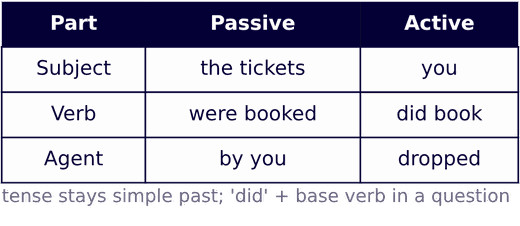
The given sentence is passive: object 'the tickets', agent 'by you', verb 'were booked' — simple past tense.
To make it active, the agent becomes the subject and the object becomes the object, while the tense stays simple past.
In an interrogative sentence the simple past is formed with 'did' + the base verb, so 'were booked by you' becomes 'did you book'.
This gives: When did you book the tickets?
(b) drops the auxiliary 'did'; (c) shifts to the present perfect and (d) to the simple present, so both change the tense of the original.
Hence the correct option is (a).
19
Select the option that expresses the given sentence in indirect voice.
She said to him, "If you help me now, I will share the secret that I was keeping from everyone."
A.She told him that if he helped her then, she would share the secret that she had been keeping from everyone.
B.She told him that if he helps her now, she will share the secret that she was keeping from everyone.
C.She told him that if he helped her then, she would share the secret that she was keeping from everyone.
D.She told him that if he could help her now, she would share the secret that she had been keeping from everyone.
Solution
Direct to indirect speech
The reporting verb 'said to' becomes 'told', and 'him' stays on as its object.
'Told' is in the past, so every reported verb moves one tense back.
The pronouns change with the speakers: 'you' becomes 'he', and 'me' / 'I' become 'her' / 'she'; the time word 'now' becomes 'then'.
Only option (a) carries out all of these changes, including 'was keeping' to the past perfect continuous 'had been keeping'.
(b) keeps the present forms and 'now'; (c) leaves 'was keeping' unchanged; (d) alters the condition to 'could help' and also keeps 'now'.
Hence the correct option is (a).
20
Choose the most suitable option to replace the highlighted part of the sentence:No less than fifty students attended the seminar.
A.No few than
B.No lesser than
C.No fewer than
D.No little than
Solution
Fewer vs less
'Fewer' is used with countable nouns in the plural, while 'less' is used with uncountable quantities.
'Students' can be counted one by one, so the comparative before it must be 'fewer'.
The correct sentence therefore reads: No fewer than fifty students attended the seminar.
'No lesser than' compares value or rank, and 'No few than' and 'No little than' are not English constructions at all.
Hence the correct option is (c).
21
Choose the most suitable option to replace the highlighted part of the sentence:
In a strategic move to reduce operational costs, the board of directors unanimously rejecting the proposal submitting by the finance committee last week.
A.unanimously rejecting the proposal submitted by the
B.unanimously rejected the proposal submitting by the
C.unanimously rejected the proposal submitted by the
D.unanimously reject the proposal submitted by the
Solution
Finite verb and participle
The clause has no finite verb — 'rejecting' is only a participle, so the sentence is left incomplete.
'last week' fixes the action in the completed past, so the main verb must be the simple past 'rejected'.
The proposal was submitted by the finance committee, so the modifier needs the past participle 'submitted', not 'submitting'.
This gives 'unanimously rejected the proposal submitted by the finance committee last week', which is option (c).
(b) keeps the wrong 'submitting'; (d) uses the present 'reject', which clashes with 'last week'.
22
Choose the correct passive voice transformation of the sentence:
He writes a letter every week.
A.A letter was written by him every week.
B.A letter is written by him every week.
C.A letter has been written by him every week.
D.A letter is being written by him every week.
Solution
Passive voice, simple present
The active sentence 'He writes a letter every week' is in the simple present tense.
Rule: subject + verb (s-form) + object becomes object + is/am/are + third form of the verb + by + agent.
So 'a letter' becomes the subject, 'writes' becomes 'is written' and 'he' becomes 'by him'.
The adverbial 'every week' stays at the end: 'A letter is written by him every week.' — option (b).
(a) 'was written' is past, (c) 'has been written' is present perfect and (d) 'is being written' is present continuous, so none of them keeps the original tense.
23
Select the option that expresses the given sentence in direct voice.
The auditor asked the accountant how he had calculated those figures when the data was missing from the report.
A.The auditor asked the accountant, "How have you calculated those figures when the data had been missing from the report?"
B.The auditor asked the accountant, "How did you calculate these figures when the data was missing from the report?*
C.The auditor asked the accountant, "How do you calculate these figures when the data is missing from the report?'
D.The auditor asked the accountant, "How had you calculated these figures when the data has been missing from the report?"
Solution
Indirect to direct speech
The reporting verb 'asked' introduces a question, so in direct speech the spoken words go inside quotation marks and end with a question mark.
The back-shift of tense is undone: past perfect 'had calculated' returns to the simple past 'did you calculate', and 'was missing' was already the speaker's own tense.
The reported word order 'how he had calculated' becomes the question order 'How did you calculate...?', and the distant 'those' becomes the near 'these'.
So the direct form is: The auditor asked the accountant, "How did you calculate these figures when the data was missing from the report?" — option (b).
(a) and (d) keep back-shifted tenses inside the quotation marks, and (c) pushes everything into the present, which the original does not support.
24
Rearrange the following sentence parts to form a meaningful and grammatically correct paragraph:
P. She sealed the envelope and pasted a stamp on the top right corner.
Q. She walked to the post office and dropped the letter in the mailbox.
R. She sat down at her desk and wrote a heartfelt letter to her friend.
S. Hoping for a quick reply, she walked back home with a smile.
A.R, P, Q, S
B.P, R, Q, S
C.R, Q, P, S
D.Q, P, R, S
Solution
Sentence rearrangement
R is the opener: it introduces the doer and the first action — she sits at her desk and writes the letter.
P follows R, because an envelope can be sealed and stamped only after the letter inside it has been written.
Q comes next: with the letter ready, she walks to the post office and drops it in the mailbox.
S closes the paragraph — 'Hoping for a quick reply' looks back at the letter she has just posted and takes her home.
The chain R - P - Q - S matches option (a).
25
Rearrange the following sentence parts to form a meaningful and grammatically correct paragraph:
P. This intellectual shift prioritized human potential and evidence over religious dogma and superstition.
Q. The Enlightenment was a dominant intellectual and philosophical movement that swept across Europe in the 17th and 18th centuries.
R. It was driven by a range of ideas centered on the sovereignty of reason and the evidence of the senses as the primary sources of knowledge.
S. Consequently, the era produced revolutionary advancements in science, politics, and society that paved the way for the modern world.
A.Q, R, P, S
B.P, Q, R, S
C.R, Q, S, P
D.S, R, Q, P
Solution
Sentence rearrangement
Q is the opening sentence: it names the topic, the Enlightenment, and places it in Europe in the 17th and 18th centuries.
R follows Q, because it begins with the pronoun 'It', which can only point back to the movement just named.
P then follows R, since 'This intellectual shift' refers to the ideas of reason and evidence described in R.
S is the conclusion — 'Consequently' sums up what the movement finally produced.
Hence the order is Q - R - P - S, option (a).
Finished reading? Now test yourself.
The same 25 questions, but with a timer and the answers hidden — 15 minutes.

 This gives: When did you book the tickets?
(b) drops the auxiliary 'did'; (c) shifts to the present perfect and (d) to the simple present, so both change the tense of the original.
Hence the correct option is (a).
This gives: When did you book the tickets?
(b) drops the auxiliary 'did'; (c) shifts to the present perfect and (d) to the simple present, so both change the tense of the original.
Hence the correct option is (a).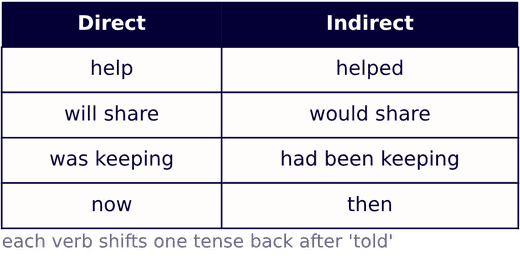 The pronouns change with the speakers: 'you' becomes 'he', and 'me' / 'I' become 'her' / 'she'; the time word 'now' becomes 'then'.
Only option (a) carries out all of these changes, including 'was keeping' to the past perfect continuous 'had been keeping'.
(b) keeps the present forms and 'now'; (c) leaves 'was keeping' unchanged; (d) alters the condition to 'could help' and also keeps 'now'.
Hence the correct option is (a).
The pronouns change with the speakers: 'you' becomes 'he', and 'me' / 'I' become 'her' / 'she'; the time word 'now' becomes 'then'.
Only option (a) carries out all of these changes, including 'was keeping' to the past perfect continuous 'had been keeping'.
(b) keeps the present forms and 'now'; (c) leaves 'was keeping' unchanged; (d) alters the condition to 'could help' and also keeps 'now'.
Hence the correct option is (a).