SSC CHSL 14 November 2025 · Shift 2 · General Intelligence — questions with answers · ShikshaSphere
Chapter 25 of 200
14 November 2025 · Shift 2
General Intelligence
25 questions ~25 min readFree
25 questions
A
26
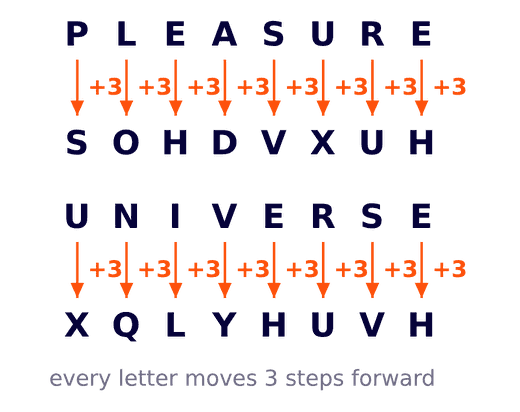
If PLEASURE is written as SOHDVXUH , how is UNIVERSE coded ?
A.XQLXHVVH
B.XQJVHTWF
C.XQLYHUVH
D.WPKXGUUH
Solution
Letter coding
Compare PLEASURE with its code SOHDVXUH letter by letter: P→S, L→O, E→H, A→D, S→V, U→X, R→U, E→H.
Every letter has moved 3 places forward in the alphabet, so the rule is +3.
Applying the same +3 shift to UNIVERSE: U→X, N→Q, I→L, V→Y, E→H, R→U, S→V, E→H.
So UNIVERSE is coded as XQLYHUVH — option (c).
27
In a certain code system, if COMPUTER is coded as DPNQVUFS and MICROWAVE is coded as NJDSPXBWF, then what is the code for ADMINISTRATION ?
A.BENJOJTUSBUJPO
B.BENJOJTUSBUIPO
C.BENJOJNUSBUJRO
D.BENJOJTUBSUJPO
Solution
Letter coding
Check COMPUTER → DPNQVUFS: C→D, O→P, M→N, P→Q, U→V, T→U, E→F, R→S.
Each letter is replaced by the very next letter of the alphabet, and MICROWAVE → NJDSPXBWF obeys the same +1 rule.
Apply +1 to every letter of ADMINISTRATION: A→B, D→E, M→N, I→J, N→O, I→J, S→T, T→U, R→S, A→B, T→U, I→J, O→P, N→O.
The code is BENJOJTUSBUJPO — option (a).
The other options match at the start but then swap or replace a letter (…BUIPO, …NUSB…, …UBSU…), so they break the one-to-one +1 shift.
28
In a particular code language, if GOVERNMENT is coded as HPWFSONFOU and DEMOCRACY is coded as EFNPDSBDZ , then what is the code for DEVELOPMENT ?
A.EFWFMPQNFOU
B.EFWFQPMNFOU
C.EFWFMPNQFOU
D.EFWFMPONFQU
Solution
Letter coding
In GOVERNMENT → HPWFSONFOU every letter is replaced by the next letter: G→H, O→P, V→W, E→F, R→S, N→O, M→N, E→F, N→O, T→U.
DEMOCRACY → EFNPDSBDZ follows the same +1 rule, with Y→Z at the end.
So for DEVELOPMENT: D→E, E→F, V→W, E→F, L→M, O→P, P→Q, M→N, E→F, N→O, T→U.
The code is EFWFMPQNFOU — option (a); the other three merely shuffle the middle letters M, P, Q and N.
29
Below is a statement followed by some conclusions. You have to decide which conclusion(s) logically follow(s) from the given statement.Statement:
Water scarcity has become a serious issue in many regions, leading authorities to promote rainwater harvesting and efficient irrigation methods. Although awareness about water conservation is increasing, many households hesitate to adopt such practices due to high installation costs and lack of technical knowledge. Overextraction of groundwater by industries and agriculture has also worsened the situation, indicating the need for coordinated action across multiple sectors.
Conclusions:
I. Household water use is the only major cause of water scarcity.
II. Adoption of water conservation methods is limited by practical challenges.
III. Addressing water scarcity requires coordinated efforts across different sectors.
Which conclusion necessarily follows?
A.Only I follows
B.Only II follows
C.Both II and III follow
D.All three follow
Solution
Statement and conclusions
A conclusion follows only if the statement itself contains it; nothing extra may be assumed.
Conclusion I calls household use the only major cause. The statement blames households, industries and agriculture together, and the word 'only' is far stronger than anything said, so I does not follow.
Conclusion II says adoption is limited by practical difficulties. The statement says households hesitate because of high installation costs and lack of technical knowledge — exactly such difficulties — so II follows.
Conclusion III says coordinated effort across sectors is needed. The statement closes by 'indicating the need for coordinated action across multiple sectors', so III follows.
Hence only II and III follow — option (c).
30
Each item describes a situation and is followed by four possible responses. Indicate the response you find most appropriate. Choose only one response for each item. The responses will be evaluated based on the level of appropriateness for the given situation. A woman finds a mobile phone on the subway. It contains personal contacts and photos. What is the most ethical action?
A.Take the phone and delete all data
B.Keep it until someone asks for it
C.Try to contact the owner or hand it over to lost-and-found authorities
D.Ignore it and leave it where it is
Solution
Ethical judgement
The phone holds another person's contacts and photographs, so whoever finds it becomes a temporary custodian of that person's property and privacy.
The ethical duty is therefore to return it — either by contacting the owner through the phone itself or by handing it to the lost-and-found authorities.
Option (a) destroys the owner's data, option (b) keeps property that is not one's own with no attempt to return it, and option (d) leaves the phone where anyone may misuse it.
Only option (c) protects both the property and the privacy of the owner, so it is the most appropriate response.
31
In this type of questions, question is provided with substitutes for various mathematical symbols, followed by a question involving calculation of an expression or choosing the correct/incorrect equation. You have to put the real signs in the given equation and then solve the questions as required. If '*' stands for '÷', '%' stands for '+', '#' stands for ' - ', ' S ' stands for ' x ', then find the value of: 12 # 16 * 20 $ 5 = ?
A.10
B.8
C.4
D.-8
Solution
Symbol substitution
Put the real signs in place of the symbols: '#' stands for '−', '*' stands for '÷' and the last symbol stands for '×'.
The expression becomes .
By BODMAS, division and multiplication are done first, from left to right.
So the value is 12-4=8 — option (b).
32
In this type of questions, question is provided with substitutes for various mathematical symbols, followed by a question involving calculation of an expression or choosing the correct/incorrect equation. You have to put the real signs in the given equation and then solve the questions as required. If '@' stands for '+', '%' stands for '-', '?' stands for ' ', '&' stands for ' ', then find the value of: 5% 18 & 5 @ ?
A.
B.
C.
D.
Solution
Symbol substitution
Put the real signs in place of the symbols: '%' stands for '−', '&' stands for '÷' and '@' stands for '+'.
The expression becomes .
By BODMAS the division is carried out first: .
So the required value is — option (b).
33
A student is being left out of the science project team because of an unverified comment. What is the socially responsible action?
A.Avoid getting involved in the situation
B.Participate in excluding the student to remain popular
C.Share another unverified comment about the student
D.Talk to the student privately, include them in the team, and discourage spreading unverified comments
Solution
Social responsibility
The student is being excluded on the strength of a comment that nobody has verified, so the harm is being done by rumour and not by fact.
A socially responsible response must do two things — undo the harm already done to the student and stop the rumour from spreading further.
Option (d) does both: it reassures the student privately, brings them back into the team and discourages the spread of unverified comments.
Option (a) lets the injustice continue, while options (b) and (c) actively join in the unfair treatment.
Hence option (d) is correct.
34
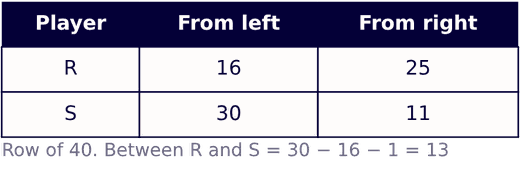
In a row of 40 players, Player R is placed 16th from the left end, and Player is 11th from the right end. How many players stand between R and S ?
A.12
B.13
C.14
D.15
Solution
Ranking in a row
Bring both players to the same end before counting.
Position from left = total - position from right .
For S: 40-11+1=30, so S is 30th from the left, while R is 16th from the left.
Players standing strictly between them =30-16-1=13.
Hence option (b).
35
Decorative Lights are hung in a line. A yellow light is 8th from left, and a green light is 11th from right. If there are 25 lights total, how many of the lights are between yellow and green?
A.6
B.9
C.7
D.10
Solution
Ranking in a row
Express both positions from the same end, the left.
Position from left = total - position from right .
For the green light: 25-11+1=15, so it is 15th from the left; the yellow light is 8th from the left.
Lights lying strictly between them =15-8-1=6.
Hence option (a).
36
Each question given below consists of a statement followed by two arguments, I and II. You have to decide which of the arguments is strong and which is weak.Statement: Should the use of single-use disposable materials be strictly regulated ?
Argument I: Yes, because excessive use of such materials leads to environmental degradation.
Argument II: No, because they are inexpensive and easily available for daily use.
A.Only I is strong
B.Only II is strong
C.Both I and II are strong
D.Neither I nor II is strong
Solution
Statement and arguments
An argument is strong only when it is directly related to the question and rests on a serious, lasting consequence.
Argument I links the excessive use of single-use materials to environmental degradation — a real and long-lasting harm that regulation can actually reduce, so it is strong.
Argument II offers only cheapness and easy availability. Convenience is a small, temporary personal gain and cannot outweigh permanent damage to the environment, so it is weak.
Hence only I is strong — option (a).
37
Each question below consists of a statement followed by two arguments, I and II. You have to decide which of the arguments is strong and which is weak.Statement: Should online video-sharing platforms be strictly monitored to prevent harmful content ?
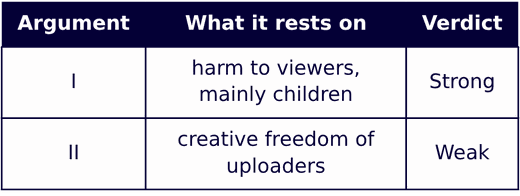
Argument I: Yes, harmful content can negatively influence viewers, especially children.
Argument II: No, strict monitoring may limit creative freedom and personal expression.
A.Only I is strong
B.Only II is strong
C.Both I and II are strong
D.Neither I nor II is strong
Solution
Statement and arguments
A strong argument must answer the question asked and must point to a consequence of real weight.
Argument I does exactly that: harmful videos can influence viewers, and children are the most easily influenced, so monitoring is justified. It is strong.
Argument II raises creative freedom, but the monitoring proposed is aimed only at harmful content, and no creator has a right to publish material that damages viewers; so the objection does not really meet the issue and is weak.
Hence only I is strong — option (a).
38
Few of the letters are given followed by a question mark (?) these letters are following a specific pattern you have to give the correct option which can replace question mark. Find the next letter:
A,D,H,M,?
A.S
B.T
C.V
D.P
Solution
Letter series
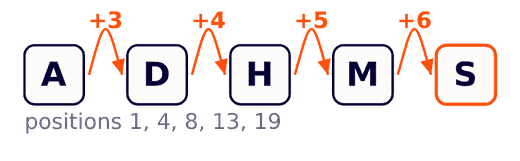
Write the alphabet position of each letter: A =1, D =4, H =8, M =13.
The differences are 4-1=3, 8-4=4, 13-8=5 — they grow by one each time, so the next gap is +6.
Next position =13+6=19, and the 19th letter of the alphabet is S.
Hence option (a).
39
Few of the letters are given followed by a question mark (?) these letters are following a specific pattern you have to give the correct option which can replace question mark.
Find the next in series:
I,F,C,Z,?
A.S
B.T
C.W
D.V
Solution
Letter series
Write the alphabet positions: I =9, F =6, C =3, Z =26.
Each term is 3 steps back: 9-3=6 gives F and 6-3=3 gives C.
From C the count runs past A, so the alphabet is treated as a circle and it wraps to the end: 3-3=0, which is read as Z (position 26).
Continuing the same step, 26-3=23, and the 23rd letter is W.
Hence option (c).
40
In this question some conditions or circumstances is provided to you, you have to make logical judgement according to mentioned circumstances and mark the correct judgement for
question.
A municipal authority plans to widen a busy city road to reduce traffic congestion. However, several small shops and street stalls occupy part of the proposed area. The administration must decide how to implement the project.
A.Stop the road-widening project completely.
B.Demolish the shops immediately and start construction.
C.Relocate the shops to nearby spaces and proceed with the project.
D.Build barriers around the shops to continue construction without relocation.
Solution
Decision making
Two interests meet here: the public need for a wider road and the livelihood of the traders who occupy part of that land.
A sound administrative decision serves the public purpose without destroying the livelihood, so the shops must be shifted rather than simply removed.
Relocating them to nearby spaces does both — the widening goes ahead and the traders keep their business and their customers.
Option (a) abandons a needed public work, option (b) is needlessly harsh and invites protest and litigation, and option (d) leaves obstructions standing on the widened road, defeating its very purpose.
Hence option (c) is the correct judgement.
41
Four meaningful words are given in the options you have to check that which of the following words cannot be formed from the letters. 'INFORMATION' ?
A.FORM
B.MENTION
C.RATION
D.NOTION
Solution
Word formation
First list the letters available in INFORMATION: I, N, F, O, R, M, A, T, I, O, N — so I, N and O are available twice each, and F, R, M, A, T once each.
FORM, RATION and NOTION use only these letters (NOTION needs two N's and two O's, and both are available).
MENTION needs the letter E, which does not occur in INFORMATION at all, so this word cannot be formed.
Hence, option (b) is the most appropriate answer.
42
In this type of questions, questions are provided with some issues/disputes/problem, followed by few methods to resolve the problem in a statement choosing the appropriate problem solving method that can be implemented.
A school's library staff face repeated delays in issuing books due to unclear workflow. What is the best way to solve this ?
A.Create a clear process chart for book issuance
B.Replace staff frequently
C.Let staff figure out their own method
D.Ignore the delays and continue
Solution
Problem solving
The stated cause of the delay is an unclear workflow, so the right remedy must remove that unclearness itself.
A clear process chart fixes every step of book issuance and the person responsible for it, so the staff no longer lose time deciding what to do next.
Replacing staff often or letting everyone invent a personal method makes the workflow even less uniform, and ignoring the delays leaves the cause completely untouched.
Hence, option (a) is the most appropriate answer.
43
In each of the following questions, there is a certain relationship between two given letter pairs on one side of (::) and pair is given on another side of (::) where another pair is to be found from the given alternatives, having the same relationship with this pair as the pairs of the given pair bear. Choose the best alternative.
?
A.RT
B.ST
C.SU
D.US
Solution
Letter-pair analogy
Compare the two letters of the first pair with the corresponding letters of the second pair.
P+2=R and X-2=V, so the first letter moves two steps forward and the second letter two steps backward.
Applying the same rule to QV: Q+2=S and V-2=T, which gives ST.
Hence, option (b) is the most appropriate answer.
44
In each of the following questions, there is a certain relationship between two given letter pairs on one side of (::) and pair is given on another side of (::) where another pair is to be found from the given alternatives, having the same relationship with this pair as the pairs of the given pair bear. Choose the best alternative.
CD : BD :: EF : ?
A.DF
B.GF
C.DG
D.EH
Solution
Letter-pair analogy
Compare CD with BD letter by letter.
C-1=B while the second letter D stays as it is, so the rule is: first letter one step back, second letter unchanged.
Applying it to EF: E-1=D and F remains F, which gives DF.
GF, DG and EH each change the second letter as well, so they break the rule.
Hence, option (a) is the most appropriate answer.
45
Find the next element that replace the ? Logically 5, 23, 59, 119, ?
A.207
B.209
C.219
D.216
Solution
Number series
Take the differences of consecutive terms: 23-5=18, 59-23=36, 119-59=60.
These differences themselves grow as 18, 24, 30 — an increase of 6 each time — so the next difference is 60+30=90.
Required term =119+90=209.
The same series can also be read as , , , , so the next term is .
Hence, option (b) is the most appropriate answer.
46
Find the next element that replace the? Logically 1, 9, 25, 57, ?
A.144
B.121
C.136
D.148
Solution
Number series
Take the differences of consecutive terms: 9-1=8, 25-9=16, 57-25=32.
Each difference is exactly double the previous one, so the next difference is .
Required term =57+64=121.
Hence, option (b) is the most appropriate answer.
47
Find the next element that replace the ? Logically 5, 29, 125, 509, ?
A.2095
B.2045
C.2345
D.2308
Solution
Number series
Each term is a little more than four times the term before it, so test the rule .
, , — the rule holds throughout.
Required term .
Hence, option (b) is the most appropriate answer.
48
In three of the following pairs are same by same pattern except one pair. Which pair does not follow this pattern ?
A.4 : 9
B.1 : 4
C.16 : 26
D.25 : 36
Solution
Odd pair out
Read each pair as (square of a number : square of the next number).
and ; and ; and — in each of these the two numbers are squares of consecutive natural numbers.
In 16:26, but 26 is not a perfect square; to follow the pattern the pair should have been 16:25.
Hence, option (c) is the most appropriate answer.
49
Select the option that represents the correct order of the given words as they would appear in an English dictionary.
1. Institutionalization
2. Insubordination
3. Instrumentation
4. Intellectualization
5. Interdisciplinary
A.1, 2, 3, 4, 5
B.2, 1, 3, 4, 5
C.1, 3, 2, 4, 5
D.1, 4, 3, 5, 2
Solution
Dictionary order
Compare the words letter by letter; all five begin with 'In'.
At the third letter s comes before t, so the 'Ins…' words (1, 2, 3) all come before the 'Int…' words (4, 5).
Inside 'Ins…': 'Inst' < 'Insu', so 1 and 3 come before 2; and between them 'Institu…' < 'Instru…' because i < r — giving 1, 3, 2.
Between 4 and 5 both start with 'Inte'; 'Intel' < 'Inter' because l < r, so 4 comes before 5.
The dictionary order is therefore 1, 3, 2, 4, 5.
Hence, option (c) is the most appropriate answer.
50
Select the option that represents the correct order of the given words as they would appear in an English dictionary.
1. Management
2. Manifestation
3. Manufacturing
4. Manipulation
5. Mannerism
6. Manuscript
A.2, 1, 3, 4, 5, 6
B.1, 2, 4, 5, 3, 6
C.2, 1, 3, 4, 6, 5
D.1, 2, 3, 4, 6, 5
Solution
Dictionary order
All six words begin with 'Man', so arrange them by the fourth letter, whose order is a, i, n, u.
'Mana…' comes first: Management (1).
Then 'Mani…': Manifestation (2) and Manipulation (4); f < p, so 2 comes before 4.
Next 'Mann…': Mannerism (5).
Finally 'Manu…': Manufacturing (3) and Manuscript (6); f < s, so 3 comes before 6.
The dictionary order is therefore 1, 2, 4, 5, 3, 6.
Hence, option (b) is the most appropriate answer.
Finished reading? Now test yourself.
The same 25 questions, but with a timer and the answers hidden — 15 minutes.

 Applying the same +3 shift to UNIVERSE: U→X, N→Q, I→L, V→Y, E→H, R→U, S→V, E→H.
So UNIVERSE is coded as XQLYHUVH — option (c).
Applying the same +3 shift to UNIVERSE: U→X, N→Q, I→L, V→Y, E→H, R→U, S→V, E→H.
So UNIVERSE is coded as XQLYHUVH — option (c).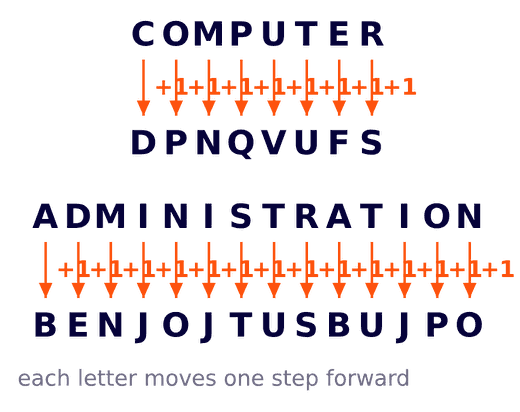 Apply +1 to every letter of ADMINISTRATION: A→B, D→E, M→N, I→J, N→O, I→J, S→T, T→U, R→S, A→B, T→U, I→J, O→P, N→O.
The code is BENJOJTUSBUJPO — option (a).
The other options match at the start but then swap or replace a letter (…BUIPO, …NUSB…, …UBSU…), so they break the one-to-one +1 shift.
Apply +1 to every letter of ADMINISTRATION: A→B, D→E, M→N, I→J, N→O, I→J, S→T, T→U, R→S, A→B, T→U, I→J, O→P, N→O.
The code is BENJOJTUSBUJPO — option (a).
The other options match at the start but then swap or replace a letter (…BUIPO, …NUSB…, …UBSU…), so they break the one-to-one +1 shift.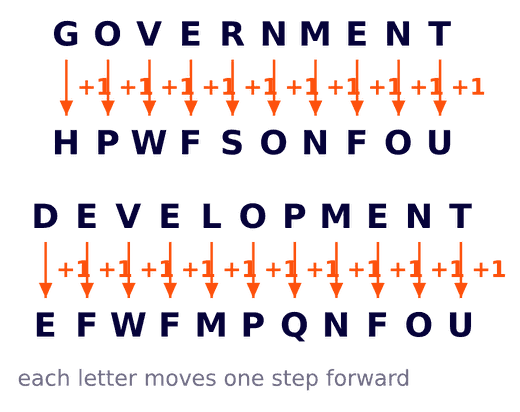 So for DEVELOPMENT: D→E, E→F, V→W, E→F, L→M, O→P, P→Q, M→N, E→F, N→O, T→U.
The code is EFWFMPQNFOU — option (a); the other three merely shuffle the middle letters M, P, Q and N.
So for DEVELOPMENT: D→E, E→F, V→W, E→F, L→M, O→P, P→Q, M→N, E→F, N→O, T→U.
The code is EFWFMPQNFOU — option (a); the other three merely shuffle the middle letters M, P, Q and N.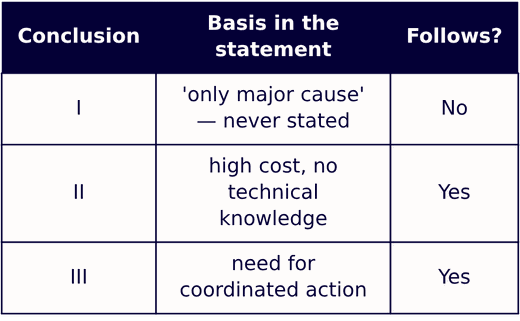 Hence only II and III follow — option (c).
 Players standing strictly between them =30-16-1=13.
Hence option (b).
Players standing strictly between them =30-16-1=13.
Hence option (b).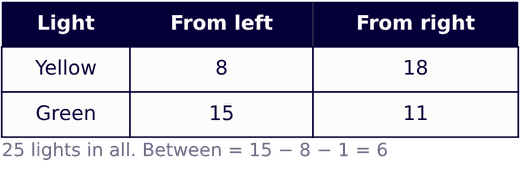 Lights lying strictly between them =15-8-1=6.
Hence option (a).
Lights lying strictly between them =15-8-1=6.
Hence option (a).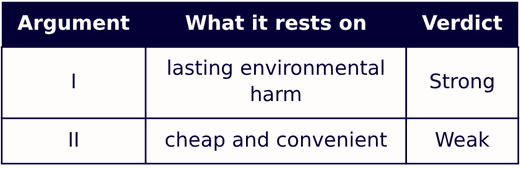 Hence only I is strong — option (a).
 Hence only I is strong — option (a).
 Next position =13+6=19, and the 19th letter of the alphabet is S.
Hence option (a).
Next position =13+6=19, and the 19th letter of the alphabet is S.
Hence option (a).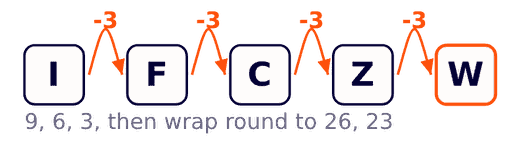 Continuing the same step, 26-3=23, and the 23rd letter is W.
Hence option (c).
Continuing the same step, 26-3=23, and the 23rd letter is W.
Hence option (c).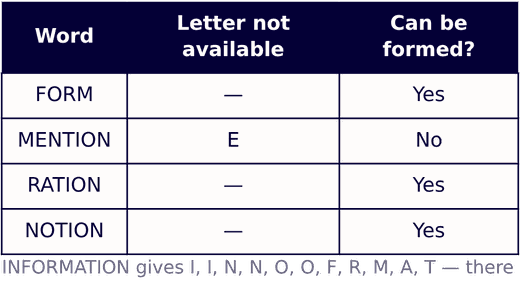 FORM, RATION and NOTION use only these letters (NOTION needs two N's and two O's, and both are available).
MENTION needs the letter E, which does not occur in INFORMATION at all, so this word cannot be formed.
Hence, option (b) is the most appropriate answer.
FORM, RATION and NOTION use only these letters (NOTION needs two N's and two O's, and both are available).
MENTION needs the letter E, which does not occur in INFORMATION at all, so this word cannot be formed.
Hence, option (b) is the most appropriate answer.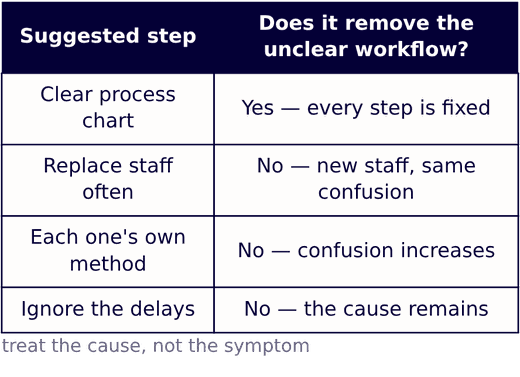 Replacing staff often or letting everyone invent a personal method makes the workflow even less uniform, and ignoring the delays leaves the cause completely untouched.
Hence, option (a) is the most appropriate answer.
Replacing staff often or letting everyone invent a personal method makes the workflow even less uniform, and ignoring the delays leaves the cause completely untouched.
Hence, option (a) is the most appropriate answer.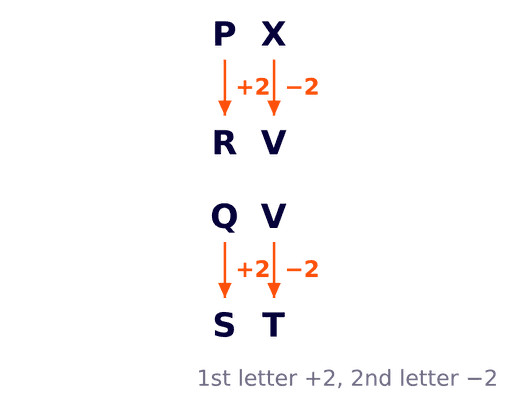 P+2=R and X-2=V, so the first letter moves two steps forward and the second letter two steps backward.
Applying the same rule to QV: Q+2=S and V-2=T, which gives ST.
Hence, option (b) is the most appropriate answer.
P+2=R and X-2=V, so the first letter moves two steps forward and the second letter two steps backward.
Applying the same rule to QV: Q+2=S and V-2=T, which gives ST.
Hence, option (b) is the most appropriate answer.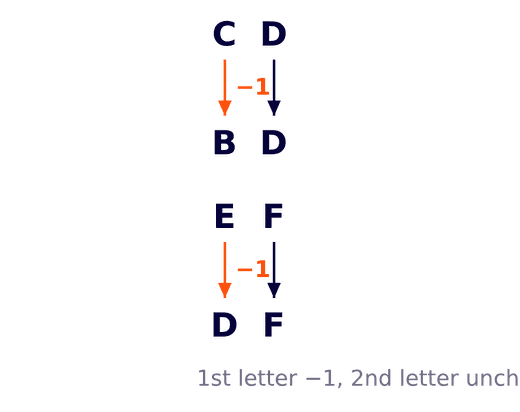 C-1=B while the second letter D stays as it is, so the rule is: first letter one step back, second letter unchanged.
Applying it to EF: E-1=D and F remains F, which gives DF.
GF, DG and EH each change the second letter as well, so they break the rule.
Hence, option (a) is the most appropriate answer.
C-1=B while the second letter D stays as it is, so the rule is: first letter one step back, second letter unchanged.
Applying it to EF: E-1=D and F remains F, which gives DF.
GF, DG and EH each change the second letter as well, so they break the rule.
Hence, option (a) is the most appropriate answer.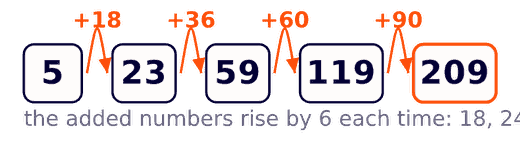 Required term =119+90=209.
The same series can also be read as , , , , so the next term is .
Hence, option (b) is the most appropriate answer.
Required term =119+90=209.
The same series can also be read as , , , , so the next term is .
Hence, option (b) is the most appropriate answer.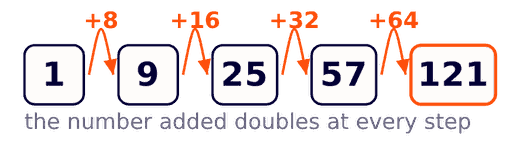 Required term =57+64=121.
Hence, option (b) is the most appropriate answer.
Required term =57+64=121.
Hence, option (b) is the most appropriate answer.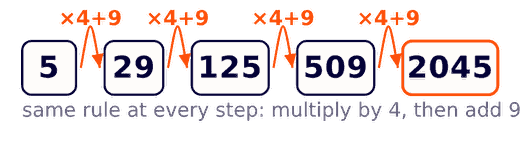 Required term .
Hence, option (b) is the most appropriate answer.
Required term .
Hence, option (b) is the most appropriate answer.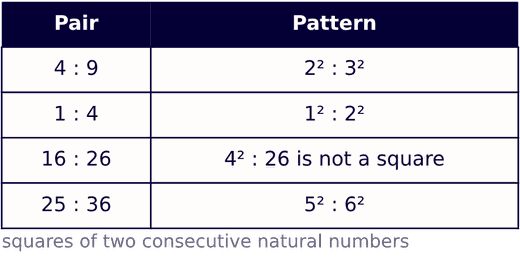 In 16:26, but 26 is not a perfect square; to follow the pattern the pair should have been 16:25.
Hence, option (c) is the most appropriate answer.
In 16:26, but 26 is not a perfect square; to follow the pattern the pair should have been 16:25.
Hence, option (c) is the most appropriate answer.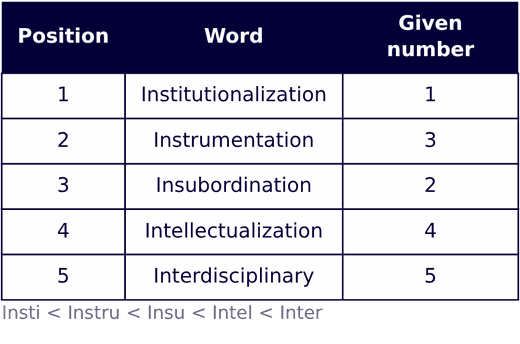 The dictionary order is therefore 1, 3, 2, 4, 5.
Hence, option (c) is the most appropriate answer.
The dictionary order is therefore 1, 3, 2, 4, 5.
Hence, option (c) is the most appropriate answer.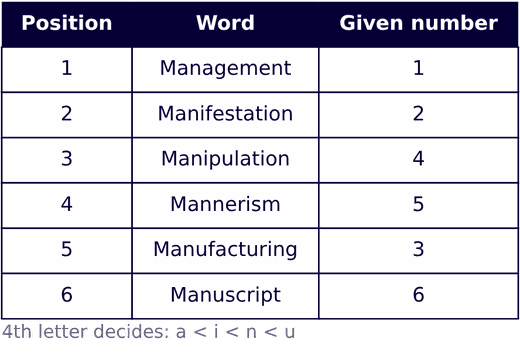 The dictionary order is therefore 1, 2, 4, 5, 3, 6.
Hence, option (b) is the most appropriate answer.
The dictionary order is therefore 1, 2, 4, 5, 3, 6.
Hence, option (b) is the most appropriate answer.