SSC CHSL 14 November 2025 · Shift 2 · General Awareness — questions with answers · ShikshaSphere
Chapter 26 of 200
14 November 2025 · Shift 2
General Awareness
25 questions ~25 min readFree
25 questions
A
76
Shila Dawre, who created history in the early 1980s, became India's first woman to work as which of the following?
A.Bus conductor
B.Taxi driver
C.Auto-rickshaw driver
D.Train driver
Solution
Women achievers of India
Shila Dawre is recognised as India's first woman auto-rickshaw driver, who began driving in Pune in the 1980s.
She obtained a commercial driving licence at a time when the trade was entirely male, and drove her auto for well over a decade before starting a travel business.
Her achievement is recorded in the Limca Book of Records and she is remembered as a pioneer for women in the transport sector.
Hence option (c) is correct.
77
As of August 2025, who is serving as the Lieutenant Governor (Governor equivalent) of the Union Territory of Jammu & Kashmir ?
A.G. C. Murmu
B.Satya Pal Malik
C.Manoj Sinha
D.R. K. Mathur
Solution
Lieutenant Governor of J&K
Manoj Sinha took office as Lieutenant Governor of the Union Territory of Jammu & Kashmir on 7 August 2020 and continues to hold the post in August 2025.
The office of Lieutenant Governor was created for J&K after the Jammu and Kashmir Reorganisation Act, 2019 split the state into the Union Territories of Jammu & Kashmir and Ladakh.
G. C. Murmu (option a) was the first LG of J&K and resigned in 2020 to become Comptroller and Auditor General; Satya Pal Malik (option b) was the last Governor of the erstwhile state; R. K. Mathur (option d) was LG of Ladakh.
Hence option (c) is correct.
78
The Youth Spiritual Summit, held in July 2025, was organized by which ministry of the Government of India?
A.Ministry of Education
B.Ministry of Culture
C.Ministry of Youth Affairs and Sports
D.Ministry of Health and Family Welfare
Solution
Youth Spiritual Summit 2025
The Youth Spiritual Summit was organised by the Ministry of Youth Affairs and Sports at the Rudraksh Convention Centre, Varanasi, from 18 to 20 July 2025.
Its theme was 'Nasha Mukt Yuva for Viksit Bharat' and it was inaugurated by Union Minister Dr Mansukh Mandaviya.
It brought together youth leaders with more than a hundred spiritual and socio-cultural organisations and adopted the 'Kashi Declaration' as the roadmap for a youth-led movement against drug abuse.
Hence option (c) is correct.
79
The Pradhan Mantri Janjatiya Unnat Gram Abhiyan, launched in 2024, is primarily aimed at improving the development of which population group ?
A.Urban poor
B.Farmers in irrigated regions
C.Tribal communities in aspirational areas
D.Coastal fishing communities
Solution
PM Janjatiya Unnat Gram Abhiyan
The Pradhan Mantri Janjatiya Unnat Gram Abhiyan (PM-JUGA), approved in 2024, is meant for tribal communities, chiefly in tribal-majority villages and aspirational districts.
It follows a saturation approach: every eligible tribal household and village is to be covered by existing schemes for housing, roads, drinking water, electricity, health, education and livelihood.
The mission covers roughly 63,000 villages and is expected to benefit more than 5 crore tribal people across 30 states and Union Territories.
Since the target group is tribal, options (a), (b) and (d) are ruled out, so option (c) is correct.
80
The Financial Inclusion Index (FI-Index) developed by the Reserve Bank of India (RBI) is based on which three key sub-indices?
A.Credit, Deposits, Insurance
B.Access, Usage, Quality
C.Banking, Technology, Infrastructure
D.Savings, Investment, Liquidity
Solution
RBI Financial Inclusion Index
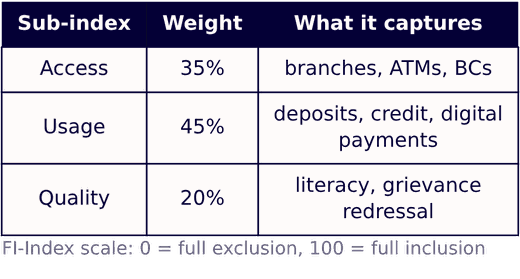
The RBI's Financial Inclusion Index, first published in 2021, is built on three sub-indices — Access, Usage and Quality.
Their weights are Access 35%, Usage 45% and Quality 20%; the index runs from 0 (complete exclusion) to 100 (full financial inclusion) and needs no base year.
Access measures branches, ATMs and banking correspondents; Usage measures deposits, credit, insurance and digital payments actually used; Quality measures financial literacy, consumer protection and grievance redressal.
Hence option (b) is correct.
81
Which Indian state became the first to link its forest ecosystem with Green GDP, incorporating factors like biodiversity, carbon sequestration, and soil conservation into economic planning?
A.Madhya Pradesh
B.Odisha
C.Chhattisgarh
D.Jharkhand
Solution
Current affairs — Green GDP
In January 2025 Chhattisgarh became the first Indian state to link its forest ecosystem with Green GDP.
Green GDP is ordinary GDP adjusted for environmental gain and loss, so the services a forest gives free of cost are given a money value and enter the state's economic planning.
The services being valued are biodiversity conservation, carbon sequestration, soil conservation, water recharge and oxygen release — significant for a state with about 44% of its area under forest.
Hence the correct option is (c).
82
The Dimasa tribe of Assam traditionally uses which bamboo wind instrument in their songs and dances?
A.Pepa
B.Muri
C.Algoza
D.Bansuri
Solution
Folk musical instruments
The Dimasa (Dimasa-Kachari) tribe of Assam plays the Muri, a bamboo wind instrument of the fife or pipe type.
It is sounded along with the Khram, their long drum, to carry the tune of Dimasa songs and dances, most of all at Busu Dima, the post-harvest festival.
Pepa is the buffalo-horn pipe of the Bihu dance, Algoza is the paired flute of Punjab and Rajasthan, and Bansuri is the ordinary transverse flute of North India — none of them is the Dimasa instrument.
Hence the correct option is (b).
83
Who is the author of the book "The Householder"?
A.Aravind Adiga
B.Amitabha Bagchi
C.Vikram Seth
D.Jhumpa Lahiri
Solution
Books and authors
The Householder (2012) is a novel by Amitabha Bagchi.
It follows a section officer in a Delhi government department and shows how the small corruptions of office life quietly reach into his home and family.
Bagchi, a computer-science teacher at IIT Delhi, also wrote Above Average, This Place and Half the Night Is Gone, which won the DSC Prize for South Asian Literature.
Hence the correct option is (b).
84
Parichakali, also known as the "Shield Dance," is a traditional folk dance of Indian Union Territory?
A.Andaman & Nicobar Islands
B.Lakshadweep
C.Puducherry
D.Ladakh
Solution
Folk dances of India
Parichakali, literally the 'shield dance', is a martial folk dance of Lakshadweep.
The performers fight in pairs with a wooden sword in one hand and a small shield (parisha) in the other, moving to the beat of drums, so the dance preserves the old warrior training of the islands.
Lakshadweep's other well-known folk forms are Kolkali, Lava (of Minicoy), Oppana and Bandiya, while Ladakh has Jabro and Shondol and Puducherry has Garadi.
Hence the correct option is (b).
85
Consider the following statements regarding stars:
Statement I: A star is made up of extremely hot gases, mainly hydrogen and helium.
Statement II: Stars do not have their own heat and light.
Which of the above statements is/are correct?
A.Only Statement I
B.Only Statement II
C.Both Statement I and II
D.Neither Statement I nor Statement II
Solution
Stars — composition
Statement I is correct: a star is an enormous ball of extremely hot gas, roughly 71% hydrogen and 27% helium by mass, held in the plasma state by the temperature of its interior.
Statement II is wrong: a star does have its own heat and light. In its core, hydrogen nuclei fuse into helium and the small loss of mass appears as a huge amount of energy.
Bodies that shine only by reflecting sunlight — the Moon and planets such as Venus — are the ones without light of their own; the Sun, our nearest star, is self-luminous.
Hence the correct option is (a).
86
Consider the following statements regarding types of forces:
Statement I: Electrostatic force is a contact force.
Statement II: Friction is a contact force. Which of the above statements is/are correct?
A.Only Statement I
B.Only Statement II
C.Both Statement I and Statement II
D.Neither Statement I nor Statement II
Solution
Contact and non-contact forces
A contact force acts only when the two bodies actually touch each other; a non-contact force acts from a distance, through a field.
Statement I is wrong: the electrostatic force acts between two charges even when they are far apart — a charged comb lifts bits of paper without touching them — so it is a non-contact force.
Statement II is correct: friction appears only where two surfaces are in contact and it opposes their relative motion, so it is a contact force.
Hence the correct option is (b).
87
Which of the following correctly represents the formula for calculating the momentum of an object ?
A.
B.
C.
D.
Solution
Momentum formula
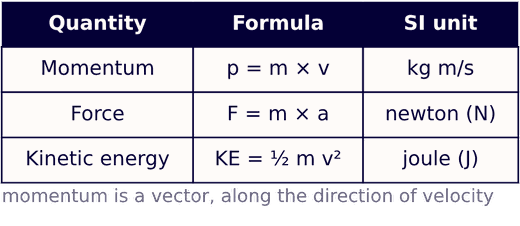
Momentum measures the 'quantity of motion' of a body, and it depends on both how heavy the body is and how fast it moves.
Formula: , where m is the mass and v the velocity of the body.
With m in kilograms and v in metres per second, the SI unit of momentum works out to , which only the product form can give.
A sum m+v, a quotient or a difference v-m would not even be dimensionally meaningful, so those three are rejected.
Hence the correct option is (c).
88
What is the name of India's first Ayurvedic diagnostic device, developed in January 2025 to modernize traditional pulse diagnosis (Nadi Pariksha) ?
A.AyuScan
B.Nadi Tarangini
C.PulseVeda
D.AyurDiag
Solution
Current affairs — Ayurveda device
Nadi Tarangini is India's first Ayurvedic diagnostic device, built to modernise Nadi Pariksha, the traditional reading of the pulse.
It was developed by the Pune-based start-up Atreya Innovations, which grew out of research at IIT Bombay, and in January 2025 it became the first Ayurvedic diagnostic instrument to receive CDSCO approval.
Pressure sensors strapped at the wrist record the pulse wave and the software analyses its rhythm, strength and shape to indicate the balance of Vata, Pitta and Kapha.
Its value is that it turns what was a physician's subjective feel into a reproducible digital record that can be stored and compared over time.
Hence the correct option is (b).
89
Which medical institution became the first in India to launch a dedicated Department of Artificial Intelligence in Healthcare in August 2025 ?
A.AllMS New Delhi
B.JIPMER Puducherry
C.Kasturba Medical College, Manipal
D.Christian Medical College, Vellore
Solution
Current affairs — AI in healthcare
In August 2025 Kasturba Medical College (KMC), Manipal launched a full Department of Artificial Intelligence in Healthcare — the first such department in any Indian medical institution.
KMC is a constituent college of the Manipal Academy of Higher Education, and the new department works on AI for diagnosis, medical imaging, predictive analytics and hospital management.
It also trains doctors and students to use and to judge AI tools clinically, so that the technology supports clinical judgement instead of replacing it.
Hence the correct option is (c).
90
As per Article 112 of the Constitution of India, which document must the government present before Parliament every year ?
A.Economic Survey
B.Finance Commission Report
C.Annual Financial Statement (Union Budget)
D.Appropriation Bill
Solution
Article 112 — Union Budget
Article 112 requires the President to cause to be laid before both Houses of Parliament, for every financial year, a statement of the estimated receipts and expenditure of the Government of India.
The Constitution names this document the Annual Financial Statement; it is popularly called the Union Budget and covers 1 April to 31 March.
It must show separately the expenditure 'charged' on the Consolidated Fund of India, which is not put to vote, and the other expenditure proposed to be made from that Fund, which the Lok Sabha votes upon.
The Economic Survey is only a convention, the Finance Commission report belongs to Article 281 and the Appropriation Bill to Article 114.
Hence the correct option is (c).
91
Which of the following is NOT an objective of the Production Linked Incentive (PLI) Scheme ?
A.Attracting major investments
B.Boosting domestic manufacturing
C.Increasing government regulation in private sector operations
D.Enhancing export potential
Solution
PLI Scheme objectives
Under the Production Linked Incentive Scheme the government pays a company an incentive on the incremental sales of goods made in its Indian units, so every objective of the scheme is growth-related.
Its declared aims are to attract large investments, scale up domestic manufacturing, make Indian producers globally competitive and raise export potential, all under Atmanirbhar Bharat.
Increasing government regulation of private-sector operations is the opposite of its method — the scheme works through ease of doing business and outcome-linked payouts — so this is NOT an objective.
Hence the correct option is (c).
92
Which agrarian community in Maharashtra formed the backbone of the early Maratha army, with many soldiers coming from this group ?
A.Kolis
B.Kunbis
C.Bhandaris
D.Ramoshis
Solution
Maratha army — social base
The Kunbis, the peasant-cultivator community of the Maratha country, supplied most of the manpower of the early Maratha army.
Shivaji raised his infantry largely from such families — the Mavalas of the western hill tracts — who knew the terrain and were ideally suited to guerrilla warfare.
These soldier-peasants went back to their fields in the monsoon, so the campaign season and the farming season did not clash and the state kept a large army at very little cost.
Kolis were fishermen and hill dwellers, Bhandaris were toddy-tappers and Ramoshis served mostly as village watchmen, so none of them formed the backbone of the army.
Hence the correct option is (b).
93
The Service Export from India Scheme (SEIS), launched under the Foreign Trade Policy 2015-20, primarily aims to promote which sector ?
A.Agricultural exports
B.Service exports
C.Manufacturing exports
D.Handicraft exports
Solution
SEIS — foreign trade policy
The name itself answers the question: the Service Exports from India Scheme was notified under the Foreign Trade Policy 2015-20 to promote the export of services from India.
It replaced the older 'Served From India Scheme' and rewarded eligible service providers with duty credit scrips calculated on their net foreign exchange earnings.
Those scrips could be used to pay basic customs duty, which lowered costs for exporters of IT, healthcare, education, tourism, transport and professional services.
The matching scheme for goods was MEIS (Merchandise Exports from India Scheme), later replaced by RoDTEP.
Hence the correct option is (b).
94
Article 85 of the Constitution of India deals with which of the following matters?
A.Procedure for impeachment of the President
B.Sessions of Parliament, including summoning and prorogation
C.Qualifications of Members of Parliament
D.Powers of the Speaker of Lok Sabha
Solution
Article 85 — sessions of Parliament
Article 85 deals with the sessions of Parliament, and with prorogation and dissolution.
The President summons each House at such time and place as he thinks fit, subject to one condition: not more than six months may pass between the last sitting of one session and the first sitting of the next.
That six-month rule is exactly why Parliament must meet at least twice a year; the same Article lets the President prorogue either House and dissolve the Lok Sabha.
Impeachment of the President falls under Article 61, qualifications of members under Article 84, and the Speaker's office under Articles 93 to 96.
Hence the correct option is (b).
95
Consider the following statements about Deendayal Port (Kandla Port):
1. It is located in the eastern part of India.
2. It is a Major Port.
3. It handles large quantities of petroleum and chemical cargo.
Which of the above statements is/are correct ?
A.1 and 2 only
B.2 and 3 only
C.1 and 3 only
D.1,2 and 3
Solution
Deendayal (Kandla) Port
Statement 1 is wrong: Deendayal Port, formerly Kandla, stands on the Gulf of Kutch in Gujarat — that is the western coast of India, not the eastern.
Statement 2 is correct: it is one of India's Major Ports, administered by a Port Authority under the Central Government.
Statement 3 is correct: it handles very large volumes of crude oil, petroleum products, chemicals, fertilisers, salt and edible oil, and is among the country's busiest ports by cargo tonnage.
The port was developed after Partition to replace Karachi as the outlet for north-western India, and it serves a hinterland covering Gujarat, Rajasthan, Punjab and Delhi.
Hence the correct option is (b).
96
After which Five Year Plan did the emphasis on the public sector in India begin to steadily decline due to deeper liberalisation and increased private sector participation ?
A.Sixth Five Year Plan
B.Seventh Five Year Plan
C.Ninth Five Year Plan
D.Tenth Five Year Plan
Solution
Five Year Plans — public sector
Indian planning rested on the public sector until the reforms of 1991; the Eighth Plan then introduced indicative planning, and it is after the Ninth Five Year Plan (1997-2002) that the emphasis on the public sector fell steadily.
The Ninth Plan itself described the private sector as the main engine of growth, pushed disinvestment of public sector undertakings and opened infrastructure such as power, telecom and roads to private investment.
From that point the State's share in plan outlay kept shrinking, and the government's role shifted towards regulation and towards social sectors like health and education rather than towards producing goods itself.
Hence the correct option is (c).
97
Who was the Chairman of the Planning Commission during the Tenth Five Year Plan (2002-2007) ?
A.Dr. Manmohan Singh
B.P. V. Narasimha Rao
C.Atal Bihari Vajpayee
D.H. D. Deve Gowda
Solution
Planning Commission — chairman
The Planning Commission was not a constitutional body; it was set up in 1950 by a Cabinet resolution, and the Prime Minister of India was its ex-officio Chairman.
The Tenth Five Year Plan ran from 2002 to 2007 and was approved by the National Development Council in December 2002, when Atal Bihari Vajpayee was Prime Minister — so he chaired the Commission that framed and launched it.
The plan aimed at 8% annual GDP growth, at halving the poverty ratio and at gainful employment for the addition to the labour force.
Hence the correct option is (c).
98
According to the National Population Policy (NPP) 2000, what is the target year for achieving population stabilization in India ?
A.2025
B.2030
C.2040
D.2045
Solution
National Population Policy 2000
The National Population Policy 2000 fixed 2045 as the target year for achieving a stable population in India.
That long-term objective was to be reached at a level consistent with the needs of sustainable economic growth, social development and environmental protection.
Its medium-term goal was to bring the Total Fertility Rate down to the replacement level of 2.1 by 2010, and its immediate goal was to supply the contraceptives, health infrastructure and trained health personnel needed for reproductive and child health care.
The policy also stressed raising the age of marriage of girls, universal immunisation and women's empowerment as the real means to slower growth.
Hence the correct option is (d).
99
Why do arteries have thick and elastic walls?
A.To allow slow flow of blood at low pressure
B.To prevent blood from flowing back into the heart
C.To withstand and maintain the high pressure of blood pumped from the heart
D.To store extra blood for later circulation
Solution
Structure of arteries
Arteries carry blood away from the heart, and the ventricles push that blood out in strong spurts at high pressure.
So an artery must have thick, muscular and elastic walls: the thickness lets it withstand the pressure without tearing, and the elasticity lets it stretch when the heart contracts and recoil afterwards.
That recoil keeps the blood moving smoothly between two heartbeats, which is why arteries need no valves at all.
Veins carry blood back at low pressure, so they have thin walls and instead need valves to stop the blood flowing backwards — that is option (b), a property of veins, not arteries.
Hence the correct option is (c).
100
The Fourth Buddhist Council, convened by the Kushana ruler Kanishka around 72 AD , was held at which place?
A.Rajagriha
B.Vaishali
C.Kundalavana
D.Pataliputra
Solution
Fourth Buddhist Council
The Fourth Buddhist Council met at Kundalavana in Kashmir under the patronage of the Kushana ruler Kanishka.
It was presided over by Vasumitra with Ashvaghosha as his deputy, and its proceedings were carried on in Sanskrit rather than Pali.
The council produced the Mahavibhasha, a great commentary on the Tripitaka of the Sarvastivada school, and after it Buddhism divided clearly into the Hinayana and Mahayana branches.
The other three options are the seats of the earlier councils, as the table shows.
Hence the correct option is (c).
Finished reading? Now test yourself.
The same 25 questions, but with a timer and the answers hidden — 15 minutes.

 Their weights are Access 35%, Usage 45% and Quality 20%; the index runs from 0 (complete exclusion) to 100 (full financial inclusion) and needs no base year.
Access measures branches, ATMs and banking correspondents; Usage measures deposits, credit, insurance and digital payments actually used; Quality measures financial literacy, consumer protection and grievance redressal.
Hence option (b) is correct.
Their weights are Access 35%, Usage 45% and Quality 20%; the index runs from 0 (complete exclusion) to 100 (full financial inclusion) and needs no base year.
Access measures branches, ATMs and banking correspondents; Usage measures deposits, credit, insurance and digital payments actually used; Quality measures financial literacy, consumer protection and grievance redressal.
Hence option (b) is correct.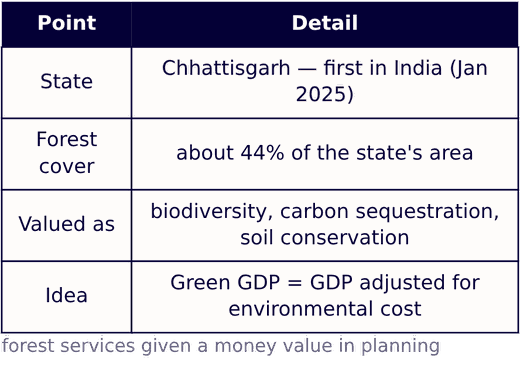 The services being valued are biodiversity conservation, carbon sequestration, soil conservation, water recharge and oxygen release — significant for a state with about 44% of its area under forest.
Hence the correct option is (c).
The services being valued are biodiversity conservation, carbon sequestration, soil conservation, water recharge and oxygen release — significant for a state with about 44% of its area under forest.
Hence the correct option is (c).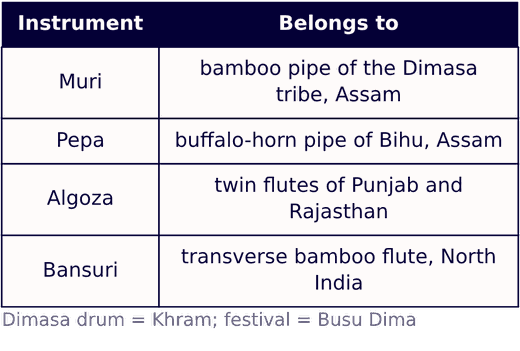 Pepa is the buffalo-horn pipe of the Bihu dance, Algoza is the paired flute of Punjab and Rajasthan, and Bansuri is the ordinary transverse flute of North India — none of them is the Dimasa instrument.
Hence the correct option is (b).
Pepa is the buffalo-horn pipe of the Bihu dance, Algoza is the paired flute of Punjab and Rajasthan, and Bansuri is the ordinary transverse flute of North India — none of them is the Dimasa instrument.
Hence the correct option is (b).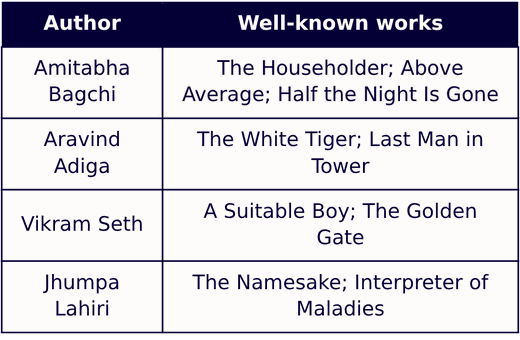 Bagchi, a computer-science teacher at IIT Delhi, also wrote Above Average, This Place and Half the Night Is Gone, which won the DSC Prize for South Asian Literature.
Hence the correct option is (b).
Bagchi, a computer-science teacher at IIT Delhi, also wrote Above Average, This Place and Half the Night Is Gone, which won the DSC Prize for South Asian Literature.
Hence the correct option is (b).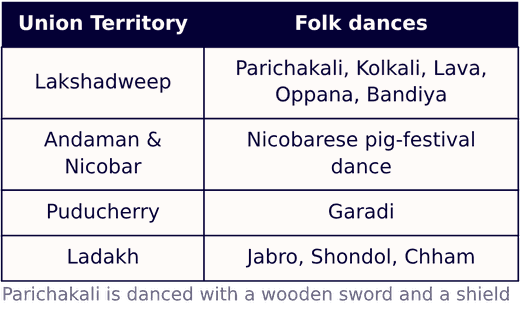 Lakshadweep's other well-known folk forms are Kolkali, Lava (of Minicoy), Oppana and Bandiya, while Ladakh has Jabro and Shondol and Puducherry has Garadi.
Hence the correct option is (b).
Lakshadweep's other well-known folk forms are Kolkali, Lava (of Minicoy), Oppana and Bandiya, while Ladakh has Jabro and Shondol and Puducherry has Garadi.
Hence the correct option is (b).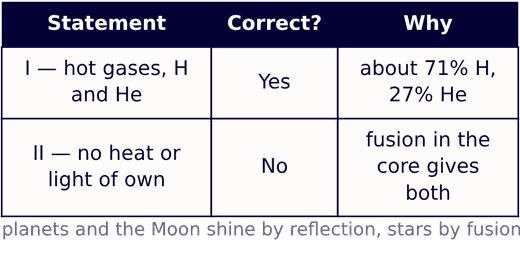 Bodies that shine only by reflecting sunlight — the Moon and planets such as Venus — are the ones without light of their own; the Sun, our nearest star, is self-luminous.
Hence the correct option is (a).
Bodies that shine only by reflecting sunlight — the Moon and planets such as Venus — are the ones without light of their own; the Sun, our nearest star, is self-luminous.
Hence the correct option is (a).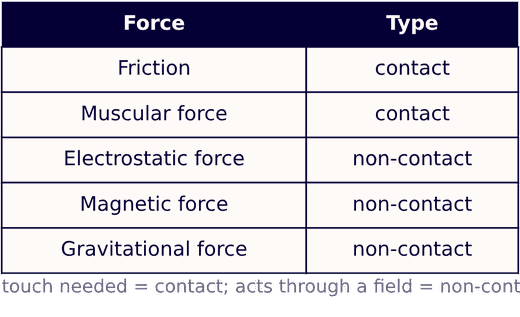 Hence the correct option is (b).
 With m in kilograms and v in metres per second, the SI unit of momentum works out to , which only the product form can give.
A sum m+v, a quotient or a difference v-m would not even be dimensionally meaningful, so those three are rejected.
Hence the correct option is (c).
With m in kilograms and v in metres per second, the SI unit of momentum works out to , which only the product form can give.
A sum m+v, a quotient or a difference v-m would not even be dimensionally meaningful, so those three are rejected.
Hence the correct option is (c).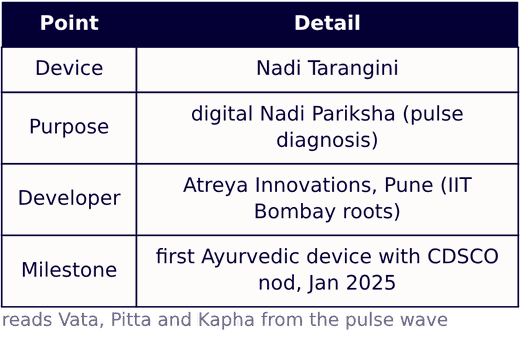 Pressure sensors strapped at the wrist record the pulse wave and the software analyses its rhythm, strength and shape to indicate the balance of Vata, Pitta and Kapha.
Its value is that it turns what was a physician's subjective feel into a reproducible digital record that can be stored and compared over time.
Hence the correct option is (b).
Pressure sensors strapped at the wrist record the pulse wave and the software analyses its rhythm, strength and shape to indicate the balance of Vata, Pitta and Kapha.
Its value is that it turns what was a physician's subjective feel into a reproducible digital record that can be stored and compared over time.
Hence the correct option is (b).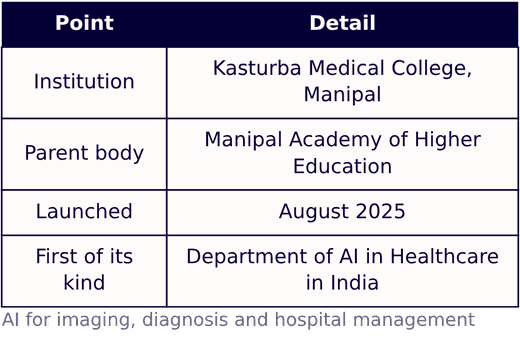 It also trains doctors and students to use and to judge AI tools clinically, so that the technology supports clinical judgement instead of replacing it.
Hence the correct option is (c).
It also trains doctors and students to use and to judge AI tools clinically, so that the technology supports clinical judgement instead of replacing it.
Hence the correct option is (c).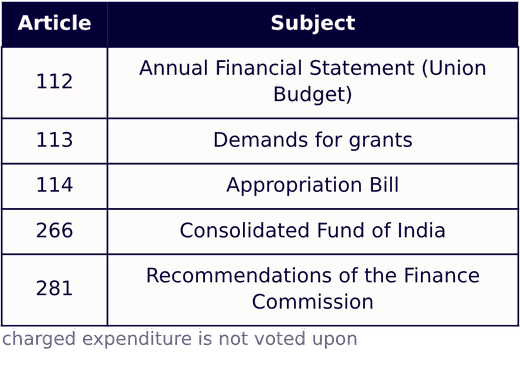 It must show separately the expenditure 'charged' on the Consolidated Fund of India, which is not put to vote, and the other expenditure proposed to be made from that Fund, which the Lok Sabha votes upon.
The Economic Survey is only a convention, the Finance Commission report belongs to Article 281 and the Appropriation Bill to Article 114.
Hence the correct option is (c).
It must show separately the expenditure 'charged' on the Consolidated Fund of India, which is not put to vote, and the other expenditure proposed to be made from that Fund, which the Lok Sabha votes upon.
The Economic Survey is only a convention, the Finance Commission report belongs to Article 281 and the Appropriation Bill to Article 114.
Hence the correct option is (c).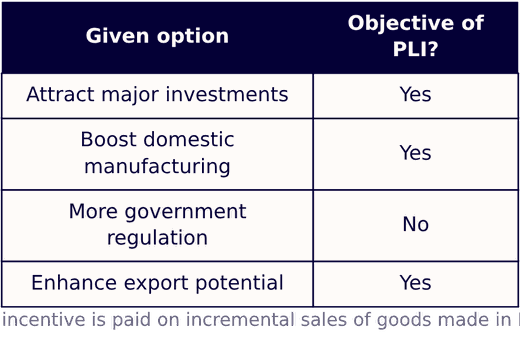 Increasing government regulation of private-sector operations is the opposite of its method — the scheme works through ease of doing business and outcome-linked payouts — so this is NOT an objective.
Hence the correct option is (c).
Increasing government regulation of private-sector operations is the opposite of its method — the scheme works through ease of doing business and outcome-linked payouts — so this is NOT an objective.
Hence the correct option is (c).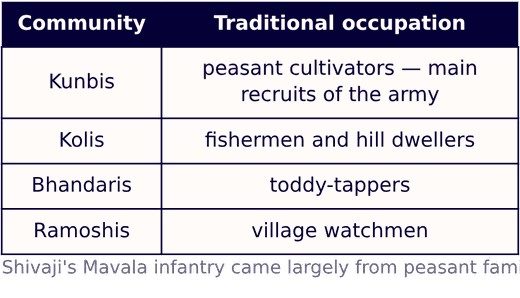 These soldier-peasants went back to their fields in the monsoon, so the campaign season and the farming season did not clash and the state kept a large army at very little cost.
Kolis were fishermen and hill dwellers, Bhandaris were toddy-tappers and Ramoshis served mostly as village watchmen, so none of them formed the backbone of the army.
Hence the correct option is (b).
These soldier-peasants went back to their fields in the monsoon, so the campaign season and the farming season did not clash and the state kept a large army at very little cost.
Kolis were fishermen and hill dwellers, Bhandaris were toddy-tappers and Ramoshis served mostly as village watchmen, so none of them formed the backbone of the army.
Hence the correct option is (b).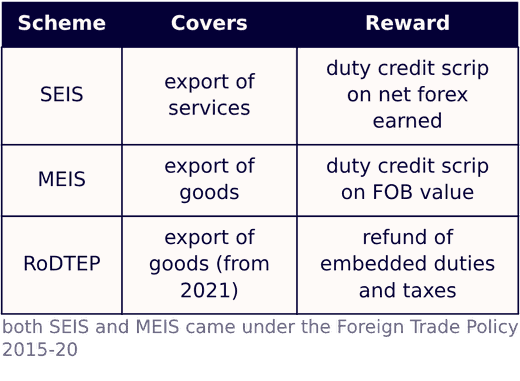 Those scrips could be used to pay basic customs duty, which lowered costs for exporters of IT, healthcare, education, tourism, transport and professional services.
The matching scheme for goods was MEIS (Merchandise Exports from India Scheme), later replaced by RoDTEP.
Hence the correct option is (b).
Those scrips could be used to pay basic customs duty, which lowered costs for exporters of IT, healthcare, education, tourism, transport and professional services.
The matching scheme for goods was MEIS (Merchandise Exports from India Scheme), later replaced by RoDTEP.
Hence the correct option is (b).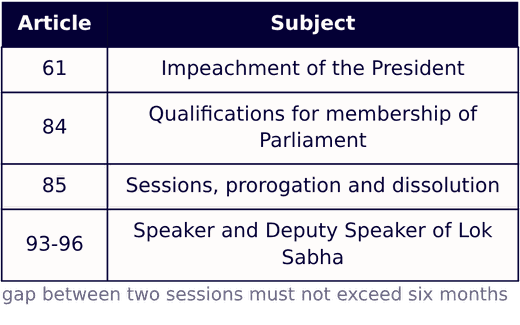 That six-month rule is exactly why Parliament must meet at least twice a year; the same Article lets the President prorogue either House and dissolve the Lok Sabha.
Impeachment of the President falls under Article 61, qualifications of members under Article 84, and the Speaker's office under Articles 93 to 96.
Hence the correct option is (b).
That six-month rule is exactly why Parliament must meet at least twice a year; the same Article lets the President prorogue either House and dissolve the Lok Sabha.
Impeachment of the President falls under Article 61, qualifications of members under Article 84, and the Speaker's office under Articles 93 to 96.
Hence the correct option is (b).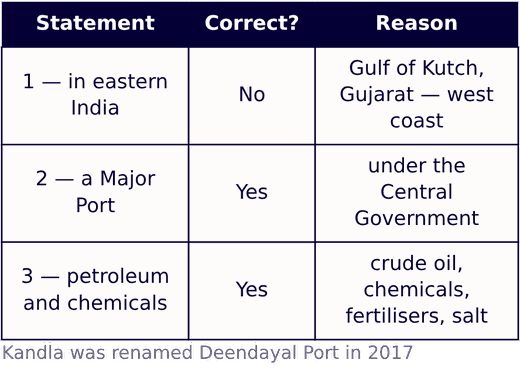 The port was developed after Partition to replace Karachi as the outlet for north-western India, and it serves a hinterland covering Gujarat, Rajasthan, Punjab and Delhi.
Hence the correct option is (b).
The port was developed after Partition to replace Karachi as the outlet for north-western India, and it serves a hinterland covering Gujarat, Rajasthan, Punjab and Delhi.
Hence the correct option is (b).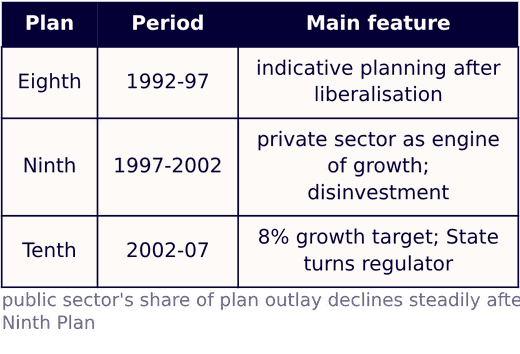 From that point the State's share in plan outlay kept shrinking, and the government's role shifted towards regulation and towards social sectors like health and education rather than towards producing goods itself.
Hence the correct option is (c).
From that point the State's share in plan outlay kept shrinking, and the government's role shifted towards regulation and towards social sectors like health and education rather than towards producing goods itself.
Hence the correct option is (c).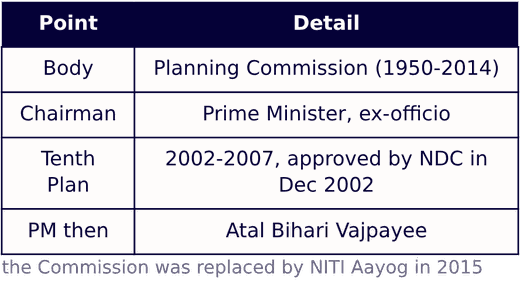 The plan aimed at 8% annual GDP growth, at halving the poverty ratio and at gainful employment for the addition to the labour force.
Hence the correct option is (c).
The plan aimed at 8% annual GDP growth, at halving the poverty ratio and at gainful employment for the addition to the labour force.
Hence the correct option is (c).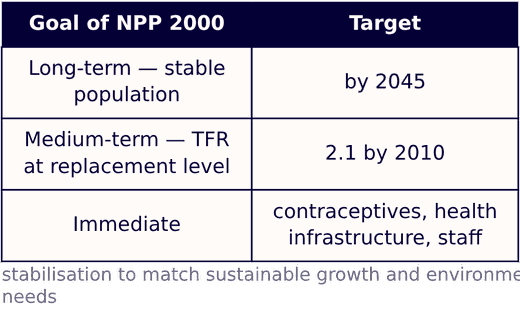 Its medium-term goal was to bring the Total Fertility Rate down to the replacement level of 2.1 by 2010, and its immediate goal was to supply the contraceptives, health infrastructure and trained health personnel needed for reproductive and child health care.
The policy also stressed raising the age of marriage of girls, universal immunisation and women's empowerment as the real means to slower growth.
Hence the correct option is (d).
Its medium-term goal was to bring the Total Fertility Rate down to the replacement level of 2.1 by 2010, and its immediate goal was to supply the contraceptives, health infrastructure and trained health personnel needed for reproductive and child health care.
The policy also stressed raising the age of marriage of girls, universal immunisation and women's empowerment as the real means to slower growth.
Hence the correct option is (d).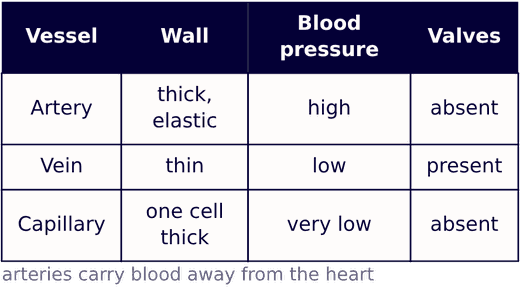 That recoil keeps the blood moving smoothly between two heartbeats, which is why arteries need no valves at all.
Veins carry blood back at low pressure, so they have thin walls and instead need valves to stop the blood flowing backwards — that is option (b), a property of veins, not arteries.
Hence the correct option is (c).
That recoil keeps the blood moving smoothly between two heartbeats, which is why arteries need no valves at all.
Veins carry blood back at low pressure, so they have thin walls and instead need valves to stop the blood flowing backwards — that is option (b), a property of veins, not arteries.
Hence the correct option is (c).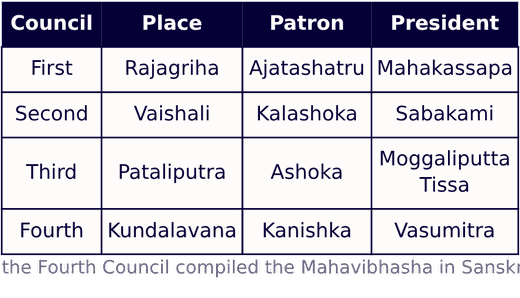 The council produced the Mahavibhasha, a great commentary on the Tripitaka of the Sarvastivada school, and after it Buddhism divided clearly into the Hinayana and Mahayana branches.
The other three options are the seats of the earlier councils, as the table shows.
Hence the correct option is (c).
The council produced the Mahavibhasha, a great commentary on the Tripitaka of the Sarvastivada school, and after it Buddhism divided clearly into the Hinayana and Mahayana branches.
The other three options are the seats of the earlier councils, as the table shows.
Hence the correct option is (c).