SSC CHSL 14 November 2025 · Shift 2 · English Language — questions with answers · ShikshaSphere
Chapter 28 of 200
14 November 2025 · Shift 2
English Language
25 questions ~25 min readFree
25 questions
A
1
Identify the part of the sentence that contains a grammatical error.
A. After she finished B. her presentation, C. she ate D. her lunch.
A.After she finished
B.her presentation,
C.she ate
D.her lunch.
Solution
Error spotting: tense
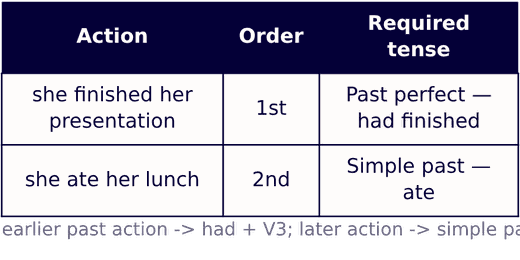
The sentence reports two completed past actions, so the one that happened earlier must be in the past perfect tense.
Finishing the presentation came before eating lunch, so part A must read 'After she had finished'; the later action correctly stays in the simple past — 'she ate'.
Parts B, C and D are already correct, so the error lies in part A.
Hence, option (a) is the most appropriate answer.
2
Fill in the blank with the most suitable idiom:
After pretending to be trustworthy for a long time, she eventually revealed her real intentions and .
A.burned the midnight oil
B.stabbed him in the back
C.played her cards right
D.took the bull by the horns
Solution
Idiom completion
The blank needs an idiom that means betraying a person who trusted you.
'Stab someone in the back' = to betray, cheat or harm someone who trusted you, usually in a secret way.
The sentence says she only 'pretended to be trustworthy' and then revealed her real intentions — that is precisely such a betrayal.
'Burn the midnight oil' means to work late into the night, 'play one's cards right' means to act shrewdly, and 'take the bull by the horns' means to face a difficulty boldly — none of them carries any sense of betrayal.
Hence, option (b) is the most appropriate answer.
3
Select the most appropriate synonym of the word:
Meticulous
A.Easygoing
B.Indulgent
C.Fastidious
D.Careless
Solution
Synonym
Meticulous = showing great attention to detail; very careful and precise in one's work.
Fastidious = giving very careful attention to accuracy and detail — the closest match in meaning.
Easygoing means relaxed and not demanding, and Indulgent means overly lenient; neither speaks of carefulness.
Careless means not giving enough attention, which is in fact the antonym of meticulous.
Hence, option (c) is the most appropriate answer.
4
Fill in the blank with the most appropriate idiom:
The official explanation was given to distract attention from the real issue, making it nothing more than a .
A.feather in the cap
B.red herring
C.can of worms
D.slip of the tongue
Solution
Idiom completion
The blank needs an idiom for something deliberately used to draw attention away from the real issue.
'Red herring' = a fact, remark or explanation introduced to mislead people and divert them from the main point.
The sentence itself says the official explanation was given 'to distract attention from the real issue', which fits the idiom exactly.
'Feather in the cap' means an achievement to be proud of, 'can of worms' means a complicated problem that one uncovers, and 'slip of the tongue' means an unintentional error in speech.
Hence, option (b) is the most appropriate answer.
5
Directions (Qs. 5-9): Read the following passage carefully and answer the questions that follow.
Creative media has become an integral part of how information is created, shared, and interpreted in the modern world. It extends far beyond surface-level visuals and focuses on communicating ideas, emotions, and messages in a structured and meaningful manner. By combining visual elements with thoughtful planning, creative media helps transform complex concepts into content that is both engaging and easy to understand. The objective is not merely to attract attention but to ensure that the intended message is conveyed clearly and effectively to the audience.
This form of communication appears in many aspects of everyday life, including digital platforms, educational resources, public information campaigns, and interactive applications. It plays a significant role in guiding user behaviour, improving accessibility, and presenting information in a more digestible format. Through careful design and organisation,
creative media supports learning, decision-making, and engagement across various fields.
To work successfully in this area, one must possess a balanced combination of creativity, analytical thinking, and technical knowledge. An understanding of visual structure, audience perception, and digital tools is essential. Equally important is the ability to adapt ideas to real-world needs and evolving technologies. Situated at the crossroads of imagination and functionality, creative media serves as a crucial link between information and people, ensuring communication remains effective, relevant, and impactful.
What is the main role of creative media as described in the passage ?
A.To decorate content for visual appeal
B.To communicate ideas and messages in a meaningful way
C.To entertain audiences through digital visuals
D.To replace written forms of communication
Solution
Reading comprehension
The question asks for the central role that the passage assigns to creative media.
The first paragraph says it 'extends far beyond surface-level visuals and focuses on communicating ideas, emotions, and messages in a structured and meaningful manner'.
So its main role is meaningful communication, not mere decoration (a) or entertainment (c); and the passage nowhere says it replaces writing (d).
Hence, option (b) is the most appropriate answer.
6
Directions (Qs. 5-9): Read the following passage carefully and answer the questions that follow.
Creative media has become an integral part of how information is created, shared, and interpreted in the modern world. It extends far beyond surface-level visuals and focuses on communicating ideas, emotions, and messages in a structured and meaningful manner. By combining visual elements with thoughtful planning, creative media helps transform complex concepts into content that is both engaging and easy to understand. The objective is not merely to attract attention but to ensure that the intended message is conveyed clearly and effectively to the audience.
This form of communication appears in many aspects of everyday life, including digital platforms, educational resources, public information campaigns, and interactive applications. It plays a significant role in guiding user behaviour, improving accessibility, and presenting information in a more digestible format. Through careful design and organisation,
creative media supports learning, decision-making, and engagement across various fields.
To work successfully in this area, one must possess a balanced combination of creativity, analytical thinking, and technical knowledge. An understanding of visual structure, audience perception, and digital tools is essential. Equally important is the ability to adapt ideas to real-world needs and evolving technologies. Situated at the crossroads of imagination and functionality, creative media serves as a crucial link between information and people, ensuring communication remains effective, relevant, and impactful.
Which of the following best explains how creative media helps audiences?
A.By increasing the volume of information presented
B.By simplifying complex ideas into understandable forms
C.By focusing only on artistic expression
D.By prioritising trends over clarity
Solution
Reading comprehension
The passage states that creative media 'helps transform complex concepts into content that is both engaging and easy to understand'.
Simplifying complex ideas into understandable forms is a direct restatement of that line, so this is how it helps the audience.
The passage never claims that it increases the volume of information (a), that it is concerned only with artistic expression (c), or that it puts trends above clarity (d) — in fact it insists on clarity.
Hence, option (b) is the most appropriate answer.
7
Directions (Qs. 5-9): Read the following passage carefully and answer the questions that follow.
Creative media has become an integral part of how information is created, shared, and interpreted in the modern world. It extends far beyond surface-level visuals and focuses on communicating ideas, emotions, and messages in a structured and meaningful manner. By combining visual elements with thoughtful planning, creative media helps transform complex concepts into content that is both engaging and easy to understand. The objective is not merely to attract attention but to ensure that the intended message is conveyed clearly and effectively to the audience.
This form of communication appears in many aspects of everyday life, including digital platforms, educational resources, public information campaigns, and interactive applications. It plays a significant role in guiding user behaviour, improving accessibility, and presenting information in a more digestible format. Through careful design and organisation,
creative media supports learning, decision-making, and engagement across various fields.
To work successfully in this area, one must possess a balanced combination of creativity, analytical thinking, and technical knowledge. An understanding of visual structure, audience perception, and digital tools is essential. Equally important is the ability to adapt ideas to real-world needs and evolving technologies. Situated at the crossroads of imagination and functionality, creative media serves as a crucial link between information and people, ensuring communication remains effective, relevant, and impactful.
In which areas of daily life does creative media commonly appear, according to the passage ?
A.Only in art exhibitions and galleries
B.Mainly in advertising campaigns
C.In digital platforms, education, and public information
D.Exclusively in entertainment industries
Solution
Reading comprehension
The second paragraph lists where creative media appears: 'digital platforms, educational resources, public information campaigns, and interactive applications'.
Option (c) reproduces that list, so it matches the passage.
The limiting words in the other options — 'Only', 'Mainly' and 'Exclusively' — narrow the field in a way the passage clearly does not.
Hence, option (c) is the most appropriate answer.
8
Directions (Qs. 5-9): Read the following passage carefully and answer the questions that follow.
Creative media has become an integral part of how information is created, shared, and interpreted in the modern world. It extends far beyond surface-level visuals and focuses on communicating ideas, emotions, and messages in a structured and meaningful manner. By combining visual elements with thoughtful planning, creative media helps transform complex concepts into content that is both engaging and easy to understand. The objective is not merely to attract attention but to ensure that the intended message is conveyed clearly and effectively to the audience.
This form of communication appears in many aspects of everyday life, including digital platforms, educational resources, public information campaigns, and interactive applications. It plays a significant role in guiding user behaviour, improving accessibility, and presenting information in a more digestible format. Through careful design and organisation,
creative media supports learning, decision-making, and engagement across various fields.
To work successfully in this area, one must possess a balanced combination of creativity, analytical thinking, and technical knowledge. An understanding of visual structure, audience perception, and digital tools is essential. Equally important is the ability to adapt ideas to real-world needs and evolving technologies. Situated at the crossroads of imagination and functionality, creative media serves as a crucial link between information and people, ensuring communication remains effective, relevant, and impactful.
What combination of abilities is necessary to work successfully in creative media ?
A.Creativity, analytical thinking, and technical knowledge
B.Artistic talent and financial management skills
C.Writing ability and public speaking skills
D.Technical expertise without creative involvement
Solution
Reading comprehension
The third paragraph says that to work successfully in this area one must possess 'a balanced combination of creativity, analytical thinking, and technical knowledge'.
Option (a) repeats this triad exactly.
Financial management (b) and public speaking (c) are never mentioned, and (d) — technical expertise without creative involvement — contradicts the word 'balanced'.
Hence, option (a) is the most appropriate answer.
9
Directions (Qs. 5-9): Read the following passage carefully and answer the questions that follow.
Creative media has become an integral part of how information is created, shared, and interpreted in the modern world. It extends far beyond surface-level visuals and focuses on communicating ideas, emotions, and messages in a structured and meaningful manner. By combining visual elements with thoughtful planning, creative media helps transform complex concepts into content that is both engaging and easy to understand. The objective is not merely to attract attention but to ensure that the intended message is conveyed clearly and effectively to the audience.
This form of communication appears in many aspects of everyday life, including digital platforms, educational resources, public information campaigns, and interactive applications. It plays a significant role in guiding user behaviour, improving accessibility, and presenting information in a more digestible format. Through careful design and organisation,
creative media supports learning, decision-making, and engagement across various fields.
To work successfully in this area, one must possess a balanced combination of creativity, analytical thinking, and technical knowledge. An understanding of visual structure, audience perception, and digital tools is essential. Equally important is the ability to adapt ideas to real-world needs and evolving technologies. Situated at the crossroads of imagination and functionality, creative media serves as a crucial link between information and people, ensuring communication remains effective, relevant, and impactful.
How is creative media positioned in relation to technology and communication ?
A.As a replacement for traditional communication methods
B.As a purely imaginative field without practical application
C.As a link between information, technology, and people
D.As a tool limited to digital platforms only
Solution
Reading comprehension
The closing lines place creative media 'at the crossroads of imagination and functionality' and call it 'a crucial link between information and people'.
So it is presented as a connector joining information and digital tools with the audience, which is what option (c) says.
It is not a replacement for traditional communication (a); the demand for technical knowledge and real-world adaptation rules out 'purely imaginative' (b); and the uses listed go well beyond digital platforms (d).
Hence, option (c) is the most appropriate answer.
10
Which of the following sentences uses the word "tear" with the same meaning as in the following sentence? "A single tear rolled down her cheek as she read the letter.'
A.Be careful not to tear the delicate fabric.
B.He tried to tear the old photograph into pieces.
C.The constant friction caused a tear in his shoe.
D.She felt a tear of sadness in her heart.
Solution
Homonym usage
In 'A single tear rolled down her cheek', 'tear' is a noun meaning a drop of liquid that flows from the eye out of emotion.
Option (d), 'a tear of sadness in her heart', uses the noun in exactly that emotional sense.
In (a) and (b) 'tear' is a verb meaning to rip something apart, and in (c) it is the noun formed from that verb — a split made in the shoe by friction.
Hence, option (d) is the most appropriate answer.
11
Choose the incorrectly spelt word:
A.Delusian
B.Illusion
C.Confusion
D.Conclusion
Solution
Spelling error
'Delusian' is wrongly spelt; the correct spelling is 'Delusion'.
Every noun of this family ends in -sion and never in -sian: illusion, confusion, conclusion, delusion.
Delusion means a false belief that a person holds in spite of clear evidence against it.
Hence, option (a) is the most appropriate answer.
12
Choose the correctly spelt word:
A.Millennium
B.Accomodation
C.Occassion
D.Enviroment
Solution
Correct spelling
'Millennium' is the correctly spelt word — it comes from Latin mille (thousand) + annus (year), so it keeps a double 'l' and a double 'n'.
'Accomodation' is wrong; the correct form is 'Accommodation' with double 'c' and double 'm'.
'Occassion' is wrong; the correct form is 'Occasion' with double 'c' but a single 's'.
'Enviroment' is wrong; the correct form is 'Environment', which keeps the 'n' before -ment.
Hence, option (a) is the most appropriate answer.
13
Choose the correct meaning of the highlighted idiom in the sentence: Her confidence waxed and waned during the course of the competition.
A.Became fixed and stable
B.Increased and decreased
C.Expanded and contracted rapidly
D.Grown steadily
Solution
Idiom meaning
The idiom comes from the moon: to 'wax' is to grow larger and to 'wane' is to grow smaller.
So 'waxed and waned' means it increased and decreased by turns.
Her confidence therefore rose at some moments of the competition and fell at others.
'Became fixed and stable' and 'grown steadily' allow no fall at all, and 'expanded and contracted rapidly' adds a speed that the idiom does not carry.
Hence, option (b) is the most appropriate answer.
14
Choose the correct one-word substitute for:
The art of forming solid objects from materials like clay or fine metal.
A.Bibliography
B.Sculpture
C.Cartography
D.Calligraphy
Solution
One-word substitution
Sculpture = the art of forming solid figures by carving or moulding materials such as clay, stone or metal.
Bibliography = a list of the books and sources consulted in a piece of scholarly work.
Cartography = the science and practice of drawing maps.
Calligraphy = the art of beautiful handwriting.
Hence, option (b) is the most appropriate answer.
15
Select the most appropriate antonym of the word:
Corrupt
A.Upright
B.Deceitful
C.Dishonest
D.Amoral
Solution
Antonym
Corrupt = willing to act dishonestly in return for money or personal gain, so its antonym must mean thoroughly honest.
Upright = strictly honourable and honest in behaviour — exactly the required opposite.
Deceitful and Dishonest are synonyms of corrupt, not opposites.
Amoral means having no sense of right or wrong at all, which is again not the opposite of corrupt.
Hence, option (a) is the most appropriate answer.
16
Choose the correct one-word substitute for:
A violent storm with very strong winds
A.Cataclysm
B.Earthquake
C.Tsunami
D.Hurricanes
Solution
One-word substitution
Hurricane = a violent tropical storm whose defining feature is extremely strong wind.
Cataclysm = any sudden violent event causing great destruction; it is not specifically a wind storm.
Earthquake = a sudden shaking of the ground, and Tsunami = a very high sea wave caused by such a disturbance — neither is defined by wind.
Only 'Hurricanes' names a storm driven by very strong winds.
Hence, option (d) is the most appropriate answer.
17
Select the most appropriate antonym of the word:
Solitary
A.Aloof
B.Gregarious
C.Insociable
D.Reclusive
Solution
Antonym
Solitary = living, done or existing alone; preferring one's own company.
Gregarious = fond of company and sociable — the exact opposite.
Aloof (cool and distant), Insociable (not enjoying company) and Reclusive (living away from people) all describe keeping apart, so they are synonyms of solitary.
Hence, option (b) is the most appropriate answer.
18
Change the following sentence into the Active form.
Where was the rare antique vase being examined by the museum conservators so meticulously?
A.Where were the museum conservators examining the rare antique vase so meticulously?
B.Where the museum conservators were examining the rare antique vase so meticulously?
C.The museum conservators were examining the rare antique vase so meticulously, where?
D.Where did the museum conservators examine the rare antique vase so meticulously?
Solution
Passive to active voice
The given sentence is a wh-question in the past continuous passive: 'was being examined'. Its active counterpart is 'were examining'.
The agent 'the museum conservators' becomes the subject and 'the rare antique vase' becomes the object; in a question the helping verb 'were' must still stand before the subject.
Option (b) drops that inversion, option (c) tacks 'where' on at the end and destroys the question structure, and option (d) changes the tense to the simple past 'did ... examine'.
Hence, option (a) is the most appropriate answer.
19
Select the option that expresses the given sentence in indirect voice. The scientist announced, "I have completed the complex experiment successfully, and the results, which are now being analysed, will be published next month."
A.The scientist announced that she has completed the complex experiment successfully, and the results, which are now being analysed, will be published next month.
B.The scientist announced that she had completed the complex experiment successfully, and the results, which were then being analysed, would be published the following month.
C.The scientist announced that she had completed the complex experiment successfully, and the results, which are now being analysed, would be published the following month.
D.The scientist announced that she has completed the complex experiment successfully, and the results, which were then being analysed, will be published next month.
Solution
Direct to indirect speech
'Announced' is a reporting verb in the past tense, so every tense inside the quotation is back-shifted and the words of time change accordingly.
The relative clause is part of the reported words, so 'are now being analysed' must also become 'were then being analysed'.
Only option (b) makes all four changes together.
Options (a) and (d) keep 'has completed' and 'will be published', while (c) leaves 'are now being analysed' untouched — none of them completes the back-shift.
Hence, option (b) is the most appropriate answer.
20
Choose the most suitable option to replace the highlighted part of the sentence: The chef (prepared the meal, wearing a crisp white apron).
A.wearing a crisp white apron, prepared the meal
B.prepared the meal, is wearing a crisp white apron
C.preparing the meal, wearing a crisp white apron
D.wore a crisp white apron, preparing the meal
Solution
Misplaced modifier
A participial phrase must stand next to the noun it describes; otherwise it becomes a misplaced modifier.
Here 'wearing a crisp white apron' describes the chef, but in the given order it sits beside 'the meal', as though the meal were wearing the apron.
Moving the phrase in front of the main verb corrects it: 'The chef, wearing a crisp white apron, prepared the meal.'
Option (b) breaks the tense with 'is wearing', option (c) leaves the sentence with no finite verb at all, and option (d) reverses the emphasis by making the cooking incidental to the apron.
Hence, option (a) is the most appropriate answer.
21
Choose the most suitable option to replace the highlighted part of the sentence: The report highlighted the challenges faced by small businesses, particularly the financial unstable in many new ventures.
A.unstability in
B.instability in
C.instability of
D.unstable to
Solution
Noun form and preposition
'The financial …' needs a noun as the head of the phrase, because an article ('the') plus an adjective ('financial') must be completed by a noun.
'Unstable' is an adjective, so it cannot stand there; its noun form is 'instability' (unstable → instability, just as stable → stability).
Option (a) 'unstability' is not an English word at all, and option (d) keeps the adjective 'unstable'.
The instability is located inside the new ventures, so the preposition that follows is 'in': 'the financial instability in many new ventures'.
Option (c) 'instability of' turns the ventures into possessors and does not fit the list of challenges 'faced by small businesses', so option (b) is correct.
22
Choose the correct passive voice transformation of the sentence:
The students have written their final essays.
A.Their final essays are written by the students.
B.Their final essays have been written by the students.
C.Their final essays are being written by the students.
D.Their final essays were being written by the students.
Solution
Active to passive voice
The active sentence 'The students have written their final essays' is in the present perfect tense — 'have + V3'.
Rule: active 'have/has + V3' becomes passive 'have/has been + V3'; the tense must not change.
The object 'their final essays' becomes the subject and the doer 'the students' moves into a 'by' phrase.
So the passive is: Their final essays have been written by the students — option (b).
Option (a) is simple present passive, option (c) present continuous passive and option (d) past continuous passive, so each of them alters the time of the action.
23
Select the option that expresses the given sentence in direct voice.
The expert warned that the structure would collapse if the foundations were not reinforced, and that similar buildings had faced the same fate.
A.The expert warned, "The structure will collapse if the foundations are not reinforced, and similar buildings faced the same fate.
B.The expert warned, 'The structure would collapse if the foundations were not reinforced, and similar buildings have faced the same fate."
C.The expert warned, "The structure will collapse if the foundations were not reinforced, and similar buildings had faced the same fate."
D.The expert warned, 'The structure will collapse if the foundations are not reinforced, and similar buildings have faced the same fate.
Solution
Indirect to direct speech
In direct speech the speaker's exact words go inside inverted commas, 'that' is dropped and every backshift made while reporting is undone.
The reported 'would collapse' must have come from the original 'will collapse'.
In the if-clause the reported past 'were not reinforced' must have come from the original present 'are not reinforced'.
The reported past perfect 'had faced' must have come from the original present perfect 'have faced'.
Putting the three back: The expert warned, 'The structure will collapse if the foundations are not reinforced, and similar buildings have faced the same fate.' — option (d).
Option (a) turns 'had faced' into the simple past 'faced', option (b) leaves 'would collapse' and 'were not reinforced' untouched, and option (c) restores only the first verb.
24
Rearrange the following sentence parts to form a meaningful and grammatically correct paragraph:
P. He coordinated with the costume and music teams to support the theme of the play.
Q. He analysed the script carefully to understand the characters and plot.
R. He conducted multiple rehearsals to refine the performance of each character.
S. On the final day, the performance received appreciation from the audience.
A.Q, R, P, S
B.P, Q, R, S
C.R, Q, P, S
D.Q, P, S, R
Solution
Para jumble
The paragraph describes how a play was prepared, so the parts must follow the order in which the work was actually done.
Q opens it: the very first step is analysing the script to understand the characters and the plot.
R follows Q — only after the script is understood can rehearsals be held to refine each character's performance.
P comes next: with the acting shaped, he turns to the costume and music teams to support the theme of the play.
S closes the paragraph with the outcome on the final day — appreciation from the audience.
The sequence is therefore Q, R, P, S — option (a).
25
Rearrange the following sentence parts to form a meaningful and grammatically correct paragraph:
P. It quickly became a vital medium for sharing news and opinions.
Q. The invention of the printing press marked a turning point in human history.
R. By making books affordable, it spread knowledge to a wider population.
S. This advancement greatly influenced education, religion, and social reform.
A.Q, P, R, S
B.P, Q, R, S
C.R, P, Q, S
D.S, R, P, Q
Solution
Para jumble
Only Q names its subject in full — 'the invention of the printing press' — so Q must be the opening line.
P begins with the pronoun 'It', which can only point back to the printing press, so P follows Q.
R carries the idea one step further: by making books affordable, the press spread knowledge to a wider population.
S is the closing generalisation — 'This advancement' sums up everything said before and names its influence on education, religion and social reform.
The order is Q, P, R, S — option (a).
Finished reading? Now test yourself.
The same 25 questions, but with a timer and the answers hidden — 15 minutes.

 Finishing the presentation came before eating lunch, so part A must read 'After she had finished'; the later action correctly stays in the simple past — 'she ate'.
Parts B, C and D are already correct, so the error lies in part A.
Hence, option (a) is the most appropriate answer.
Finishing the presentation came before eating lunch, so part A must read 'After she had finished'; the later action correctly stays in the simple past — 'she ate'.
Parts B, C and D are already correct, so the error lies in part A.
Hence, option (a) is the most appropriate answer.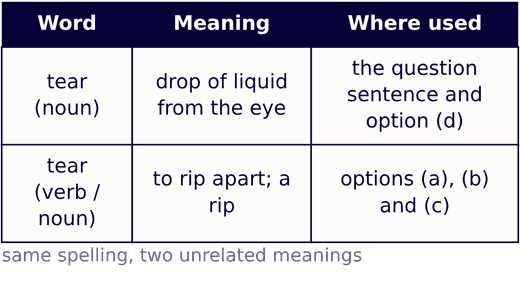 Option (d), 'a tear of sadness in her heart', uses the noun in exactly that emotional sense.
In (a) and (b) 'tear' is a verb meaning to rip something apart, and in (c) it is the noun formed from that verb — a split made in the shoe by friction.
Hence, option (d) is the most appropriate answer.
Option (d), 'a tear of sadness in her heart', uses the noun in exactly that emotional sense.
In (a) and (b) 'tear' is a verb meaning to rip something apart, and in (c) it is the noun formed from that verb — a split made in the shoe by friction.
Hence, option (d) is the most appropriate answer.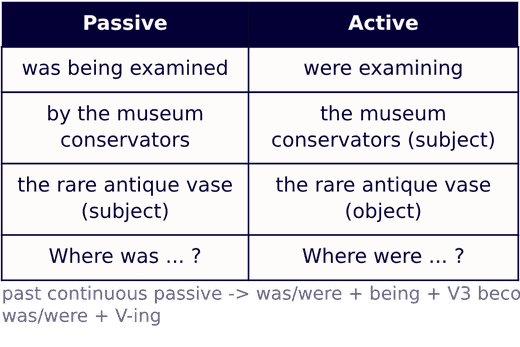 The agent 'the museum conservators' becomes the subject and 'the rare antique vase' becomes the object; in a question the helping verb 'were' must still stand before the subject.
Option (b) drops that inversion, option (c) tacks 'where' on at the end and destroys the question structure, and option (d) changes the tense to the simple past 'did ... examine'.
Hence, option (a) is the most appropriate answer.
The agent 'the museum conservators' becomes the subject and 'the rare antique vase' becomes the object; in a question the helping verb 'were' must still stand before the subject.
Option (b) drops that inversion, option (c) tacks 'where' on at the end and destroys the question structure, and option (d) changes the tense to the simple past 'did ... examine'.
Hence, option (a) is the most appropriate answer.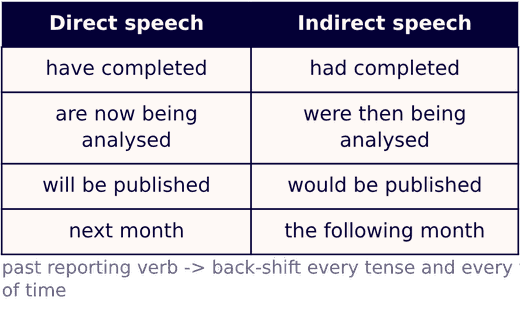 The relative clause is part of the reported words, so 'are now being analysed' must also become 'were then being analysed'.
Only option (b) makes all four changes together.
Options (a) and (d) keep 'has completed' and 'will be published', while (c) leaves 'are now being analysed' untouched — none of them completes the back-shift.
Hence, option (b) is the most appropriate answer.
The relative clause is part of the reported words, so 'are now being analysed' must also become 'were then being analysed'.
Only option (b) makes all four changes together.
Options (a) and (d) keep 'has completed' and 'will be published', while (c) leaves 'are now being analysed' untouched — none of them completes the back-shift.
Hence, option (b) is the most appropriate answer.