SSC CHSL 14 November 2025 · Shift 3 · English Language — questions with answers · ShikshaSphere
Chapter 32 of 200
14 November 2025 · Shift 3
English Language
25 questions ~25 min readFree
25 questions
A
1
Identify the part of the sentence that contains a grammatical error.
A. The large box of chocolates
B. were distributed among
C. the children present
D. at the birthday party.
A.The large box of chocolates
B.were distributed among
C.the children present
D.at the birthday party
Solution
Subject-verb agreement
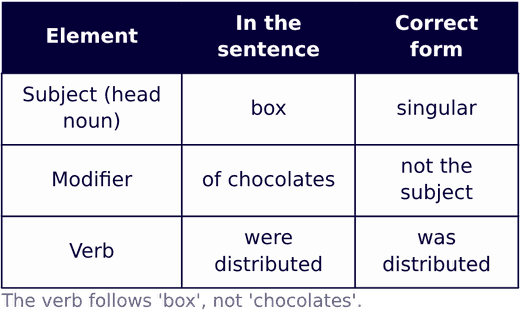
The error lies in part B, where the verb does not agree with the real subject of the sentence.
Rule: a verb agrees with the head noun of its subject, not with a noun sitting inside the following 'of …' phrase.
Here the head noun is 'box' (singular); 'of chocolates' only describes it, so the singular verb 'was distributed' is required.
Correct sentence: The large box of chocolates was distributed among the children present at the birthday party.
Parts A, C and D contain no error, so option (b) is correct.
2
Fill in the blank with the most appropriate preposition:
The thieves broke the guarded vault during the midnight storm.
A.into
B.onto
C.up
D.open
Solution
Preposition with phrasal verb
The blank needs a preposition that turns 'break' into the phrasal verb meaning 'to enter by force'.
'Break into' = to enter a building, room or container illegally or forcibly — exactly what thieves do to a guarded vault.
Complete sentence: The thieves broke into the guarded vault during the midnight storm.
'Break up' means to end or to split apart, and 'onto' expresses movement on to a surface, so neither suits a vault.
'Open' is an adjective, not a preposition, so it fails the requirement of the question.
Hence option (a) is correct.
3
Select the most appropriate synonym of the word:
PURPOSE-DRIVEN
A.Teleological
B.Random
C.Historical
D.Reactive
Solution
Synonym
'Purpose-driven' describes action that is guided by a definite aim or goal.
'Teleological' means directed towards an end or purpose — it comes from the Greek 'telos', meaning end or goal.
So 'Teleological' carries the same idea of being governed by a purpose.
'Random' (happening without any plan) and 'Reactive' (merely responding to events) are opposite in sense, while 'Historical' (relating to the past) is unrelated.
Hence option (a) is correct.
4
Choose the incorrectly spelt word:
A.Acknowledgement
B.Responsibility
C.Environment
D.Management
Solution
Spelling
The word that is not spelt correctly here is 'Acknowledgement'; the spelling required is 'Acknowledgment'.
It is formed from 'acknowledge' + '-ment', and the silent 'e' of the root is dropped before the suffix.
The other three are spelt correctly: 'Responsibility' (response + -ibility), 'Environment' (environ + -ment, the 'n' before 'm' is retained) and 'Management'.
Hence option (a) is correct.
5
Which of the following sentences uses the word "desert" with the same meaning as in the sentence below?
"We were forced to desert the ship when the engine malfunctioned."
A.The Sahara Desert experiences extremely high daytime temperatures.
B.Plants in the desert have adapted to survive with little water.
C.Travelers crossed a vast desert during their journey.
D.He would never desert his companions when they needed him most.
Solution
Homonym 'desert'
'Desert' is a homonym: as a noun (DES-ert) it means a dry, barren region, and as a verb (de-SERT) it means to abandon or leave behind.
In 'We were forced to desert the ship…', the word follows 'to' and means to abandon the ship, so it is the verb.
Option (d), 'He would never desert his companions when they needed him most', uses the verb in the same sense of abandoning.
In options (a), (b) and (c), 'desert' is the noun naming a sandy region, so the meaning is different.
Hence option (d) is correct.
6
Choose the incorrectly spelt word:
A.Commemoretive
B.Celebration
C.Anniversary
D.Memorial
Solution
Spelling
The incorrectly spelt word is 'Commemoretive'; the correct spelling is 'Commemorative'.
It is built on the verb 'commemorate' (to honour the memory of someone or something); the '-ate' ending becomes '-ative', so the vowel before '-tive' is 'a', not 'e'.
'Celebration', 'Anniversary' and 'Memorial' are all spelt correctly.
Hence option (a) is correct.
7
Directions (Qs. 7-11): Read the following passage carefully and answer the questions that follow.
The rapid advancement of Genetic Engineering (GE) in modern medicine introduces a tangled web of moral dilemmas that need to be carefully addressed. While GE offers the promise of eradicating hereditary diseases, enhancing physical resilience, and new opportunities for biological improvement, it raises to its highest power fundamental questions regarding eugenics, genetic inequality, and the
alteration of human nature. Robust ethical frameworks and international regulatory treaties are necessary to counteract societal polarization in the face of the possibility of a genetic divide, particularly between the wealthy and the underprivileged. More alarmingly, GE technologies that edit the germline have the potential to introduce and even accelerate permanent changes to the human gene pool, resulting in unforeseen mutations or irreversible biological consequences. This creates issues of consent and safety in a more manipulated future. In addition, as GE influences increasing numbers of evolutionary outcomes, the liability question is at the forefront: who is to blame when a genetic modification triggers a catastrophic side effect or ecological imbalance?
What is one of the main moral concerns related to the advancement of GE in medicine?
A.Increased medical costs in all hospitals
B.Introduction and acceleration of permanent changes to the gene pool
C.Improved surgical techniques in emergency care
D.Reduction in the study of biology in schools
Solution
Reading comprehension
The passage lists several moral dilemmas of Genetic Engineering, and its sharpest warning concerns germline editing.
It states that GE technologies which edit the germline have the potential to introduce and even accelerate permanent changes to the human gene pool.
Such changes are passed on to later generations, so the harm is not confined to one patient — that is why it is a central moral concern.
Medical costs, surgical techniques and school biology are never discussed in the passage, so (a), (c) and (d) lie outside it.
Hence option (b) is correct.
8
Directions (Qs. 7-11): Read the following passage carefully and answer the questions that follow.
The rapid advancement of Genetic Engineering (GE) in modern medicine introduces a tangled web of moral dilemmas that need to be carefully addressed. While GE offers the promise of eradicating hereditary diseases, enhancing physical resilience, and new opportunities for biological improvement, it raises to its highest power fundamental questions regarding eugenics, genetic inequality, and the
alteration of human nature. Robust ethical frameworks and international regulatory treaties are necessary to counteract societal polarization in the face of the possibility of a genetic divide, particularly between the wealthy and the underprivileged. More alarmingly, GE technologies that edit the germline have the potential to introduce and even accelerate permanent changes to the human gene pool, resulting in unforeseen mutations or irreversible biological consequences. This creates issues of consent and safety in a more manipulated future. In addition, as GE influences increasing numbers of evolutionary outcomes, the liability question is at the forefront: who is to blame when a genetic modification triggers a catastrophic side effect or ecological imbalance?
What is necessary to address societal polarization caused by GE in medicine?
A.Increased privatization of medical research
B.Robust ethical frameworks and international regulatory treaties
C.Limiting the use of medicine in certain countries
D.Complete removal of doctors from hospitals
Solution
Reading comprehension
The passage warns of a genetic divide, particularly between the wealthy and the underprivileged, which can polarise society.
To counteract that polarisation it prescribes robust ethical frameworks and international regulatory treaties.
Both halves matter — ethical frameworks to guide practice, and international treaties because the technology crosses national borders.
Privatisation of research, restricting medicine in some countries and removing doctors from hospitals are nowhere suggested.
Hence option (b) is correct.
9
Directions (Qs. 7-11): Read the following passage carefully and answer the questions that follow.
The rapid advancement of Genetic Engineering (GE) in modern medicine introduces a tangled web of moral dilemmas that need to be carefully addressed. While GE offers the promise of eradicating hereditary diseases, enhancing physical resilience, and new opportunities for biological improvement, it raises to its highest power fundamental questions regarding eugenics, genetic inequality, and the
alteration of human nature. Robust ethical frameworks and international regulatory treaties are necessary to counteract societal polarization in the face of the possibility of a genetic divide, particularly between the wealthy and the underprivileged. More alarmingly, GE technologies that edit the germline have the potential to introduce and even accelerate permanent changes to the human gene pool, resulting in unforeseen mutations or irreversible biological consequences. This creates issues of consent and safety in a more manipulated future. In addition, as GE influences increasing numbers of evolutionary outcomes, the liability question is at the forefront: who is to blame when a genetic modification triggers a catastrophic side effect or ecological imbalance?
Which of the following is the primary liability question associated with GE, as discussed in the passage?
A.The loss of natural immunity in the general population
B.The challenge of determining who is to blame when a modification triggers side effects
C.The introduction of highly expensive medical procedures
D.The complete removal of government oversight in research
Solution
Reading comprehension
The closing sentence of the passage brings the liability question to the forefront: who is to blame when a genetic modification triggers a catastrophic side effect or ecological imbalance?
So the primary liability question is the difficulty of fixing responsibility for the harm a modification causes.
Option (b) states exactly this challenge of determining who is to blame.
Loss of natural immunity, the cost of procedures and removal of government oversight are not the liability issue the passage raises.
Hence option (b) is correct.
10
Directions (Qs. 7-11): Read the following passage carefully and answer the questions that follow.
The rapid advancement of Genetic Engineering (GE) in modern medicine introduces a tangled web of moral dilemmas that need to be carefully addressed. While GE offers the promise of eradicating hereditary diseases, enhancing physical resilience, and new opportunities for biological improvement, it raises to its highest power fundamental questions regarding eugenics, genetic inequality, and the
alteration of human nature. Robust ethical frameworks and international regulatory treaties are necessary to counteract societal polarization in the face of the possibility of a genetic divide, particularly between the wealthy and the underprivileged. More alarmingly, GE technologies that edit the germline have the potential to introduce and even accelerate permanent changes to the human gene pool, resulting in unforeseen mutations or irreversible biological consequences. This creates issues of consent and safety in a more manipulated future. In addition, as GE influences increasing numbers of evolutionary outcomes, the liability question is at the forefront: who is to blame when a genetic modification triggers a catastrophic side effect or ecological imbalance?
Which of the following statements is grammatically correct?
A.The advancement of GE in modern medicine introduces questions regarding eugenics, genetic inequality, and the alteration of human nature.
B.The advancement of GE in modern medicine introduce questions regarding eugenics, genetic inequality, and the alteration of human nature.
C.The advancement of GE in modern medicine introduce questions regarding eugenics, genetic inequality, and the alteration of human natures.
D.The advancement of GE in modern medicine introduces questions regarding eugenics, genetic inequality, and the alteration of human natures.
Solution
Grammatically correct sentence
Two points have to be checked in each option: the agreement of the verb and the form of the noun 'nature'.
The head of the subject is 'The advancement' (singular); 'of GE in modern medicine' only modifies it, so the verb must be 'introduces'. This rules out (b) and (c).
'Human nature' is an abstract, uncountable noun in this sense, so it has no plural form 'natures'. This rules out (c) and (d).
Only option (a) satisfies both requirements, and it also matches the wording of the passage.
Hence option (a) is correct.
11
Directions (Qs. 7-11): Read the following passage carefully and answer the questions that follow.
The rapid advancement of Genetic Engineering (GE) in modern medicine introduces a tangled web of moral dilemmas that need to be carefully addressed. While GE offers the promise of eradicating hereditary diseases, enhancing physical resilience, and new opportunities for biological improvement, it raises to its highest power fundamental questions regarding eugenics, genetic inequality, and the
alteration of human nature. Robust ethical frameworks and international regulatory treaties are necessary to counteract societal polarization in the face of the possibility of a genetic divide, particularly between the wealthy and the underprivileged. More alarmingly, GE technologies that edit the germline have the potential to introduce and even accelerate permanent changes to the human gene pool, resulting in unforeseen mutations or irreversible biological consequences. This creates issues of consent and safety in a more manipulated future. In addition, as GE influences increasing numbers of evolutionary outcomes, the liability question is at the forefront: who is to blame when a genetic modification triggers a catastrophic side effect or ecological imbalance?
How does the application of GE create a potential risk in terms of biological safety, according to the passage ?
A.GE will completely replace natural reproduction, leading to population decline
B.GE's editing of the germline could result in unforeseen mutations or irreversible biological consequences.
C.GE will make biological decisions based on politics rather than science
D.GE's impact on evolution will primarily benefit the pharmaceutical industry
Solution
Reading comprehension
The question asks for the risk to biological safety, which the passage states in its sentence on germline editing.
Editing the germline can result in unforeseen mutations or irreversible biological consequences — changes that cannot be undone once they enter the gene pool.
Option (b) reproduces this idea exactly.
Replacement of natural reproduction, decisions taken on political grounds and profits for the pharmaceutical industry are not offered in the passage as safety risks.
Hence option (b) is correct.
12
Choose the correct meaning of the highlighted idiom.
Despite their different backgrounds, the two partners see eye to eye on all major decisions.
A.To look directly into someone's eyes
B.To have the same opinions or views
C.To carefully observe someone's behavior
D.To strongly oppose another person
Solution
Idiom
The idiom 'see eye to eye (with someone)' means to agree completely — to hold the same opinion or view.
The sentence sets 'different backgrounds' against agreement 'on all major decisions', so the idiom must express agreement.
Option (a) gives only the literal sense of the separate words, not the idiomatic meaning.
Options (c) and (d) distort the sense — the idiom is neither about watching someone nor about opposing them.
Hence option (b) is correct.
13
Select the most appropriate antonym of the word: Light
A.Fragile
B.Ponderous
C.Petite
D.Slender
Solution
Antonym
Here 'light' is used in the sense of 'having little weight', so its antonym must convey heaviness.
'Ponderous' means so heavy that it moves or reads slowly and clumsily — the exact opposite of light.
'Fragile' (easily broken), 'Petite' (small and slim) and 'Slender' (gracefully thin) all suggest smallness or delicacy, which is closer to 'light' than opposite to it.
Hence option (b) is correct.
14
Choose the correct one-word substitute for:
A person who flies an aircraft.
A.Captain
B.Pilot
C.Mason
D.Salior
Solution
One-word substitution
A person who flies an aircraft is called a 'Pilot'.
'Captain' is the person in command of a ship, 'Sailor' is one who works on a ship, and 'Mason' is a worker skilled in cutting and laying stone.
Note also that option (d) is printed as 'Salior'; the word is spelt 'Sailor'.
Hence option (b) is correct.
15
Choose the correct one-word substitute for:
A person who has an exceptional aptitude in one particular field.
A.Layman
B.Dilettante
C.Amateur
D.Savant
Solution
One-word substitution
'Savant' means a person of exceptional learning or ability in one particular field.
'Layman' has no special training in the subject, 'Dilettante' dabbles in it without serious study, and 'Amateur' takes part for pleasure rather than as an expert.
All three of those describe the absence of expertise, which is the opposite of an exceptional aptitude.
Hence option (d) is correct.
16
Change the following sentence into the Active form.
Fresh vegetables are sold at the market every Sunday morning.
A.Fresh vegetables sell at the market every Sunday morning.
B.They sell fresh vegetables at the market every Sunday morning.
C.They are selling fresh vegetables at the market every Sunday morning.
D.Fresh vegetables have been sold at the market every Sunday morning.
Solution
Active and passive voice
The given sentence is passive: 'Fresh vegetables' (subject) + 'are sold' (be + V3) + the rest.
To turn it into the active voice, supply the doer of the action. No agent is named, so the general subject 'They' is used, and the passive subject becomes the object.
The tense is simple present with a plural subject, so the active verb is the plain form 'sell'.
Active sentence: They sell fresh vegetables at the market every Sunday morning.
Option (a) leaves the sentence without a doer, (c) wrongly shifts to the present continuous, and (d) is still passive.
Hence option (b) is correct.
17
Select the most appropriate antonym of the word:
Oppose
A.Resist
B.Reject
C.Connive
D.Protest
Solution
Antonym
'Oppose' means to disagree with something and to try to prevent it.
'Connive' means to co-operate secretly in a wrongdoing, or to allow it by pretending not to notice — that is, to go along with a thing instead of resisting it.
This makes 'Connive' the opposite of 'Oppose'.
'Resist', 'Reject' and 'Protest' all express disagreement, so they are synonyms of 'oppose', not antonyms.
Hence option (c) is correct.
18
Select the option that expresses the given sentence in indirect voice. She said, 'I cooked the dinner, and I was waiting for the guests."
A.She said that she had cooked the dinner and she was waiting for the guests.
B.She said that she had cooked the dinner and she had been waiting for the guests.
C.She said that she cooked the dinner and she had been waiting for the guests.
D.She said that she cooked the dinner and she was waiting for the guests.
Solution
Direct and indirect speech
The reporting verb 'said' is in the past tense, so every verb of the reported speech moves one step back in tense.
'I cooked' (simple past) becomes 'she had cooked' (past perfect), and 'I was waiting' (past continuous) becomes 'she had been waiting' (past perfect continuous).
The pronoun 'I' changes to 'she', the inverted commas are dropped, and the reported clause is joined by 'that'.
This gives: She said that she had cooked the dinner and she had been waiting for the guests.
Options (a), (c) and (d) leave one or both verbs un-shifted.
Hence option (b) is correct.
19
Choose the most suitable option to replace the highlighted part of the sentence:A fraction of the student body are attended the seminar.
A.A fractions of the student body have attended
B.A fraction of the student body have attended
C.A fraction of the student body were attended
D.A fraction of the student body has attended
Solution
Sentence improvement
The highlighted part carries two faults — the wrong voice and the wrong number of the verb.
The students did the attending, so the verb must be active ('has attended'), not passive ('are attended'). This removes option (c).
With an expression like 'a fraction of …', the verb agrees with the noun that follows 'of'.
Here that noun is 'the student body', a singular collective noun, so the singular verb 'has attended' is required.
Option (b) wrongly uses the plural 'have', and option (a) adds the ungrammatical form 'A fractions'.
Correct sentence: A fraction of the student body has attended the seminar. Hence option (d) is correct.
20
Choose the most suitable option to replace the highlighted part of the sentence:
Anita , a skilled chef who managed the kitchen in hotels as well as resorts, will be prepare the feast Sunday in Goa.
A.will prepare
B.in preparation
C.will preparing
D.is prepare
Solution
Sentence improvement
The sentence speaks of an action still to come, so the simple future tense is needed: 'will' + the base form of the verb.
The highlighted part wrongly inserts 'be' between 'will' and the base form; the required form is simply 'will prepare'.
Correct sentence: Anita, a skilled chef who managed the kitchen in hotels as well as resorts, will prepare the feast Sunday in Goa.
'Will preparing' has no auxiliary to support the '-ing' form, 'is prepare' joins a present-tense auxiliary to a base verb, and 'in preparation' is a noun phrase, which leaves the sentence without a main verb.
Hence option (a) is correct.
21
Choose the correct passive voice transformation of the sentence:
The scientists, after endless months of testing, have developed a new effective vaccine.
A.A new effective vaccine was developed by the scientists after endless months of testing.
B.A new effective vaccine has been developed by the scientists after endless months of testing.
C.A new effective vaccine had been developed by the scientists after endless months of testing.
D.A new effective vaccine is developed by the scientists after endless months of testing.
Solution
Present perfect passive
The active verb is 'have developed', which is present perfect, so the passive must be 'has/have + been + V3'.
The new subject is the object of the active sentence, 'a new effective vaccine', and it is singular, so the auxiliary becomes 'has'.
Passive: A new effective vaccine has been developed by the scientists after endless months of testing.
Options (a) 'was developed' and (d) 'is developed' shift the sentence to the simple past and the simple present, and (c) 'had been developed' makes it past perfect, so option (b) is correct.
22
Choose the correct passive voice transformation of the sentence: Why do they always place such a high tax on imported goods?
A.Why is such a high tax always placed on imported goods?
B.Why such a high tax is always placed on imported goods?
C.Why was such a high tax always placed on imported goods?
D.Why has such a high tax always been placed on imported goods?
Solution
Passive of a question
'Do they place' is simple present, and the passive of the simple present is 'is/are + V3'.
The object 'such a high tax' becomes the subject; it is singular, so the auxiliary is 'is', and in a question the auxiliary comes before the subject, right after 'Why'.
The adverb 'always' keeps its place just before the main verb: Why is such a high tax always placed on imported goods?
Option (b) keeps the statement word order with no auxiliary before the subject, while (c) 'was' and (d) 'has been' change the tense, so option (a) is correct.
23
Select the option that expresses the given sentence in direct voice. The new clerk asked his boss how he could finish his daily task.
A.The new clerk asked, 'How could I finish my daily task?"
B.The new clerk said, "How can he finish his daily task?"
C.The new clerk said to his boss, "How could he finish his daily task?"
D.The new clerk asked his boss, "How can I finish my daily task?"
Solution
Indirect to direct speech
The reported sentence is a question, so in direct speech the reporting verb stays 'asked', the listener 'his boss' is kept, and the words spoken go inside quotation marks.
The back-shift is undone: 'could' returns to 'can', and the reported 'he/his' returns to the speaker's own 'I/my'.
The interrogative word order of the original question is restored after 'How'.
Direct: The new clerk asked his boss, "How can I finish my daily task?"
Option (a) drops the listener and keeps 'could', (b) keeps the third-person 'he', and (c) keeps 'could' with 'he', so option (d) is correct.
24
Select the option that expresses the given sentence in direct voice. The general said that the captain's plan of retreat had been a breach of the army's code, as the map which had been drawn by the scout had clearly shown that he was safe.
A.'The captain's plan of retreat has been a breach of the army's code, as the map which was drawn by the scout has clearly shown that he was safe," the general said.
B."The captain's plan of retreat had been a breach of the army's code, as the map which was drawn by the scout had clearly shown that he was safe," the general said.
C."The captain's plan of retreat has been a breach of the army's code, as the map which was drawn by the scout has clearly shown that he is safe," the general said.
D."The captain's plan of retreat was a breach of the army's code, as the map which was drawn by the scout has clearly shown that he is safe," the general said.
Solution
Direct speech back-shift
Turning indirect speech into direct speech undoes every back-shift: past perfect goes back to present perfect and simple past goes back to simple present.
'had been a breach' becomes 'has been a breach'.
'which had been drawn by the scout' becomes 'which was drawn by the scout', because the drawing was already over when the general spoke.
'had clearly shown' becomes 'has clearly shown' and 'that he was safe' becomes 'that he is safe'.
Direct: "The captain's plan of retreat has been a breach of the army's code, as the map which was drawn by the scout has clearly shown that he is safe," the general said.
Option (a) keeps 'he was safe', (b) keeps the whole sentence in the past perfect, and (d) turns 'had been' into a plain past 'was', so option (c) is correct.
25
Rearrange the following sentence parts to form a meaningful and grammatically correct paragraph:
P. After setting up the equipment in the lab, the students began to observe the chemical reaction.
Q. They meticulously recorded the changes in color and temperature as the solution was slowly heated up.
R. Every result they noted, including the gas bubbles and precipitates, was analyzed and compared later.
S. The findings confirmed the theory of the professor by providing solid proof of the concept.
A.P, Q, R, S
B.Q, P, R, S
C.S, R, Q, P
D.P, R, Q, S
Solution
Para jumble
P is the opening sentence: it names the doers (the students) and starts the action — the equipment is set up and the observation begins.
Q must follow P, because 'They' can only refer back to 'the students' of P, and it tells what was noticed while the reaction went on.
R comes after Q: the results 'they noted' during the observation are the ones analysed and compared later.
S closes the paragraph with the outcome of that analysis — the professor's theory is confirmed.
So the correct order is P, Q, R, S, i.e. option (a).
Finished reading? Now test yourself.
The same 25 questions, but with a timer and the answers hidden — 15 minutes.

 Rule: a verb agrees with the head noun of its subject, not with a noun sitting inside the following 'of …' phrase.
Here the head noun is 'box' (singular); 'of chocolates' only describes it, so the singular verb 'was distributed' is required.
Correct sentence: The large box of chocolates was distributed among the children present at the birthday party.
Parts A, C and D contain no error, so option (b) is correct.
Rule: a verb agrees with the head noun of its subject, not with a noun sitting inside the following 'of …' phrase.
Here the head noun is 'box' (singular); 'of chocolates' only describes it, so the singular verb 'was distributed' is required.
Correct sentence: The large box of chocolates was distributed among the children present at the birthday party.
Parts A, C and D contain no error, so option (b) is correct.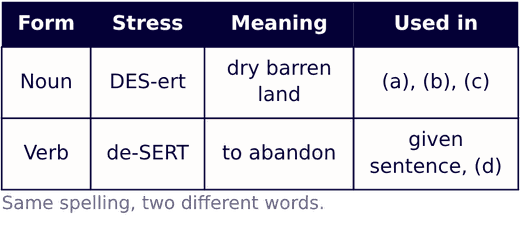 In 'We were forced to desert the ship…', the word follows 'to' and means to abandon the ship, so it is the verb.
Option (d), 'He would never desert his companions when they needed him most', uses the verb in the same sense of abandoning.
In options (a), (b) and (c), 'desert' is the noun naming a sandy region, so the meaning is different.
Hence option (d) is correct.
In 'We were forced to desert the ship…', the word follows 'to' and means to abandon the ship, so it is the verb.
Option (d), 'He would never desert his companions when they needed him most', uses the verb in the same sense of abandoning.
In options (a), (b) and (c), 'desert' is the noun naming a sandy region, so the meaning is different.
Hence option (d) is correct.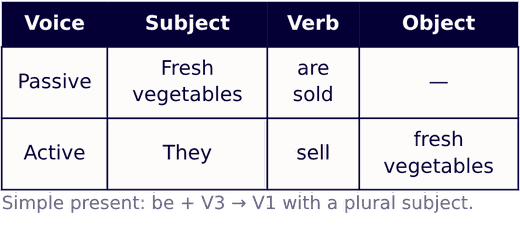 The tense is simple present with a plural subject, so the active verb is the plain form 'sell'.
Active sentence: They sell fresh vegetables at the market every Sunday morning.
Option (a) leaves the sentence without a doer, (c) wrongly shifts to the present continuous, and (d) is still passive.
Hence option (b) is correct.
The tense is simple present with a plural subject, so the active verb is the plain form 'sell'.
Active sentence: They sell fresh vegetables at the market every Sunday morning.
Option (a) leaves the sentence without a doer, (c) wrongly shifts to the present continuous, and (d) is still passive.
Hence option (b) is correct.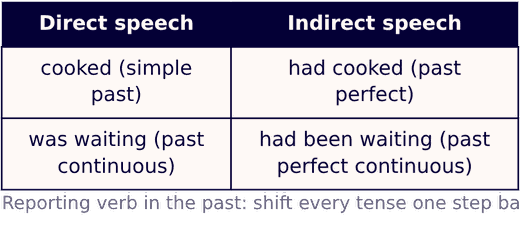 'I cooked' (simple past) becomes 'she had cooked' (past perfect), and 'I was waiting' (past continuous) becomes 'she had been waiting' (past perfect continuous).
The pronoun 'I' changes to 'she', the inverted commas are dropped, and the reported clause is joined by 'that'.
This gives: She said that she had cooked the dinner and she had been waiting for the guests.
Options (a), (c) and (d) leave one or both verbs un-shifted.
Hence option (b) is correct.
'I cooked' (simple past) becomes 'she had cooked' (past perfect), and 'I was waiting' (past continuous) becomes 'she had been waiting' (past perfect continuous).
The pronoun 'I' changes to 'she', the inverted commas are dropped, and the reported clause is joined by 'that'.
This gives: She said that she had cooked the dinner and she had been waiting for the guests.
Options (a), (c) and (d) leave one or both verbs un-shifted.
Hence option (b) is correct.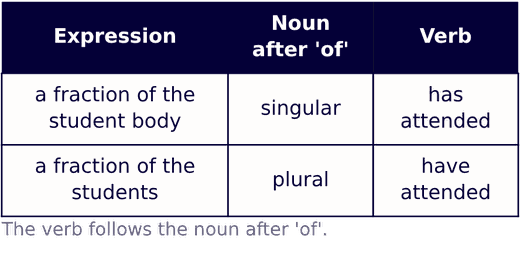 Here that noun is 'the student body', a singular collective noun, so the singular verb 'has attended' is required.
Option (b) wrongly uses the plural 'have', and option (a) adds the ungrammatical form 'A fractions'.
Correct sentence: A fraction of the student body has attended the seminar. Hence option (d) is correct.
Here that noun is 'the student body', a singular collective noun, so the singular verb 'has attended' is required.
Option (b) wrongly uses the plural 'have', and option (a) adds the ungrammatical form 'A fractions'.
Correct sentence: A fraction of the student body has attended the seminar. Hence option (d) is correct.