SSC CHSL 15 November 2025 · Shift 1 · General Intelligence — questions with answers · ShikshaSphere
Chapter 33 of 200
15 November 2025 · Shift 1
General Intelligence
25 questions ~25 min readFree
25 questions
A
26
A bus travels at a speed of 84 km/hr. How much distance will it cover in 40 minutes?
A.40 km
B.56 km
C.60 km
D.70 km
Solution
Speed, time and distance
Formula: distance = speed time, where the time must be measured in the same unit as the speed.
The speed is in km/hr, so 40 minutes has to be changed into hours: hr.
Distance
km.
Hence the bus covers 56 km in 40 minutes, so option (b) is correct.
27
A bike travels from town P to town at an average speed of and returns from town Q to town P at an average speed of . What is the average speed for the entire trip ?
A.32.5 km/hr
B.
C.
D.
Solution
Average speed
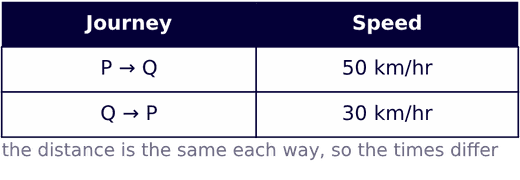
The same distance is covered twice, once at each speed, so the average speed is the harmonic mean of the two speeds and not their simple average.
Formula: average speed , where x and y are the two speeds.
Here x=50 km/hr and y=30 km/hr.
Average speed
=37.5 km/hr.
Hence the average speed for the entire trip is 37.5 km/hr, so option (b) is correct.
28
If a piece of cloth is 12 meters long and 4.5 meters are cut from it, how much cloth is left ?
A.6.5 meters
B.7.5 meters
C.5.5 meters
D.8.5 meters
Solution
Subtraction of decimals
The cloth left over is the whole length minus the length that was cut off.
Cloth left =12-4.5
=7.5 metres.
Hence 7.5 metres of cloth is left, so option (b) is correct.
29
Find the least common multiple (LCM) of 8, 24, and 40.
A.72
B.60
C.120
D.56
Solution
LCM by prime factors
Rule: the LCM is the product of every prime factor taken to the highest power in which it occurs in any one of the numbers.
, and .
The highest powers are , 3 and 5.
LCM .
Hence the LCM of 8, 24 and 40 is 120, so option (c) is correct.
30
Read the following statement carefully and identify the inference that follows.Statement: The ABC company has decided to reduce its workforce by 500 employees due to declining profits.
Inference:
I. The company is experiencing financial difficulties.
II. The employees who were laid off were underperforming.
III. The company will improve its profits after reducing its workforce.
A.If only I follows
B.If only III follows
C.If both I and II follow
D.If both I and III follow
Solution
Statement and inference
An inference follows only when the statement itself supports it; whatever the statement is silent about must be rejected.
Inference I: the cut is being made 'due to declining profits', and falling profits are precisely a financial difficulty, so I follows.
Inference II: the statement says nothing whatever about how the employees worked; the cut is tied to profits, not to performance, so II does not follow.
Inference III: a workforce cut forced by declining profits is made in order to bring costs down and profits back up, which is the purpose behind the very decision reported, so III follows.
Hence I and III follow, and the answer is option (d).
31
Pick the correct options from the given alternatives
11 : 1000 : : 6 :?
A.125
B.216
C.512
D.343
Solution
Number analogy
Look for a single rule that turns the first number of the pair into the second one.
and 10=11-1, so the rule is: subtract 1 from the number, then cube it.
Applying the same rule to 6:
=125.
Hence the missing number is 125, so option (a) is correct.
32
Which of the following numbers would replace the question mark (?) in the given number series?
4, 12, 28, ?, 124
A.40
B.50
C.60
D.70
Solution
Number series
Work out the differences between the terms that are given.
12-4=8 and 28-12=16, so each difference is double the one before it.
The next difference is therefore , which makes the missing term 28+32=60.
Check: the difference after that is , and 60+64=124, the last term of the series.
Hence the missing number is 60, so option (c) is correct.
33
Select the correct option that will complete the series.
(5, 9), (8, 14),
A.
B.
C.
D.
Solution
Number pair series
Treat the first numbers of the pairs as one series and the second numbers as another.
First numbers: — each one is 3 more than the one before it.
Second numbers: — each one is 5 more than the one before it.
So the missing pair is .
Check: 14+3=17 and 24+5=29, which is exactly the pair given last.
Hence the missing term is (14,24), so option (a) is correct.
34
Find out the wrong number in the following series.
88, 69, 52, 37, 23, 13, 4
A.69
B.52
C.37
D.23
Solution
Wrong number in series
Find what is being subtracted at every step and look for a pattern in those subtractions.
88-69=19, 69-52=17, 52-37=15 — the numbers subtracted are odd numbers falling by 2 each time.
So the next subtraction must be 13, which gives 37-13=24 and not 23.
With 24 in that place the rest fits perfectly: 24-11=13 and 13-9=4.
Hence 23 is the wrong number of the series, so option (d) is correct.
35
Three of the following are from the same category and one is different. Choose the odd one out.
A.Mouse
B.Keyboard
C.Scanner
D.Monitor
Solution
Odd one out (devices)
Sort the four items by the work each of them does in a computer system.
A mouse, a keyboard and a scanner all carry data into the computer, so all three are input devices.
A monitor does the opposite — it shows the processed result to the user, so it is an output device.
Hence the monitor is the odd one out, so option (d) is correct.
36
In the set of four numbers given, select the odd one out.
A.31
B.37
C.41
D.65
Solution
Odd one out (prime numbers)
Test each number for a factor other than 1 and the number itself.
31, 37 and 41 have no such factor, so all three are prime numbers.
65 breaks up as , so it has factors besides 1 and 65 and is a composite number.
Hence 65 is the odd one out, so option (d) is correct.
37
Select the correct options from the given alternatives 12, 13.5, 15.5, 18, ?
A.21.5
B.20.5
C.21
D.22
Solution
Number series
Work out the difference between each pair of consecutive terms.
13.5-12=1.5, 15.5-13.5=2, 18-15.5=2.5 — every difference is 0.5 more than the one before it.
So the next difference is 2.5+0.5=3.
Missing term =18+3=21.
Hence the required number is 21, so option (c) is correct.
38
Complete the following series from the given options.
a_cd_cba_bcddc_a
A.aaba
B.bdab
C.adcb
D.babd
Solution
Letter series completion
The series has 16 places, so break it into four blocks of four letters each.
The blocks read a _ c d / _ c b a / _ b c d / d c _ a, and the pattern is 'abcd' and 'dcba' turn by turn.
Block 1 needs b, block 2 needs d, block 3 needs a and block 4 needs b.
So the blanks, taken in order, are filled by b, d, a, b.
Hence the answer is 'bdab', so option (b) is correct.
39
What comes next in the following series?
X9, V25, T49, R121, P169, ?
A.Q289
B.N289
C.M289
D.0289
Solution
Alpha-numeric series
Handle the letters and the numbers as two separate patterns.
Letters: X, V, T, R and P stand at places 24, 22, 20, 18 and 16, so each letter moves 2 places backwards; the next place is 14, which is N.
Numbers: are — the squares of the prime numbers taken in order.
The prime after 13 is 17, so the next number is .
Hence the next term is N289, so option (b) is correct.
40
Find the missing term in the series. C, E, H, L, Q, ?
A.S
B.V
C.T
D.W
Solution
Letter series
Write down the position of each letter in the English alphabet.
C =3, E =5, H =8, L =12, Q =17.
The gaps between them are , growing by one every time.
So the next gap is +6, which gives the position 17+6=23.
The 23rd letter of the alphabet is W.
Hence the missing term is W, so option (d) is correct.
41
Some letters are missing from the series. From the given alternative choose the best option which follow the pattern of the series.
b__hj_d_h_b_f_j
A.dfhbeff
B.dfhfhdf
C.dfbfjdh
D.dbfdhjh
Solution
Missing letter series
The given string has 15 places, so split it into three equal blocks of 5 letters each: b _ _ h j / _ d _ h _ / b _ f _ j.
Every block that is complete enough to read shows the same five letters b, d, f, h, j, i.e. alternate letters of the alphabet.
Block 1 already has b, h, j, so the two blanks are d and f.
Block 2 already has d and h, so its three blanks are b, f and j.
Block 3 already has b, f and j, so its two blanks are d and h.
Reading the missing letters in order gives d f b f j d h, so option (c) is correct.
42
If: Then evaluate:
A.80
B.66
C.46
D.86
Solution
Mathematical sign substitution
First replace every sign of the expression by the sign given against it.
So + becomes , - becomes , becomes - and becomes +.
The expression therefore becomes .
Simplify the brackets: and 5+4=9, which gives .
By BODMAS, and are done from left to right: , then .
Finally , so option (a) is correct.
43
If: Then evaluate: ?
A.2
B.8
C.7
D.4
Solution
Mathematical sign substitution
Replace the signs exactly as instructed before doing any calculation.
Only +, - and actually occur inside the expression, so the numerator becomes .
Solve the bracket first: , so the numerator is .
By BODMAS division comes before subtraction: , hence the numerator =30-2=28.
The whole expression is , so option (c) is correct.
44
If all papers are copy and some copies are clean, which of the following must be true?
A.Some papers are clean.
B.All clean things are copies.
C.Some copy are papers.
D.All copies are clean things.
Solution
Syllogism: definite conclusion
'All papers are copy' means the whole group of papers lies inside the group of copies.
Since papers exist and each one of them is a copy, that group of papers forms a part of the copies.
Therefore 'Some copies are papers' is bound to be true — a universal statement always gives this converse in the particular form.
'Some copies are clean' says nothing about where the clean part lies, so it may or may not overlap the papers; hence (a) is only possible, not certain.
(b) and (d) are universal claims that the statements never make, so option (c) is correct.
45
Choose the related word from the given alternatives
String : ? :: Mouse : Computer
A.Television
B.Guitar
C.Refrigerator
D.Washing Machine
Solution
Analogy: part and whole
Read the complete pair first: a mouse is a part of a computer, without which the computer is not comfortably operated.
The same part-to-whole relation must hold in the first pair.
A string is a part of a guitar; it is the string that is plucked to produce the sound.
A television, a refrigerator and a washing machine have no strings in them, so option (b) is correct.
46
In a certain code language, 'apple mango banana' is written as 'rt, km, hp', 'banana orange grape' is written as 'hp, qw, ns' 'apple grape lemon' is written as 'rt, ns, vx'. How is 'orange' written in that language?
A.rt
B.qw
C.km
D.vx
Solution
Code language: word codes
Compare the statements two at a time: the word common to a pair must own the code common to that pair.
Statements 1 and 2 share only the word 'banana' and only the code 'hp', so banana = hp.
Statements 1 and 3 share only 'apple' and only 'rt', so apple = rt.
Statements 2 and 3 share only 'grape' and only 'ns', so grape = ns.
In statement 2 the words are banana, orange, grape and the codes are hp, qw, ns; hp and ns are already fixed for banana and grape.
The only code left for 'orange' is 'qw', so option (b) is correct.
47
Three of the following words are alike in some manner and hence form a group. Which word does NOT belong to that group?
(The words must be considered as meaningful English words and must not be grouped based on the number of letters/number of consonants/vowels in the word).
A.Punjab
B.Haryana
C.Rajasthan
D.Andaman & Nicobar
Solution
Odd one out: States and UTs
All four names belong to the political map of India, so compare their administrative status.
Punjab, Haryana and Rajasthan are States; each has its own legislative assembly and a Governor as constitutional head.
Andaman & Nicobar Islands is a Union Territory, administered directly by the Union Government through a Lieutenant Governor.
Hence Andaman & Nicobar does not belong to the group of States, and option (d) is the odd one out.
48
When all the alphabets of 'DEVELOPMENT' are arranged in the reverse alphabetical order from left to right, then which alphabet is 5th to the right of the 11th alphabet from the right end of the new word formed ?
A.D
B.M
C.E
D.L
Solution
Word rearrangement: position
DEVELOPMENT has 11 letters: D, E, V, E, L, O, P, M, E, N, T.
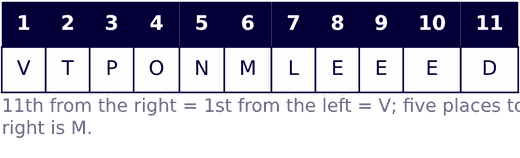
Arranging them in reverse alphabetical order (Z towards A) gives V, T, P, O, N, M, L, E, E, E, D.
In an 11-letter word, the 11th letter from the right end is the 11-11+1=1st letter from the left, which is V.
Now count 5 places to the right of V: T (1st), P (2nd), O (3rd), N (4th), M (5th).
The required letter is M, so option (b) is correct.
49
Find the next number.
3, 9, 45, 315, ?
A.3435
B.2455
C.3465
D.3365
Solution
Number series: prime multipliers
The terms grow very fast, so check what each term is multiplied by to give the next one.
, and .
The multipliers are — successive prime numbers, so the next multiplier is the next prime, 11.
Hence the required term , so option (c) is correct.
50
Identify the pattern in the following sequence.
89, 289, 689, 1289, 2089,
What is the next number in the sequence?
A.3089
B.3099
C.3689
D.3589
Solution
Number series: differences
Take the difference of each pair of consecutive terms.
289-89=200, 689-289=400, 1289-689=600 and 2089-1289=800.
These differences themselves increase by 200 each time, so the next difference is 800+200=1000.
Next term =2089+1000=3089, so option (a) is correct.
Finished reading? Now test yourself.
The same 25 questions, but with a timer and the answers hidden — 15 minutes.

 Here x=50 km/hr and y=30 km/hr.
Average speed
=37.5 km/hr.
Hence the average speed for the entire trip is 37.5 km/hr, so option (b) is correct.
Here x=50 km/hr and y=30 km/hr.
Average speed
=37.5 km/hr.
Hence the average speed for the entire trip is 37.5 km/hr, so option (b) is correct.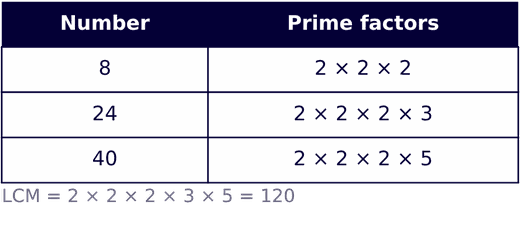 , and .
The highest powers are , 3 and 5.
LCM .
Hence the LCM of 8, 24 and 40 is 120, so option (c) is correct.
, and .
The highest powers are , 3 and 5.
LCM .
Hence the LCM of 8, 24 and 40 is 120, so option (c) is correct.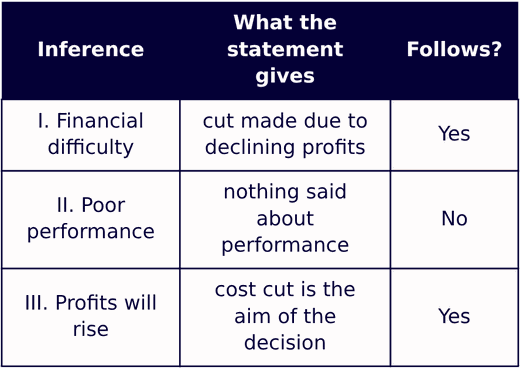 Inference I: the cut is being made 'due to declining profits', and falling profits are precisely a financial difficulty, so I follows.
Inference II: the statement says nothing whatever about how the employees worked; the cut is tied to profits, not to performance, so II does not follow.
Inference III: a workforce cut forced by declining profits is made in order to bring costs down and profits back up, which is the purpose behind the very decision reported, so III follows.
Hence I and III follow, and the answer is option (d).
Inference I: the cut is being made 'due to declining profits', and falling profits are precisely a financial difficulty, so I follows.
Inference II: the statement says nothing whatever about how the employees worked; the cut is tied to profits, not to performance, so II does not follow.
Inference III: a workforce cut forced by declining profits is made in order to bring costs down and profits back up, which is the purpose behind the very decision reported, so III follows.
Hence I and III follow, and the answer is option (d).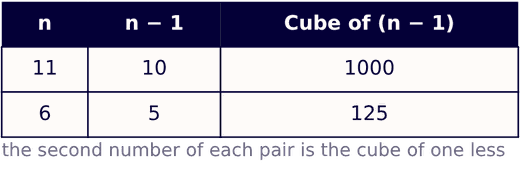 Applying the same rule to 6:
=125.
Hence the missing number is 125, so option (a) is correct.
Applying the same rule to 6:
=125.
Hence the missing number is 125, so option (a) is correct.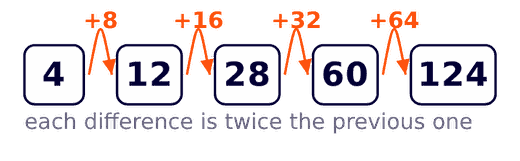 The next difference is therefore , which makes the missing term 28+32=60.
Check: the difference after that is , and 60+64=124, the last term of the series.
Hence the missing number is 60, so option (c) is correct.
The next difference is therefore , which makes the missing term 28+32=60.
Check: the difference after that is , and 60+64=124, the last term of the series.
Hence the missing number is 60, so option (c) is correct.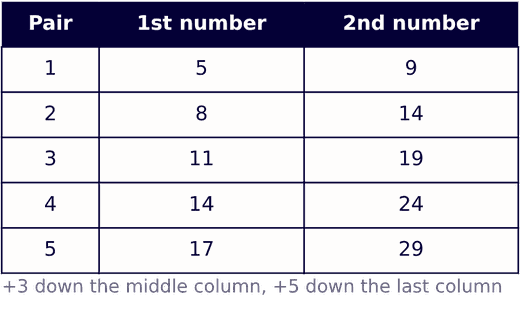 So the missing pair is .
Check: 14+3=17 and 24+5=29, which is exactly the pair given last.
Hence the missing term is (14,24), so option (a) is correct.
So the missing pair is .
Check: 14+3=17 and 24+5=29, which is exactly the pair given last.
Hence the missing term is (14,24), so option (a) is correct.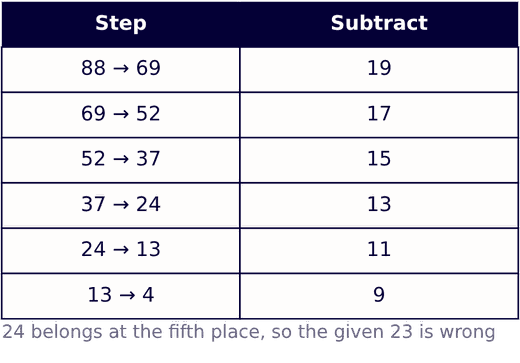 So the next subtraction must be 13, which gives 37-13=24 and not 23.
With 24 in that place the rest fits perfectly: 24-11=13 and 13-9=4.
Hence 23 is the wrong number of the series, so option (d) is correct.
So the next subtraction must be 13, which gives 37-13=24 and not 23.
With 24 in that place the rest fits perfectly: 24-11=13 and 13-9=4.
Hence 23 is the wrong number of the series, so option (d) is correct.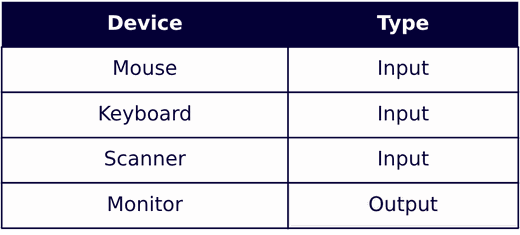 A mouse, a keyboard and a scanner all carry data into the computer, so all three are input devices.
A monitor does the opposite — it shows the processed result to the user, so it is an output device.
Hence the monitor is the odd one out, so option (d) is correct.
A mouse, a keyboard and a scanner all carry data into the computer, so all three are input devices.
A monitor does the opposite — it shows the processed result to the user, so it is an output device.
Hence the monitor is the odd one out, so option (d) is correct.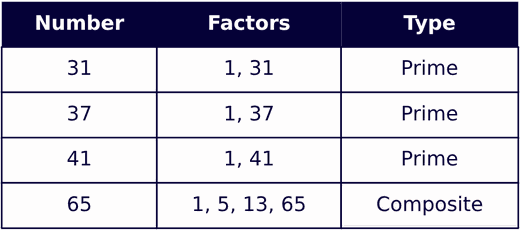 31, 37 and 41 have no such factor, so all three are prime numbers.
65 breaks up as , so it has factors besides 1 and 65 and is a composite number.
Hence 65 is the odd one out, so option (d) is correct.
31, 37 and 41 have no such factor, so all three are prime numbers.
65 breaks up as , so it has factors besides 1 and 65 and is a composite number.
Hence 65 is the odd one out, so option (d) is correct.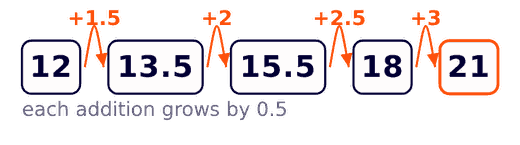 So the next difference is 2.5+0.5=3.
Missing term =18+3=21.
Hence the required number is 21, so option (c) is correct.
So the next difference is 2.5+0.5=3.
Missing term =18+3=21.
Hence the required number is 21, so option (c) is correct.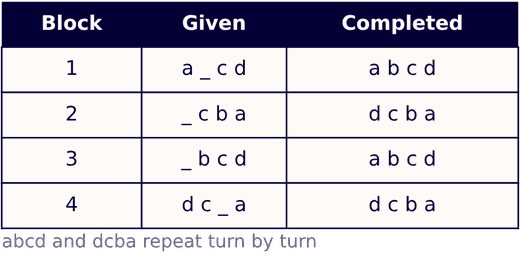 The blocks read a _ c d / _ c b a / _ b c d / d c _ a, and the pattern is 'abcd' and 'dcba' turn by turn.
Block 1 needs b, block 2 needs d, block 3 needs a and block 4 needs b.
So the blanks, taken in order, are filled by b, d, a, b.
Hence the answer is 'bdab', so option (b) is correct.
The blocks read a _ c d / _ c b a / _ b c d / d c _ a, and the pattern is 'abcd' and 'dcba' turn by turn.
Block 1 needs b, block 2 needs d, block 3 needs a and block 4 needs b.
So the blanks, taken in order, are filled by b, d, a, b.
Hence the answer is 'bdab', so option (b) is correct.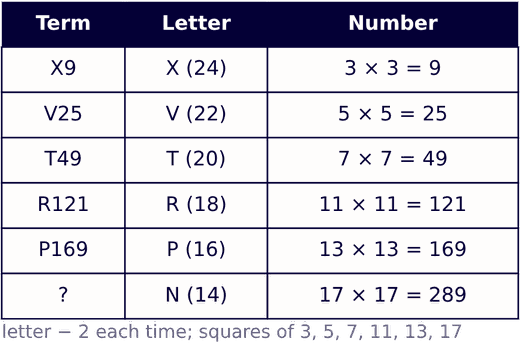 The prime after 13 is 17, so the next number is .
Hence the next term is N289, so option (b) is correct.
The prime after 13 is 17, so the next number is .
Hence the next term is N289, so option (b) is correct. So the next gap is +6, which gives the position 17+6=23.
The 23rd letter of the alphabet is W.
Hence the missing term is W, so option (d) is correct.
So the next gap is +6, which gives the position 17+6=23.
The 23rd letter of the alphabet is W.
Hence the missing term is W, so option (d) is correct.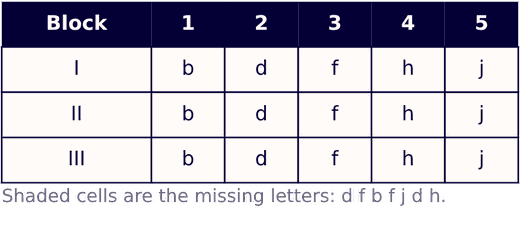 Block 1 already has b, h, j, so the two blanks are d and f.
Block 2 already has d and h, so its three blanks are b, f and j.
Block 3 already has b, f and j, so its two blanks are d and h.
Reading the missing letters in order gives d f b f j d h, so option (c) is correct.
Block 1 already has b, h, j, so the two blanks are d and f.
Block 2 already has d and h, so its three blanks are b, f and j.
Block 3 already has b, f and j, so its two blanks are d and h.
Reading the missing letters in order gives d f b f j d h, so option (c) is correct.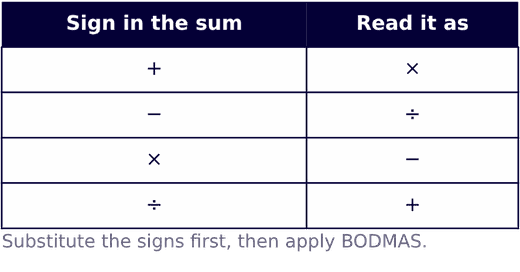 So + becomes , - becomes , becomes - and becomes +.
The expression therefore becomes .
Simplify the brackets: and 5+4=9, which gives .
By BODMAS, and are done from left to right: , then .
Finally , so option (a) is correct.
So + becomes , - becomes , becomes - and becomes +.
The expression therefore becomes .
Simplify the brackets: and 5+4=9, which gives .
By BODMAS, and are done from left to right: , then .
Finally , so option (a) is correct.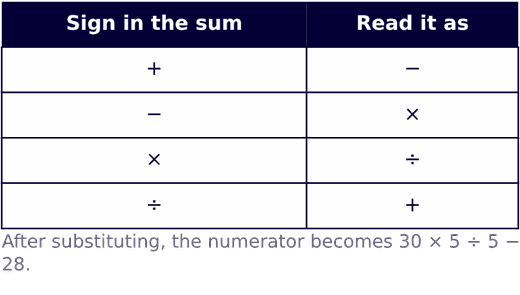 Only +, - and actually occur inside the expression, so the numerator becomes .
Solve the bracket first: , so the numerator is .
By BODMAS division comes before subtraction: , hence the numerator =30-2=28.
The whole expression is , so option (c) is correct.
Only +, - and actually occur inside the expression, so the numerator becomes .
Solve the bracket first: , so the numerator is .
By BODMAS division comes before subtraction: , hence the numerator =30-2=28.
The whole expression is , so option (c) is correct.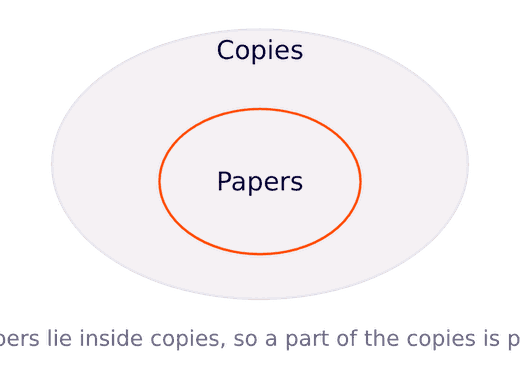 Since papers exist and each one of them is a copy, that group of papers forms a part of the copies.
Therefore 'Some copies are papers' is bound to be true — a universal statement always gives this converse in the particular form.
'Some copies are clean' says nothing about where the clean part lies, so it may or may not overlap the papers; hence (a) is only possible, not certain.
(b) and (d) are universal claims that the statements never make, so option (c) is correct.
Since papers exist and each one of them is a copy, that group of papers forms a part of the copies.
Therefore 'Some copies are papers' is bound to be true — a universal statement always gives this converse in the particular form.
'Some copies are clean' says nothing about where the clean part lies, so it may or may not overlap the papers; hence (a) is only possible, not certain.
(b) and (d) are universal claims that the statements never make, so option (c) is correct.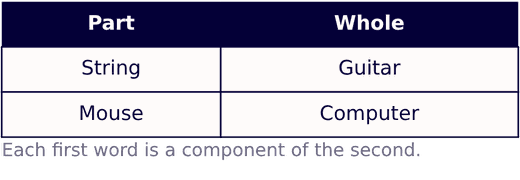 A string is a part of a guitar; it is the string that is plucked to produce the sound.
A television, a refrigerator and a washing machine have no strings in them, so option (b) is correct.
A string is a part of a guitar; it is the string that is plucked to produce the sound.
A television, a refrigerator and a washing machine have no strings in them, so option (b) is correct.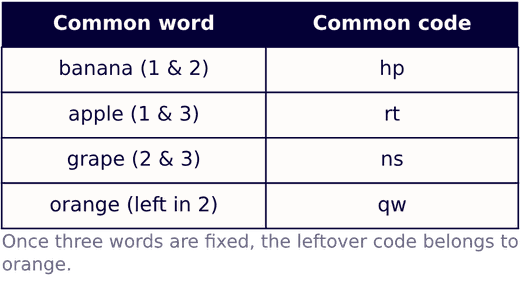 In statement 2 the words are banana, orange, grape and the codes are hp, qw, ns; hp and ns are already fixed for banana and grape.
The only code left for 'orange' is 'qw', so option (b) is correct.
In statement 2 the words are banana, orange, grape and the codes are hp, qw, ns; hp and ns are already fixed for banana and grape.
The only code left for 'orange' is 'qw', so option (b) is correct.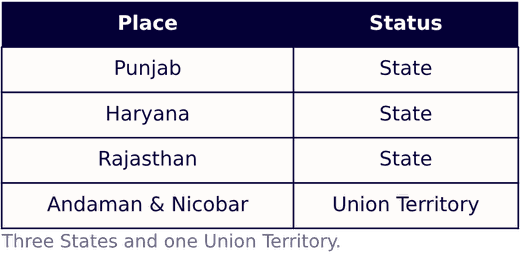 Hence Andaman & Nicobar does not belong to the group of States, and option (d) is the odd one out.
 In an 11-letter word, the 11th letter from the right end is the 11-11+1=1st letter from the left, which is V.
Now count 5 places to the right of V: T (1st), P (2nd), O (3rd), N (4th), M (5th).
The required letter is M, so option (b) is correct.
In an 11-letter word, the 11th letter from the right end is the 11-11+1=1st letter from the left, which is V.
Now count 5 places to the right of V: T (1st), P (2nd), O (3rd), N (4th), M (5th).
The required letter is M, so option (b) is correct.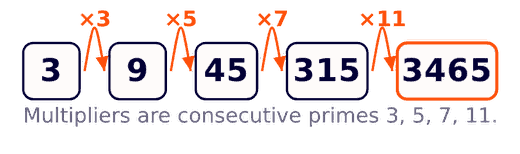 Hence the required term , so option (c) is correct.
 Next term =2089+1000=3089, so option (a) is correct.