SSC CHSL 15 November 2025 · Shift 1 · English Language — questions with answers · ShikshaSphere
Chapter 36 of 200
15 November 2025 · Shift 1
English Language
25 questions ~25 min readFree
25 questions
A
1
Identify the part of the sentence that contains a grammatical error.
A. The lecture, B. which our teacher delivered, C. was not only engaging D. but also inspire.
A.The lecture
B.which our teacher delivered
C.was not only engaging
D.but also inspire
Solution
Error spotting: parallelism
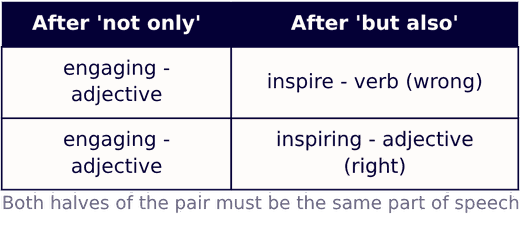
The correlative pair 'not only ... but also' must join two grammatically parallel elements.
After 'not only' the sentence uses the adjective 'engaging', so after 'but also' another adjective is required.
Part D has the verb 'inspire', which breaks this parallelism; it should be 'but also inspiring'.
Parts A, B and C are grammatically sound, so the error lies in part D.
2
Select the most appropriate synonym of the word: INSTITUTE
A.Abolish
B.Commence
C.Terminate
D.Dissolve
Solution
Synonym
INSTITUTE, used as a verb, means to set up, establish or begin something such as a rule, an inquiry or a programme.
'Commence' means to begin or start, which carries exactly this sense.
Abolish, Terminate and Dissolve all mean to bring something to an end, i.e. the opposite idea.
3
Fill in the blank with the most appropriate phrasal verb:
The teacher began to the exam papers to the students.
A.deal out
B.deal with
C.deal in
D.deal off
Solution
Phrasal verb
The phrasal verb 'deal out' means to distribute or hand out something among the members of a group.
The teacher is giving the exam papers to the students, that is, distributing them, so 'deal out' fits the blank.
'Deal with' means to handle a problem, 'deal in' means to trade in goods, and 'deal off' is not a standard phrasal verb.
4
Fill in the blank with the most appropriate phrase:
Facing unexpected financial losses, the company was forced to to stay afloat.
A.spill the beans
B.tighten its belt
C.hit the road
D.pull someone's leg
Solution
Idiom in context
The idiom 'tighten one's belt' means to spend less money because one has less of it.
The company has suffered unexpected financial losses and must cut costs to survive, so this idiom suits the blank.
'Spill the beans' means to reveal a secret, 'hit the road' means to set off, and 'pull someone's leg' means to tease - none of them fits a financial crisis.
5
Select the most appropriate synonym of the word: COGNITIVE
A.Emotional
B.Physical
C.Mental
D.Spiritual
Solution
Synonym
COGNITIVE relates to the mental processes of knowing, perceiving, remembering and reasoning.
'Mental' means relating to the mind, so it is the closest synonym.
Emotional concerns feelings, Physical concerns the body, and Spiritual concerns the soul, not the thinking process.
6
Directions (Qs. 6-10): Read the following passage carefully and answer the questions that follow.
The concept of 'forest bathing', or shinrin-yoku, originated in Japan in the 1980s as a preventative health measure and a way to encourage people to reconnect with nature. It's not about strenuous hiking or intense exercise; rather, it's about mindfully immersing oneself in the atmosphere of the forest using all five senses. Participants are encouraged to walk slowly, breathe deeply, and consciously observe their surroundings - the scent of pine, the rustle of leaves, the feel of moss, the dappled sunlight, and the sounds of birds. This practice is believed to reduce stress hormones like cortisol, lower blood pressure, improve mood, and even boost the immune system by increasing the activity of natural killer (NK) cells. The beneficial effects are partly attributed to phytoncides, airborne chemicals emitted by trees and plants,
which have antimicrobial properties and appear to have a positive impact on human physiology. While often seen as a simple walk, forest bathing is a deliberate and sensory engagement with the natural world, fostering a sense of calm and well-being that modern urban life often lacks. It serves as a gentle reminder of our intrinsic connection to the environment and the healing power inherent in simply 'being' in nature.
Where did the concept of 'forest bathing' originate ?
A.China
B.Japan
C.Korea
D.India
Solution
Reading comprehension
The very first sentence states that the concept of 'forest bathing', or shinrin-yoku, originated in Japan in the 1980s.
It was introduced there as a preventative health measure and a way to reconnect people with nature.
China, Korea and India are never mentioned in the passage.
7
Directions (Qs. 6-10): Read the following passage carefully and answer the questions that follow.
The concept of 'forest bathing', or shinrin-yoku, originated in Japan in the 1980s as a preventative health measure and a way to encourage people to reconnect with nature. It's not about strenuous hiking or intense exercise; rather, it's about mindfully immersing oneself in the atmosphere of the forest using all five senses. Participants are encouraged to walk slowly, breathe deeply, and consciously observe their surroundings - the scent of pine, the rustle of leaves, the feel of moss, the dappled sunlight, and the sounds of birds. This practice is believed to reduce stress hormones like cortisol, lower blood pressure, improve mood, and even boost the immune system by increasing the activity of natural killer (NK) cells. The beneficial effects are partly attributed to phytoncides, airborne chemicals emitted by trees and plants,
which have antimicrobial properties and appear to have a positive impact on human physiology. While often seen as a simple walk, forest bathing is a deliberate and sensory engagement with the natural world, fostering a sense of calm and well-being that modern urban life often lacks. It serves as a gentle reminder of our intrinsic connection to the environment and the healing power inherent in simply 'being' in nature.
What is the primary focus of shinrin-yoku ?
A.Strenuous hiking and exercise.
B.Mindfully immersing oneself in the forest atmosphere.
C.Collecting plants and specimens.
D.Identifying different tree species.
Solution
Reading comprehension
The passage says shinrin-yoku is not about strenuous hiking or intense exercise.
Its primary focus is mindfully immersing oneself in the atmosphere of the forest using all five senses.
Collecting specimens and identifying tree species are activities the passage never links to the practice.
8
Directions (Qs. 6-10): Read the following passage carefully and answer the questions that follow.
The concept of 'forest bathing', or shinrin-yoku, originated in Japan in the 1980s as a preventative health measure and a way to encourage people to reconnect with nature. It's not about strenuous hiking or intense exercise; rather, it's about mindfully immersing oneself in the atmosphere of the forest using all five senses. Participants are encouraged to walk slowly, breathe deeply, and consciously observe their surroundings - the scent of pine, the rustle of leaves, the feel of moss, the dappled sunlight, and the sounds of birds. This practice is believed to reduce stress hormones like cortisol, lower blood pressure, improve mood, and even boost the immune system by increasing the activity of natural killer (NK) cells. The beneficial effects are partly attributed to phytoncides, airborne chemicals emitted by trees and plants,
which have antimicrobial properties and appear to have a positive impact on human physiology. While often seen as a simple walk, forest bathing is a deliberate and sensory engagement with the natural world, fostering a sense of calm and well-being that modern urban life often lacks. It serves as a gentle reminder of our intrinsic connection to the environment and the healing power inherent in simply 'being' in nature.
According to the passage, what are phytoncides ?
A.A type of forest animal.
B.Stress hormones released by the body.
C.Airborne chemicals emitted by trees and plants.
D.Microbes found in forest soil.
Solution
Reading comprehension
The passage defines phytoncides as airborne chemicals emitted by trees and plants.
They have antimicrobial properties and the benefits of forest bathing are partly attributed to them.
So option (c) reproduces the passage exactly.
9
Directions (Qs. 6-10): Read the following passage carefully and answer the questions that follow.
The concept of 'forest bathing', or shinrin-yoku, originated in Japan in the 1980s as a preventative health measure and a way to encourage people to reconnect with nature. It's not about strenuous hiking or intense exercise; rather, it's about mindfully immersing oneself in the atmosphere of the forest using all five senses. Participants are encouraged to walk slowly, breathe deeply, and consciously observe their surroundings - the scent of pine, the rustle of leaves, the feel of moss, the dappled sunlight, and the sounds of birds. This practice is believed to reduce stress hormones like cortisol, lower blood pressure, improve mood, and even boost the immune system by increasing the activity of natural killer (NK) cells. The beneficial effects are partly attributed to phytoncides, airborne chemicals emitted by trees and plants,
which have antimicrobial properties and appear to have a positive impact on human physiology. While often seen as a simple walk, forest bathing is a deliberate and sensory engagement with the natural world, fostering a sense of calm and well-being that modern urban life often lacks. It serves as a gentle reminder of our intrinsic connection to the environment and the healing power inherent in simply 'being' in nature.
Which of the following is NOT listed as a benefit of forest bathing ?
A.Lowering blood pressure.
B.Reducing stress hormones.
C.Increasing natural killer cell activity.
D.Improving physical endurance.
Solution
Reading comprehension
The benefits actually listed are: reduced stress hormones such as cortisol, lower blood pressure, improved mood and increased activity of natural killer (NK) cells.
Improving physical endurance is nowhere mentioned; on the contrary, the passage says the practice is not about strenuous exercise.
Hence (d) is the benefit NOT listed.
10
Directions (Qs. 6-10): Read the following passage carefully and answer the questions that follow.
The concept of 'forest bathing', or shinrin-yoku, originated in Japan in the 1980s as a preventative health measure and a way to encourage people to reconnect with nature. It's not about strenuous hiking or intense exercise; rather, it's about mindfully immersing oneself in the atmosphere of the forest using all five senses. Participants are encouraged to walk slowly, breathe deeply, and consciously observe their surroundings - the scent of pine, the rustle of leaves, the feel of moss, the dappled sunlight, and the sounds of birds. This practice is believed to reduce stress hormones like cortisol, lower blood pressure, improve mood, and even boost the immune system by increasing the activity of natural killer (NK) cells. The beneficial effects are partly attributed to phytoncides, airborne chemicals emitted by trees and plants,
which have antimicrobial properties and appear to have a positive impact on human physiology. While often seen as a simple walk, forest bathing is a deliberate and sensory engagement with the natural world, fostering a sense of calm and well-being that modern urban life often lacks. It serves as a gentle reminder of our intrinsic connection to the environment and the healing power inherent in simply 'being' in nature.
What does the passage suggest is a key outcome of forest bathing for participants?
A.Increased urban connectivity.
B.A heightened sense of competition.
C.A sense of calm and well-being.
D.Enhanced academic performance.
Solution
Reading comprehension
The closing part of the passage says forest bathing fosters a sense of calm and well-being that modern urban life often lacks.
That is the key outcome the passage suggests for participants.
Urban connectivity, competition and academic performance find no support anywhere in the text.
11
Which of the following sentences uses the word "content" with the same meaning as in the following sentence ? She felt content after a productive day's work.
A.The book's content was both informative and engaging.
B.He was content to stay home and read.
C.The table of contents listed all the chapters.
D.The jar contained enough content for two servings.
Solution
Word used in same sense
In the given sentence 'content' is an adjective meaning satisfied or pleased.
Option (b), 'He was content to stay home and read', uses 'content' as the very same adjective.
In (a), (c) and (d) 'content/contents' is a noun meaning what is held inside something, so the sense is different.
12
Choose the correctly spelt word:
A.Candice
B.Candise
C.Coundice
D.Caundiece
Solution
Correct spelling
Among the four choices only 'Candice' is a correctly spelt word.
Its structure is CAN + DICE, so the letter before the final 'e' is 'c', not 's'.
'Candise', 'Coundice' and 'Caundiece' distort that structure by changing 'c' to 's' or by inserting an extra 'ou'/'ie'.
13
Choose the correctly spelt word:
A.Archaeology
B.Arcology
C.Archology
D.Archolgy
Solution
Correct spelling
The correct spelling is 'Archaeology' - the study of human history through the excavation of remains.
It comes from the Greek 'arkhaios' (ancient) + '-logia' (study), which is why the 'ae' after 'arch' is retained.
'Arcology', 'Archology' and 'Archolgy' drop or scramble those letters and are therefore wrong.
14
Choose the correct meaning of the idiom:
Blow hot and cold
A.To experience extreme weather conditions
B.To be indecisive or change one's mind frequently
C.To serve both hot and cold beverages
D.To act with great enthusiasm and then suddenly lose interest
Solution
Idiom meaning
The idiom 'blow hot and cold' means to keep changing one's mind, i.e. to be indecisive about something.
It comes from Aesop's fable of the man who blew on his hands to warm them and on his soup to cool it - the same breath used two opposite ways.
Option (d) describes losing interest after initial enthusiasm, which is a different idea, while (a) and (c) take the words literally.
15
Select the most appropriate antonym of the word: EFFECTIVE
A.Efficient
B.Potent
C.Fruitless
D.Powerful
Solution
Antonym
EFFECTIVE means successful in producing the desired or intended result.
Its antonym must therefore mean 'producing no result': 'Fruitless' means failing to achieve the desired result.
Efficient, Potent and Powerful are all close in sense to effective, so none of them is its opposite.
16
Choose the correct one-word substitute for:
A person who studies atmospheric phenomena and processes, especially for weather forecasting.
A.Hydrologist
B.Seismologist
C.Meteorologist
D.Oceanographer
Solution
One-word substitution
A meteorologist is a person who studies atmospheric phenomena and processes, especially in order to forecast the weather.
The word comes from 'meteorology', the science of the atmosphere.
A hydrologist studies water on the earth, a seismologist studies earthquakes, and an oceanographer studies the oceans.
17
Choose the correct one-word substitute for:
An advocate of maintaining tradition, especially so as to resist change.
A.Traditionalist
B.Conformist
C.Orthodox
D.Permissive
Solution
One-word substitution
'Traditionalist' means an advocate of maintaining tradition, especially so as to resist change.
A conformist merely follows accepted behaviour; defending old ways against change is not part of that meaning.
'Orthodox' describes conformity to established religious or accepted belief, and 'permissive' (allowing excessive freedom) is the opposite idea.
18
Select the most appropriate synonym of the word:
Reticent
A.Introvert
B.Gregarious
C.Extrovert
D.Candid
Solution
Synonym
'Reticent' means reserved - unwilling to speak freely or to reveal one's thoughts and feelings.
An 'introvert' is a person who is reserved and prefers limited social interaction, which is the closest of the four in sense.
Gregarious and Extrovert mean sociable and outgoing, and 'Candid' means open and frank in speech - all three are opposite in sense.
19
Change the following sentence into the Active form.
The results are hoped to be declared by the organisers soon.
A.The organisers are hoping to declare the results soon.
B.The organisers hope to be declaring the results soon.
C.The organisers hope to declare the results soon.
D.The organisers will be hoping to declare the results soon.
Solution
Active-passive voice
In the passive sentence the doer is 'the organisers', shown by the phrase 'by the organisers'.
In the active voice this doer becomes the subject, and the verb agrees with it: 'The organisers hope ...'.
The passive is in the simple present ('are hoped'), so the active must also stay in the simple present ('hope'), and 'to be declared' becomes the plain infinitive 'to declare'.
Hence the active form is 'The organisers hope to declare the results soon'.
Options (a) and (d) wrongly shift the tense to the present continuous and the future continuous, and (b) uses the faulty infinitive 'to be declaring'.
20
Select the option that expresses the given sentence in indirect voice.
The explorer announced, "We have been trekking through dense jungles for weeks, but the ancient city we have been searching for is now visible from this peak, and we will reach it by sundown."
A.The explorer announced that they have been trekking through dense jungles for weeks, but the ancient city they have been searching for is now visible from this peak, and they will reach it by sundown.
B.The explorer announced that they had been trekking through dense jungles for weeks, but the ancient city they had been searching for was then visible from that peak, and they would reach it by sundown.
C.The explorer announced that they had been trekking through dense jungles for weeks, but the ancient city they have been searching for is now visible from this peak, and they would reach it by sundown.
D.The explorer announced that they were trekking through dense jungles for weeks, but the ancient city they were searching for was then visible from that peak, and they would reach it by sundown.
Solution
Direct-indirect speech
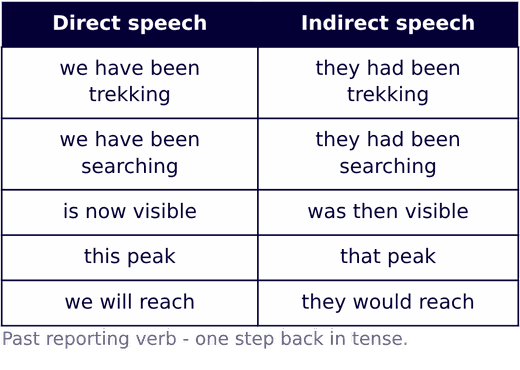
The reporting verb 'announced' is in the past tense, so every tense inside the quotation moves one step back.
'have been trekking' becomes 'had been trekking' and 'have been searching' becomes 'had been searching'.
'is now visible' becomes 'was then visible' and 'will reach' becomes 'would reach'.
Words of nearness change as well: 'this peak' becomes 'that peak', and the pronoun 'we' becomes 'they'.
Only option (b) makes all these changes; (a) keeps the present tense, (c) changes them only partly, and (d) wrongly reduces the perfect continuous to a past continuous.
21
Choose the most suitable option to replace the highlighted part of the sentence:
The new software is designed to operate in an efficient, reliable, and in a secure manner.
A.in an efficient, reliable, and with great security
B.in an efficient, reliable, and secure manner
C.in an efficient, reliably, and secure
D.in an efficiently, reliable, and securely manner
Solution
Parallel structure
The three describing words 'efficient', 'reliable' and 'secure' all qualify the same noun 'manner', so they must stand as one parallel list.
Rule: when a single preposition governs a whole list, it is written once at the head of the list and is not repeated before the last item.
The sentence repeats 'in' before 'a secure manner', which breaks the parallelism and forces the noun 'manner' to be understood twice.
Dropping the extra preposition gives 'in an efficient, reliable, and secure manner', which is option (b).
Option (a) replaces the adjective by the phrase 'with great security', and options (c) and (d) mix adjectives with adverbs ('reliably', 'efficiently', 'securely'), so neither keeps the list parallel.
22
Choose the most suitable option to replace the highlighted part of the sentence:
The company owns several valuable patents, of whom many are licensed to competitors.
A.of whom many are licensed to competitors
B.of which many are licensed to competitors
C.of which many is licensed to competitors
D.of whom many have been licensed to competitors
Solution
Relative pronoun
A relative pronoun must agree with the noun it points back to — here 'patents', which are things, not persons.
Rule: 'who/whom' is used for people, while 'which' is used for things and animals, so 'of whom' has to become 'of which'.
'Many' stands for several of those patents and is plural, so the plural verb 'are licensed' is right.
Both points together give 'of which many are licensed to competitors', which is option (b).
Option (c) puts the singular 'is' with the plural 'many', while options (a) and (d) keep 'whom' for lifeless objects.
23
Choose the correct passive voice transformation of the sentence:
Can the students complete the assignment?
A.The assignment can be completed by the students?
B.Can the assignment be completed by the students?
C.Is the assignment completed by the students?
D.The assignment could be completed by the students?
Solution
Active to passive voice
The sentence is a question opening with the modal 'Can', so the passive must also open with that modal and remain a question.
Rule: active 'modal + V1' (can complete) becomes passive 'modal + be + V3' (can be completed).
The object 'the assignment' moves up to become the subject, and the doer 'the students' goes into the 'by' phrase.
This gives 'Can the assignment be completed by the students?', which is option (b).
Option (a) is written in statement order yet still carries a question mark, option (c) drops the modal 'can' altogether, and option (d) turns 'can' into 'could', which changes the meaning.
24
Select the option that expresses the given sentence in direct voice.
He said to her that the challenging puzzle they had been attempting since morning was proving to be more difficult than he had initially thought.
A.He said to her, "The challenging puzzle we were attempting since morning is proving to be more difficult than I initially thought."
B.He said to her, "The challenging puzzle we have been attempting since morning is proving to be more difficult than I initially thought."
C.He said to her, "The challenging puzzle we had been attempting since morning was proving to be more difficult than I had initially thought."
D.He said to her, 'The challenging puzzle we have been attempting since morning was proving to be more difficult than I initially thought."
Solution
Indirect to direct speech
Turning indirect speech into direct speech means dropping 'that', putting the speaker's own words inside inverted commas and undoing every backshift of tense and pronoun.
'They had been attempting' is the backshifted form of the present perfect continuous, so it goes back to 'we have been attempting' — the speaker is one of them, hence 'we'.
'Was proving' goes back to the simple present 'is proving', because the difficulty is being felt at the very moment of speaking.
'He had initially thought' goes back to the simple past 'I initially thought', the past perfect being only the backshifted form of that past tense.
All three changes appear together only in option (b): He said to her, "The challenging puzzle we have been attempting since morning is proving to be more difficult than I initially thought."
Option (a) writes 'we were attempting', option (c) leaves every reported tense untouched, and option (d) both mismatches the inverted commas and keeps 'was proving'.
25
Rearrange the following sentences to form a meaningful and grammatically correct paragraph:
P. The results, however, were not always consistent or easily reproducible.
Q. Early alchemists tirelessly experimented with various substances and reactions.
R. Their ultimate goal was often to transmute base metals into gold or discover an elixir of life.
S. This lack of systematic methodology often hampered true scientific progress.
A.Q, R, P, S
B.R, Q, P, S
C.Q, P, R, S
D.P, Q, S, R
Solution
Para jumble
First find the sentence that can open without depending on anything before it: Q introduces the subject — the early alchemists and their experiments.
R speaks of 'Their ultimate goal', where 'their' points back to the alchemists of Q, so R must come second.
P begins with the contrast word 'however' and tells what came of those experiments — the results were not consistent — so P follows R.
S opens with 'This lack of systematic methodology', which sums up the inconsistent, irreproducible results described in P, so S closes the paragraph.
The order is therefore Q, R, P, S, which is option (a).
Finished reading? Now test yourself.
The same 25 questions, but with a timer and the answers hidden — 15 minutes.

 Parts A, B and C are grammatically sound, so the error lies in part D.
 Only option (b) makes all these changes; (a) keeps the present tense, (c) changes them only partly, and (d) wrongly reduces the perfect continuous to a past continuous.