SSC CHSL 15 November 2025 · Shift 1 · Quantitative Aptitude — questions with answers · ShikshaSphere
Chapter 35 of 200
15 November 2025 · Shift 1
Quantitative Aptitude
25 questions ~25 min readFree
25 questions
A
51
Which one of the following statements is FALSE ?
A.Every whole number is an integer
B.Every integer is a rational number
C.Both rational and irrational numbers are real numbers
D.Every rational number is an irrational number
Solution
Classification of numbers
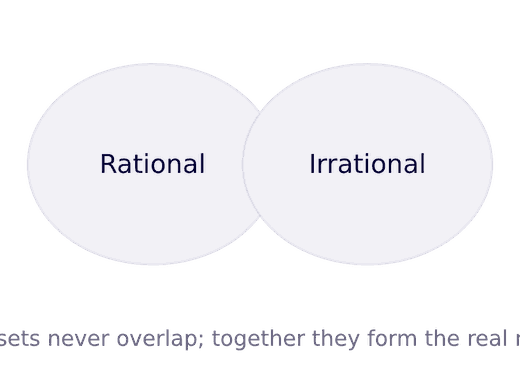
A rational number can be written as with p,q integers and ; an irrational number cannot be written in that form.
So the two families are completely separate — no number can be rational and irrational at the same time.
Hence 'Every rational number is an irrational number' is false, which makes option (d) the required answer.
Every whole number is an integer (the integers merely add the negative numbers), so (a) is true.
Every integer n can be written as , so (b) is true, and the real numbers are exactly the rationals together with the irrationals, so (c) is true.
52
The decimal expansion of an irrational number is:
A.Terminating
B.Repeating
C.Non-terminating and non-repeating
D.Terminating and repeating
Solution
Decimal expansion of numbers
A number is rational exactly when its decimal expansion either terminates or repeats a fixed block of digits for ever.
An irrational number cannot be written as , so its expansion can do neither of these two things.
Hence its decimal expansion is non-terminating and non-repeating, as in or
Terminating expansions such as 0.25 and repeating expansions such as belong to rational numbers, so option (c) is correct.
53
A dealer bought two electronic items. On the first item, he gained , and on the second item, he lost 10%. The cost price of the first item was more than that of the second. If the overall profit from both items was ₹200, find the cost price of each item.
A.₹1,200 and ₹800
B.₹1,000 and ₹700
C.₹900 and ₹600
D.₹1,500 and ₹1,000
Solution
Profit and loss on two articles
Let the cost price of the second item be x; the first item costs more, so its cost price is 1.5x.
Profit on the first item .
Loss on the second item .
Overall profit =0.3x-0.1x=0.2x.
Given that this equals ₹200, .
So the second item costs ₹1,000 and the first costs , i.e. ₹1,500 — option (d).
54
A dealer buys a batch of 30 electric kettles at ₹500 each. He sells 20 of them at 20% profit and the remaining 10 at loss. Find the overall profit or loss percentage.
A.8% Profit
B.6% Profit
C.10% Profit
D.5% Loss
Solution
Overall profit percentage
Total cost price , i.e. ₹15,000.
First lot: 20 kettles cost and are sold at profit, so their selling price .
Second lot: 10 kettles cost and are sold at loss, so their selling price .
Total selling price =12000+4500=16500, so the overall profit =16500-15000=1500.
Profit percentage , so option (c) is correct.
55
15 plates, each of Rs. 320, are sold at Rs. 4000. What is the percentage of the discount given?
A.
B.
C.13.5%
D.16.67%
Solution
Discount percentage
The listed price of one plate is Rs. 320, so the marked price of 15 plates .
They are actually sold for Rs. 4000, so the discount =4800-4000=800.
Discount percentage is always taken on the marked price: .
, so option (d) is correct.
56
A mobile was bought for ₹12000. Its price was marked up by 30%. Thereafter, it was sold at a discount of on the marked price. What was the percentage profit on the transaction?
A.5%
B.
C.4%
D.3%
Solution
Mark-up, discount and profit
Cost price =12000.
Marked price .
A discount of is allowed on this, so selling price .
Profit =12480-12000=480.
Profit percentage , so option (c) is correct.
Shortcut: the net effect of a mark-up and a discount is , i.e. a profit of .
57
A teacher calculated the average marks of 20 students in a test as 65 . Later, she found that the marks of one student were wrongly entered as 45 instead of 85 . After correcting the error, what is the correct average mark of the class?
A.63
B.67
C.68
D.62
Solution
Average with a corrected entry
Wrong total of marks .
One student's marks were entered as 45 instead of 85, so the total fell short by 85-45=40.
Correct total =1300+40=1340.
Correct average , so option (b) is correct.
Quick check: the average rises by , and 65+2=67.
58
A student scored 25% more marks in History than in English. If the average of his marks in both subjects is 81 , what are his marks in English ?
A.72
B.54
C.90
D.64
Solution
Average and percentage
Let the marks in English be x.
History marks are more than this: .
The average of the two subjects is 81, so their total .
Therefore , i.e. .
.
So the marks in English are 72 (and in History 90), which makes option (a) correct.
59
A school conducted a scholarship test where 55% of the students passed in English,65% passed in Math, and 40% passed in both subjects.What is the percentage of students who passed in at least one subject ?
A.80%
B.75%
C.90%
D.85%
Solution
Percentage: union of two sets
Students who passed in both subjects have been counted once in English and once in Maths, so they are counted twice.
Use .
Passed in at least one subject .
, so option (a) is correct.
60
P and Q invest ₹20,000 and ₹30,000 respectively. After 5 months, R joins with ₹40,000. What will be the ratio of their profits at the end of the year ?
A.5 : 6 : 7
B.6 : 7 : 5
C.7 : 9 : 6
D.6 : 9 : 7
Solution
Partnership: profit sharing
In a partnership the profit is divided in the ratio of (capital time) of each partner.
P invests for the whole year: .
Q also invests for the whole year: .
R joins after 5 months, so he stays for 12-5=7 months: .
Ratio =240000:360000:280000=24:36:28.
Dividing throughout by 4 gives 6:9:7, so option (d) is correct.
61
K, L, and M invest ₹30,000, ₹40,000, and ₹70,000, respectively, in a business. The profit at the end of the year is ₹84,000. What is L's share of the profit ?
A.Rs. 20000
B.Rs. 22000
C.Rs. 24000
D.Rs. 48000
Solution
Partnership profit sharing
When all the partners keep their money in the business for the same time, the profit is divided in the ratio of the capitals.
K:L:M=30000:40000:70000=3:4:7
Total number of parts =3+4+7=14, and these 14 parts together stand for the whole profit of ₹84,000.
Value of one part
L's share
Hence L receives ₹24,000, so option (c) is correct.
62
If the radii of two cylinders are in the ratio of and their heights are in the ratio of , then the ratio of their volumes is:
A.22 : 15
B.20 : 27
C.3 : 4
D.16 : 23
Solution
Ratio of cylinder volumes
Volume of a cylinder , so for two cylinders (the cancels).
Take and .
Hence the required ratio is 20:27, so option (b) is correct.
63
A circle is inscribed within a square with a side length of 20 cm . Find the area of the part of the square not covered by ine circle.
A.
B.
C.
D.
Solution
Circle inscribed in a square
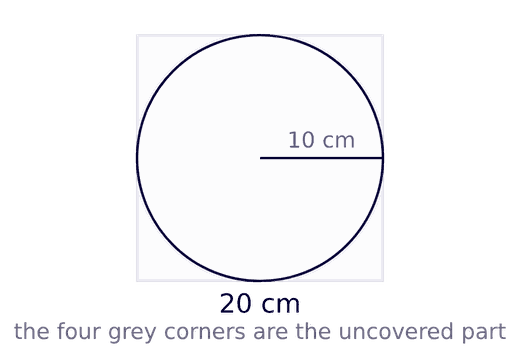
A circle inscribed in a square touches all four sides, so its diameter is exactly the side of the square.
Side =20 cm, hence radius cm.
Area of the square sq cm
Area of the circle sq cm
Uncovered area =400-314=86 sq cm
Hence the required area is , so option (b) is correct.
64
If and , then find the value of .
A.468
B.441
C.484
D.488
Solution
Algebraic identity
Use the identity .
The question already gives both pieces on the right-hand side, so nothing needs to be solved for a,b,c separately.
=300+184=484
Hence the required value is 484, so option (c) is correct.
65
A cone and a hemisphere have equal curved surface areas. The radius of the cone is and the radius of the hemisphere is . Find the slant height of the cone in terms of .
A.
B.
C.
D.
Solution
Curved surface areas
Curved surface area of a cone , where R is its base radius and l its slant height.
Curved surface area of a hemisphere .
Here the cone's radius is R=2r, so its curved surface area .
The two areas are equal:
Cancelling from both sides gives l=r.
Hence the slant height of the cone is l=r, so option (b) is correct.
66
is equal to:
A.
B.
C.
D.
Solution
Trigonometric simplification
Add the two fractions over the common denominator .
Numerator , and , so it becomes .
Hence the expression equals , so option (d) is correct.
67
The value of when , is:
A.90°
B.30°
C.60°
D.0°
Solution
Trigonometric equation
The coefficients are and 1, whose resultant is , so divide the whole equation by 2.
, i.e.
Since , the angle lies between and , so it must be .
Check: , which satisfies the equation.
Hence , so option (a) is correct.
68
A woman and a girl received Rs. 800 as wages for 4 days for the work they did together. The woman's efficiency in the work was thrice that of the girl. What are the daily wages of the girl ?
A.50/-
B.30/-
C.40/-
D.20/-
Solution
Wages in ratio of efficiency
Wages are always shared in the ratio of the work done, that is, in the ratio of the efficiencies.
Woman : girl =3:1, so the money of each day is cut into 3+1=4 equal parts.
The pair earned Rs. 800 for 4 days, so their daily earning together
Girl's daily wage
Hence the girl gets Rs. 50 per day, so option (a) is correct.
69
The perimeter of a square is equal to the perimeter of a rectangle of length 16 cm and breadth 14 cm . Find the circumference of a semicircle whose diameter is equal to the side of the square.
A.38.57
B.21.57
C.23.57
D.25.57
Solution
Perimeter of a semicircle
Perimeter of the rectangle =2(l+b)=2(16+14)=60 cm
The square has the same perimeter, so its side cm.
This side is the diameter of the semicircle, hence cm.
The circumference of a semicircle includes the bounding diameter: .
=38.57 cm
Hence the required circumference is 38.57 cm, so option (a) is correct.
70
A rectangular parallelopiped has its base diagonal equal to 21 cm and height 18 cm . If the area of its base is , find the total surface area of the parallelopiped.
A.
B.
C.
D.
Solution
Total surface area of cuboid
Let the base edges be l and b, with height h=18 cm.
Base diagonal: , so ; base area: lb=92.
l+b=25
Total surface area =2(lb+bh+hl)=2lb+2h(l+b)
=184+900=1084
Hence the total surface area is , so option (c) is correct.
71
If , find .
A.
B.
C.
D.
Solution
Value of a surd expression
Here ; build first and then .
Hence the required value is , so option (a) is correct.
72
A regular right pyramid has a square base with side length 20 cm and a height of 21 cm . Calculate the slant height and total surface area (approximately).
A.
B.
C.
D.
Solution
Square pyramid surface area
In a right pyramid on a square base, the slant height l, the vertical height h and half of a base edge form a right triangle.
cm
Lateral surface area
sq cm
Area of the square base sq cm
Total surface area sq cm
Hence the slant height is about 23.25 cm and the total surface area about , so option (a) is correct.
73
AB is a chord in a circle with centre . is produced to such that is equal to the radius of the circle. C is joined to 0 and produced to meet the circle at . If , then the measure of is .
A.48°
B.108°
C.80*
D.96°
Solution
Angles in a circle
Join OB. Since OB is a radius and BC equals the radius, OB=BC, so is isosceles.
Therefore .
is the exterior angle of at B, so .
In , OA=OB (radii), hence .
In : .
D lies on CO produced, so and make a straight line at O.
Hence , so option (d) is correct.
74
Two vessels of equal capacity, and both completely filled, contain mixtures of milk and water in the ratio 5 : 1 and 6 : 5, respectively. Both the mixtures are now mixed thoroughly. What is the ratio of milk to water in the new mixture so obtained?
A.105 : 67
B.57 : 41
C.91 : 41
D.28 : 43
Solution
Mixture of two vessels
The two vessels are equally full, so both totals must be written as the same number before adding.
The ratios have 5+1=6 and 6+5=11 parts; the LCM of 6 and 11 is 66, so take 66 units in each vessel.
First vessel: milk , water
Second vessel: milk , water
After mixing, milk =55+36=91 and water =11+30=41.
Hence milk : water =91:41, so option (c) is correct.
75
A sum is invested at compound interest (compounded annually) at a certain rate. The interest earned in the 1st year is ₹3,000, and in the 2nd year it is ₹3,600. Find 40% of the sum invested.
A.Rs. 3,000
B.Rs. 8,000
C.Rs. 6,000
D.Rs. 5,000
Solution
Compound interest
In compound interest the second year earns more than the first only because the first year's interest itself now earns interest.
Extra interest =3600-3000=600, and this is one year's interest on ₹3,000.
Rate
For the first year compound interest equals simple interest, so of the sum =3000.
Sum , i.e. ₹15,000.
of the sum
Hence the required amount is ₹6,000, so option (c) is correct.
Finished reading? Now test yourself.
The same 25 questions, but with a timer and the answers hidden — 15 minutes.

 Hence 'Every rational number is an irrational number' is false, which makes option (d) the required answer.
Every whole number is an integer (the integers merely add the negative numbers), so (a) is true.
Every integer n can be written as , so (b) is true, and the real numbers are exactly the rationals together with the irrationals, so (c) is true.
Hence 'Every rational number is an irrational number' is false, which makes option (d) the required answer.
Every whole number is an integer (the integers merely add the negative numbers), so (a) is true.
Every integer n can be written as , so (b) is true, and the real numbers are exactly the rationals together with the irrationals, so (c) is true.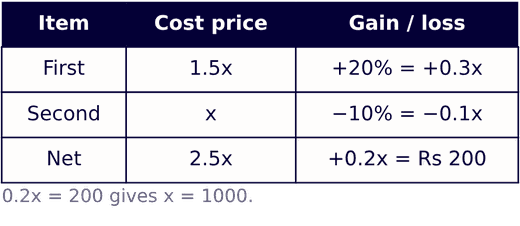 Overall profit =0.3x-0.1x=0.2x.
Given that this equals ₹200, .
So the second item costs ₹1,000 and the first costs , i.e. ₹1,500 — option (d).
Overall profit =0.3x-0.1x=0.2x.
Given that this equals ₹200, .
So the second item costs ₹1,000 and the first costs , i.e. ₹1,500 — option (d).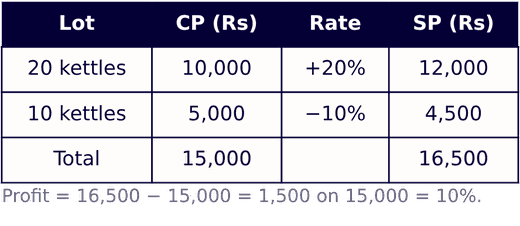 Total selling price =12000+4500=16500, so the overall profit =16500-15000=1500.
Profit percentage , so option (c) is correct.
Total selling price =12000+4500=16500, so the overall profit =16500-15000=1500.
Profit percentage , so option (c) is correct.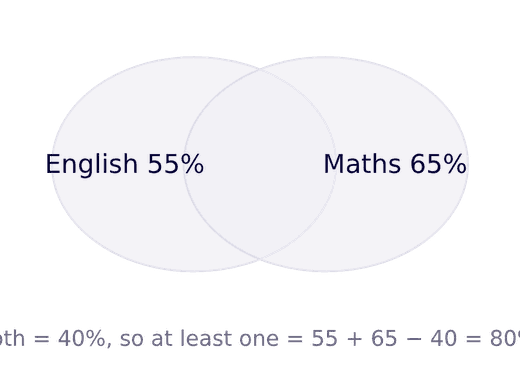 Use .
Passed in at least one subject .
, so option (a) is correct.
Use .
Passed in at least one subject .
, so option (a) is correct.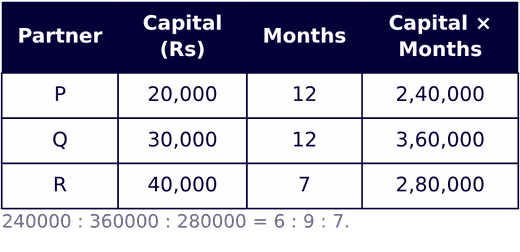 Ratio =240000:360000:280000=24:36:28.
Dividing throughout by 4 gives 6:9:7, so option (d) is correct.
Ratio =240000:360000:280000=24:36:28.
Dividing throughout by 4 gives 6:9:7, so option (d) is correct.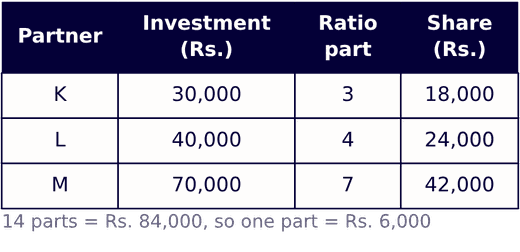 Total number of parts =3+4+7=14, and these 14 parts together stand for the whole profit of ₹84,000.
Value of one part
L's share
Hence L receives ₹24,000, so option (c) is correct.
Total number of parts =3+4+7=14, and these 14 parts together stand for the whole profit of ₹84,000.
Value of one part
L's share
Hence L receives ₹24,000, so option (c) is correct.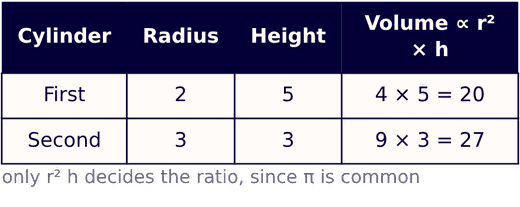 Hence the required ratio is 20:27, so option (b) is correct.
 Side =20 cm, hence radius cm.
Area of the square sq cm
Area of the circle sq cm
Uncovered area =400-314=86 sq cm
Hence the required area is , so option (b) is correct.
Side =20 cm, hence radius cm.
Area of the square sq cm
Area of the circle sq cm
Uncovered area =400-314=86 sq cm
Hence the required area is , so option (b) is correct.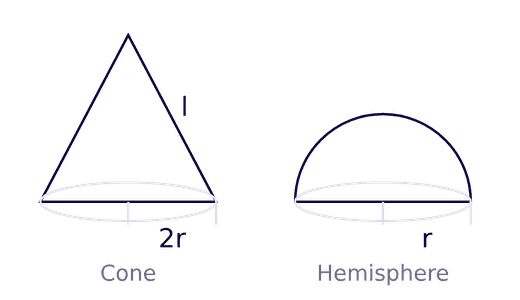 Here the cone's radius is R=2r, so its curved surface area .
The two areas are equal:
Cancelling from both sides gives l=r.
Hence the slant height of the cone is l=r, so option (b) is correct.
Here the cone's radius is R=2r, so its curved surface area .
The two areas are equal:
Cancelling from both sides gives l=r.
Hence the slant height of the cone is l=r, so option (b) is correct.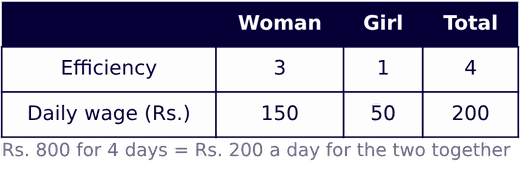 Girl's daily wage
Hence the girl gets Rs. 50 per day, so option (a) is correct.
Girl's daily wage
Hence the girl gets Rs. 50 per day, so option (a) is correct.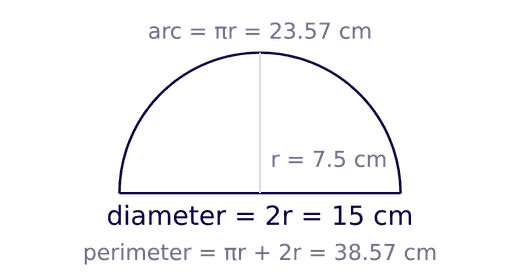 The circumference of a semicircle includes the bounding diameter: .
=38.57 cm
Hence the required circumference is 38.57 cm, so option (a) is correct.
The circumference of a semicircle includes the bounding diameter: .
=38.57 cm
Hence the required circumference is 38.57 cm, so option (a) is correct.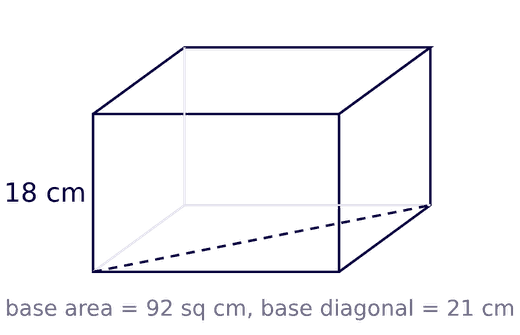 Base diagonal: , so ; base area: lb=92.
l+b=25
Total surface area =2(lb+bh+hl)=2lb+2h(l+b)
=184+900=1084
Hence the total surface area is , so option (c) is correct.
Base diagonal: , so ; base area: lb=92.
l+b=25
Total surface area =2(lb+bh+hl)=2lb+2h(l+b)
=184+900=1084
Hence the total surface area is , so option (c) is correct.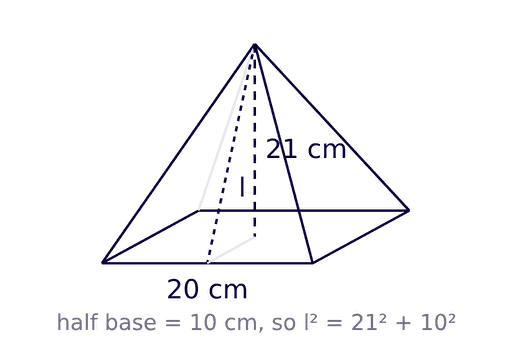 cm
Lateral surface area
sq cm
Area of the square base sq cm
Total surface area sq cm
Hence the slant height is about 23.25 cm and the total surface area about , so option (a) is correct.
cm
Lateral surface area
sq cm
Area of the square base sq cm
Total surface area sq cm
Hence the slant height is about 23.25 cm and the total surface area about , so option (a) is correct.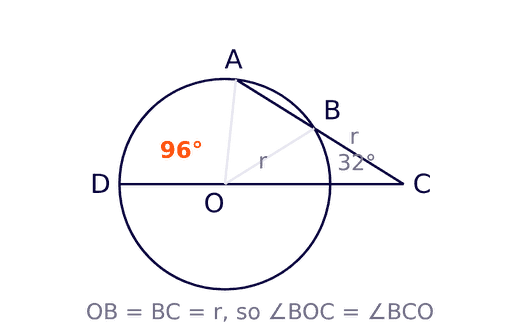 Join OB. Since OB is a radius and BC equals the radius, OB=BC, so is isosceles.
Therefore .
is the exterior angle of at B, so .
In , OA=OB (radii), hence .
In : .
D lies on CO produced, so and make a straight line at O.
Hence , so option (d) is correct.
Join OB. Since OB is a radius and BC equals the radius, OB=BC, so is isosceles.
Therefore .
is the exterior angle of at B, so .
In , OA=OB (radii), hence .
In : .
D lies on CO produced, so and make a straight line at O.
Hence , so option (d) is correct.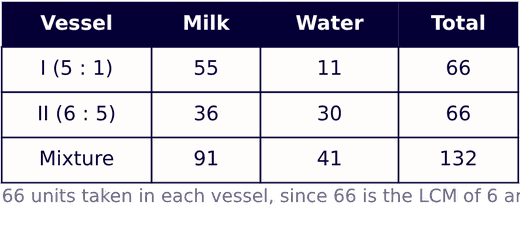 After mixing, milk =55+36=91 and water =11+30=41.
Hence milk : water =91:41, so option (c) is correct.
After mixing, milk =55+36=91 and water =11+30=41.
Hence milk : water =91:41, so option (c) is correct.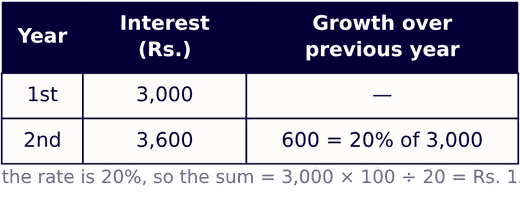 For the first year compound interest equals simple interest, so of the sum =3000.
Sum , i.e. ₹15,000.
of the sum
Hence the required amount is ₹6,000, so option (c) is correct.
For the first year compound interest equals simple interest, so of the sum =3000.
Sum , i.e. ₹15,000.
of the sum
Hence the required amount is ₹6,000, so option (c) is correct.