SSC CHSL 15 November 2025 · Shift 2 · English Language — questions with answers · ShikshaSphere
Chapter 40 of 200
15 November 2025 · Shift 2
English Language
25 questions ~25 min readFree
25 questions
A
1
Identify the part of the sentence that contains a grammatical error.
A. Each of the candidates B. were given a chance C. to present their ideas D. during the interview session.
A.Each of the candidates
B.were given a chance
C.to present their ideas
D.during the interview session.
Solution
Subject-verb agreement
Rule: 'Each of / One of / Either of / Neither of + plural noun' is always followed by a singular verb, because the head word 'Each' is singular.
Here the subject is 'Each', not 'the candidates', so the plural verb 'were' used in part B is wrong.
Correct: Each of the candidates was given a chance to present their ideas during the interview session.
Parts A, C and D are free of error, so the error lies in part B.
2
Identify the part of the sentence that contains a grammatical error.
A. They are B. not only late C. and careless D. but also rude
A.They are
B.not only late
C.and careless
D.but also rude
Solution
Parallelism with correlatives
Rule: the correlative pair 'not only … but also' must join two parallel, that is grammatically similar, elements.
Here 'not only' is followed by two adjectives 'late and careless', while 'but also' is followed by a single adjective 'rude'; the extra 'and' in part C destroys the balance.
Correct: They are not only late but also careless and rude.
Parts A, B and D are correctly framed, so the error lies in part C.
3
Fill in the blank with the most appropriate preposition:
The minister was accused misappropriating public funds to finance his personal business ventures secretly.
A.with
B.for
C.of
D.about
Solution
Prepositions after verbs
'Accuse' takes the fixed preposition 'of': accuse somebody of something, where 'something' names the offence.
So the sentence reads: The minister was accused of misappropriating public funds to finance his personal business ventures secretly.
'With' goes with 'charged' and 'for' with 'blamed', while 'about' is used for a topic, not an offence; hence none of them suits 'accused'.
4
Fill in the blank with the most appropriate conjunction:
The plan is quite solid, the lack of funds may delay the project.
A.whereas
B.unless
C.because
D.although
Solution
Conjunctions of contrast
The two clauses carry opposite ideas: the plan is sound, yet it may still be delayed.
'Although' is the subordinating conjunction that introduces such a concession, admitting a drawback without cancelling the main statement.
'Because' shows a cause and 'unless' a condition, so neither fits; 'whereas' compares two different subjects, and here both clauses are about the same plan.
Correct: The plan is quite solid, although the lack of funds may delay the project.
5
Choose the correctly spelt word:
A.Anaesthesia
B.Aneasthesia
C.Anaesthseia
D.Anaesthisia
Solution
Correct spelling
The correct spelling is 'Anaesthesia' — a-n-a-e-s-t-h-e-s-i-a (British form; the American spelling is 'anesthesia').
It means the loss of sensation produced by a drug before surgery.
Option (b) reverses 'ae' into 'ea', option (c) reverses 'esia' into 'seia', and option (d) writes 'i' in place of the second 'e'.
6
Choose the correctly spelt word:
A.Recieve
B.Receeve
C.Receive
D.Recive
Solution
Correct spelling
The correct spelling is 'Receive'.
Rule: 'i' before 'e' except after 'c' — the letter just before is 'c', so the order must be c-e-i.
Hence 'Recieve' breaks the rule, 'Receeve' doubles the 'e', and 'Recive' drops the 'e' altogether.
7
Choose the correct meaning of the idiom: Throw caution to the wind
A.Taking a very big risk
B.Dropping things in the wind
C.A storm on the way
D.A bold move
Solution
Idiom meaning
Idiom: 'Throw caution to the wind' means to stop being careful and do something very risky.
Example: He threw caution to the wind and invested all his savings in a new business.
So it means taking a very big risk; the other options only read the words literally, as if something were being dropped or a storm were coming.
8
Select the most appropriate antonym of the word: Obscure
A.Unclear
B.Vague
C.Distinct
D.Hidden
Solution
Antonyms
'Obscure' means not clearly seen or not easily understood, that is, dim and vague.
Its antonym must therefore mean 'clearly seen or easily noticeable', which is 'Distinct'.
'Unclear', 'Vague' and 'Hidden' all carry the same sense as 'obscure', so they are synonyms, not antonyms.
9
Choose the correct one-word substitute for:
A person who is skilled in the study of plants
A.Florist
B.Biologist
C.Botanist
D.Zoologist
Solution
One-word substitution
'Botanist' is a person skilled in botany, the branch of science that studies plants.
Florist sells or arranges flowers; Biologist studies living organisms in general; Zoologist studies animals.
Since the definition names plants specifically, 'Botanist' is the exact one-word substitute.
10
Choose the correct one-word substitute for:
A small piece broken off something.
A.Chip
B.Chunk
C.Bit
D.Hunk
Solution
One-word substitution
'Chip' is a small piece broken or chipped off a larger, harder object.
'Chunk' and 'Hunk' both mean a large, thick piece, so they are the opposite in size.
'Bit' does mean a small piece, but it need not have been broken off something; only 'Chip' carries that sense, so it fits the definition exactly.
11
Which sentence contains a misspelled word "possess"?
A.You must possess a valid driver's license to rent a car.
B.He does not possess the necessary funds to buy the house.
C.Leaders should possess integrity and strong vision.
D.They did not posess the right tools to fix the engine.
Solution
Spelling error in a sentence
The correct spelling carries a double 's' twice: p-o-s-s-e-s-s.
Option (d) writes 'posess', dropping one 's' from the first pair, so this sentence contains the misspelling.
Options (a), (b) and (c) all spell 'possess' correctly.
12
Change the following sentence into the Active form.
It was suspected that the bank vault had been breached by the thieves.
A.The thieves suspected that the bank vault had been breached.
B.People suspected that the thieves had breached the bank vault.
C.The bank vault was breached by the thieves.
D.The thieves breached the bank vault, it was suspected.
Solution
Passive to active voice
The opening 'It was suspected that…' hides the doer, so in the active form a general doer, 'People', is supplied as the subject: People suspected that…
The inner clause 'the bank vault had been breached by the thieves' is itself passive; its active form is 'the thieves had breached the bank vault'.
Putting both changes together gives: People suspected that the thieves had breached the bank vault.
Option (a) wrongly makes the thieves the ones who suspected, while (c) and (d) leave the clause passive or incomplete.
13
Select the option that expresses the given sentence in indirect voice.
The doctor said, "The symptoms observed last week indicate that the infection is viral."
A.The doctor said that the symptoms observed the previous week indicated that the infection was viral.
B.The doctor said that the symptoms observed last week indicate that the infection is viral.
C.The doctor said that the symptoms observed the previous week indicated that the infection is viral.
D.The doctor said that the symptoms observed last week indicated that the infection was viral.
Solution
Direct to indirect speech
The reporting verb 'said' is in the past, so every reported verb is back-shifted one tense and the time expression changes as well.
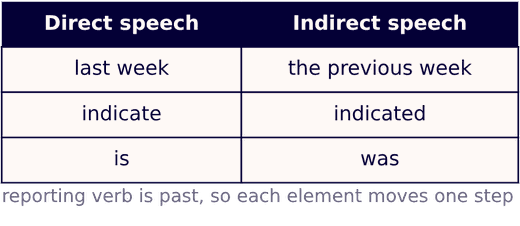
Thus 'indicate' becomes 'indicated' and 'is' becomes 'was', while 'last week' becomes 'the previous week'; the conjunction 'that' replaces the inverted commas.
Result: The doctor said that the symptoms observed the previous week indicated that the infection was viral.
Options (b) and (c) leave a present-tense verb un-shifted, and option (d) keeps 'last week' unchanged.
14
Choose the most suitable option to replace the highlighted part of the sentence:
I bought a new pair of shoes and they are badly scratched.
A.I bought a new pair of shoes and it is badly scratched
B.I bought a new pair of shoes and it has badly scratched
C.I bought a new pair of shoes and it was badly scratched
D.I bought a new pair of shoes and which are badly scratched
Solution
Pronoun-antecedent agreement
'A new pair of shoes' is one single unit, and the word that governs the pronoun and the verb is 'pair', not 'shoes'.
A singular antecedent needs a singular pronoun and a singular verb, so 'they are' must become 'it is'.
The buying is over, but the scratched condition is being described as it stands now, so the present tense 'is' is retained.
Option (b) 'it has badly scratched' needs a passive form, (c) shifts needlessly to 'was', and (d) turns the second clause into a fragment with 'and which'.
15
Choose the most suitable option to replace the highlighted part of the sentence:
The runner ran ten miles in the past six hours.
A.in the last six hours
B.in the next six hours
C.during the past six hours
D.in six hours
Solution
Time expressions with tense
The verb 'ran' is in the simple past, which needs a time expression naming a finished stretch of time.
'In the last six hours' is the idiomatic phrase for a period counted backwards from now, whereas 'in the past six hours' normally goes with the present perfect, as in 'has run ten miles in the past six hours'.
'In the next six hours' points forward to the future and 'in six hours' states only the duration taken, so both alter the meaning; 'during the past six hours' keeps the same unsuitable 'past'.
Correct: The runner ran ten miles in the last six hours.
16
Choose the correct passive voice transformation of the sentence: The committee will be reviewing the important financial documents next week.
A.The important financial documents will be reviewed by the committee next week.
B.The important financial documents will be being reviewed by the committee next week.
C.The important financial documents are being reviewed by the committee next week.
D.The important financial documents will have been reviewed by the committee next week.
Solution
Future continuous passive
The active sentence is in the future continuous tense: 'will be reviewing'.
The passive of the future continuous is 'will be being + V3', so 'will be reviewing' becomes 'will be being reviewed'.
The object 'the important financial documents' moves to the front as the new subject and the doer follows as 'by the committee'.
Option (a) is the simple future passive, (c) is the present continuous passive and (d) is the future perfect passive, so none of them keeps the tense of the original sentence.
17
Select the option that expresses the given sentence in direct voice. His brother told him that he had been planning on selling his car but that he had not found a potential buyer yet.
A.His brother said to him, "I was planning on selling my car, but I have not found a potential buyer yet."
B.His brother said to him, "I have been planning on selling my car, but I have not found a potential buyer yet."
C.His brother said to him, "I had been planning on selling my car, but I had not found a potential buyer yet."
D.His brother said to him, "I have been planning on selling my car, but I did not find a potential buyer yet."
Solution
Indirect to direct speech
Turning indirect speech back into direct speech reverses the back-shift, so each verb moves one tense forward and the pronouns return to the speaker's point of view.
Hence 'had been planning' becomes 'have been planning', 'had not found' becomes 'have not found', and 'his car' becomes 'my car'.
The adverb 'yet' also belongs with the present perfect, which confirms 'have not found'.
So the direct form is: His brother said to him, "I have been planning on selling my car, but I have not found a potential buyer yet."
18
Directions (Qs. 18-22): Read the following passage carefully and answer the questions that follow.
In the modern medical landscape, Artificial Intelligence (AI) systems assuming the functions of diagnostic tools and surgical assistants have increasingly revolutionized the traditionally human-centric domain. Despite systemic hurdles such as data privacy and ethical concerns, a growing array of AI applications is reshaping clinical workflows through predictive analytics and algorithmic precision.
The proliferation of AI diagnostics and robotics is indicative of radical shifts in medical and operational protocols, prioritizing efficiency and accuracy at critical intervention stages. Their implementation is often marked by a data-driven method, machine learning, and speed, which integrate effectively with medical expertise and patient care. However, these cutting-edge systems frequently encounter obstacles including insufficient access to diverse datasets,
integration costs, and algorithmic biases embedded within coding structures. The continuation of such issues highlights the requirement for regulatory frameworks designed for ensuring patient safety in digital health. Furthermore, the convergence of biology with computational power by AI developers has accelerated breakthrough discoveries across pathologies, emphasizing the intrinsic connection between digital innovation and curative outcomes. This model not only optimizes hospital operations but also advances global health targets associated with accessibility. In summary, the integration of AI as diagnostics and surgeons signals a sophisticated realignment of care delivery within the health sector, illustrating a horizon where human empathy and automation merge to drive longevity and wellness.
In the sentence, "The continuation of such issues highlights the requirement for regulatory frameworks designed for ensuring patient safety in digital health," the phrase "designed for ensuring patient safety* is:
A.a misplaced modifier
B.a participial phrase modifying "frameworks"
C.an absolute phrase modifying the entire sentence
D.an infinitive phrase modifying "requirement"
Solution
Participial phrase
'Designed' here is a past participle, and 'designed for ensuring patient safety' is the whole participial phrase built on it.
The phrase stands immediately after the noun 'regulatory frameworks' and tells us what those frameworks are meant to do, so it post-modifies that noun.
Being placed right next to the noun it describes, it is correctly positioned and so cannot be a misplaced modifier.
An absolute phrase would carry its own subject and modify the whole sentence, and an infinitive phrase would begin with 'to' as in 'to ensure'; neither description fits this phrase.
19
Directions (Qs. 18-22): Read the following passage carefully and answer the questions that follow.
In the modern medical landscape, Artificial Intelligence (AI) systems assuming the functions of diagnostic tools and surgical assistants have increasingly revolutionized the traditionally human-centric domain. Despite systemic hurdles such as data privacy and ethical concerns, a growing array of AI applications is reshaping clinical workflows through predictive analytics and algorithmic precision.
The proliferation of AI diagnostics and robotics is indicative of radical shifts in medical and operational protocols, prioritizing efficiency and accuracy at critical intervention stages. Their implementation is often marked by a data-driven method, machine learning, and speed, which integrate effectively with medical expertise and patient care. However, these cutting-edge systems frequently encounter obstacles including insufficient access to diverse datasets,
integration costs, and algorithmic biases embedded within coding structures. The continuation of such issues highlights the requirement for regulatory frameworks designed for ensuring patient safety in digital health. Furthermore, the convergence of biology with computational power by AI developers has accelerated breakthrough discoveries across pathologies, emphasizing the intrinsic connection between digital innovation and curative outcomes. This model not only optimizes hospital operations but also advances global health targets associated with accessibility. In summary, the integration of AI as diagnostics and surgeons signals a sophisticated realignment of care delivery within the health sector, illustrating a horizon where human empathy and automation merge to drive longevity and wellness.
In the sentence, "Their implementation is often marked by a data-driven method, machine learning, and speed," the verb "is marked" is in:
A.active voice, present tense
B.passive voice, present tense
C.active voice, past tense
D.passive voice, past tense
Solution
Voice and tense identification
In 'Their implementation is often marked by…', the subject 'implementation' does not perform the action but receives it, and the agent is introduced by 'by' — both are marks of the passive voice.
The structure is 'is + marked', that is 'be + V3', and the auxiliary 'is' is a present-tense form, so the tense is simple present.
Hence the verb 'is marked' is in the passive voice, present tense.
20
Directions (Qs. 18-22): Read the following passage carefully and answer the questions that follow.
In the modern medical landscape, Artificial Intelligence (AI) systems assuming the functions of diagnostic tools and surgical assistants have increasingly revolutionized the traditionally human-centric domain. Despite systemic hurdles such as data privacy and ethical concerns, a growing array of AI applications is reshaping clinical workflows through predictive analytics and algorithmic precision.
The proliferation of AI diagnostics and robotics is indicative of radical shifts in medical and operational protocols, prioritizing efficiency and accuracy at critical intervention stages. Their implementation is often marked by a data-driven method, machine learning, and speed, which integrate effectively with medical expertise and patient care. However, these cutting-edge systems frequently encounter obstacles including insufficient access to diverse datasets,
integration costs, and algorithmic biases embedded within coding structures. The continuation of such issues highlights the requirement for regulatory frameworks designed for ensuring patient safety in digital health. Furthermore, the convergence of biology with computational power by AI developers has accelerated breakthrough discoveries across pathologies, emphasizing the intrinsic connection between digital innovation and curative outcomes. This model not only optimizes hospital operations but also advances global health targets associated with accessibility. In summary, the integration of AI as diagnostics and surgeons signals a sophisticated realignment of care delivery within the health sector, illustrating a horizon where human empathy and automation merge to drive longevity and wellness.
The word "proliferation" in the passage most nearly means:
A.decline
B.rapid increase or spread
C.stagnation
D.separation
Solution
Vocabulary in context
'Proliferation' means a rapid increase or spread in number.
In the passage it is followed by 'is indicative of radical shifts', and the paragraph before speaks of 'a growing array of AI applications', so the context is clearly one of growth.
'Decline' and 'stagnation' therefore give the opposite sense, and 'separation' is unrelated to number or spread.
21
Directions (Qs. 18-22): Read the following passage carefully and answer the questions that follow.
In the modern medical landscape, Artificial Intelligence (AI) systems assuming the functions of diagnostic tools and surgical assistants have increasingly revolutionized the traditionally human-centric domain. Despite systemic hurdles such as data privacy and ethical concerns, a growing array of AI applications is reshaping clinical workflows through predictive analytics and algorithmic precision.
The proliferation of AI diagnostics and robotics is indicative of radical shifts in medical and operational protocols, prioritizing efficiency and accuracy at critical intervention stages. Their implementation is often marked by a data-driven method, machine learning, and speed, which integrate effectively with medical expertise and patient care. However, these cutting-edge systems frequently encounter obstacles including insufficient access to diverse datasets,
integration costs, and algorithmic biases embedded within coding structures. The continuation of such issues highlights the requirement for regulatory frameworks designed for ensuring patient safety in digital health. Furthermore, the convergence of biology with computational power by AI developers has accelerated breakthrough discoveries across pathologies, emphasizing the intrinsic connection between digital innovation and curative outcomes. This model not only optimizes hospital operations but also advances global health targets associated with accessibility. In summary, the integration of AI as diagnostics and surgeons signals a sophisticated realignment of care delivery within the health sector, illustrating a horizon where human empathy and automation merge to drive longevity and wellness.
The phrase "sophisticated realignment" implies:
A.a complex and subtle restructuring
B.a simplistic rearrangement
C.a chaotic disruption
D.an immediate reversal
Solution
Vocabulary in context
The phrase comes from the closing sentence of the passage, so its meaning must fit the summing-up tone of that sentence.
'Sophisticated' means advanced, refined and finely worked out — the opposite of crude or simple.
'Realignment' means putting the same parts into a new arrangement, not throwing them away.
Together the phrase describes a carefully worked out, finely balanced reorganisation of the way care is delivered, which is exactly option (a).
Option (b) uses 'simplistic', the direct opposite of sophisticated; option (c) 'chaotic disruption' clashes with the passage's approving tone.
Option (d) 'immediate reversal' suggests speed and undoing, whereas a realignment is gradual and forward-looking.
22
Directions (Qs. 18-22): Read the following passage carefully and answer the questions that follow.
In the modern medical landscape, Artificial Intelligence (AI) systems assuming the functions of diagnostic tools and surgical assistants have increasingly revolutionized the traditionally human-centric domain. Despite systemic hurdles such as data privacy and ethical concerns, a growing array of AI applications is reshaping clinical workflows through predictive analytics and algorithmic precision.
The proliferation of AI diagnostics and robotics is indicative of radical shifts in medical and operational protocols, prioritizing efficiency and accuracy at critical intervention stages. Their implementation is often marked by a data-driven method, machine learning, and speed, which integrate effectively with medical expertise and patient care. However, these cutting-edge systems frequently encounter obstacles including insufficient access to diverse datasets,
integration costs, and algorithmic biases embedded within coding structures. The continuation of such issues highlights the requirement for regulatory frameworks designed for ensuring patient safety in digital health. Furthermore, the convergence of biology with computational power by AI developers has accelerated breakthrough discoveries across pathologies, emphasizing the intrinsic connection between digital innovation and curative outcomes. This model not only optimizes hospital operations but also advances global health targets associated with accessibility. In summary, the integration of AI as diagnostics and surgeons signals a sophisticated realignment of care delivery within the health sector, illustrating a horizon where human empathy and automation merge to drive longevity and wellness.
According to the passage, what is a major barrier faced by AI systems?
A.Excessive computational speed
B.Lack of mechanical parts
C.Insufficient access to diverse datasets and integration costs
D.Overrepresentation in rural clinics
Solution
Reading comprehension: detail
The obstacles are listed in the second paragraph, in the sentence beginning 'However, these cutting-edge systems frequently encounter obstacles …'.
The three barriers named there are insufficient access to diverse datasets, integration costs, and algorithmic biases embedded within coding structures.
Option (c) repeats the first two of these word for word, so it is the answer.
Speed is presented in the passage as a strength of AI, not a barrier, so option (a) is wrong; the passage never mentions mechanical parts or rural clinics, so options (b) and (d) have no support in the text.
23
Rearrange the following sentence parts to form a meaningful and grammatically correct paragraph:
P. The tasty meal appeared on the app, so he clicked to order it for lunch.
Q. He typed in his street and building code, then checked out.
R. With a quick swipe, his order was paid and processed.
S. Now he waits for the driver to knock at his doorway.
A.P, Q, R, S
B.S, Q, P, S
C.Q, R, P, S
D.S, P, R, Q
Solution
Para jumble
The paragraph narrates the ordering of food on an app, so the parts must follow the order in which the actions actually happen.
P opens it: the meal appears on the app and he clicks to order it — nothing else can happen before an item is chosen.
Q follows, because the street and building code are typed in at checkout, which comes only after the item is selected.
R comes next: 'his order was paid and processed', the step that follows checking out.
S closes with 'Now he waits for the driver', the stage after the order is paid for.
So the order is P, Q, R, S, which is option (a); note that option (b) even repeats S and drops R, so it cannot be a valid sequence at all.
24
Rearrange the following sentences to form a meaningful and grammatically correct paragraph:
P. She improved her soil mix and pruning by tending her plants and shrubs daily.
Q. She read plant guides for hours, learning to grow blooms that got rarer and rarer.
R. She had mastered her green thumb and was now a gardener.
S. She grew a beautiful rose perfectly from seed while preparing for the contest.
A.P, Q, S, R
B.R, Q, S, P
C.Q, P, S, R
D.S, Q, P, R
Solution
Para jumble
The paragraph traces how a woman turned into a gardener, so the parts must run from her first effort to the final result.
Q starts it: she reads plant guides for hours — learning always comes before doing.
P follows, because she puts that reading into practice by improving her soil mix and pruning through daily care.
S comes next: the daily practice bears fruit when she grows a beautiful rose from seed for the contest.
R must close the paragraph, since 'She had mastered her green thumb and was now a gardener' is a summing-up in the past perfect and nothing can follow it.
So the order is Q, P, S, R, which is option (c).
25
Which of the following pairs of homonyms can be used to fill in the blanks most suitably ?
The city decided to seek legal
regarding the new zoning laws.
A.council, counsel
B.counsel, council
C.cancel, conceal
D.conceal, cancel
Solution
Homonyms
Homonyms sound alike but differ in meaning, so each blank must be settled by the sense of the sentence.
The first blank names the body that governs a city and takes the decision, and that body is the 'council'.
The second blank comes after the adjective 'legal' and means the advice a lawyer gives, which is 'counsel'.
The sentence therefore reads: The city council decided to seek legal counsel regarding the new zoning laws.
Option (b) puts the two words the wrong way round; 'cancel' and 'conceal' in options (c) and (d) mean 'to call off' and 'to hide', neither of which fits either blank.
Hence option (a) is correct.
Finished reading? Now test yourself.
The same 25 questions, but with a timer and the answers hidden — 15 minutes.

 Thus 'indicate' becomes 'indicated' and 'is' becomes 'was', while 'last week' becomes 'the previous week'; the conjunction 'that' replaces the inverted commas.
Result: The doctor said that the symptoms observed the previous week indicated that the infection was viral.
Options (b) and (c) leave a present-tense verb un-shifted, and option (d) keeps 'last week' unchanged.
Thus 'indicate' becomes 'indicated' and 'is' becomes 'was', while 'last week' becomes 'the previous week'; the conjunction 'that' replaces the inverted commas.
Result: The doctor said that the symptoms observed the previous week indicated that the infection was viral.
Options (b) and (c) leave a present-tense verb un-shifted, and option (d) keeps 'last week' unchanged.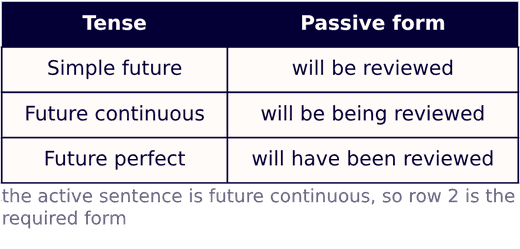 The passive of the future continuous is 'will be being + V3', so 'will be reviewing' becomes 'will be being reviewed'.
The object 'the important financial documents' moves to the front as the new subject and the doer follows as 'by the committee'.
Option (a) is the simple future passive, (c) is the present continuous passive and (d) is the future perfect passive, so none of them keeps the tense of the original sentence.
The passive of the future continuous is 'will be being + V3', so 'will be reviewing' becomes 'will be being reviewed'.
The object 'the important financial documents' moves to the front as the new subject and the doer follows as 'by the committee'.
Option (a) is the simple future passive, (c) is the present continuous passive and (d) is the future perfect passive, so none of them keeps the tense of the original sentence.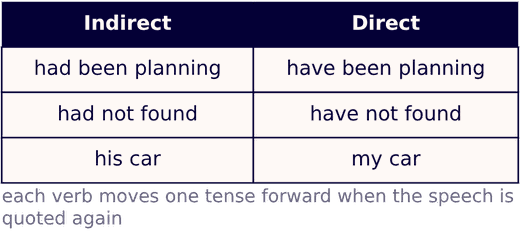 Hence 'had been planning' becomes 'have been planning', 'had not found' becomes 'have not found', and 'his car' becomes 'my car'.
The adverb 'yet' also belongs with the present perfect, which confirms 'have not found'.
So the direct form is: His brother said to him, "I have been planning on selling my car, but I have not found a potential buyer yet."
Hence 'had been planning' becomes 'have been planning', 'had not found' becomes 'have not found', and 'his car' becomes 'my car'.
The adverb 'yet' also belongs with the present perfect, which confirms 'have not found'.
So the direct form is: His brother said to him, "I have been planning on selling my car, but I have not found a potential buyer yet."