SSC CHSL 15 November 2025 · Shift 3 · General Intelligence — questions with answers · ShikshaSphere
Chapter 41 of 200
15 November 2025 · Shift 3
General Intelligence
25 questions ~25 min readFree
25 questions
A
26
If February 29, 2032, falls on a Sunday, what day of the week will February 29, 2036, be ?
A.Wednesday
B.Friday
C.Saturday
D.Monday
Solution
Calendar and odd days
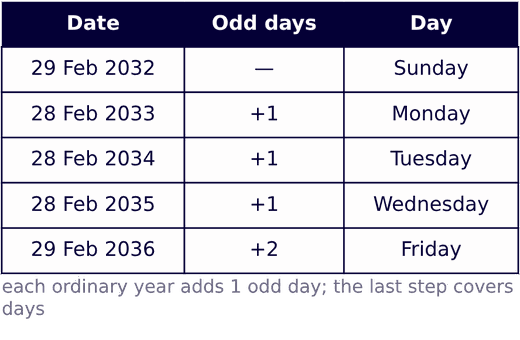
An ordinary year has 365 days = 52 weeks day, so it gives 1 odd day; a stretch of 366 days gives 2 odd days.
Move forward year by year from 29 February 2032, using 28 February as the marker for the three ordinary years.
From 28 February 2035 to 29 February 2036 there are 366 days, i.e. 2 odd days.
Total odd days = 1 + 1 + 1 + 2 = 5.
Counting 5 days on from Sunday: Monday, Tuesday, Wednesday, Thursday, Friday.
Hence 29 February 2036 is a Friday, option (b).
27
What is the product of the smallest even composite number and the smallest odd prime number?
A.10
B.12
C.14
D.18
Solution
Composite and prime numbers
A composite number has more than two factors. The even numbers are ; here 2 is prime, so the smallest even composite number is 4 (factors 1, 2, 4).
The prime numbers are ; the first of them, 2, is even, so the smallest odd prime number is 3.
Required product .
Hence the correct option is (b).
28
What is the result of ?
A.29.74
B.28.70
C.28.74
D.28.75
Solution
BODMAS with decimals
By the BODMAS rule the multiplication is carried out before the addition and the subtraction.
(since and two decimal places are needed).
19.44 + 17.6 = 37.04.
37.04 - 8.3 = 28.74.
Hence the correct option is (c).
29
The sum of five consecutive odd numbers is 85 . What is the largest of these numbers ?
A.21
B.23
C.25
D.27
Solution
Consecutive odd numbers
Let the five consecutive odd numbers be , taking the middle one as x.
Their sum = 5x, so 5x = 85 and x = 17.
The numbers are therefore 13, 15, 17, 19, 21.
The largest number = x + 4 = 17 + 4 = 21.
Hence the correct option is (a).
30
The average weight of 4 boys is 55 kg . If a new boy with a weight of 75 kg joins them, what is the new average weight of the group?
A.55 kg
B.60 kg
C.58 kg
D.59 kg
Solution
Average of a group
Total = average number of items, so the total weight of the 4 boys kg.
After the new boy joins, total weight = 220 + 75 = 295 kg and the number of boys becomes 5.
New average kg.
Short cut: the new boy is 75 - 55 = 20 kg above the old average, and this excess is shared by 5 boys, so the average rises by kg, giving 55 + 4 = 59 kg.
Hence the correct option is (d).
31
Read the following statement carefully and identify the inference that follows.Statement: The government has announced that applications for all government services will be accepted only through the online mode.
Inference:-
I. Most citizens have access to the internet
II. The online process is more transparent.
III. The offline application system was corrupt.
A.only I follows
B.both I and II follow
C.both II and III follow
D.only III follows
Solution
Statement and inference
An inference is what reasonably follows from the fact stated — not an accusation and not an extreme claim.
I: making the online mode the only mode is workable only if the internet is within the reach of most citizens; the government's step therefore rests on that belief, so I follows.
II: when every application passes through a single online channel, each step leaves a record and the counter clerk can no longer be approached, so a gain in transparency is a fair inference — II follows.
III: the statement nowhere says the offline system was corrupt; a system may be replaced simply because it is slow or costly, so this charge is too strong — III does not follow.
Hence both I and II follow, option (b).
32
Read the following statement carefully and identify the inference that follows.Statement: The municipal corporation has launched a rainwater harvesting scheme to reduce the water crisis in the city
Inference:
I. The municipal corporation is taking the future water shortage seriously.
II. There will never be a water shortage in the city now.
III. The municipal corporation gives priority to environmental protection and sustainable development.
A.only I Follows
B.Both I and III Follow
C.Both II and III Follow
D.only II Follows
Solution
Statement and inference
Judge each inference against what the corporation has actually done — launched a scheme to reduce the water crisis.
I: a body launches such a scheme only when it treats the shortage as a real and continuing problem, so I follows.
II: 'there will never be a water shortage now' is an extreme claim; harvesting reduces the crisis, it cannot guarantee that shortage will never occur again — II does not follow.
III: rainwater harvesting stores a natural resource instead of letting it run off, which is precisely environmental protection and sustainable development, so III follows.
Hence both I and III follow, option (b).
33
Pick the correct options from the given alternatives 15 : 256 :: 20 :?
A.441
B.484
C.440
D.400
Solution
Number analogy
Compare the two numbers of the first pair: and 16 = 15 + 1.
So the rule is: second number .
Applying the same rule to 20: .
Note that and , which are the tempting but wrong squares.
Hence the correct option is (a).
34
What will be the 5th term in the following series?
.
A.15225
B.15625
C.15635
D.15665
Solution
Geometric series
Check the ratio of consecutive terms: and , so each term is 5 times the one before it.
4th term .
5th term .
In powers of 5: the terms are , so the 5th term .
Hence the correct option is (b).
35
Select the correct option that will complete the series.
(1, 2), (4, 4), (9, 6), (16, 8), ?,
A.
B.
C.
D.
Solution
Number pair series
Treat the two members of every pair as two separate series.
First members: 1, 4, 9, 16, ?, 36 are the squares , so the missing first member is .
Second members: 2, 4, 6, 8, ?, 12 are the even numbers , so the missing second member is .
So the nth pair is and the 5th pair is (25, 10).
Hence the correct option is (b).
36
Find the missing number pair in the following series.
(4, 3), (9, 5), (16, 7),
A.
B.
C.
D.
Solution
Number pair series
Split each pair and read the two positions as separate series.
First members: 4, 9, 16, 25, ?, 49 are , so the missing first member is .
Second members: 3, 5, 7, 9, ?, 13 are consecutive odd numbers rising by 2, so the missing second member is 9 + 2 = 11.
So the nth pair is and the missing pair is (36, 11).
Option (d) has the same two numbers but in the reversed order, which breaks the pattern.
Hence the correct option is (b).
37
Which of the following numbers is divisible by both 7 and 13 ?
A.299
B.1001
C.715
D.286
Solution
Divisibility rules
A number divisible by both 7 and 13 must be a multiple of their LCM, and since 7 and 13 are co-prime, LCM .
, i.e. , so it is divisible by both.
The other options: , and — each is a multiple of 13 but none is a multiple of 7.
Hence the correct option is (b).
38
Pick the correct options from below.
22, 58.5, 122, 214.5, 338, ....?
A.505.5
B.500.5
C.495.5
D.494.5
Solution
Number series
Take the differences of consecutive terms: 58.5 - 22 = 36.5, 122 - 58.5 = 63.5, 214.5 - 122 = 92.5, 338 - 214.5 = 123.5.
Now take the differences of these differences: 63.5 - 36.5 = 27, 92.5 - 63.5 = 29, 123.5 - 92.5 = 31 — consecutive odd numbers.
So the next second difference is 33, giving the next difference = 123.5 + 33 = 156.5.
Required term = 338 + 156.5 = 494.5.
Hence the correct option is (d).
39
Pick the correct options from below.
8.5, 13.5, ?, 29.5, 40.5
A.19.5
B.20.5
C.21.5
D.13.5
Solution
Number series
The differences that can be seen are 13.5 - 8.5 = 5 and 40.5 - 29.5 = 11.
Between them two differences are missing, and 5 and 11 fit the pattern of consecutive odd numbers +5, +7, +9, +11.
Missing term = 13.5 + 7 = 20.5.
Check: 20.5 + 9 = 29.5 and 29.5 + 11 = 40.5, which match the given terms.
Hence the correct option is (b).
40
Pick the correct options from below.
0, 0.2, ?, 5.4, 12.8
A.1.25
B.2
C.1.6
D.1.5
Solution
Number series
The decimals suggest a common divisor, so multiply every term by 5: .
These are the perfect cubes , so the nth term of the given series is with n = 0, 1, 2, 3, 4.
Missing term .
Check: and , which match the given terms.
Hence the correct option is (c).
41
Complete the following series from the given options.
P_TP_S_CT_RSPC_PR_P_T_RS
A.CSPCRPTP
B.CRPCS PPT
C.CCPPPRST
D.CRPPTSCP
Solution
Letter series completion
The string has 24 places and 8 blanks, so break it into four blocks of six letters each.
Wherever the letters are visible they read P, C, T, P, R, S, so the block P C T P R S simply repeats four times.
Block 1 needs C and R, block 2 needs P and P, block 3 needs T and S, and block 4 needs C and P.
Reading the missing letters in order gives CRPPTSCP.
Hence option (d) is the answer.
42
What comes next in the following series?
P0, Q1, R4, S9, T16, U25, ?
A.V49
B.V25
C.V30
D.V36
Solution
Alphanumeric series
Each term is a letter followed by a number, so treat the two parts separately.
The letters P, Q, R, S, T, U are consecutive, so the next letter is V.
The numbers are perfect squares: , , , , , .
The next number is therefore .
So the missing term is V36 and option (d) is the answer.
43
What comes next in the following series?
G1, H1, I1.5, J3, K3. 5, L10.5, ?
A.M12
B.M11.5
C.M11
D.M12.5
Solution
Alphanumeric series
The letters G, H, I, J, K, L are consecutive, so the next letter must be M.
The numbers use two operations turn by turn: a multiplication, then +0.5.
, then 1+0.5=1.5, then , then 3+0.5=3.5, then .
The next step is an addition, so the number is 10.5+0.5=11.
The required term is M11, so option (c) is the answer.
44
If: Then evaluate: ?
A.16
B.15
C.14
D.12
Solution
Symbol substitution
First replace every sign of the expression by the sign it is changed into.
So becomes .
Now apply BODMAS. Brackets first: .
Division next: 12+12-10.
Finally 24-10=14.
Hence option (c) is the answer.
45
If: - Then evaluate: ?
A.15
B.16
C.17
D.18
Solution
Symbol substitution
Change each sign exactly as the question directs, and only then work the sum out.
So becomes .
Inner brackets: [18+24]-25.
Square bracket: 42-25.
So the value is 17, and option (c) is the answer.
46
In the word DAUGHTER (in both forward and backward directions), how many pairs of letters are there such that the number of letters between them in the word is the same as the number of letters between them in the English alphabet?
A.Four
B.five
C.Two
D.Three
Solution
Letter pairs in a word
Number the letters of DAUGHTER: D-1, A-2, U-3, G-4, H-5, T-6, E-7, R-8.
A pair counts when the number of letters standing between the two in the word equals the number standing between them in the alphabet, counting either forward or backward.
D–G, D–H and G–H match in the forward direction, while T–R matches in the backward direction.
That gives four such pairs, so option (a), Four, is the answer.
47
From the given alternative words, select the word that cannot be formed using letters of the given word only once. PARALLELOGRAM
A.ROLE
B.LARGE
C.LEAP
D.ALERT
Solution
Word formation
The letters available in PARALLELOGRAM are P, A, R, A, L, L, E, L, O, G, R, A, M.
ROLE needs R, O, L, E and LARGE needs L, A, R, G, E — every one of those letters is present.
LEAP needs L, E, A, P, which are present as well.
ALERT needs the letter T, and there is no T anywhere in PARALLELOGRAM.
So ALERT cannot be formed, and option (d) is the answer.
48
How many letter pairs are there in the word 'CLUSTERS' which has as many letters in both the forward as well as the backward direction) as there are between them in the English alphabetical series?
A.Two
B.One
C.Zero
D.Three
Solution
Letter pairs in a word
Number the letters of CLUSTERS: C-1, L-2, U-3, S-4, T-5, E-6, R-7, S-8.
A pair counts when the letters standing between the two in the word are as many as those standing between them in the alphabet, in either direction.
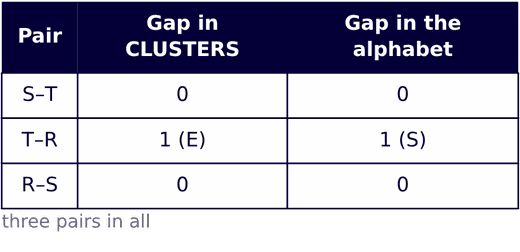
S–T and R–S are neighbours in the word and neighbours in the alphabet as well, so both qualify.
In T…R only E stands between them in the word, and only S stands between R and T in the alphabet, so this backward pair qualifies too.
There are three such pairs, so option (d) is the answer.
49
Identify the next number.
7, 14, 42, 168, ?
A.840
B.850
C.860
D.830
Solution
Number series
The terms grow quickly, so divide each term by the one before it.
, , — the multiplier rises by one every time.
The next multiplier is therefore 5.
So the next term is , and option (a) is the answer.
50
What comes next in the sequence? 2, 5, 11, 17, 23, 31, 41, ?
A.43
B.47
C.45
D.46
Solution
Prime number series
The differences 3, 6, 6, 6, 8, 10 form no pattern, so look at the nature of the terms instead.
Every term is a prime number: 2, 5, 11, 17, 23, 31, 41.
Write the primes in order — 2, 3, 5, 7, 11, 13, 17, 19, 23, 29, 31, 37, 41, 43, 47 — and the rule appears: take one prime, skip the next.
After 41 the prime 43 is skipped, so the next term is 47.
Hence option (b) is the answer.
Finished reading? Now test yourself.
The same 25 questions, but with a timer and the answers hidden — 15 minutes.

 From 28 February 2035 to 29 February 2036 there are 366 days, i.e. 2 odd days.
Total odd days = 1 + 1 + 1 + 2 = 5.
Counting 5 days on from Sunday: Monday, Tuesday, Wednesday, Thursday, Friday.
Hence 29 February 2036 is a Friday, option (b).
From 28 February 2035 to 29 February 2036 there are 366 days, i.e. 2 odd days.
Total odd days = 1 + 1 + 1 + 2 = 5.
Counting 5 days on from Sunday: Monday, Tuesday, Wednesday, Thursday, Friday.
Hence 29 February 2036 is a Friday, option (b).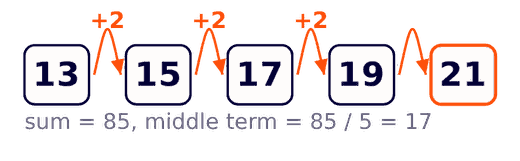 The largest number = x + 4 = 17 + 4 = 21.
Hence the correct option is (a).
The largest number = x + 4 = 17 + 4 = 21.
Hence the correct option is (a).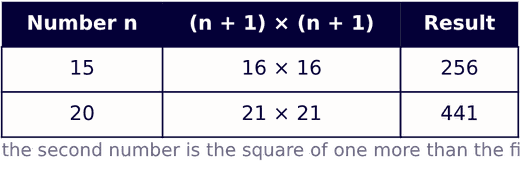 Applying the same rule to 20: .
Note that and , which are the tempting but wrong squares.
Hence the correct option is (a).
Applying the same rule to 20: .
Note that and , which are the tempting but wrong squares.
Hence the correct option is (a).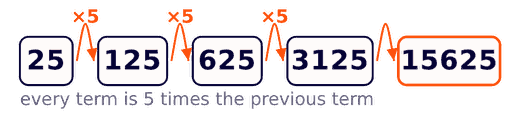 4th term .
5th term .
In powers of 5: the terms are , so the 5th term .
Hence the correct option is (b).
4th term .
5th term .
In powers of 5: the terms are , so the 5th term .
Hence the correct option is (b).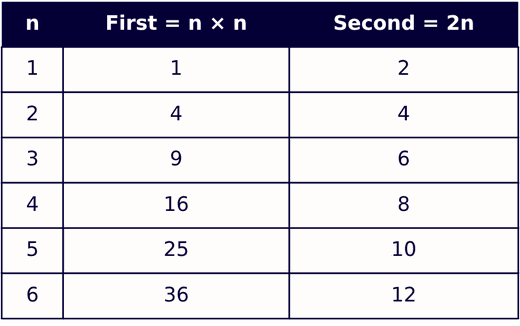 So the nth pair is and the 5th pair is (25, 10).
Hence the correct option is (b).
So the nth pair is and the 5th pair is (25, 10).
Hence the correct option is (b).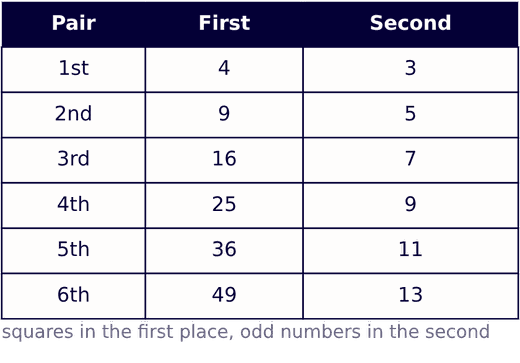 So the nth pair is and the missing pair is (36, 11).
Option (d) has the same two numbers but in the reversed order, which breaks the pattern.
Hence the correct option is (b).
So the nth pair is and the missing pair is (36, 11).
Option (d) has the same two numbers but in the reversed order, which breaks the pattern.
Hence the correct option is (b).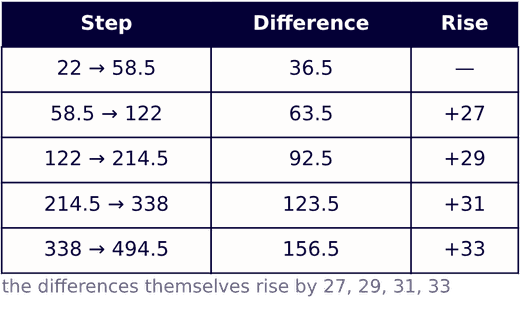 So the next second difference is 33, giving the next difference = 123.5 + 33 = 156.5.
Required term = 338 + 156.5 = 494.5.
Hence the correct option is (d).
So the next second difference is 33, giving the next difference = 123.5 + 33 = 156.5.
Required term = 338 + 156.5 = 494.5.
Hence the correct option is (d). Missing term = 13.5 + 7 = 20.5.
Check: 20.5 + 9 = 29.5 and 29.5 + 11 = 40.5, which match the given terms.
Hence the correct option is (b).
Missing term = 13.5 + 7 = 20.5.
Check: 20.5 + 9 = 29.5 and 29.5 + 11 = 40.5, which match the given terms.
Hence the correct option is (b).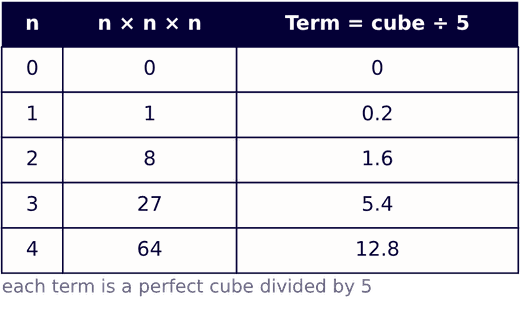 Missing term .
Check: and , which match the given terms.
Hence the correct option is (c).
Missing term .
Check: and , which match the given terms.
Hence the correct option is (c).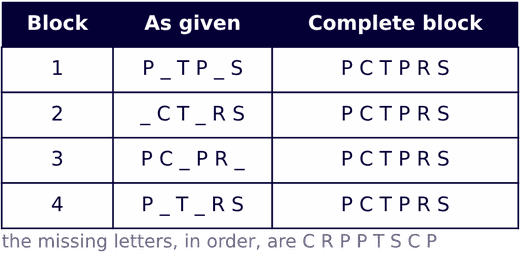 Block 1 needs C and R, block 2 needs P and P, block 3 needs T and S, and block 4 needs C and P.
Reading the missing letters in order gives CRPPTSCP.
Hence option (d) is the answer.
Block 1 needs C and R, block 2 needs P and P, block 3 needs T and S, and block 4 needs C and P.
Reading the missing letters in order gives CRPPTSCP.
Hence option (d) is the answer. The next number is therefore .
So the missing term is V36 and option (d) is the answer.
The next number is therefore .
So the missing term is V36 and option (d) is the answer.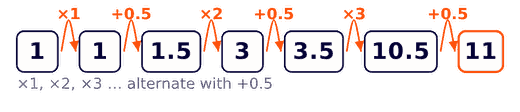 The next step is an addition, so the number is 10.5+0.5=11.
The required term is M11, so option (c) is the answer.
The next step is an addition, so the number is 10.5+0.5=11.
The required term is M11, so option (c) is the answer.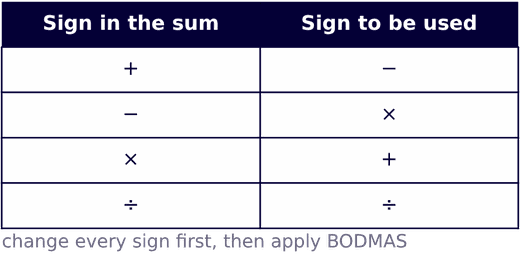 So becomes .
Now apply BODMAS. Brackets first: .
Division next: 12+12-10.
Finally 24-10=14.
Hence option (c) is the answer.
So becomes .
Now apply BODMAS. Brackets first: .
Division next: 12+12-10.
Finally 24-10=14.
Hence option (c) is the answer.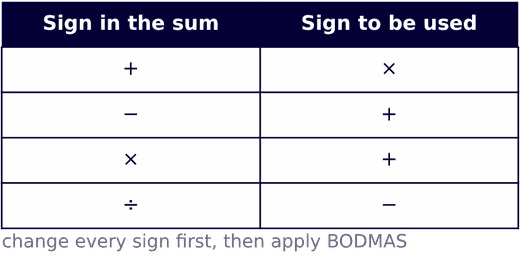 So becomes .
Inner brackets: [18+24]-25.
Square bracket: 42-25.
So the value is 17, and option (c) is the answer.
So becomes .
Inner brackets: [18+24]-25.
Square bracket: 42-25.
So the value is 17, and option (c) is the answer.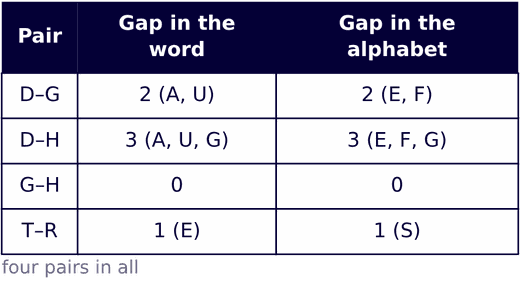 D–G, D–H and G–H match in the forward direction, while T–R matches in the backward direction.
That gives four such pairs, so option (a), Four, is the answer.
D–G, D–H and G–H match in the forward direction, while T–R matches in the backward direction.
That gives four such pairs, so option (a), Four, is the answer.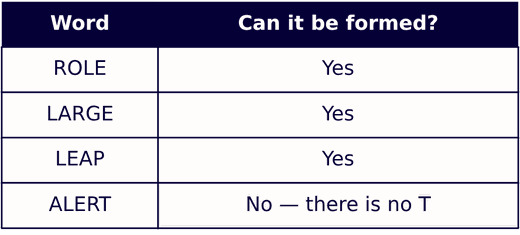 So ALERT cannot be formed, and option (d) is the answer.
 S–T and R–S are neighbours in the word and neighbours in the alphabet as well, so both qualify.
In T…R only E stands between them in the word, and only S stands between R and T in the alphabet, so this backward pair qualifies too.
There are three such pairs, so option (d) is the answer.
S–T and R–S are neighbours in the word and neighbours in the alphabet as well, so both qualify.
In T…R only E stands between them in the word, and only S stands between R and T in the alphabet, so this backward pair qualifies too.
There are three such pairs, so option (d) is the answer.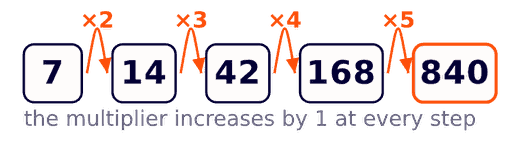 The next multiplier is therefore 5.
So the next term is , and option (a) is the answer.
The next multiplier is therefore 5.
So the next term is , and option (a) is the answer.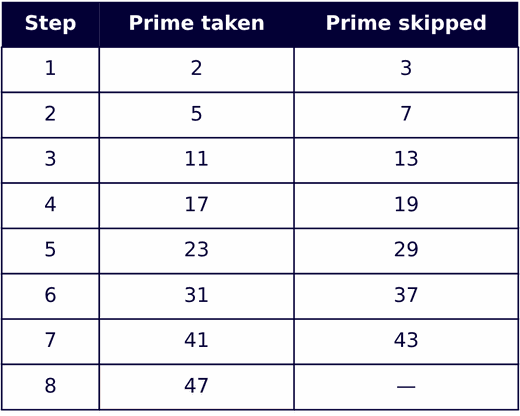 After 41 the prime 43 is skipped, so the next term is 47.
Hence option (b) is the answer.
After 41 the prime 43 is skipped, so the next term is 47.
Hence option (b) is the answer.