SSC CHSL 15 November 2025 · Shift 3 · Quantitative Aptitude — questions with answers · ShikshaSphere
Chapter 43 of 200
15 November 2025 · Shift 3
Quantitative Aptitude
25 questions ~25 min readFree
25 questions
A
51
Which of the following is true ?
A.All real numbers are either rational or irrational
B.All rational numbers are irrational
C.No real number is rational
D.All integers are irrational
Solution
Rational and irrational numbers
By definition the set of real numbers is made up of the rational numbers together with the irrational numbers, and of nothing else.
So every real number is either rational or irrational, which makes option (a) true.
Option (b) is false: a rational number can be written as with , which is exactly what an irrational number cannot be.
Option (c) is false: and 2 are real numbers and both are rational.
Option (d) is false: every integer n can be written as , so integers are rational.
Hence option (a) is the answer.
52
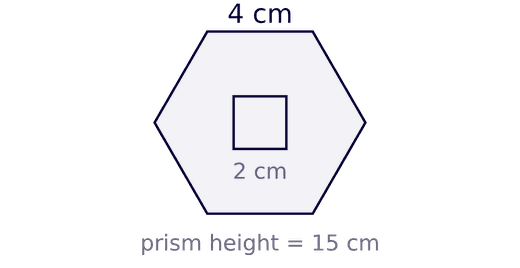
A solid right prism has a base that is a regular hexagon of side 4 cm . The height of the prism is 15 cm . A square cavity of side 2 cm is carved vertically through the center of the prism from top to bottom. Calculate the volume of the material remaining in the prism.
(Use )
A.
B.
C.
D.
Solution
Volume of a hexagonal prism
Area of a regular hexagon of side a is .
Here a=4, so the base area .
Volume of the prism = base area height .
The cavity is a cuboid of square cross-section running through the whole height: .
Material remaining .
Hence option (a) is the answer.
53
A glass manufacturer produces transparent right prism blocks with a square base of side 12 cm and height 30 cm . If the selling price is ₹ 0.80 per and the cost price is ₹0.50 per , what is the total profit earned on selling 20 such prisms?
A.₹15400
B.₹16000
C.₹18500
D.₹25920
Solution
Volume and profit
The base is a square, so the volume of one prism = base area height .
Profit on each cubic centimetre = ₹0.80 − ₹0.50 = ₹0.30.
Profit on one prism , that is ₹1,296.
Profit on 20 prisms .
So the total profit is ₹25,920, and option (d) is the answer.
54
A and B invest ₹40,000 and ₹30,000 respectively. After 8 months, A withdraws all of his capital. At the end of the year, what is their profit-sharing?
A.
B.8 : 7
C.
D.8 : 9
Solution
Partnership ratio
In a partnership the profit is divided in the ratio of capital time.
A's capital worked for only 8 months: .
B never withdrew, so his capital worked for all 12 months: .
Ratio =320000:360000=32:36=8:9.
Hence option (d) is the answer.
55
A started a business with ₹50,000. B joined after 6 months with ₹20,000. At the end of the year, what is their profit-sharing ratio?
A.
B.
C.
D.
Solution
Partnership ratio
Profit is shared in the ratio of capital time, so count the months each sum actually worked.
A started the business, so his money worked for all 12 months: .
B joined after 6 months, so his money worked for the remaining 6 months: .
Ratio =600000:120000=5:1.
Hence option (a) is the answer.
56
A sphere and a cone have the same base radius and the same height. What is the ratio of their volumes (sphere : cone) ?
A.1 : 3
B.1 : 2
C.2 : 1
D.3 : 1
Solution
Sphere and cone volumes
The height of a sphere of radius r is its diameter, so the cone also has h=2r.
Volume of the sphere .
Volume of the cone .
Ratio .
Hence option (c) is the answer.
57
The point of intersection of the perpendicular bisectors of the three sides of a triangle is called:
A.Incenter
B.Circumcenter
C.Centroid
D.Orthocenter
Solution
Centres of a triangle
Every point on the perpendicular bisector of a side is equally far from the two end points of that side.
So the point where all three perpendicular bisectors meet is equally far from A, B and C, and a circle drawn with that point as centre passes through all three vertices.
That point is therefore the circumcentre, the centre of the circumcircle.
For contrast: the incentre is where the angle bisectors meet, the centroid where the medians meet and the orthocentre where the altitudes meet.
Hence option (b) is the answer.
58
If a sphere is inscribed in a cylinder with the same radius and height, what is the ratio of the volume of the sphere to the volume of the cylinder?
A.
B.
C.3 : 2
D.1 : 3
Solution
Sphere in a cylinder
A sphere of radius r that just fits inside a cylinder touches the curved surface and both flat faces, so the cylinder has radius r and height h=2r.
Volume of the sphere .
Volume of the cylinder .
Ratio .
Hence option (a) is the answer.
59
If ' x ' and ' y ' = , then find the value of .
A.1250
B.1150
C.1350
D.1160
Solution
Trigonometric identity
Square both expressions and add them; the cross terms will cancel.
.
.
On adding, cancels: .
Since , this gives .
Worth remembering: .
Therefore .
Hence option (a) is the answer.
60
The ratio of the two angles of a triangle is , respectively. If the third angle of the triangle is more than the sum of the given two angles of the triangle, then find the largest angle of the triangle.
A.108°
B.110*
C.120*
D.100°
Solution
Angles of a triangle
Let the two given angles be x and 3x, so their sum is 4x.
The third angle is 50% more than this sum: .
The three angles of a triangle add up to , so .
, which gives .
The angles are , and , so the largest angle is .
Hence option (a) is the answer.
61
PQR is a triangle where and .Point S lies on QR such that .
If the perimeter of triangle is 54 cm , find the length of PS.
A.
B.
C.
D.
Solution
Apollonius theorem — median
Since QS=SR, the point S is the mid-point of QR, so PS is the median drawn from P.
Perimeter =PQ+QR+RP, so QR=54-10-20=24 cm and hence QS=SR=12 cm.
Apollonius theorem for the median PS: .
cm.
Hence the correct option is (d).
62
In , points M and N lie on sides PQ and PR respectively, such that .
If , and , find NR.
A.10 cm
B.6 cm
C.8 cm
D.4 cm
Solution
Basic proportionality theorem
, so by the Basic Proportionality (Thales) theorem the two sides are cut in the same ratio: .
cm.
Hence the correct option is (a).
63
An alloy contains gold, silver and brass in the ratio and another contains silver, brass and tin in the ratio 3 : 5 : 2. If equal weights of both alloys are melted together to form a third alloy, then the weight of tin per kg in new alloy will be:
A.0.25 kg
B.0.5 kg
C.0.1 kg
D.0.20 kg
Solution
Alloys and ratio
Take 1 kg of each alloy, so the new alloy weighs 1+1=2 kg.
The first alloy has gold : silver : brass =2:3:3, i.e. 8 parts, and it contains no tin at all.
The second alloy has silver : brass : tin =3:5:2, i.e. 10 parts, so tin in it kg.
Total tin in the 2 kg of new alloy =0+0.2=0.2 kg.
Tin per kg kg.
Hence the correct option is (c).
64
The cost of Type 1 rice is Rs. 32 per kg, and Type 2 rice is Rs. 48 per kg. If both Type 1 and Type 2 are mixed in the ratio of , then the price per kg of the mixed variety of rice is:
A.43.4 kg
B.42.5 kg
C.41.6 kg
D.44.8 kg
Solution
Mixture — weighted average
The price of a mixture is the weighted average of the two prices, the weights being the quantities mixed.
Cost per kg
By alligation the same value satisfies (48-M):(M-32)=2:3, which again gives M=41.6.
So the mixed rice costs ₹41.6 per kg.
Hence the correct option is (c).
65
Aman started a juice (sugar syrup
water) counter. Initially, he had 120 liters of juice, which contained 25% water. He sold 24 liters of the juice. Then he added an equal amount of sugar syrup and water. Now the ratio of water to sugar syrup becomes . How much water was added later on?
A.12 litres
B.30 Litres
C.24 litres
D.20 litres
Solution
Mixture — removal and addition
Initially water of 120=30 L, so sugar syrup =120-30=90 L.
The 24 L that is sold has the same composition, so water sold of 24=6 L and syrup sold =24-6=18 L.
Water left =30-6=24 L and syrup left =90-18=72 L.
Let x litres of sugar syrup and x litres of water be added.
x=24
So 24 litres of water was added later on.
Hence the correct option is (c).
66
8 liters of lemon syrup is mixed in liters of water. If the syrup is 25% of the mixture, what is the value of ?
A.22 litres
B.24 litres
C.12 litres
D.30 litres
Solution
Percentage in a mixture
The mixture is syrup + water =(8+x) litres.
Syrup is of the mixture:
x=32-8=24 litres.
Check: syrup , as required.
Hence the correct option is (b).
67
Ravi can finish a task in 12 days, and Sohan can finish the same task in 18 days. They work together for 4 days. The remaining work was finished by Ravi and Kiran in 4 days. How much time would Kiran alone take to finish the entire work?
A.22 days
B.18 days
C.36 days
D.15 days
Solution
Time and work — efficiency
Let the total work units.
Ravi's efficiency units/day and Sohan's units/day.
Work done by both in 4 days units, so work left =36-20=16 units.
Ravi and Kiran finish these 16 units in 4 days, so their combined efficiency units/day.
Kiran's efficiency =4-3=1 unit/day.
Time taken by Kiran alone days.
Hence the correct option is (c).
68
X can do a certain work in the same time that Y and Z together can do it. If X and Y together can complete the work in 12 days and Z alone can complete it in 36 days, then X alone can complete the work in:
A.18 days
B.16 days
C.15 days
D.14 days
Solution
Time and work — efficiency
Let the total work =36 units.
X and Y together take 12 days, so their combined efficiency units/day.
Z alone takes 36 days, so Z's efficiency unit/day.
Given that X works as fast as Y and Z together: X=Y+Z, so Y=X-Z=X-1.
units/day.
Time taken by X alone days.
Hence the correct option is (a).
69
P can finish a work in 20 days, and Q can finish the same work in 15 days.Q worked for 6 days and then left the job. In how many days can alone finish the remaining work?
A.15 days
B.12 days
C.8 days
D.6 days
Solution
Time and work — remaining work
Let the total work units.
P's efficiency units/day and Q's efficiency units/day.
Work done by Q in 6 days units.
Work left =60-24=36 units.
Time taken by P alone days.
Hence the correct option is (b).
70
A rectangular tile having a perimeter of 200 cm has been used to pave a floor of length and breadth 32.4 m and 19.6 m , respectively. If the ratio of length to breadth of each tile is , then find the number of tiles required to pave the floor completely.
A.1896
B.2544
C.1676
D.2646
Solution
Area — tiles on a floor
Perimeter of a tile =2(l+b)=200 cm, so l+b=100 cm.
Since l:b=3:2 (5 parts), cm and cm.
Area of one tile cm.
Floor: 32.4 m =3240 cm and 19.6 m =1960 cm, so area of floor cm.
Number of tiles .
Hence the correct option is (d).
71
The curved surface area of a cylindrical pillar is and its volume is . The ratio between its radius and height is .
A.9 : 10
B.
C.7:3
D.
Solution
Cylinder — CSA and volume
For a cylinder, curved surface area and volume .
Dividing the volume by the curved surface area removes and h: .
m.
Putting r=7 in :
m.
Required ratio r:h=7:12.
Hence the correct option is (b).
72
Two circles and have radii 4 and 5 units, and their centers are 15 units apart. Then the number of common tangents they have is:
A.4
B.3
C.2
D.1
Solution
Circles — common tangents
Here , and the distance between the centres is d=15.
, and 15>9, so .
When the distance between the centres exceeds the sum of the radii, the two circles lie completely outside each other without touching or cutting.
In that position both direct (external) tangents and both transverse (internal) tangents exist, so the number of common tangents =2+2=4.
Hence the correct option is (a).
73
One of the angles of a quadrilateral is . If the ratio of the remaining angles of a quadrilateral is , respectively, then find the difference between the smallest and largest angles.
A.36°
B.50°
C.57°
D.26°
Solution
Angles of a quadrilateral
The four angles of a quadrilateral add up to .
Sum of the remaining three angles .
Let them be 6x, 5x and 3x, so .
So the three angles are , and .
The four angles are ; the largest is and the smallest is .
Required difference .
Hence the correct option is (c).
74
If the graph of a linear equation passes through and has a slope 5 , what is its equation?
A.
B.
C.
D.
Solution
Equation of a line
Point-slope form of a straight line: .
Here the slope m=5 and the point is .
y-3=5(x-2)
y-3=5x-10
y=5x-7
Check: at x=2, , so the line does pass through (2,3).
Hence the correct option is (a).
75
P can complete a work in 10 days, Q in 12 days, and R in 15 days. They work in the following manner:
On the 1st day, P works. On the 2nd day, Q works. On the 3rd day, R works. This cycle continues in the same order.In how many days will the work be completed?
A.6 days
B.9 days
C.10 days
D.12 days
Solution
Work done in cycles
Let the total work units.
, and units per day.
One cycle of 3 days gives 6+5+4=15 units.
complete cycles are needed, and no part-cycle is left over.
Total time days.
Hence the correct option is (d).
Finished reading? Now test yourself.
The same 25 questions, but with a timer and the answers hidden — 15 minutes.

 Area of a regular hexagon of side a is .
Here a=4, so the base area .
Volume of the prism = base area height .
The cavity is a cuboid of square cross-section running through the whole height: .
Material remaining .
Hence option (a) is the answer.
Area of a regular hexagon of side a is .
Here a=4, so the base area .
Volume of the prism = base area height .
The cavity is a cuboid of square cross-section running through the whole height: .
Material remaining .
Hence option (a) is the answer.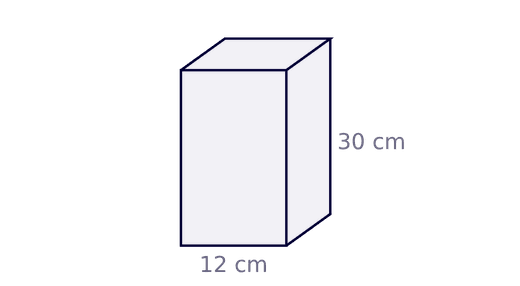 The base is a square, so the volume of one prism = base area height .
Profit on each cubic centimetre = ₹0.80 − ₹0.50 = ₹0.30.
Profit on one prism , that is ₹1,296.
Profit on 20 prisms .
So the total profit is ₹25,920, and option (d) is the answer.
The base is a square, so the volume of one prism = base area height .
Profit on each cubic centimetre = ₹0.80 − ₹0.50 = ₹0.30.
Profit on one prism , that is ₹1,296.
Profit on 20 prisms .
So the total profit is ₹25,920, and option (d) is the answer.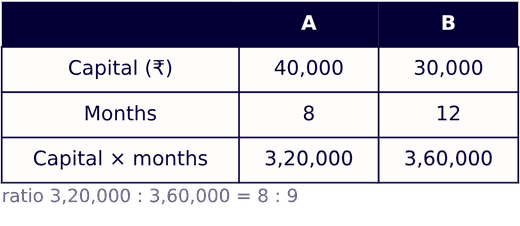 A's capital worked for only 8 months: .
B never withdrew, so his capital worked for all 12 months: .
Ratio =320000:360000=32:36=8:9.
Hence option (d) is the answer.
A's capital worked for only 8 months: .
B never withdrew, so his capital worked for all 12 months: .
Ratio =320000:360000=32:36=8:9.
Hence option (d) is the answer.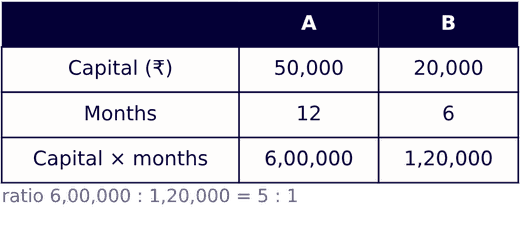 A started the business, so his money worked for all 12 months: .
B joined after 6 months, so his money worked for the remaining 6 months: .
Ratio =600000:120000=5:1.
Hence option (a) is the answer.
A started the business, so his money worked for all 12 months: .
B joined after 6 months, so his money worked for the remaining 6 months: .
Ratio =600000:120000=5:1.
Hence option (a) is the answer.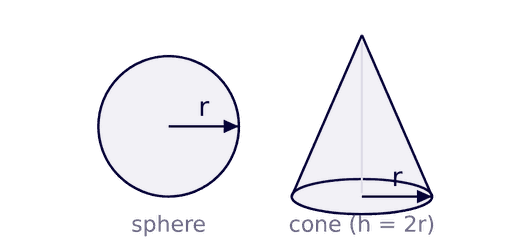 The height of a sphere of radius r is its diameter, so the cone also has h=2r.
Volume of the sphere .
Volume of the cone .
Ratio .
Hence option (c) is the answer.
The height of a sphere of radius r is its diameter, so the cone also has h=2r.
Volume of the sphere .
Volume of the cone .
Ratio .
Hence option (c) is the answer.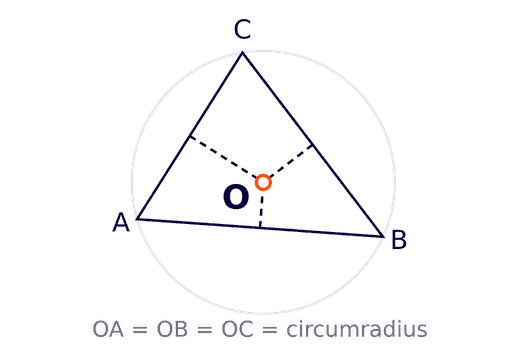 Every point on the perpendicular bisector of a side is equally far from the two end points of that side.
So the point where all three perpendicular bisectors meet is equally far from A, B and C, and a circle drawn with that point as centre passes through all three vertices.
That point is therefore the circumcentre, the centre of the circumcircle.
For contrast: the incentre is where the angle bisectors meet, the centroid where the medians meet and the orthocentre where the altitudes meet.
Hence option (b) is the answer.
Every point on the perpendicular bisector of a side is equally far from the two end points of that side.
So the point where all three perpendicular bisectors meet is equally far from A, B and C, and a circle drawn with that point as centre passes through all three vertices.
That point is therefore the circumcentre, the centre of the circumcircle.
For contrast: the incentre is where the angle bisectors meet, the centroid where the medians meet and the orthocentre where the altitudes meet.
Hence option (b) is the answer.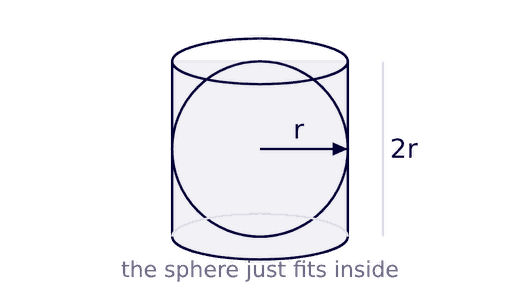 A sphere of radius r that just fits inside a cylinder touches the curved surface and both flat faces, so the cylinder has radius r and height h=2r.
Volume of the sphere .
Volume of the cylinder .
Ratio .
Hence option (a) is the answer.
A sphere of radius r that just fits inside a cylinder touches the curved surface and both flat faces, so the cylinder has radius r and height h=2r.
Volume of the sphere .
Volume of the cylinder .
Ratio .
Hence option (a) is the answer.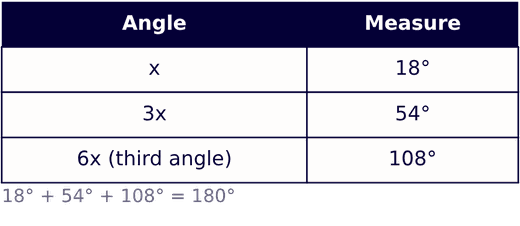 The angles are , and , so the largest angle is .
Hence option (a) is the answer.
The angles are , and , so the largest angle is .
Hence option (a) is the answer.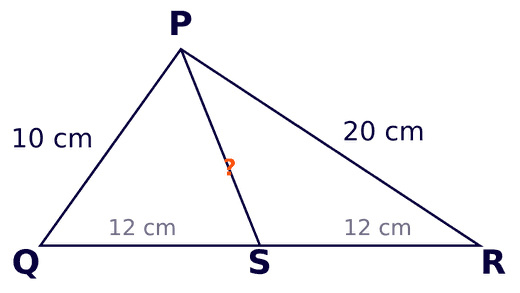 Apollonius theorem for the median PS: .
cm.
Hence the correct option is (d).
Apollonius theorem for the median PS: .
cm.
Hence the correct option is (d).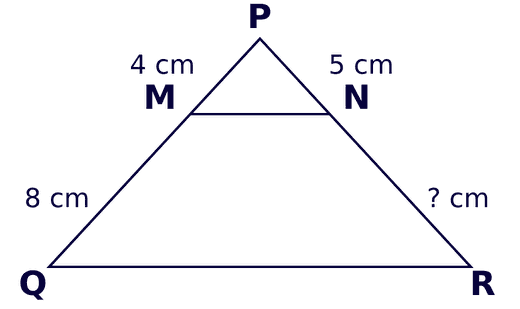 , so by the Basic Proportionality (Thales) theorem the two sides are cut in the same ratio: .
cm.
Hence the correct option is (a).
, so by the Basic Proportionality (Thales) theorem the two sides are cut in the same ratio: .
cm.
Hence the correct option is (a).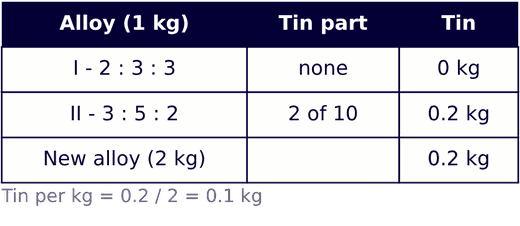 Total tin in the 2 kg of new alloy =0+0.2=0.2 kg.
Tin per kg kg.
Hence the correct option is (c).
Total tin in the 2 kg of new alloy =0+0.2=0.2 kg.
Tin per kg kg.
Hence the correct option is (c).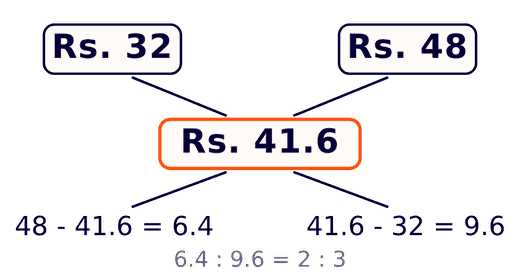 By alligation the same value satisfies (48-M):(M-32)=2:3, which again gives M=41.6.
So the mixed rice costs ₹41.6 per kg.
Hence the correct option is (c).
By alligation the same value satisfies (48-M):(M-32)=2:3, which again gives M=41.6.
So the mixed rice costs ₹41.6 per kg.
Hence the correct option is (c).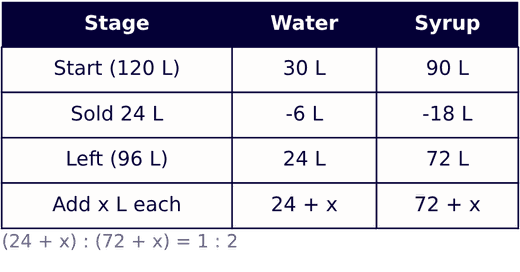 Let x litres of sugar syrup and x litres of water be added.
x=24
So 24 litres of water was added later on.
Hence the correct option is (c).
Let x litres of sugar syrup and x litres of water be added.
x=24
So 24 litres of water was added later on.
Hence the correct option is (c).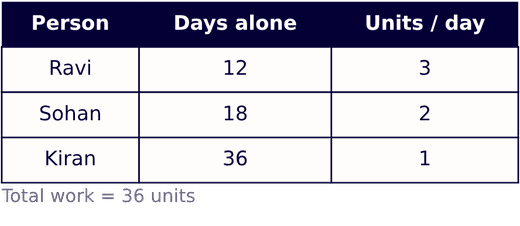 Time taken by Kiran alone days.
Hence the correct option is (c).
Time taken by Kiran alone days.
Hence the correct option is (c).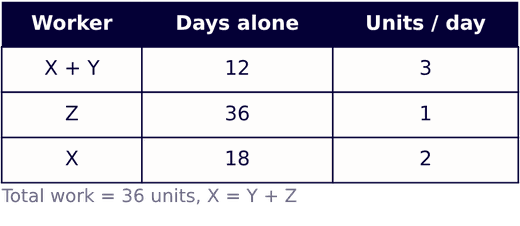 Time taken by X alone days.
Hence the correct option is (a).
Time taken by X alone days.
Hence the correct option is (a).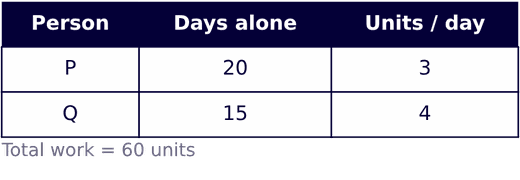 Work done by Q in 6 days units.
Work left =60-24=36 units.
Time taken by P alone days.
Hence the correct option is (b).
Work done by Q in 6 days units.
Work left =60-24=36 units.
Time taken by P alone days.
Hence the correct option is (b).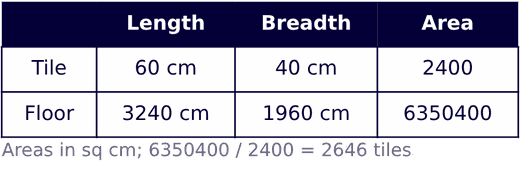 Number of tiles .
Hence the correct option is (d).
Number of tiles .
Hence the correct option is (d).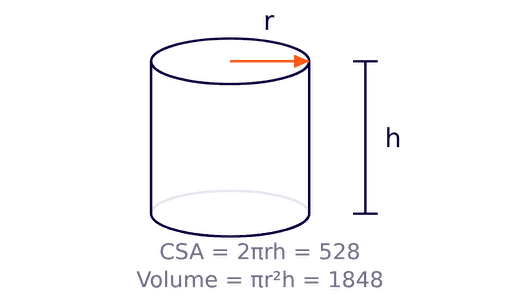 Dividing the volume by the curved surface area removes and h: .
m.
Putting r=7 in :
m.
Required ratio r:h=7:12.
Hence the correct option is (b).
Dividing the volume by the curved surface area removes and h: .
m.
Putting r=7 in :
m.
Required ratio r:h=7:12.
Hence the correct option is (b).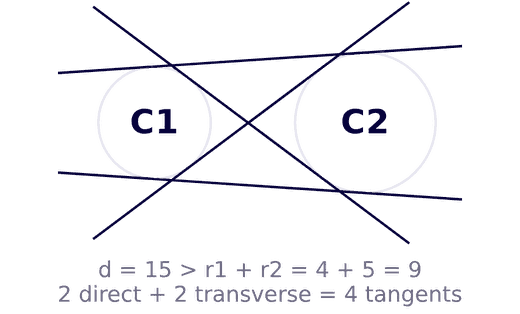 When the distance between the centres exceeds the sum of the radii, the two circles lie completely outside each other without touching or cutting.
In that position both direct (external) tangents and both transverse (internal) tangents exist, so the number of common tangents =2+2=4.
Hence the correct option is (a).
When the distance between the centres exceeds the sum of the radii, the two circles lie completely outside each other without touching or cutting.
In that position both direct (external) tangents and both transverse (internal) tangents exist, so the number of common tangents =2+2=4.
Hence the correct option is (a).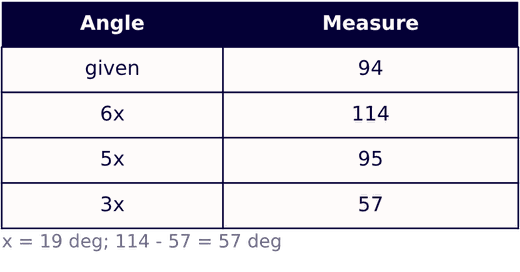 The four angles are ; the largest is and the smallest is .
Required difference .
Hence the correct option is (c).
The four angles are ; the largest is and the smallest is .
Required difference .
Hence the correct option is (c).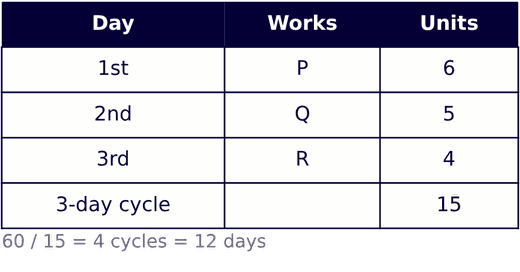 One cycle of 3 days gives 6+5+4=15 units.
complete cycles are needed, and no part-cycle is left over.
Total time days.
Hence the correct option is (d).
One cycle of 3 days gives 6+5+4=15 units.
complete cycles are needed, and no part-cycle is left over.
Total time days.
Hence the correct option is (d).