SSC CHSL 15 November 2025 · Shift 3 · English Language — questions with answers · ShikshaSphere
Chapter 44 of 200
15 November 2025 · Shift 3
English Language
25 questions ~25 min readFree
25 questions
A
1
Identify the part of the sentence that contains a grammatical error,
A. The directors final script, B. which was written just last summer, C. contains the scenes that D. confuse the main audience.
A.The directors final script
B.which was written just last summer
C.contains the scenes that
D.confuse the main audience.
Solution
Possessive apostrophe
The error lies in part A.
A noun that shows possession must carry an apostrophe: the script belongs to the director, so "directors" has to become "director's".
Correct sentence: The director's final script, which was written just last summer, contains the scenes that confuse the main audience.
Parts B, C and D are sound — "which" refers back to "script", the singular verb "contains" agrees with "script", and "confuse" agrees with the plural "scenes".
Hence option (a) is the answer.
2
Identify the part of the sentence that contains a grammatical error.
A. The reason for the delay . is because it C. rained heavily D. all day long.
A.The reason for the delay
B.is because it
C.rained heavily
D.all day long.
Solution
Redundant expression
The error lies in part B.
The structure "The reason ... is because" is redundant: the noun "reason" already expresses cause, and "because" states the same cause a second time.
After "The reason ... is", English needs a noun clause introduced by "that", not by "because".
Correct sentence: The reason for the delay is that it rained heavily all day long.
Hence option (b) is the answer.
3
Select the most appropriate synonym of the word:
TERMINATE
A.Initiate
B.Cease
C.Commence
D.Start
Solution
Synonym
TERMINATE means to bring something to an end, to stop or finish it.
Cease also means to stop or come to an end, so it carries the same sense.
Initiate, Commence and Start all mean to begin — they are opposites of terminate, not synonyms.
Hence option (b) is the answer.
4
Fill in the blank with the most appropriate phrasal verb:
The safety officer will every tool before beginning the job.
A.look over
B.give in
C.call off
D.fall back
Solution
Phrasal verb
The blank needs a phrasal verb meaning 'to inspect or examine'.
Look over = to examine or check something; a safety officer looks over every tool before the job starts.
Give in = to surrender, call off = to cancel, fall back = to retreat or rely on — none of these expresses inspection.
Hence option (a) is the answer.
5
Select the most appropriate synonym of the word:
Obstinate
A.Flexible
B.Pliable
C.Stubborn
D.Yielding
Solution
Synonym
Obstinate means stubbornly refusing to change one's opinion or chosen course of action.
Stubborn expresses exactly this unyielding, inflexible attitude.
Flexible, Pliable and Yielding all describe someone easily bent or persuaded — the opposite quality.
Hence option (c) is the answer.
6
Choose the correctly spelt word:
A.Entripreneur
B.Entreprenuer
C.Enterpreneur
D.Entrepreneur
Solution
Correct spelling
The correct spelling is Entrepreneur — a person who sets up and runs a business, taking financial risk.
It comes from French, so the word keeps the pattern entre + pre + neur: e-n-t-r-e-p-r-e-n-e-u-r.
Entripreneur uses 'i' for the first 'e', Entreprenuer reverses 'eu' to 'ue', and Enterpreneur inserts an extra 'r' after 'ente'.
Hence option (d) is the answer.
7
Which of the following sentences uses the word "bank" with the same meaning as in the following sentence?
"She went to the bank to deposit her check"
A.They sat on the grassy bank and watched the river flow.
B.The city bank downtown is closed on Sundays.
C.The river bank was muddy after the heavy rain.
D.They built a house on the steep bank of the stream.
Solution
Homonym in context
In "She went to the bank to deposit her check", the word bank means a financial institution that keeps money.
Test each option for that sense.
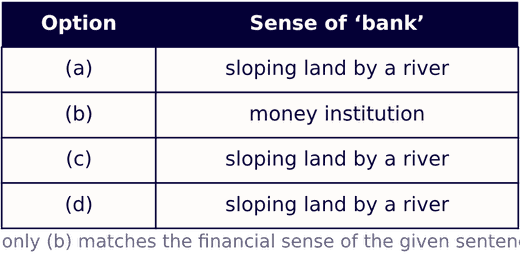
Only (b) — "The city bank downtown is closed on Sundays" — speaks of such an institution.
In (a), (c) and (d), bank means the raised ground along a river or stream.
Hence option (b) is the answer.
8
Directions (Qs. 8-12): Read the following passage carefully and answer the questions that follow.
The rapid expansion of artificial intelligence represents a vast and intricate challenge to update the economic and planning paradigms of modern industry. As machine learning, robotics, and predictive algorithms make human labor redundant, millions are currently being pushed out of careers, thereby forming a new demographic of displaced workers who currently possess no guaranteed financial safety net as "technological casualties." The question today is no longer if this will happen, but how societies need to adapt collectively and humanely. A comprehensive answer demands a multi-pronged approach: first, the design of updated educational and vocational standards to recognize and retrain displaced staff and move beyond the present, outdated model of schooling. Second, it necessitates anticipatory, not retrospective, planning, such as the creation of robust and accessible avenues for upskilling, firm social protections for redundant individuals, and substantial funding in fostering cognitive flexibility among those who are likely to be marginalized, ensuring they are not discarded in the first instance.
It brings into stark focus the difficult issue of how the profit is to be distributed. A compelling argument, grounded in the concept of economic equity, places the primary duty on the technology giants. They have been the sole beneficiaries of efficiency gains in recent decades, a fact that is intimately linked with the width of the wealth gap. Their dominance was largely secured through data-harvesting practices, and these are the very mechanisms responsible for replacing the working - class populations, who have provided essential labor for the economy. Thus, a moral and fair reaction dictates that these wealthy corporations assume the mantle with both monetary and structural support. They ought to be spearheading the effort in funding transition programs for affected workers and holding the capital required for the retraining and sustenance of displaced personnel. The global economy must ultimately acknowledge that the benefits of automation are not universally felt, and a just resolution must entail entities who reaped the rewards taking the steps to alleviate the most disruptive sociological impacts of the transition.
According to the passage, what is the central moral conflict raised by workforce automation?
A.Whether machines should be permitted to work
B.How the wealth of automation should be split
C.Whether technological growth is a natural process
D.How to stop further technological growth
Solution
Reading comprehension
The second paragraph names the moral issue in its very first line: "the difficult issue of how the profit is to be distributed".
The whole paragraph then argues that the technology giants, who took the gains, must fund the transition of displaced workers.
So the central moral conflict is how the wealth created by automation should be shared.
Options (a) and (d) suggest banning machines or halting growth, which the passage never demands, and (c) is a factual question, not a moral one.
Hence option (b) is the answer.
9
Directions (Qs. 8-12): Read the following passage carefully and answer the questions that follow.
The rapid expansion of artificial intelligence represents a vast and intricate challenge to update the economic and planning paradigms of modern industry. As machine learning, robotics, and predictive algorithms make human labor redundant, millions are currently being pushed out of careers, thereby forming a new demographic of displaced workers who currently possess no guaranteed financial safety net as "technological casualties." The question today is no longer if this will happen, but how societies need to adapt collectively and humanely. A comprehensive answer demands a multi-pronged approach: first, the design of updated educational and vocational standards to recognize and retrain displaced staff and move beyond the present, outdated model of schooling. Second, it necessitates anticipatory, not retrospective, planning, such as the creation of robust and accessible avenues for upskilling, firm social protections for redundant individuals, and substantial funding in fostering cognitive flexibility among those who are likely to be marginalized, ensuring they are not discarded in the first instance.
It brings into stark focus the difficult issue of how the profit is to be distributed. A compelling argument, grounded in the concept of economic equity, places the primary duty on the technology giants. They have been the sole beneficiaries of efficiency gains in recent decades, a fact that is intimately linked with the width of the wealth gap. Their dominance was largely secured through data-harvesting practices, and these are the very mechanisms responsible for replacing the working - class populations, who have provided essential labor for the economy. Thus, a moral and fair reaction dictates that these wealthy corporations assume the mantle with both monetary and structural support. They ought to be spearheading the effort in funding transition programs for affected workers and holding the capital required for the retraining and sustenance of displaced personnel. The global economy must ultimately acknowledge that the benefits of automation are not universally felt, and a just resolution must entail entities who reaped the rewards taking the steps to alleviate the most disruptive sociological impacts of the transition.
In the passage, the word "intricate' most nearly means:
A.Boring
B.Unclear
C.Frustrating
D.Complicated
Solution
Vocabulary in context
The passage calls artificial intelligence "a vast and intricate challenge" with many interlinked parts.
Intricate means having many small connected details, that is, complicated.
Boring, Unclear and Frustrating describe a reader's feeling, not the many-layered structure of the problem.
Hence option (d) is the answer.
10
Directions (Qs. 8-12): Read the following passage carefully and answer the questions that follow.
The rapid expansion of artificial intelligence represents a vast and intricate challenge to update the economic and planning paradigms of modern industry. As machine learning, robotics, and predictive algorithms make human labor redundant, millions are currently being pushed out of careers, thereby forming a new demographic of displaced workers who currently possess no guaranteed financial safety net as "technological casualties." The question today is no longer if this will happen, but how societies need to adapt collectively and humanely. A comprehensive answer demands a multi-pronged approach: first, the design of updated educational and vocational standards to recognize and retrain displaced staff and move beyond the present, outdated model of schooling. Second, it necessitates anticipatory, not retrospective, planning, such as the creation of robust and accessible avenues for upskilling, firm social protections for redundant individuals, and substantial funding in fostering cognitive flexibility among those who are likely to be marginalized, ensuring they are not discarded in the first instance.
It brings into stark focus the difficult issue of how the profit is to be distributed. A compelling argument, grounded in the concept of economic equity, places the primary duty on the technology giants. They have been the sole beneficiaries of efficiency gains in recent decades, a fact that is intimately linked with the width of the wealth gap. Their dominance was largely secured through data-harvesting practices, and these are the very mechanisms responsible for replacing the working - class populations, who have provided essential labor for the economy. Thus, a moral and fair reaction dictates that these wealthy corporations assume the mantle with both monetary and structural support. They ought to be spearheading the effort in funding transition programs for affected workers and holding the capital required for the retraining and sustenance of displaced personnel. The global economy must ultimately acknowledge that the benefits of automation are not universally felt, and a just resolution must entail entities who reaped the rewards taking the steps to alleviate the most disruptive sociological impacts of the transition.
What is meant by "economic equity" as described in the passage?
A.Equal access to digital internet
B.Responsibility of technology firms for social inequality
C.Fairness in hiring practices
D.International trade to speed up global automation
Solution
Reading comprehension
The passage uses the phrase in one sentence: an argument "grounded in the concept of economic equity, places the primary duty on the technology giants".
Those firms took the efficiency gains, a fact "intimately linked with the width of the wealth gap", so equity here means holding them answerable for the inequality they helped create.
Equal internet access, fair hiring and global trade are never attached to the phrase in the passage.
Hence option (b) is the answer.
11
Directions (Qs. 8-12): Read the following passage carefully and answer the questions that follow.
The rapid expansion of artificial intelligence represents a vast and intricate challenge to update the economic and planning paradigms of modern industry. As machine learning, robotics, and predictive algorithms make human labor redundant, millions are currently being pushed out of careers, thereby forming a new demographic of displaced workers who currently possess no guaranteed financial safety net as "technological casualties." The question today is no longer if this will happen, but how societies need to adapt collectively and humanely. A comprehensive answer demands a multi-pronged approach: first, the design of updated educational and vocational standards to recognize and retrain displaced staff and move beyond the present, outdated model of schooling. Second, it necessitates anticipatory, not retrospective, planning, such as the creation of robust and accessible avenues for upskilling, firm social protections for redundant individuals, and substantial funding in fostering cognitive flexibility among those who are likely to be marginalized, ensuring they are not discarded in the first instance.
It brings into stark focus the difficult issue of how the profit is to be distributed. A compelling argument, grounded in the concept of economic equity, places the primary duty on the technology giants. They have been the sole beneficiaries of efficiency gains in recent decades, a fact that is intimately linked with the width of the wealth gap. Their dominance was largely secured through data-harvesting practices, and these are the very mechanisms responsible for replacing the working - class populations, who have provided essential labor for the economy. Thus, a moral and fair reaction dictates that these wealthy corporations assume the mantle with both monetary and structural support. They ought to be spearheading the effort in funding transition programs for affected workers and holding the capital required for the retraining and sustenance of displaced personnel. The global economy must ultimately acknowledge that the benefits of automation are not universally felt, and a just resolution must entail entities who reaped the rewards taking the steps to alleviate the most disruptive sociological impacts of the transition.
How does the passage characterize the current model of "schooling" in the context of workforce automation?
A.It is too flexible to train future workers
B.It is old and inadequate to support displaced staff
C.It is precise and globally standard
D.It is too strict to allow digital learning
Solution
Reading comprehension
The first paragraph asks for updated standards that "recognize and retrain displaced staff and move beyond the present, outdated model of schooling".
Calling it outdated and asking to move beyond it means the present model is old and not enough to support displaced workers.
The passage never says schooling is too flexible, precise and globally standard, or too strict for digital learning.
Hence option (b) is the answer.
12
Directions (Qs. 8-12): Read the following passage carefully and answer the questions that follow.
The rapid expansion of artificial intelligence represents a vast and intricate challenge to update the economic and planning paradigms of modern industry. As machine learning, robotics, and predictive algorithms make human labor redundant, millions are currently being pushed out of careers, thereby forming a new demographic of displaced workers who currently possess no guaranteed financial safety net as "technological casualties." The question today is no longer if this will happen, but how societies need to adapt collectively and humanely. A comprehensive answer demands a multi-pronged approach: first, the design of updated educational and vocational standards to recognize and retrain displaced staff and move beyond the present, outdated model of schooling. Second, it necessitates anticipatory, not retrospective, planning, such as the creation of robust and accessible avenues for upskilling, firm social protections for redundant individuals, and substantial funding in fostering cognitive flexibility among those who are likely to be marginalized, ensuring they are not discarded in the first instance.
It brings into stark focus the difficult issue of how the profit is to be distributed. A compelling argument, grounded in the concept of economic equity, places the primary duty on the technology giants. They have been the sole beneficiaries of efficiency gains in recent decades, a fact that is intimately linked with the width of the wealth gap. Their dominance was largely secured through data-harvesting practices, and these are the very mechanisms responsible for replacing the working - class populations, who have provided essential labor for the economy. Thus, a moral and fair reaction dictates that these wealthy corporations assume the mantle with both monetary and structural support. They ought to be spearheading the effort in funding transition programs for affected workers and holding the capital required for the retraining and sustenance of displaced personnel. The global economy must ultimately acknowledge that the benefits of automation are not universally felt, and a just resolution must entail entities who reaped the rewards taking the steps to alleviate the most disruptive sociological impacts of the transition.
What strategy is suggested in the passage to address workforce displacement?
A.Retrospective measures to fix unemployment
B.Anticipatory measures to secure employment
C.Total stop on machine learning
D.Government manufacturing restrictions
Solution
Reading comprehension
The passage states that the task "necessitates anticipatory, not retrospective, planning".
It then lists the anticipatory steps: accessible avenues for upskilling, firm social protections and funding for cognitive flexibility, so that workers are not discarded in the first instance.
Retrospective action is expressly rejected in (a); stopping machine learning or restricting manufacturing appears nowhere in the passage.
Hence option (b) is the answer.
13
Choose the correct meaning of the idiom:
Dropped off the map
A.Became very famous
B.Disappeared or was no longer noticed
C.Traveled to a new place
D.Achieved success
Solution
Idiom
Dropped off the map = disappeared from view, or was no longer noticed by anyone.
The image is of a place no longer marked on a map, so nobody can find it any more.
E.g. After moving abroad, he dropped off the map and no one heard from him for years.
Hence option (b) is the answer.
14
Choose the correct meaning of the idiom:
Brush with death
A.A minor disagreement
B.A very close escape from death
C.A sudden success
D.A dangerous habit
Solution
Idiom
Brush with death = a very close escape from dying.
A 'brush' is a light passing touch, so death only touched the person instead of taking them.
E.g. The climber had a brush with death when he slipped from the mountain but was saved by his safety rope.
Hence option (b) is the answer.
15
Which of the following sentences uses the word "train" with a different meaning from the others?
A.The morning train left the station early.
B.The subway train was crowded with people.
C.The athlete had to train for the race.
D.The fast train connects the two cities.
Solution
Homonym in context
Check the part of speech that "train" takes in each sentence.
In (a), (b) and (d) train is a noun standing for a railway vehicle.
In (c) train is a verb meaning to practise or prepare oneself for an event, so its meaning differs from the rest.
Hence option (c) is the answer.
16
Choose the correct one-word substitute for:
A person who loves collecting stamps.
A.Postmaster
B.Collector
C.Philatelist
D.Sender
Solution
One-word substitution
A person who loves collecting stamps is a Philatelist.
The hobby itself is philately, from Greek philos (loving) + ateleia (freedom from tax, i.e. postage already paid).
Postmaster is the officer in charge of a post office, Collector is too general a word for any kind of collecting, and Sender is the one who posts the letter.
Hence option (c) is the answer.
17
Select the most appropriate antonym of the word:
Ephemeral
A.Fleeting
B.Brief
C.Eternal
D.Short
Solution
Antonym
Ephemeral means lasting for a very short time, like a mayfly or a passing trend.
Its antonym must convey unending duration, and Eternal means lasting or existing forever.
Fleeting, Brief and Short are the trap: all three repeat the idea of shortness, so they are synonyms of ephemeral, not antonyms.
Hence option (c) is the answer.
18
Select the most appropriate antonym of the word:
Squalid
A.Dirty
B.Clean
C.Filthy
D.Nasty
Solution
Antonym
Squalid means extremely dirty, neglected and unpleasant, as in squalid living conditions.
The opposite quality is expressed by Clean, that is, free from dirt and hygienic.
Dirty, Filthy and Nasty all restate the same unpleasant idea, so they are synonyms of squalid.
Hence option (b) is the answer.
19
Change the following sentence into the Active form.
The river could not be crossed without the old wooden boat.
A.We could not cross the river without the old wooden boat.
B.The river cannot be crossed without the old wooden boat.
C.Without the old wooden boat, the river was not crossed.
D.The old wooden boat could not cross the river.
Solution
Active voice
The given sentence is passive: subject "The river" + could not be + V3 "crossed".
To turn it active, the doer must be supplied. No agent is named, so the general doer "we" is used.
Active pattern: doer + could not + V1 + object → We + could not + cross + the river.
Active sentence: We could not cross the river without the old wooden boat.
(b) and (c) are still passive, and (d) changes the sense by making the boat itself the doer of the crossing.
Hence option (a) is the answer.
20
Select the option that expresses the given sentence in indirect voice.
The captain said, 'The cruise ship will be leaving later."
A.The captain said that the cruise ship would be leaving later.
B.The captain said that the cruise ship will be leaving later.
C.The captain said that the cruise ship would leave later.
D.The captain said that the cruise ship had been leaving later.
Solution
Direct and indirect speech
The reporting verb "said" is in the past tense, so the reported verb moves one step back in time.
The future continuous "will be leaving" therefore becomes "would be leaving"; the continuous form "be + leaving" is kept unchanged.
The comma and inverted commas are dropped and the conjunction "that" joins the two clauses.
(b) keeps "will", (c) drops "be" and so loses the continuous aspect, and (d) uses a wrong tense.
Hence option (a) is the answer.
21
Choose the most suitable option to replace the highlighted part of the sentence:
Each of the boys recited their poem
A.Each of the boys recited there poem
B.Each of the boys recited her poem
C.Each of the boys recited his poem
D.Each of the boys recited their poems
Solution
Pronoun agreement
The subject of the sentence is 'Each of the boys', and the head word is 'Each', which is always singular.
Every word that refers back to a singular subject must itself be singular, so the plural possessive 'their' is wrong; the singular masculine possessive 'his' is required because the group consists of boys.
Option (a) uses 'there' (an adverb of place), not a possessive; option (b) uses the feminine 'her'; option (d) keeps the plural 'their' and adds a plural noun as well.
Hence the correct sentence is 'Each of the boys recited his poem.', option (c).
22
Choose the correct passive voice transformation of the sentence:
The artist drew that sketch in 1999.
A.That sketch was drawn by the artist in 1999.
B.That sketch is drawn by the artist in 1999.
C.That sketch was being drawn by the artist in 1999.
D.That sketch has been drawn by the artist in 1999.
Solution
Active to passive voice
The given sentence is in the simple past tense: subject 'The artist' + verb 'drew' + object 'that sketch'.
Rule for the simple past passive: object + was/were + third form of the verb + by + subject.
'That sketch' is singular, so 'was' is used, and the third form of 'draw' is 'drawn' — 'That sketch was drawn by the artist in 1999.'
Option (b) shifts the sentence to the simple present, (c) to the past continuous and (d) to the present perfect, so all three change the tense of the original sentence.
Hence option (a) is correct.
23
Select the option that expresses the given sentence in direct voice. The analyst stated that although the stock had been judged stable for years, recent drops now suggested that it was weak.
A.The analyst stated, "Although the stock have been judged stable for years, recent drops now suggest that it is weak."
B.The analyst stated, "Although the stock was judged stable for years, recent drops now suggest that it is weak."
C.The analyst stated, "Although the stock has been judged stable for years, recent drops now suggest that it is weak."
D.The analyst stated, "Although the stock was judged stable for years, recent drops then suggested that it was weak.'
Solution
Direct and indirect speech
In the indirect form the reporting verb 'stated' pushed every tense one step back, so to recover the direct form each tense must be moved one step forward.
'had been judged' (past perfect) moves forward to the present perfect 'has been judged'; the subject 'the stock' is singular, so it takes 'has', not 'have'.
In the same way 'suggested' becomes 'suggest' and 'was' becomes 'is' — the word 'now' inside the sentence confirms that the present tense is intended.
The spoken words are then placed inside double inverted commas after a comma: The analyst stated, "Although the stock has been judged stable for years, recent drops now suggest that it is weak."
Option (a) uses the plural 'have', (b) drops the perfect aspect, and (d) keeps the backshifted 'then suggested ... was', so only (c) restores the speaker's own words.
Hence option (c) is correct.
24
Rearrange the following sentence parts to form a meaningful and grammatically correct paragraph:
P. The tall chef, with his white hat and stern face, stood proudly.
Q. He had spent a whole life as a baker, and his shop was a palace of sweet loaves of bread.
R. He kneaded a soft dough he was shaping, his fingers pressing the sticky flour.
S. They all had a flavor, a secret, a taste of his love.
A.PQRS
B.QPRS
C.QSRP
D.SQPR
Solution
Para jumble
Find the opening part first: P is the only part that names the character in full — 'The tall chef, with his white hat and stern face' — while Q, R and S all begin with the pronouns 'He' or 'They'.
Q follows P, because 'He' now has an antecedent and Q gives the background: a whole life as a baker and a shop full of sweet loaves of bread.
R comes next, moving from the background to what the chef is doing at this moment — kneading the soft dough.
S is the closing part: 'They all' refers back to the loaves of bread introduced in Q, and the sentence rounds the paragraph off with the idea of his love.
So the correct sequence is P-Q-R-S, option (a).
25
Rearrange the following sentences to form a meaningful and grammatically correct paragraph:
P. He analyzed the stained canvas closely, spotting the cracking paint.
Q. After that, he wiped the dusty surface softly so as not to smear it any worse.
R. With a vibrant style filled with color, the art has been admired by people for generations.
S. Before starting the cleaning process, he mixed the solvents and cloths he would need ready.
A.P, S, Q, R
B.S, R, P, Q
C.Q, S, P, R
D.R, S, P, Q
Solution
Para jumble
R is the opening sentence: it is the only one that introduces the subject itself — 'the art', admired for generations — whereas P, Q and S all start from the pronoun 'he', who must be introduced only after the artwork.
S follows R, because the time marker 'Before starting the cleaning process' places it first among the restorer's own actions: he gets the solvents and cloths ready.
P comes next — with the material ready he examines the stained canvas closely and notices the cracking paint.
Q is last, since 'After that' points back to that examination and describes the careful wiping that follows it.
So the correct sequence is R, S, P, Q — option (d).
Finished reading? Now test yourself.
The same 25 questions, but with a timer and the answers hidden — 15 minutes.

 Only (b) — "The city bank downtown is closed on Sundays" — speaks of such an institution.
In (a), (c) and (d), bank means the raised ground along a river or stream.
Hence option (b) is the answer.
Only (b) — "The city bank downtown is closed on Sundays" — speaks of such an institution.
In (a), (c) and (d), bank means the raised ground along a river or stream.
Hence option (b) is the answer.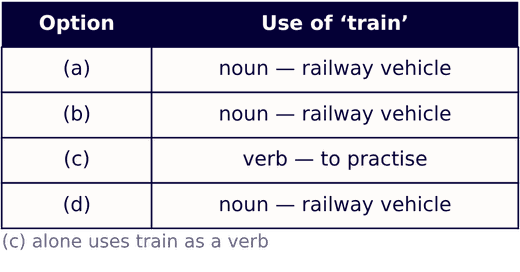 In (a), (b) and (d) train is a noun standing for a railway vehicle.
In (c) train is a verb meaning to practise or prepare oneself for an event, so its meaning differs from the rest.
Hence option (c) is the answer.
In (a), (b) and (d) train is a noun standing for a railway vehicle.
In (c) train is a verb meaning to practise or prepare oneself for an event, so its meaning differs from the rest.
Hence option (c) is the answer.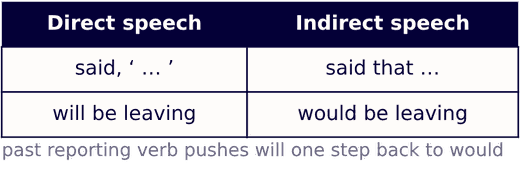 The future continuous "will be leaving" therefore becomes "would be leaving"; the continuous form "be + leaving" is kept unchanged.
The comma and inverted commas are dropped and the conjunction "that" joins the two clauses.
(b) keeps "will", (c) drops "be" and so loses the continuous aspect, and (d) uses a wrong tense.
Hence option (a) is the answer.
The future continuous "will be leaving" therefore becomes "would be leaving"; the continuous form "be + leaving" is kept unchanged.
The comma and inverted commas are dropped and the conjunction "that" joins the two clauses.
(b) keeps "will", (c) drops "be" and so loses the continuous aspect, and (d) uses a wrong tense.
Hence option (a) is the answer.