SSC CHSL 17 November 2025 · Shift 1 · General Intelligence — questions with answers · ShikshaSphere
Chapter 45 of 200
17 November 2025 · Shift 1
General Intelligence
25 questions ~25 min readFree
25 questions
A
26
A sum of money is to be distributed among , and C in the ratio of . If receives ₹ 1600 , what is the total sum of money?
A.₹3200
B.₹3700
C.₹4200
D.₹4600
Solution
Ratio, distribution of money
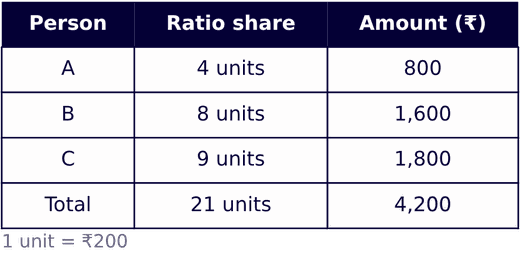
Let the shares of A, B and C be 4x, 8x and 9x.
B's share is given, so 8x=1600.
, i.e. one ratio unit is worth ₹200.
Total sum =4x+8x+9x=21x.
.
Hence the total sum is ₹4,200 and option (c) is correct.
27
12 men can complete a piece of work in 9 days. How many men are required to complete the same work in 6 days?
A.17 men
B.15 men
C.18 men
D.21 men
Solution
Time and work, inverse variation
The work is the same in both cases, so the number of men and the number of days vary inversely.
Formula: .
.
.
Hence 18 men are required and option (c) is correct.
28
In a certain code, "BAT" is written as "DCV". How is "GOAT" written in that code?
A.IQCV
B.IQVC
C.IPHC
D.FIQH
Solution
Letter coding, forward shift
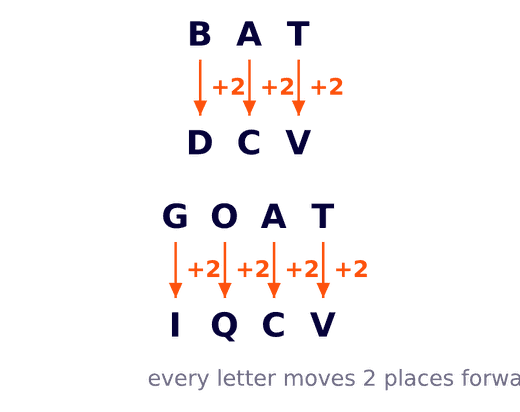
Compare BAT with its code DCV letter by letter.
B(2)+2=D(4), A(1)+2=C(3) and T(20)+2=V(22) - every letter moves 2 places forward.
Applying the same rule to GOAT: G+2=I, O+2=Q, A+2=C, T+2=V.
So GOAT is written as IQCV and option (a) is correct.
29
In a certain code, "ORANG" is written as "RUDQJ". How is "MANGO" written in that code?
A.PDQJR
B.PDQRJ
C.PQDJR
D.PDJQR
Solution
Letter coding, forward shift
Write ORANG above RUDQJ and find the gap at each position.
O(15)+3=R(18), R(18)+3=U(21), A(1)+3=D(4), N(14)+3=Q(17), G(7)+3=J(10).
So each letter is moved 3 places forward.
For MANGO: M+3=P, A+3=D, N+3=Q, G+3=J, O+3=R.
MANGO is therefore written as PDQJR, so option (a) is correct.
30
In a certain code, "TRAIN" is written as "UTBJP". How is "BOARD" written in that code?
A.CQBSF
B.CQSBF
C.CBQSF
D.CSBQF
Solution
Letter coding, positional shift
Write TRAIN above its code UTBJP and measure the shift at each position separately.
is +1, is +2, is +1, is +1 and is +2.
The shifts are not the same for every letter; they belong to the positions, in the fixed pattern +1,+2,+1,+1,+2.
Applying that pattern to BOARD: B+1=C, O+2=Q, A+1=B, R+1=S, D+2=F.
BOARD is therefore written as CQBSF, so option (a) is correct.
31
In a certain code, 'HOUSE' is written as "ESUOH". How is "TRAIN" written in that code?
A.NIART
B.NIATR
C.NIRAT
D.NAIRT
Solution
Coding by reversal
Read the code ESUOH from its last letter to its first: H, O, U, S, E - that is the word HOUSE itself.
So the rule is simply to write the letters in the reverse order; no letter is changed or shifted.
Reversing TRAIN gives N, I, A, R, T.
TRAIN is therefore written as NIART, so option (a) is correct.
32
A sum of ₹1800 is divided among , and R in the ratio . How much does Q receive?
A.₹640
B.₹760
C.7780
D.₹720
Solution
Ratio, division of a sum
Let the shares of P, Q and R be 3x, 4x and 3x.
Their sum is the whole amount: 3x+4x+3x=1800.
10x=1800, so .
Q's share .
Hence Q receives ₹720 and option (d) is correct.
33
If and , what is the value of ?
A.36
B.38
C.30
D.42
Solution
Substitution in an expression
Put A=-4 and B=5 into .
, so .
.
.
=38.
Note that squaring removes the minus sign; writing is the usual slip.
Hence option (b) is correct.
34
Pick the correct options from the given alternatives.
374 : 14 :: 441 :?
A.9
B.11
C.13
D.17
Solution
Number analogy, digit sum
Compare 374 with 14 and look at the digits of the first number.
3+7+4=14, which is exactly the second number.
So in each pair the second number is the digit sum of the first.
For 441: 4+4+1=9.
Hence the missing number is 9 and option (a) is correct.
35
Pick the correct options from the given alternatives.
312 : 156 :: 412 :?
A.206
B.244
C.208
D.260
Solution
Number analogy, halving
Compare 312 with 156: .
So the second number of each pair is half of the first.
For 412: .
Hence the missing number is 206 and option (a) is correct.
36
Find the number of terms in the following series.
25, 30, 35, 40, ......., 215
A.39
B.49
C.41
D.42
Solution
AP, number of terms
The terms 25, 30, 35, 40, ... increase by 5 each time, so this is an AP with first term a=25 and common difference d=5.
Formula for the last term: l=a+(n-1)d.
.
, so .
.
n=38+1=39.
Hence the series has 39 terms and option (a) is correct.
37
Which term of the series 5, 10, 15, 20 ,... is 130 ?
A.25th
B.28th
C.26th
D.29th
Solution
AP, position of a term
The series 5, 10, 15, 20, ... is an AP with a=5 and d=5.
Formula for the n-th term: .
.
, so n-1=25.
n=26.
Quick check: every term is a multiple of 5, so the position of 130 is .
Hence 130 is the 26th term and option (c) is correct.
38
Choose odd one out from the following options.
A.Painting
B.Drawing
C.Sketching
D.Sculpture
Solution
Odd one out, art forms
Painting, drawing and sketching are all done on a flat surface such as paper or canvas, so they are two-dimensional art forms.
Sculpture is made by carving, casting or moulding solid material, so the finished work has length, breadth and height.
Being three-dimensional, sculpture does not belong with the other three.
Hence option (d) is correct.
39
For each set of four words, three belong to the same category or group, and one does not. Select the word that is different.
A.Australia
B.India
C.Japan
D.Nilgiri
Solution
Odd one out, place names
Australia, India and Japan are names of countries.
Nilgiri is not a country; it is a hill range of the Western Ghats where Tamil Nadu, Kerala and Karnataka meet, famous for Ooty and for Nilgiri tea.
Since it names a mountain range and not a nation, Nilgiri is the word that does not fit the group.
Hence option (d) is correct.
40
Pick Odd one out from the given options.
A.Coal
B.Solar Energy
C.Wind Turbine
D.Biomass
Solution
Odd one out, energy sources
Group the four options by the kind of energy they stand for.
Solar energy, the wind tapped by a wind turbine and biomass are all renewable - nature keeps replacing them within a short time.
Coal is a fossil fuel formed from buried plant matter over millions of years, so once it is burnt it cannot be replaced in a human lifetime.
Being the only non-renewable source, coal is the odd one out.
Hence option (a) is correct.
41
Which of the following options will be the next term in the given series? bbcbbbbb, bcbbbbbb, cbbbbbbb, (?)
A.bbbbbcbb
B.bbbbbbbc
C.bbbcbbbb
D.bbbbbbcb
Solution
Position-shift letter series
Every term is 8 letters long and contains exactly one c, so only the place of c changes from term to term.
c stands at the 3rd place, then at the 2nd place, then at the 1st place, i.e. it moves one place to the left each time.
After the 1st place it comes round to the last (8th) place, so the next term is seven b's followed by c.
Hence, option (b) bbbbbbbc is the most appropriate answer.
42
Which of the following should be the next term in the given series?
A1, B8, D27, G64, ?
A.K125
B.H 125
C.L729
D.L125
Solution
Letter-number series
Break every term into its letter part and its number part and study the two separately.
Letters: A(1), B(2), D(4), G(7) — the jumps are +1, +2, +3, so the next jump is +4 and the letter is the 7+4=11th letter, K.
Numbers: , , , , so the next number is .
The missing term is therefore K125.
Hence, option (a) is the most appropriate answer.
43
What comes next in the series?
C, F, J, O, U, ?
A.A
B.Z
C.B
D.X
Solution
Alphabet series
Write the alphabetical position of each letter: C = 3, F = 6, J = 10, O = 15, U = 21.
The differences are +3, +4, +5, +6 — each gap is one more than the previous one, so the next gap is +7.
Next position =21+7=28; the alphabet has only 26 letters, so counting on past Z gives 28-26=2, i.e. B.
Hence, option (c) is the most appropriate answer.
44
What should come in place of the question mark (?) in the given series based on the English alphabetical order? SQN, VRJ, YSF, ?
A.BTB
B.GTZ
C.ERX
D.SHY
Solution
Letter cluster series
Compare the first, second and third letters of the clusters separately.
1st letters: S(19), V(22), Y(25) move +3 each time, so the next is 25+3=28, i.e. 28-26=2 = B.
2nd letters: Q(17), R(18), S(19) move +1 each time, so the next is T(20).
3rd letters: N(14), J(10), F(6) move -4 each time, so the next is 6-4=2 = B.
Putting the three letters together, the missing cluster is BTB.
Hence, option (a) is the most appropriate answer.
45
What comes next in the series? AB/ABC/ABCD/ABCDE/ABCDE F/ABCDEFG/
A.ABCDEFGH
B.ABCDEFHG
C.ABCDFEGH
D.ABDCEFGH
Solution
Growing letter series
Each term is simply the opening letters of the alphabet written in their natural order.
Every new term keeps the previous term unchanged and adds the next letter of the alphabet at its end, so the lengths run 2, 3, 4, 5, 6, 7, …
The 7th term ABCDEFG has 7 letters, so the next term has 8 letters in alphabetical order: ABCDEFGH.
The other options contain the same eight letters, but in each of them two letters are out of alphabetical order.
Hence, option (a) is the most appropriate answer.
46
Some letters are missing from the series. From the given alternative choose the best option which follow the pattern of the series: k_m__Im_k_mn
A.I, n, k, n, I
B.n, m, k, n, I
C.I, n, m, k, I
D.m, n, k, n, l
Solution
Missing letters series
Only the letters k, l, m, n occur and the string is 12 places long, so try the block klmn repeated three times.
Splitting the given string into blocks of four gives k _ m _ / _ l m _ / k _ m n.
Wherever a letter is already printed it agrees with klmn, so the pattern is confirmed.
Completing every block as klmn, the blanks taken in order are l, n, k, n, l.
Hence, option (a) is the most appropriate answer.
47
Identify the next term in the following sequence of letter clusters. DGJ, FIL, HKN, ?
A.JMP
B.JKN
C.IKN
D.JKO
Solution
Letter cluster series
Inside every cluster the three letters rise in steps of 3: D→G→J, F→I→L, H→K→N.
From one cluster to the next each letter moves 2 places forward: D→F→H, G→I→K, J→L→N.
So the next cluster is H+2=J, K+2=M, N+2=P, i.e. JMP.
Hence, option (a) is the most appropriate answer.
48
Which letter cluster should come next in the following series? DGJ, EHK, FIL, ?
A.GJM
B.GJN
C.GKM
D.GKN
Solution
Letter cluster series
Inside every cluster the letters rise in steps of 3: D, G, J — and the same gap of 3 holds in EHK and FIL.
From one cluster to the next every letter moves just 1 place forward: DGJ → EHK → FIL.
So the next cluster is F+1=G, I+1=J, L+1=M, i.e. GJM.
Hence, option (a) is the most appropriate answer.
49
If + means +, × means -, - means × , and means + , then what is the value of the expression: ?
A.5
B.4
C.7
D.9
Solution
Substitution of signs
The signs work in interchanged pairs: + and take each other's place, and and - take each other's place.
So the expression has to be read as .
Now apply BODMAS — division and multiplication first: and .
Value =8-12+8=4.
Hence, option (b) is the most appropriate answer.
50
Identify the pattern in the following sequence. What is the next number in the sequence? 13, 25, 41, 61, 85, ?
A.113
B.114
C.117
D.115
Solution
Number series
Take the differences of consecutive terms: 25-13=12, 41-25=16, 61-41=20, 85-61=24.
These differences themselves grow by 4 each time, so the next difference is 24+4=28.
Next term =85+28=113.
Hence, option (a) is the most appropriate answer.
Finished reading? Now test yourself.
The same 25 questions, but with a timer and the answers hidden — 15 minutes.

 Total sum =4x+8x+9x=21x.
.
Hence the total sum is ₹4,200 and option (c) is correct.
Total sum =4x+8x+9x=21x.
.
Hence the total sum is ₹4,200 and option (c) is correct.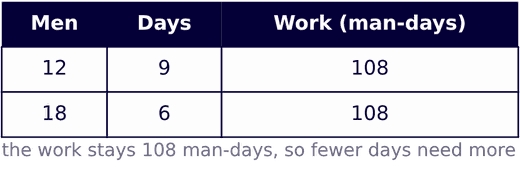 Hence 18 men are required and option (c) is correct.
 B(2)+2=D(4), A(1)+2=C(3) and T(20)+2=V(22) - every letter moves 2 places forward.
Applying the same rule to GOAT: G+2=I, O+2=Q, A+2=C, T+2=V.
So GOAT is written as IQCV and option (a) is correct.
B(2)+2=D(4), A(1)+2=C(3) and T(20)+2=V(22) - every letter moves 2 places forward.
Applying the same rule to GOAT: G+2=I, O+2=Q, A+2=C, T+2=V.
So GOAT is written as IQCV and option (a) is correct.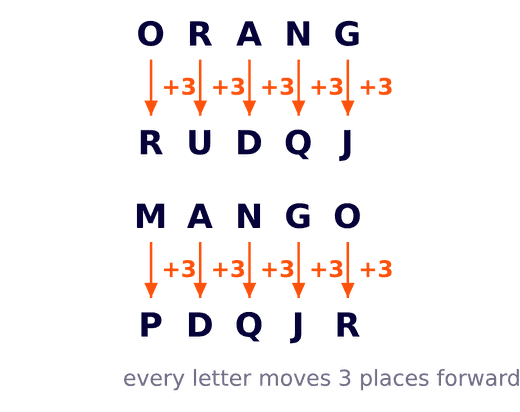 O(15)+3=R(18), R(18)+3=U(21), A(1)+3=D(4), N(14)+3=Q(17), G(7)+3=J(10).
So each letter is moved 3 places forward.
For MANGO: M+3=P, A+3=D, N+3=Q, G+3=J, O+3=R.
MANGO is therefore written as PDQJR, so option (a) is correct.
O(15)+3=R(18), R(18)+3=U(21), A(1)+3=D(4), N(14)+3=Q(17), G(7)+3=J(10).
So each letter is moved 3 places forward.
For MANGO: M+3=P, A+3=D, N+3=Q, G+3=J, O+3=R.
MANGO is therefore written as PDQJR, so option (a) is correct.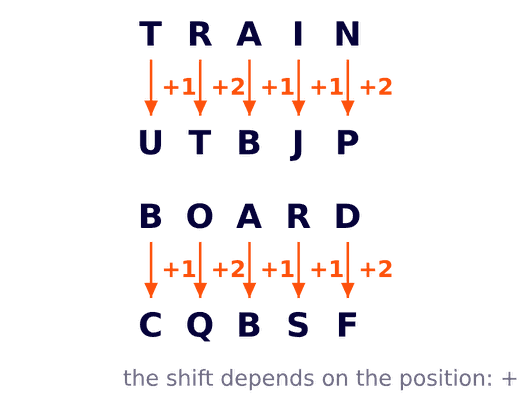 is +1, is +2, is +1, is +1 and is +2.
The shifts are not the same for every letter; they belong to the positions, in the fixed pattern +1,+2,+1,+1,+2.
Applying that pattern to BOARD: B+1=C, O+2=Q, A+1=B, R+1=S, D+2=F.
BOARD is therefore written as CQBSF, so option (a) is correct.
is +1, is +2, is +1, is +1 and is +2.
The shifts are not the same for every letter; they belong to the positions, in the fixed pattern +1,+2,+1,+1,+2.
Applying that pattern to BOARD: B+1=C, O+2=Q, A+1=B, R+1=S, D+2=F.
BOARD is therefore written as CQBSF, so option (a) is correct.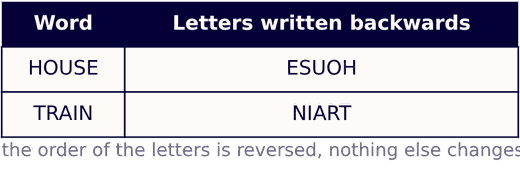 So the rule is simply to write the letters in the reverse order; no letter is changed or shifted.
Reversing TRAIN gives N, I, A, R, T.
TRAIN is therefore written as NIART, so option (a) is correct.
So the rule is simply to write the letters in the reverse order; no letter is changed or shifted.
Reversing TRAIN gives N, I, A, R, T.
TRAIN is therefore written as NIART, so option (a) is correct.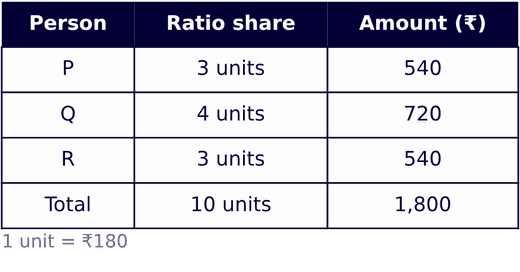 Q's share .
Hence Q receives ₹720 and option (d) is correct.
Q's share .
Hence Q receives ₹720 and option (d) is correct.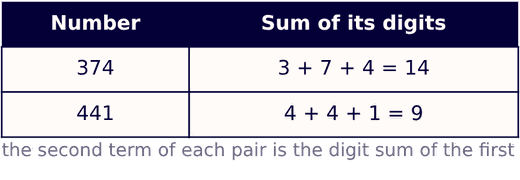 So in each pair the second number is the digit sum of the first.
For 441: 4+4+1=9.
Hence the missing number is 9 and option (a) is correct.
So in each pair the second number is the digit sum of the first.
For 441: 4+4+1=9.
Hence the missing number is 9 and option (a) is correct.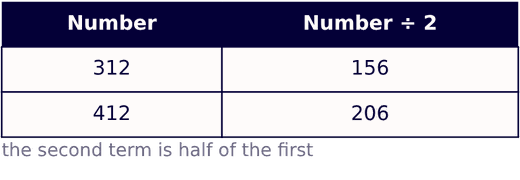 So the second number of each pair is half of the first.
For 412: .
Hence the missing number is 206 and option (a) is correct.
So the second number of each pair is half of the first.
For 412: .
Hence the missing number is 206 and option (a) is correct.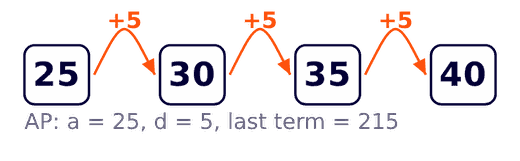 Formula for the last term: l=a+(n-1)d.
.
, so .
.
n=38+1=39.
Hence the series has 39 terms and option (a) is correct.
Formula for the last term: l=a+(n-1)d.
.
, so .
.
n=38+1=39.
Hence the series has 39 terms and option (a) is correct.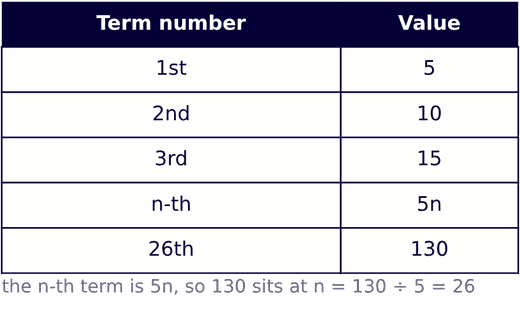 Formula for the n-th term: .
.
, so n-1=25.
n=26.
Quick check: every term is a multiple of 5, so the position of 130 is .
Hence 130 is the 26th term and option (c) is correct.
Formula for the n-th term: .
.
, so n-1=25.
n=26.
Quick check: every term is a multiple of 5, so the position of 130 is .
Hence 130 is the 26th term and option (c) is correct.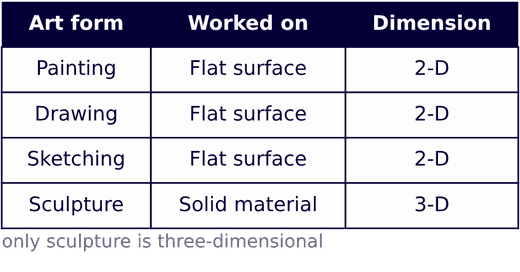 Sculpture is made by carving, casting or moulding solid material, so the finished work has length, breadth and height.
Being three-dimensional, sculpture does not belong with the other three.
Hence option (d) is correct.
Sculpture is made by carving, casting or moulding solid material, so the finished work has length, breadth and height.
Being three-dimensional, sculpture does not belong with the other three.
Hence option (d) is correct.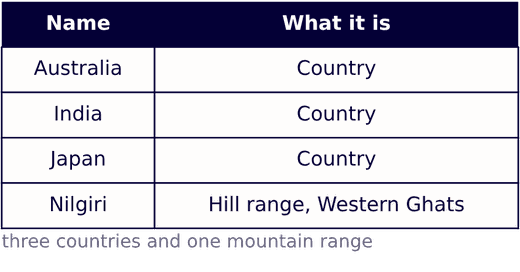 Nilgiri is not a country; it is a hill range of the Western Ghats where Tamil Nadu, Kerala and Karnataka meet, famous for Ooty and for Nilgiri tea.
Since it names a mountain range and not a nation, Nilgiri is the word that does not fit the group.
Hence option (d) is correct.
Nilgiri is not a country; it is a hill range of the Western Ghats where Tamil Nadu, Kerala and Karnataka meet, famous for Ooty and for Nilgiri tea.
Since it names a mountain range and not a nation, Nilgiri is the word that does not fit the group.
Hence option (d) is correct.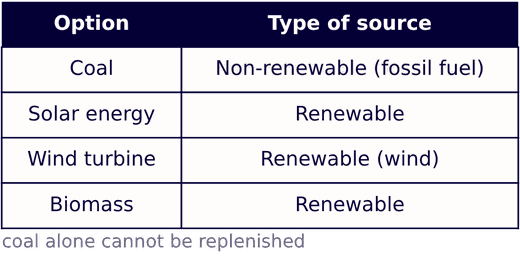 Solar energy, the wind tapped by a wind turbine and biomass are all renewable - nature keeps replacing them within a short time.
Coal is a fossil fuel formed from buried plant matter over millions of years, so once it is burnt it cannot be replaced in a human lifetime.
Being the only non-renewable source, coal is the odd one out.
Hence option (a) is correct.
Solar energy, the wind tapped by a wind turbine and biomass are all renewable - nature keeps replacing them within a short time.
Coal is a fossil fuel formed from buried plant matter over millions of years, so once it is burnt it cannot be replaced in a human lifetime.
Being the only non-renewable source, coal is the odd one out.
Hence option (a) is correct.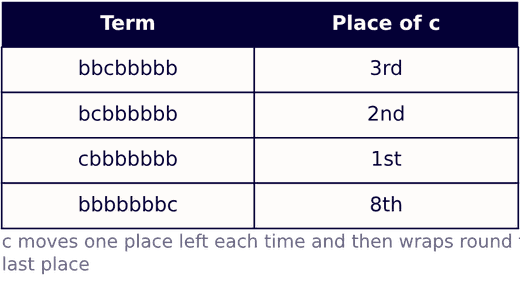 c stands at the 3rd place, then at the 2nd place, then at the 1st place, i.e. it moves one place to the left each time.
After the 1st place it comes round to the last (8th) place, so the next term is seven b's followed by c.
Hence, option (b) bbbbbbbc is the most appropriate answer.
c stands at the 3rd place, then at the 2nd place, then at the 1st place, i.e. it moves one place to the left each time.
After the 1st place it comes round to the last (8th) place, so the next term is seven b's followed by c.
Hence, option (b) bbbbbbbc is the most appropriate answer.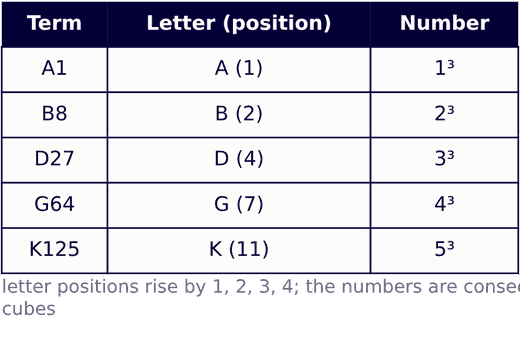 The missing term is therefore K125.
Hence, option (a) is the most appropriate answer.
The missing term is therefore K125.
Hence, option (a) is the most appropriate answer.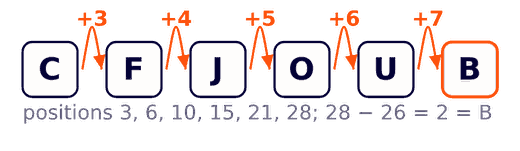 Next position =21+7=28; the alphabet has only 26 letters, so counting on past Z gives 28-26=2, i.e. B.
Hence, option (c) is the most appropriate answer.
Next position =21+7=28; the alphabet has only 26 letters, so counting on past Z gives 28-26=2, i.e. B.
Hence, option (c) is the most appropriate answer.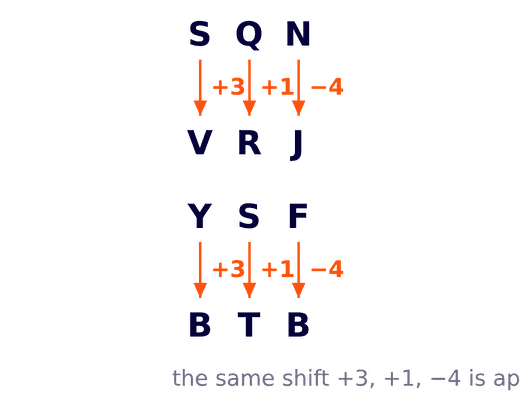 Putting the three letters together, the missing cluster is BTB.
Hence, option (a) is the most appropriate answer.
Putting the three letters together, the missing cluster is BTB.
Hence, option (a) is the most appropriate answer.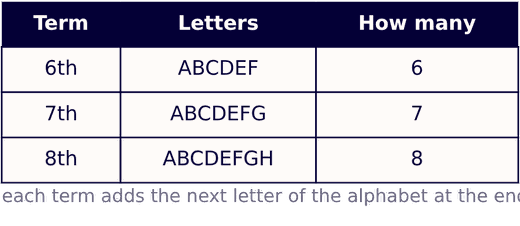 The 7th term ABCDEFG has 7 letters, so the next term has 8 letters in alphabetical order: ABCDEFGH.
The other options contain the same eight letters, but in each of them two letters are out of alphabetical order.
Hence, option (a) is the most appropriate answer.
The 7th term ABCDEFG has 7 letters, so the next term has 8 letters in alphabetical order: ABCDEFGH.
The other options contain the same eight letters, but in each of them two letters are out of alphabetical order.
Hence, option (a) is the most appropriate answer.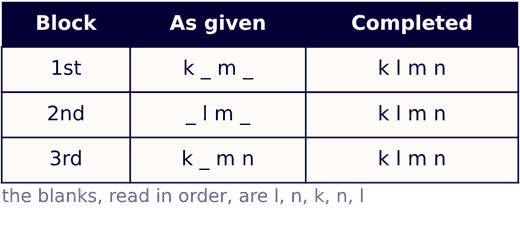 Wherever a letter is already printed it agrees with klmn, so the pattern is confirmed.
Completing every block as klmn, the blanks taken in order are l, n, k, n, l.
Hence, option (a) is the most appropriate answer.
Wherever a letter is already printed it agrees with klmn, so the pattern is confirmed.
Completing every block as klmn, the blanks taken in order are l, n, k, n, l.
Hence, option (a) is the most appropriate answer.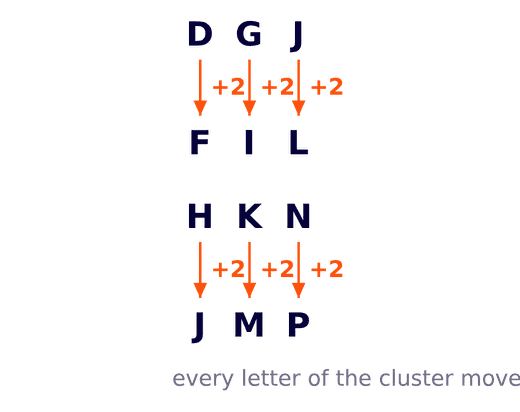 So the next cluster is H+2=J, K+2=M, N+2=P, i.e. JMP.
Hence, option (a) is the most appropriate answer.
So the next cluster is H+2=J, K+2=M, N+2=P, i.e. JMP.
Hence, option (a) is the most appropriate answer.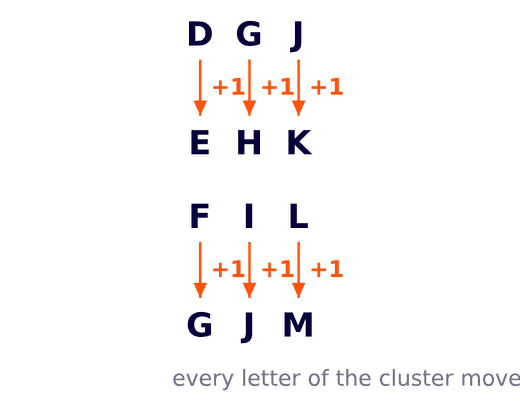 So the next cluster is F+1=G, I+1=J, L+1=M, i.e. GJM.
Hence, option (a) is the most appropriate answer.
So the next cluster is F+1=G, I+1=J, L+1=M, i.e. GJM.
Hence, option (a) is the most appropriate answer.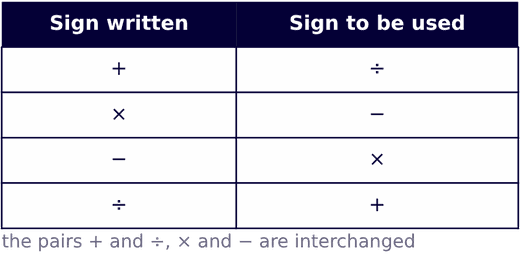 So the expression has to be read as .
Now apply BODMAS — division and multiplication first: and .
Value =8-12+8=4.
Hence, option (b) is the most appropriate answer.
So the expression has to be read as .
Now apply BODMAS — division and multiplication first: and .
Value =8-12+8=4.
Hence, option (b) is the most appropriate answer.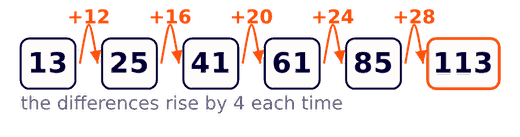 Next term =85+28=113.
Hence, option (a) is the most appropriate answer.
Next term =85+28=113.
Hence, option (a) is the most appropriate answer.