SSC CHSL 17 November 2025 · Shift 1 · Quantitative Aptitude — questions with answers · ShikshaSphere
Chapter 47 of 200
17 November 2025 · Shift 1
Quantitative Aptitude
25 questions ~25 min readFree
25 questions
A
51
A man purchased 3 identical electric fans at a total cost of ₹5,320. He sold two of them at a gain of each and the third one at a loss of . What is his overall profit or loss percentage?
A.6% Profit
B.6.75% Profit
C. Profit
D.8% Profit
Solution
Overall profit percentage
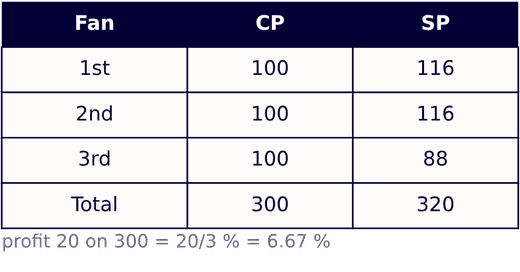
All three fans are identical, so the actual figure ₹5,320 is not needed — take the cost price of one fan as ₹100, making the total cost price ₹300.
Two fans sold at a gain of : their selling price .
The third fan sold at a loss of : its selling price =88.
Total selling price =232+88=320, so profit =320-300=20 on a cost of 300.
Profit profit.
Hence, option (c) is the most appropriate answer.
52
Gita gets a discount of 20% on Rs. 12000 oven. Since she pays cash, she gets an additional discount too. How much does she pay?
A.Rs. 7400
B.Rs. 9216
C.Rs. 8350
D.Rs. 9500
Solution
Successive discount
Two successive discounts are applied one after the other, so they are multiplied — they are never simply added.
Price after the first discount .
Price after the extra cash discount .
So Gita pays ₹9,216.
Hence, option (b) is the most appropriate answer.
53
The selling price of a vintage vase is Rs. 2668 , and the discount given is . What is the marked price of the vase?
A.₹2900
B.₹2800
C.₹2600
D.₹2500
Solution
Marked price from discount
Discount is always reckoned on the marked price, so the selling price is of the marked price.
SP = MP , i.e. 2668= MP .
MP .
Check: of 2900=232 and 2900-232=2668, which matches the given selling price.
Hence, option (a) is the most appropriate answer.
54
A school had 105 students with an average age of 30 years. Later, a new batch of students joined. After their inclusion, the average age dropped to 29.5 years, even though the newcomers had an average age of 28 years. Find the number of students in the new batch.
A.38
B.35
C.42
D.46
Solution
Average of two groups
Total age of the 105 old students years.
Let the new batch have x students; their total age =28x years.
The average of all of them together is 29.5, so .
students.
Hence, option (b) is the most appropriate answer.
55
A construction project was estimated to be completed in 540 days. Due to rain, only 70% of the days were productive. If the work done each productive day is constant, by what percent must daily output be increased to complete the project on time?
A.
B.
C.
D.
Solution
Work and daily output
Days on which work is actually possible days.
The whole project must still be finished on time, so the work planned for 540 days has to be done in 378 days.
(daily output) (number of days) is constant, so new output : old output =540:378=10:7.
Required increase .
Hence, option (a) is the most appropriate answer.
56
In a survey conducted at a university, it was found that 60% of the students like Mathematics, 50% like Physics, and 20% like both Mathematics and Physics. Among the remaining students, 30% prefer Computer Science, while the rest have no preference. If the total number of students surveyed is 500 , how many students had no preference for any of the three subjects?
A.35
B.20
C.32
D.28
Solution
Percentage and sets
Students who like Mathematics or Physics — the common is subtracted so that it is not counted twice.
Remaining students of .
Of these 50, those preferring Computer Science .
Students with no preference =50-15=35.
Hence, option (a) is the most appropriate answer.
57
Which of the following numbers is NOT a perfect square?
A.1600
B.625
C.1225
D.840
Solution
Perfect squares
A number is a perfect square only if its square root is a whole number.
, and .
For 840, and , so 840 lies between two consecutive squares and cannot be a perfect square.
Hence, option (d) is the most appropriate answer.
58
Two investors, P and Q , invest in the Business in the ratio of . If the share of Q is Rs 1200 in profit. Find the total profit.
A.2700
B.2800
C.2900
D.3000
Solution
Partnership profit share
Both partners invest for the same period, so the profit is divided in the ratio of their investments, i.e. 5:4.
Q's share is 4 parts of the profit, and these 4 parts =₹1200.
One part .
Total profit .
Hence, option (a) is the most appropriate answer.
59
P, Q, and R invest ₹16000, ₹20,000, and ₹24,000 respectively for a year. What percentage of the total profit will R get?
A.35%
B.
C.
D.45%
Solution
Share of profit in percent
All three invest for the same period of one year, so the profit is shared in the ratio of the capitals.
16000:20000:24000=16:20:24=4:5:6, so the profit is cut into 4+5+6=15 equal parts.
R gets 6 of these 15 parts of the total profit.
Hence, option (c) is the most appropriate answer.
60
P and Q invest ₹25,000 and ₹33,000 in a business. Q receives ₹1000 more than P from the annual profit. What is the total profit?
A.₹7250
B.₹7450
C.₹7520
D.₹6800
Solution
Partnership profit difference
The time is the same for both, so the profit is shared in the ratio of the capitals: 25000:33000=25:33.
Q gets 33-25=8 parts more than P, and this extra amount is given as ₹1000.
One part .
Total profit .
Hence, option (a) is the most appropriate answer.
61
A circular field is surrounded by a path of uniform width 2 m . The total area of the field, including the path, is 452.16 . If the area of the circular field (excluding the path) is , find the radius of the circular field and the radius including the path. (Use )
A.
B.9.99 m, 11.99 m
C.
D.
Solution
Area of circle and path
The area of a circle is , so each radius comes from the area that belongs to it.
Inner circle (field only):
m
Outer circle (field with the path):
m
Check: m, which is exactly the given width of the path.
Hence the correct option is (b).
62
If and , then find the value of .
A.19
B.9
C.18
D.21
Solution
Algebraic identity, cubes
Identity: .
Substituting a-b=6 and :
540=216+18ab
18ab=324
ab=18
Hence the correct option is (c).
63
If and , then find the value of .
A.2923
B.3023
C.3593
D.3922
Solution
Algebraic identities
Square the first condition:
Using :
For the required expression use .
=3364-441=2923
Hence the correct option is (a).
64
If , then find the value of .
A.3
B.5
C.1
D.-3
Solution
Trigonometric identity
Given , so .
But , hence .
Squaring both sides:
Adding the two results:
The right-hand side is exactly the given expression, whose value is 1.
Hence the correct option is (c).
65
If, , such that , then find the value of
A.4
B.3
C.5
D.2
Solution
Trigonometric ratios, angles
Complementary angles: , so the equation becomes .
(positive, since ), so .
Hence the correct option is (b).
66
A firefighter's ladder of length 53 meters is resting against a wall and makes an angle with the ground such that . Find the horizontal distance of the foot of the ladder from the wall.
A.45 meters
B.35 meters
C.36 meters
D.42 meters
Solution
Height and distance
The ladder is the hypotenuse of a right triangle, and .
Since and the hypotenuse is 53 m, the height reached on the wall is 28 m.
By Pythagoras' theorem, base
=45
So the foot of the ladder is 45 metres from the wall.
Hence the correct option is (a).
67
Rs. 14,000 is invested at the rate of p.a. for 5 years at simple interest in scheme 'P'. The amount received from scheme ' P ' is then invested for 2 years at rate of 10% p.a., compounded annually in scheme ' '. Find the amount received from scheme ' '.
A.Rs. 27104
B.Rs. 21704
C.Rs. 27401
D.Rs. 25104
Solution
Simple and compound interest
Scheme P is simple interest:
Amount received from P = 14000 + 8400 = ₹22,400.
This ₹22,400 becomes the principal of scheme Q, at 10% p.a. compounded annually for 2 years.
So the amount received from scheme Q is ₹27,104.
Hence the correct option is (a).
68
A person invested Rs. 22,000 each in two different schemes for 2 years. One scheme offered p.a. simple interest and the other offered 25% p.a. compound interest, compounded annually. Find the difference between the interest earned from both schemes.
A.Rs. 1375
B.Rs. 1275
C.Rs. 1489
D.Rs. 1411
Solution
CI minus SI, two years
For 2 years at the same rate, the compound interest exceeds the simple interest by .
=1375
So the difference between the two interests is ₹1,375.
Hence the correct option is (a).
69
If Rs. 70,000 is invested at a compound interest of p.a. for 18 months, then find the interest earned given that the sum is compounded every 6 months.
A.Rs. 23170
B.Rs. 21370
C.Rs. 23107
D.Rs. 23710
Solution
Half-yearly compound interest
Compounding every 6 months halves the rate and doubles the count of periods: rate per period per cent, periods .
Interest =93170-70000=23170
So the interest earned is ₹23,170.
Hence the correct option is (a).
70
A box contains Rs 5, Rs 2 and Rs 1 coins in the ratio 8 : 4 : 3. The total amount in the box is Rs 1122. Find the number of Rs 2 coins.
A.77
B.76
C.88
D.89
Solution
Ratio of coins
The ratio counts the coins, not the money, so let the numbers be 8x, 4x and 3x.
Total value =5(8x)+2(4x)+1(3x)
=40x+8x+3x=51x
Number of ₹2 coins
Hence the correct option is (c).
71
A tank contains liquid A and B in the ratio litres of the mixture are taken out and filled with 60 litres of B. Now the ratio changes to . Find the quantity of liquid initially.
A.179.2 litres
B.189.2 litres
C.175.2 litres
D.169.2 litres
Solution
Mixture replacement, ratio
Let the initial quantities be A=16k and B=14k litres, so the mixture totals 30k litres.
The 60 litres drawn out keep the same ratio: A removed , B removed .
After the removal and the addition of 60 litres of B: A=16k-32 and B=14k-28+60=14k+32.
11(16k-32)=9(14k+32)
176k-352=126k+288
Initial quantity of B litres.
Hence the correct option is (a).
72
A mixture containing 24% of methanol is mixed with another mixture containing b% of methanol in the ratio 4 : 5. If the percentage of methanol in the final mixture is , what is the percentage of b ?
A.13.26%
B.
C.18.2%
D.19.32%
Solution
Alligation, mixtures
Take the two mixtures as 4 parts and 5 parts, so the final mixture is 9 parts.
The methanol must balance: 4(24)+5(b)=9(20)
96+5b=180
5b=84
b=16.8
The alligation cross gives the same relation, since 20 lies between b and 24.
Hence the correct option is (b).
73
A person travels a total distance of 300 km , partly by car at a speed of 60 and the rest by bike at . If 60% of the total distance is covered by car, find the average speed of the entire journey.
A.
B.
C.
D.74 km/h
Solution
Average speed
Distance by car km, so distance by bike =300-180=120 km.
Time by car hours
Time by bike hours
Average speed = (total distance) ÷ (total time)
So the average speed for the whole journey is 50 km/h.
Hence the correct option is (b).
74
How many perfect squares lie between 15,000 and 25,000 (inclusive)?
A.37
B.43
C.36
D.38
Solution
Counting perfect squares
We need every integer n with .
is below the range and is inside, so the smallest such n is 123.
is inside and is above the range, so the largest such n is 158.
Count of integers from 123 to 158 =158-123+1
=36
Hence the correct option is (c).
75
A motorist travels from City P to City Q, a distance of 240 km . For the first 80 km , he drives at . For the next 80 km he drives at . For the remaining distance, he drives at (constant). His overall average speed for the whole trip is . What is x ?
A.45 km/h
B.
C.40 km/h
D.48 km/h
Solution
Average speed, unknown leg
Total time = (total distance) ÷ (average speed) hours.
Time for the first 80 km hours
Time for the next 80 km hour
Remaining distance =240-160=80 km and remaining time =5-3=2 hours.
So the speed over the last stretch is 40 km/h.
Hence the correct option is (c).
Finished reading? Now test yourself.
The same 25 questions, but with a timer and the answers hidden — 15 minutes.

 Total selling price =232+88=320, so profit =320-300=20 on a cost of 300.
Profit profit.
Hence, option (c) is the most appropriate answer.
Total selling price =232+88=320, so profit =320-300=20 on a cost of 300.
Profit profit.
Hence, option (c) is the most appropriate answer.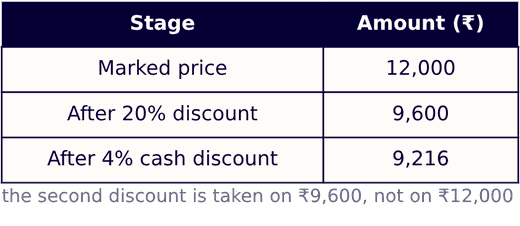 So Gita pays ₹9,216.
Hence, option (b) is the most appropriate answer.
So Gita pays ₹9,216.
Hence, option (b) is the most appropriate answer.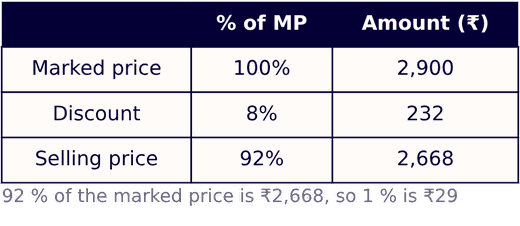 Check: of 2900=232 and 2900-232=2668, which matches the given selling price.
Hence, option (a) is the most appropriate answer.
Check: of 2900=232 and 2900-232=2668, which matches the given selling price.
Hence, option (a) is the most appropriate answer.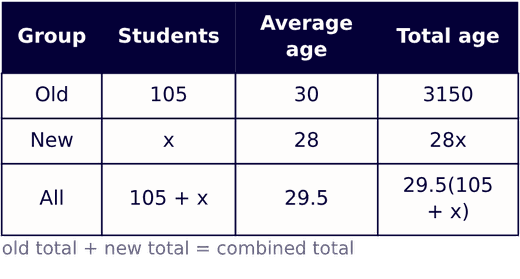 The average of all of them together is 29.5, so .
students.
Hence, option (b) is the most appropriate answer.
The average of all of them together is 29.5, so .
students.
Hence, option (b) is the most appropriate answer.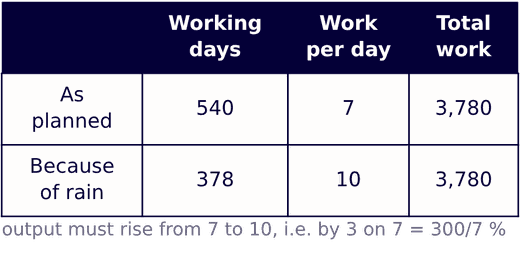 (daily output) (number of days) is constant, so new output : old output =540:378=10:7.
Required increase .
Hence, option (a) is the most appropriate answer.
(daily output) (number of days) is constant, so new output : old output =540:378=10:7.
Required increase .
Hence, option (a) is the most appropriate answer.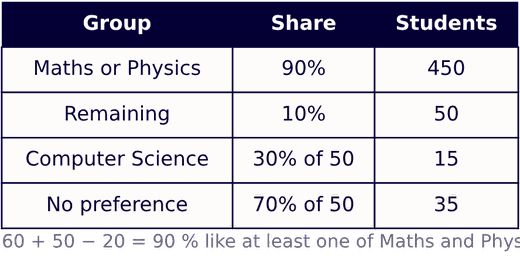 Remaining students of .
Of these 50, those preferring Computer Science .
Students with no preference =50-15=35.
Hence, option (a) is the most appropriate answer.
Remaining students of .
Of these 50, those preferring Computer Science .
Students with no preference =50-15=35.
Hence, option (a) is the most appropriate answer.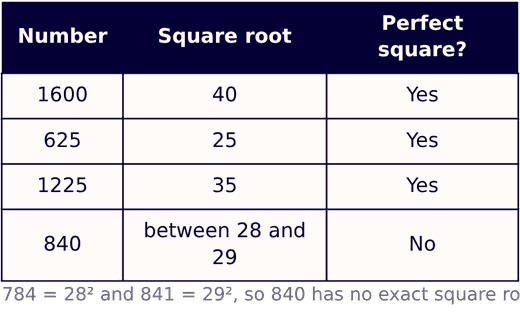 For 840, and , so 840 lies between two consecutive squares and cannot be a perfect square.
Hence, option (d) is the most appropriate answer.
For 840, and , so 840 lies between two consecutive squares and cannot be a perfect square.
Hence, option (d) is the most appropriate answer.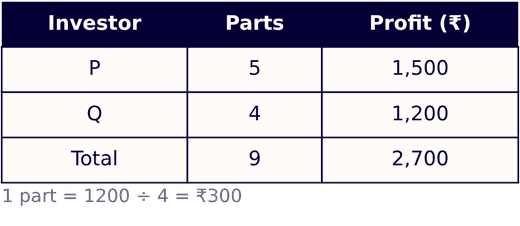 Total profit .
Hence, option (a) is the most appropriate answer.
Total profit .
Hence, option (a) is the most appropriate answer.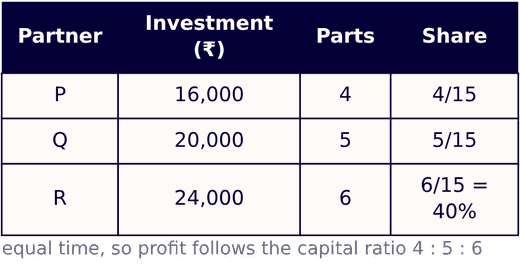 R gets 6 of these 15 parts of the total profit.
Hence, option (c) is the most appropriate answer.
R gets 6 of these 15 parts of the total profit.
Hence, option (c) is the most appropriate answer.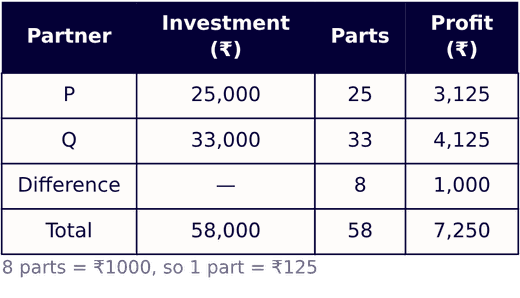 Total profit .
Hence, option (a) is the most appropriate answer.
Total profit .
Hence, option (a) is the most appropriate answer.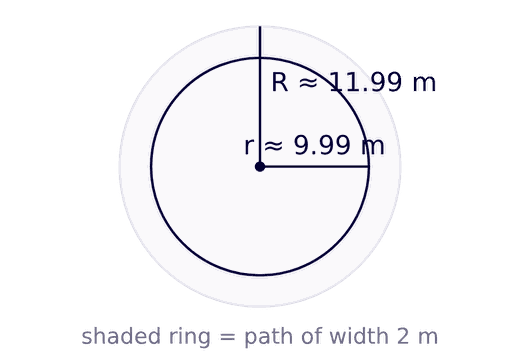 Check: m, which is exactly the given width of the path.
Hence the correct option is (b).
Check: m, which is exactly the given width of the path.
Hence the correct option is (b).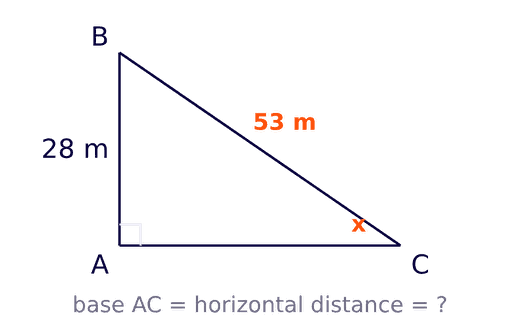 By Pythagoras' theorem, base
=45
So the foot of the ladder is 45 metres from the wall.
Hence the correct option is (a).
By Pythagoras' theorem, base
=45
So the foot of the ladder is 45 metres from the wall.
Hence the correct option is (a).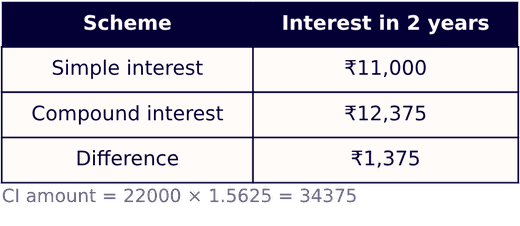 So the difference between the two interests is ₹1,375.
Hence the correct option is (a).
So the difference between the two interests is ₹1,375.
Hence the correct option is (a).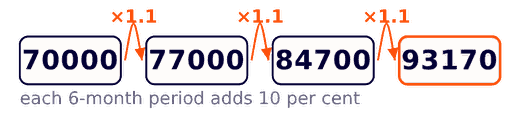 Interest =93170-70000=23170
So the interest earned is ₹23,170.
Hence the correct option is (a).
Interest =93170-70000=23170
So the interest earned is ₹23,170.
Hence the correct option is (a).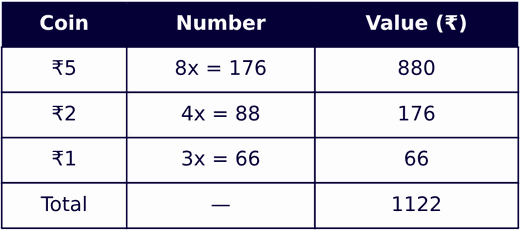 Number of ₹2 coins
Hence the correct option is (c).
Number of ₹2 coins
Hence the correct option is (c).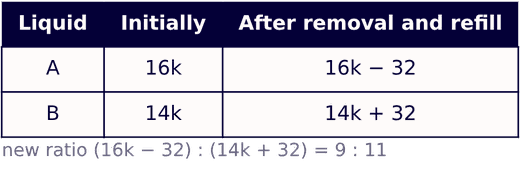 11(16k-32)=9(14k+32)
176k-352=126k+288
Initial quantity of B litres.
Hence the correct option is (a).
11(16k-32)=9(14k+32)
176k-352=126k+288
Initial quantity of B litres.
Hence the correct option is (a).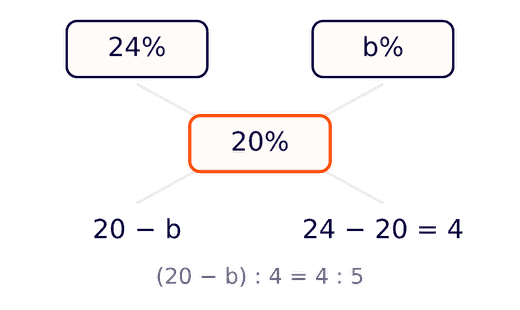 The alligation cross gives the same relation, since 20 lies between b and 24.
Hence the correct option is (b).
The alligation cross gives the same relation, since 20 lies between b and 24.
Hence the correct option is (b).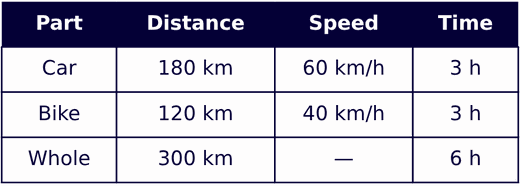 Average speed = (total distance) ÷ (total time)
So the average speed for the whole journey is 50 km/h.
Hence the correct option is (b).
Average speed = (total distance) ÷ (total time)
So the average speed for the whole journey is 50 km/h.
Hence the correct option is (b).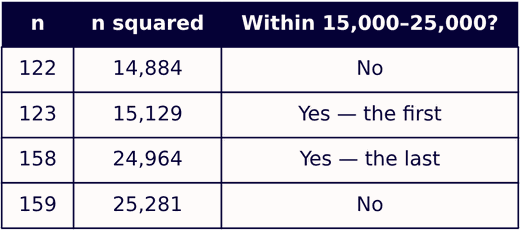 Count of integers from 123 to 158 =158-123+1
=36
Hence the correct option is (c).
Count of integers from 123 to 158 =158-123+1
=36
Hence the correct option is (c).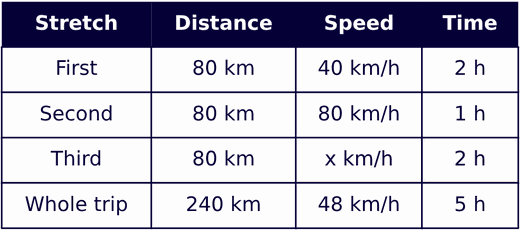 So the speed over the last stretch is 40 km/h.
Hence the correct option is (c).
So the speed over the last stretch is 40 km/h.
Hence the correct option is (c).